Where scholarship by other authors was used, it was duly acknowledged. This in turn led to the formation of a hegemonic masculine form of the historical boy, established towards the upper end of the hierarchy of masculinity within this South African independent boys' school.
LIST OF ACRONYMS
INTRODUCTION
- The Professional is Personal
- The Play’s The Thing
- Conceptual Framework
- A Route Map of the Study
There is the added pressure of the boys' exam results which determine which university they attend. It provides an overview of the key concept of masculinity and the major developments in history education in the 20th and 21st centuries.
LITERATURE REVIEW
Introduction
The first is relevance – the information must contribute to the development of one's argument or positioning. Second is authority – the information must be published in a reputable journal that has been peer-reviewed or critically evaluated in other sources, and third is validity – the research must be recent and still carry weight in the field (Andersson & Beveridge, 2007). .
Masculinity
According to Connell (1996, p.211) defenders of the Straight Path are reinforcing "the existing social organization of masculinity". At the same time, boys are much more self-inquiring and aware of the dynamics involved in constructing masculinity than researchers in the past have given them credit for.

History Education
Ravitch's notion of historical literacy is a conservative notion and dismissed by critics as alarmist and. Lee (2004) argues that historical awareness is integral to the conceptualization and development of historical literacy.
Masculinity and History Education
Mathematics and science therefore placed themselves at the top of the curriculum hierarchy and began to be perceived as masculine subjects, and art at the bottom as feminine (Salisbury & Jackson, 1996). History was found to be one of the subjects that contained a fairly even mix of boys and girls in its classes (Department for Education and Skills, 2007).
Conclusion
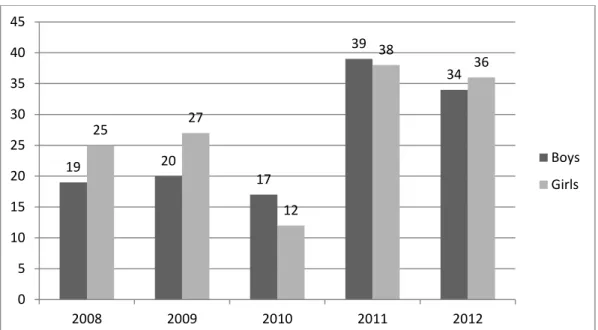
This is borne out by the almost 50:50 split in the number of boys and girls choosing to take the I.E.B N.S.C exam in South Africa. Boys question themselves a lot more and are much more aware of the dynamics involved in the construction of masculinity than what researchers have given them credit for in the past. In Whitehead's (1996) research, she found that boys and girls in Britain do indeed have sex-stereotypical views on topics.
In the past, adults came together to decide which historical facts all students, including boys, should know. Masculinity and glorification of war are inextricably intertwined in the narratives of official school history. It was Wineburg who asked the question "how do students navigate between the images of the past learned at home and those encountered at school?" (Wineburg, 2001, p.4).
Moreover, of crucial importance to this study – how do boys in particular place their own personal narratives within the context of the national and international history to which they are exposed in the history classroom.
RESEARCH METHODOLOGY
Introduction
Research Design
- Boy-Centred Research
- Research Paradigm
- Qualitative Methodology
- Case Study
- Purposive Sample
- Ethical Issues
In addition, when designing my research, I drew on the epistemology of pro-feminist theorists. A mirror image is an artificial projection of the self-modeled onto the visual images of objects and others that the individual encounters in the world. The mirror does not reflect feelings and lies about the apparent independence of the image, which the child does not have (Lacan, 1949).
Since most of the boys in the study were over 18, I asked them directly for their consent to be involved in my study. One is responsibility to the subjects of the study and involves privacy, confidentiality and civility. I have tried my best to be as accurate as possible in the descriptions at all stages of the research process.
With internal research, the concept of validity is called into question as the researcher is closely involved with the subjects of the study.
Research Methodology
- Narrative Inquiry
- Focus Groups
- Triangulation
- Data Analysis
- Open Coding
In my study I tried to elicit the autobiographical details of the participants through the writing of their personal stories or narratives. Because of the time commitment it requires, it is not conducive to research involving many people (Sinclair Bell, 2002). The boys were asked to use the entire area of the paper to draw a map of their life journey.
I recorded the focus group sessions so that I could not only hear what each of the boys had to say, but also observe the group dynamics. As Krauss (2005) again points out, the rigor of data analysis depends on whether the researcher is able to immerse himself in the research environment. In addition to using narrative research, I followed the writing of personal narratives by conducting two focus group interviews.
Second, the two methods are often not given the same importance – I acknowledge that the use of focus groups was only undertaken to verify the data drawn from the narrative research – a secondary method and not my first method of choice.
Conclusion
The headings of the columns in the grid were Character; events; Actions and settings that fall under the broad heading of Personal History. Carefully combing through each of the nine personal narratives, I wrote notes in each of the columns. After analyzing both the personal narratives and the focus group interview transcripts, individual responses were then compared to draw out commonalities and then highlight differences or silences.
Following this process, a number of themes were identified which are used as sub-categories in Chapter 4 to answer the first two research questions. Furthermore, I have explained that I have chosen to make use of qualitative methods for narrative investigation and focus group interviews in order to answer my first two research questions as fully as possible as outlined in chapter 1. In addition, I have drawn on the epistemology of the pro-feminist theorists to frame my research.
Once again, Lacan's (1949) Mirror Stage model was elaborated and identified as the model that was used to understand the data obtained through this study.
DATA ANALYSIS
- Introduction – Let’s Hear It For The Boys
- Man’s Man
- Manning Up – The Impact of the School on the Boys’ Masculine Identity
- Every Man for Himself – Reasons Why Boys Choose History as a Subject in Grade 10
- Personal Significance
- Man for the Job
- Man Made History – The Role of Official History in History Education
- Historical Significance
- Going Down in History – History Education and Masculinity
- Good Men of History
- Bad Men of History
- Men History Teachers
- Women and History
- History in the Making – The Role of Unofficial History in History Education
- Family and History
- Media and History
- Historical Places
- Conclusion – Boys Will Be Boys
- What do boys understand about history and masculinity?
- How does masculinity influence boys’ understanding of history?
In two of the history boy stories there was a distinct absence of father figures. This is when the boys' perception of their own reflection does not match the reflection of the ideal boy. I remember when asked to describe what it means to be a man, most, if not all, of the boys described a man in hegemonic terms.
Suffice it to say at this stage that most history boys acknowledged that their history studies were important. Most of the boys' first answers revealed a connection of history to some kind of conflict - specifically war. Many of the boys in the focus group interviews agreed with Brad's sentiments and found modern South African history interesting.
No elementary school teacher was mentioned in any of the boys' stories. Themes of mystery, suspense, and intrigue featured prominently in many of the boys' unofficial histories. In many of the boys' narratives, grandfathers were involved in telling stories and instilling interest in history.
DISCUSSION
- Introduction
- Thinking Historically
- Having Significant Historical Knowledge
- Knowing More than Other Men
- Defenders of Justice
- Warriors
- Evolved Cavemen
- Institutionalized Cavemen
- Limited Sense of Gender Justice
- Conclusion - Why does masculinity influence boys’ understanding of history the way it does?
At other times, the image was both challenged and legitimized by the boys' experiences with the official school history. Returning to Lacan's (1949) mirror as a metaphor, the boys in this study's ambiguous understanding of masculinity leads to the formation of a third image - the image of the independent school story boy. For most of the boys, the greatest experiences in the school's official history involved mistakes made and the need to avoid them.
The image of the warrior appeared in both the official and unofficial history to which these boys were exposed. The image of the warrior also appeared in the lessons learned by boys from informal history. The unofficial history eventually overshadows the school's official history's efforts to create a just and equal society.
Some of the boys seemed quite divided in their traditional view of what it meant to be one.
CONCLUSIONS
- Introduction
- Review of the Study
- Personal-Professional Reflections on the Study
- Limitations of Study
The image of the mirror against which the history boys observed themselves was used to analyze how the study of history has an impact on the boys' understanding of masculinity. That what was deemed significant enough further served to shape the image of the history boy in the mirror. Therefore, these history boys' understanding of masculinity as shaped by the official school history curriculum and unofficial sources is ambiguous.
There is also the third, blurred image of the history boy which is created by the clash between the lessons of unofficial history and official school history. These are some of the reasons why masculinity affects boys' understanding of history as it does. In addition, this study will hopefully also contribute to the development of the growing scholarship of masculinity studies.
All these conflicting teachings led to contradictory and ambiguous notions of what it means to be a man and to the formulation of the image of the story boy.
APPENDIX
Paper presented at the 'International Boys' School Coalition' conference held at St John's College, Johannesburg, South Africa 11-12 February 2011. Strategies to address gender inequalities in Scottish schools: A literature review, Social Research Executive Scottish. The mirror stage as formative of the function of the I as revealed in psychoanalytic experience.
International Journal of Historical Learning, Teaching and Research Analysis of Social Institutions: A Guide to Qualitative Observation and Analysis. The tyranny of surveillance: Male teachers and the policing of masculinity in a sex school. Male teachers in feminized educational spaces: marching to the beat of the men's movement drums?.
Benchmarks of Historical Thinking: A Framework for Assessment in Canada, Center for the Study of Historical Consciousness.