UNIVERSITY OF KWAZULU-NATAL
INFORMATION AND COMMUNICATION TECHNOLOGIES AND SUSTAINABLE LIVELIHOODS: A CASE OF SELECTED RURAL AREAS OF TANZANIA
WANYENDA LEONARD CHILIMO
INFORMATION AND COMMUNICATION TECHNOLOGIES AND SUSTAINABLE LIVELIHOODS: A CASE OF SELECTED RURAL AREAS OF TANZANIA
Wanyenda Leonard Chilimo (BSc., P.G. DIP., MA.)
Submitted in partial fulfilment of the requirements for the degree of Doctor of Philosophy (Information Studies) in the School of Sociology and Social Studies, Faculty of Humanities,
Development and Social Science.
University of KwaZulu-Natal, Pietermaritzburg, South Africa.
Supervisor: Prof. Patrick Ngulube.
………..
Co-Supervisor: Prof. Christine Stilwell.
……….
Submitted: December 2008
DECLARATION I, ……….. declare that
(i) The research reported in this dissertation, except where otherwise indicated, is my original work.
(ii) This dissertation/thesis has not been submitted for any degree or examination at any other university
(iii) This dissertation/thesis does not contain other persons‟ data, pictures, graphs or other information, unless specifically acknowledged as being sourced from other persons.
(iv) This dissertation/thesis does not contain other persons‟ writing, unless specifically acknowledged as being sourced from other researchers. Where other written sources have been quoted, then:
(a) their words have been re-written but the general information attributed to them has been referenced;
(b) where their exact words have been used, their writing has been placed inside quotations marks, and referenced.
(v) Where I have reproduced a publication of which I am an author, co- author or editor, I have indicated in detail which part of the publication was actually written by myself alone and have fully referenced such publications (vi) This dissertation/thesis does not contain text, graphics or tables copied and pasted from the Internet, unless specifically acknowledged, and the source being detailed in the dissertation and in the References sections.
Signed: ………
ABSTRACT
Information and communication technologies (ICTs) have, in the recent past, attracted enormous attention as important tools for socio-economic development. However, the role of ICTs in fostering development and addressing the needs of the poor, especially in developing countries, has become the subject of a heated debate. This contestation is due to the high failure rate of the ICTs for development projects and a widening gap between the expectations of what ICTs can possibly do and the experiential reality of how these technologies are actually being used. More often than not ICTs have been regarded as a panacea or a „magic bullet‟ that will solve all development problems, with ill-conceived expectations of how they would be used.
This study examined the relationship between ICTs and sustainable livelihoods in selected rural areas of Tanzania. The aim was to investigate how and for what purposes ICTs are used by people in the selected rural areas of Tanzania and to study the effect that ICTs have had on the various aspects of their livelihoods. A combination of the sustainable livelihoods framework and other ICTs for development models formed the theoretical foundation of the study. The investigation was carried out using ICT services provided by the telecentres and mobile phone services.
The study was conducted in four rural districts in Tanzania which have telecentres. It used a multi-case study research design. A mixed paradigm methodology was adopted and the qualitative research was used as a dominant paradigm. Data was collected through structured interview protocols administered to 203 users and non-users of ICTs in communities surrounding the telecentres. Semi-structured interview protocols were administered to four managers of the telecentres. In addition, eight focus group discussions were conducted in communities surrounding the telecentres. An observation checklist was used to verify data obtained from managers, users and non-users of the telecentres. The study administered semi- structured interview protocols to officers from the ministry responsible for ICTs in Tanzania, that is the Ministry of Infrastructure Development (MoID), The Tanzania Communication and Regulatory Authority (TCRA) and a national research institution (The Commission for Science and Technology- COSTECH).
The findings of the study indicated that, contrary to the use of mobile phones, which was characterised by greater uniformity across socio-economic groups and gender, telecentre users in the researched areas were generally young. The majority were males with higher levels of education. It was found that telecentres management have failed to take into consideration the appalling conditions of the extremely poor and disadvantaged individuals in their provision of ICT services to the community.
The study established that the urban rural digital divide still exists and is still a reality in the areas reviewed, despite some efforts that are under way to bring ICTs to those communities. Old ICTs such as radio and television are not universally available. It was observed that inadequate road infrastructure makes it difficult for farmers to transport their produce to markets outside the districts, even in cases where farmers are provided with information on the availability of those markets. Inadequate electricity supply hinders large-scale uptake of ICTs in rural areas. The findings show that telecentres managers were not aware of the information needs of the communities they serve and therefore they were not in a position to meet such information needs.
Due to personnel‟s inadequate skills and capacity the Ministry of Infrastructure Development did not play its policy-making function effectively. This problem, coupled with delayed implementation of important policy objectives such as the universal access policy and even the national ICT policy itself, affects the development of the ICT sector in rural areas of Tanzania.
The findings further show that while the necessary conditions for access exist in all the telecentres involved in the study, sufficient conditions for access are still lacking, especially with regard to skills, awareness and affordability.
On the relationship between ICT and rural livelihoods the findings of the study show that while ICTs may not fully support and sustain socio-economic development in poor communities, the impact of these technologies extends to various aspects of the livelihoods of the rural people.
Economically, these technologies lead to better earnings and savings. Socially, they help in community interaction and knowledge-sharing, better follow-up for remittances and creation of savings and credit co-operative societies. In relation to human capital, the technologies‟
implications extend to ICT literacy, improved farming techniques and better access to information on new cash crops. The use of ICTs in rural areas is still faced with many barriers.
These range from affordability to language problems and the lack of basic infrastructure such as electricity. Language was particularly found to be a substantial barrier to effective use and application of ICTs.
The study recommends that telecentre managers should re-design programmes with the aim of bringing the under-represented groups such as farmers back to the centre of their projects, rather than treating them as passive receivers of ICT services. On the issue of mobile phones, there is a need to develop services that are nuanced towards the real needs of the rural people and incorporate them into the mobile technology. The study recommends that universal access policies should involve old ICTs such as radio and television, or people in the rural areas, who have fewer resources, will eventually pay too much for basic communication services, as in the case of satellite television and radio. Capacity-building is important, not only in the regulatory authorities, but also in the ministries responsible for ICTs and other institutions involved with ICTs, so as to provide effective national ICT leadership.
The study recommends that managers of telecentres learn about the different aspects of access, in order for them to go beyond the provision of physical access to ICTs. Continuous improvement and renewal of telecentre services is necessary to ensure survival of the telecentres. Collaboration of the telecentres and other organisations, such as academic institutions, is needed to create content both for the telecentres and the community radios.
Telecentres and other information systems developed or adopted to serve the people must meet the needs of the people intended to be served. This can be done by regularly conducting information needs assessment.
ACKNOWLEDGEMENTS
The journey of my research was made possible by many individuals and institutions that I wish to acknowledge. I am sincerely grateful to my principal supervisor, Professor Patrick Ngulube, and co-supervisor, Professor Christine Stilwell, for their dedication, encouragement, support and motivation in the course of my writing the thesis. They have become to me true mentors and motivators.
I thank my sponsor, Deutscher Akademischer Austausch Dienst (DAAD), for supporting my studies financially. Without their support this study would not have been conducted. I thank my employer, Sokoine University of Agriculture (SUA), for granting me study leave to undertake the PhD programme.
I thank all those who made my field data collection possible. Special thanks go to telecentre managers, Mr. Felician Chenge of Sengerema, Mrs. Naomi Masele of CROMABU, Mr. Joseph Sekiku of FADECO and Mr. Abdul Mombokaleo of Ngara telecentre, for availing themselves for the interviews, granting me access to the telecentres premises and to the users of the telecentres, and for exposing me to the activities being carried out in their telecentres. I am grateful to my research assistants in all the telecentres, for helping me with the data collection. I thank the officers from COSTECH, TCRA and the national ICT co-ordination office at the Ministry of Infrastructure Development, who agreed to be interviewed.
I thank my colleagues and staff at the Information Studies Programme at the University of KwaZulu-Natal. I thank Mr. Richard Bell for providing valuable editorial assistance. I thank members of my family and my husband‟s family for their support and prayers. I am grateful to my husband, Stephen, for his love, encouragement and support. Lastly, I thank almighty God for giving me the health, strength and grace to pursue my PhD studies.
DEDICATION
I dedicate this work to my husband, Joshua Stephen Muoki, and my son, Denis Mumo Muoki.
TABLE OF CONTENTS
DECLARATION --- iii
ABSTRACT --- iv
ACKNOWLEDGEMENTS --- vii
DEDICATION --- viii
TABLE OF CONTENTS --- ix
LIST OF TABLES --- xx
LIST OF FIGURES --- xxi
LIST OF APPENDICES --- xxiii
LIST OF ABBREVIATIONS AND ACRONYMS --- xxiv
CHAPTER ONE: BACKGROUND TO THE STUDY --- 1
1.0 Introduction --- 1
1.1 Background to the problem --- 5
1.2 Statement of the problem --- 8
1.3.1 Objectives --- 10
1.3.2 Research questions--- 10
1.4 Preliminary literature study and reasons for choosing the topic --- 11
1.5 Originality of the study --- 13
1.6 Assumptions of the study --- 14
1.7 Definition of key concepts - Operational definitions --- 14
1.7.1 Development --- 15
1.7.2 Sustainable human development --- 15
1.7.3 Sustainable livelihoods --- 16
1.7.4 Poverty --- 17
1.7.5 Rural areas --- 18
1.7.6 Information and communication technologies --- 19
1.7.7 Telecentre --- 19
1.7.8 Teledensity --- 20
1.7.9 Universal access/universal service to ICTs --- 20
1.7.10 Digital divide --- 20
1.8 Scope and limitations of the study --- 21
1.8 Methodology --- 22
1.10 Structure of dissertation --- 23
1.11 Summary --- 24
CHAPTER TWO: STUDY AREA, POVERTY LEVEL, POLICIES AND ICT SECTOR DEVELOPMENT IN TANZANIA --- 25
2.0 Introduction --- 25
2.1 The area of study--- 25
2.1.1 Overview of Tanzania --- 25
2.1.2 Population --- 25
2.1.3 Economic conditions --- 26
2.1.4 Tanzania and rural development --- 27
2.2 Tanzania poverty reduction strategies and policies --- 29
2.2.1 National Poverty Eradication Strategy (NPES) and Development Vision 2025 --- 30
2.2.2 Poverty Reduction Strategy Paper (PRSP) --- 31
2.2.3 National Strategy for Growth and Reduction of Poverty (NSGRP) --- 33
2.2.4 Communication Strategy for the National Strategy for Growth and Reduction of Poverty --- 34
2.3 Telecommunication sector reforms --- 35
2.3.1 Status of ICT services in Tanzania --- 36
2.3.1.1 Telephone --- 37
2.3.1.2 Fixed telephony --- 37
2.3.1.3 Mobile telephone --- 37
2.3.1.4 Internet, data services, broadcasting and other services --- 38
2.3.1.4.1 Network facility licence (NFL) --- 39
2.3.1.4.2 Network service licence (NSL) --- 39
2.3.1.4.3 Application service licence (ASL) --- 40
2.3.1.4.4 Content service licence (CSL) --- 40
2.3.2 Tanzania ICT policy/e-strategy --- 40
2.3.2.1 Strategic ICT leadership --- 41
2.3.2.3 ICT industry --- 42
2.3.2.4 Human capital --- 42
2.3.2.6 Productive sectors --- 42
2.3.2.7 Service sectors --- 42
2.3.2.9 Local content --- 43
2.3.2.10 Universal access --- 43
2.4 Universal access policies in Tanzania --- 44
2.4.1 Universal access fund --- 45
2.4.1.1 Sources for funding --- 46
2.4.1.2 Fund management --- 46
2.4.1.3 Type of services covered by the fund --- 47
2.5 ICT sector development in rural areas of Tanzania --- 47
2.6 Telecentres in Tanzania --- 48
2.7 Rationale for choosing the specific areas of study --- 50
2.7.1 Sengerema --- 51
2.7.2 Ngara --- 52
2.7.3 Karagwe --- 52
2.7.4 Magu --- 53
2.8 Summary --- 54
CHAPTER THREE: LITERATURE REVIEW --- 55
3.0 Introduction --- 55
3.1 Definitions, purpose and organisation of the literature review --- 55
3.2 Theoretical framework of the study --- 58
3.3 Use of theory/models in quantitative and qualitative research --- 60
3.4 Models and the theoretical perspective that guided the study --- 62
3.4.1 United National Development Programme model --- 62
3.4.2 Multiple stakeholder model of the Washington State University (WSU) --- 65
3.4.3 Information and communication technologies and socio-economic development models --- 68
3.4.3.1 The information chain model --- 68
3.4.3.2 Onion ring model --- 70
3.4.3.3 The push and pull model --- 72
3.4.4 Sustainable livelihoods framework --- 73
3.5 Prominent global initiatives in ICTs for socio-economic development discourse --- 76
3.5.1 Modernisation theory and stages of development --- 77
3.5.2 The Jipp curve --- 78
3.5.3 The missing link report --- 78
3.5.4 Knowledge for development - World Development Report of 1998 --- 80
3.5.5 Digital Opportunity Task Force --- 80
3.5.6 Other global initiatives in the ICT for development discourse --- 81
3.5.6.1 World Summit on Information Society (WSIS) --- 81
3.5.6.2 United Nations‟ ICT Task Force --- 83
3.5.6.3 The World Bank‟s Global Information and Communication Technologies Department (GICT) --- 83
3.6 African initiative in the ICT for development discourse --- 84
3.6.1 African Information Society Initiative --- 84
3.6.2 New Partnership for Africa's Development --- 85
3.6.3 The East Africa Submarine System cable --- 86
3.7 Telecentres, access to ICTs and socio-economic development --- 87
3.7.1 Definition of a telecentre --- 88
3.7.2 Different models of telecentres --- 90
3.7.2.1 Micro-telecentre --- 91
3.7.2.2 Small computerised telecentre --- 92
3.7.2.3 Standard telecentre --- 92
3.7.2.4 Major developmental telecentre --- 92
3.8 Research in ICTs for socio-economic development --- 92
3.9 ICTs, telecentres and socio-economic development in developed countries --- 93
3.10 ICTs and socio-economic development in rural areas of the developed world: review of empirical studies --- 97
3.11 ICT, telecentres and socio-economic development in the rural areas of the developing world --- 99
3.12 Other ICTs service and socio-economic development in rural areas of developing
countries --- 101
3.12.1 Mobile phones, access to ICTs and socio-economic development --- 101
3.12.2 Experiences from the Village Pay Phones (VPPs) project --- 103
3.12.3 Community radio and socio-economic development --- 105
3.13 The digital divide and access to ICTs --- 108
3.13.1 Universal service and universal access policies --- 112
3.13.2 Mechanisms to achieve universal access --- 113
3.14 Policy and regulatory issues related to universal access: review of empirical study -- 114
3.15 ICTs for socio-economic development in rural areas in developing countries: review of empirical studies --- 116
3.16 ICT for socio-economic development in the rural areas of Tanzania: review of empirical studies --- 121
3.17 Information need and seeking patterns --- 128
3.17.1 Information --- 128
3.17.2 The information need --- 128
3.17.3 Information-seeking patterns --- 129
3.17. 4 The concept of information-seeking patterns and telecentre operations --- 130
3.18 Summary --- 132
CHAPTER FOUR: RESEARCH METHODOLOGY --- 133
4.0 Introduction --- 133
4.1 Research design --- 133
4.2 Qualitative versus quantitative research methods --- 134
4.3 Justification for combined methods --- 136
4.4 Case study research --- 137
4.5 Study population --- 139
4.6 Sampling procedures --- 140
4.6.1. Sampling of telecentres (cases) to be involved in the study --- 142
4.6.1.1 Magu telecentre --- 143
4.6.1.2 Sengerema Multipurpose Community Telecentre --- 144
4.6.1.3 Family Alliance for Development and Co-operation (FADECO) telecentre - 144 4.6.1.4 Ngara telecentre --- 145
4.6.3 Strata and the economic activities in the research areas --- 146
4.6.3.1 Sampling of the respondents at Sengerema district --- 147
4.6.3.2 Sampling of the respondents at Magu district --- 148
4.6.3.3 Sampling of the respondents at Karagwe district --- 148
4.6.3.4 Sampling of the respondents at Ngara district --- 148
4.6.4 Sampling of other categories of respondents --- 149
4.7 Methods of data collection --- ---150
4.7.1 Interviews --- 150
4.7.1.1 Structured interviews --- 152
4.7.1.1.1 The structured interview protocol for users and non-users of the telecentres --- 153
4.7.1.1.2 Critical incident technique (CIT) --- 156
4.7.1.1.3 Administering the CIT --- 158
4.7.1.2 Semi-structured interviews --- 159
4.7.1.2.1 Semi-structured interview protocol with managers of telecentres --- 160
4.7.1.2.2 Semi-structured interview protocol with officers from TCRA, COSTECH --- 160
4.7.2 Focus group discussions --- 161
4.7.2.1 Group sizes --- 162
4.7.2.2 Group composition --- 163
4.7.2.3 Number of groups --- 164
4.7.2.4 Selection of group members --- 165
4.7.3 Observation --- 167
4.8 Problems encountered during data collection --- 169
4.9 Validity and reliability of the study --- 171
4.9.1 Validity and reliability in quantitative research --- 172
4.9.2 Validity and reliability in qualitative research --- 173
4.9. 3 Triangulation --- 175
4.9.3.1 Data triangulation --- 176
4.9.3.2 Methodological triangulation --- 177
4.9.4 Verification --- 177
4.9.5 Instruments pre-testing, translation and approval --- 178
4.9.6 Sampling adequacy and saturation --- 180
4.9.7 Other strategies adopted to ensure validity and reliability --- 181
4.10 Data analysis --- 182
4.10.1 Analysing quantitative data with SPSS --- 182
4.10.2 Analysing qualitative data with Nvivo --- 182
4.11 Ethical considerations --- 185
4.12 Evaluation of research methods --- 186
4.13 Summary --- 188
CHAPTER FIVE: DATA PRESENTATION --- 190
5.1 Introduction --- 190
5.1.1 Generalisation of the study --- 191
5.1.2 Characteristics of respondents --- 192
5.1.3 Personal data: age, gender and literacy level of the respondents --- 193
5.1.4 Level of education --- 193
5.1.5 Occupation of the respondents --- 194
5.1.6 Household data --- 196
5.1.7 Relationship to the head of the household --- 196
5.1.8 Household size --- 197
5.1.9 Household dependence on relatives living elsewhere --- 197
5.1.10 Economic status and ownership of household assets --- 198
5.1.11 Access to the services of the telecentres --- 198
5.2 Current status of ICT sector development in the selected rural areas of Tanzania --- 199
5.2.1 Sengerema district --- 199
5.2.1.2 Fixed telephone services --- 200
5.2.1.3 Mobile telephone services --- 201
5.2.1.4 Internet services and other telecentre-based services--- 202
5.2.1.5 Radio and television --- 203
5.2.2 Magu district --- 206
5.2.2.1 Condition of roads and electricity supply --- 206
5.2.2.2 Fixed telephone services --- 207
5.2.2.3 Mobile telephone services --- 207
5.2.2.4 Radio and television --- 208
5.2.2.5 Internet services and Magu telecentre --- 209
5.2.2.6 Access to market information --- 209
5.2.2.7 Access to information for market-oriented agricultural production --- 211
5.2.3 Karagwe district --- 212
5.2.3.1 Access to electricity supply and condition of the roads --- 212
5.2.3.2 Fixed telephone services --- 213
5.2.3.3 Mobile telephone services --- 213
5.2.3.4 Radio and television --- 214
5.2.3.5 Internet services and other services offered by FADECO telecentre --- 216
5.2.4 Ngara district --- 218
5.2.4.1 Access to electricity supply and condition of the roads --- 218
5.2.4.2 Fixed telephone services --- 219
5.2.4.3 Mobile telephone services --- 219
5.2.4.4 Radio and television --- 219
5.3 Policies available to facilitate development and utilisation of ICTs in the selected rural areas of Tanzania --- 221
5.3.1 The then Ministry of Infrastructure Development (MoID) --- 222
5.3.2 Tanzania Communication Regulatory Agency (TCRA) --- 222
5.3.3 Tanzania Commission for Science and Technology (COSTECH) --- 222
5.3.4 Co-operation between MoID, TCRA and COSTECH for the development of ICTs in rural areas --- 223
5.3.4 Policies to ensure wider accessibility of ICTs to the majority in Tanzania --- 224
5.3.5 National ICT policy and its implementation strategy --- 224
5.3.6 Infrastructure development --- 225
5.3.7 Universal access fund --- 225
5.3.8 Comments on the delayed implementation of the universal access policy --- 226
5.3.8.1 Political changes --- 226
5.3.8.2 Changes within the regulatory authority --- 227
5.3.8.3 Privatisation of incumbent telecommunication company in Tanzania TTCL 227 5.3.8.4 Ideological changes --- 227
5.3.8.5 Fast technological change --- 228
5.3.9 Comments on the ICTs for socio-economic development in the Tanzanian context -- 228 5.3.10 Barriers to effective utilisation of ICTs for poverty reduction in the Tanzania
context --- 230
5.3.10.1 Financial/economic barriers --- 230
5.3.10.2 Infrastructural barriers --- 230
5.3.10.3 Inadequately trained labour force --- 230
5.3.10.4 Mindset issues --- 230
5.3.10.5 Lack of capacity within the ministry --- 231
5.3.10.6 Language barriers --- 231
5.3.10.7 Too much commercialisation of the ICT sector activities --- 231
5.3.10.8 Regulatory interventions --- 232
5.3.10.9 Other barriers --- 232
5.4 Access to ICTs by people in the selected rural areas of Tanzania --- 232
5.4.1 Awareness of the telecentre and use of telecentre services--- 232
5.4.2 Reasons for visiting the telecentre --- 234
5.4.3 Ability (skills) to use computers --- 237
5.4.4 How do you use email? --- 238
5.4.5 Reasons for email use --- 239
5.4.6 Frequency of using email in a month --- 240
5.4.7 Cost of services at the telecentre --- 240
5.4.8 Telephone access and ownership --- 242
5.5 Usage patterns of ICTs by people in the selected rural areas of Tanzania --- 246
5.5.1 Critical incident technique --- 246
5.5.1.1 Information needs --- 246
5.5.1.2 Information-seeking patterns --- 249
5.5.2 Websites commonly visited --- 249
5.5.3 Websites commonly visited: observation of internet search histories --- 252
5.5.4 Use of the other means of communication, apart from email --- 253
5.5.4.1 Use of letters and the post office --- 254
5.5.4.2 Face-to-face communication --- 254
5.5.4.3 Making social visits --- 255
5.5.4.4 Use of public phones --- 256
5.5.4.5 Use of newspapers --- 256
5.5.4.6 Referral to village council --- 257
5.6 Impact of ICTs on livelihoods --- 258
5.6.1 Community-related problems faced before the telecentre project was initiated --- 258
5.6.1.1 Lack of access to information--- 260
5.6.1.2 Lack of access to local news and information --- 261
5.6.1.3 Lack of pricing information for agricultural products --- 262
5.6.1.4 Lack of computer training --- 262
5.6.1.5 Lack of access to secretarial services --- 263
5.6.1.6 Other community problems raised during focus group discussions --- 263
5.6.2 Community members‟ expectations of the telecentre --- 264
5.6.2.1 The telecentre had led to more communication among residents --- 264
5.6.2.2 The telecentre had led to stronger social cohesion among residents --- 265
5.6.2.3 The telecentre had led to increased income of the people in the community - 266 5.6.3 Impact of the use of internet/email on human capital --- 267
5.6.4 Impact of the use of internet/email on financial capital --- 271
5.6.5 Impact of the use of internet or web/email on social capital --- 272
5.6.6 Impact of the use of telephones on human capital --- 273
5.6.7 Impact of the use of the telephone on financial capital --- 273
5.6.8 Impact of the use of the telephone on social capital --- 273
5.6.9 Impact of the use of ICTs on the vulnerability context --- 274
5.7 Barriers to effective utilisation of ICTs --- 275
5.7.1 Barriers to the use of internet and other services provided by the telecentre --- 275
5.7.2 Barriers to the use of telephones --- 276
5.7.2 Problems and other negative consequences of the ICTs --- 277
5.8 Summary of the findings --- 277
5.8.1 Current status of ICT sector development in the selected rural areas of Tanzania - 277 5.8.2 Policies which are available to facilitate development and utilisation of ICTs in the selected rural areas of Tanzania --- 278
5.8.3 Access to ICTs by people in the selected rural areas of Tanzania --- 278
5.8.4 Usage patterns of ICTs by people in the selected rural areas of Tanzania --- 279
5.8.5 Impact of the use of ICTs on various aspects of the livelihoods of the people living in the selected rural areas of Tanzania --- 279
5.8.5.1 ICTs and social capital: internet and other services offered by telecentres -- 279
5.8.5.2 Community radio and social capital --- 280
5.8.5.3 Mobile phones and social capital --- 280
5.8.5.4 ICTs and human capital: internet and other services offered by telecentres -- 280
5.8.5.5 Mobile phones and human capital --- 281
5.8.5.6 Community radio and human capital --- 281
5.8.5.7 ICTs and financial capital: internet and other services offered by telecentres 281 5.8.5.8 Mobile phones and financial capital --- 282
5.8.5.9 ICTs and diverse livelihoods strategies --- 282
5.8.5.10 ICTs and the vulnerability context --- 283
5.8.6 Barriers to the use of internet and other services provided by the telecentre --- 283
5.9 Summary --- 284
CHAPTER SIX: DATA INTERPRETATION AND DISCUSSION --- 286
6.0 Introduction --- 286
6.1 Characteristics of respondents and the use of internet and other telecentre services --- 287
6.1.1 Age of the respondents --- 287
6.1.2 Gender --- 288
6.1.3 Literacy and levels of education of the respondents--- 290
6.1.4 Occupation of the respondents --- 291
6.1.5 Characteristics of respondents and the use of mobile phones --- 292
6.2 Research question I: Current status of ICT sector development in the selected rural areas of Tanzania. --- 292
6.2.1 Condition of roads and transportation system --- 293
6.2.2 Electricity supply --- 294
6.2.3 Telephone services --- 295
6.2.4 Television --- 296
6.2.5 Radio --- 297
6.3 Research question II: Policies which are in place to facilitate development and utilisation of ICTs in the selected rural areas of Tanzania --- 299
6.3.1 Policy-making functions compared with regulation functions in the ICT sector --- 299
6.3.2 Quality of service regulation --- 301
6.3.3 Universal access policy --- 302
6.4 Research question III: Access to ICTs by people in the selected rural areas of Tanzania --- 303
6.4.1 Access to telecentre services --- 303
6.4.2 Access to mobile phone services --- 306
6.5 Research question IV: Usage patterns of ICTs by people in the selected rural areas of Tanzania. --- 306
6.5.1 Information needs assessment --- 307
6.5.2 Information needs --- 308
6.5.3 Inability to articulate information needs --- 310
6.5.4 Sources of information --- 311
6.5.5 Internet and pornography --- 313
6.6 Research question V: Impact of ICTs on various aspects of the livelihoods of the people living in the selected rural areas of Tanzania --- 314
6.6.1 The vulnerability context --- 315
6.6.2 The assets pentagon --- 317
6.6.3 Human capital --- 317
6.6.4 Social capital --- 319
6.6.5 Financial capital --- 322
6.6.6 ICTs and diverse livelihood strategies --- 325
6.6.7 Transforming structures and processes --- 326
6.7 Research question VI: Barriers to effective utilisation of ICTs in the selected rural areas of Tanzania --- 328
6.7.1 Barriers to the use of internet and other services provided by the telecentre --- 328
6.7.1 .1 Language barriers --- 328
6.7.1 .1.1 Computer localisation projects in Tanzania and their use --- 329
6.7.1 .1.2 Open Kiswahili Localisation Project (kilinux) --- 329
6.7.1 .1.3 Kiswahili version of Microsoft office --- 330
6.7.1 .1.4 „KKK Tuwasiliane‟ --- 330
6.7.1.2 Other barriers --- 331
6.7.2 Barriers to the use of the mobile phones --- 332
6.7.3 Negative consequences that may be caused by the misuse of the ICTs --- 332
6.8 Summary --- 333
CHAPTER SEVEN: SUMMARY, CONCLUSIONS, RECOMMENDATIONS AND A NEW MODEL --- 335
7.1 Research purpose, research questions and summary of the findings --- 335
7.2 Summary on research findings based on research questions --- 336
7.2.1 Summary on the characteristics of the respondents --- 336
7.2.2 Summary of the current status of ICT sector development in the selected rural areas of Tanzania --- 336
7.2.3 Summary of policies to facilitate development and utilisation of ICTs in the selected rural areas of Tanzania --- 337
7.2.4 Summary on access to ICTs by people in the selected rural areas of Tanzania --- 338
7.2.5 Summary on use patterns of ICTs by people in the selected rural areas of Tanzania - 338 7.2.6 Summary of the effect of ICTs use on various aspects of the rural livelihoods --- 339
7.2.6.1 ICTs and social capital: internet and other services offered by telecentres -- 339
7.2.6.2 Community radio and social capital --- 339
7.2.6.3 Mobile phones and social capital --- 340
7.2.6.4 ICTs and human capital: internet and other services offered by telecentres -- 340
7.2.6.5 Mobile phones and human capital --- 340
7.2.6.6 Community radio and human capital --- 340
7.2.6.7 ICTs and financial capital: internet and other services offered by telecentres 341 7.2.6.8 Mobile phones and financial capital --- 341
7.2.6.9 ICTs and diverse livelihoods strategies --- 342
7.2.6.10 ICTs and vulnerability context --- 342
7.2.7 Summary of the barriers to effective utilisation of ICTs in the selected rural areas of Tanzania --- 342
7.3 CONCLUSIONS --- 343
7.3.1 Conclusion on the characteristics of the respondents --- 343
7.3.2 Conclusions on the current status of ICT sector development in the selected rural areas of Tanzania --- 345
7.3.3 Conclusions on policies to facilitate development and utilisation of ICTs in the selected rural areas of Tanzania --- 348
7.3.4 Conclusions on access to ICTs by people in the selected rural areas of Tanzania --- 350
7.3.5 Conclusions on use patterns of ICTs by people in the selected rural areas of Tanzania--- 351
7.3.6 Conclusion on the impact of ICTs use on various aspects of the rural livelihoods ---- 352
7.3.6.1 ICTs and livelihoods: ICTs and social capital --- 352
7.3.6.2 ICTs and human capital --- 353
7.3.6.3 ICTs and financial capital --- 354
7.3.7 Conclusion on the barriers to effective utilisation of ICTs in the selected rural areas of Tanzania --- 356
7.3.8 Overall conclusion about the research questions --- 356
7.4 RECOMMENDATIONS --- 357
7.4.1 Recommendations on the characteristic of rural ICT users --- 357
7.4.2 Recommendations on the current status of ICT sector development in the selected rural areas of Tanzania--- 358
7.4.3 Recommendations on policies to facilitate development and utilisation of ICTs in the selected rural areas of Tanzania --- 360
7.4.4 Recommendations on access to ICTs by people in the selected rural areas of Tanzania --- 361
7.4.5 Recommendations on use patterns of ICTs by people in the selected rural areas of Tanzania --- 361
7.4.6 Recommendations on the impact of ICTs use on various aspects of rural livelihoods 363 7.4.6.1 ICTs and social capital --- 363
7.4.6.2 ICTs and human capital --- 363
7.4.6.3 ICTs and financial capital --- 364
7.4.7 Recommendations on the barriers to effective utilisation of ICTs in the selected rural areas of Tanzania--- 364
7.5 A new proposed tripartite ICT for development model --- 365
7.6 Suggestions for further research --- 368
REFERENCES --- 370
APPENDICES --- 404
LIST OF TABLES
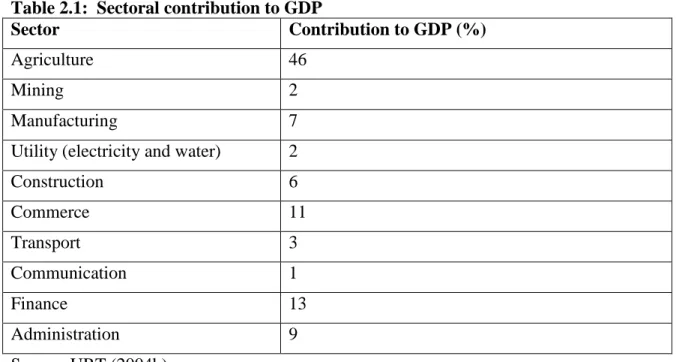
Table 2.1 Sectoral contribution to GDP………..………..…..27
Table 3.1 Overview of the access rainbow………..….………….... 111
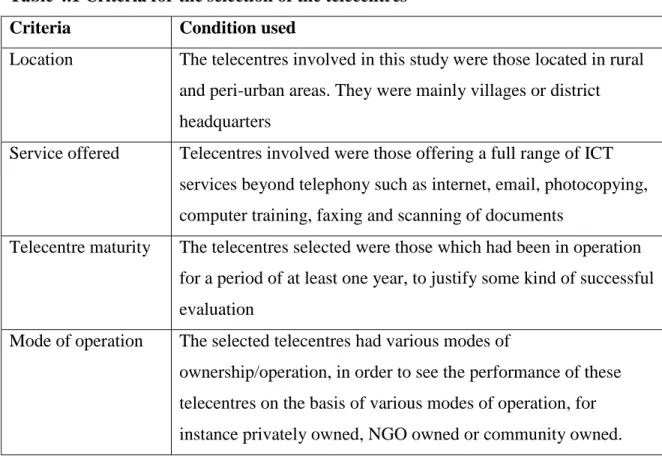
Table 4.1 Criteria for the selection of the telecentres……….…………..……….……142
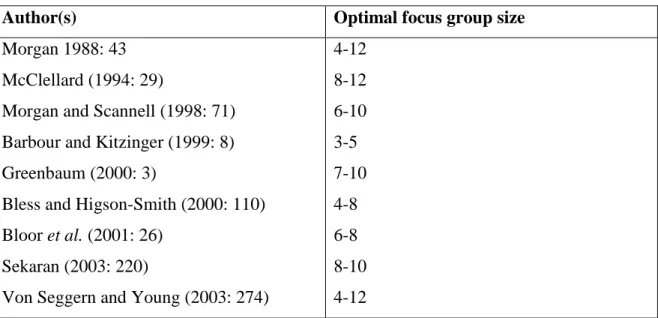
Table 4.2 Optimal focus group size found in the literature……. ….…...……….…....163
Table 4.3 Participants in instruments‟ pre-testing ………...179
Table 4.4 Analysing focus group discussion data……….… 183
Table 5.1.1 Age, gender and literacy level of the respondents………..………. ….193
Table 5.1.2 Levels of education of the respondents……….……….. …..194
Table 5.1.3 Main occupation of the respondents ……….…….…………..……….195
Table 5.1.4 Main occupation of the respondents: formal versus informal sector……….196
Table 5.1.5 Household dependence on relatives living elsewhere…..…….…..…..….... 197
Table 5.1.6 Ownership of household assets and utilities ………..………….. .198
Table 5.4.2 Cost of services in each telecentre ………..………...….. .241
Table 5.4.3 Computer training modules for each telecentre ……..……….… .... 242
Table 5.5.1 Categories of the respondents‟ information needs……..………..… .248
Table 5.5.2 Internet users in each telecentre……….…………..……….… .250
Table 5.5.3 Websites commonly visited: observation of internet search histories………252
Table 5.6.1 Respondents interviewed and responses recorded ………..…….259
Table 5.6.2 Community-related problems faced before the telecentre project was initiated……….…………..………...259
LIST OF FIGURES
Figure 2.1 Map of Tanzania showing the location of telecentres……….49
Figure 3.1 United National Development Programme model ………...….63
Figure 3.2 Washington State University model……….65
Figure 3.3 The information chain model……….….. 69
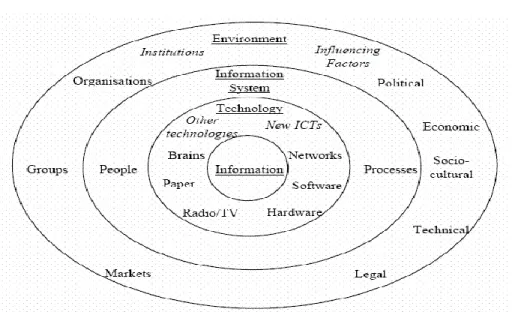
Figure 3.4 Onion ring model……….….71
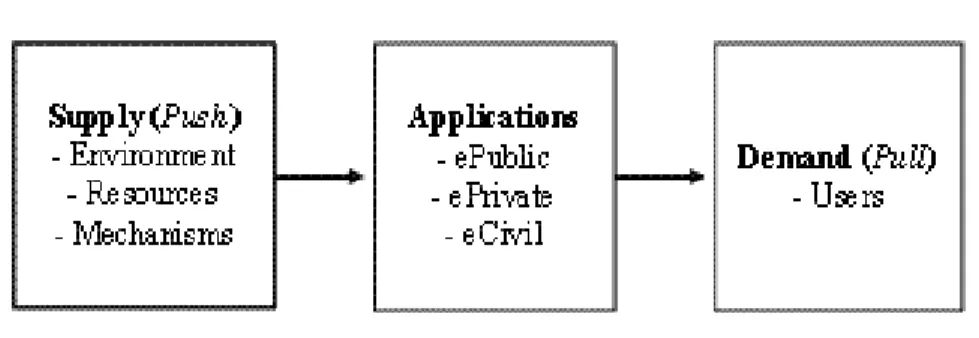
Figure 3.5 The push and pull framework……….….… 73
Figure 5.1.1 Relationship of the respondents to the head of the household ….…..197
Figure 5.1.2 Users and non-users of the telecentres………... 199
Figure 5.2.1 Wireless internet at FADECO …….……….…..217
Figure 5.4.1 Awareness of the telecentre……….………....233
Figure 5.4.2 Visit the telecentre ………...….234
Figure 5.4.3 Reasons for visiting the telecentre ….……….…234
Figure 5.4.4 Satisfaction with the services provided by the telecentre…….….…. 236
Figure 5.4.5 Frequency of using the telecentre in a week……….…...237
Figure 5.4.6 Ability to use computers……….…...238
Figure 5.4.7 How do you use email?...239
Figure 5.4.8 Reasons for email use.………...239
Figure 5.4.9 Frequency of using email in a month…….……….240
Figure 5.4.10 Type of telephone used the most………...…243
Figure 5.4.11 Mobile phone ownership……….244
Figure 5.4.12 Access to a mobile phone ………....….. 244
Figure 5.5.1 Websites commonly visited…….………250
Figure 5.5.2 Use of letters and post office……….…. 254
Figure 5.5.3 Face-to-face communication……….…. 255
Figure 5.5.4 Making social visits………….………... 256
Figure 5.5.5 Use of public phones……….. 256
Figure 5.5.6 Use of newspapers……….…..257
Figure 5.6.1 Jatropha oil demonstration at FADECO telecentre ………. …..261
Figure 5.6.2 More communication among residents………...265
Figure 5.6.3 Stronger social cohesion……….266
Figure 5.6.4 Increased income of the people in the community……….…267 Figure 5.6.5 Attendance at computer training classes at the telecentre…………..267 Figure 7.1 Proposed tripartite ICT for development model………...368
LIST OF APPENDICES
Appendix 3.1 Sustainable livelihoods framework………...404 Appendix 4.1: Interview protocol for users and non-users of telecentres …………...405 Appendix 4.2: Focus group discussion guide………...419 Appendix 4.3: Observation guide……….……...420 Appendix 4.4: Interview protocol for Managers of telecentres ……….….421 Appendix 4.5: Interview protocol for officer responsible for telecentre projects at
Tanzania Communication Regulatory Authority (TCRA)…….…….…424 Appendix 4.6: Interview protocol for officer responsible for telecentre projects at
Commission for Science and Technology (COSTECH)………..……...425 Appendix 4.7: Interview protocol for officer responsible for telecentre projects at
the ministry responsible for ICTs: Ministry of infrastructure
development………..……….……….….426 Appendix 4.8: Research objectives, research questions and possible sources
of data………..…….427 Appendix 4.9 Introductory letter from office of vice chancellor, Sokoine University of
Agriculture……….430
Appendix 4.10 Introductory letter from University of KwaZulu-Natal……….….434 Appendix 4.11 Informed Consent Forms……….436 Appendix 5.1 CROMABU Price Bulletin ……….…………...439
LIST OF ABBREVIATIONS AND ACRONYMS AISI - African Information Society Initiative
AM - Ante Meridiam - before mid-day ASK - Anomalous State of Knowledge CAI - Computer Aid International
CAQDAS - Computer Assisted Qualitative Data Analysis
CBO - Community Based Organisation
CD-ROM - Compact Disk Read Only Memory
CINSA - Community Information Network for Southern Africa CIT - Critical Incident Technique
COSTECH - Tanzanian Commission for Science and Technology CROMABU - Crop and Marketing Bureau
CTA - Technical Centre for Agricultural and rural Co-operation DC - District Commissioner
DOT Force - Digital Opportunity Task Force Email - Electronic mail
FADECO - Family Alliance for Development Co-operation
FM - Frequency Modulated
GICT - Global Information and Communication Technology GKP - Global Knowledge Partnership
GMPCS - Global Mobile Personal Communication Service GSM - Global System for Mobile communications HIPC - Highly Indebted Poor Countries Initiative HTML - Hypertext Markup Language
ICT - Information and Communication Technologies IDRC - International Development Research Centre IFAD - International Fund for Agricultural Development IFIs - International Financial Institutions
IICD - International Institute for Communication and Development ILFS - Integrated Labour Force Survey
ILO - International Labour Organisation IMF - International Monetary Fund ISP - Internet Service Provider
IT - Information Technology
ITU - International Telecommunication Union
KACE - Kenya Agricultural Commodity Exchange Limited KADEVO - Karagwe Development Volunteer Organisations KAMEA - Karagwe Media Association
LAN - Local Area Networks LCD - Liquid Crystal Display LDC - Least Developed Countries
LZARDI - Lake Zone Agriculture Research Development Institute MCT - Multipurpose Community Telecentres
MDG - Millennium Development Goals MIS - Market Information Service
MIT - Ministry of Information and Technology MoID - Ministry of Infrastructure Development MS-DOS - Microsoft Disk Operating System MTN - Mobile Telecom Network
NGO - Non-Governmental Organisation
NSGRP - National Strategy for Growth and Reduction of Poverty OEDC - Organisation for Economic Co-operation and Development
OKN - Open Knowledge Network
PM - Post Meridian - after mid day PRSP - Poverty Reduction Strategy Paper PTO - Public Telecom Operator
RAIN - Agricultural Information Network RTD - Radio Tanzania Dar es Salaam
SACCOS - Savings and Credit Co-operative Society
SCECSAL - Standing Conference of Eastern, Central and Southern African Library and Information Associations
SDC - Swiss Agency for Development and Co-operation
SIDA - Swedish International Development Co-operation Agency SIM - Subscriber Identity Module
SME - Small and Medium Enterprises SMS - Short Message Service
SPSS®. - SPSS Inc.
STD - Subscriber Trunk Dialing
TANESCO - Tanzania Electric Supply Company Limited TBC - Tanzania Broadcasting Commission
TCC - Tanzania Communication Commission
TCCIA - The Tanzania Chamber for Commerce Industry and Agriculture TCRA - Tanzania Communication Regulatory Authority
TPC - Tanzania Posts Corporation
TPTC - Tanzania Posts and Telecommunication Corporation TTCL - Tanzania Telecommunication Company Limited UCC - University Computer Centre
UCSAF - Universal Communications Service Access Fund
UK - United Kingdom
UNDP - United Nations Development Programme
UNESCO - United Nations Educational, Scientific and Cultural Organisation UNFPA - United Nations Population Fund
UNHCR - United Nations High Commission for Refugees URT - United Republic of Tanzania
USA - United States of America
USAID - United States Agency for International Development VCR - Video Cassette Recorder
VETA - Tanzania Vocational Education Training Authority VPPs - Village Pay Phones
VSAT - Very Small Aperture Terminals
WSIS - World Summit on Information Society
WWW - World Wide Web
ZANTEL - Zanzibar Telecom
CHAPTER ONE
BACKGROUND TO THE STUDY 1.0 Introduction
Globally, it is estimated that a fifth of the world‟s population lives in extreme poverty. Most of the world‟s poor are found in developing countries, particularly in the countries of Sub- Saharan Africa. Tanzania is among the least developed countries of the world with about 36 percent of its population living below the poverty datum line of one United States (US) dollar per day (UNDP 2005). The Tanzanian economy depends heavily on agriculture, which accounts for about half of the Gross Domestic Product (GDP), provides 85 percent of exports and employs 80 percent of the workforce (URT 2002a). Seventy percent of the Tanzanian population lives in rural areas where agriculture, in the form of smallholder producers, is the major economic activity (URT 2005b). In most rural areas the small-scale activities of other sectors such as livestock-keeping, business, handicrafts, arts and cultural activities are common. Mining and fishing are also undertaken. However, most of these economic activities are underdeveloped and poverty levels are still high in most rural areas of Tanzania (URT 2005c). It is estimated that 80 percent of the poor in Tanzania are in rural areas (URT 2005c).
The Tanzanian Government has taken various measures to address the problem of poverty and various policies have been enacted to this effect. Some of these measures include the Poverty Reduction Strategy Paper (PRSP) of 2001; Tanzania‟s Development Vision 2025 of 1998 and National Strategy for Growth and Reduction of Poverty (NSGRP) of 2005 (URT 1998; URT 2000a; URT 2005a). NSGRP is committed to the Millennium Development Goals (MDGs)1, as internationally agreed targets for reducing poverty, hunger, diseases, illiteracy, environmental degradation and gender inequality, by 2015 (URT 2005a). Despite these efforts, poverty levels are high in Tanzania. By the year 2000 about half of the population was poor and about one-third lived in abject poverty (URT 2000a). There is a large and growing
1 MDGs are internationally agreed goals/targets to address the needs of the world‟s poor by the year 2015. They include eradicating extreme poverty and hunger; achieving universal primary education; promoting gender equality and empowerment of women; reducing child mortality; improving maternal health; combating HIV/AIDS, malaria and other diseases; ensuring environmental sustainability; and developing a global partnership for development. For further information, refer to <http://www.un.org/millenniumgoals/>
disparity between urban and rural areas, with indicators of income poverty, survival and nutrition, human capabilities and the Human Development Index2 clearly showing that poverty is more prevalent in rural areas (URT 2005b).
Information and Communication Technologies (ICTs) such as computers, telephones (fixed and mobile) and the internet have gained much attention as important tools for socio- economic development in developing countries (World Bank 1998; DOT force 2001; InfoDev 2005). As a result, in recent years, developing countries and their partners in the international development community have devoted considerable attention to the role that ICTs may play in promoting economic growth, combating poverty and attaining sustainable livelihoods (Gerster and Zimmermann 2003). The Tanzanian government appreciates the positive role of ICTs for socio-economic development and sustainable livelihoods (URT 2003a). NSGRP describes ICTs as a critical “soft” infrastructure that can accelerate productivity in the productive and service sectors, in government, business, teaching and in small and medium enterprises (SMEs) development (URT 2005a).
ICTs may play a role in the livelihoods of people in rural areas by facilitating access to information which can boost agricultural production and provide marketing information for agricultural products, hence improving farmers‟ income. ICTs may also improve poor people‟s access to education, health, government and financial services (Cecchini and Scott 2005: 73; Mathur and Ambani 2005: 348). ICTs can facilitate the availability of information that provides opportunities for diversification from subsistence production of traditional crops to the production of market-oriented high value agricultural products (Temu and Temu 2006).
This would have an impact on rural livelihoods by increasing and diversifying the income of small-scale farmers through the exploitation of new market opportunities and existing market niches. ICTs may benefit farmers by enabling them to participate in co-operative activities such as participation in agricultural supply co-operatives which provide farmers with required inputs for agricultural production or marketing co-operatives which assist farmers in
2 The Human Development Index (HDI) is a summary composite index that measures a country's average achievements in three basic aspects of human development. These are longevity, measured by life expectancy;
knowledge, measured by adult literacy rate and gross primary, secondary and tertiary enrolments ratios; and a decent standard of living, measured by GDP per capita.
marketing their products (Sife, Lwoga and Chilimo 2004). ICTs may promote growth of other small-scale enterprises in rural areas and provide people with multiple and more sustainable livelihoods opportunities (Duncombe and Heeks 1999).
As a result of the attention given to ICTs as tools for socio-economic development, different organisations have made massive investments in ICTs and various projects have been initiated with the aim of making ICTs accessible to people in developing countries. In the developing countries context an example of such projects is the multipurpose community telecentres advocated by International Telecommunication Union (ITU), the International Development Research Centre (IDRC), United Nations Development Programme (UNDP) and United Nations Educational, Scientific and Cultural Organisation (UNESCO) (ITU 1998). Tanzania hosts one of the six African pilot telecentres within the framework of ITU/UNESCO/IDRC initiative. Telecentres were designed to experiment with new technologies, new forms of partnership and funding mechanisms and the experiences acquired in the pilot projects were meant to develop appropriate strategies for the application of ICTs for development and poverty reduction.
In many developing countries, telecentres have become hubs for rural connectivity and in many rural areas telecentres are the only places that provide internet services, computer training and other ICT related services to the public. In Tanzania, and in many other African countries, mobile phone services have experienced phenomenonal growth in recent years and cellular telephone is described as an „ICT‟ that is bridging the digital divide in Africa and is considered the most significant entry point to the information society for Africans (Heeks 1999; Intelcon Research and Consultancy 2002). For these reasons, this study refers mainly to these two services when investigating the use of ICTs by people in rural areas of Tanzania.
In Tanzania, as is the case in many other developing countries, the benefits of ICTs are still unevenly spread, especially between urban and rural areas resulting in what can be termed as
“urban–rural digital divide.” Most ICTs facilities in developing countries are concentrated in urban areas (UNESCO 2003a). Ngalinda and Mutagahywa (2005) found that only six percent of households in Tanzania had access to fixed telephones and 90 percent of these were in Dar es Salaam. The same study revealed that 48 percent of people living in Dar es Salaam had
access to mobile phone, whereas in rural areas only eight percent of the population had access to mobile phones. In that regard, various steps have been put in place to facilitate access and utilisation of ICTs facilities in rural areas of Tanzania. Some of these steps include the adoption of a pro-poor national ICT policy and establishment of an independent communication regulatory authority, whose role, among others, is to ensure universal accessibility of ICTs facilities in the country (URT 2003a). Other measures include the establishment of telecentres in various areas of the country.
Experience from elsewhere shows that most telecentres have neither led to development, nor to the improvement of peoples‟ livelihoods, as expected (Kenny 2002; Maepa and Mphahlele 2004; Burton 2003: 198). Most of these ICT projects put much emphasis on the supply side of the ICT services such as developing the infrastructure, the hardware, the software and having appropriate policies, but little has been done to analyse the demand side of these services and therefore, as a result, these services are not effectively used to bring about the socio-economic development of people in rural areas (Heeks 2005a).
The purpose of this study is to investigate how, and for what purposes, ICTs are used by people in selected rural areas of Tanzania and to study the impact that ICTs have on the various aspects of their livelihoods. This investigation is carried out using ICT services provided by the telecentres and mobile phone services. The investigation uses the concept of sustainable livelihoods, with an asset/vulnerability approach (DFID 2001; Chambers and Conway 1992; Carney 1998), as a lens through which to assess the contribution to livelihood sustainability made by ICT services. The holism of livelihoods framework will help to describe the multi-dimensionality of poverty, which includes not only lack of income and financial resources, but also deprivation in terms of a lower likelihood of being able to live a long and healthy life and deprivation regarding increased access to the knowledge, education and resources which enable people to have a decent standard of living (UNDP 2002; World Bank 2003). The study assesses the extent of implementation of the Tanzania national ICT policy and the universal access policy and the degree to which these policies facilitate accessibility and utilisation of ICTs in the selected rural areas.
1.1 Background to the problem
Information and communication technologies (ICTs) involve innovations in microelectronics, computing (hardware and software), telecommunications and opto-electronics (UNDP 2001).
These innovations allow the processing and storage of large amounts of information, along with rapid distribution of information through communication networks (UNDP 2001). ICTs include computers, the internet, telephones, radio and television. These technologies help in the delivery of information to where it is required, in a timely manner. ICTs multiply time, shorten distances and eliminate hierarchy and geographical boundaries. This leads to reduced costs of operations (Adeya and Cogburn 2001: 6). The collective legacy of ICTs is built on empowering people with the ability to communicate instantaneously, which is known to facilitate the development process by increasing efficiency, effectiveness and equity (Yonah 2002).
ICTs are now regarded as an important tool in development, which is increasingly becoming technology-oriented, and success in the global economy depends on access to information and communication technologies (Adeya and Cogburn 2001: 8). ICTs have been the driving force behind the global information society, in which information work predominates and information is regarded as a valuable resource. An information society is a society in which the creation, distribution and manipulation of information is a significant economic and cultural activity and where the production, distribution and consumption of knowledge and information are the driving forces for change (Dordick and Wang 1993). The information society is made possible by ICTs and is characterised by networking forms of activities in economy, society, politics and culture, which Castells (1996: 21) referred to as the networked society.
ICTs are regarded as powerful tools for socio-economic development (UNDP 2001; OECD 2004; Gills and Mitchel 2002). The World Bank (1998) and UNDP (1999) assert that ICTs have the potential to improve the welfare of the poor by providing opportunities to increase social capital; improved availability of market information; creation of new economic opportunities; improved economic efficiency and competitiveness; better access to health and
education facilities and more efficient and effective governance. ICTs have in fact made a new development paradigm possible (Hilbert 2001).
Various international initiatives have been initiated to facilitate the use of ICTs for development in developing countries and help bridge the digital divide. Some of these initiatives include the World Summit on Information Society, the G-8‟s Digital Opportunity Task Force (DOT Force); UNDP‟s Information Technologies for Development Initiative (Info21); the World Bank‟s Global Information and Communication Technologies Department (GICT); and the World Bank‟s Information for Development (InfoDev) initiative and the UN‟s ICT Task Force (UNICT Task Force 2002; WSIS 2003; UNDP 2000; GICT 2006; DOT force 2001; InfoDev 2006).
The role of ICT in fostering development and addressing the needs of the poor has been the subject of heated debate in recent years. This contestation has been attributed partly to a high failure rate of the ICTs for development projects, especially in developing countries (Benjamin 2001a; Chapman and Slaymaker 2002; Heeks 1999; Maepa and Mphahlele 2004).
Myriad challenges involved in leveraging ICTs in poor countries which, in most case are overlooked or not taken seriously by the proponents of ICTs for development projects, is another source of controversy. The extent to which ICTs can be used to reduce poverty in poor countries is strongly contested (Heeks 1999; Mercer 2005; Wilson 2001).
Critics of "ICTs for development" say that ICTs are a waste of money, given the many other pressing development issues; that it would be best to divert resources from ICT development towards areas of greater impact and real need; that human beings face the risk of disillusionment with ICT, as ICT projects do not bring the benefits claimed; they also say that ICTs will not benefit but instead will harm people, by opening up new avenues for exploitation (Wyatt et al., 2000: 3-8; Moodley and Cloete 2004).
Supporters of the "ICTs for development" view are generally saying that the divide between those who have access to ICTs and those who do not will become even greater if ICTs are not promoted; that ICTs will support other sectors in the economy and people‟s lives will improve
through investment in ICTs; that ICTs are precisely the tool to bring everyone into the
"information age" and so ensure that the benefits of this form of social organisation are shared (WSIS 2003; InfoDev 2006; Chowdhury 2000; Heeks 2005b).
On the other side of the debate there are those who feel that, if used wisely, ICT can be effective in addressing development objectives, including the economic and social empowerment goals of the poor (SDC and GPK 2004; Mansell and Wehn 1998; Lewis 2004;
Moodley and Cloete 2004). This view is supported by recent developments in the ICT sector, such as falling ICT costs, resulting from the declining cost of personal computers, development of open-source software solutions, the emergence of new cost-effective technologies such as wireless technologies and increased competition in the communications sector (SDC and GPK 2004).
Despite these developments the fact is that the gap between those who have access to ICTs and those who do not and between people living in urban areas and those living in rural areas of developing countries is still large (Bridges.org 2003). There is a wide gap between the expectations of what ICTs can do for poor people living in rural areas of developing countries and the reality of how these technologies are actually being used in these areas.
This study investigates how and for what purposes ICTs are used by people in selected rural areas of Tanzania so as to provide a balanced understanding of the relationship between ICTs, socio-economic development and sustainable livelihoods. The investigation will be done by taking into consideration local conditions and realities in these areas and hence move beyond an enthusiastic and a technological deterministic approach of the role of ICTs for poverty reduction to a more balanced view of ICTs for development.
To use the words of Moodley and Cloete (2004), in order to retain the “hope” that ICTs can play a role in development, it is necessary not to succumb to the seductive “hype” that surrounds technological developments. Álvarez and Calás (1996: 42) emphasise that, in order to fully understand the relationship between ICTs and poverty reduction, it is necessary to articulate multi-disciplinary and dynamic models capable of considering concurrently the
multiple realities, subjectivities and political agendas enabled by information technologies.
These approaches should recognise the context in which these new realities are appearing and should be dynamic and proceed beyond simplicity.
1.2 Statement of the problem
Within the context of development, ICTs are regarded as tools for socio-economic development and sustainable livelihoods (Lewis 2004; SDC and GPK 2004; Mansell and Wehn 1998). There is an increasing commitment from international institutions to support this goal. The central question for developing countries is not whether ICTs should be introduced for development purposes, but rather what will be the best way to implement ICTs with a developmental focus and in a manner that facilitates developing countries to respond to the information society?
The ability to use and adapt ICTs is regarded as a critical factor for generating and accessing wealth, power and knowledge, which can be used to achieve socio-economic development (Castells 1998: 92). ICTs may also cause inequality, fragmentation of the society and social exclusion for those who are not able to use ICTs and participate in the network society (Castells 1998: 68-69). Disparities in the use of ICTs, generally known as the digital divide, exist throughout the world between rich and poor countries and between specific groups of people within countries (Bridges.org 2003). In developing countries telecentre projects are being used as a mechanism to bridge the urban/rural digital divide and to enable rural people to use ICTs for socio-economic development and sustainable livelihoods (Etta and Parvyn- Wamahiu 2003: 3-4). In the case of Tanzania, various initiatives are in place to ensure that ICTs become widely used for poverty reduction and sustainable livelihoods. There is also a political will within the government to facilitate this role (URT 2003a; URT 2005a).
Despite this strong belief in the role of ICTs for socio-economic development, clear evidence of how ICTs can be used to achieve this purpose in the Tanzanian context and elsewhere is lacking. There is a danger of people embracing the „technological determinism theory‟ and therefore regarding ICTs as a panacea or a „magic bullet‟ that will solve all development problems, without understanding the local context, or with ill-conceived expectations of how they would be used (Chacko 2004; Long and Long 1992: 19; Moodley and Cloete 2004;). A
report from the Swedish International Development Co-operation Agency (SIDA) (2005) pointed out that:
Despite the strong belief in the role of ICTs in poverty reduction and large investments that have already been made, there has been little readily discernable hard evidence that demonstrates that the use of ICTs could be a significant contributor to poverty alleviation. In the case where there has been some evidence of benefits from the use of ICTs, there has been little indication that it could be cost-effective and applicable on a large scale (SIDA 2005).
Research findings from other African countries show that, even in places where rural ICTs access points such as telecentres are in place, these facilities are sometimes not used as effectively as expected, thus rendering their impact on socio-economic development and sustainable livelihoods minimal (Benjamin 2001b; Chapman and Slaymaker 2002; Maepa and Mphahlele 2004; Burton 2003: 198).
This study investigates how, and for what purposes, ICTs are used by people in selected rural areas of Tanzania and studies the impact that ICTs have on the various aspects of their livelihoods. This is important because different countries have different conditions which might result in different experiences with the use of ICTs for livelihoods strategies and socio- economic development. Mansell and Wehn (1998) explained that there is no universal “best practice” formula for adoption of information and communication technologies for socio- economic development, especially in developing countries, because of the diversity of conditions. This research will contribute positively to the ongoing discussion on ICTs for socio-economic development in Tanzania. It will be of particular interest to ICT policy- makers, promoters and managers of telecentres and other ICT projects in rural areas. The study will also provide valuable information to the implementation of the universal access policy which is currently in progress.
1.3 Purpose
The research question which this study investigated was: how and for what purposes ICTs are used by people in the selected rural areas of Tanzania and what is the impact of ICTs on the various aspects of their livelihoods?
1.3.1 Objectives
The specific objectives of the study were:
1. To establish the current status of ICT sector development in the selected rural areas of Tanzania.
2. To determine policies which are in place to facilitate development and utilisation of ICTs in the selected rural areas of Tanzania.
3. To examine the extent to which people in the selected rural areas of Tanzania have access3 to ICTs.
4. To examine use patterns of ICTs by people in the selected rural areas of Tanzania.
5. To determine the impact of ICTs use on various aspects of the livelihoods of the people living in the selected rural areas of Tanzania
6. To identify barriers to effective utilisation of ICTs in the selected rural areas of Tanzania
7. To recommend a model for effective implementation of ICTs and their use for sustainable livelihoods in the selected rural areas of Tanzania
1.3.2 Research questions
In order to address the objectives of the study, answers to the following research questions were sought:
1. What is the current status of ICT sector development in the selected rural areas of Tanzania?
3 The study will focus on the broader definition of access, which Bridges.org (2003) called „real access‟ to ICTs. This is the kind of access that not only refers to the availability of the physical infrastructure but also focuses on all other factors that actually affect who can take full advantage of the ICTs in an effective way. These factors include affordability, integration of the technology into peoples‟ daily lives and routine, capacity of the people to use and understand the technology and whether or not there is relevant locally produced content.