UNIVERSITY OF KWAZULU-NATAL
The role of information systems integration in achieving Batho Pele within the KZN Provincial
Public Service
BY
Vusi Blessing Bongani Mhlongo
A dissertation submitted in partial fulfillment of the requirements for the degree of
Master of Commerce
School of Information Technology and Systems
Supervisor: Prof M. Maharaj
2014
Declaration
I, Vusi Blessing Mhlongo, declare that:
(i) The research reported in this dissertation, except where otherwise indicated, is my original research.
(ii) This dissertation has not been submitted for any degree or examination at any other university.
(iii) This dissertation does not contain other person’s data, picture, graphs or other information, unless specifically acknowledged as being sourced from other persons.
(iv) This dissertation does not contain other person’s writing, unless specifically acknowledged as being sourced from other researchers. Where other written sources have been quoted, then:
a) Their words have been rewritten but the general information attributed to them has been referenced;
b) Where their exact words have been used, their writing has been placed inside quotation marks, and referenced.
(v) This dissertation does not contain text, graphics or tables copied and pasted from the Internet, unless specifically acknowledged, and the source being detailed in the dissertation and Reference section.
Signature
ii
Acknowledgement
Many people assisted in the completion of this Master’s thesis. Very little can be achieved without the help of others along the way. I wish to make special mention of a few people who have really mattered on the journey to completion.
• My wife, Bongekile Mhlongo, for her love and support in making this possible especially for all the personal sacrifices that she has made.
• My supervisor, Professor Manoj Maharaj, for his guidance and assistance in reaching this milestone.
• Deepak Singh, for his guidance on SPSS.
• The organisation that participated, for allowing me access to their staff and records.
• All the participants, for their time in completing the questionnaires.
• The Lord for guidance and wisdom.
iii
Abstract
A major responsibility confronted the Government of National Unity (GNU) in 1994 was to undo the apartheid legacies of poverty, inequality and racial segregation in order to create a single, and efficient public service that delivered on the basic needs of all citizens (Managa, 2012). Integrated information systems and technologies have been identified as being integral for the acceleration of efficient and effective service delivery (Gershon, 2004).
The objective of this study is to examine integrated information systems (IS) as a means of achieving Batho Pele within the KwaZulu-Natal Provincial Government (KZNPG). This research looks at how integration of information systems in the KZNPG can enhance the levels of service delivery through effective and optimal utilisation of integrated IT/IS resources and the alignment of processes to Batho Pele Principles. The KZNPG subscribes to Batho Pele (a Sotho word which means “People first”) principles and procedures. The Batho Pele policy provides a formalised structure in accelerating the delivery of public services to citizens and process improvement initiatives by national government (Government Gazette Notice 1459 of 1997). Objectives for the study and research questions were formulated after an in-depth literature review. The literature review serves to provide both the information integration framework and the e-government integration framework; and to establish what evidence, as discovered by other researchers, exist on information integration.
The questionnaire was developed in line with the research objectives, and was distributed to approximately four hundred KZNPG staff members identified as IT end-users who form part of the target population. A total number of one hundred and forty-four questionnaires were returned.
Data was collected using a self administered questionnaire and the SPSS software package was used to analyse the data. Descriptive frequency analysis and frequency bar graphs results were used to present the data. Bivariate Spearman’s correlation showed that there was a positive association between integrated systems and service delivery. The findings of the study indicated that information systems (IS) integration can help achieve Batho Pele within the KZNPG. Other findings suggested that KZN Provincial government lacks adequately trained IT resources to properly achieve its stated goals.
iv
Table of Contents
Declaration ... i
Acknowledgement ... ii
Abstract ... iii
List of Tables ... viii
List of Figures ... ix
List of Acronyms and Abbreviations ... x
1. Introduction ... 1
1.1. Background of the Study ... 1
1.2. Problem Statement ... 2
1.3. Research Objectives ... 4
1.4. Focus of the Study ... 5
1.4.1. Information Systems (IS) Integration ... 5
1.4.2. Process Integration ... 5
1.4.3. Batho Pele - Process Improvement Principle ... 5
1.5. Writing Conventions ... 5
1.6. Summary ... 6
2. Literature Review ... 7
2.1. Background ... 7
2.2. Integration of Information Technology (IT) and Information Systems (IS) ... 9
2.2.1. Process Integration ... 10
2.2.2. Information Integration ... 11
2.3. Enterprise Information Systems Integration Framework ... 12
2.3.1. Network Level ... 14
2.3.2. Data Level ... 14
2.3.3. Application Level ... 15
2.3.4. Process Level ... 15
2.4. E-Government Architecture Framework ... 16
2.4.1. Access Layer ... 19
2.4.2. E-Government Layer ... 19
2.4.3. E-Business Layer ... 20
2.4.4. Infrastructure Layer ... 20
2.5. IT Alignment ... 21
2.5.1. Strategic Information Systems Alignment ... 22
2.5.2. IT/IS and KZN Provincial Government Alignment ... 23
2.5.3. Enterprise Architecture (EA) ... 24
2.6. Services ... 25
2.6.1. Service Development ... 28
2.6.2. New Service Development (NSD) Process ... 29
2.7. Batho Pele ... 30
2.8. Benefits Management ... 33
v
2.8.1. Benefits Management Process ... 33
2.8.2. Linking IT Strategy with Benefits Management... 35
2.9. Conclusion ... 36
3. Research Design and Methodology ... 38
3.1. Background ... 38
3.2. Research Design ... 39
3.2.1. Research Type ... 40
3.2.2. Research Approach ... 40
3.2.3. Research Philosophy ... 40
3.2.4. Research Strategy ... 41
3.3. Target Population... 41
3.4. Sampling ... 42
3.4.1. Sampling Frame ... 42
3.4.2. Sampling Techniques ... 42
3.5. Data Collection ... 43
3.5.1. Questionnaire Design ... 43
3.5.2. Administration of Questionnaires ... 44
3.5.3. Collection of Questionnaires ... 44
3.6. Data Analysis ... 44
3.6.1. Descriptive Statistics ... 45
3.6.2. Frequency Distribution ... 45
3.6.3. Representation of the Data ... 46
3.6.4. Validity Consideration ... 46
3.6.5. Reliability Testing ... 46
3.7. Conclusion ... 46
4. Data Analysis ... 48
4.1. Introduction ... 48
4.2. Descriptive Statistics ... 49
4.3. Reliability Analysis ... 52
4.4. Factor Analysis ... 53
4.4.1. Batho Pele Principles ... 53
4.4.2. Service Delivery Impact ... 54
4.4.3. Importance of integrated information systems ... 54
4.4.4. Strategic alignment ... 55
4.4.5. Problem Associated with Implementing IS&T ... 55
4.5. Frequency Analysis ... 56
4.5.1. Service Delivery Impact ... 58
4.5.2. Importance of integrated information systems ... 60
4.5.3. Strategic Alignment ... 61
4.5.4. Problem associated with implementing IS&T ... 63
4.6. Hypothesis Testing ... 64
4.7. Correlations ... 67
4.8. Conclusion ... 69
5. Discussion of Findings ... 70
vi
5.1. Introduction ... 70
5.2. Discussion of Findings ... 70
5.3. Research Objective 1: Service Delivery Impact ... 71
5.3.1. Performance Review ... 71
5.3.2. Good working conditions increase job satisfaction ... 73
5.4. Research Objective 2: The Importance of Integrated Information Systems in Improving Service Delivery... 74
5.4.1. E-Government Integration ... 75
5.4.2. Enterprise Resource Planning (ERP) ... 77
5.5. Research Objective 3: Strategic Alignment ... 77
5.5.1. Strategic Alignment Maturity Model ... 79
5.5.2. Business Performance Measurement ... 80
5.6. Research Objective 4: Problem Associated with Implementing Information Systems ... 81
5.6.1. Strategy Barriers ... 83
5.6.2. Technology Barriers ... 83
5.6.3. Policy Barriers ... 84
5.6.4. Organisation Barriers ... 84
5.7. Conclusion ... 85
6. Recommendations and Conclusion... 86
6.1. Introduction ... 86
6.2. Recommendations ... 87
6.2.1. Integrated Information Systems (IS) ... 87
6.2.2. Cloud Computing as Service ... 89
6.2.3. Strategic IT Resource Management ... 91
6.3. Recommendations from this Study ... 93
6.3.1. Inter-Governmental Relations ... 93
6.3.2. Management Reporting ... 93
6.3.3. Service Delivery Initiatives ... 94
6.4. Limitations Of The Study ... 94
6.4.1. Population and Sample ... 94
6.4.2. Identifying and Targeting Respondents... 94
6.4.3. The Size and Scope of Study ... 94
6.4.4. Time ... 94
6.4.5. Accuracy of results... 95
6.5. Conclusion ... 95
7. References... 96
Appendix 1: Ethical Clearance ... 106
Appendix 2: Questionnaire ... 107
Appendix 3: Descriptive Statistics ... 112
A. Batho Pele ... 112
B. Service Delivery Impact ... 113
C. Integrated Systems ... 114
D. Strategic Alignment ... 115
vii E. Problems Associated With IT ... 117 Appendix 4: Correlation Summary ... 119 Appendix 5: Letter of Permission to Conduct the Study ... 121
viii
List of Tables
Table 1 : Process Integration Principles (Berente, Vandenbossch, & Aubert, 2009) ... 11
Table 2 : IS Integration types (Madnick, 1995) ... 12
Table 3 : Infrastructure Layer Components ... 21
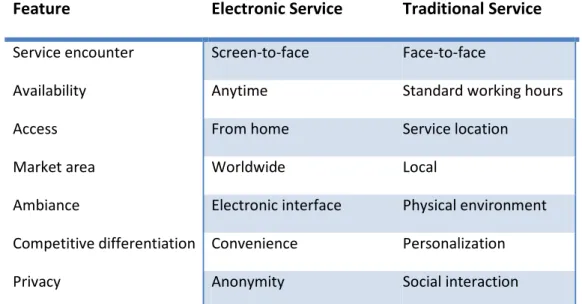
Table 4 : Comparison of Electronic & Traditional Service (Fitzsimmons & Fitzsimmons, 2006) ... 27
Table 5 : Levels of Service Innovation (Johnson, Menor, Roth, & Chase, 2000) ... 29
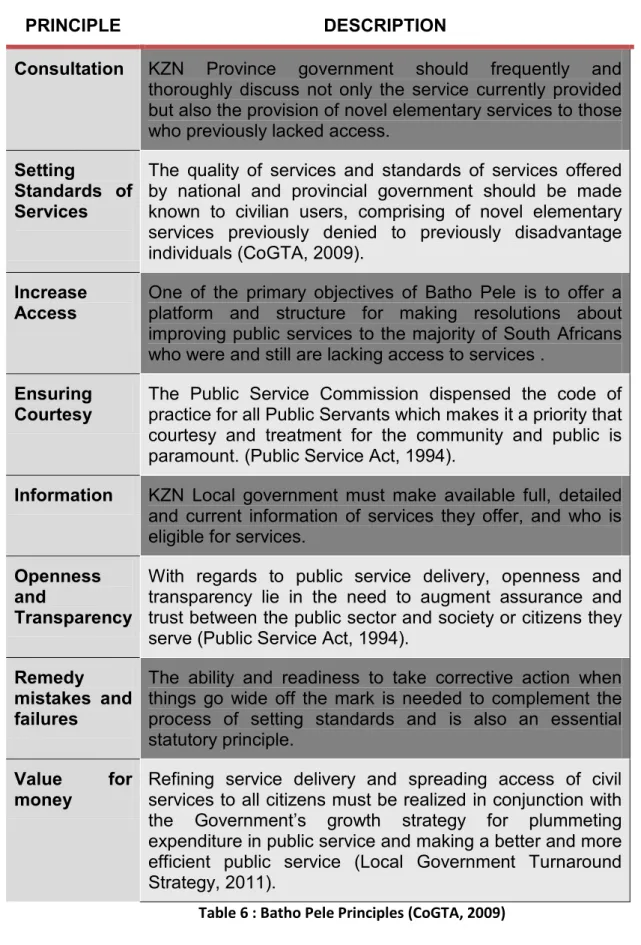
Table 6 : Batho Pele Principles (CoGTA, 2009) ... 32
Table 7 : Age and Gender and gender participation ... 49
Table 8 : Reliability Analysis ... 52
Table 9 : Factor Analyses - Batho Pele Principles... 53
Table 10 : Factor Analyses - Service Delivery Impact ... 54
Table 11 : Factor Analyses - Importance of integrated systems ... 54
Table 12 : Factor Analyses - Strategic alignment ... 55
Table 13 : Factor Analyses - Problem Associated with Implementing IS&T ... 55
Table 14 : Frequency Analyses - Batho Pele Principles ... 56
Table 15 : Frequency Analyses - Service Delivery Impact ... 58
Table 16 : Frequency Analyses - Importance of integrated systems ... 60
Table 17 : Frequency Analyses - Strategic alignment ... 61
Table 18 : Frequency Analyses - Problem associated with implementing IS&T ... 63
Table 19 : Chi square test ... 66
Table 20 : Correlation Coefficient ... 68
Table 21 : Importance of integrated systems ... 74
Table 22 : SAMM Components (Luftman, 2000) ... 80
Table 23 : Business Performance Measure vs. KZN Local Government... 80
ix
List of Figures
Figure 1 : Example diagram used in each Chapter ... 6
Figure 2 : Literature Review Outline ... 7
Figure 3 : Enterprise Information Integration Framework (Giachetti, 2004) ... 13
Figure 4 : Framework of E-Government Architecture (Ebrahim & Irani, 2005) ... 18
Figure 5: IT Alignment Components (Laudon & Laudon, 2006) ... 22
Figure 6 : Strategic Alignment (Henderson & Venkatraman, 1993), (Ahmed, Aloufi, Issa-Salwe, & Kabir, 2010) ... 23
Figure 7 : Characteristics of Service (Kumar & Gupta, 2006) ... 26
Figure 8 : NSD Process Cycle (New Service Development, 2000) ... 30
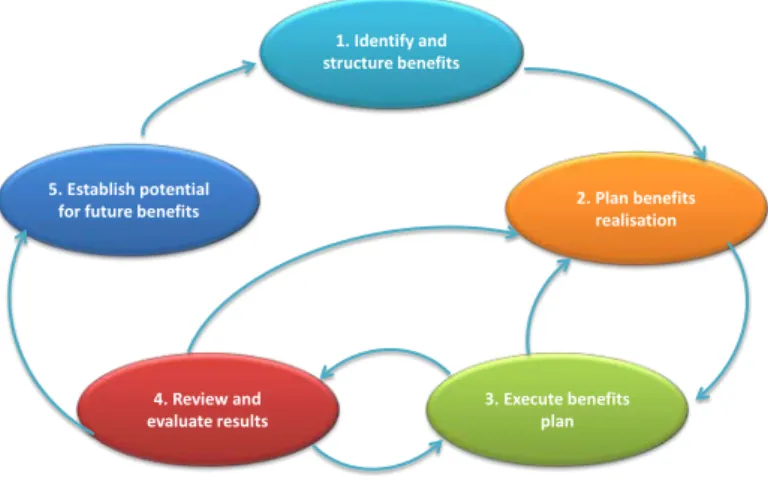
Figure 9 : A Process model for Benefits Management (Ward & Daniel, 2006) ... 33
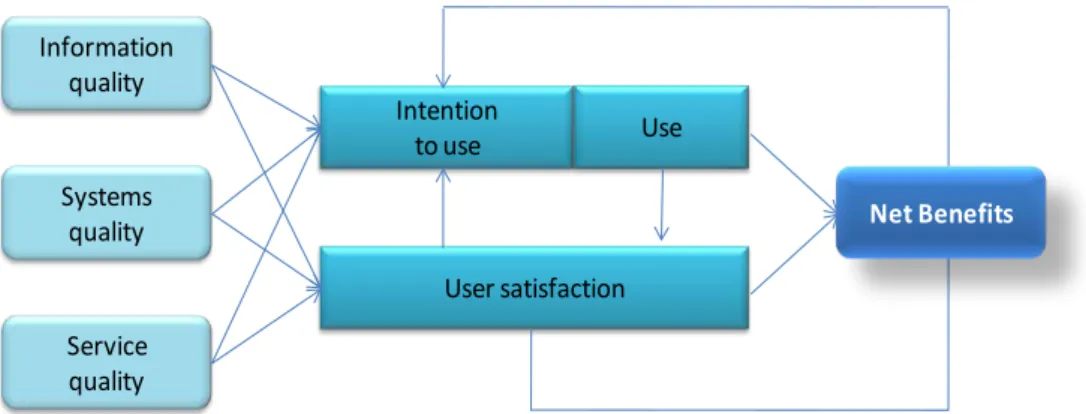
Figure 10 : DeLone and McLean Information Systems Success Model (DeLone & McLean, 2004) ... 35
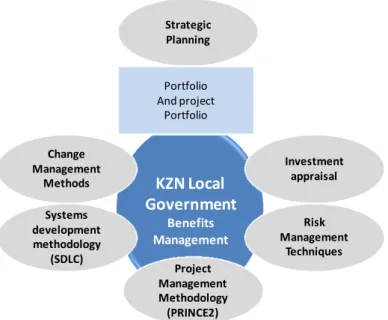
Figure 11 : The Context of Benefits Management (Ward & Daniel, 2006) ... 36
Figure 12 : Research Design & Methodology Outline ... 38
Figure 13 : Research Design (McBurney, 2002) ... 39
Figure 14 : Data Analysis Chapter Outline ... 48
Figure 15 : Race Group ... 50
Figure 16 : KZN CoGTA Head office vs. Regional Office ... 50
Figure 17 : Years of Service ... 51
Figure 18 : Batho Pele Principles ... 57
Figure 19 : Service Delivery Impact ... 59
Figure 20 : Importance of integrated systems ... 60
Figure 21 : Strategic Alignment ... 62
Figure 22 : Problem associated with implementing IS&T ... 63
Figure 24 : Discussion of Findings Chapter Outline ... 70
Figure 24 : ICT House of Values (Dept of Public Service & Administration, 2003) ... 76
Figure 25 : Chapter Outline for Recommendation and Conclusion ... 86
Figure 26 : Perspective of e-government integration ... 89
Figure 27 : Types of Cloud Computing (Dialogic, 2010) ... 90
Figure 28 : KZN Provincial Government IS Integration Overview ... 93
x
List of Acronyms and Abbreviations
BAS Basic Accounting System
BEE Black Economic Empowerment
CRM Customer Relationship Management
EA Enterprise Architecture
EAI Enterprise Application Integration
EGI E-Government Integration
E-Government Electronic Government E-procurement Electronic Procurement
EA Enterprise Architecture
EAI Enterprise Application Integration
IS Information Systems
IT Information Technology
IT/IS Information Technology and Information Systems
KZN KwaZulu-Natal
KZN CoGTA KwaZulu-Natal Corporative Governance and Traditional Affairs KZNPG KwaZulu-Natal Provincial Government
LAN Local Area Network
LGTAS Local Government Turnaround Strategy
NSD New Service Development
PERSAL Personal Salary System
SAM Strategic Alignment Model
SISA Strategic Information Systems Alignment SOA Service Oriented Architecture
SPSS Statistical Package for the Social Sciences
TCP/IP Transmission Control Protocol/ Internet Protocol
WAN Wide Area Network
1
The role of information systems integration in achieving Batho Pele within the KZN Provincial Public Service
1. Introduction
1.1. Background of the Study
Despite the relative successes of the post-apartheid South African Government, the country still faces serious challenges of unemployment, poverty and inequality.
These are some of the key factors that have culminated in citizens taking to the streets to raise their dissatisfaction over the problem of poor service delivery.
(Managa, 2012). The public sector in South Africa is undergoing a modification of management practices and internal business processes, focusing on the acceleration of service delivery.
This research has been conducted in an endeavor to support and assist provincial government in developing and implementing integrated information systems to achieve Batho Pele principles within KZNPG (KwaZulu-Natal Provincial Government). Batho Pele is a service delivery mechanism devised to address challenges of poverty, inequality, quality of services and put communities at the forefront of operations and planning for the government. According to Baltzan and Phillips (2010), integration of information technology and systems (IT/IS) and information management are issues at the forefront of management as the potential source of improving efficiency in business processes and transformation of service delivery. The national and provincial government acknowledge that in a highly complex and dynamically developing technological age, information systems (IS) integration is the common problem within government and externally. The reason is that the basic processes in provincial government are not consistent across government structures to support the successful utilisation of integrated information systems (Lam, 2005).
The performance of IS integration must be strategically aligned to KZNPG governmental performance. KZN CoGTA (KwaZulu-Natal Corporate Governance and Traditional Affairs) is at the centre of the KZN Provincial local government drive to accelerate service delivery for communities through provincial departments and
2 municipalities. KZNPG and KZN CoGTA will be used in some discussions inter- changeably. According to the Constitution of the Republic of South Africa No. 108 (1997), KZN CoGTA is mandated to Support, Intervene, and Monitor the KZN Provincial government and KZN municipalities.
1.2. Problem Statement
Poor service delivery has elicited protests all over the country, which have brought local government under the spotlight. Over the years, exceptionally high levels of violence and vandalism have marked the majority of these protests, as people vent their frustration and anger (Koelble & LiPuma, 2009). During 2009, 105 protests were recorded, while 2010 recorded 111 protests in all provinces except for Limpopo Province (Municipal IQ, 2012).
KZNPG subscribes to Batho Pele principles and procedures. The Batho Pele policy provides a formalised structure for enhancing the delivery of public service which requires KZN CoGTA to set standards in terms of quality and timeliness for the delivery of services. Batho Pele, a paraphrase from Sotho for “People First’, is a service-orientated programme for civil servants, to endeavor for better service delivery (Government Gazette Notice 1459 of 1997, 1997). Through this initiative, public servants have the obligation to be accountable for poor levels of service they deliver.
These factors exert greater pressure on KZNPG to expedite and accelerate service delivery cost-effectively through IT/IS intervention at all levels of management activities (operational, managerial, and strategic) that they support. Also, public sector and government departments experience difficulty in information technology implementation due to the lack of experience, lack of training and know-how in evaluating the implementation of IT/IS (Lam, 2005). Taking a best practice approach is a significant start in improving service quality.
KZN Provincial departments operate as silos with independent and stand-alone IT/IS. The status quo of provincial department’s IT infrastructure and systems result in diverse topologies and dissimilar platforms. The decentralization of IT/IS in local government with common mandate and common objectives results in dissemination of unstructured information management with ineffective management reporting for
3 Provincial Government on the status and progress of each KZN Provincial department. IT/IS in the government plays an integral part in accelerating service delivery and is a key and vital resource across any business discipline (Gershon, 2004).
KZN Provincial government is required to define and document each process they employ and to show how service quality assurance and improvement are built into it (Brown, Bessant, Jones, & Lamming, 2006). KZN Local Government uses different legacy information management systems to execute operational activities and business processes. According to Yakhou and Rahali (1992) an integrated information system is sharing of information and jointly executing business activities accordingly in all functional areas.
According to Alter (2002), a mutual collaboration of activities responsive to distinct processes is called integration. Information systems play a role in both aspects of integration. Firstly, information systems support integration in communications.
Secondly, information systems effectively integrate fragmented information on each business process. Klischewski (2004), suggests that there are two types of integration approaches namely: (1) Information integration which aims at facilitating information flow; while (2) process integration looks at interdepended steps and stages of process performance across the enterprise.
Coordinating these activities require benefits management and other process models to realise IT/IS benefits. Benefits Management is a collaborative approach for value creation, by creating transparency in demand that drives the execution of participants of supply chains to optimize value for citizens and customers (Bozarth, 2007).
The study will benefit SITA, which is a State Information Technology Agency responsible for IT advisory, support, implementation and monitoring of local government and municipalities. SITA has SLAs (Service Level Agreements) with the provincial government and a few municipalities for IT/IS support. The main beneficiary of the study is KZN CoGTA (Corporate Governance and Traditional Affairs), which is mandated to provide people-centered sustainable co-operative governance, a focal point for the acceleration of service delivery responsive to the requirements of the citizens.
4
1.3. Research Objectives
The aim of the study is to examine integrated information systems in order to achieve Batho Pele principles within KZN Provincial Government. This research looks at how information integration and process integration at provincial government can enhance the levels of service delivery through effective and optimal utilisation of technological resources. In the study of IT/IS integration, enterprise integration (EI) presents a value proposition to KZN Provincial government, since IS integration offers prospect to leverage IS into processes and offer a seamless view of their information (Lam, 2005).
The aim of this study is to establish whether integrated information systems (IS) can enhance the levels of service for KZN Provincial government. The study attempts to address the following research objectives:
• To examine factors impacting on the service delivery at Provincial local government.
• To determine the importance of integrated systems in improving the service delivery at Provincial local government.
• To establish how strategic alignment between integrated systems and Provincial local government strategic objectives can improve service delivery.
• To establish the problems associated with IT/IS in improving service delivery.
• To make recommendations to improve service delivery through integrated technology.
The research questions are as follows:
• What factors impact on service delivery at Provincial local government?
• What is the importance of integrated systems in improving the service delivery at Provincial local government?
• Can strategic alignment between collaborative technologies and Provincial local government strategic objectives improve service delivery?
• What are the benefits of utilisation of e-government at Provincial local government?
• What are the problems associated with IT/IS in improving service delivery at Provincial local government?
5
1.4. Focus of the Study
The focus of this research lies within the theory of information systems (IS) integration, business process integration and business process improvement. Each of this concepts is interconnected.
1.4.1. Information Systems (IS) Integration
Information systems integration focuses around enabling information flow by offering access to structured informational means across enterprise and technical parameters (Klischewski, 2004). Information systems integration eliminates the duplication of IT systems and infrastructure and breaks down the barriers between inter-departmental functions (Palaniswamy & Frank, 2000). Therefore the questionnaire was designed to establish the relationship between IS integration and the impact on service delivery.
1.4.2. Process Integration
The objective of this research is to highlight the significance of information flow to progressive business process, and draw upon current IS literature to describe process integration and derive four principles of process integration namely:
timeliness, accessibility, granularity of information flows and transparency (Berente, Vandenbossch, & Aubert, 2009).
1.4.3. Batho Pele - Process Improvement Principle
Batho Pele is a service delivering mechanism devised to put communities at the forefront of operations and planning for the government. The introduction of Batho Pele by the Cabinet was aimed at improving national and provincial governement processes of delivering cost effective public services to citizens. Therefore, the vital objective of the transformation of public service is the acceleration of service delivery (Government Gazette Notice 1459 of 1997).
1.5. Writing Conventions
This section outlines a brief overview of the writing conventions in the dissertation and concludes this chapter. Every chapter in the dissertation begins with a diagrammatic representation (See Figure 1) of where the particular chapter is situated within the overall dissertation.
6 Figure 1 : Example diagram used in each Chapter
• All abbreviations will be written in full the first time they appear in each chapter;
• Tables, graphs and figures are numbered sequentially in order of appearance.
1.6. Summary
The introduction served as an overview of the study. The literature review that follows provides the reader with an in-depth understanding of how information systems (IS) integration improves service delivery through Batho Pele principles.
Theoretical frameworks on IS integration and e-government architecture will be discussed. The research methodology explains the tools and techniques used for obtaining results. Results will be analysed, based on the questionnaire administered. Thereafter, recommendations will be presented.
7
2. Literature Review
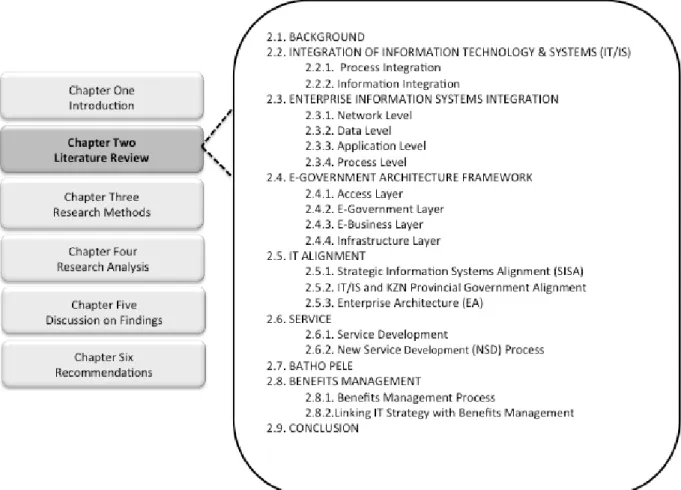
2.1. BackgroundThis chapter is the result of desktop-based literature review on the investigation of IS integration in achieving Batho Pele principles. Figure 2, presents the outline of the literature review and where the chapter is on the overall research.
Figure 2 : Literature Review Outline
The establishment of local spheres of government has resulted in a number of interventions developed to strengthen KZN Local government ability to deliver service. These interventions include business process improvement initiatives through Batho Pele, Local Government Support Programmes, training and development on various municipal and local government management information systems. According to the Constitution of the Republic of South Africa No.108 (1997), these support measures were designed for government to fulfill their municipal and local government operational objectives.
8 Chapter 3 of the Constitution (1997) determines that three spheres (national, provincial and local) of government are distinctive, inter-dependent and interrelated, and are bound by the principles of co-operative government and intergovernmental relations. Further to these general principles, the Constitution defines the following key duties for provincial departments (KZN CoGTA) responsible for local government and municipalities: Support, Intervention, and Monitoring (Constitution of the Republic of South Africa No. 108 of 1996).
One of the mandates aimed specifically at the KZN CoGTA, is the Local Government Turn Around Strategy (Local Government Turnaround Strategy, 2011). This strategy was developed to accelerate operational efficiencies in provincial government, and was submitted to the Executive Committee of the Cabinet on 02 December 2009, with the below-mentioned strategic objectives:
• Local government is equipped with public services supply to meet the demand for service delivery responsive to communities.
• Local government that is accountable, effective, clean and transparent.
• Develop professionalism in all spheres of government.
• Develop national policy, monitor and support.
• Fortify partnerships between communities, civil society and local government.
The LGTAS (Local Government Turn Around Strategy) places interest in multiple approach interventions, focusing on annual department and municipal performance assessments, financial viability and the accountability of municipalities (Local Government Turnaround Strategy, 2011). Key interventions, with emphasis on mobilizing society and government, have been set up to move the objectives forward.
The above-mentioned turn-around strategic objectives of KZN Provincial government require a holistic approach that will accelerate the level of services internally and externally. The aim of the study is to examine the importance of an integrated systems approach in information management at the KZN Provincial government.
The study will investigate how the integration of IT/IS for the KZN Provincial government can enhance the extraction of information and data from KZN
9 departments and the conversion of that data into executive management information for local government.
The research will look into details of the following theoretical frameworks for the effective implementation of integrated IT/IS for KZN Provincial government to improve service delivery: -
• Enterprise Information Integration Framework;
• E-government integration framework;
• New Service Development process and
• Benefits Management.
The status quo suggests that provincial government is underutilising IT/IS service and infrastructure at their disposal. Methodologies and strategic tools have been developed to ensure successful organisational development and the re-engineering of process to ensure that the gap between KZN Provincial government organisational demand and IT/IS supply is closed. This can be achieved through the strategic alignment of KZN Provincial government strategic objectives with IT/IS objectives for the department. According to Porter (1998), strategy can be seen as the alignment of activities and resources of a business to the environment in which it operates. The following section looks at the integration of IS and business process to achieve acceptable level of service delivery.
2.2. Integration of Information Technology (IT) and Information Systems (IS)
To obtain operational effectiveness and efficiencies, to lower costs, to accelerate service delivery and improve citizen relations, all departments of the KZN Provincial government must work together towards a harmonious, congruent goal. Inter- government communication and information systems are the LGTAS components identified towards mobilizing government and society to improve the provincial government systems (Local Government Turnaround Strategy, 2011).
10 Integration allows the unlocking of information to make it available to any user, anywhere, and anytime. Various enterprise process improvement initiatives stress better integration, yet process integration can relate to several things.
Notwithstanding decades of research relating to integration, Barki and Pansonneault (2005) established that the concept of organisational integration was still under- theorised. They describe the view of organisational integration as “the extent to which isolated and inter-dependent activities establish a unified whole”, where activities represent independent functional components in an organisational process chain.
Technical and organisational performances of various KZN Provincial government administrative components need to be interrelated. This involves both cooperation and interoperability. With cooperation indicating to common cross-enteprise strategy and interoperability indicating technical means which enable IT systems to exchange messages. Klischewski (2004) states that given these two enablers; integration is the result of both cooperation and interoperability. Within the context of this study integration represents the state of readiness to provide services which are possible through connecting interrelated components which were isolated before.
Integration involves a great degree of responsiveness between interrelated functional components, suggesting fast access to and interpretation of messages for components that are observed to be highly integrated, Barki and Pansonneault (2005). Berente et al. (2009) indicated that integration between functional enterprise components require different levels (network, data, application and process) of implementation effort as highlighted in Section 2.3 of the Enterprise Information Integration framework, depending on the nature of business process that integration supports. For the purpose of this study, the researcher has emphasised process and information integration. In practice these two integration approaches overlay and complement of each other.
2.2.1. Process Integration
Process integration is defined as the integration of business and information flows (Themistocleous, Irani, & O'Keefe, 2001). Process integration aims at interconnected phases and steps of process performance across enterprise and/or technical parameters. On enterprise level, process integration is described as an
11 organisational form that combines the interdependence of tasks, people, business units and functions needed to deliver “product or service” to citizen or customer (Earl, 1994).
Process integration encompasses the minimisation of communication and coordination effort between activities of process (Berente, Vandenbossch, & Aubert, 2009). A key indicator of the level of integration is related to the time associated with the flow of information between distributed activities. The researcher has derived four principles of process integration (see Table 1) from the literature on information integration and organisational integration namely: (1) timeliness; (2) accessibility; (3) transparency; and (4) granularity (Berente, Vandenbossch, & Aubert, 2009).
Principle Definition
Accessibility This principle addresses the syntactic aspect of process flow and the ability to access information from each required point in a process.
Timeliness This principle refers to the frequency of the information passed from one activity to another (Wakayama, Kannapan, Khoong, Navathe, & Yates, 1998).
Transparency This principle refers to ease of information flow from one activity in a process to another (Barki & Pinsonneault, 2005).
Granularity The provision of information exchange in the process at the right level of detail (Volkoff, Strong, & Elmes, 2005).
Table 1 : Process Integration Principles (Berente, Vandenbossch, & Aubert, 2009) 2.2.2. Information Integration
The purpose of the study is to investigate information systems (IS) integration in achieving Batho Pele Principles. In this research information systems integration is described as the way in which the KZN Provincial government applications and data are shared through different communication network for organisational use (Bhatt,
12 2000). In this study the fundamental purpose of IS integration is to provide reliable information support throughout the KZN Provincial government to respond to vigorous challenges in government. Information Systems integration focuses on enabling information flow by offering access to structured informational means across enterprise and technical parameters (Klischewski, 2004). Currently, integration is contemplated to be a driving force of IT expenditure, the purpose of information integration has become complex owing to heterogeneity of appropriate data and also the need for information processing speed.
In studying the role of IS integration, researchers have only examined two aspect of IS integration namely: data integration and communication networks integration (Madnick, 1995). Table 2 briefly describes the two basic aspects of IS integration.
IS Integration type Characteristics
Data integration One of the significant characteristics of IS integration is the way in which various enterprises can share a variety of databases for coordinating their activities.
Communication networks
integration
The way in which various information systems communicate with other using enterprise-wide IS to coordinate present and future activities dependent on network scalability and connectivity
Table 2 : IS Integration types (Madnick, 1995)
2.3. Enterprise Information Systems Integration Framework
Since the mid-1980, the subject of information systems (IS) integration and its role in business process improvement has been of considerable interest to business managers and researchers (Bhatt, 2000). This research examines the role of information systems integration in achieving Batho Pele principles. Both private and public sector organisations are experiencing difficulty in dealing with heterogeneous information systems that utilise various data representation syntax (format) and apply different meanings (semantics) to data (Giachetti, 2004). The KZN Provincial
13 Government faces the challenging task of integrating their disparate information systems, business processes and inter-departmental units for enhancing operation and attainment of Batho Pele.
Lim et al. (1997) defined integration as, ‘integration of several business processes to make the running of these processes as if there is only one business process.
Despite decade of research associated with the idea of integration, Barki and Pinsonneault (2005) found that the concept of organisational integration was still ill- defined and under-theorised. They define the notion of organisational integration as
“the extent to which distinct and interdependent organisational component constitute a unified whole”, where the components represent functional units along an organisational process chain.
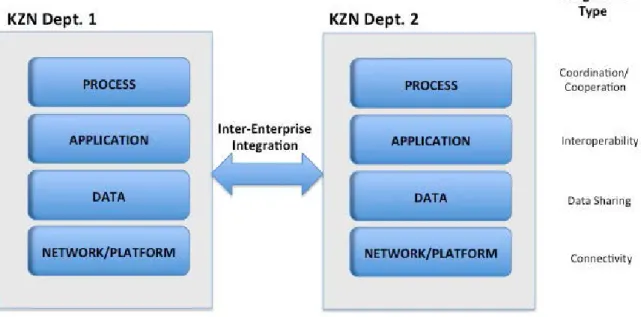
Information systems literature illustrates how information technology can support integration across inter-departmental units or the whole organisation through process integration, data integration, application integration and systems integration (Davenport, Harris, & Cantrell, 2004). The objective of the enterprise information integration framework is to decompose the organisation to reveal and define integration types (Giachetti, 2004). The four levels of enterprise integration framework are platform/network, data, application and process level. Figure 3 highlights the enterprise integration framework.
Figure 3 : Enterprise Information Integration Framework (Giachetti, 2004)
14 There are two types of integration approaches namely: (1) Information integration which aims at facilitating information flow; while (2) process integration looks at interdepended steps and stages of process performance across the enterprise, Klischewski (2004).
2.3.1. Network Level
The entry-level for enterprise integration framework is the network/platform level.
According to Bhatt (2000) the foremost advantage of network integration lies in its capability to coordinate. Flexible networks permit an enterprise to coordinate previously isolated activities. The integration issue at this level is physical heterogeneity of devices, hardware and their operating systems in a physical network. The objective of the network/ platform level is connectivity, which simple ensures that information and messages can be sent from one system to the other. At this level, connectivity refers to linkage between application, modules and systems.
Network connectivity for the KZN Provincial government has been achieved through standard protocols such as TCP/IP and other networking technologies.
2.3.2. Data Level
At the data level, information systems design principles require the isolation of data from algorithms and business logic. Data level integration focuses on the data sharing between multiple enterprises, applications and resources. This level specifies the details the enterprise system uses to complete its business functions.
The integration objective of this level is the sharing of data where two or more organisational units exchange information with each other. According to Batini et al.
(1986), the approaches illustrated on this level are for data schema integration described as “the activity of integrating the schema of proposed or current database into global unified schema”.
Gooodhue (1992) found that the value of data integration is not always positive; a shared data model is most appropriate when the organisation system being modelled is stable. This has generated interest for researchers to find more flexible methods for data integration, which combines concepts from message-based integration with data schema integration. Extensible Markup Language (XML) is developing as a data exchange standard between organisations by identifying the content of data for electronic documents (Cert, Fratenale, & Paraboschi, 2000). By developing the standardisation of data codes and definition, the KZN Provincial
15 government will progress to the level of integrated systems development. The standardisation of data codes and definition supports in fulfilling the requirements of future information needs, (Bhatt, 2000).
2.3.3. Application Level
Applications are programs or information systems designed to provide a service (Giachetti, 2004). Every programming language or application utilises local defined messages and data formats which result in heterogeneity. The objective of integration in this level is interoperability which overcomes the problem of heterogeneity. Interoperability is an essential requirement to support the development of distributed systems and component-based applications. Middleware is an application that provides an interface that hides the complexity of networking, application interoperability and distributed computing from users, (Schantz &
Schimdt, 2001).
Interoperability of applications are realised through the application programme interface (API), which describes a service an application provides and how those services are accessed. The Interface Definition Language (IDL) describes the public interface to an object which services two objectives: (1) it notifies the client of the services offered as well how to invoke the services; (2) it notifies communication infrastructure of the format and syntax of the access method. IDL can possibly wrap any application, even legacy applications which are difficult to integrate into the enterprise (Bullinger, Faehrich, & Linsamaier, 1998). Currently, the KZN Provincial Government has standardized on using BAS (Basis Accounting Systems) as financial management and PERSAL (Personal Salary Systems) systems across all KZN departments, which currently lacks integration with other programs or applications.
2.3.4. Process Level
Process integration essentially needs information integration as a platform, and therefore requires the appropriate transfer of usable information (Berente, Vandenbossch, & Aubert, 2009). Process integration aims at coordinating process performance stages and interrelated steps across organisational and technical borders in order to support new services based on control of process flow and overarching monitoring (Klischewski, 2004). The overall objective of process level integration is to coordinate the dependencies that arise between resources, objects
16 and process activities in order to achieve an efficient and effective process.
Coordination involves managing the dependencies and the control structure of the process. Progressively, researchers now acknowledge the need to consider the function of coordination more closely in enterprise integration (EI).
Workflow management systems are process level information systems devised to systematise business process by controlling and coordinating information between participants and the flow of work (Storh & Zhoa, 2001). Berente et al. (2009) state that Enterprise Resource Planning (ERP) is another process level system designed to coordinate all the information, resources and tasks required to complete business process. Enterprises that have effectively implemented ERP have reported benefits of better customer satisfaction, (Themistocleous, Irani, & O'Keefe, 2001).
2.4. E-Government Architecture Framework
Integration is a critical success factor for realising an established level of e- government (Golden, Hughes, & Scott, 2003). In recent years, ambitious e- government programs have been launched in different countries. President George W Bush of the US signed an e-government Act in law, indicating a major phase towards revolutionising public sector IT in the US (CIO, 2004). Eventually, e- government seeks to integrate and make a unified set of government services available to end-users. This research seeks to investigate the role of integrated information systems in achieving Batho Pele principles.
E-Government has numerous drivers which include better efficiency, government improvement, citizen empowerment, increased access to public sector services, reduced corruption, greater transparency and improved levels of service (Schware &
Theil, 2003). A survey by James (2000) reported that 60 per cent of respondents believed that government organisations would be more effective if citizens could use the internet to register their cars, pay parking tickets, fill out forms and apply for permits. About 50% thought it would be a good idea to allow citizens to vote online and have government auctions on the Internet. Through an integrated web-portal, it will be possible for citizens and businesses to complete a transaction with
17 government agencies without having to visit several separate ministries/departments in separate physical locations.
In addition, e-government strategy is allowing government agencies to interact directly and work better with citizens and businesses, regardless of their localities within the physical world. This comprises digitising supply chain services from and to businesses in order to enhance the quality of service, accessibility, and cost effectiveness (Heeks, 2001). In this section, the researcher decided to analyse application and information management infrastructure through discussing the framework of e-government architecture. The importance of the framework layers and technologies of e-government architecture is discussed below.
A government department planning to implement an e-government program and formulate its IT strategies must assess its business models and choose suitable technology solutions that deliver on central government policy (Lam, 2005). The e- government architecture defines the standards, infrastructure components, applications, technologies, business models and guidelines for electronic commerce among and between organisations that facilitates the interaction of the government and promote group productivity (Ebrahim & Irani, 2005).
18
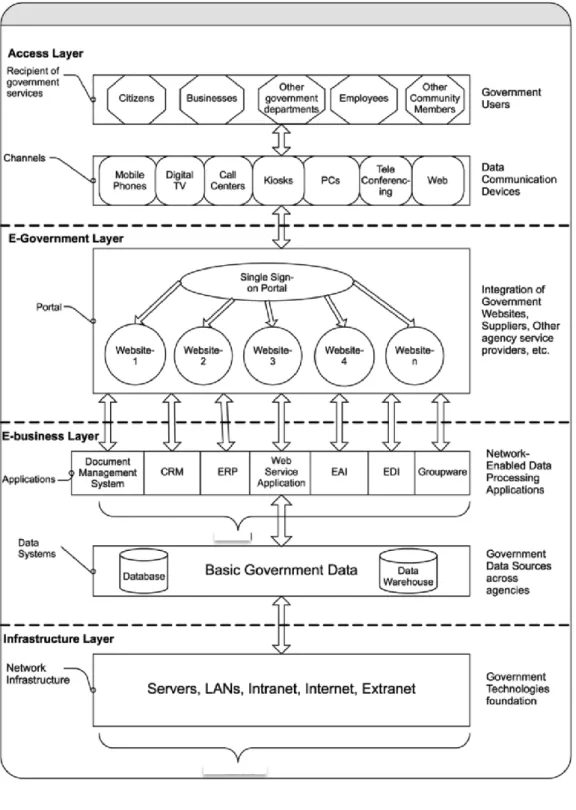
Figure 4 : Framework of E-Government Architecture (Ebrahim & Irani, 2005)
Although there are major differences in the structure of government agencies, public sector institutions need to adopt common systems infrastructure to support integration of their systems in a way that enables them to build a platform for sharing their knowledge resources. For example, an e-government portal requires a common and integrated architecture framework that allows different local
19 government departments, provinces, and municipalities to share and exchange data, independent of formats, devices and underlying architecture (Sharma & Gupta, 2002). Since e-government goes beyond the IT infrastructure, the contribution of this study is to provide an integrated architecture framework for e-government that signify the alignment of IT infrastructure with business process management in the KZN Provincial public service.
The e-government architecture framework depicted in Figure 4 is organised into four layers linked through two-direction arrows which present the hierarchical level of e- government implementation and portray the logical connection of each relevant layer that allow two-way transmission of data and services. Figure 4 presents the e- government architecture which is divided into four (4) layers namely: access, government, business, and infrastructure layers.
2.4.1. Access Layer
The access layer involves the channel that KZNPG users can use to access various public sector services. Access channels are important components in e-government as they consist of online and offline channels. Government users are managing and controlling this layer. However, it is important that KZN Provincial government provides a common way of finding all government information and services, maintain channel coordination, create a common look and feel across different channels, and comply with the guidelines of technical standards (Cabinet Office, 2000).
2.4.2. E-Government Layer
The e-government layer focuses on the integration of digital data for various organisations into a government services web-portal. This may result in better access to government resources, decreases transactional and service-processing costs, and supports organisations to provide high quality services (Ho, 2002).
According to Chan and Chung (2002), this layer enables the user to use the web browser to get all KZNPG information needed through a single window. One of the specific priorities for the intervention framework mentioned in the Local Government Turn Around Strategy (CoGTA, 2009) was the establishment of single window of coordination for local government. Citizens can search on-line for information they request to see, as opposed to the information government want to present to them.
This layer relates to access and information, which are the principles of Batho Pele
20 mentioned in Section 2.7. This layer allows citizens’ access to materials in the order that they desire (West, 2004).
2.4.3. E-Business Layer
The e-business layer is focused on implementing ICT tools and applications to strengthen the sharing of knowledge, processing of information and network of trust that exist within and between enterprises (Moodley, 2003). The e-business layer provides a solid basis for the development of a single e-government portal and also enables the relationship and interaction between government-to-government and government to-enterprise. This layer delivers unified and real-time communication between their systems at both a process and data level. Integrating disparate IT components and applications inside and outside the enterprise parameters remain time consuming and costly, due to the heterogeneous state of KZN Provincial government ICT environment (Themistocleous, Irani, & O'Keefe, 2001).
Legacy systems and other applications across the government ICT environment need to be upgraded to a web-enabled level to improve their process functionalities beyond organisational parameters and to attain complete communication between all information systems and processes. Web services are standards-based and suited to build common infrastructure to reduce the barriers of enterprise integrations, hence, enable e-government systems to collaborate with each other regardless of underlying infrastructure (Haung & Chung, 2003).
2.4.4. Infrastructure Layer
Forming an information society by utilising applications and tools for e-business layer is an efficient manner requiring a technology infrastructure that spreads out to all segments of government organisation. Table 3 presents infrastructure layer components which offer essential technologies, such as a LAN that support integration with current hardware resources and mobile devices which support current ICT provision.
21 Table 3 : Infrastructure Layer Components
2.5. IT Alignment
The previous section presented an overview of information systems and e- government integration frameworks, which can be impossible to achieve without the alignment of information systems and overall KZN Provincial government strategy.
According to Ahmed et al. (2010), a fundamental benefit of strategic alignment is a perception of higher business value of IT/IS. This section presented theoretical views on strategic IS alignment for KZNPG to achieve integration of business process and information systems for KZN.
Technology Description Characteristics
LAN ICT network focused in a
specific geographic area, like, regional government offices
• Interconnect with
different devices.
• Enable sharing of citizen file.
• Enable Data or
information exchange among devices (Kurose &
Ross, 2003).
Server High end and resourceful
computer that runs and host government programs and applications
• High speed data access of government information.
• Communication
processing across government network (Stallings, 2000).
Internet Direct connectivity over LAN
or ISP provided through collection of global and public communication network.
• Enable government
information access to citizen, which is on of the principles of Batho Pele.
• Delivers low cost
communication (Singh, 2002).
Intranet An IP (Internet Protocol)
technology that allows sharing of computer services on internal website within an organisation
• Improve communication and connectivity with an enterprise (Chan &
Chung, 2002).
Extranet Dynamic WAN(wide area
network) that connects enterprise supplier, employees, citizen and other
stakeholders
• Support Government-to- Government.
• Support SCM (Supply
Chain Management) with business (Singh, 2002).
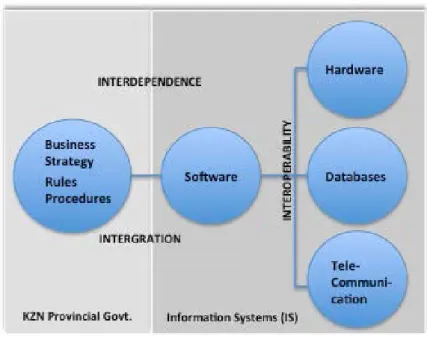
22 Laudon and Laudon (2006) developed an IT alignment model that seeks to establish components required for successful business alignment. Figure 5 depicts the model, which clearly outlines the interdependence of business strategy to IT components, and interoperability of ICT (Software, Database and telecommunication).
Figure 5: IT Alignment Components (Laudon & Laudon, 2006)
Changes in KZN Provincial government strategy, processes, and rules increasingly need changes in hardware, software, databases, and telecommunications (see Figure 5
).
The relationship between IS and the enterprise results from the developing reach and scope of system projects and applications (Ahmed, Aloufi, Issa-Salwe, & Kabir, 2010). The KZN Provincial government needs to understand what evaluation tools methods are available for alignment to be feasible. IS strategy can be described as a strategy to deploy information systems that acknowledges enterprise requirements, in other words ‘demand’ for the information and systems to support the overall business strategy and its plan to gain or maintain the advantage (Bhatnagar, 2007).2.5.1. Strategic Information Systems Alignment
In order for KZN Provincial government to utilise integrated information systems, it is vital to have strategy that describes the systems and offer a means to support them.
Strategic Information Systems Alignment (SISA) is an operational way of developing and maintaining information systems integration that support the business operations
23 for the KZN Provincial government (Ahmed, Aloufi, Issa-Salwe, & Kabir, 2010). The objective of Strategic Information Systems Alignment (SISA) is to help deploy IS solutions to integrate with KZN Provincial government’s overall strategy. SISA helps in the transformation of information into functional form for coordinating the workflow within organisation, and assists in decision-making process (Laudon & Laudon, 2006).
Before setting an IS integration framework, KZN Provincial government should formulate an information systems planning framework that induces all important components required to draw up an IT strategy that would be coherent with the overall provincial government strategy.
2.5.2. IT/IS and KZN Provincial Government Alignment
The strategic alignment model (SAM) proposed by Henderson and Venkatraman (1993) is one of the most cited strategic alignment models (Chan & Reich, 2007).
SAM consists of two main constructs: strategic fit and functional integration. For the purpose of our study, functional integration is referred to, as IS Integration.
. Figure 6 : Strategic Alignment (Henderson & Venkatraman, 1993), (Ahmed, Aloufi, Issa-Salwe, &
Kabir, 2010)
Strategic fit denotes to the relationship between internal and external domains (see figure 6). Functional integration refers to two type of integration between business
24 and IT domains, previously discussed in Section 2.3 and 2.4 respectively.
Henderson and Venkatraman (1993) established a strategic alignment model depicted in Figure 6 covering the four domain linkages in local government namely:
the business strategy, information strategy, business process and information technology process. Two major perspectives were identified in aligning the four domains.
The first perspective relates to BP (Business Process) as referred to as KZN Provincial Government Process or ITS (IT Strategy), which is the enabling factor of business strategy influencing the IT/IS infrastructure and processes. The second perspective, IT/IS Infrastructure and Process (IT Process) or BS (Business Strategy) also referred to as KZN Provincial government strategy is the driving force of IT strategy affecting KZN Provincial Government Process (business process).
2.5.3. Enterprise Architecture (EA)
Establishing a single point of entry for the support, monitoring and intervention in the KZN Provincial government requires strategic alignment of IS and business process.
Government agencies are progressively implementing enterprise architecture (EA) to align business process with information systems (IS) and objectives of the organisation (Harmon, 2003). Architecture is an instrument to direct information systems (IS) integration developments and make sure that the individual efforts are coordinated (Aagesen, Janssen, Krogstie, & Van Veenstra, 2012). Traditionally, the objective of enterprise architecture is to operationally align enterprise strategies with their business processes and the coordination of their resources (Ebrahim & Irani, 2005).
For the purpose of the study, focus will be on one of the EA models famous for successful implementation of IS Integration. Service oriented architecture (SOA) is an organisational-driven topology method that enables a business as connected, recurring activities or services (Baltzan & Phillips, 2010). SOA benefits organizations and departments modernise their information systems environment by guaranteeing that IT systems are adaptive, easy, cheaper and economically viable to support ever increasing departmental needs. SOA assists organisations, enhancing the scalability of their business processes, strengthening of fundamental information technology
25 architecture and information technology reclamation by integrating dissimilar systems and data sources.
KZN Provincial government should quickly respond to departmental changes with agility, leverage existing investments in applications and applications infrastructure to address newer departmental requirements; and support new channels of interactions with customers or citizens, partners and other government organs. The crucial technical concepts of SOA are (Dialogic, 2010):
• Services – organisation activities, including processes.
• Interoperability – the capacity for different computers, using different operating systems and on different platforms, to work together, exchanging information in standard ways without any changes in functionality and without physical intervention (McNurlin & Sprague, 2003).
• Loose coupling or Cloud Computing – the ability of an on-demand integration of services to form compound service, or disengagement of functionality.
2.6. Services
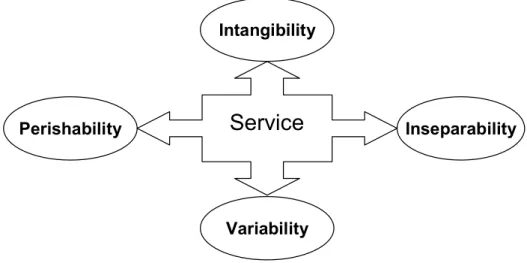
This section presents an overview of the service since the study examines the impact of IS integration in improving service delivery. In terms of the new developmental mandate, provincial departments and municipalities are firmly embedded in local communities and committed to working with citizens to find new sustainable ways to meet their social, economic and material needs while improving their lives through efficient service delivery mechanisms (Raga & Taylor, 2006).
Batho Pele is regarded as a service delivery improvement process that all South African government agencies subscribe to. National government is encouraging provincial departments to find innovative ways of delivering service to their constituencies effectively (Local Government Turnaround Strategy, 2011). The study investigates the impact of integrated IT/IS for KZN CoGTA in delivering quality services to stakeholders.