INTEGRATIVE POLICY INSTRUMENTS FOR
IMPLEMENTING THE NATIONAL WATER ACT: A CASE STUDY OF THE MGENI CATCHMENT
NP Vilakazi
FINAL DISSERTATION
Submitted in partial fulfilment of the requirements for the degree of MSc in Environmental Hydrology
School of Environmental Hydrology University of KwaZulu-Natal
Pietermaritzburg December 2013
i
PREFACE
I, Ntombifuthi Pretty Vilakazi, declare that
(i) The research reported in this dissertation, except where otherwise indicated, is my original work.
(ii) This dissertation has not been submitted for any degree or examination at any other university.
(iii) This dissertation does not contain other person‟s data, pictures, graphs or other information, unless specifically acknowledged as being sourced from other persons.
(iv) This dissertation does not contain other persons writing, unless specifically acknowledged as being sourced from other researchers. Where other written sources have been quoted, then:
(a) their words have been re-written, but the general information attributed to them has been referenced;
(b) where their exact words have been used, their writing has been placed inside quotation marks, and referenced.
(v) Where I have reproduced a publication of which I am an author, co-author or editor, I have indicated, in detail, which part of the publication was actually written by myself alone and have fully referenced such publications.
(vi) This dissertation does not contain text, graphics or tables copied and pasted from the Internet, unless specifically acknowledged, and the source being detailed in the thesis and in the References sections.
Signed:
Supervisor:
Co-supervisor:
ii
ACKNOWLEDGEMENTS
I wish to thank:
My Supervisor, Mrs Sabine Stuart-Hill, for her insightful comments, encouragement, motivation and advice. I would like to thank her for believing in me, for all the support she provided during the entire research process and for giving me my first time overseas experience.
My Co-Supervisor Professor GWP Jewitt for his support, encouragement throughout the research project and for his insightful comments.
Professor RE Schulze for his assistance and for being the source of inspiration.
Water Research Commission for financial support and for granting me the opportunity to equip myself with research skills.
The School of Agriculture, Earth and Environmental Science, particularly the discipline of Hydrology, for providing all the required resources and support throughout the entire research process.
All the key-informant and household participants who voluntarily participated in my study, giving of their own time without expecting something in return.
My family and friends who always provided support and encouragement throughout this entire process.
My daughter Nkanyezi, who has been my main source of inspiration.
Most of all, my heavenly Father, the God Almighty Jehovah, for being the source of strength that I needed from the beginning till the end of this long journey.
iii
ABSTRACT
South Africa experienced a paradigm shift with the introduction of the National Water Act in 1998 (NWA). Previously, water resource management was based on a centralized approach. Today, it is framed by the Integrated Water Resources Management approach and rests on the three important principles of equity, sustainability and efficiency. The implementation of these principles is characterized by decentralized decision-making within a framework that brings together all water stakeholders in a new form of communication, particularly those of marginalized groups.
However, no matter how clear and ambitious the objectives of the NWA are, the problem of effective implementation remains significant. A mix of centralized and decentralized management instruments, aiming at integrated and adaptive management, has created considerable complexity. This then calls for integrative instruments to allow for greater coordination and enhanced stakeholder participation, in order to produce an integrated management outcome.
Although a set of instruments is available under the South African (SA) NWA, these do not seem to be sufficient. Perspectives emerging from a study undertaken in the Mgeni Catchment, using key-informant interviews and household surveys, suggest that this is based on a lack of institutional and management capacity, missing Catchment Management Agencies, limited monitoring and evaluation and lack of integration between the water stakeholders and other sectors that impact on the water resources. Further, it seems that specific elements are creating bottlenecks as well as a loss of responsibility in a decentralized system e.g. the National Water Resource Strategy. This study adopts a social perspective on water resource management and examines the suggestions proposed by water stakeholders in the Mgeni Catchment in relation to major constraints to the implementation process.
iv
TABLE OF CONTENTS
Page
1. INTRODUCTION ... 1
2. LITERATURE REVIEW: WATER GOVERNANCE ... 5
2.1 Water Governance ... 7
2.1.1 Why water governance matters ... 10
2.1.2 Coordination in water governance ... 12
2.1.3 Water governance capacity ... 13
2.1.4 Water Policy in South Africa ... 14
2.1.5 Integrated Water Resource Management ... 15
2.1.6 Linking the WSA and the NWA through the Sanitation Business Cycle ... 17
2.2 Implementation of Water Policies ... 18
2.2.1 National Water Resource Strategy ... 21
2.2.2 Catchment Management Strategy ... 22
2.3 Current Situation of NWA Implementation in SA ... 22
2.3.1 Progress to date on sector reforms ... 23
2.4 Facilitating a Way Forward: Considering a Mix of Instruments for the Implementation of the NWA ... 24
2.5 Discussion and Conclusion ... 26
3. BACKGROUND TO THE STUDY AREA AND METHODOLOGY ... 28
3.1 Case Study Used for Investigation: the Mgeni Catchment... 29
3.2 Research Methodology ... 31
3.2.1 Formulation Stage ... 32
Step 1: Aims of the mixed research study ... 32
Step 2: Objectives of the mixed research study ... 32
Step 3: Rationale for mixing methods ... 32
Step 4: Purpose for mixing ... 33
Step 5: Research hypothesis (research questions) ... 33
Research questions ... 34
Participants and setting ... 36
3.2.2 Planning stage ... 37
Step 6: Mixed research sampling scheme ... 37
v
Step 7: Mixed research design ... 38
Sampling strategy ... 38
Selection of key-informant participants ... 39
Selection of study areas/communities ... 40
Selection of individual households ... 41
3.2.3 Implementation Stage ... 42
Step 8: Collecting the data (data sources) ... 42
Collecting the data: instruments ... 42
Pilot Test ... 43
Collecting the data: procedures ... 44
Step 9: Data analysis (sequentially mixed analysis) ... 44
Descriptive analysis ... 45
Exploratory analysis ... 45
Exploratory analysis: quantification of qualitative data ... 46
Exploratory analysis: correlation analysis ... 46
Step 10: Validating/Legitimating the findings ... 46
Step 12 and 13: Writing the mixed research report/ reformulating the mixed research question ... 47
3.3 Integrative Research Question for Integration of the Undertaken Data Analysis on Two Different Groups ... 47
3.3.1 Ethical Treatment of Respondents ... 48
3.4 Workshop ... 49
3.5 Limitations and Challenges of the study ... 49
3.6 Conclusion ... 50
4. RESULTS AND DISCUSSION ... 51
4.1 Integrative Instruments for Policy Implementation of the NWA ... 52
4.2 Participant‟s Rating of the Identified Policy Instruments ... 53
4.3 The Sharing of Integrative Policy Instruments ... 53
4.4 Major Constraints Associated with the Lack of Implementation of the NWA 55 4.4.1 Relationship between the major constraints associated with the lack of implementation of the NWA (RQ5) ... 56
4.4.2 Suggestions in overcoming the identified major constraints ... 58
vi
4.5 Indicators of Limited Monitoring and Evaluation of Implementation of the
NWA ... 63
4.6 Discussion of Key Findings ... 64
4.6.1 Identified integrative policy instruments ... 64
4.6.2 Perceived major constraints of the implementation of the NWA ... 65
4.6.3 Relationship between the perceived major constraints ... 69
4.6.4 Participants‟ suggestions in relation to major constraints ... 69
4.6.5 The level of sharing of integrative policy instruments among the water management approaches ... 70
4.7 Demographic Profile of Respondents ... 72
4.8 Educational Level ... 73
4.9 Employment Status ... 73
4.10 Socio-Economic Characteristics ... 74
4.11 Water Supply Equity between High- and Low-Income Households/ Communities in the Mgeni Catchment ... 75
4.12 Household Level of Satisfaction with Water Supply Received ... 76
4.13 Barriers to Improved Water Supply in Low-Income Communities ... 77
4.14 Households/Community Participation on Water Management ... 79
4.15 Links between Water Resources Management (NWA) and Water Supply Services (WSA) in the Mgeni Catchment ... 79
4.16 Discussion of Household Key Findings ... 81
4.16.1 Household level of satisfaction with water service received ... 81
4.16.2 Barriers to improved water supply in the Mgeni Catchment ... 82
4.16.3 Household/community contribution to water management ... 82
4.16.4 Social equity: comparing water service provision between high- and low-income households/communities ... 83
4.16.5 Perceived links between water resource management and water services in the Mgeni Catchment ... 84
5. RECOMMENDATIONS AND CONCLUSIONS ... 86
5.1 Summary of Key Findings ... 86
5.2 Recommendations ... 88
5.2.1 Local stakeholder participation and involvement ... 88
vii
5.2.2 Communication and dissemination of information to the local
level ... 88
5.2.3 Integrative management of water resources and water services... 89
5.3 Conclusion ... 89
6. REFERENCES ... 92
viii
LIST OF TABLES
Table 2.1 Instruments for Policy Implementation (Source: Plummer and Slaymaker, 2007)
... 20
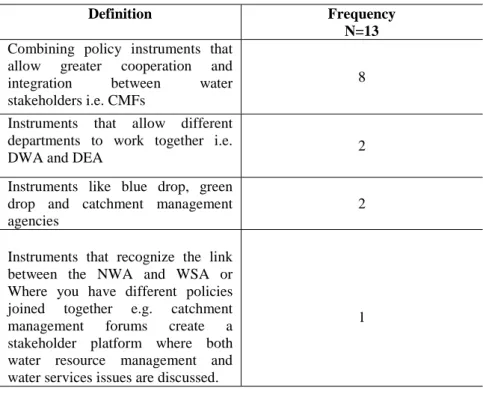
Table 4.1 Key-informant understanding of integrative policy instruments... 52
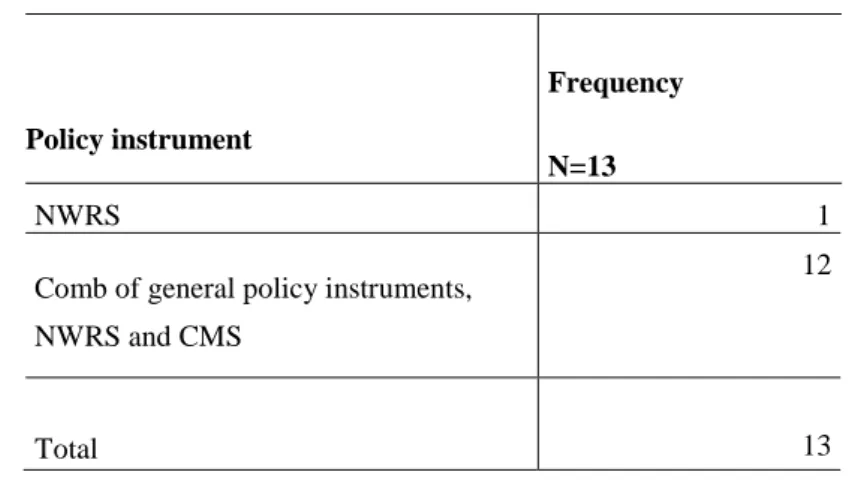
Table 4.2 Identified instruments for implementation of the NWA ... 53
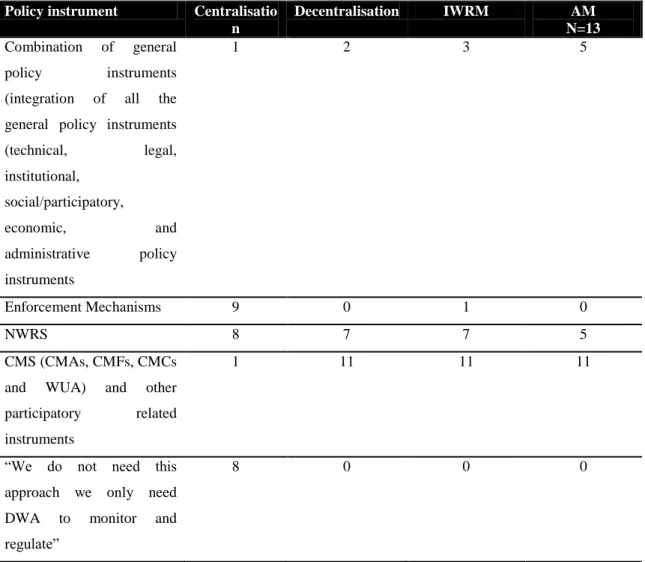
Table 4.3 Policy Instruments for Implementation of Various Water Management Approaches ... 54
Table 4.4 Major Constraints to Effective Implementation of the NWA ... 56
Table 4.5 Suggestions in Relation to Major Constraints N=13 ... 61
Table 4.6 Level of education of respondents (in %) (n=40) ... 73
Table 4.7 Employment status of respondents (in %) (n=40) ... 74
Table 4.8 Perceived barriers to improved water supply in low-income communities ... 78
Table 4.9 Perceived Future Water Management Problems in the Mgeni Catchment ... 80
ix
LIST OF FIGURES
Figure 2.1 Dimensions of effective water governance (Source: UNDP, 2013) ... 10
Figure 2.2 Appreciating links between the National Water Act and the Water Services Act through the Sanitation Business Cycle (DWA, 2005) ... 17
Figure 2.3 Phases of the Governance Cycle (Source: Abrams, 2000 ... 19
Figure 2.4 Incomplete water resource institutional reform (Source: DWA, 2011) ... 24
Figure 3.1 The Mgeni Catchment ... 30
Figure 4.1 Dendogram demonstrating both correlation and the distance of the relationship between the perceived major constraints to the implementation of the NWA ... 57
Figure 4.2 Stakeholders‟ level of agreement with the non-existence of effective monitoring and evaluation of the implementation of the NWA ... 63
Figure 4.3 Monthly income of the respondents (in %) (n=40) ... 75
Figure 4.4 Household's main source of income (in %) (n=40)... 76
x
LIST OF ABREVEATIONS
EEA: European Environmental Agency
AM: Adaptive Management
APSC: Australian Public Service Commission CASA Clean Air Strategy Alliance
CMA: Catchment Management Agencies
CMF: Catchment Management Forums
CMS: Catchment Management Strategy
DBN: Durban
DWA: Department of Water Affairs
DWAF: Department of Water Affairs and Forestry
GDP: Gross Domestic Product
GWP: Global Water Partnership
IWRM: Integrated Water Resource Management
IUCN: International Union for Conservation of Nature and Natural Resources
JCWRE: Journal of Contemporary Water Research and Education
KZN: KwaZulu-Natal
MCMF: Mgeni Catchment Management Forum
MCMP: Mgeni Catchment Management Plan
MDGs: Millennium Development Goals
NWA: National Water Act
NWRS: National Water Resource Strategy
OECD: Organisation for Economic Cooperation Development
PMB: Pietermaritzburg
WMA: Water Management Areas
WSA: Water Services Act
UNDP: United Nations Development Program
RQ: Research questions
UN: United Nations
RSA: Republic of South Africa
SA: South Africa
xi
SPSS: Statistical Packages for Social Sciences UNICEF: United Nations Children‟s Fund
WHO: World Health Organisation
WWD: World Water Day
1
1. INTRODUCTION
The National Water Act No. 36 of 1998 (NWA) is regarded as one of the most advanced pieces of water legislation in the world (Naster and Hansen, 2009; Tewari, 2009). This Act is framed through Integrated Water Resource Management (IWRM) and hence, rests on the three fundamental principles of equity, sustainability and efficiency in the management and distribution of water resources (Naster and Hansen, 2009; Stuart-Hill and Schulze, 2010; Movik and de Jong, 2011). The integrated approach to water resource management is characterised by decentralised decision-making within a framework, which brings together all water stakeholders in a transparent form of communication, particularly those from marginalised groups (Stuart-Hill and Schulze, 2010; du Toit et al., 2011). However, the ambitious objectives of the NWA remain significantly problematic with regard to effective implementation. A prevailing problem of policy implementation is linked to the water sector‟s inadequate institutional capacity (Plummer and Slaymaker, 2007; Naster and Hansen, 2009; IUCN, 2009; Stuart-Hill and Schulze, 2010; Woodwill, 2010; Meissner et al., 2013; Schreiner, 2013). The transfer of technical knowledge and skills is not sufficient for the complex situation of the South African (SA) water sector in terms of the required establishment of the sector reforms (Woodwill, 2010). Furthermore, there is a need for enhanced communication, collaboration, trust building, networking and a clear understanding of the disorganised social situations, political advocacy and leadership (IUCN, 2009; Woodwill, 2010).
The country‟s water governance system shows significant elements of fragmentation (Tewari, 2009; DWA, 2011; Movik and de Jong, 2011). In many areas there is high a level of disintegration between water stakeholders and various sectors that impact on water resources (Ashton et al., 2006; Naster and Hansen, 2009; du Toit et al., 2011; DWA, 2011;
Movik and de Jong, 2011). Various studies show that this is partially due to the legacy of the previous water legislation, in which water resource management was highly centralised and did not allow the civil society to influence decision-making (Naster and Hansen, 2009;
Tewari, 2009; du Toit et al., 2011; Movik and de Jong, 2011; Quinn, 2013). In addition, recent studies show that there are two main factors underpinning the problems of policy implementation, these being the incomplete sector/institutional reforms that were imagined in the new National Water Policy and the performance of the Department of Water Affairs (DWA) itself (Woodwill, 2010; du Toit et al., 2011; DWA, 2011; Schreiner, 2013).
2
Amongst various sector reforms, in order to enable effective water resource management at local as well as catchment level, and in order to allow previously marginalised people to influence decision-making (du Toit et al., 2011; Movik and de Jong, 2011), the NWA made provision for the establishment of Catchment Management Agencies in each Water Management Area (NWA, 1998). The establishment of these entities has only partially taken place. Consequently, there is a delay which has unfortunately created more problems in the SA water sector than ever before (du Toit et al., 2011; DWA, 2011).
Various factors have been found to contribute to the delay, but most significantly the lack of public involvement and insufficient representation of local stakeholders and their vested interests, in particular, the poor and disadvantaged groups (DWAF, 1999; Naster and Hansen, 2009; Pollard and du Toit, 2010; Carden and Armitage, 2013). This highlights a need for more research to be undertaken on integrative instruments that will allow for greater coordination and enhanced stakeholder participation and which will also fast track the establishment of the current sector reforms, thereby facilitating the implementation of the NWA (du Toit et al., 2011).
The term „policy instruments‟ is used to describe tools, methods and measures used by government authorities to achieve desired outcomes (CASA, 2013). „Policy instruments‟
can also be defined as tools that can be used to provide solutions to problems and achieve objectives (Clean Strategy Alliance (CSA), 2013; OECD, 2008). The different types of instruments used worldwide include economic, technical, institutional, legal, administrative and participatory or social policy instruments (Plummer and Slaymaker, 2007; OECD, 2008). Various studies show that, due to the complexity of environmental issues, there is no single universal policy instrument that can provide solutions to all problems and therefore a number of various instruments have accumulated (EEA, 2012;
OECD, 2008). Often, several instruments are integrated or combined together with the aim of addressing certain policy problems and, in that manner, the notion of integrative policy instruments or a policy instrument mix results (EEA, 2012; OECD, 2008).
„Integrative policy instruments‟ in relation to water can therefore be defined as a mix of various policy tools, measures and methods created to enable greater co-ordination and cooperation between different water users (OECD, 2008; du Toit et al., 2011; EEA, 2012), different stakes and views on how water should be managed. These instruments integrate
3
or combine various government departments because of their interest in, and impacts on, water resources.
Integrative policy instruments are especially required in the water sector, since water issues have many different aspects and therefore several policy instruments are needed to adequately address each one. Furthermore, integrative policy instruments may enable greater flexibility in finding ways to comply with the water policy, while reducing the uncertainty in the cost of doing so.
It should be noted that a set of integrative instruments is available in the South African legal framework i.e. National Water Resource Strategy (NWRS) and the Catchment Management Strategies (CMS), but these do not seem to suffice and do not appear to be designed yet for public participation (Naster and Hansen, 2009; Woodwill, 2010; du Toit et al., 2011).
Therefore, this dissertation adopts a social perspective on water resource management and investigates integrative instruments for the policy implementation of the NWA. In addition, the challenges associated with the effective functioning of the available integrative instruments for policy implementation are examined.
In summary, the aim of this study is to examine the possible reasons associated with the lack of policy implementation and to investigate integrative instruments for the effective implementation of the National Water Act of 1998 and the associated challenges in the establishment of the integrative policy instruments.
The research objectives for this study are:
to identify integrative policy instruments for the implementation of the National Water Act;
to identify major constraints and challenges affecting the process of implementation of the National Water Act;
to examine suggestions proposed by the relevant stakeholders (both institutional and local) in relation to the major constraints and challenges affecting the effective implementation of the National Water Act; and
to acknowledge the important links between the National Water Act (NWA) and the Water Services Act (WSA).
4
This dissertation is comprised of seven chapters. This first chapter introduces the study and provides an understanding of the issue and it also describes the aims, objectives and relevance of the study. The second chapter comprises of the literature review, which suggests a framework for understanding water governance in the context of this study. In addition, it discusses the challenges associated with policy implementation in South Africa and sets the scene for the next chapter through linking literature with the study‟s objectives. Moreover, it provides the basis for an appropriate research methodology to be used for primary data collection. Chapter Three examines and describes the research methodology used for the study. It describes the data collection method, the target population, sample size, data collection process and the limitations of the study. Chapter Four reports and discusses the results of the research findings from the primary investigation, while Chapter Five concludes the dissertation by setting out a summary of key findings and recommendations, based on the findings of the study. This last Chapter also sets the scene for potential future research.
5
2. LITERATURE REVIEW: WATER GOVERNANCE
The central role of water to all life on earth cannot be over-emphasized. This natural resource is vital for the welfare of all humankind socially, as well as economically, and is essential for the healthy functioning of the world‟s ecosystems (UNDP, 2004; Batchelor, 2007; Dukhovny, 2009). Moreover, water is often seen as „a catalytic entry point to help developing countries deal with poverty and hunger, maintain human health, reduce child mortality and both manage and protect their natural resources‟ (UNDP, 2012). The role of water and its associated intrinsic value of sanitation in poverty eradication, are recognised under Target 10 of the Millennium Development Goals (MDGs), namely, to“Halve by 2015, the proportion of people without sustainable access to safe drinking water and basic sanitation” (UNDP 2003; Folifac, 2006).
Over the past 20 years, most countries, especially in the developing world (e.g. Ghana, Mauritius, South Africa, Uganda and Zimbabwe), have reformulated and modified their water policies in order to align them with achieving not only the MDGs, but also to make water management equitable, sustainable and efficient (Chikozho, 2005; Folifac, 2006).
Countries, such as South Africa, have re-written their laws in order to overcome past injustices and inequalities and to ultimately achieve the equitable, sustainable and efficient use of water resources. Unfortunately, no matter how attractive and ambitious some of these laws are, for almost all of the world‟s poorest citizens, the equitable and efficient provision of water services still remains an unfulfilled promise (Folifac, 2006; Gowland- Gualtieri, 2007; Plummer and Slaymaker, 2007; Tissington et al., 2008; Brisbane Times, 2011). This implies that there is a „significant gap between policy and actual water allocation and hence, distribution (Folifac, 2006; Batchelor, 2007; Naster and Hansen, 2009; du Toit et al., 2011).
Various studies depict that a water challenge is mainly „this crisis in governance‟ (Al- Eryani, 2002; GWP, 2003; Solanes and Jouravlev, 2003; Plummer and Slaymaker, 2007;
Miranda et al., 2011). Hence, severe scarcity seldom results from natural limitations or insufficient funds and technical support, but rather from intense water governance failures (UNDP, 2004; Plummer and Slaymaker, 2007; Miranda et al., 2011). This implies that problems arise from how „individuals and societies have assigned value to, made decisions about and managed the water resources available to them‟ (Solanes and Jouravlev, 2006).
6
In addition, various studies indicate that water governance challenges should be dealt with through improving the capacity of water management institutions (Plummer and Slaymaker, 2007; IUCN, 2009). These studies suggest that the capacity of management institutions can be achieved by developing the capacity to implement policies in various water departments that are responsible for policy implementation (IUCN, 2009; Tewari, 2009). It should be noted that institutions in the context of this research, refers to water management organisations/departments such as DWA, CMAs, WUAs, etc. In the case of South Africa, the National Water Act (No 36 of 1998) acknowledged that the key to effective water management is linking water and other natural resources through an integrated approach. As a result, Integrated Water Resource Management (IWRM) was incorporated into all policies and is seen as the best way to undertake water resources management (Dent, 2009; Pollard and du Toit, 2008; DWA, 2011).
The IWRM framework is characterized by decentralized decision-making within a framework that brings together all water stakeholders in an innovative form of communication, particularly those from marginalised groups (Pollard and du Toit, 2010).
However, the mix of centralised and decentralised management instruments aiming at integrated and adaptive management has created considerable complexity (Naster and Hansen, 2009). This therefore calls for integrative instruments to allow for greater coordination and enhanced stakeholder participation, to produce an integrated management outcome (du Toit et al., 2011). Although a set of instruments is available under the South African set-up e.g. water use licensing or NWRS (centralised) and water services or CMS (decentralised), these do not seem to be sufficient, as it appears that they are currently used in isolation to each other and the links between them are ignored (Plummer and Slaymaker, 2007).
Given the background, this literature review is aimed at reviewing the relevant literature on integrative policy instruments for the policy implementation of the NWA. However, it should be acknowledged that integrative policy instruments for the implementation of the NWA fall under a bigger umbrella of water governance, which is why Plummer and Slaymaker (2007) assert that challenges concerning failure to properly use policy instruments integratively in the water sector, are water governance challenges. It is therefore of vital importance to this study that the review of literature begins with the
7
wider topic of water governance and its purpose, on a global as well as the local scale, and only then moves to policy instruments for implementation of the NWA.
2.1 Water Governance
This section begins by providing an understanding of governance and water governance specifically. It must be understood that each of these concepts are disciplines in their own right, therefore it is necessary to describe and define them individually, to emphasise and establish their relationship. Furthermore, the current global prominence of water governance, water governance capacity, the status of water governance in South Africa (SA) and the country‟s water management policies, will be introduced and described in this section.
The term „governance‟ is given various definitions by different users and has gained prominent attention from various government departments and agencies ever since the twentieth century. Paproski (1993) generally defines governance as the management process which involves interaction between the public sector and the various actors in civil society (see also Harpham and Boateng, 1997). On the other hand, the United Nations (2006) assert that a more inclusive and more precise definition of governance was given by Hirst (2000) when he expressed it as a means of “creating an effective political framework conducive to private economic action”. Hirst (2000) further expressed that good governance includes stable governments, clear laws, well-organized State administration modified to the roles that governments can perform, and a strong civil society, which is free from the State‟s influence (UN, 2006).
From the stated definitions by Praspoki (1993) and Hirst (2000), it can be clearly seen that the fundamental difference between governance and government is the role of civil society and the interaction between the two, whereby civil society refers to the individuals and institutions which are independent of state control (Harpham and Boateng, 1997).
Moreover, according to the United Nations Development Programme (UNDP, 2013), good governance incorporates four poverty-centred dimensions, namely, political, economic, social and environmental. Notably, from the definitions of good governance described above, only three dimensions of governance are visible in the undertaking of decision- making: the political dimension (governance includes stable governments and clear laws), the economic dimension (governance allows for economic action) and the social dimension
8
(governance includes civil society, which is independent of the State‟s influence). The fourth one, which is the environmental dimension, is not evident in the definition stated above. The main cause for concern associated with this, is that the lack of recognition of the environmental dimension, when defining governance, may result in ignorance of the environmental-related impacts when dealing with water management issues.
Therefore, drawing from the existing definition of good governance by both Hirst (2000) and the UNDP (2013), this dissertation defines good governance as a higher level of the management process that includes interaction between the government or public sector and civil society, with the hope of creating an effective political system that is conducive to sustainable economic action, natural resource management and livelihood wellbeing.
It is important to note that the word governance and management are not inter-changeable.
Governance focuses on controlling all the activities of the sector i.e. it is concerned with the vision of the sector and translation of that vision into policy (Grigg, 2011). On the other hand, management operates at the level of service organization and is concerned with making decisions to implement policies. Clearly, governance is at a higher level than management. It consists of higher level oversight that is designed to ensure that things are done right (Grigg, 2011).
Governance, as applied to water, is also defined differently by various users. However, the most widely accepted definition of water governance was given by the Global Water Partnership (2003), stating that water governance comprises of a “range of political, social, economic and administrative systems that are in place to develop and manage water resources, and manage the delivery of water services at different levels of society”.
Various other authors have incorporated a similar definition (Rogers and Hall, 2003;
JCWRE, 2006; Plummer and Slaymaker, 2007). Expanding from the GWP‟s definition, Castro (2007 p.107) states that “water governance involves interactions between governments, businesses, political parties, civil and other organizations representing sector interests, international agencies, NGOs and other relevant power holders”. The role-players mentioned in Castro‟s definition are involved in engagements and socio-political engagements about „how water and the necessary water services should be administered, by whom and for whom‟. In addition, these engagements are guided by the democratic water governance, which is not only characterised by discussions and negotiations, but
9
also, unfortunately, by increasing uncertainty and socio-political conflicts (Miranda et al., 2011).
According to the UNDP (2013), it is important to note that the water sector is part of the wider social, political and economic development of a country and, therefore, such developmental decisions impact on the water sector as a whole. Castro (2007) accordingly notes that, while a high level of advancement has been reached in water-related fields of science and technology, it is still going to take some time for anyone to understand the historical, cultural, socio-economic and political processes underpinning water governance and hence, the water crisis. Castro (2007 p.99) thus concludes that “achieving water governance that is grounded on the principles of equity and sustainability is by far the most cause for concern in the water sector today”.
As a means of developing an enabling environment in order to address the existing water governance predicament, the IUCN (2009) and UNDP (2013) suggest considering the following key issues:
the principles of equity, sustainability and efficiency in water resource and services allocation and distribution;
the need to incorporate an integrated approach to water management and the urgent need to balance out water use between socio-economic activities and ecosystems;
the development, reformulation and implementation of water policies, legislation and institutions; and
the clarification of the roles and responsibilities of government institutions, civil society and the private sector concerning ownership, management of water resources and associated services.
Notably, the four suggestions stated above have been widely explored in South Africa through the principles of NWA, yet their full implementation remains a major challenge.
Thus the scope of this dissertation includes the examination of the reasons associated with the lack of implementation of these suggestions, as they form the main principles of the NWA.
10
Having briefly discussed the notion of water governance, it should be noted that there is no universally accepted definition of this term. However, this dissertation rests its understanding around water governance on the definition given by GWP (2003).
2.1.1 Why water governance matters
Effective governance is critically important because, when practised, it can solve the complexities in water management that have resulted from the increasing demand for water (UNDP, 2004; Batchelor, 2007; Moriarty et al., 2007; IUCN, 2009). According to Hoekstra (2011) and the UNDP (2012), the way a country decides on how to govern its water resources and services has a fundamental effect on people‟s livelihood opportunities, as well as the sustainable development of water resources. Effective water governance can potentially provide measures for poverty alleviation and is therefore important to the wellbeing of human society as a whole (World Bank, 2011).
The main reason why water governance matters so much, is summarized in Figure 2.1:
Figure 2.1 Dimensions of effective water governance (Source: UNDP, 2013)
As shown in Figure 2.1, there are four inter-linked and poverty-related dimensions of good water governance. These dimensions include the social, economic, political and environmental dimensions. Notably, the social dimension of water governance emphasizes the importance of the equitable use of water resources. This dimension is designed to ensure that even though water is heterogeneously distributed spatially and in time, it should
11
be evenly distributed to everyone, regardless of the socio-economic status of society, both in rural and urban settlements (UNDP, 2013).
The economic dimension of water governance recognizes that water plays an important role in poverty reduction and the economic development of a country and hence emphasizes the importance of the responsible use of water resources, in order to ensure efficiency (UNDP, 2013).
The political dimension of water governance acknowledges that, in order to ensure effective water management, every citizen should be granted equal opportunities to influence and monitor political decision-making related to water (Miranda et al., 2011;
UNDP, 2013). This dimension suggests that all levels of government and civil society, including the previously marginalized citizens, such as indigenous people, slum dwellers and women, should be recognized as legitimate stakeholders and should be given opportunities to influence water-related decision-making.
Last, but not least, the environmental sustainability dimension recognizes the importance of the enhanced sustainable use of water resources and ecosystem integrity (UNDP, 2010;
UNDP, 2013). This dimension acknowledges that sufficient good water quality is critical to maintaining ecosystem functions and services. However, in reality, this is usually an unfulfilled dream. Various studies show that water quality continues to deteriorate in most regions with intensive agricultural, urban and industrial development (UNICEF WHO, 2008; World Water Day, 2010). Unfortunately, with such deterioration of water quality, the health of the poor is usually put in jeopardy, as they tend to reside in environments that are prone to pollution, droughts and floods (UNICEF WHO, 2008; UNDP, 2012).
This section has clearly shown the importance of water governance and has especially emphasized the important link for the South African case between „good‟ governance and poverty reduction. According to Pollard and du Toit (2008), coordination between various water institutions and other sectors related to water management is crucial in achieving effective water governance. Hence, the next sub-section will discuss the notion of co- ordination in water governance.
12 2.1.2 Coordination in water governance
It does not matter whether it is in developed or developing countries or whether water is scarce or plentiful, water governance remains in a state of confusion and remains one of the greatest challenges facing human civilisation worldwide (Castro, 2007; OECD, 2011;
Hoekstra, 2011; UNDP, 2013). This is more of a concern, as regardless of location or life style, various life components are connected by water, one way or another (Castro, 2007;
OECD, 2011).
Furthermore, due to the trans-boundary nature of water, it has also been understood by many that water problems do not only occur locally or nationally, but are also found on a global dimension (Hoekstra, 2011; Biggars, 2012).
Achieving effective water governance demands a much broader approach that allows enhanced cooperation with other forms of governance (Hoekstra, 2006; Hoekstra, 2011). It is therefore important to note that, „coordination‟ (internal and external) in the context of water governance, is extensively emphasized in this dissertation.
Given the notion of coordination, effective water governance does not rest on the question of which instruments are available or which arrangements water managers can make, to solve the water problems of today and of the future (UNDP, 2006; Plummer and Slaymaker, 2007; IUCN, 2009; Hoekstra, 2011). A much broader question one should address is how various water stakeholders and civil society as a whole, can manage their water resources in a coordinated manner (UNDP, 2006; Plummer and Slaymaker, 2007;
IUCN, 2009; Hoekstra, 2011). In this way, „effective water governance' has a much broader perspective than that of the water manager.
The distinction between water management and water governance lies in the control function (Grigg, 2011; UNDP, 2013). Water management controls and monitors the usage of water resources, in order to ensure that the needs of society and the environment are met (Grigg, 2011). Water governance, on the other hand, controls water management to ensure that it fulfils its function (Grigg, 2011). If the two were to work in a perfectly coordinated manner, enough water would be provided to meet human and environmental needs, thereby ensuring the equitable access, efficient use and sustainability of water resources (Grigg, 2011; Hoekstra, 2011). Given the distinction between water governance and water
13
management, it becomes clear that enhanced coordination for effective water governance is significant and carries with it the necessity of coordinated water management, where the input of all stakeholders, including the poor, is welcome.
One important factor for effective water governance is water governance capacity. This is discussed briefly in the following section. According to IUCN (2009), a precondition for effective or „good‟ water governance is its capacity to implement effective water arrangements and reforms (cf. Section 2.1.3). Thus, the next section will discuss water governance capacity.
2.1.3 Water governance capacity
Water governance capacity (also known as governability) is defined as the society‟s ability to implement effective water arrangements through policies, laws, institutions, regulations and compliance mechanisms (Kauzya, 2002; MacKay et al., 2004; Plummer and Slaymaker, 2007; IUCN, 2009). IUCN (2009) further adds that, in order to achieve a system of effective water governance, it is necessary for a country to develop all of the components of water governance capacity (policies, laws and institutions and the four dimensions of effective water governance, namely, the social, political, economic and environmental dimensions) and to implement them effectively.
Notably, water governance capacity requires clear policies, a clearly established legal structure, effective institutions, appropriate and sufficient financial and human resources for water supply activities, dedicated people and experts performing allocated roles, improved access to information, and most of all, integrative policy instruments in order to allow for effective water governance (UNDP, 2004; Plummer and Slaymaker, 2007;
IUCN, 2009).
One way in which the country can assess the efficacy of its water governance is through looking at its governability, which is also known as governance capacity and is defined as the ability of a country to implement water policies. Hence, the next section will consider more closely the water policy implementation situation in South Africa as the case study under investigation lies within this country.
14 2.1.4 Water Policy in South Africa
South Africa has semi-arid climatic conditions, with an average annual rainfall of 500 mm and characterised by high annual variability and unpredictability (Nomquphu, 2005;
McKay, 2004; Stein, 2005; Ashton et al., 2006; Folifac, 2006; Naster and Hansen, 2009;
du Toit et al., 2011; DWA, 2012). Prior to democratisation in 1994, water supply responsibility in South Africa was highly centralised, with the national government being the only body responsible for water resource management (Tewari, 2009; Movik and de Jong, 2011; du Toit et al., 2011). This resulted in an uneven distribution of water resources and water services between various ethnic groups (Anderson et al., 2008; Naster and Hansen, 2009; Movik and de Jong, 2011). Exacerbating the issue further, was the lack of comprehensive national water legislation and effective administrative support structures (Muller and Lane, 2002).
Abrams (2000) and Thompson (2006) note that before democracy, the policy and functions of the Department of Water Affairs and Forestry (DWAF) were concentrated on irrigation and forestry. As a result, this impacted badly on the water sector and the environment in general i.e. out of a total population of about 41 million at the time, an estimated 15.2 million (of which 12 million lived in rural areas) did not have access to the basic water supply and 20.5 million, were denied basic sanitation(Thompson, 2006).
Therefore, the post-apartheid government developed a new legal framework and policies, which initiated an extensive reform process in the water sector (RSA, 1999; Pegram, 2000;
Eberhardt and Pegram, 2000; Thompson et al., 2001; Ashton et al., 2006; JCWRE, 2006;
Naster and Hansen, 2009; Tewari, 2009; du Toit et al., 2011). This reform process will still continue for years to come, due to fact that reforming the entire governance system is extensive, dynamic and costly (Medema et al., 2008; Tewari, 2009; Movik and de Jong, 2011). Eberhardt and Pegram (2000) and Tewari (2009) refer to this process of reform in water policy and its associated institutional structure, as an evolutionary process, occurring over a long period.
The reform process was mainly driven by the need to address and rectify the inequity issues that resulted from the previous political system, together with the need to ensure that sufficient water is continuously supplied, in order to meet the increasing demands of people accruing from increased industrialization and urbanization, and lastly, to encourage
15
the efficient use of water (Pegram, 2000; Farolfi, 2004; Ashton et al., 2006; Ashton et al., 2005; Movik and de Jong, 2011).
Notably, the National Water Act (No 31 of 1998) and the Water Services Act (No 108 of 1998) are the two core pillars of the new water legislation. These are linked through the sanitation business cycle, the details of which will be given in Section 2.2.1.
2.1.5 Integrated Water Resource Management
As mentioned earlier, one of the major drivers of the formulation of the new water policies in South Africa was to allow for greater coordination between water managers and other water users, in order to facilitate the equitable, sustainable and efficient use of water resources. Therefore, the new national water policy, specifically the NWA, makes provision for the management of water resources in an integrated manner through Integrated Water Resource Management (IWRM) (Anderson et al., 2008; Pollard and du Toit, 2008; Naster and Hansen, 2009; DWA, 2012). IWRM is primarily concerned with the reformulation of water governance arrangements (Medema et al., 2008) and is defined as a
“process for coordinated planning and management of water, land and environmental resources. It takes into account the amount of available water, water use, water quality, environmental and social issues as an integrated whole, in order to ensure sustainability, equity and efficiency” (Global Water Partnership, 2000).
IWRM therefore, allow different water users with different stakes and views to influence water management. This should enable them to arrive at a single strategic plan for specific hydrological planning (du Toit et al., 2011) and overall management. Hence, IWRM is designed to enable collaborative planning and the improved participation of all citizens to influence water-related decision-making. The idea is to decentralize decisions, in order to promote multi-scale coordination and integration as a means of achieving improved water resource sustainability, thereby achieving a more holistic management of water resources and services (Medema et al., 2008).
Working hand in hand with IWRM is the concept of Adaptive Management (AM), which is defined as “a systematic process for improving management policies and practices by learning from the outcomes of management strategies that have already been implemented” (Pahl-Wostl et. al., 2007 p.3). AM promotes and embraces social learning
16
from the outcomes of new policies and practices by an adaptive multi-disciplinary and systematic approach to water management (Medema et al., 2008). An adaptive approach to water resource management recognizes that management strategies and goals have to be adapted, as new information becomes available (NeWater, 2007). A good example of the adaptive approach to water management is the importance of considering who is involved and what kind of information should be taken into account (Pahl-Wostl, 2007). An adaptive approach to water management is also more appropriate for water resources management nowadays, as major challenges of global change are being faced, particularly the impacts of climate change (Mackay and Rogers, 2003; Pahl-Wostl, 2010).
IWRM is concerned with reformulating the system of water governance, in order to implement positive change in the way in which water is managed (i.e. creating a better understanding and a clearer link between human and ecosystem requirements and the interactions between them). It also aims to manage human “activities in a manner that promotes sustainable development (improving livelihoods without disrupting the water cycle” (Medema et al., 2010 p.3). AM, on the other hand, is concerned with focusing authorities and citizens at large on the idea of learning (even from previous governance failures) as a key way of governing socio-ecological systems into which on-going change is embedded per se. This is especially important during periods of sudden and dynamic change, thereby promoting adaptability. In this way AM is trying to change the way in which relevant authorities view and manage water resources in times of unexpected change (Medema et al., 2008; Pahl-Wostl, 2010). Specifically in the case of South Africa, AM is highly relevant, as it will provide measures to adapt to a new democratic and decentralised system, considering the protracted process of change in the country (du Toit et al., 2011).
The main objectives of both the NWA and WSA are to achieve equity in water allocation, as well as sustainability and efficiency in water use (DWA, 2005). This implies that there are important links that should be acknowledged between the two Acts. The next section therefore gives an overview of these linkages through the sanitation business cycle.
17
2.1.6 Linking the WSA and the NWA through the Sanitation Business Cycle
The provision of water services and the management of water resources are inseparable.
This is explicitly shown by the water and sanitation business cycle demonstrated in Figure 2.2.
Figure 2.2 Appreciating links between the National Water Act and the Water Services Act through the Sanitation Business Cycle (DWA, 2005)
Figure 2.2 shows that implementation of the National Water Resource Strategy (NWRS) and the Catchment Management Strategy (CMS) of the NWA, the protection, development, management and control of the use of raw water will be ensured. It also ensures the safe storage of raw water in dams through the DWA. Raw water abstraction and bulk water treatment are guided by both the NWA and WSA, as it is in terms of the NWA that the municipalities, water boards and bulk suppliers obtain the legal use of the
18
water that they require for distribution to consumers (by means of water use licence applications to the DWA) (DWA, 2005; DWA, 2006).
The NWA also guides municipalities on how they may return effluent and other waste water back to the water resource. The WSA then has to ensure that the municipalities accordingly allocate the obtained water to consumers and to ensure that the used water is treated accordingly and returned to the relevant water resources in a required state of quality (DWA, 2005). This is where the links between the two Acts lie. Both the NWA and the WSA aim at equity, sustainability and efficiency in water management (DWA, 2005).
Hence, both these Acts contribute to social and economic development.
Notably, cooperation between all role players in water resource management and service delivery is essential and this can be best achieved by treating the NWA and the WSA as integrated Acts (DWA, 2005; DWA, 2006; NWRS, 2013). Having identified the links between that main two Acts guiding the management of water resources and services, the next section will review literature on the implementation of policies, with specific reference to the NWA.
2.2 Implementation of Water Policies
The Water Resource Management Reform Process documented by Abrams (2000) provides a plan for the implementation of the water sector reforms that had been introduced by the National Water Policy and the National Water Act of 1998. Those reforms included the introduction of the Water Services Act and National Water Act, which called for more reforms to be implemented in the form of water sector institutions.
19
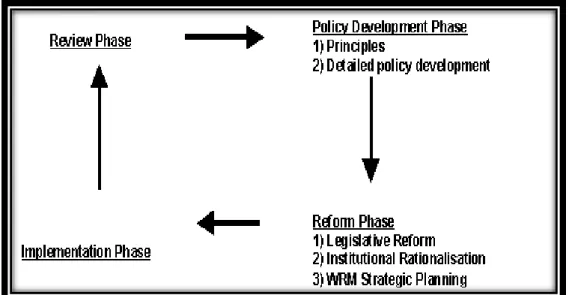
According to Abrams (2000) and Moriarty et al. (2007), the effective implementation of water policy can be obtained by following the governance/management cycle as shown in Figure 2.3 below.
The governance cycle consists of four phases, all of which are important and should be followed carefully. It must, however, be noted, that the reform phase is considered the most important phase in achieving the effective implementation of policies, as it constitutes the phase where approved policy is integrated into legislation, institutional arrangements, as well as into the planning activities associated with water resource management (Abram, 2000). The latter includes strategic planning, which determines whether the policy will be implementable or not, and what time frames are needed for the effective policy implementation process. The governance/management cycle is continuous and therefore, after the implementation phase, it continues to the review phase (Figure 2.3), so as to ensure the continuous monitoring of progress (Abram, 2000).
Various studies show that the governance cycle has proven itself effective in policy implementation. Furthermore, these studies indicate that more often the governance „cycle‟
is not treated as a cycle in practice (Abrams, 2000; Moriarty et al., 2007). Usually after the implementation phase the cycle ends and there is no continuous monitoring and evaluation of the process. This mostly leads to the process of policy implementation being hindered (Abrams, 2000) and the aims of adaptive management being defeated.
Figure 2.3 Phases of the Governance Cycle (Source: Abrams, 2000
20
So the question must be raised as to what tools – especially in the implementation phase - would be needed to achieve policy implementation. As discussed previously, this will strongly rest on the existing legal framework that is pre-given. In South Africa, the implementation of policies such as the Free Basic Water, has mainly been in the form of tools such as strategies, procedures and guidelines i.e. the Implementation Strategy for Free Basic Water of 2002 (Gowland-Gualtieri, 2007). Some countries have incorporated social or participatory instruments, such as community of practice and social learning activities (Wenger, 1999; Pahl-Wostl et al., 2007).
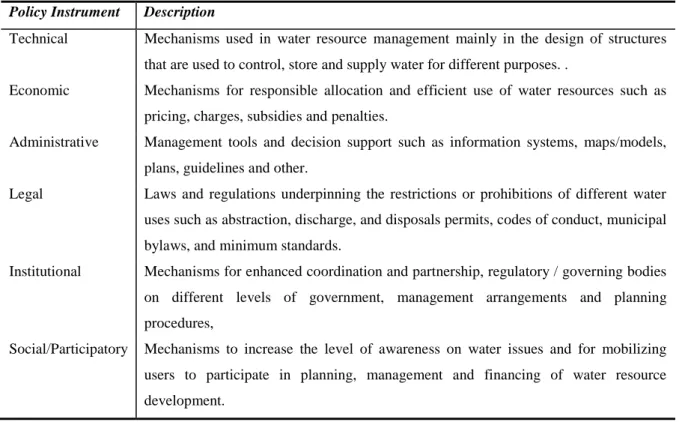
Policy instruments can be described as tools and methods used by governments or policy makers to achieve desired objectives (OECD, 2008). Plummer and Slaymaker (2007) present a blend of policy instruments in Table 2.1.
Table 2.1 Instruments for Policy Implementation (Source: Plummer and Slaymaker, 2007)
Policy Instrument Description
Technical Mechanisms used in water resource management mainly in the design of structures that are used to control, store and supply water for different purposes. .
Economic Mechanisms for responsible allocation and efficient use of water resources such as pricing, charges, subsidies and penalties.
Administrative Management tools and decision support such as information systems, maps/models, plans, guidelines and other.
Legal Laws and regulations underpinning the restrictions or prohibitions of different water uses such as abstraction, discharge, and disposals permits, codes of conduct, municipal bylaws, and minimum standards.
Institutional Mechanisms for enhanced coordination and partnership, regulatory / governing bodies on different levels of government, management arrangements and planning procedures,
Social/Participatory Mechanisms to increase the level of awareness on water issues and for mobilizing users to participate in planning, management and financing of water resource development.
Each policy instrument in Table 2.1 represents an important aspect of water governance and various studies reveal that much useful research has been done in relation to each (Herbertson and Tate, 2001; Batchelor, 2007; Plummer and Slaymaker, 2007; OECD, 2008). According to the European Environmental Agency (EEA, 2012) and the Australian Public Service Commission (APSC, 2008), there is no one universal policy tool or instrument that can provide solutions to all policy problems. Thus, it means that policy
21
instruments displayed in Table 2.1 should be all integrated or applied in an integrated way.
In addition, the links between them should be recognized (Plummer and Slaymaker, 2007).
The benefits of acknowledging the links between policy instruments is that the implementers would be able to see a broader perspective of how various water components fit together into one logical system (Dent, 1998; Plummer and Slaymaker, 2007; OECD, 2008).
In addition, environmental issues often have many different aspects and as a result several policy instruments may be required to be combined, in order to adequately address each issue (OECD, 2007). Governments may therefore consider using a number of different types of instruments when dealing with policy issues (OECD, 2008; EEA, 2012). Usually an „instrument mix‟ is formulated to address water governance related issues (OECD, 2008). The benefits associated with using a mix of instruments is that it allows greater flexibility in discovering ways to ensure compliance with various government policies, while at the same time it reduces the uncertainty in the cost of doing so.
However, instrument mixes need to be carefully formulated, in order to ensure that the individual mechanisms within them do not underestimate each other or create unnecessary costs in ensuring compliance. Specifically relating to the South African water policy, the NWA makes provision for water management strategies as one of the many tools to ensure its implementation. These are the National Water Resource Strategy and the Catchment Management Strategy.
2.2.1 National Water Resource Strategy
The National Water Resource Strategy is meant to integrate and coordinate all water institutions and water users. Its main purpose is to ensure the implementation of the NWA through facilitating the proper management of the nation‟s water resources, providing a mechanism for the protection, use, development, conservation, management and control of water resources for the country as a whole (NWRS, 2013). The NWRS should also provide a framework, which will guide the management of water resources and services at regional or catchment level in the defined water management areas (DWA, 1999).
Information about all aspects of water resource management in SA must be provided in the NWRS (DWAF, 1999).
22
According to the NWA (1998), the Minister is obliged to update the NWRS every five years. Moreover, the NWRS must ensure that there are enough water resources available to satisfy basic human needs and to cater for socio-economic development, both now and in the future. In order to achieve these goals, stakeholder consultation and participation is critical (DWAF, 2005; du Toit et al., 2011; NWRS, 2013).
2.2.2 Catchment Management Strategy
Water resource management functions in South Africa are divided into nine (previously ninteen19) Water Management Areas (WMAs). The NWA requires that a strategy to guide water management at catchment level be developed. Hence, this strategy is referred to as the Catchment Management Strategy (CMS). The NWA also requires a Catchment Management Agency (CMA) to be established for each WMA. The CMA is then responsible for developing a CMS for its WMA (DWAF, 2002). This implies that the Catchment Management Strategy is developed as a main tool to enable the implementation of the NWA at catchment level. Key elements of the CMSs include being aligned with the national and regional plans, the classification of the resource, licensing issues enabling public involvement in facilitating management of water resources (DWAF, 2002).
This strategy also needs to guide the way in which Water Management Institutions (WMIs) in a Water Management Area should perform their functions. However, where there is no CMA established, the DWA regional offices should perform the CMA functions as a Proto-CMA (DWAF, 2002).
2.3 Current Situation of NWA Implementation in SA
Mandated in the new National Water Policy (NWA, 1998) are the institutional reforms designed to redress the mistakes of the past and to provide adaptive capacity to the paradigm shift in water governance (DWA, 2011). However, recent literature reveals that the envisaged institutional reforms have not been fully implemented (Simpungwe, 2003;
Naster and Hansen, 2009; Tewari, 2009; du Toit et al., 2011; Movik and de Jong, 2011;
DWA, 2011). Moreover, the water sector is at a critical juncture where water resource management and service delivery are not at the level that it should be. Progress in the essential transformation in the sector, particularly related to delegation of water resource management to the regional level, has been much slower than anticipated (Naster and
23
Hansen, 2009; du Toit et al., 2011; DWA, 2011; Carden and Armitage, 2013). Moreover, the status quo threatens water security and carries with it the unacceptable economic and socio‐political risks for the country (Movik and de Jong, 2011; DWA, 2011). Instead of bringing the anticipated change, the slow establishment of the sector reforms has created more problems than at the time of policy reform i.e.
it has lowered staff drive and morale and therefore has resulted in poor water resources management performance and outcome (DWA, 2011);
it has weakened the Department‟s performance of its direct water resource management functions, as well as its regulatory, oversight, support roles (DWA, 2011); and
the uncertainty around the establishment of Catchment Management Agencies (CMAs) in particular, has weakened staff interest i.e. it has taken too long to establish CMAs in such a way that the staff‟s enthusiasm of being part of what has faded and there is now hesitation to move across to CMAs, once they are established. Furthermore, staff recruitment and retention have been negatively impacted (DWA, 2011; Meissner et al., 2013).
According to the DWA (2011), even though a range of factors contribute to the current poor state of water management and services, the two key underlying factors are incomplete institutional reforms and the performance of the Department itself. The existing institutional arrangements are failing to ensure sustainable water resources management.
As a result, the Department made efforts to rectify the situation and to support the implementation of the envisaged institutional reforms. The following section will therefore give an overview of the progress that the Departments have made to date with regards to the implementation of the institutional reforms.
2.3.1 Progress to date on sector reforms
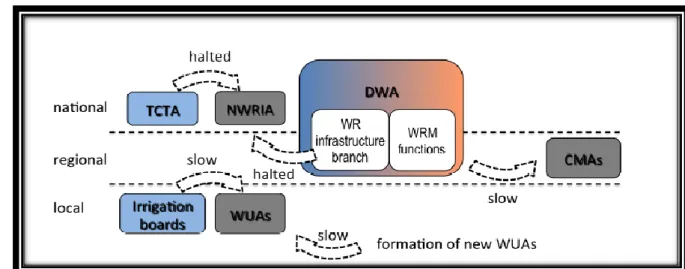
To date, the DWA has developed various institutional options for improving the management of water resources infrastructure.
24 These options are demonstrated in Figure 2.4
Figure 2.4 Incomplete water resource institutional reform (Source: DWA, 2011) Figure 2.4 demonstrates that the options that were developed by the DWA for improving water resource infrastructure management include:
The establishment of the public entity Trans Caledon Tunnel Authority (TCTA), which included the establishment of the National Water Resource Infrastructure Agency and the internal water resources infrastructure branch at DWA.
The establishment of Catchment Management Agencies:
Following the concerns that some of the initial 19 WMAs were not economically viable due to the limited technical human resources, capacity, skills and expertise in some of them, these have been delimited to nine, to enable integrated planning.
These include: Limpopo, Olifants; Nkomati/Usutu/Pongola; KZN Rivers; Vaal;
Orange; Eastern Cape Coastal Rivers; Western Cape South Coast Rivers; and Western Cape West Coast Rivers (Naster and Hansen, 2009; Movik and de Jong, 2011; DWA, 2011). Progress to date also includes the establishment of Water User Associations and the transformation of Irrigation Boards to Water User Associations. However, the latter is outside the scope of this study, hence it will not be discussed in the literature review.
2.4 Facilitating a Way Forward: Considering a Mix of Instruments for the Implementation of the NWA
Section 2.4.1 defined and discussed the instruments for policy implementation (also known as water governance instruments). From this section it was evident that there is a general