This study aims to establish whether teachers in the targeted schools are aware of the Nationa1 Language Policy and whether they implement it. The situation has been that schools in the Republic of South Africa were segregated according to the color and language of the speakers during the apartheid era (1948 to 1993). Schools must be aware of the education policies and understand them so that they are implemented.
QVESTIONS
If this does not happen, reasons for the non-implementation must be identified and recommendations for the implementation of the legislation must be made. Similar research on the non-implementation of the legislation includes Chick and Mc Kay (1999) who reported on the non-implementation of LiEP in the study they conducted in one former Indian school and one former colored school in Durban. What are the attitudes of the learners, the parents and the educators towards the '; language/languages used for purposes of teaching and learning.
OVERVIEW OF CHAPTERS
Has the policy of each school been adapted to promote the policy of additional multilingualism as set out in LiEP. What are the attitudes of the learners, the parents and the educators towards language(s), which are offered as subjects. This will include discussions of the current and past language policies in South Africa and their influence on language choice and the attitudes of the educators and learners in the schools investigated.
CHAPTER TWO
INTRODUCTION
Fasold says that attitudes consist of three components, namely: affective (feeling), behavioral (action) and cognitive (thought). This study will focus on all three parts of attitudes viz. the feeling (affective) respondents have towards isiZulu and English as teaching media, the behavior (action), i.e. the attitudes are revealed by the answers the respondents give in the questionnaires and interviews.
PRINCIPAL THEORIES
- Gramsci's Hegemony Theory (1971)
- Language, Ideology and Power
South Africans appear to have agreed to the use of English as the sole official language in almost all public domains of the state. He says this is because teachers in schools are victims of the education system, which promoted the use of English as a medium because it was considered the language of power. The content of the Education and Training Act reinforced the use of English as the language of instruction from group 5 onwards.
LANGUAGE PLANNING
- Language in Education
- Mother Tongue Education
- Bilingual education
From the language planning process comes a policy that governs the use of language, and that is the language policy. The British colonizers promoted English while at the same time allowing mother tongue education for the African children. Mother tongue education contributed to the launch of weak bilingual education, which produces limited bilingualism, in South African schools, as a feature of the language-in-.
ATTITUDES
One way this was done was to task the Department of Education with promoting multilingualism by transforming the education system as a whole in the Republic of South Africa, developing all official languages, including previously marginalized languages, and respecting all South African languages. This move has eased the historical political pressure of overvaluing English at the expense of indigenous languages, which were devalued. At the moment, not much has changed in the use of language in schools, but the Ministry of Education is on the way.
CONCLUSION
CHAPTER THREE
INTRODUCTION
METHODOLOGY
- The Learner Questionnaire
- The Governing Body Questionnaire
- Pre-testing
- Administering interviews
- Documents
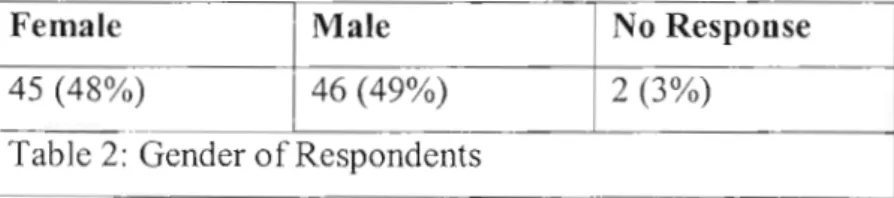
All participants were asked to sign the questionnaire to confirm that they voluntarily agreed to participate in the study. The questionnaire was given to Grade 11 students (30 per school for Masakhaneni and KwaMakhutha secondary schools and 33 at Umkhumbi secondary school). This is the only group where some respondents chose to complete the questionnaire in isiZulu.
CQNCLUSION
One of the reasons given by these educators for the emphasis on English was that the exam is written in English, so if learners get used to using isiZulu during lessons, they will have language problems during tests and exams and will fail the exams . For this study, I requested each school to provide me with the primary documents that would give me an indication of the language policy followed by the school.
CHAPTER FOUR
INTRODUCTION
LEARNER QUESTIONNAIRE
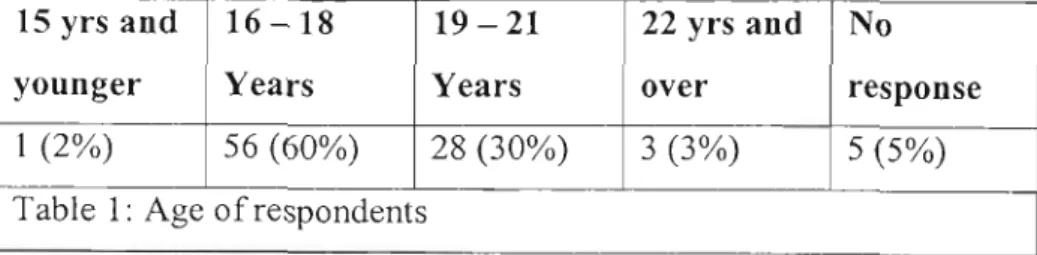
- Demographics
- Language Policy and Planning
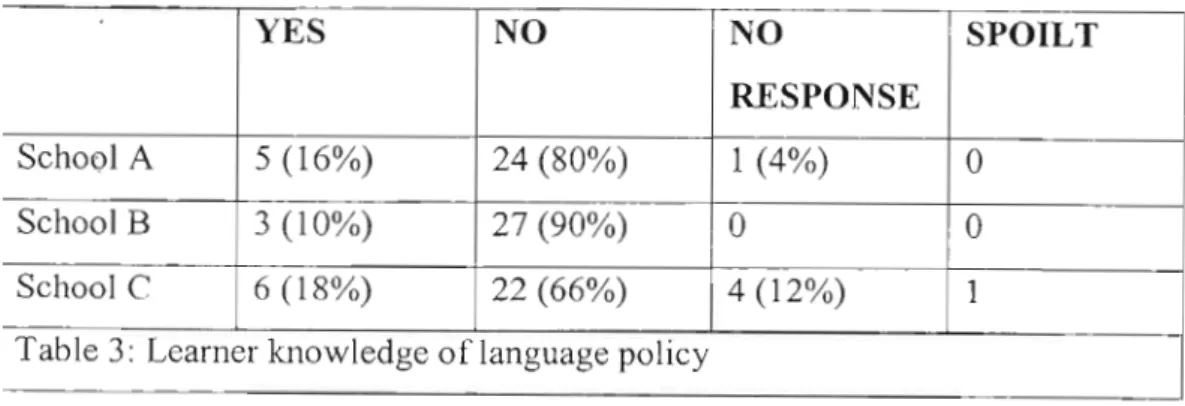
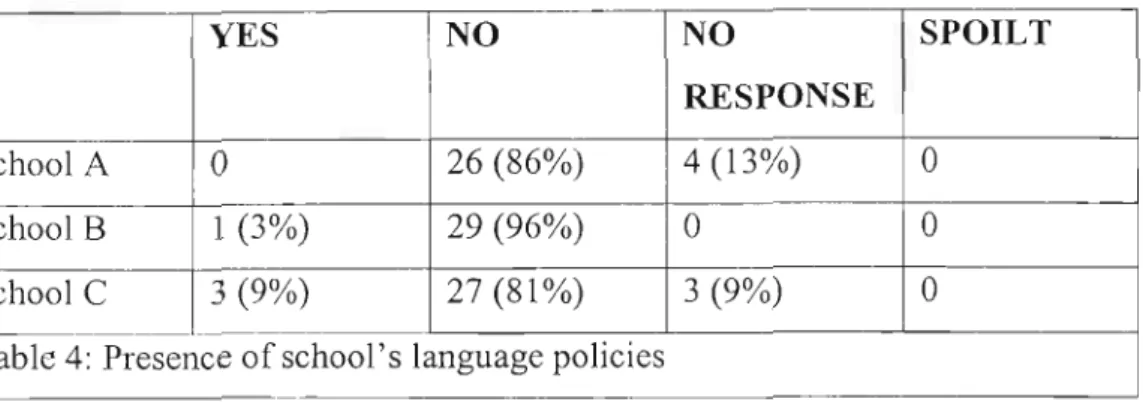
In the three schools, 80% of respondents in school A, 90% in school B and 66% in school C indicate that they do not know what language policy is. In schools A and C, some students chose not to answer this question, which could be interpreted as not knowing what the language policy is but not saying so. In school B, only 1 (3%) of respondents and in school C only 3 (9%) of respondents said that their school had a language policy.
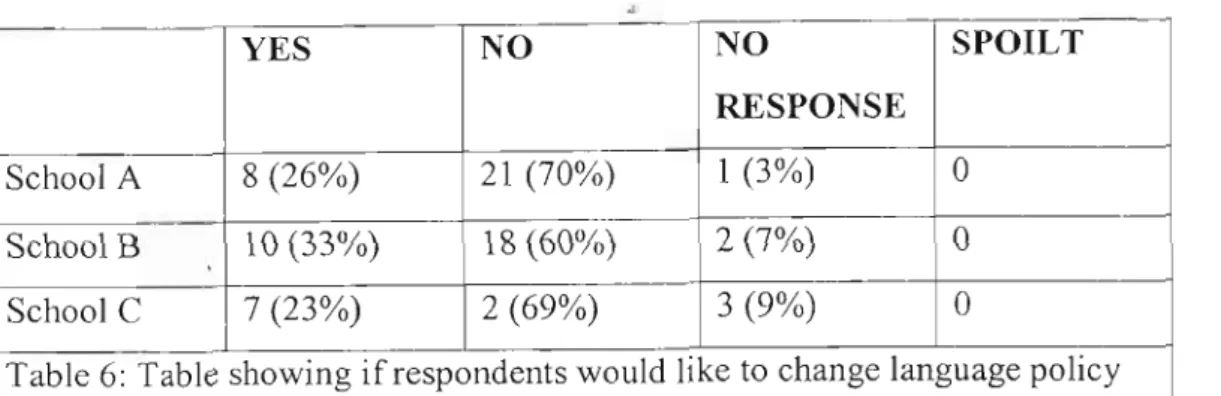
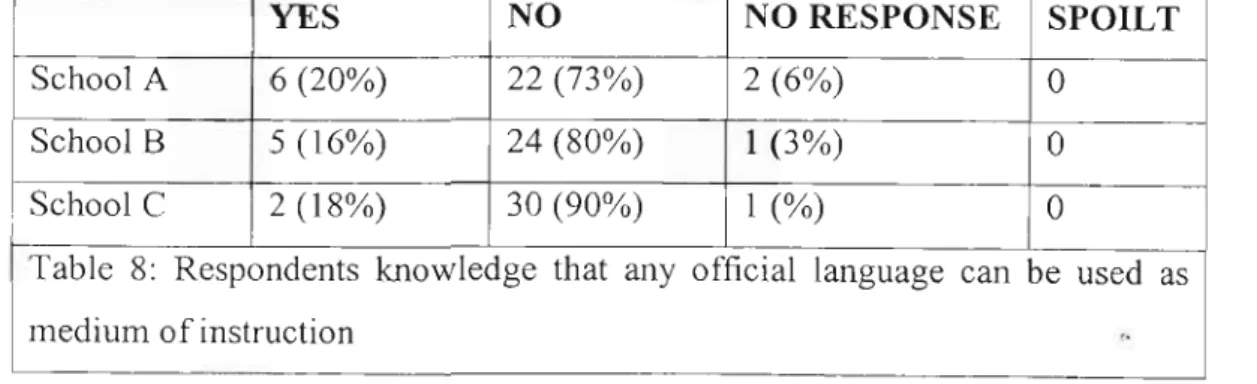
Seventy percent of respondents in School A would not want changes in language practice in their schools, while 26% want to see a change. A total of 73% in school A, 80% in school and 90% in school C do not know that any of the official languages can be used as a medium of instruction. In School A, 60% of respondents indicated that they would like to have lessons in English, while only 13% would prefer to have lessons in isiZulu.
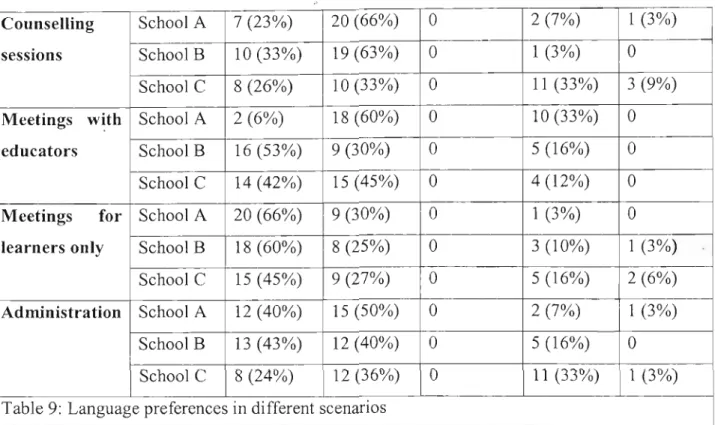
In school A, just over 60% of respondents prefer isiZulu for group discussions, 43% in Band school 42% in school C. The table shows that only 6% of respondents in school A prefer meetings with educators to be held in English. In both school B and school C, there are many respondents who chose English compared to those in school A.
At school One-third of students indicated both Isizulu and English for meeting with teachers.
GOVERNING BODY QUESTIONNAIRE
- Language Policy and Planning
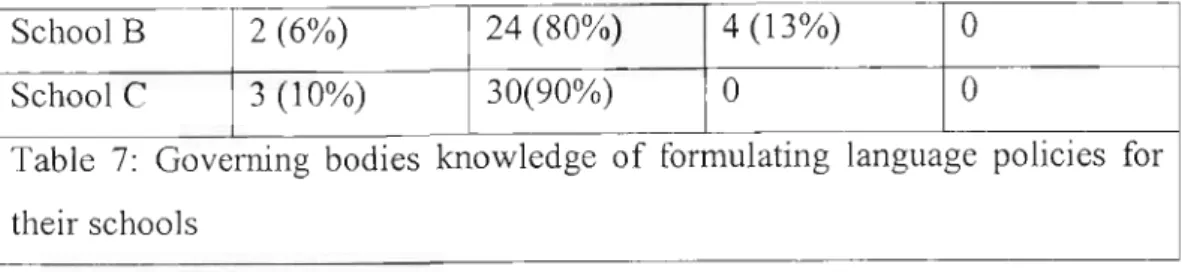
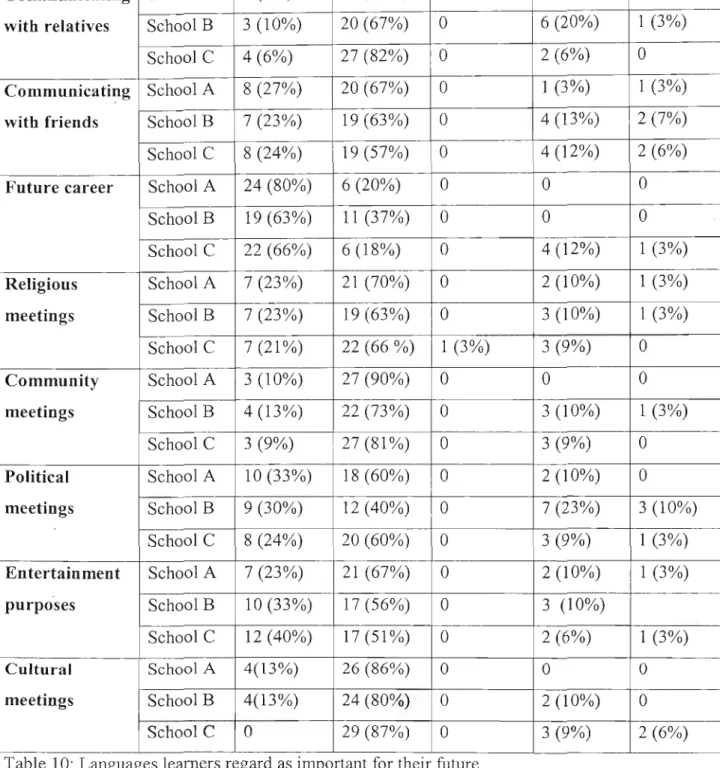
The respondents indicated that they did not think that isiZulu will be useful in the work situation in the future. In the career domain (high domain), respondents chose the language they believe will serve them better (English). According to this table, only 20% of respondents in school A know what a language policy is.
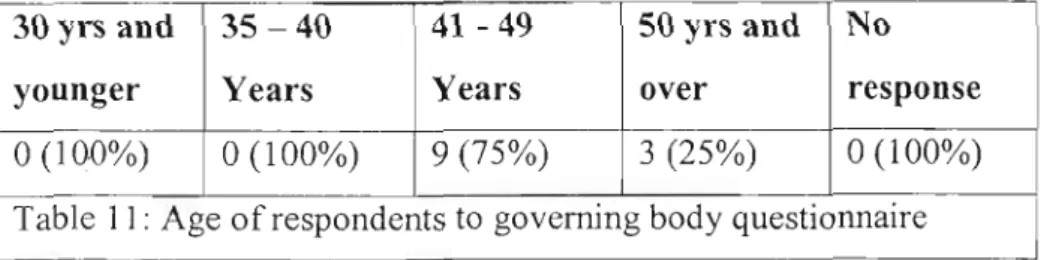
The table below shows whether the parents in the governing body were aware that any official language can be used as a medium of instruction. In the three schools, 100% of the respondents unanimously agreed that they do not know that any official language can be used as a medium of instruction in schools. According to the table, the parents in the governing body of the three schools show a general positive attitude towards English in most scenarios.
Most parents in all three schools favor English over isiZulu and Afrikaans. There is a marked difference in the administration scenario where in school A, 80% of parents chose isiZulu and only 20% chose English. The table below shows which language(s) parents think will be important for the students' future.
The results in ~able show that the vast majority of parents chose isiZulu as important for most areas (for example, 100% of respondents . in all three schools chose isiZulu as a language for communication with the family).

INTERVIEWS
- The learners interviews
- Educators Interviews
Half of the respondents (50%) mentioned that it was better to learn in English, as it was the language that offered one possibility in the future world of work. The ANC still promotes English as most of the time politicians speak at political meetings in English. A total of 66% of teachers said that their schools have no language policies, and the other 33% gave different answers such as
A total of 77% of teachers indicated that they did not know what LiEP is and did not know anything about it. The majority of teachers know what bilingualism is, probably because they are all bilingual. An overwhelming 100% of teachers agreed that students learn best in isiZulu, which is their native language.
Through practical experience they realize that learners learn best through isiZulu, while the parents of the governing body think that learners should be taught in English as it appeared in their questionnaires. A total of 22% of the educators said that they find it difficult to use English textbooks and English materials for the learners. QUESTION: What do you think about the implication of the introduction of isiZulu in all public schools in KZN.
An overwhelming 100% of the educators said they were all looking forward to the introduction of isiZulu in all the schools in KZN.

DOCUMENTS
This shows that there is a positive attitude towards isiZulu among these teachers, although some do not find it useful to use isiZulu when teaching. It is also clear that the lack of knowledge of LiEP is holding back the use of ofisiZulu in these schools. If the schools were aware of LiEP, there might have been a way to introduce isiZulu, which could be used together with English (bilingual medium), as most teachers reported that isiZulu helps students understand it better.
The fact that some educators use isiZulu in their lessons shows that they see the advantages of a bilingual way of education.
CONCLUSION
CHAPTER FIVE
- INTRODUCTION
- CONCLUSIONS
- RECOMMENDATIONS
- CONCLUSION
The choices of parents in this study showed that they prefer English to be used as a medium of instruction for students in schools because they are concerned about their children's future. Students' attitudes are positive about the use of isiZulu and English as media of instruction. A task force should be created to help develop indigenous languages and implement language policy in education, to help schools like these overcome problems in the middle of teaching.
The Ministry of Education must also find means to promote the use of indigenous languages as a means of instruction in schools. This research shows that at the three schools studied, English is mainly used as the language of instruction. These schools all followed the same procedure, with English being recognized as the language of instruction.
How primary school teachers experience changes in education policy in South Africa.Per:,pectives in Education. English as a second language in South Africa's tertiary institutions: a case study at the University of Pretoria. Which language choice would you most like to use at school in the following scenarios?
Who do you think should choose the language students should learn as a subject and as a medium of instruction?
SCHOOLS KWAMAKHUTHA
What do you think will be the consequences of introducing isiZulu into all public schools in KZN. Who do you think should monitor the implementation of official education policies in public schools? Do you think students benefit from using both English and isiZulu in the learning process?
Question: Who do you think should choose the language(s) that students should learn as a medium language and subject?.