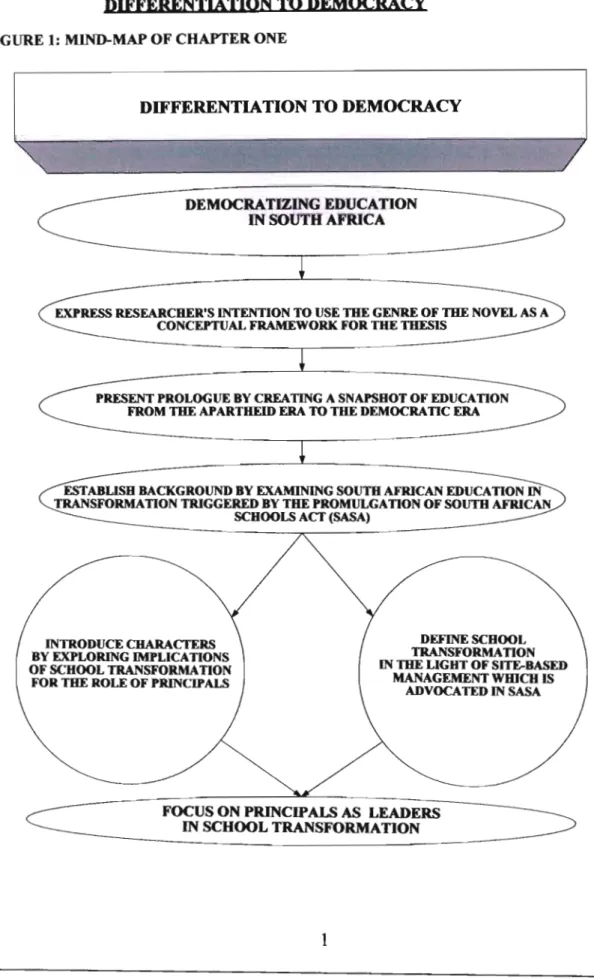
Working within the interpretive paradigm, with the theory of transformational leadership underpinning the theoretical orientation of the study, led to the understanding that the role of the principal is a conflicting role. A colossal task, if one considers that the findings of the investigation illustrate that principals are charged with the following conflict situations.
RATING AS A LEADER IN SCHOOL
INTERWEAVING THE THEMES OF THE STORIES EMANATING
2 2.1 Organizational value of the leadership roles: a quick overview 36 3 3.1 Variables included in identifying current life 50. 4 4.8 Ten highly rated characteristics considered important by principals and teachers within a transforming school context.
CBAPTERQNE
DIFFERENTIATION TO DEMOCRACY
- A GLIMPSE OF TRANSFORMATION IN EDUCATION
- WHAT SIGNIFIES TRANSFORMATION IN SOUTH AFRICAN EDUCATION
- PURPOSE OF STUDY
- CRITICAL OUESTIONS
- RATIONALE
- SYNOPSIS OF EACH CHAPTER
- Chapter One: Differentiation To Democracy
- Chapter Two: The PriBcipals
- Chapter Six: Summary, Conclusions And Recommendations
The Personnel Administration Measures (PAM), the South African Council for Educators (SACE), the Employment of Educators Act (EEC) and the Skills Development Act (SDA) outline the duties and responsibilities of the principal. Research on the role of the principal gained momentum in the 1980s, showing the principal's central role in school change (Fullan & Stiegelbauer, 1991).

CBAPTERTWO THE PRINCIPALS
LITERATURE REVIEW
- RecoDcepualiziag tile role of the priDdpal
- Who is a traDsformationalleader?
- Research unfolding on principals
- Leadersbip versus management
- ID closiDg
This educational revolution required, in turn, that the role of the principal be reconceptualized. A literature review on transformational leadership theory led me to conceptualize the principal as a transformational leader within the school.

THEORETICAL ORIENTATION OF THE STUDY
CONCLUSION
CHAPTER THREE
- THE SECONDARY PLOT
- THE PRIMARY PWT
- COURTING UNCONFORMITY
- TELLING AN INCOMPLETE STORY•••
- BUT MORE IMPORTANTLY •••
- LIMITATIONS
- CONCLUSION
These respondents were selected from the field of 81 directors that was created by the survey methodology in the initial phase of the study. The next stage was to observe each of them working within the framework of teaching staff - conducting a staff meeting.

CHAPTER FOUR
CONFLICTING VIEWS ON PRINCIPALS AS LEADERS
INTRODUCTION
To provide a glimpse of the transformation of schools, this chapter is structured to maintain the essential style of the report, which is in keeping with the tradition of the story. To introduce the main theme of the chapter, three short stories from principals (questionnaire respondents) are told that illustrate how they operate within their school context to approach school transformation. The main theme is then explored in more detail by engaging in a full-scale questionnaire analysis (Appendices A and B) of the study, focusing on the schools as sites of transformation, and then moving to the principals as leaders in school transformation.
Analysis of results will not be presented in a traditional style, but will take place in each of the subsections of chapters four and five.
SHORT STORIES
- CONCLUDING COMMENTS ON THE SHORT STORIES
The principal appears to have a good understanding of leadership and claims to be performing leadership duties at all times. However, if we compare the female educators who observed the principal in action, they claim that they did not observe him in any leadership role. The principal perceives herself as a leader who confidently leads by example and follows the common vision of the school.
The principal assessed herself as very good, 'because of the achievements I made in moving the school/Roma from where it was to where it is'.
SCHOOLS AS SITES OF TRANSFORMATION
Furthermore, the disjuncture/dissonance between principals as leaders and principals as leaders is constantly played out in this chapter. These strategies range from perceptions of what they do, to questioning projects carried out by principals, to understanding the different attributes of leadership and management.
TYPE OF SCHOOL
SCHOOL LOCATION
SCHOOL INTEGRATION (BY RACE) PRIOR TO 1994
SCHOOL INTEGRATION (BY RACE) POST 1994
The current study is unable to list any statistics regarding the movement to independent schools, as it excluded independent schools from its sample; an exclusion that can provide impetus for further study in the field of school transformation in South Africa.
LEARNER INTEGRATION (BY RACE) PRIOR TO 1994
LEARNER INTEGRATION (BY RACE) POST 1994
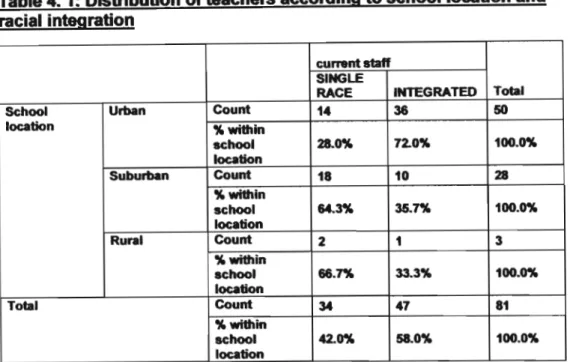
The above reasons for personnel profiling also contributed to all schools playing a dominant role in the racial profile of the groups targeted by apartheid. To take a brief look at how the example schools are governed, we again discover the implementation of the South African Schools Act – all schools have school governing bodies (Section 16 of SASA) and all secondary and combined schools have student representative councils (Section 11 of SASA). Since the administration of schools has been assigned to the governing bodies that include members from the various stakeholder constituencies, the majority of whom are parents, the rise of the multiracial school has become increasingly evident.
There is also a movement by school governing bodies to hire teachers of different racial backgrounds to meet the needs of the multiracial school and to hire teachers of competence and merit regardless of color.
INFRASTRUCTURE PRIOR TO 1994
INFRASTRUCTURE POST 1994
DEMOGRAPIDCS OF THE PRINCIPALS
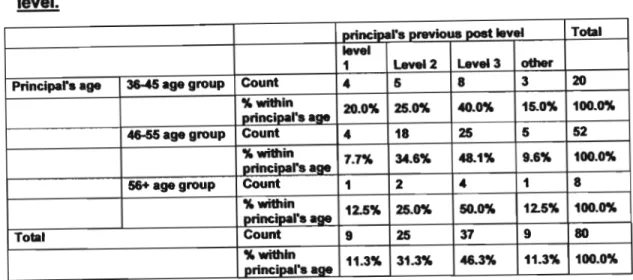
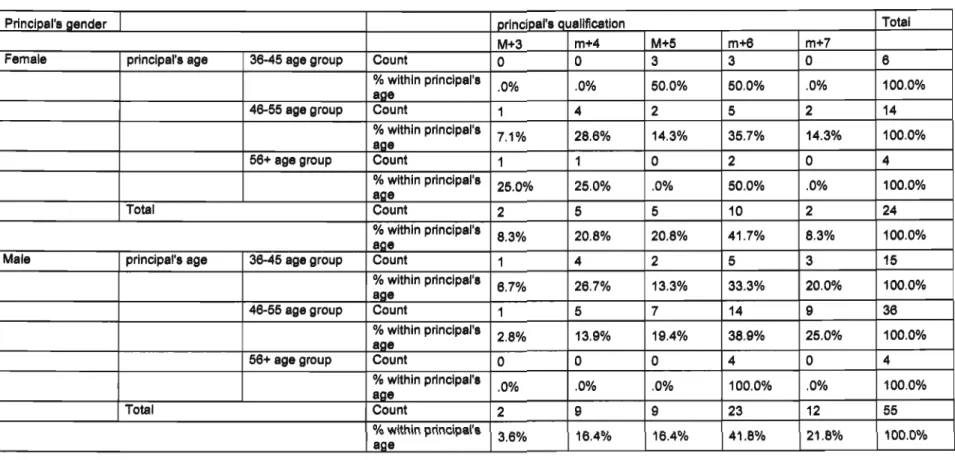
This can be attributed to the re-emergence of the reliance on higher education to lead transformation in schools. The majority (20%) of the principals who have been promoted to the principalship, from level one, come from the younger age group of 36-45 years. Before the enactment of the South African Schools Act and the formation of school governing bodies, those aspiring to the headship were obliged to go through the ranks.
However, after ten years of democracy, school governing bodies are cautious about who is promoted to principal.
PERCEPTIONS OF LEADERSHIP
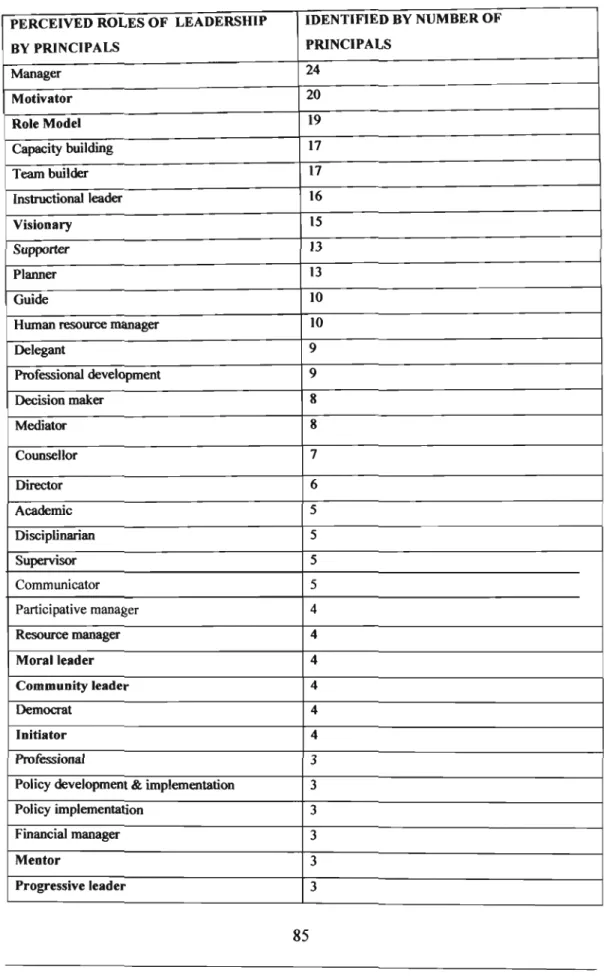
The top of the list in Table 4.5 shows that 24 of the principals (30%) perceived managing a school as a leadership role that surpasses all other roles. Most of their time is spent on designing and developing the necessary systems and structures that are conducive to the functioning of the school. Again we see the impact of meeting the basic needs of the institution.
What we detect here is the power of the organizational context - it is the context that determines the direction taken by the principal.
LEADERSHIP ROLES PERFORMED BY PRINCIPALS AS IDENTIFIED BY PRINCIPALS AND TEACHERS
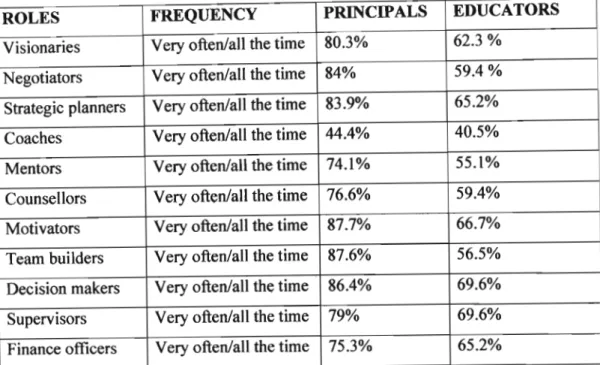
Principals in the study claim to pay attention to the multifaceted roles associated with their job descriptions. Educators who agree with the principals' opinion that they fulfill these roles claim that they fulfill these roles to a lesser extent (table 4.6). Perhaps principals have misconceptions about their leadership roles, or they may be so overwhelmed with their leadership functions that they truly believe they are actually running schools.
This also explains why they are inclined towards management but tend to perceive themselves as inclined towards leadership, pointing to the claim that there is a degree of discrepancy/dissonance between directors' perceptions and their actual leadership practices.
PROJECTS DISCUSSED BY PRINCIPALS TO DEMONSTRATE THEIR LEADERSHIP QUALITIES
- Organization of functions and programmes
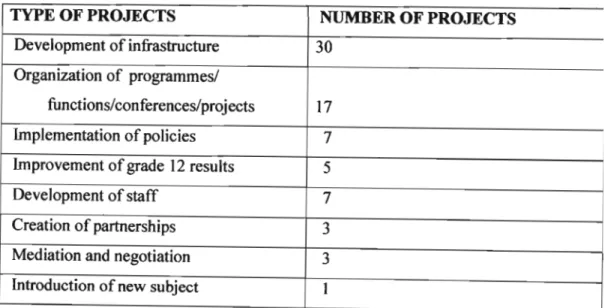
Thirty of the 81 principals discussed infrastructure development as a project that demonstrated their leadership qualities. These duties may be distributed to staff at different levels of the organization and require effective delegation by the principal. In fact, it is the responsibility of the principal to provide sufficient opportunities for teachers to empower themselves in the context of schools.
The final partnership was a home-based partnership where the principal motivated a former student community that has the school's interests at heart.
ATTRIBUTES OF LEADERSHIP CONSIDERED IMPORTANT WITHIN A TRANSFORMING SCHOOL CONTEXT
This is an indication that at least about 8% of directors have begun to understand that the concept of leadership is increasingly requiring leaders to understand that they must be human in order to lead people. However, it is important to be aware of the discrepancy between teachers' expectations and observations of perceived or actual attributes. This means they look to the director to be a visionary who can provide direction for the people and the organization.
The rest of the characteristics, such as the ability to generate team spirit, caring, open-minded, empowering, tolerant and transparent, while at the same time being assertive, means that while teachers want to be respected and capable, they also expect the principal to provide leadership to the change process.
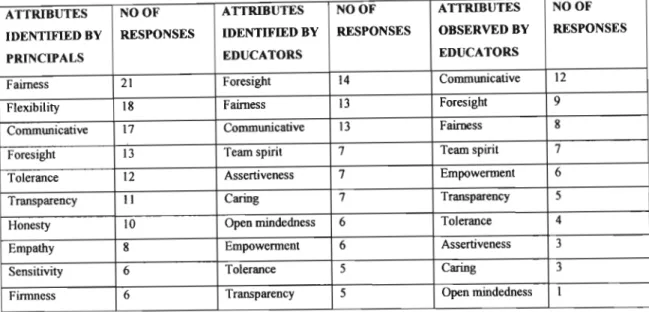
RATING OF PRINCIPALS
The above results show a tendency towards the school reform literature, which emphasizes how the principal as a transfonnal leader gradually develops to take on not only the professional qualities, but also the humanistic qualities (Caldwell &. Spinks, 1992). The above characteristics introduce a third dimension to the characteristics necessary for a principal to lead school transformation, which can be considered creative. In order to lead transfonnation in the school area, principals must explore their professional, humanistic and creative qualities.
After examining the characteristics of school principals that prompt them to act as change agents at the school site, it is time to evaluate (i) how principals rate themselves as leaders of school transformation and (ii) how educators rate their principals as leaders of school transformation . .
PRINCIPAL'S SELF RATING AS A LEADER
Perhaps it is human to disassociate with weakness or that principals actually believe they are making an impact on school transformation. Conclusions that can be drawn from what principals say about their ability to lead support the main theme that filters through this chapter and that is that they prioritize their roles as managers of school transformation and only begin to emerge as leaders of school transformation. However, the interpretation of certain management functions can be regarded as leadership functions, and therefore supports the claim that school principals are beginning to emerge as leaders of school transformation.
The purpose of engaging educators in a process of evaluating their principals was also twofold: first, to determine how educators rated their principals as leaders in school transformation, and second, to provide principals as a whole with exposure to how some of their colleagues are assessed. .
EDUCATOR'S RATING OF PRINCIPAL
CONCLUSION
The baseline study shows that not all principals are up to the challenge of leading school transformation. There seems to be a continuum from ensuring that the school simply continues to operate to ensuring that it does. They have worked towards the implementation of policies related to site-based management and governance and the overall efficient functioning of the school.
Principals' construction of themselves as leaders is of great importance in relation to the schools' transformation agenda.
CHAPTER FIVE
TOPICAL LIFE mSTORIES
INTRODUCTION
After explaining the timeless value of storytelling and making a case for the inclusion of the pilot study, this chapter is presented in four separate sections. Each of the first three sections takes on a different principle: the initiator, the mediator, and the experience, respectively. In the third part, the narrative deviates to critique each portrait with the express aim of understanding how and why each principal engages in the process of school transformation.
The fourth section interweaves narrative themes that derive from actual life stories to highlight experiences/influences that have a positive impact on how the initiator, facilitator, and experiencer carry out their leadership tasks.
STORY TELLING
THE BAT EVOLVES
This is her way of attuning to the needs of the organization's members and community members. I suspect that this attitude led to the creation of the school's vision, a vision clearly shared by the students, educators and the community. The voices that echoed through the stories were again those of the researcher and the researched.
After dealing with the above questions, I expected the telling of three current life stories to be a challenging but rewarding experience.
TELLING THE STORIES OF PRINCIPALS AS TRANSFORMATIONAL LEADERS
- THE INITIATE
- THE LADY WHO BEARS THE LEGACY OF APARTBEID IN ALL ITS FORMER GLORY
- BEYOND THE NARRATIVE
- THE INTERMEDIARY
- THE MAN WITH A MISSION
- BEYOND THE NARRATIVE
- RESPONSE TO CARTOON
- RATING AS A LEADER IN SCHOOL TRANSFORMATION
Being in the school choir gave me the wonderful opportunity to travel to Mafikeng, a rare experience for an African scholar. On the career front, fortune favored me as I had a supportive headmistress in Miss Shelembe, so I quickly immersed myself in the school's activities. With a lot of persistence I got a place in the school football team and even went on to play for the Durban U19 team.
1 You skills in the academic fudd, you have to be the professional leader, you have to be m. At critical moments in the interview, he alluded to the need for stakeholders to sharpen the 'global image' of the school. However, being a follower of the transfonnation process education, he engages in various activities to become empowered.
District eachi 9 Awards
BAYAT l\IIF
EXCELLENCE IN SCHOOL LEADERSHIP AT SECONDARY LEVEL
THE EXPERIENCED
- THE CONSERVATIST TURNED PROGRESSIVE
- BEYOND THE NARRATIVE
- RESPONSE TO CARTOON
- RATING AS A LEADER IN SCHOOL TRANSFORMATION
The principal works with the staff and includes them in decision-making most of the time. It also helps with the time management of the school principal, enabling him to focus on the professional matters of the school. He is of the firm belief that maintaining constant contact with the learners is essential for him to lead the school.
Like the principal of Sarel Cilliers High, Joppie did not allow the school's conservative background to hinder the gradual process of transformation.