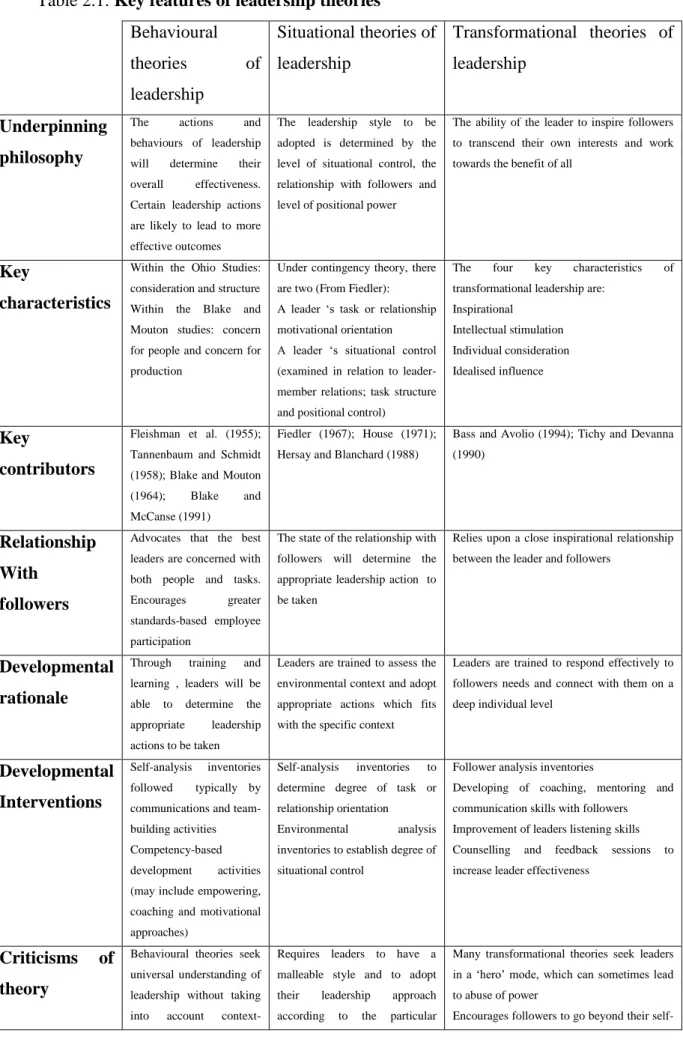
Koontz and Weihhrich (1988, p. 4) define management as “…the process of designing and maintaining an environment in which individuals, working together in groups, efficiently achieve selected goals.” Dynamics is also defined as “the pattern of change or growth of any object or phenomenon” (Gove, 1993, p. 711). According to Werner (2011, p. 365): “The influence of the transformational leader causes followers to believe that change offers them the opportunity to grow and develop to heights they previously could only dream of.”
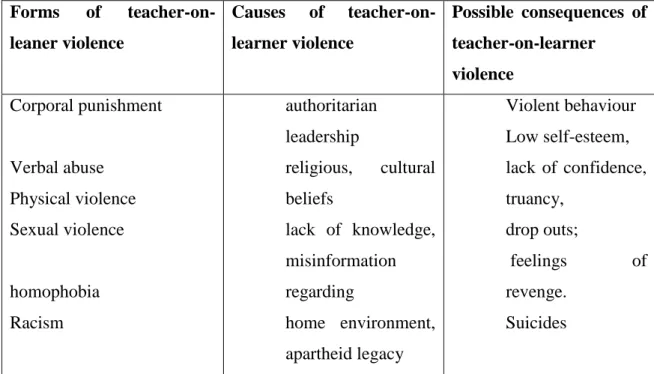
One of the common forms of violence perpetrated by teachers on students is corporal punishment. Straus and Yodanis (1996, p. 826) define corporal punishment as “the use of physical force intended to cause pain rather than injury for purposes of correction or control”. In Botswana and Ghana, Dunne and Leach (2007) found that corporal punishment was used more often for boys than for girls in most schools. To that end, Sowetan reports that "The Gauteng Department of Education has suspended Meadowlands High School principal and Sadtu leader Moss Senye for two months and fined him R50,000 for assaulting a student last year".
According to Berman and Paradies (2010, p. 217) “Racism can be expressed through stereotypes (racist beliefs), prejudice (racist emotions/affects) or discrimination (racial behaviors and practices). The legacy of apartheid is still prevalent in schools where discrimination and segregation prevail (Vally & Dalamba, 1999). According to Spillane and Hearley (2010, p. 264) this dimension concerns "the extent to which those occupying formally defined positions are focused on a single leadership position or have their time divided between multiple positions that have potentially competing responsibilities". The assumption is that leaders who focus only on one leadership position are likely to devote more time to that particular position and therefore perform their duties effectively. Merriam (1998, p. 7) suggests that the second characteristic of qualitative research is that "the researcher is the primary instrument for data collection and analysis". During data collection, the researcher may decide to process, summarize and classify the data as the study proceeds.
Most of the teachers who were in the chamber at that time filled out the questionnaire. This is also in line with Yin's (2003, p. 87) suggestion that: "The most important use of documents is to confirm and supplement evidence from other sources." Rule and John (2011) argue that it can be beneficial for the researcher to use a variety of data generation methods, including documents, starting with document analysis. The code of conduct stated that "a student shall not be found guilty of any of the following offenses: (q) making threats to fellow students and/staff." The MHS school safety policy stated that students and teachers are not expected to be exposed to threats of physical violence.
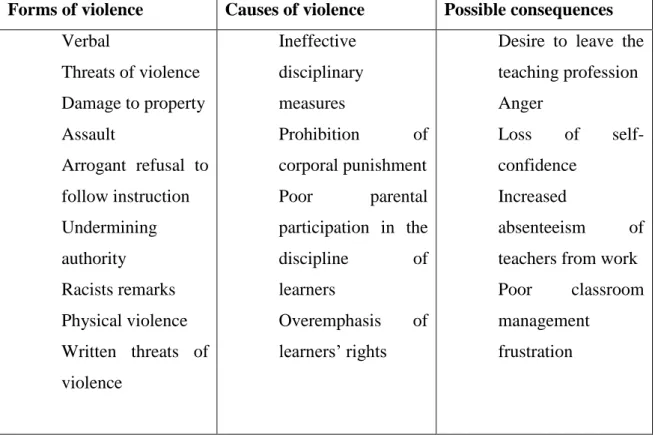
Just try to hit me and you will see what I will do.’ The student was suspended. A HoD from THS indicated: “The common [violence committed by students against the teachers] is resistance to carry out instructions (HTersee2)”. In THS, all the students were black and the majority of the teachers were black.
However, he reported that "The teachers hit us, but if I'm not mistaken, the government doesn't allow them to hit us" (Focus group of THS boys). Some of the teachers say that the students in this school behave well when the teachers use corporal punishment. If you take your hand off again, I'm going to smack that big useless head of yours.” The student was aware that the teacher was angry and she reached out to take a hit and did not remove her hand until the teacher was done hitting.
Emerging issues 157
Consistent with the literature, teachers were likely to continue to perpetrate violence on students because leaders avoided providing guidance and direction (Jones & Rudd, 2007). At the level of leaders without formal leadership positions, the results show that some teachers relied on the use of violent tactics in an attempt to control students rather than influencing students to behave in an acceptable manner.
LEARNER- ON- LEARNER VIOLENCE
Fights 159
- Types of fights 159
- Fights between two learners 160
- Gang fights 162
- Causes of fights among learners 164
- Popular places where learners fought 166
- Fighting as a form of entertainment 167
- Responses of stakeholders to fights 169
The common types of fights in both schools were those that occurred between two students. The findings suggest that boys and girls in both schools could be involved in fighting. Buhle and Velaphi actually fought in the classroom during recess; but some of the students stopped them before the other boys could join.
The two teachers and the learners concerned met in the waiting area near the reception. It also appeared that some learners were fighting in the classroom while teaching and learning process was taking place. Learners fought when they were not supervised during breaks or in the classrooms in the absence of the teachers.
Those who were there when the fight started in the school will spread the word that there will be a fight after school and the whole school will know. This also happens in a school situation where learners who are not involved in the fight add fuel to the fire. The findings show that fights among learners served as entertainment for learners in the two participating schools.
The findings further showed that the behavior of bystanders who cheered on the fighters reflected what happened in the community when people were fighting. A head of department at the same school reported that some teachers were not exercising their managerial and leadership roles in classrooms due to fear of violence. The findings show that some students in both cases resolved misunderstandings by fighting.
Students at the two participating schools seemed to find the fights between students as entertaining as they see them on TV. The findings also show that students who fought in both schools were rewarded by other students or bystanders who cheered them on.
Bullying 173
- Types of bullying 173
- Plundering of learners’ possessions 173
- Cyber bullying 176
- Possible consequences of bullying 177
Students bully each other and those who suffer the most are the new students in the school. For DMax, bullying at MHS took forms he described as "normal": "The type of violence between students is just your normal bullying where they bully other little students by demanding their lunch." We took some mobile phones from the students and showed the messages to their parents.
Although students at MHS were prohibited from using cell phones, I saw many students who had cell phones. They write messages on mobile phones and send them to as many people as possible. Cell phones appeared to be a means some MHS students could use to circulate messages intended to humiliate and harm others.
However, this form of bullying appears to be complicated because mobile phones were small devices that students carried to school even though they were not allowed to do so. Mobile phones can also be used without the supervision of any adult, be it teachers or parents, and as such could easily be misused by students. You see other students not coming to school because they know someone will abuse or bully them (Girls Focus group THS).
We advised him that it is not safe for him to come to school because we can only protect him while he is in school. It also appeared that new technology such as mobile phones was misused by some learners at MHS to bully other learners. This form of bullying was a complicated phenomenon for the school managers and learners.
The school managers could do nothing but ban the use of cell phones on the school grounds. This strategy of banning cell phones hardly worked because some learners continued to carry and use cell phones while on school grounds.
Verbal violence 180
- Teasing 180
- Insults 182
- Factors contributing to verbal violence 184
Some learners are not free to speak in class because they do not want to be embarrassed. In the classroom, some learners were verbally criticized by others as a way to control their behavior. This was the case in the classroom where the findings indicated that some learners avoided responding to teachers' questions so as not to be teased.
However, one of the victims of verbal abuse from MHS seemed satisfied that the perpetrator was suspended by the principal. They were subjected to verbal violence as a way for the perpetrators to express their disapproval of some students who behaved against societal norms and values. Some students experienced verbal abuse instigated by their peers because of their families' socioeconomic status.
Some of the students are said to use verbal violence against others because they imitated their parents who used vulgar language. The results revealed that lesbian and gay students at the two schools were subjected to verbal ridicule because of their sexual orientation, which appeared to be in defiance of what was generally considered to be "normal." This homophobic attack against lesbians and gays was carried out through language with the purpose of sending a strong message that some students disliked, despised and/or hated lesbians and gays. Such intolerance was demonstrated through verbal expressions in the two schools by some students against lesbian and gay students.
The verbal attacks on gay and lesbian students by some students at the two participating schools can be seen as an indirect influence that wider South African society has on such students. It was also clear that some boys at the two schools were engaging in gender-based verbal abuse against girls by calling them derogatory names. The socio-economic status of some parents appeared to influence the violence committed or experienced by some students at the two schools.
Leaners who experienced verbal abuse at home were likely to verbally abuse their fellow students. At MHS, some students were verbally abused by their peers for eating food provided by.
Sexual harassment 187
- Physical sexual harassment 187
- Visual and verbal sexual harassment 191
- Girls like what the boys do on their bodies 193
Teachers not trained about school violence 196
Emerging issues 198
Crystallising the research journey 200
Lessons from the research journey 202
- Types of school violence 203
- Causes of school violence 208
- Variation and gravity of school violence 212
- Relationship within and between forms of school violence 214
- The relationship between leadership and school violence 216
Ending the research journey 217