LIBRARY SERVICES’ PROVISION FOR PEOPLE WITH VISUAL IMPAIRMENTS AND IN WHEELCHAIRS IN ACADEMIC LIBRARIES IN
TANZANIA
REBECCA MGUNDA MAJINGE (BA., MA)
Thesis Submitted in partial fulfilment of the requirements for the degree of Doctor of Philosophy (Information Studies) in the School of Social Sciences,
College of Humanity, University of KwaZulu-Natal, Pietermaritzburg, South Africa
Supervisor: Prof. Christine Stilwell
……….
Submitted: February 2014
i
DECLARATION I, REBECCA MGUNDA MAJINGE declare that:
(i) The research reported in this thesis, except where otherwise indicated, is my original work.
(ii) This thesis has not been submitted for any degree or examination at any other university.
(iii) This thesis does not contain other persons’ data, pictures, graphs or other information, unless specifically acknowledged as being sourced from other persons.
(iv) This thesis does not contain other persons’ writings, unless specifically acknowledged as being sourced from other researchers. Where other written sources have been quoted, then:
(a) their words have been re-written but the general information attributed to them has been referenced;
(b) where their exact words have been used, their writing has been placed inside quotations marks and referenced.
(v) Where I have reproduced a publication of which I am an author, co- author or editor, I have indicated in detail which part of the publication was actually written by myself alone and have fully referenced such publications.
(vi) This thesis does not contain text, graphics or tables copied and pasted from the internet, unless specifically acknowledged, and the sources being detailed in the dissertation and in the references sections.
Signed……….Date………
Supervisor
Prof. Christine Stilwell
Signed…… Date 24 February 2014
ii ABSTRACT
This study examined library services’ provision for people with visual impairments and in wheelchairs in academic libraries in Tanzania. It looked into access to the information resources available and the layout of library buildings in five universities. The universities studied were University of Dar es Salaam (UDSM), Open University of Tanzania (OUT), Dar es Salaam University College of Education (DUCE), Sebastian Kolowa Memorial University (SEKOMU) and St. John’s University of Tanzania (SJUT). The broader issues in this study were drawn from issues relating to the importance of access to information as a fundamental human right.
The main research question the study sought to answer was what services do academic libraries provide for people with visual impairments and in wheelchairs?
Specific subsidiary research questions were what is the physical layout of academic libraries in Tanzania? what information resources are provided by academic libraries for people with visual impairments ? what are the challenges facing people with visual impairments and in wheelchairs in accessing and using library services? what is the role of information and communication technology (ICT) in facilitating provision of information resources to people with visual impairment and in wheelchairs? and what challenges are experienced by the library in seeking to provide services to people with visual impairments and in wheelchairs?
The study was guided by the social model of disability of Oliver and used the International Classification of Functioning (ICF) framework to address the research problem in the context of the academic library. The pragmatism paradigm was employed in the study. Both quantitative and qualitative methods were used.
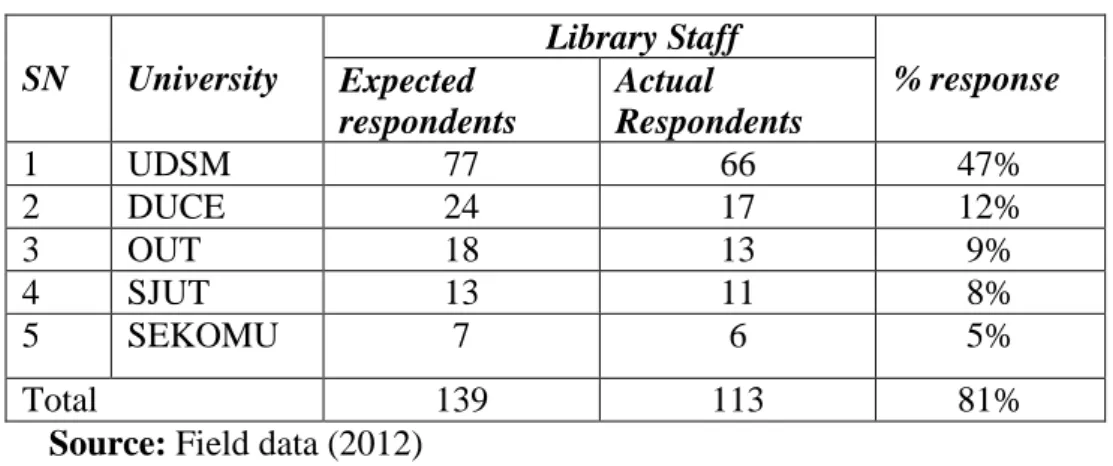
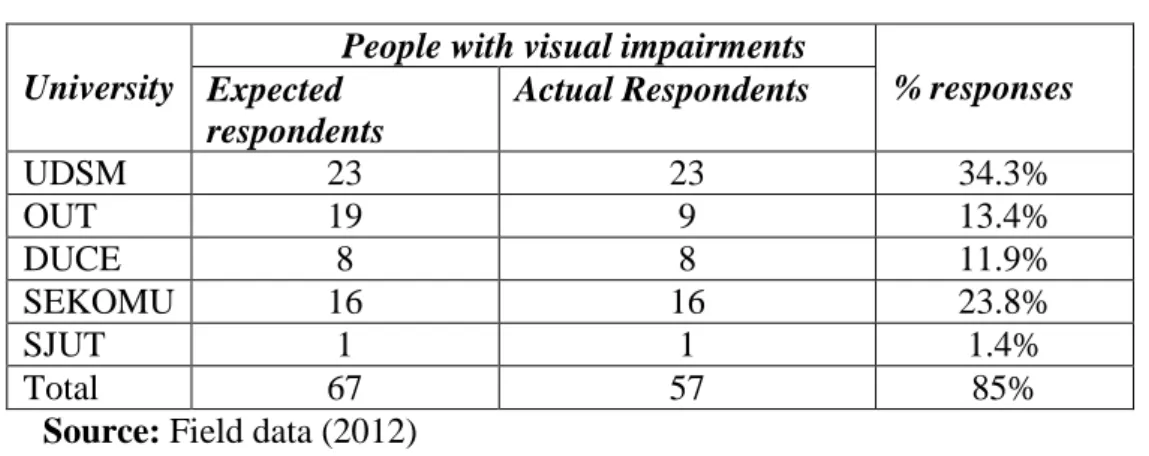
Regarding the respondents 113, (of a population of 139) were surveyed by questionnaire and 57 of 67 were interviewed. The population of the study involved library directors, professional library staff, disability unit staff, and people with visual impairments and in wheelchairs. Snowball sampling was used to identify the people with visual impairments and in wheelchairs. In order to obtain good measures of validity and reliability three data collection methods were employed:
iii
questionnaires, interview schedules and an observation checklist. The overall response rate from the questionnaires was 81%. Data gathered through the questionnaires were analyzed using descriptive statistics facilitated by SPSS and data gathered through interviews were analyzed using thematic analysis. The research conformed to the research ethics policy of University of KwaZulu-Natal.
Access to information is a fundamental right of every human being and academic libraries exist to support learning, teaching, research and consultancy to all in a university’s community of users, including people with visual impairments and in wheelchairs The study confirmed that academic libraries in Tanzania provide services to people with visual impairments and in wheelchairs which are not inclusive or universal. The study put forward a new non-recursive interactive model for application and testing. It offered guidelines for academic libraries in providing inclusive and universal services to people with visual impairments and in wheelchairs
For academic libraries to provide services which are inclusive and universal, the layout of library buildings need to include working lifts and ramps for people with visual impairments and in wheelchairs so that they can easily access the information resources housed in the library. In addition, information resources which are in Braille and large print are required for people with visual impairments to read easily as well as assistive equipment to help them read the information resources available.
Furthermore, having staff trained and experienced in special needs requires university programmes and curricula to include components, at all levels of qualification, on special needs for people with disabilities. Positive attitudes to both library staff and people with visual impairments and in wheelchairs are needed to allow access and use of information resources. In addition policy addressing library services for people with disabilities is important for the library, to not only guide the provision of universal services, but also to ensure adequate allocation of funds to support library services to people with visual impairments and in wheelchairs.
iv
ACKNOWLEDGEMENT
First of all I would like to thank God for the blessing and strength given to me throughout my PhD programme. Many people have provided support and helpful assistance in the preparation and completion of my thesis. It is not possible to acknowledge them by mentioning their names, but I would like to take this opportunity to express my special gratitude to all of them.
I would like to express my sincere appreciation to my supervisor Prof. Christine Stilwell for her timely guidance, comments, constructive criticism and encouragement from the initial stage of my research proposal to the final copy of this thesis. I would like to convey my gratitude to my employer The Institute of Finance Management (IFM) for granting me three years study leave and financial support.
I would like to express my deepest thanks to my loving and caring husband Deusdedit R. Majinge and to my lovely children Majinge, Peter, Caroline and my parents Axon Mgunda and Ester Kihupi, as without their prayers, love, sacrifice, support, understanding and encouragement this study would not have been successful.
My very special thanks to Prof. Stephen Mutula for his advice, support, encouragement and timely guidance throughout my PhD studies. My heart-felt thanks should go to Rev. Gabriel Nduye and Rev. Cornelius Simba, Sikustahili R.
Mushi, Ernest Nyari, Prof. Paul Manda, Hetty Gideon Barnabas, Wilson Muna and John Jackson Iwata for their support, encouragement and cooperation throughout my study journey.
I would like to convey my gratitude to my colleagues and all staff from School of Social Sciences who supported me in one way or the other to finish my PhD successfully as well as to all workers at the University of Dar es Salaam, Open University of Tanzania, Dar es Salaam University College of Education, Sebastian Kolowa Memorial University, St. John’s University of Tanzania and all staff of disability unit in all the universities surveyed and the Ministry of Education and
v
Vocational Training for their support and cooperation during my research data collection. I also thank Mr Robert Mathenge Mutwiri for helping with SPSS and Barbara Gentil for valuable editorial assistance.
vi
DEDICATION
This thesis is dedicated to my lovely husband, Deusdedit. R. Majinge, who supported and encouraged me during my studies and my beloved children Majinge, Peter and Caroline for their prayers, patience and understanding which impelled me to continue with my studies.
vii
TABLE OF CONTENTS
DECLARATION ... i
ABSTRACT ... ii
ACKNOWLEDGEMENT ... iv
DEDICATION ... vi
TABLE OF CONTENTS ... vii
LIST OF APPENDICES ... xvi
LIST OF TABLES ... xvii
LIST OF FIGURES ... xix
LIST OF ABBREVIATIONS AND ACRONYMS ... xxi
CHAPTER ONE ... 1
BACKGROUND TO THE STUDY ... 1
1.1 Introduction ... 1
1.2 Background to the research problem... 3
1.3 Statement of the problem ... 10
1.4 Purpose, objectives and research questions of the study ... 11
1.4.1 Purpose ... 11
1.4.2 Specific objectives ... 11
1.4.3 Research questions ... 12
1.5 The significance of the study ... 13
1.6 Assumptions of the study ... 13
1.7 Scope and limitations of the study ... 14
1.8 Methodology ... 15
1.9 Ethical issues ... 16
1.10 Definition of key terms ... 16
1.10.1 Academic libraries ... 16
1.10.2 Disabilities ... 17
1.10.3 Impairments ... 17
1.10.4 Information and communication technology (ICT) ... 17
1.10.5 Libraries ... 18
1.10.6 Library services ... 18
1.10.7 Visual impairments and persons with low vision ... 19
1.10.8 Wheelchairs and wheelchair users ... 20
viii
1.11 The structure of the thesis ... 20
1.12 Summary ... 21
CHAPTER TWO ...23
CONTEXT OF THE STUDY ...23
2.1 Introduction ... 23
2.2 The area of the study ... 23
2.2.1 Overview of Tanzania ... 23
2.2.2 Climate and rainfall patterns ... 24
2.2.3 Population ... 25
2.2.4 The government ... 25
2.2.5 The parliament ... 26
2.2.6 The judiciary ... 26
2.2.7 Tanzania’s economy ... 26
2.3 The universities where the study was conducted and their libraries ... 27
2.3.1 The University of Dar es Salaam and the University Library ... 27
2.3.2 The Open University of Tanzania (OUT) and the University Library ... 29
2.3.3 Dar es Salaam University College of Education (DUCE) and the University Library……….30
2.3.4 Sebastian Kolowa Memorial University (SEKOMU) and the University Library ……….32
2.3.5 St. John’s University of Tanzania (SJUT) and the University Library ... 34
2.4 The Ministry of Education and Vocational Training ... 35
2.5 Summary ... 39
CHAPTER THREE ...40
THEORETICAL FRAMEWORK AND MODEL ...40
3.1 Introduction ... 40
3.2 The theoretical framework and model used in the study ... 40
3.2.1 The use of a theoretical framework in quantitative and qualitative methods studies ……….41
3.2.2 The theoretical perspectives that guided the study ... 42
3.2.3 Medical and social model of disability ... 43
3.2.3.1 Medical model of disability ... 43
3.2.3.2 Social model of disability ... 45
ix
3.2.3.3 The human rights perspective on disability within the social model of
disability ……….46
3.2.3.4 The International Classification of Functioning (ICF) model ... 47
3.2.3.5 The International Classification of Functioning (ICF) model and the social model of disability ... 48
3.2.4 The model adopted for the study ... 49
3.3 Summary ... 58
CHAPTER FOUR ...59
LITERATURE REVIEW ...59
4.1 Introduction ... 59
4.2 Literature on library services’ provision for people with visual impairments and in wheelchairs ... 59
4.2.1 Policy formulation and implementation ... 61
4.2.1.1 National Policy on Disability ... 63
4.2.1.2 The Persons with Disabilities ACT, 2010 ... 65
4.2.1.3 National Library policy ... 67
4.2.2 Non-governmental organizations for people with visual impairments ... 68
4.2.2.1 Tanzania Society for the Blind (TSB) ... 68
4.2.2.2 Tanzania League of the Blind (TLB) ... 68
4.2.3 Challenges facing people with visual impairments and in wheelchairs in accessing and using library services ... 71
4.2.4 Library services’ provision for people with visual impairments and in wheelchairs in academic libraries ... 80
4.2.4.1 Layout of library buildings ... 85
4.2.4.2 Information resources for people with visual impairments ... 87
4.2.4.3 The role of ICT in information provision for people with visual impairments and in wheelchairs ... 89
4.2.4.4 Assistive technologies used by people with visual impairment ... 93
4.2.4.5 Challenges experienced by the library in seeking to provide services to people with visual impairments and in wheelchairs ... 95
4.2.5 Summary ... 97
CHAPTER FIVE ...100
RESEARCH METHODOLOGY ...100
5.1 Introduction ... 100
x
5.2 Research methodologies ... 100
5.3 Research design ... 100
5.3.1 Distinction between quantitative and qualitative research approaches ... 101
5.3.2 Justification for using combined methods ... 102
5.4 Area of the study ... 103
5.5 Population of the study ... 104
5.6 Sample size and sampling techniques ... 106
5.7 Data collection and instruments used ... 108
5.7.1 Questionnaires ... 108
5.7.2 Semi-structured interview schedule ... 110
5.7.3 Observation ... 111
5.8 Validity and reliability ... 112
5.8.1 Pre-testing of research instruments ... 113
5.9 Data collection procedures ... 114
5.10 Data analysis and presentation of data ... 115
5.11 Ethical issues ... 117
5.12 Evaluation of the research methodology ... 119
5.13 Summary ... 120
CHAPTER SIX ...121
PRESENTATION OF FINDINGS ...121
6.1 Introduction ... 121
6.2 Study respondents ... 122
6.2.1 Characteristics of respondents ... 123
6.2.1.1 Gender composition of the respondents ... 124
6.2.1.2 Age groups of the respondents ... 125
6.2.1.3 Education levels of the respondents ... 126
6.2.1.4 Work experience ... 128
6.2.1.5 Education and training in special needs ... 129
6.3 Library services provided to people with visual impairments and in wheelchairs in academic libraries in Tanzania ... 130
6.3.1 Library services provided to people with visual impairments and in wheelchairs ………...130
xi
6.3.2 Awareness of the services provided to people with visual impairments and in wheelchairs ... 133 6.3.3 Adequacy of the available services provided by the library to people with visual impairments and in wheelchairs ... 135 6.3.4 Academic libraries to be redesigned to meet the needs of people with visual impairments and in wheelchairs ... 137 6.3.5 Specialised services or adaptive equipment provided by the library to people with visual impairments and in wheelchairs ... 138 6.3.6 Whether library staff assisted people in the library with visual impairments and in wheelchairs ... 140 6.3.7 Frequency of incidents of library staff assisting people with visual impairments and in wheelchairs ... 141 6.3.8 Library services needed for people with visual impairments ... 142 6.3.9 Library services needed for people in wheelchairs ... 145 6.3.10 Whether libraries have staff who are trained and experienced to provide for or assist users with visual impairments and in wheelchairs in the use of library services 146 6.3.11 Whether the attitude of most library staff is favourable when providing library services to people with visual impairments and in wheelchairs ... 148 6.3.12 Whether the attitudes of people with visual impairments and in wheelchairs are negative to the library staff in the provision of library services ... 151 6.3.13 Whether libraries have a written policy that describes services to people with visual impairments and in wheelchairs ... 154 6.3.14 Whether libraries have a budget for library services for people with visual impairments and in wheelchairs ... 156 6.3.15 Other initiatives taken by the library regarding library services to people with visual impairments and in wheelchairs ... 157 6.4 Physical layout of academic libraries in Tanzania ... 159 6.4.1 The way in which people with visual impairments and in wheelchairs locate an item they need in the library ... 159 6.4.2 Whether the library shelves allowed people with visual impairments and in wheelchairs to locate information resources by browsing ... 161 6.4.3 Whether the arrangement of shelves in the library allowed people with visual impairments and in wheelchairs to move freely ... 164 6.4.4 Suitability of the study carrels, computer workstations, tables and chairs for people with visual impairments and in wheelchairs ... 166 6.4.5 Whether people with visual impairments and in wheelchairs were able to use the restroom facilities in the library independently ... 168
xii
6.4.6 Whether the layout of library buildings allowed people with visual impairments
and in wheelchairs to get access to the information resources ... 170
6.5 Information resources provided for people with visual impairments ... 174
6.5.1 Alternative materials for people with visual impairments ... 175
6.6 Challenges facing people with visual impairments and in wheelchairs in accessing and using library services ... 177
6.6.1 Challenges which hinder access to and use of library services for people with visual impairments and in wheelchairs ... 177
6.7 The role of ICT in facilitating provision of information resources to people with visual impairments and in wheelchairs ... 179
6.7.1 Adaptive equipment or technology available ... 179
6.7.2 Whether ICT equipment would assist in library services’ provision of information resources to people with visual impairments and in wheelchairs ... 181
6.8 Challenges experienced by libraries when they sought to provide services to people with visual impairments and in wheelchairs ... 183
6.8.1 Challenges experienced by libraries when providing services to people with visual impairments and in wheelchairs ... 184
6.9 Suggestions on the improvement of library services’ provision for people with visual impairments and in wheelchairs in academic libraries in Tanzania ... 185
6.10 Additional comments regarding library services’ provision to people with visual impairments and in wheelchairs ... 188
6.11 Summary ... 192
CHAPTER SEVEN ...193
DISCUSSION OF THE FINDINGS...193
7.1 Introduction ... 193
7.2 Library services’ provision for people with visual impairments and in wheelchairs ………194
7.2.1 Awareness of the services provided to people with visual impairments and in wheelchairs ... 196
7.2.2 Academic libraries’ need to be redesigned to meet the needs of people with visual impairments and in wheelchairs ... 197
7.2.3 Whether library staff assisted people in the library with visual impairments and in wheelchairs ... 198
7.2.4 Frequency of library staff assisting people with visual impairments and in wheelchairs ... 198
7.2.5 Library services needed for people with visual impairments ... 198
7.2.6 Library services needed for people in wheelchairs ... 199
xiii
7.2.7 Whether libraries had staff who were trained and experienced to provide for or assist users with visual impairments and in wheelchairs in the use of library services 200 7.2.8 Attitudes of library staff towards people with visual impairments and in
wheelchairs in the provision and use of library services ... 202
7.2.9 Whether libraries had a written policy that described services to people with visual impairments and in wheelchairs ... 204
7.2.10 Whether libraries had a budget for people with visual impairments and in wheelchairs regarding library services ... 204
7.2.11 Other initiatives taken by the library regarding library services to people with visual impairments and in wheelchairs ... 206
7.3 Physical layout of academic libraries in Tanzania ... 207
7.3.1 The way in which people with visual impairments and in wheelchairs located an item they needed in the library ... 208
7.3.2 Whether the library shelves allowed people with visual impairments and in wheelchairs to locate information resources by browsing ... 209
7.3.3 Whether the arrangement of shelves in the library allowed people with visual impairments and in wheelchairs to move freely ... 210
7.3.4 The suitability of study carrels, computer workstations, tables and chairs for people with visual impairments and in wheelchairs ... 210
7.3.5 Whether the library restroom facilities were able to be used independently by people with visual impairments and in wheelchairs ... 211
7.4 Information resources provided for people with visual impairments ... 211
7.5 The role of ICT in facilitating provision of information resources to people with visual impairments and in wheelchairs ... 214
7.6 Suggestions on the improvement of library services’ provision for people with visual impairments and in wheelchairs in academic libraries in Tanzania ... 216
7.7 Additional comments regarding library services’ provision to people with visual impairments and in wheelchairs ... 217
7.8 Summary ... 218
CHAPTER EIGHT ...226
SUMMARY OF FINDINGS, CONCLUSIONS AND RECOMMENDATIONS ...226
8.1 Introduction ... 226
8.2 Research purpose and research questions ... 226
8.3 Summary of the findings ... 227
8.3.1 Library services provision for people with visual impairments and in wheelchairs ... 227
xiv
8.3.1.1 Library staff who are trained and experienced to assist users with visual
impairments and in wheelchairs in the use of library services ... 228
8.3.1.2 Attitudes of library staff towards people with visual impairments and in wheelchairs to the provision and use of library services ... 229
8.3.1.3 Library policy that underpins services to people with visual impairments and in wheelchairs ... 229
8.3.1.4 Library budgets for services to people with visual impairments and in wheelchairs ... 230
8.3.2 Physical layout of academic libraries in Tanzania ... 230
8.3.3 Information resources provided for people with visual impairments ... 231
8.3.4 The role of ICT in facilitating provision of information resources to people with visual impairments and in wheelchairs ... 231
8.4 Conclusion ... 232
8.4.1 Library services provision: users with visual impairments and in wheelchairs 232 8.4.1.1 Trained and experienced library staff to assist users with visual impairments and in wheelchairs in the use of library services ... 232
8.4.1.2 Attitudes of library staff towards users with visual impairments and in wheelchairs in the provision and use of library services ... 233
8.4.1.3 Library policy: services to people with visual impairments and in wheelchairs ... 233
8.4.1.4 Library budgets for services to people with visual impairments and in wheelchairs ... 233
8.4.2 Physical layout of academic libraries ... 234
8.4.3 Information resources provided: users with visual impairments ... 234
8.4.4 The role of ICT in the provision of information resources to people with visual impairments and in wheelchairs ... 234
8.5 Recommendations ... 235
8.5.1 Library services’ provision for users with visual impairments and in wheelchairs ………...235
8.5.1.1 Library staff who are trained and experienced to provide or assist users with visual impairments and in wheelchairs ... 236
8.5.1.2 Attitudes of library staff towards people with visual impairments and in wheelchairs ... 237
8.5.1.3 Library policy ... 237
8.5.1.4 Library budget ... 238
8.5.2 Physical layout of Tanzanian academic libraries ... 238
xv
8.5.3 Information resources provided for users with visual impairments ... 239
8.5.4 The potential role of ICT in facilitating provision of information resources to people with visual impairments and in wheelchairs ... 239
8.6 Originality of the study ... 240
8.7 Contribution of the study ... 240
8.7.1 Contribution to theory ... 241
8.7.2 Contribution to policy ... 246
8.7.3 Contribution to practice ... 249
8.8 Summary of the study ... 250
8.9 Suggestions for further research ... 251
REFERENCES ...252
xvi
LIST OF APPENDICES
Appendix 1: Informed consent form ………. 271 Appendix 2: Application letter for data collection at the University of Dar es Salaam 273 Appendix 3: Research permit from the University of Dar es Salaam ……….. 274 Appendix 4: Application letter for data collection at the Open University of Tanzania... 275 Appendix 5: Research permit from Open University of Tanzania ………... 276 Appendix 6: Application letter for data collection at Dar es Salaam University College of Education ………. 277 Appendix 7: Research permit from Dar es Salaam University College of Education ... 278 Appendix 8: Application letter for data collection at Sebastian Kolowa Memorial
University ………. 279 Appendix 9: Research permit from Sebastian Kolowa Memorial University ………….. 280 Appendix 10: Application letter for data collection at St. John’s University of Tanzania 281 Appendix 11: Research permit from St. John’s University of Tanzania ……….. 282 Appendix 12: Application letter for data collection at Ministry of Education and
Vocational Training ………... 283 Appendix 13: Research permit from Ministry of Education and Vocational Training... 284 Appendix 14: Request for permission to pre-test instruments at the University of
KwaZulu-Natal Library ………... 285 Appendix 15: Request for permission to pre-test instruments at the University of
KwaZulu-Natal Disability Unit ……… 286 Appendix 16: Questionnaire for library staff ……… 288 Appendix 17: Questionnaire for users in wheelchairs ……….. 295 Appendix 18: Questionnaire for staff of Special Needs Education Unit for Disability… 300 Appendix 19: Semi-structured interview schedule for people with visual impairments... 304 Appendix 20: Semi-structured interview schedule for the directors of libraries ……….. 308 Appendix 21: Observation checklist used at selected universities in Tanzania ………... 311 Appendix 22: Pre-testing checklist ………... 313
xvii
LIST OF TABLES
Table 1: Population of library staff ... 105
Table 2: Population of people with visual impairments and in wheelchairs ... 105
Table 3: Response Rate of library staff, disability unit staff and people in wheelchairs ... 122
Table 4: Response rate of people with visual impairments ... 123
Table 5: Gender of the library staff ... 124
Table 6: Gender of people in wheelchairs ... 124
Table 7: Gender of staff for special needs of education unit ... 124
Table 8: Age range of library staff ... 125
Table 9: Age of people in wheelchairs ... 125
Table 10: Education level of library staff ... 126
Table 11: Education level of people in wheelchairs ... 126
Table 12: Education level of staff of special needs of education unit ... 127
Table 13: Work experience of library staff ... 128
Table 14: Work experience of staff of special needs of education unit ... 128
Table 15: Education and training in disability ... 130
Table 16: Library services used by people in wheelchairs ... 132
Table 17: Services provided by disability unit ... 133
Table 18: Awareness of the services provided by disability unit... 134
Table 19: Whether respondents were satisfied with the services provided by the academic libraries ... 136
Table 20: Specialized service or adaptive equipment provided by the library to people with visual impairments and in wheelchairs ... 139
Table 21: Frequency of using library services ... 142
Table 22: To what extent do you agree with the following statement: the attitude of library staff towards people with visual impairments and in wheelchairs in provision of library services is principally negative ... 150
Table 23: Attitudes of people in wheelchairs to library staff ... 153
Table 24: Whether the Special Needs Unit has a policy relating to library services’ provision for people with disabilities ... 155
Table 25: Budget dedicated to people with a disability: disability unit staff responses ... 156
Table 26: Existence of other initiatives undertaken by academic libraries ... 158
Table 27: Manner of locating items in the library by people with visual impairments and in wheelchairs ... 159
Table 28: Manner of locating items in the library by people in wheelchairs ... 160
Table 29: Whether the library shelves allowed people in wheelchairs to locate information resources by browsing: people in wheelchairs’ responses ... 163
Table 30: Whether the arrangement of shelves in the library allowed them to move freely: people in wheelchairs ... 165
xviii
Table 31: Suitability of study carrels, computer workstations, tables and chairs:
people in wheelchairs ... 168 Table 32: Responses of library staff on independent use of library restroom by people with visual impairments and in wheelchairs ... 169 Table 33: Responses of people in wheelchairs on the independent use of library restrooms ... 169 Table 34: Whether layout of the library buildings allowed access: people in
wheelchairs ... 172 Table 35: Challenges that hinder access to and use of library services for people with visual impairments and in wheelchairs: library staff responses ... 177 Table 36: Challenges that hinder access to and use of the library: people in
wheelchairs ... 178 Table 37: Responses of people in wheelchairs on whether ICT equipment will assist them ... 183 Table 38: Challenges experienced by libraries when providing services to people with visual impairments and in wheelchairs: library staff responses ... 184 Table 39: Challenges facing staff of special needs education units for disability in providing services for people with disabilities ... 185 Table 40: Improvement measures for library services to people with visual
impairments and in wheelchairs: library staff responses ... 186 Table 41: Responses of people in wheelchairs on improvements in library services ... 187 Table 42: Additional comments regarding library services’ provision to people with visual impairments and in wheelchairs: library staff responses ... 188 Table 43: Responses for people in wheelchairs on additional comments ... 189 Table 44: Responses for staff of special needs education units for disability on additional comments ... 190 Table 45: Matrix of the social model, literature reviewed, principles and
prerequisites, research questions, and findings ... 221
xix
LIST OF FIGURES
Figure 1: Map showing location of regions selected for study ... 24 Figure 2: International Classification of Functioning model (World Health
Organization 2001:18) ... 57 Figure 3: Education and training in special needs ... 129 Figure 4: Provision of library services to people with visual impairments and in wheelchairs ... 131 Figure 5: Training in the community regarding awareness raising about the activities of the unit relating to people with disabilities ... 135 Figure 6: Adequacy of the available services provided by the library to people with visual impairments and in wheelchairs ... 136 Figure 7: Academic libraries to be redesigned to meet the needs of people with visual impairments and in wheelchairs ... 138 Figure 8: Library staff assistance to people in the library with visual impairments and in wheelchairs ... 140 Figure 9: Frequency of incidents of library staff assisting people with visual
impairments and in wheelchairs ... 141 Figure 10: Library services needed for people with visual impairments ... 143 Figure 11: Library staff views on services needed for people in wheelchairs ... 145 Figure 12: Availability of trained and experienced staff who provide for or assist users with visual impairments and in wheelchairs in the use of library services .... 147 Figure 13: “To what extent do you agree with the following statement: generally the attitude of most library staff towards providing library services to people with visual impairments and in wheelchairs is not good” ... 149 Figure 14: To what extent do you agree with the following statement: “the attitude of people with visual impairments and in wheelchairs towards library staff provision of library services to them is principally negative” ... 152 Figure 15: Whether library has a policy describing services regarding people with visual impairments and in wheelchairs ... 154 Figure 16: Whether the library shelves allowed people with visual impairments and in wheelchairs to locate information resources by browsing: staff responses ... 162 Figure 17: Photograph of library book shelves ... 164 Figure 18: Whether the arrangement of shelves in the library allowed people with visual impairments and in wheelchairs to move freely: library staff responses ... 164 Figure 19: Photographs of library shelves ... 166 Figure 20: The suitability of study carrels, computer workstations, tables and chairs for people with visual impairments and in wheelchairs: library staff ... 167 Figure 21: Photograph of chairs and tables ... 168 Figure 22: Access for persons with disabilities facilitated by the layout of library buildings: library staff ... 171
xx
Figure 23: Photographs of stairs going up to the services and library collections from three of the institutions studied, with no lifts or ramps available ... 174 Figure 24: Alternative materials for people with visual impairments: library staff 175 Figure 25: Adaptive equipment or technology available in the library: library staff responses ... 180 Figure 26: ICT equipment assists in the provision of information to people with visual impairments and in wheelchairs: library staff responses ... 182 Figure 27: Proposed new non-recursive interactive model of disability. ... 242
xxi
LIST OF ABBREVIATIONS AND ACRONYMS ADA American Disabilities Act
ALA American Library Association API Application programme interface CCTV Closed Circuit Television
DES Disability Equality Scheme DPSA Disabled People South Africa
DUCE Dar es Salaam University College of Education GDP Gross Domestic Product
ICF The International Classification of Functioning ICT Information and Communication Technology
IFLA International Federation of Library Associations and Institutions IFM Institute of Finance Management
ILO International Labour Organization
INASP International Network for the Availability of Scientific Publications LIASA Library and Information Association of South Africa
MoEVT Ministry of Education and Vocational Training OPAC Online Public Access Catalogue
OUT Open University of Tanzania
PEPUDA The Promotion of Equality and Prevention of Unfair Discrimination Act
PERii Programme for Enhancement of Research Information PhD Doctor of Philosophy
SARUA Southern African Regional Universities Association SEKOMU Sebastian Kolowa Memorial University
SEKUCO Sebastian Kolowa University College of Tumaini SJUT St. John’s University of Tanzania
TCU Tanzania Commission for Universities TLB Tanzania League of the Blind
TSB Tanzania Society for the Blind UDSM University of Dar es Salaam UKZN University of KwaZulu-Natal
xxii
UNESCO United Nations Educational, Scientific and Cultural Organization UPIAS Union of the Physically Impaired Against Segregation
URT United Republic of Tanzania WHO World Health Organization
WIPO World Intellectual Property Organization
1
CHAPTER ONE
BACKGROUND TO THE STUDY 1.1 Introduction
Information is essential to all human beings and every library’s aim is to provide the right information at the right time and in the right format to its patrons regardless of race, religion, age, nationality and language. This core function includes the provision of information to people with disabilities. Bagandanshwa (2006a) emphasizes that all persons have a right to information regardless of disability. He further stresses that information is power because it is the source of knowledge and facts. The American Library Association (2001) insists that libraries must not discriminate against individuals on the basis of disability and should ensure that every learner and/or patron has equal access to library resources. In the same vein the international library body, International Federation of Library Associations and Institutions (IFLA) and the United Nations Educational, Scientific and Cultural Organization (UNESCO) in the Public Library Manifesto (1994) emphasize that, libraries must not discriminate on the basis of age, race, sex, religion, nationality, language or social condition. Every library must also provide proper services for those who do not have easy access to them, such as the mentally and physically disabled, the ill and the imprisoned.
Arko-Cobbah’s (2006) study carried out in South Africa, confirmed that libraries are essential to the functioning of a democratic society; libraries are “the great symbols of freedom of the mind” (Arko-Cobbah 2006:349). Arko-Cobbah (2006:355) further states that the library must be open to all, irrespective of age, profession, race or colour. There must be free access to any literature required. In line with this Bagandanshwa (1998), in his study carried out on library services for the visually impaired and blind in Tanzania, insisted that library services are very important in any community. Their importance lies in the fact that they facilitate individuals’
interests and efforts in the search for knowledge and bettering skills. The need to improve one’s skills and acquire knowledge is paramount in all people regardless of gender, age, race or disability. Library services therefore, are necessary to all people, and must be made available and accessible to all.
2
The South African Community Library and Information Services Bill (2010) asserts that
Library and information services must be provided on the basis of equal access for all regardless of race, gender, sex, pregnancy, marital status, ethnic or social origin, colour, sexual orientation, age, disability, religion, consciences, belief, culture, language or birth;
Special measures must be taken to ensure equitable access to library and information services, including measures to ensure access to library and information services by people with disabilities and other categories of persons disadvantaged by unfair discrimination;
Library and information services must be provided in a manner that is accessible by the public and that complies with the principles of administration service delivery as stipulated in section 195(1) of the constitution;
Library and information services must facilitate and promote the development of information literacy and electronic communication and technology skills of library users, especially people with disabilities, women and young children;
Library and information services must promote awareness of cultural heritage, appreciation of the arts, scientific achievements, innovations, inter- cultural dialogue and cultural diversity.
Therefore academic libraries should be well equipped with information resources which are in Braille and large print as well as assistive equipment which enables people with visual impairments and in wheelchairs to access information independently. In addition, the layout of library buildings should be accessible to allow easy access to information resources kept in the library for the purpose of providing universal services to all users including people with visual impairments and in wheelchairs.
3 1.2 Background to the research problem
Throughout the world people with disabilities face numerous difficulties as they seek to assert their position in a modern, complex and competitive world dominated by able-bodied individuals. People with disabilities are often excluded from social activities and are not treated in the same way as their able-bodied equals. The fact is that in one way or another, their physical state means that they live a life that is perceived to be different from that of able-bodied people (Ochoggia 2003a:307).
Valleman (1990 cited in Ochoggia 2003a:307) highlights this point stating that,
“how one looks often influences how one is treated”. In the same vein Mandesi (2007) states that people with disabilities face numerous challenges to opportunities equal to those of their peers in day to day life. Environmental, physical, legal and institutional barriers are found throughout society, and people’s negative attitudes to persons with disabilities often cause social exclusion and are the hardest to overcome. Persons with disabilities are often assigned a low social status and in some cases are considered worthless; viewed by those around them with feelings of shame, fear and rejection. There is also the common belief that people with disabilities are cursed or may place a curse on others (Mandesi 2007). Mandesi further insisted that for people with disabilities to be treated equally, physical barriers to accessing resources and attitudes need to change.
Oliver and Barnes (1998:35) concur with Mandesi’s (2007) statement that there has been a “consistent cultural bias against people with impairments throughout recorded history. However, it was following the socio-economic changes of the eighteenth and nineteenth centuries, with their emphasis on economic performance, medical science and individualism, that this discrimination became even more extreme”. In the nineteenth and early twentieth centuries, state policy was exclusionary in that it saw
“the systematic removal of disabled people from the mainstream of economic and social life through institutionalization and segregated education” (Oliver and Barnes 1998:35).
It has been difficult throughout the world for people with disabilities to cope well with life, and sometimes they lack the necessary assistance and services. For instance
4
in Tanzania, employment for people with disabilities is hampered by the number of challenges inherent in the society. Parents, who are supposed to prepare children who are disabled to be independent and responsible adults, often do not know what to do for their children. Occasionally, the birth of a child with a disability is seen as a calamity, a misfortune, a shame, and as a result the child is neglected, hidden from the public, and sometimes left to die (Daily News 1992 cited in Bagandanshwa 1998:3). In line with this, Shimweya (1990 cited in Bagandanshwa 1993) states that in Africa, the presence of a child with a disability is usually associated with witchcraft, punishment, and a calamity to the family who must subsequently bear the blame. As a result of this, the community does not provide services to people with disabilities. In Lesotho some families actually hide their children from the public because they are ashamed of them, an attitude which is typical practice in most African countries (Chitereka 2010). Chitereka further claimed that, the excessive overprotection of some people with disabilities by society leads to the development of a dependency syndrome which further prevents them from accessing social and economic services. This overprotection affects them and their families as well. In the majority of cases, people with disabilities are treated as sick people who deserve sympathy, care and cure. The end result is that these people are marginalized.
The Tungaraza (2010) study carried out at the University of Dar es Salaam on
“Accomplishments and challenges facing students with disabilities at the University of Dar es Salaam: thirty years of navigating the hill” recommends that people with disabilities have the right to live in a just society that recognizes their needs and helps to reduce or eliminate all the challenges confronting them. However, due to ignorance or prejudice, persons with disabilities are prevented from participating fully in the life and activities of their communities. Therefore society should know that people with disabilities have the right to live peaceful and respectable lives to the full like non-disabled people. Mandesi (1995), in his study on “The legal status of the visually handicapped in Tanzania: a case study of Dar es Salaam”, discovered that, Tanzanian family law and government policy did not protect people with disabilities adequately. They had challenges in accessing health services and education, needed specialized legal aid, and were left behind both socially and
5
economically. In short, they needed the same opportunities and rights as other Tanzanians.
In recent years many countries throughout the world have adopted policies aimed at promoting the rights of people with disabilities, and promoting their equal participation in society (ILO 2004). This was also supported by Yokoyama (2012) who carried out a study on a comparative analysis of institutional capacities for implementing disability policies in East African countries. Yokohama further noted that the function of national councils for disabilities in developing countries have shown positive attitudes towards the implementation of disability policies. ILO (2004) states further that some countries in Africa have made progress in introducing disability-related legislation, but many of these laws have not yet been implemented.
In other African countries, existing national laws need to be reviewed in order to achieve equalization of opportunities for persons with disabilities. In addition, improving legislation and implementation strategies has been identified as one of the main issues to be tackled in the African Decade of Disabled Persons 1999 to 2009 (ILO 2004).
Academic libraries, as the providers of information and the heart of higher learning institutions, should be at the forefront in removing all the barriers hindering access to information. In addition the social model of disability of Oliver (1990) requires society to provide equal services by removing barriers which hinder access to education, employment, transport, health, information and so on. In line with this statement, Lee (2007:105) insisted that libraries are an important part of society and reflect social trends. Anti-discrimination acts in many countries require mainstream library services to be accessible to people with disabilities. Libraries must be designed to be universally accessible and to accommodate individuals with disabilities (Burgstahler 2002:421), with this being the norm rather than an add-on to existing services. Libraries should have equipment in place that facilitates both easy mobility and easier intellectual access for those that are challenged by visual impairments and are in wheelchairs. Such provision would enable all users to get the
6
maximum benefit from the library’s materials and services (Deines-Jones 2007:
145).
In 1979 the Library Association of Australia adopted a policy statement on library services for people with disabilities stating that the association believes that everyone has the right of access to library services and materials to meet their needs for information, inspiration, education and recreation. Furthermore, the Americans with Disabilities Act (ADA) passed in 1990 in the United States of America (USA), and now fully implemented, holds information specialists in all types of setting responsible for assuring equal access to all the information they provide. With the passage in 2001 of a revision to section 508 of the Rehabilitation Act, equal access has been extended to the web pages of an expanding array of institutions and agencies. Equal access is implemented in large part through accessible web design and appropriate adaptive technology (Walling 2004:137).
The United Kingdom (UK) Parliament (2005) has expanded the definition of disability and introduced new statutory duties on public bodies (including universities and their libraries) to eliminate unlawful discrimination, promote equality of opportunity for people with disabilities and publish a Disability Equality Scheme (DES). In addition a new emphasis on combating social exclusion (whether arising from class, poverty, race, gender, disability or other forms of discrimination) through library and information services was introduced in the UK at the beginning of the century. The UK Department for Culture, Media and Sports (1999) set out policy guidelines for libraries on social inclusion, and these naturally have considerable implications for cultural minorities (Sturges 2005:299; Forrest 2007:
708).
Moving to the African continent, Disabled People South Africa (DPSA) (2001) argues that disabilities are imposed by society when a person with impairments is denied access to full economic and social participation. The Promotion of Equality and Prevention of Unfair Discrimination Act (PEPUDA) No. 4 of 2000, according to The Office of the President (2000), compels institutions of higher learning to make
7
sure that visually impaired students are able to consult whichever information source or services they require without barriers or discrimination, and that such services should be provided equitably (Seyama 2009:16). Rowland (2008) cited in Babalola and Haliso (2011), noted that of all the countries in Africa, only South Africa has a well-developed, functional library for people with visual impairments. Despite Rowland’s assertions and strong support at national level for such provision, many people with disabilities are still denied access to full economic and social participation in South Africa. Not all South African libraries have JAWS, a software progamme for people who are visually impaired, and so many universities make it necessary for students to buy it for themselves.
Ndinda’s (2005) study highlighted that people with disabilities in Kenya not only represent a crucial sector of the marginalized population but also face special problems as a result of their disabilities. Many lack access to basic services such as education, information, medical health care, employment, transport and rehabilitation. The majority of disabled people experience hardship as a result of cultural and economic prejudice, stigmatization and more often exclusion, abuse and violence, as well as a disability-unfriendly environment.
Recognizing the fact that Kenyans with disabilities, in trying to meet their daily needs, are faced with numerous problems the Kenyan Government has proposed to enact the Persons with Disabilities Act. This act attempts to correct some of the anomalies and misconceptions held by society about disabled people. The act seeks to provide enabling legislation for this group of citizens to realize their full potential as Kenyans. The Persons with Disabilities Bill 2002 further seeks to provide for the rights and rehabilitation of persons with disabilities to enable them to enjoy opportunities equal to those of other more able-bodied persons (Ochoggia 2003a:
25).
Tanzania has initiatives to address the situation of people with disabilities in areas such as health, education and employment. The National Policy on Disability of 2004 tackles the challenges of disability from various angles including national
8
health initiatives to eradicate the childhood diseases that cause disablement (United Republic of Tanzania 2004). In addition the Constitution of the United Republic of Tanzania firmly states that all human beings are equal and are entitled to equal rights irrespective of colour, tribe, gender and region. United Nations Resolution No. 27(a) (iii) of 20 December 1948 states that all human beings are born free with equal rights and dignity. In line with this resolution human beings have the right to use society and its resources for their development and protection. Since a person with a disability is also a human being he/she is equally entitled to these rights (United Republic of Tanzania 2004). Furthermore Tanzania has implemented a number of laws, policies and standards pertaining to people with disabilities, including their right to productive and good jobs suited to their skills, vocational training and basic services (ILO 2009:1).
In 2009, Tanzania ratified the Convention on the Rights of Persons with Disabilities, 2006.The purpose of the convention is to promote, protect and ensure the full and equal enjoyment of all human rights by persons with disabilities. It covers a number of key areas such as universal accessibility of services, personal mobility, health, education, employment, habilitation and rehabilitation, participation in political life, equality and non-discrimination. The convention marks a shift in thinking about disability from a social welfare concern, to a human rights issue, which acknowledges that societal barriers and prejudices are themselves disabling.
Moreover, the convention does not create new rights; rather, it addresses the needs of the people with disabilities in a more special way (Mpandikizi and Maro 2010:92).
Furthermore, the issue of disability has been the subject of various seminars in Tanzania. A special programme was launched in 2011 aimed at teachers and students with impaired vision. The programme looked at ways to help people with such disabilities to access knowledge and use information and communication technologies (Rugonzibwa 2011). Another two-day capacity building seminar attended by participants from Kilimanjaro, Tanga and Arusha regions was organized by Rumbi Shani, a national structure which represents people with disabilities.
9
Members deliberated on unfriendly attitudes to people with disabilities and the lack of essential infrastructure in the education sector (Guardian reporter in Moshi 2011).
There have been notable international guidelines for inclusive services. The Tanzanian examples in the last three paragraphs reveal a level of awareness of these issues in Tanzania. However, despite the 1977 Constitution, National Policy of Disabilities, Convention on the Rights of Persons with Disabilities and all the other related policies underpinning the rights of people with disabilities in accessing public services such health, education, employment, freedom of expression and participation in political life, no initiatives have been taken to address the issues of people with disabilities relating to the use of libraries and information resources.
There appears to be only one library that provides services for people with disabilities, the Tanzania Library Services Board. These services are for people with visual impairments and not for people with other disabilities, and although this library provides services to people with visual impairments, the layout of the library building is not disability-friendly for people with visual impairments and in wheelchairs. For them, access to the information resources kept in the library remains limited.
In addition, collections do not seem to be sufficiently well stocked with information resources for such patrons; neither do libraries appear to be employing competent, trained staff with the experience to provide services to people with disabilities. To support this assertion Kaijage’s (1991) study, “An assessment of library and information services for the visually impaired: with particular reference to information needs of visually impaired university students and information plans for Tanzania” revealed that there was a lack of properly trained staff. Such staff would be expected to consider and understand people with visual impairments and their information resources and also provide them with quality services. In addition Bagandanshwa (1998) in his study “On library services for visually impaired and blind people in Tanzania” observed that materials available in libraries are not generally accessible for users with visual impairments. All the available journals,
10
periodicals and books were in normal print only and large print materials for the partially sighted were not available.
1.3 Statement of the problem
Personal experience in Tanzanian academic libraries suggests there is a lack of access to services that meet the needs of users with visual impairments and in wheelchairs. The World Health Organization (2008) describes a wheelchair as a device providing wheeled mobility and seating support for a person with difficulty in walking or moving around. This study specifically addressed the situation of people in wheelchairs with physical disabilities such as paraplegia but did not include those with mental impairments. It also addressed access for those who were totally blind or partially sighted.
Bagandashwa (1998), in his study carried out on library services for visually impaired and blind people in Tanzania, noted that library services for people with visual impairments are significantly lacking in Tanzania. In line with this, Ndumbaro’s (2009) study observed that in Tanzania generally, library and information services were planned without considering the needs of people with visual impairments. These services appeared to be based on the assumption that people with visual impairments do not exist, or even if they exist they do not need these services. In addition the United Republic of Tanzania (2004) policy states openly that the education system in Tanzania does not allow equal access for children with disabilities. Almost all school facilities, at all levels are physically inaccessible. Teacher education and the curriculum do not incorporate the needs of those with disabilities. The government document, however, supports the need for all public buildings to be built to cater for the needs of those with disabilities but stairs, narrow doorways and toilets remain inaccessible for the majority of disabled persons in most academic library buildings and schools. Adetoro (2011:6) noted that the availability of information material for use by persons with visual impairment in many countries is premised on equal access with the sighted, although what is available the world over is far from ideal. Brazier (2003) and Brunson (2005) cited in Adetoro (2011:6) offer evidence that the availability of information material for
11
use by people with disabilities in advanced countries is grossly inadequate. In a similar way Stilwell (2007:87) claimed that access to information is a global problem and not one peculiar to less developed countries.
This study sought to explore this apparently anomalous situation of the gap between apparent policy and practice by focusing on library services provision for people with visual impairments and in wheelchairs in academic libraries in Tanzania. The study investigated the layout of library buildings, access to key facilities, the resources available, and whether the staff were equipped to assist such patrons in the selected universities in Tanzania with regard to the two groups described above.
1.4 Purpose, objectives and research questions of the study
This section presents purpose, specific objectives and research questions guided the research study.
1.4.1 Purpose
The purpose of this study was to investigate library services provision for people with visual impairments and in wheelchairs, with physical disabilities such as paraplegia, in academic libraries in Tanzania. The study investigated the information resources that were available, access to these resources and the physical layout of the library buildings.
1.4.2 Specific objectives
The specific objective of the study were as follows:
To examine the physical layout of academic libraries in Tanzania.
To find out information resources provided by academic libraries for people with visual impairments.
To establish the challenges facing people with visual impairments and in wheelchairs in accessing and using academic library services.
12
To examine the role of ICT in facilitating provision of information resources to people with visual impairments and in wheelchairs.
To identify challenges experienced by the academic library in seeking to provide services to people with visual impairments and in wheelchairs.
1.4.3 Research questions
The study was guided by research questions which follow the objectives :
What is the physical layout of academic libraries in Tanzania?
In asking this question the researcher wanted to know if the physical building of these libraries allows access for people with visual impairments and in wheelchairs.
What information resources are provided by academic libraries for people with visual impairments?
With this question the researcher wanted to know if the printed information resources available in these libraries met the needs of people with visual impairments, for example, whether software, such as JAWS that makes access possible, was available in the libraries.
What challenges do people with visual impairments and in wheelchairs face in accessing and using academic library services?
The question addresses the specific challenges that are encountered by people with visual impairments and in wheelchairs in accessing and using information resources.
What is the role of information and communication technology (ICT) in facilitating provision of information resources to people with visual impairments and in wheelchairs?
The researcher wanted to know how ICT could assist in the provision of library services to people with visual impairments and in wheelchairs.
13
What challenges are experienced by the academic library services in seeking to provide services to people with visual impairments and in wheelchairs?
In this question the researcher wanted to know the challenges which the academic library faces in seeking to provide services to people with visual impairments and in wheelchairs.
Having addressed these resea