169
The Malady of Perpetual Municipal-finance Mismanagement: Designing a Leadership Framework as
a Panacea
Doi: https://doi.org/10.31920/2634-3649/2022/v12n1a9
Zweni A
Yan, B
Cape Peninsula University of Technology South Africa
Email: [email protected]
&
Juta LB
Department of Public Administration & Local Government Faculty of Economic and Management Sciences
North-West University, Mafikeng South Africa
Email: [email protected]
Abstract
The post-1994 new democratic government had an obligation to address the social injustices that the apartheid government enacted. These injustices were to be addressed by municipalities in combination with the national and provincial government. Municipalities in South Africa are to provide critical services to the citizens. Apart from political turmoil and instability in South African
African Journal of Development Studies (AJDS)
ISSN 2634-3630 E-ISSN 2634-3649
Indexed by IBSS, EBSCO, COPERNICUS, ProQuest, SABINET and J-Gate
Volume 12, Number 1, March 2022 pp 169-189
Cape Peninsula University of Technology Email: [email protected]
170
municipalities, research suggests that administrators lack knowledge of financial management. This has negatively affected how financial resources are managed, thus affecting service delivery. It has resulted in some municipalities being placed under administration by the provincial governments. Thus, this study aimed to develop a conceptual framework for effectively managing ever-eroding municipal finances in South Africa. This study adopted a qualitative research approach by looking into the key factors affecting leadership and financial management in municipalities to develop a leadership framework. This study contributed to a solid understanding of the need for change in the municipality's existing financial management activities and long-term viability.
Furthermore, once the conceptual structure is implemented appropriately, it can assist South African municipalities and African countries in managing their finances effectively and ultimately improve their service delivery.
Keywords: Municipal Finance, Leadership, Financial Performance, Municipality JEL Classification: G38; H70; H83.
1. Introduction
Leadership is a touchy subject in both the public and private sectors (Mbandlwa, Dorasamy & Fagbadebo, 2020:1643). One of the alarming issues in the public sector is that leaders, in most cases, do not understand their leadership roles and styles (Mbandlwa et al., 2020:1643).
This makes relationships extraordinarily challenging with subordinates and colleagues. Inevitably, one needs to understand which leadership style is applicable when and where to effectively manage financial resources in a municipality. In addition, there has been mismanagement of financial resources in municipalities from the administrative layer of leadership in South Africa. This phenomenon has contributed immensely to political and social unrest from the 2010/11 fiscal year to date (Makwethu, 2019:2). There are various layers of leadership in municipal spaces. Note that this study will only focus on the administrative leadership layers, which are municipal managers, not the political office bearers.
The administrative leadership of municipalities needs to understand and have financial management systems as required by the Constitution, Public Finance Management Act (PFMA) and Municipal Finance Management Act (MFMA). In this regard, the lack of financial management systems negatively affects how municipalities deliver services to the people.
171
The purpose of the administrative layer of leaders is to ensure that the legal will prevails. This is done by following legislation and municipal policies, while the political layer of leaders ensures that the political will prevails by advancing the agenda and wishes of the political party before the needs of the citizens.
2. Literature Review
This section discusses the literature on leadership and financial management. Since 1994, South African municipalities have relied on outdated budgeting and financial management systems which the National Treasury developed in the 90s. When it comes to municipal financial management, one size fits all approach should not be adopted by Treasury. Municipalities who were previously under administration should be treated with care to ensure that they are not placed under administration again. In the past decade, no structured framework has been developed to assist municipalities in managing their municipal finance. This shows that municipal financial management becomes a considerable gap in South African municipalities. There is a need to develop a conceptual framework that these municipalities can use to manage their finances effectively.
2.1 Functions of leadership and municipal performance
According to Siswana (2007:1), types of leadership, such as political, managerial and traditional leadership, are most predominant in the public sector. According to Shekari and Nikooparvar (2012:54), effective leadership simplifies a difficult working environment for employees, sets aside doubt and takes convincing actions in ensuring that an organisation performs effectively. Sethuraman and Suresh (2014:165) mention leadership functions in Table 1 below:
172 Table 1: Functions of Leadership
Leadership Create a vision and focus on it.
Leadership Establish a high-performance team.
Leadership Uphold noble relationship with people.
Leadership Keep the team motivated.
Leadership Satisfy employees to minimise attrition.
Source: Author’s construction from Sethuraman et al. (2014:165)
It is apparent from Table 1 above that leadership is responsible for setting the strategic direction for an organisation by articulating a clear vision and mission. Leadership must ensure that employees or followers are kept motivated to improve performance. According to Mmamokgothu (2011:1), leadership improves the acceleration of service delivery effectively and efficiently. Jowah (2016:12) posits that leadership becomes essential to ensure that different individuals within an organisation channel their thinking towards a common goal and direction. Leadership involves a wide range of skills and a series of characteristics that a leader brings to address or overcome a particular situation (Van Wart, 2015:3). This means that leadership skills vary from entity to entity, possibly due to environmental and life cycle changes.
Fairholm (2009:7) offers five (5) leadership perspectives in Table 2 below:
Table 2: Leadership perspectives
Scientific management Focuses on strategic planning for efficiency.
Excellence management Focuses on improving process and employee participation in developing strategic plans.
Values leadership and or trust
cultural leadership Focuses on prioritising other people’s principles to support and implement organisational goals.
Trust cultural leadership and or
whole soul leadership Focuses on boosting and upholding mutual trust to achieve common goals.
Source: Adapted from Fairholm (2009:7)
Leaders that possess effective leadership competencies can help organisations attain high-profit margins and high productivity (Jowah, 2016:11). Hellriegel et al. (2011:np) define competencies as a set of skills,
173
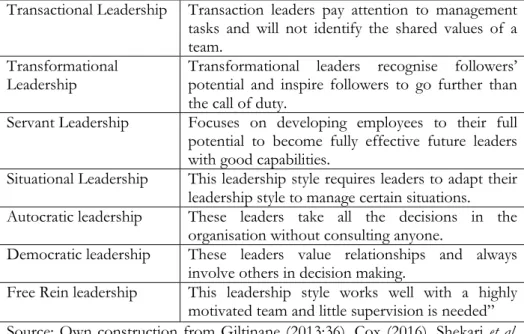
behaviour, abilities, knowledge that an individual has to serve as a strength. When such competencies manifest in a leader, the following leadership styles can be observed (Refer to Table 3).
Table 3: Leadership styles
Transactional Leadership Transaction leaders pay attention to management tasks and will not identify the shared values of a team.
Transformational
Leadership Transformational leaders recognise followers’
potential and inspire followers to go further than the call of duty.
Servant Leadership Focuses on developing employees to their full potential to become fully effective future leaders with good capabilities.
Situational Leadership This leadership style requires leaders to adapt their leadership style to manage certain situations.
Autocratic leadership These leaders take all the decisions in the organisation without consulting anyone.
Democratic leadership These leaders value relationships and always involve others in decision making.
Free Rein leadership This leadership style works well with a highly motivated team and little supervision is needed”
Source: Own construction from Giltinane (2013:36), Cox (2016), Shekari et al.
(2012:55) and Bishop (2013:1)
Table 3 above shows different leadership styles and differentiates one (1) from the other. Leadership style is how a leader behaves to influence employees (Jowah, 2016:11). According to Cox (2016:156), a leadership style tends to affect the whole organisation, including employee determination, ultimately affecting production and performance.
There are certain challenges facing leaders in local government, such as skills (Cox, 2016:158). Leaders in any organisation must demonstrate leadership skills such as interpersonal skills, flexibility, and the skill to mentor others and build trust. Leaders play a crucial role in assisting subordinates in realising their full potential (Shekari et al., 2012:55).
Beinecke (2009:7) argues that different organisational positions or levels require different skills. Those in the higher levels require transformative skills, while those in the lower levels require transactional skills.
Transformative skills are needed to resolve strategic challenges, while transactional skills are required to implement them. Leaders should
174
possess certain leadership abilities to be good leaders as listed below (Beinecke, 2009:7):
Need to be knowledge synthesisers;
Must be creative and innovative;
Need to create a vision and get others to commit and share the vision;
Must nurture and expedite collaboration;
Need to have the entrepreneurial capability;
Are systems thinkers;
Need to build teams;
Must set priorities; and
Act like a friend, colleague and humanitarian.
As can be seen above, leaders are a crucial component of an organisation. Without the capabilities mentioned above, leaders will not know what is expected of them and how to execute their functions effectively. If leaders in an organisation only know how to manage but not how to adapt and transform, organisational performance may suffer (Archbald, 2013:137). An effective leader should be able to predict the future from past events (Gibbs, 2013:10). According to Chlopczik (2014:267), for leaders to respond to economic challenges, they have to be familiar with the following important elements:
Self-reflection;
Individual ethics;
Create a shared responsibility in an organisation; and
Create a shared responsibility in social systems.
2.2 The principles of municipal financial management
Financial management can be defined as business management relevant to a farsighted use of financial resources to enable an organisation to carry out its activities to achieve its objectives (Ross, Westerfield &
Jordan, 2007:14). Cheruiyot et al. (2017:213) further add that financial management is a critical element of planning, decision-making and controlling activities and systems of an organisation. The pathetic state of municipal finances is becoming a consistent obstacle in terms of governance in South Africa.
175
For an organisation to operate efficiently, its financial resources should be managed effectively. In other words, resources should be used optimally to meet organisational goals. Albeit the Auditor-General assesses financial management and performance, internal controls and effective budget processes need to be established and secured. According to Molobela (2016:263), to measure the financial performance of a municipality, it is imperative that financial statements (statement of financial position, the budget, statement of financial performance and the cash flow statement) are reviewed and compared focusing on the current fiscal year and the previous financial years.
The national government prioritises financial management in the municipalities to enable them to meet the needs of the people and policy objectives of the country. With the massive demand for services by the citizens, especially from disadvantaged communities and the limited resources available for municipalities to render those services to meet the needs of the people, all limited and available resources should be utilised effectively and efficiently.
To manage finances effectively, financial managers in the municipality have to follow certain principles. These principles are tabled in Table 4 below.
Table 4: Principles of Financial Managers
Objective Set the financial priorities for municipalities.
Policies Prepare policies that will guide a municipality towards achieving its target.
Fiscal Plans Develop financial plans to allocate financial resources that will assist a municipality to perform.
Performance
review Evaluate whether or not a municipality has achieved its performance targets.
Deviations Establish if there are any material reasons for any deviations.
Remedial action Take corrective action if need be for future purposes.
Source: own construction from (Murana, 2015:6)
Finances of a municipality command the pace at which the administration or management of the municipality renders services to the people (Murana, 2015:6). Table 4 above outlines the principles management should follow in managing a municipality’s finances to
176
achieve its goals and objectives. The above-mentioned principles in Table 4 should be communicated to people involved in managing finances. In the same vein, resources and information should also be provided to employees to enhance financial practices in an organisation.
Financial management practices can be enhanced by planning properly for future events or activities of the organisation. Proper planning leads to positive cash flow for an organisation (Cheruiyot et al., 2017:213).
According to Jayashree and Priya (2016:1202), financial management is important because it helps leaders make proper decisions. Some leaders choose not to do what is required of them; as a result, municipalities suffer financial losses.
Municipalities in financial anguish are categorised by poor cash flow management, poor debt management and credit management (National Treasury, 2017:3). Financial management in the local government needs constant monitoring and management to ensure that resources are used optimally. This process needs to be led by the leaders of the municipality.
Municipal officials, particularly managers, cannot rely on old and outdated methods of managing finances. South Africa is still a fairly new democracy, and hence, its systems are also still new and developing.
There is a greater need to understand leadership’s role in managing municipal finances (Mello, 2018:2).
2.3 Municipal governance and service delivery
As is evident from the literature reviewed, there is a serious disjuncture between the policy that the government promulgates and the implementation needed for effective service delivery in some municipalities in South Africa. Through the allocation of a budget, the national government provides opportunities and capital for local government to deliver on the constitutional mandate to provide services to residents of municipalities. South African municipalities are not performing at the level required by law and residents. Most municipalities lack leaders who are skilled and competent to manage resources.
One of the reasons municipalities fail to fulfil their executive obligations is political instability that makes the municipalities not have proper governance structures and tools (Sebola, 2014). Lack of proper governance leads to collapse in municipal structures, thus leading to municipalities being placed under administration by the provincial governments in their respective provinces. In most instances, municipal leadership administrative lacks accountability (Mbandlwa et al., 2020:
1643).
177
Section 139 is one of the mechanisms used by the provincial government to intervene when there is instability in municipalities. The instability within these municipalities is caused by political interference and a lack of governance structures. Another reason is that many municipalities are not financially stable, often lacking a revenue base that can sustain expenditures necessary to honour its statutory obligations/liabilities. These include ESKOM, Medical Aids, Pension Funds and South African Revenue Service (SARS).
3. Problem Statement
There is persistent financial mismanagement in various municipalities in South Africa. The Auditor General’s (AG) office attest to this; as such, the then AG identified immense financial management challenges in municipalities in South Africa (Makwetu, 2018:1). Obviously, this is an alarming and urgent issue that leadership should pay attention to municipal financial management. For instance, the lack of effective financial management has been a problem in municipalities from 2010/11 to date (Maluleke:2020). Moreover, some researchers indicate a lack of understanding of leadership roles and styles for municipal financial management (Mbandlwa et al., 2020). Effective leadership in managing mismanagement of finances is crucial in South African municipalities to overcome these challenges.
The current AG found that the pitiable state of municipal finances is becoming a consistent obstacle in terms of governance in South Africa (Maluleke, 2020). Therefore, sound financial management is vital in any organisation, particularly municipalities with limited resources at their disposal. The South African constitution states that the provincial government should intervene when municipalities cannot fulfil their executive obligations. Specifically, this study seeks to answer whether or not leadership plays an effective role in municipal financial management.
4. The Aim of the Study
In dealing with the lack of leadership to effectively manage finances in municipalities, this study aimed to develop a leadership conceptual framework for effective municipal finances in South Africa.
178 5. Research Methodology
This is desktop research, where literature from different scholars is reviewed and discussed.
Desk research is a typical method commonly used to gather secondary data from internal resources, industry associations, government departments and agencies, from the Internet, other published work by scholars. Two thematic areas serve as important principles within the research approach that would assist municipalities in achieving their goals and objectives, resource allocation, and accountable leadership. A study conducted by Sebola (2014), revealed many leadership challenges, such as a high rate of senior management vacancies, which affects how municipalities function. The Auditor- General of South Africa, in his report on the state of municipality, found that municipalities lacked leadership, good governance, performance management and oversight, and that led to municipalities being allocated disclaimer audit opinions by the Auditor-General (Makwetu, 2018:2).
Sound financial management, improved skills of employees and compliance with legislation can assist a municipality in achieving clean audits (Mantzaris, 2014: 90).
6. Theories Underpinning the Study
There are several theories on leadership and financial management that academics and practitioners have discussed in the past few years. This study adopted the Theory of Reasoned Action (TRA), Theory of Financial Control, and Agency Theory to tease out the problem.
Theory of Reasoned Action was introduced by Icek Ajzen and Martin Fishbein in 1980.Using TRA, socio-economic issues and service delivery problems might be resolved within a municipality. This theory might assist a municipality in alleviating poverty and creating jobs within their municipal boundaries or jurisdiction. Theory of Reasoned Action suggests that a human’s performance of any task is determined by his or her willingness to perform certain functions (Satope, Akintunde &
Bosede, 2014: 175). This kind of theory fits the behaviour or problem to be explored in this research. Davis, Bagozzi, and Warshaw (1989) developed this theory to determine why managers resist doing certain functions within their scope of work. Figure 2 below depicts the TRA model by Otieno, Liyayla and Odongo (2015).
Otieno et al. (2015:5) conducted a study using the TRA, and they they wanted to assess the inconsistency between attitude and behaviour. The
179
study found that attitude and subjective norms influence the intention for managers to use computerised management systems, rather than superficial behavioural control that influence the intention to use computerised management systems. Theory of Reasoned Action can be used to conceptualise the human behavioural pattern of decision-makers in the municipality to manage the budgeting process. Moreover, this study will look at TRA to assist the municipality in addressing its problems. It is more realistic to study the exact behaviour of a leader instead of studying factors associated with the concept of leadership.
Zepp (2018:66) adds that it is important to look at what a good leader does rather than what a good leader is. Solid leadership theories are one of the most important tools that leaders can use to plan and achieve organisational goals with certainty in the uncertain environment they are operating in (Jowah, 2013:26).
Behavioural theories focus on what the leader does rather than their qualities (Sukkar, 2017:134). Other authors who have done research in this particular theory say that a human’s performance of certain behaviour is determined by his or her behavioural intention to execute the behaviour. Thus between the 1940s to 1950s this theory was introduced to focus on the actual behaviour of leaders. Other scholars have critiqued the behavioural leadership theory as lacking a theoretical contribution (Flocy, 2017:13).
According to Barling, Christie and Hoption (2011:np), behavioural theory's limitations and its inconsistencies led to the introduction of situational and contingency theories. Insignificant situations can give rise to consequential behavioural discrepancies to build a situational based theory based on the leader’s behaviour at a given time. Any leader that develops or adopts certain behaviour for a particular situation can become effective. The theory of reasoned action will blend in well with the behavioural theory, because the theory of reasoned action can be used effectively to conceptualise the human behavioural pattern of decision-makers to manage resources in an organisation (Otieno et al., 2015:2). The TRA is shown in Figure 2.
180
Figure 2: Theory of Reasoned Action (TRA) (Source: Otieno et al., 2015:2)
Figure 2 depicts the relationship between attitudes and human behaviour.
This theory provides useful information for anticipating the behaviours of leaders. This particular theory will look at the leadership behaviour in an organisation and what informs such behaviour and not who the leader is. The willingness, intention and behaviour of leaders to perform their duties is critical in the overall performance of an organisation, particularly in the public sector (Mafini, 2014:1).
According to Wakiriba, Ngahu and Wagoki (2014:106), officials working in the public sector should always strive towards improving financial management, budgeting, and changes in accounting reporting standards. Financial controls are policies that ensure management instructions and decisions are carried out with diligence (Wakiriba et al., 2014:10). El-Nafabi (2009, np) asserted that in many government departments, financial control systems and internal controls are weak and ineffective; as a result, public funds and assets of the departments cannot be safeguarded as required by the legislation. The theory of financial control states that existing financial management functions are essential for the survival of an organisation. This theory is relevant to this research given the fact that it will assist in teasing out the problems surrounding municipal finance matters in the selected municipality.
Agency theory describes how people should behave in an organisation; as a result, rules and regulations can be constructed around this expected behaviour to direct outcomes from all concerns. According to Tshipa (2017:90), the agency theory was developed by Jensen and Meckling in 1976to focus on the relationship between the agent and the principal. In the municipality context, the agent is the municipality management, while the principal is the constituency. In most instances,
Beliefs and evaluations
Attitude towards Behaviour
Normative beliefs and Motivation to comply
Subjective Norm
Intension Behaviour
181
managers of the municipality (Agents) act in their self-interest; they do not act in the best interest of the citizens; hence financial resources are not managed with diligence. The Agency theory is mostly concerned about the configuration of interests of the citizens and managers (Tshipa, 2017:90).
7. Conceptual Framework and Hypotheses Development
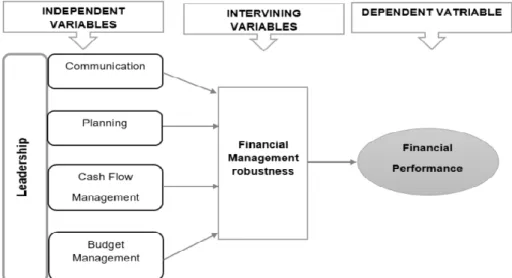
According to Jowah (2016:77), a conceptual framework illustrates how the variables used in the study will relate to each other. Furthermore, it narrates some experiences the researcher might have. Figure 3 below presents a proposed leadership framework for municipal financial management. This leadership framework was developed in parallel with the literature review. In this study, the authors used literature that will contribute to developing the conceptual framework. Figure 3 below illustrates the independent variables, intervening variables and dependent variables.
Figure 3: A proposed leadership framework for municipal financial management
(Source: Authors Construction)
The variables mentioned in Figure 3 are explained in detail below.
182 7.1 Communication
Communication is a key function that needs to be handled with diligence within an organisation. Thus, communicating organisational plans, strategies, goals and objectives positively affect any organisation’s performance, particularly in municipalities. Communication can be done formally or informally, and it can be done verbally or in writing. It is crucial that leaders in municipalities communicate municipal plans and needs to the right people/employees. Furthermore, leaders need to ensure that the information communicated to people is understood in an intended way. Thus communicating information effectively enables leaders and employees to manage financial resources effectively. There is a relationship between communication and effective municipal financial management robustness (Mafini, 2014:2).
7.2 Planning
According to Daft, Kendrick and Vershinina (2010:7), the determination of planning within an organisation is to identify its goals and objectives for future organisational performance and further assist management in deciding on effective resource allocation. Since planning entails making decisions about options, it is mostly a decision-making exercise conducted by a local leader of municipalities on how finances should be managed (Zweni & Jowah, 2018:22). There is a relationship between planning and effective municipal financial management robustness (Daft et al., 2010:7).
7.3 Cash Flow Management
Cash Flow Management is one of the vital accounting and financial management tools for the survival of any organisation, particularly government organisations such as municipalities (Coker & Adams, 2012:5). Effective cash flow management results in proper financial management within an entity. Cash flow management, in most instances, is achieved through realistic projections before the beginning of a financial year. Cash flow problems can affect the sustainability of an organisation, particularly government organisations. How revenue/
income will be collected needs to be outlined and communicated clearly by leaders to the municipality, in the same vein, plans of expenditure need to be detailed and outlined in the cash flow statement (Cheruiyot et al., 2017:230). This will assist municipalities in managing finances
183
effectively. According to Coker et al. (2012:5), there is a connection between cash flow management and municipal financial management robustness.
7.4 Budget Management
Budgets are management planning and control systems; thus, the effectiveness of budgeting depends on how it is organised in the municipality (Imuezerua & Chinomona, 2015:360). A budget is defined as a financial plan that summarises, in financial terms (income and expenditure), an organisation for a particular financial year (Abogun &
Fagbemi, 2012:177). Budgeting allows top management to shift their focus away from short-term objectives and the organisation’s day-to-day operations and into long-term goals (Zweni et al., 2018:118). According to Abogun et al., 2012:178), “One of the key benefits of budgeting is that it focuses on preparation, resource distribution, and profitability assessment to ensure that achieving organisational targets becomes the primary objective of budgeting”. Actual income and expenditure have to be monitored in the budget through regular financial reporting, and corrective action must be taken if actual performance is not in line with what was stated in the budget (Zweni et al., 2018: 122). Therefore, working out the municipality’s income and balancing this with the planned expenditure will lead to effective budget management. Thus, there is a relationship between budget management and municipal- financial management robustness (Abogun et al., 2012:178).
7.5 Financial Performance
Effective organisational performance demands effective management of financial resources to allocate scarce resources and utilise them optimally.
The ineffectiveness or lack of financial management systems negatively affects how resources are used to achieve organisational objectives, thus impacting the organisation’s overall performance (Mafini, 2014:2).
Managing finances effectively is one of the modalities of financial performance with which municipal leaders need to handle with diligence.
According to Cheruiyot et al. (2017:230), financial performance is measured by how an organisation can use its assets to generate revenue over a certain period. There is a relationship between financial robustness and financial performance (Mafini, 2014:2).
184 8. Conclusion
Since the management of finances varies between the private and public sectors, one of the most critical functions of municipal leaders is to ensure that municipal finances are not mismanaged and are handled with care (Zweni, 2017:70). In most municipalities, leaders find it difficult to manage finances due to a lack of financial management skills. In his report, the Auditor General of South Africa found that South African municipalities are managing Billions of Rands contrary to South African prescripts and Accounting standards and principles. Furthermore, the Auditor General reported that municipalities are underspending on their budgets. While there might be several reasons for such underspending, lack of leadership has been found to be the main contributor to this problem. That negatively affects how financial resources are managed, leading to compromised service delivery. This implies that limited resources are not managed properly. This study needed to develop a framework that would assist municipal leaders in managing finances effectively. If implemented properly, the proposed conceptual framework can assist and guide municipal leaders to manage municipal finance effectively.
As alluded to in the previous sections, the leadership that the study refers to is the municipality's administrative authority (municipal managers). According to Madumo (2012:86), administrative officials have a duty and a responsibility to ensure that the environment is conducive enough to achieve the developmental objectives of the municipality.
It can be noted with great concern that, in most instances, political leaders interfere with how finances are managed in municipalities. It is the responsibility of municipal managers to ensure that the municipality complies with all the legal prescripts to ensure credibility within the municipality. An alignment between political leadership and administrative leadership is crucial to achieving the common goal of the municipality, which is to deliver quality services to citizens. Quality services can be achieved through effective and robust financial management systems.
The conceptual framework can further ensure that financial management systems and policies are easily enforced and monitored to improve service delivery and improve residents' quality of life. Financial management systems should be responsive and accommodate mobility and be accessible to officials within a municipality (Mapitsa & Landau, 2019:4). This framework, if implemented correctly, can assist
185
municipalities and municipal entities in the South African context to manage their finances with diligence.
For a municipality to meet its goals, municipal managers should effectively manage financial resources by ensuring that the municipality’s plans are linked to the approved budget. Municipal success and financial management are inextricably linked. Through proper implementation of the proposed conceptual framework in this study, municipal managers will be able to connect different business activities or operational strategies with the expected deliverables of the municipality. Municipal managers must implement systems to help implement financial management systems (Thaba & Kanjere, 2014:1221).
Accountability is the first step municipal leaders (Managers) need to take towards effective financial management systems. Thaba et al.
(2014:1223) posit that accountability and responsibility in municipalities can be measured by the utilisation of scarce resources efficiently.
Municipal managers need to use public funds transparently so that citizens, Provincial and National government can hold municipalities accountable (Madumo, 2012:86).
References
Ajzen, I., & Fishbein, M. (1980). Understanding attitudes and predicting social behavior. Englewood Cliffs, NJ: Prentice-Hall.
Archbald, D. 2013. Vision and Leadership: Problem-based Learning as a Teaching Tool. Journal of Leadership Education. Vol 12(2):136-147 Barling, J., Christie, A., & Hoption, C. 2011. Leadership. In S. Zedeck
(Ed.), APA handbook of industrial and organizational psychology, Vol 1: Building and developing the organization. APA Handbooks in Psychology: 183– 240. American Psychological Association.
Beinecke, R.H. 2009. Introduction: Leadership for Wicked Problems. The Innovation Journal: The Public Sector Innovation Journal. Vol 14(1):1-17 Bishop, W.H. 2013.Defining the Authenticity in Authentic Leadership.
The Journal of Values-Based Leadership. Vol 6(1):1-9
Cheruiyot, P.M., Oketch,J.R., Namusonge,G.S., Sakwa,M.2017. Effect of public financial management practices on performance in kericho county government, kenya: a critical review. International Journal of Education and Research. Vol 5(12): 211-224
Chlopczik, A. 2014. Magic Moments- Otto Scharmer’s Theory U and its implications for Personal and Organizational Development. Gestalt Theory. Vol 36(3): 267-278
186
Coker, M.A., Adams, J.A. 2012. Challenges of Managing Local Government Finance in Nigeria: Research on Humanities and Social Sciences.Vol.2(3):1-12
Cox, A. Leadership and Management Roles: Challenges and Success Strategies. AORN Journal. Vol 104(2):154-160
Daft, R.L. Kendrick, M. & N, Vershinina. 2010. Management. London:
Cengage Learning EMEA
Davis, F.D., Bagozzi, R.P. and Warshaw, P.R. 1989. User Acceptance of Computer Technology: A Comparison of Two Theoretical Models.
Management Science. Vol 35(8): 982-1003.
El-Nafbi, H. M. 2008. The role of public sector audit and financial control systems in safeguarding public funds in Sudan. Journal of Economics & Administration. Vol 2(1): 1-11
Fairholm, M.R.2009. Leadership and Organizational Strategy. The Innovation Journal: The Public Sector Innovation Journal. Vol 14(1): 1-16 Flocy, J. 2017. Responsible leadership: A behavioural perspective.
Doctoral Dissertation Submitted to Lee Kong Chian School of Business.
Gibbs, G. (2013). Reflections on the changing nature of educational development. International Journal for Academic Development, Vol 18(1): 4–14. doi.org/10.1080/1360144X.2013.751691
Giltinane, C.L. 2013. Leadership styles and theories. Nursing Standard. Vol 27(41): 35-39
Hellriegel, D., Slocum, J.W., Jackson, S.E., Amos, T., Klopper, H.B., Louw, L., Louw, M., Oosthuizen, T., Perks, S., Staude, G., Zindiwe, S. 2011. Management. 4th South African Edition. OXFORD University Press. South Africa
Imuezerua,E., Chinomona, E. 2015. Analysing the concept of municipal budgeting and service delivery pattern in a South African Municipality. Mediterranean Journal of Social Sciences. Vol 6(1): 359-367 Jayashree, G; Priya,I.C.M.2016. A study on the financial management
concepts for organizational success. Imperial Journal of Interdisciplinary Research.Vol 2(12):1201-1204
Jowah, L. E. 2013. Critical core competencies for effective project leadership in the presence of the authority gap. Doctoral thesis published at NMMU Business School.
Jowah, L.E. 2016. The impact of leadership styles on effective project execution. Sky Journal of Business Administration and Management. Vol 4(3): 10-17
Koma, S.B. 2010. The state of local government in South Africa: Issues, trends and options. Journal of Public Administration. Vol 45(11):111-120
187
Madumo, O.S. 2012. Contexualising leadership challenges in municipalities: A developmental impression. African Journal of Public Affairs. Vol 5(3): 82-92
Mafini, C. 2014. The relationship between organisational resources and organisational performance in a National Government department.
Doctoral Thesis. Faculty of Management Sciences. Vaal University of Technology.
Makwetu, K., (Auditor General of South Africa) 2018, Auditor-general reports marginal improvements in local government audit results, media release, Pretoria, viewed 20 January 2020, from https://www.agsa.co.za/Portals/0/AGSAReports/MFMA201516/2 015-16%20MFMA%20media%20release.pdf
Mantzaris, E. 2014. Municipal financial management to fight corruption and enhance development: A holistic approach. African Journal of Public Affairs. Vol 7(2): 80-92
Mapitsa, C.B., Landau, L. 2019. Measuring Municipal Capacity to respond to Mobility. SAGE Open. 1-11. https://doi.org/10.1177/
2158244019829565
Mbandlwa, Z., Dorasamy , N., Fagbadebo, O. 2020. Leadership challenges in the South African local government system. Journal of Critical Reviews. 1642- 1653
Mello, D.M., 2018. Monitoring and evaluation: The missing link in South African municipalities. The Journal for Transdisciplinary Research in Southern Africa. Vol 14(1): 1-6
Mmamokgothu, T.L. 2011. The impact of leadership in the acceleration of service delivery in the Department of Health and Social Development, Capricorn district. Masters thesis. Faculty of Management Sciences and Law. University of Limpopo
Molobela, T.T. 2016. The effect of revenue planning on municipal financial performance: A case study of the Polokwane local municipality in the Limpopo province. SAAPAM Limpopo Chapter 5th 262 Annual Conference Proceedings. University of Limpopo
Municipal Data and Intelligence. 2017, Service delivery protests up in this election year, media release. Viewed 15 February 2019, from http://www.municipaliq.co.za/publications/press/20160511090434 1573.doc
Murana, A.O. 2015. Local government finance in Nigeria: A case study of Iwo local government area of Osun state: International Journal of Politics and Good Governance. Vol.4(6):1-29
National Treasury. 2017. In Year management, monitoring and reporting. National Treasury.
188
Otieno, O.C., Liyayla, S., Odongo, B.C. 2015. Theoretical and Practical Implications of Applying Theory of Reasoned Action in an Information Systems Study. Open Access Library Journal. Vol 2:1-5 Ross, Westerfield, Jordan. (2007). 5th Edn. Essentials of Corporate
Finance. McGrawHill Co. New York.
Satope, F.B., Akintunde,T.S., Bosende,O.C. 2014. Effect of Leadership behaviour on labour (employees’) turnover: A case study of Nigerian Universities. Journal of Leadership and Management studies. Vol 1(2):173- 184
Sebola, M.P. 2014. Research in South African Public Administration: The Paradox of Science, Politics and Economics of a Public Policy.
Bangladesh e-Journal of Sociology. Vol 11(2): 29-40
Sethuraman, K., Suresh,J.2014. Effective Leadership styles. International Business Research. Vol 7(9): 165-172
Shekari, H., Nikooparvar, M.Z. 2012. Promoting Leadership Effectiveness in Organizations: A Case Study on the Involved Factors of Servant Leadership. International Journal of Business Administration. Vol 3(1): 54-65
Siswana, B. 2007. Leadership and governance in the South African Public Service: An overview of the public finance management system.
Doctorate thesis. Faculty of Economic and Management Sciences.
University of Pretoria
Sukkar, A.E. 2017. Culture Influences and Leadership Theories, a Case Study: Egyptian Culture. Journal of Basic and Applied Research. Vol 3(4):133-135
Thaba, K.L., Kanjere, M.M. 2014. The experience of Municipal Management on the Implementation of Performance Management Systems in Lepelle-Nkumpi Local Municipality, in Limpopo Province. Mediterranean Journal of Social Sciences. Vol 5(27): 1216- 1121.
DOI:10.5901/mjss.2014.v5n27p1216
Tshipa, J.2017. Corporate Governance and Financial Performance: A Study of companies listed on the Johannesburg Stock Exchange.
PHD thesis, Faculty of Economic and Management Sciences, University of Pretoria
Van Wart,M. 2015. Dynamics of Leadership in Public Service: Theory and Practice. 2nd Edition. Routledge. New York. USA
Wakiriba,J.W., Ngahu,S., Wagoki,J.2014. Effects of Financial Controls on Financial Management In Kenya’s Public Sector: A Case Of National Government Departments In Mirangine Sub-County, Nyandarua County. Journal of Business and Management. Vol 16(10):105-115
189
Zepp, R.A.2018. Perceptions of Good and Bad Leaders by Philippine Teachers. Journal of Management and Strategy. Vol 9(1):66-81
Zweni, A.G. 2017. Factors affecting management of budgets at a department in the western cape government, South Africa. Masters Thesis, Faculty of Business and Management Sciences. Cape Peninsula University of Technology. South Africa
Zweni, A.G., Jowah, L.E.2018. An Exploration of Involvement of Budget Managers in the Budget Development Process: A Case of Western Cape Department of Social Development. Journal of Public Administration and Development Alternatives. Vol.2(2):118-132