USmakade, the Almighty who gave me wisdom, strength and guidance in the process of carrying out this study. The main finding of this study was that employees were not adequately trained in the use of this tool.
LIST OF TABLES
CHAPTER ONE
OVERVIEW OF THE STUDY
- Introduction
- Background of the study
- Statement of the research problem
- Aim of the study
- Research objectives
- Research questions
- Organisation of study
- Concluding summary
However, there is still a need to move from old forms of contract management to NEC implementation. The exceptional qualities of NEC justify its introduction into the TNPA procurement process.
CHAPTER TWO
LITERATURE REVIEW
Introduction
Defining change management
The consensus in the literature is that in the change management process there must be planning at both company and personal level, where the process is controlled and stabilized (Singh, Saeed and Berch, 2012), while at the same time reacting easily and flexibly to the internal and external environments that Sujova and Rajnoha (2012) add. To be able to manage change effectively, the role players need to understand the change processes as well as their models.
Change management models
- Kotter’s model
Gerdsri, Assakul and Vatananan warn that “if change is not well managed, resistance will impact the change effort and may increase its cost, delay its completion, or even jeopardize the survival of change” .
Establish a sense of urgency
Form a powerful high level coalition to guide and lead the changes
Create a vision of the organisation’s future
Communicate that vision widely, repeatedly and consistently
Empower people in the organisation to act on the vision
Plan for visible short-term performance improvements
Consolidate improvements and produce more change
Anchor new approaches in the corporate culture
- Kurt Lewin’s model
- Doppelt’s model
- Prosci ADKAR model
- Resistance to change
- Definitions of resistance to change
- Employee response to change
- Managerial response to change
- Communicating change
- Training during change management
- Overcoming resistance to change
- Learning organisation
- Characteristics of learning organisation
- Leadership roles in organisations
- Concluding summary
According to Bellanca (2010), resistance to change in the workplace can be observed in several ways. Scheid (2011) points out that when employees do not understand the need for changes, there is very little chance that the organization will accept them, while employees will accept changes if the changes are communicated early and effectively. which takes place periodically.
CHAPTER THREE
OVERVIEW OF THE NEW ENGINEERING CONTRACT
Introduction
TNPA: An overview
This is the portion of the R46.9 billion that is expected to be spent over the next seven years (Ports SA, 2012). This requires that all government bodies in South Africa meet the requirements of the Standard for Uniformity in Construction Procurement (Baird, 2011).
Procurement Process for Construction and Engineering
From time to time, external experts are invited, depending on the nature of the decision to be made. An approved demand document will then trigger the next stage of the procurement process, such as a procurement strategy. If necessary, an on-site meeting will be held prior to the closing date to clarify any issues that may arise regarding the technical and commercial specifications of the bid.
The requesting user department members, who are professionals, will conduct the technical review in the presence of purchasing and minutes of the meeting will be taken. Procurement will then conduct the commercial and financial evaluation, based on the appropriate approved strategy, and shortlist bidders. A contract is then drawn up and approved by the company's legal experts, which includes the offer and all conditions of the offer.
Evolution of the NEC in Transnet SOC LTD
As stated earlier, information on the above contracts is obtained from the website dedicated to the development of the NEC. Being an international commissioning tool, the NEC also gives users the tools to leverage their skills and apply them to the environment in which they work (Baird, 2006). A key aspect of the NEC was to move away from a reactive and retrospective approach to decision-making and management to one that is forward-looking and fosters a creative environment with proactive and collaborative relationships.
There is still a need to move from the numerous current contract management forms that Transnet ports still use, to the NEC. The NEC is the preferred contract for Transnet SOC. Therefore, a large number of capital projects are being implemented within the organization. The NEC form provides that such requirements can be inserted as additional clauses under “Option Z”.
Moving towards NEC as a form of contract
Baird (2011) points out that the NEC family was extensively updated in 2005 and that all contracts within the new extended family are named "NEC". Some of the contracts are in their third edition, while others are still in their second edition. The new members of the family deal with the procurement of services and supply category.
Along with established engineering and construction contracts and professional services, the extended family now covers all aspects of procurement using modern project management principles. This website states that the initial use of the NEC form of contract quickly grew to include a list of top South African government organizations and private corporations. Transnet, the employer, can choose how or what the basis for payment is and how the risk is shared between the parties involved by choosing the right contract from the NEC family of contracts.
Characteristics of the NEC
- Flexibility
- Clarity and simplicity
- Stimulus good management
NEC family of contracts
The ECSS can be used for low-risk and direct contracts to appoint the subcontractor, when the main contractor is appointed to the ECC or ECSC. TSSC is an alternative to TCS and is used for simple and straightforward contracts that do not require sophisticated management skills and is used for low-risk contracts. SC is used for domestic and international procurement of high-value goods and related services, including design, for example, supply and distribution of tugboats, helicopters, ships, trains, wagons, electrical components of wooden and steel beams, etc.
SSC is used for domestic and international low-risk procurement of single order or group order goods. The RFQ is used to appoint one or more suppliers to carry out construction work or to provide design or consultancy services on an "as instructed" basis for a specified term. When the NEC contract is concluded, the format of professional, supply and service contracts is the same.
The structure of the NEC Contract
- Nine (9) core clauses
- Main Option Clauses
- Secondary options
Access dates are also indicated in the contract data, which allows the contractor to access different parts of the website. The Project Manager shall estimate the work completed and the amount due at each assessment date as specified in the contract information provided by the Employer. Confirmed payment will be made within three weeks of the valuation date as specified in the contract details.
It must be clearly stated that the contractor's equipment, machinery, people and risks are not the responsibility of the employer. This option can be used to assist the contractor with cash flow to purchase equipment early in the contract. This payment is made before the first assessment of the amount owed by the project manager.
Concluding summary
This option can be used to pay incentives or bonuses to the contractor for exceeding performance. This should be evident from the tender data; alternatively, the employer can set specific objectives that are important to him and ask the tenderers to propose appropriate Key Performance Indicators (KPIs). The use of KPIs is to encourage the bidders to perform and it should only be used as an incentive, not as a penalty.
This option can be used in cases not covered by the NEC where there are deviations, even though it is clear that the contractor is delivering works in accordance with the Works Information.
CHAPTER FOUR
RESEARCH METHODOLOGY
- Introduction
- Research objectives
- Research questions
- Research design
- Research philosophy
- Research methodology
- Research instrument
- Questionnaire construction
- Pilot study
- Administration of the questionnaire
- Test for reliability
- Test for validity
- Sampling procedure
- Target population
- Access to sample
- Sampling technique
- Sample size
- Characteristics of the sample The sample was made up of
- Data analysis
- Ethical considerations
- Ensuring participants have given informed consent
- Ensuring no harm is caused to participants
- Ensuring confidentiality and anonymity
- Ensuring that permission is obtained
- Limitation of study
- Concluding summary
Govender sees face validity as "realistically looking at the instrument and making the results believable to the common audience." According to Govender, content validity refers to the extent to which the measure assesses the broad characteristics of the study. Sampling is the process used to select a sufficient number of appropriate elements drawn from the population so that studying the sample and understanding its properties enable the researcher to generalize to the elements of the population (Sekaran and Bougie, 2009).
The target population for this study consisted of all qualified employees who are part of the inter-. Snowball sampling is used when it is not easy to identify members of the desired population. Out of the 400 questionnaires that were distributed only 200 were completed and returned and this made the sample size of this study.
CHAPTER FIVE
PRESENTATION AND DISCUSSION OF RESULTS
Introduction
Results and discussion
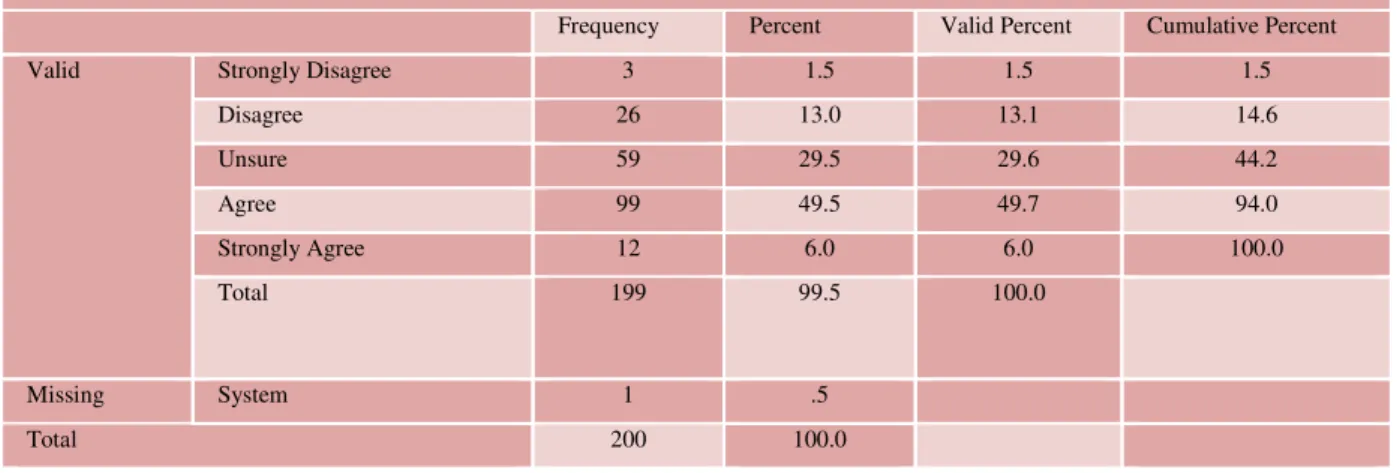
According to Table 5.21, the general level of the NEC's use in TNPA was still very low. Correlation between the role of the managers and the organizational factors Total role of the. Predictors: (Constant), Total of the NEC knowledge, Total of organizational factors, Total role of the managers b.

Concluding summary
CHAPTER SIX
CONCLUSION AND RECOMMENDATIONS
- Introduction
- Addressing the research objectives
- To establish the organisational factors that hinder the process of changing to the NEC form
- To ascertain the role of managers in facilitating the change
- To establish the individual factors that hinder the process of changing to the NEC
- Recommendations
- Improve on training, learning and skills development
- Promote communication and information sharing
- Top management to develop a strategy to promote NEC usage across the TNPA
- Mentoring and coaching extended to TNPA
- Proposed future research
- Concluding summary
Not sharing information can result in bottlenecks in the initial phase of implementing the NEC. The third objective of the study was to identify the individual factors that hinder the process of change to the NEC. The results indicated that the majority of all management levels are aware of the NEC.
Rapid implementation of practical experience is essential for the successful implementation of the NEC in TNPA. Mentoring and coaching programs should be designed and aligned with the organization's mission and objectives. The findings also indicate that the prevailing conditions within TNPA are not those of a learning organization which has had an impact on employees in implementing the NEC.
RESEARCH QUESTIONNAIRE
- Gender
- Number of years at TNPA 6. Position in the organisation
- Implementing new tools helps this organisation to work towards the organisational vision and operational objectives
- Employees are eager to share information about what does or does not work in our organisation
- Newly hired and experienced employees always receive training when new initiatives are launched
- In our organisation, managers establish forums and provide time and resources for identifying and solving problems and organisational challenges
- Working in teams is supported in our organisation through training
- Managers and leaders do coach and mentor their subordinates
- Managers are continually looking for opportunities to train and develop subordinates
- I do know that there is a new form of contract, the NEC Strongly
- I have been trained on and I understand the NEC form of contract
- Our department is using the NEC form of contract Strongly
- I am in favour of the NEC because it encourages collaboration Strongly
- I am in favour of the NEC because it facilitates communication in the organisation
- Although changing to the NEC is important, I feel more comfortable with what I am used to than the unknown
- I don’t feel comfortable with the new form of contract; it changes the systems we are used to
- I don’t see the need for the change; things have been working pretty well without this new form of contract
- I try not to think about the NEC because when I do, I get stressed out
- I don’t really think changing to the NEC was necessary
- Changing to the NEC will benefit the organisation in the long term
- I feel that as employees we need to embrace new ways of doing things
- The NEC is just another trick to take away people’s jobs
- Xaba (Researcher) Date
Employees are eager to share information about what is working or not working in our organization. While switching to NEC is important, I feel more comfortable with what I'm used to than the unknown. I do not feel comfortable with the new form of contract; it changes the systems we are used to.
I don't see the need for change; things have worked well enough without this new form of contract. With your participation, I hope to understand the reasons for the delayed adaptation of this new form of contract in the company. The results of this survey are intended to contribute to a better understanding of the factors involved.
Exploring the contribution of the virtual world to learning in organizations [Online] http.//www.sagepublications .com: 263-285. An opportunity to reduce resistance to change in the process of organizational change, West University, Faculty of Economics and Business Administration. The role of organizational commitment in the analysis of resistance to change: co-predictor and moderator effects.
The relationship between psychological contract fulfillment and resistance to change during organizational transformations.