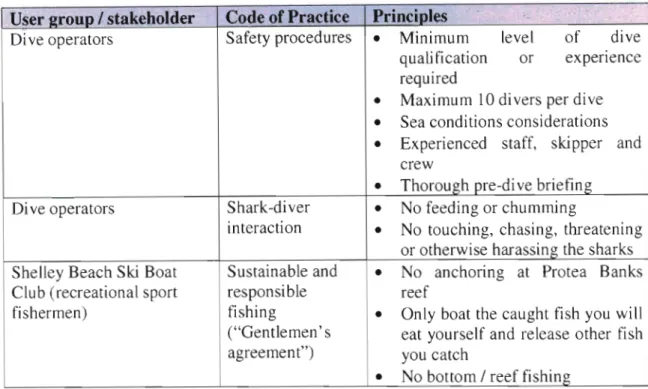
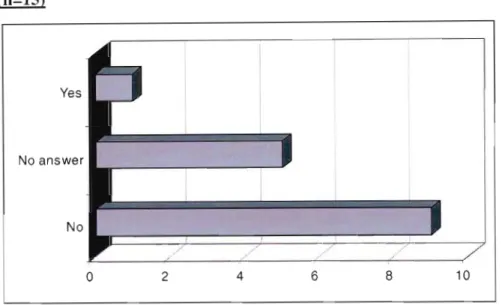
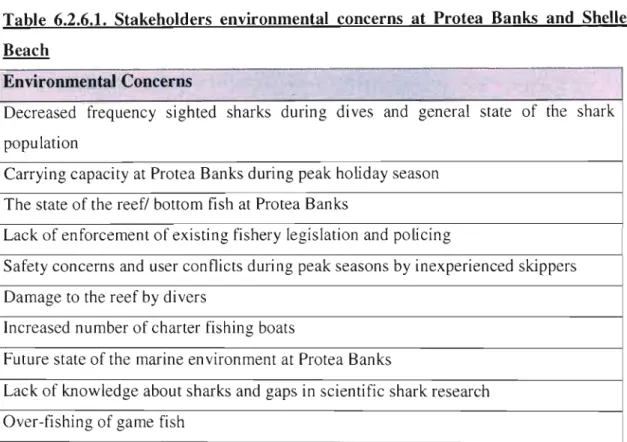
This study looks at marine tourism and sharks using the Protea Banks as a case study for marine tourism and management. Current user groups and direct stakeholders at Protea Banks 91 Table 6.2.2.Code of Practice developed by.
INTRODUCTION
- Sustainable developm ent and sustainability
- Tourism, sustainability and ecotourism
- Tourism and ecotourism in South Africa
- Marine tourism in South Africa
- Marine tourism and diving in KwaZulu-Natal
- A brief introduction of the study area Protea Banks
- Prev ious st udies conducted at Protea Banks
- Rational for the study
- Aim and objectives of the study
- Chapter outline
An important element of eco-tourism and one of the necessary components that separate eco-tourism from tourism is interpretation. Ecotourist is not only observing the natural environment or animals, but also learning about them and realizing their value. The development of ecotourism in South Africa is based on a controversial background. Wild animals were mainly used by the English and Africans, who hunted either for commercial or sporting purposes.
THE STUDY AREA: PROTEA BANKS
- Recreational fishing at Protea Banks and boat launches from Shelley Beach
- Different user groups and conflict at Protea Banks
- Legislation applicable for Protea Banks
- Shark regulations in South Africa
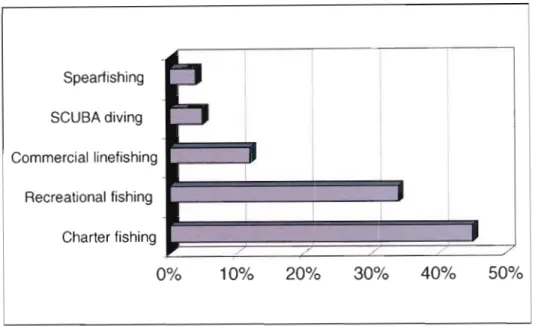
The target species for charter fishing are bottom (reef) fish (43%), gamefish (4 1%), billfish (15%) and sharks (1%). The fishing effort and the target species depend on the season. First, the Sea Shore Act of 1935. The law states that the waters from hizh.
MA RINE TOURISM: MANA GEMENT AND CONSERVATION
Introduction to marine tourism
The impact of tourism on marine areas has seen a growing concern and issues related to the sustainability of tourism in general have affected marine tourism research. It is not only the tourism industry that causes negative impacts on the marine environment.
Marine tourism management
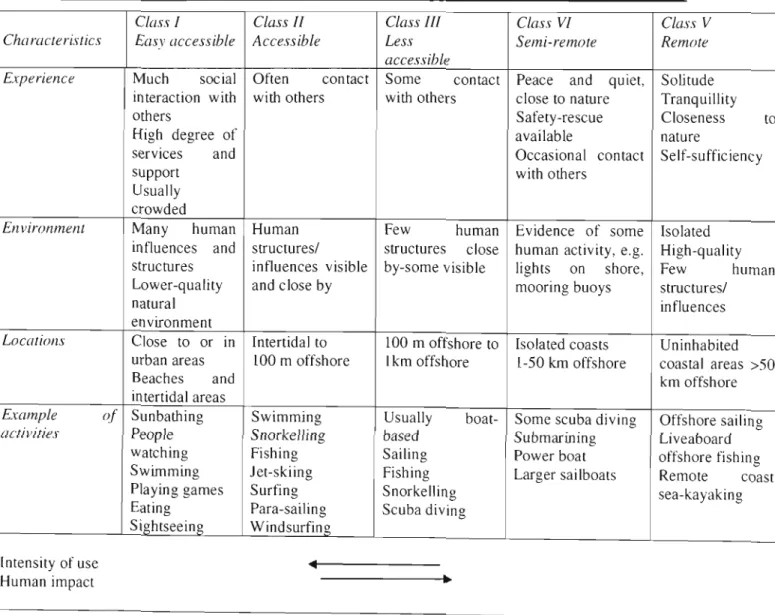
A further development of TOS is the Ecotouri sm Opportunity Spectrum (ECOS). The model has eight factors considered essential for ecotourism, including access, compatibility between ecotourists and other users of the area, attractions and infrastructure, skills and knowledge requirements, social interaction, and human type or need for control. This task is carried out by the CSIR Division of Water, Environment and Forest Technology on behalf of the Ministry of Environment and Tourism. CSIR has developed a set of coastal indicators for monitoring coastal areas.
Marine tourism and SCUBA diving
The Great Trade Ui te Shark cage diving has been organized since 1992 in South Africa. The main attraction for White Shark cage diving is the international market and some local tourist spots from Gaut en g. South Africa has a long history of sport fishing. The east coast was and still is a popular area for spea rfis hing (Condon, 1971).
Marine conservat ion and tourism
The future of many aquatic species may depend on the conservation and protection of areas and species (Moyle & Leid y,1992). Another key problem is the overexploitation of certain species that may be leading species. Marine protected areas can be instrumental in addressing problems such as marine ecosystem degradation and endangered species (Robinson,1995).
Marine Protected Areas
Five new WMPAs were established in 2005, and South Africa now has a total of 19 MPAs. The new areas include Bird Island Marine and Namaqua land reserves, which are absolute. In addition, the MPAs are considered important in the protection of importation areas and habits of importation stages in different fish life cycles, increasing overall fisheries in South African waters (DE AT, 2005c). a target is a minimum of 20% as stated at the World Parks Congress held in Durban in 2004. Responsibility for the management of the MPAs is a joint collaboration between Marine and Coastal Management under the national government, the South African National Parks and Ezem velo KwaZulu-Nat al Wildlife (MCM, 2005a). The protection of biodiversity is considered imperative in the context of the establishment of MPAs. A conflict resolution process or the process of establishing a nature reserve is similar to the Environmental Impact Assessment (EIA) process. The first step in a conflict resolution process is to determine the different roles of the participants. Second, there should be an assessment of the conflict, determining who it includes, in addition to gathering other relevant information.
METHODOLOGY
- Qualitative methods
- Methods and techniques used in the study
- Processing and ana lysis of primary data
- Limitations of the study and its methods
General questions about marine tourism and shark management in South Africa were asked. The second part of the interview relates to the management of Protea Banks' recreational fishing and diving. Description should include situational content as it may affect the data and its collection. The situational context covers social environment and context t,spatia lare na (place) and time frames. These subthemes must all be internally consistent (refer to the same issue), conceptually related and analytically useful (related to the aim and objectives). The division of category data into sub-the mes is called (Kitchen & Tate, 2000).
PERCEPTIONS AND MANAGEMENT OF SHARKS
Introduction
Sharks and marine tourism history on the KwaZulu -Natal Sou th Coast;
Stat attacks on the Natal Coast and the Austrian Coast were red, but with some difficulty. The Australian coastline used in comparison included a total of 12,210 miles while the Natal Coast is only 360 miles. The boy's body was taken to the beach, but he was almost dead because of his injuries (8). The third shark attack in just one week (two of which were fatal) during December occurred on December 24th. in the view of over 200 Christmas holidaymakers. After the attack on 30 December 1957, the bath was temporarily closed by Margate Town Council to allow time for the lagoon to be closed using sandbags. The process of installing permanent shark fences in the area began (11).
Human perception of sharks
But for humans, these statistics may not be that important. The fact is that people are still afraid of sharks and the thought of being attacked, bitten and perhaps eaten by animals that are stronger, bigger and more dangerous than any human. terrible for most people. Shark killing used to be a popular sport among male divers and spear fishermen in South Africa. The south coast of Natal was popular with spear fishermen, but especially in winter due to poor visibility due to river runoff in summer (Codon, 1971). It is illegal to harm, buy, sell or possess an endangered red species (CoA, 2005). The protection of the Gray Nurse Shark in Australia is an example of how increased knowledge about a shark species has led to the realization of how vulnerable they are to human impacts and the need for environmentally sustainable people to ensure the sharks' survival.
Recent shark attacks in South Africa
Nature programs about sharks on TV, books and magazine articles about sharks help create a different attitude towards sharks and a view towards protection (although sen sati onali sm is still very much present). Sharks are beginning to appear on endangered species lists, and environmental non-governmental organizations (NGOs) such as the World Wildlife Foundation support research and studies on sharks. Furthermore, there are few small states or small NGO regimes focused on sharks and conservation, in addition to public awareness of sharks (Gribbleetal., 1998). Thus, the continuous role of blood loss, in addition to liquid acemen, is most important in the given situation (Woolge et al., 200 1).
International shark fishing and management
Furthermore, most of the sharks caught are not used for scientific research (unlike South Africa) but thrown into the sea (Stevens, 2002). Examples from Ireland, Norway and California of targeted shark fisheries show that catches are highest in the first few years of systematic fishing, followed very quickly. International concern about the ecological effects of the growing demand for and trade in shark products, coupled with poor knowledge of global shark stocks, became a topic of increasing debate around the world in the early 1990s.
RESULTS AND DISCUSSION
Introduction
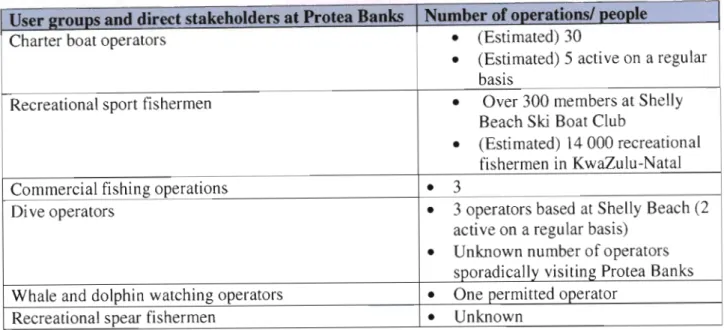
Objective J: The current user groups and direct stakeholders at Protea Banks Objective I of the study was to identify the current user groups and direct stakeholders at Protea Banks. All stakeholders were aware of this specific conflict at Protea Banks. The results of the survey showed that the majority of stakeholders were not in favor of establishing Protea Banks as a marine protected area.
Overview of the main findings
Another concern is that fees will be introduced. The fee system to be paid Protea Banks is occasionally dived by several dive operators, but only two main operators based at Shelley Beach regularly take divers to the reef. The largest operator has three boats but rarely operates at full capacity. Divers are thoroughly briefed on dive depth and dive plan. The initial location of the dive will be the north or south tip depending on the currents.
CONCLUSION AND RECOMENDATIONS
Concluding remarks
Recommendations towards a s ite specific management plan for Protea Banks
Research is needed to determine the sustainable limit on the number of users. The user priority should be given to the existing and established users. There is a significant gap in shark research in South Africa. It is recommended that specific research be conducted on sharks, their abundance and behavior and the general condition of the South African shark species. There is currently no specific legislation, but there are various guidelines or codes of conduct.
International Action Plan for the Conservation and Management of Sharks (IPOA).FAD, IUCN.Available online: www.fao.org. WWF) (2003). The state of the marine protected area in South Africa. Available on the website: www.panda.org.za/marine docslstate mpa.pdf. Touri smK waZulu-N at al (2005c). Available online: www.kzn.org.zald bnscoastsc uba.jpg.
Anti-shar kenclos ures Newspaper unknown to non-Europeans at Margate.Council reacts quickly to Saturday's deaths.Newspaper unknown.
LIST OF INTERVIEW PARTICIPANTS
DIVING WITH SHARKS CODE OF CONDUCT USED AT PROTEA BANKS BY ANDY COBB ,
ANDY COBB ECO DIVING
Shark Diving Code of Conduct
DIV IN G RESPONSIBLY WI TH SHARKS