35
The Role of Municipal Officials in Financial Crimes and the Effects Thereof: A Conceptual Framework to
Combat Financial Crimes in South African Municipalities
DOI: https://doi.org/10.31920/2516-5305/2022/19n4a2
Abongile Zweni
Department of Accounting and Economics Faculty of Economic and Management Sciences
Sol Plaatje University Kimberley, South Africa Email: [email protected]
&
Bingwen Yan
Department of Industrial and Systems Engineering Faculty of Engineering and the Built Environment
Cape Peninsula University of Technology Email: [email protected]
Abstract
The laws that govern financial management in South Africa are ignored by municipal officials at all levels. The disregard of statutes by municipal officials is a norm rather than an exception. As such, poor financial management controls and effective application of legislation put municipalities under enormous financial pressure. These predicaments have a negative impact on the provision of services to citizens; therefore, it is imperative that the finances
ISSN: 1744-2532 (Print) ISSN: 2516-5305 (Online)
Indexed by: SCOPUS, IBSS, EBSCO, COPERNICUS, ERIH PLUS, ProQuest, J-Gate and Sabinet
Vol. 19, (No. 3), December 2022 pp 35–57
36
of municipalities are managed and handled with diligence. This study aimed to propose a conceptual framework to assist municipalities in implementing financial controls to combat and deal with financial crimes. The study used a qualitative approach in the form of desktop and secondary data analysis. The study found that municipal employees disregard legislation such as the Municipal Finance Management Act 56 of 2003 when it comes to financial management, and as such public funds are constantly abused by municipal officials. The study concludes that financial crimes negatively affect the financial performance of municipalites, ultimately affecting the delivery of services. On that note, the study recommends stricter financial management controls and the enforcement of laws and policies. This study further recommends municipalities that are found to have mismanaged finances should be referred to Financial Intelligence for futher invesigations.
Keywords: Fraud, Corruption, Municipalities, Financial Crimes
1. Introduction
Since 1994, South Africa has seen an increase in financial crimes, particularly in the local government division such as municipalities.
Municipal resources are constantly redirected to private citizens or private organisations; thus, constituencies are always left suffering due to lack of services from their respective municipalities (Hasan, Agustang, Kahar & Tahir, 2019:189). Consequently, the increase in financial crimes in South Africa is alarming and affects the country‘s economic growth and development. The study will use the Venda Building Society (VBS) as a case study to illustrate the effects of financial crimes in municipalities. Furthermore, the study will provide insights on the role municipal officials played in financial crimes committed by VBS Bank executives ‗organized crime‘. Fafore and Adekoye (2019:110) define organized crime as ‗continuous planned criminal activities with some sort of organizational division of labor, which also applies to business practices‘.
In 2018, Advocate (Adv) Terry Motau SC was appointed by the Deputy Governor of the South African Reserve Bank in terms of the Financial Sector Regulation Act 9 of 2017, to conduct an investigation into the affairs of the VBS Bank. This decision was taken by the Deputy Governor after the curator (SizweNtsalubaGobodo Advisory Services), found that there were massive losses in VBS Bank. Political officials and
37
the administrative layer of municipalities were involved in the alleged financial misconduct (Motau, 2018).
2. Objective
Mismanagement of funds and financial irregularities have been traits of some South African municipalities (Machinjike & Bonga, 2021). Thus, the objective of this study was to develop a conceptual framework to combat financial crimes in South African municipalities.
3. Background
South Africa and Nigeria have registered the highest number of fraud cases on the African continent. The high number of fraud cases in these two countries is related to the size of their economies; therefore, increases in fraud cases are expected (Net Guardians, 2014: 11). In November 2005, former President Thabo Mbeki noted the rife in corruption in Local government and stated the following:
This unseemly scramble for political power in Local Government appears to be driven by the desire to abuse elected positions to lay hands on the economic resources that local authorities have the ability to access.
The South African Government has established several anticorruption agencies, which include the following; South African Police Services (Commercial Branch), Office for Serious Economic Offences, Special Investigation Unit (previously Heath Special Investigating Unit), Directorate of Special Operations (Scorpions), Independent Complaints Directorate, National Directorate of Public Prosecutions, National Intelligence Agency, and the Public Service Commission (Hollands, 2007: 18). Furthermore, the South African government in its efforts to combat corruption has introduced the following acts:
1) Public Service Act Proclamation Act, No. 103 of 1994;
2) The Public Finance Management Act, No. 1 of 1999 (hereafter referred to as PFMA);
3) The Promotion of Access to Information Act, No. 2 of 2000;
4) Promotion of Administrative Justice Act, No. 3 of 2000 (hereafter referred to as PAJ);
38
5) The Local Government Systems Act, No.32 of 2000 (hereafter referred to as the Municipal Systems Act, MSA);
6) Protected Disclosure Act, No. 26 of 2000;
7) Municipal Finance Management Act, No. 5 of 2003 (hereafter referred to as MFMA);
8) The Prevention and Combating of Corruption Activities Act, No. 12 of 2004.
Although there are several legislative frameworks established to combat corruption, corruption continues to worsen in South Africa. All the above mentioned statutes are meant to promote accountability, transparency, and responsibility in the South African Public Service (Nzewi & Musokeru, 2014). During the 2006/2007 financial year, approximately 60% of South African municipalities could not indicate how they spent their revenue (Skenjana., Ngamlana, Mabhula, Mgwebi, Sokupa, Kimemia & Afesis-corplan, 2010: 44). More than a decade later, the situation in South African municipalities has not improved much (Lazarus & Okolorie, 2019:14). According to the 2018/19 audit results, of 257 municipalities, only 20 received clean audits for the period in question. Although the South African Local Government Association (SALGA) has congratulated the 20 municipalities, urgent interventions are needed in most municipalities that are struggling to achieve clean audit opinions.
The 2018/19 audit results also found that 77,3% of the audit committees and 67.7% of the Municipal Public Accounts Committees (MPAC) are currently functional (SALGA, 2020: n.d.). Based the audit results, as a concern, MPAC plays a crucial role in managing the financial affairs of municipalities. National Treasury Program 5:
Financial Accounting and Supply Chain Management Systems seek to provide the necessary assistance to municipalities to improve their financial matters. This program promotes accountability, good governance, and oversight through the Financial Management Grant (FMG). This grant will help municipalities build or rebuild technical and institutional skills for effective financial management (National Treasury, 2020:78).
Most researchers state that it is difficult to accurately identify financial crimes (e.g., IMF, 2011; Jung & Lee, 2017; Ryder, 2010;
Vousinas, 2019) because it covers a number of criminal offences such as bribery, skimming, theft, fraud, corruption, tax evasion, money laundering, and racketeering, to mention a few. Financial crime
39
jeopardizes the geopolitical, political, and financial interests of developed and developing countries. Financial crimes have a negative impact on society at large (Budhram & Geldenhuys, 2017).
In international communities, financial crimes are mostly referred to as ‗white collar‘ crimes, which are non-violent in nature and in most cases are committed by educated employees / agents (e.g., Dearden, 2015; Gottschalk, 2017; Holtfreter, 2015). Financial crimes are constantly occurring in South African municipalities and this problem is worsening (Breetzke et al., 2014). According to Henning (2009), financial crime involves property crime, fraud, bribery, embezzlement, tax violations, corruption, insider trading, money laundering, and cyber attacks. Therefore, Gottshalk (2010:2) concludes that financial crimes encompass a variety of concepts that depend on the context of the crime and the jurisdiction (Botha, 2018: 18).
4. Financial Misconduct in South African Municipalities
There are several statutes that regulate financial misconduct in South African municipalities. Section 57 managers who are suspected of financial misconduct must be reported to the mayor, and financial misconduct by other municipal employees must be reported to the Accounting Officer (Municipal Manager). After the preliminary investigation has been concluded, Section 173 of the Municipal Finance Management Act (MFMA) requires a municipality to report financial misconduct that constitutes a criminal offence to the South African Police Services. According to Section 171 (1), the municipal manager will be found guilty of financial misconduct if he or she commits wasteful and fruitless expenditures, irregular expenditures, and unauthorized expenditure. A municipality is required under Section 172, (3), (a) of the MFMA to examine claims of financial misconduct against the Accounting Officer or any municipal employee accused of engaging in fraudulent practices.
5. Financial Misconduct in Selected African Countries
The findings of studies into financial misbehavior throughout the years have further demonstrated that Governments in Africa lack effective risk management and control systems. To stop financial malfeasance, risk management, internal controls must be strengthened in the public sector in all African countries. In Nigeria, public officials commit theft,
40
bribery, embezzlement, and money laundering more than any other country in Africa (Obuah, 2010:19; Das, 2018:58). No area of the Nigerian economy is immune from corrupt activities (Paul & Ofuebe, 2020).
According to Chitimira and Ncube (2021), financial misconduct and financial crimes in Zimbabwe date back to 2003. To this end, these crimes continue to be the norm. Most of these crimes occur in the public sector and the informarl sector where the is not accountability. A combination of insufficient institutional capabilities increases the specific risk of corruption in the public sector, as suh, it is challenging to find evidence of the issue, particularly in the lack of legal cases involving corruption in the public sector (Amara & Khlif, 2018).
Amara et al. (2018) assume that the public in Angola is becoming more suspicious about the presence of corruption due to the numerous indications of poor governance over government-financed infrastructure projects. According to Abreu and Gomes (2021:2), the government took a decision to prosecute cabinet ministers, senior miliary officials, provincial governors and municipal employees who are involved in corruption and financial crimes.
Although these countries have some statutes to handle financial crimes and financial misconduct, these transgressions are increasing and spreading. These countries need to establish good governance systems and strong institutions that are capable and competent to deal with these crimes.
6. Classification of Financial Crimes
The South African law does not make provision for the classification or degrees of crimes in the country. This is because South African law is not a codified law. Crime is categorised as common law crime or statutory offence, which is related to the source (Botha, 2018). Financial mismanagement or malfeasance has become the standard in government, especially in Local Governments. This financial misconduct is based on widespread occurrences of fraud, corruption, and bribery in municipalities. For the purpose of this paper, the following classifications of financial crime will be unpacked in the context of South Africa.
41 6.1 Fraud
According to Henning (2009), fraud is understood as an unlawful misrepresentation that is intentionally prejudiced against another person (Botha, 2018). Legotlo and Mutezo (2018) further add that fraud is any deliberate act or omission meant to mislead others, resulting in a loss for the victim and/or gain for the perpetrator. Fraud is a common occurrence in both government and industry. Local government fraud has been on the increase since the election of the new democratic government in 1994. Fraud cases in South Africa include; any breach of the Municipal Financial Management Act and Supply Chain Management and procurement policies, omitting or being dishonest in a report or act of dishonesty, presenting the same or false invoice for duplicate payments. As such, administrative fraud is usually committed by management is South African municipalities (Pillay, 2016:119). Pillay (2016:119) further states that, fraud may significantly impact revenue collections and effective expenditure management in South African municipalities. Fraud and corruption could disrupt growth and development on a variety of levels of the municipalities (Naidoo, 2016).
Therefore, to combat fraud in South African municipalities, it is critical to first develop a thorough understanding of the phenomenon.
6.2 Racketeering
Heddell (2005:9) defines racketeering as the unlawful acquisition of a business, the operation of an enterprise utilizing illegally generated money, or the use of a business to accomplish criminal activities.
Racketeering is a phenomenon that affects both developed and developing economies around the world, and as such, South African municipalities are not exempted from this problem. Despite the introduction and passing of legislation such as The Prevention of Organised Crime Act 121 of 1998, Public Finance Management Act 1 of 1999, Banks Act 94 of 1990, and Municipal Finance Management Act 56 of 2003 to mention a few to deal with this phenomenon, municipal officials still commit these transgressions (racketeering, money laundering, fraud, and corruption). However, these Acts do not define racketeering explicitly; rather, it describes the types of behavior that can lead to racketeering (Matlala & Dintwe, 2013:1014).
42 6.3 Money Laundering
According to Boles (2017), money laundering is classified as 'transfer (of) fraudulently acquired money through an external party in order to evade the true source.' According to Chitimira et al. (2021), the general definitions, money laundering refers to the practice of disguising the original source of illicit funds by passing cash or other monies obtained via unlawful activity through legitimate financial institutions and commercial enterprises.
Money laundering is one of the largest financial crimes worldwide, involving human trafficking, narcotics trade, and diamond smuggling (Raweh et al., 2017). As such, money laundering is the most sophisticated and popular type of transgression in South Africa (Chitimira, 2021).
According to the South African Government, approximately $2 and $8 billion are laundered through financial institutions annually (Net Guardians, 2019). Money laundering is becoming more prevalent worldwide (Sergij et al., 2021).
Mohammad, Abu, and Rahman (2016) add that money laundering undermines democratic governance because it causes political upheaval and social unrest. Furthermore, money laundering also undermines the marginal private sector (Beebeejaun, 2022; Storm, 2013). Hamman (2015) posits that money laundering allows criminals to operate with impunity; thus, it threatens to undermine the principles associated with a free, fair and transparent democratic society.
7. Case Study: Impact of the VBS Mutual Bank on Municipalities The executives and managers of VBS Bank were accused of allegedly bribing and colluding with municipal officials to invest municipal money with the bank without following Section 56 of the 2003 Municipal Finance Management Act. The primary objectives of the Adv Motau investigation were the following.
1) Investigate whether VBS Bank intended to defraud the depositor.
2) Determine whether or not VBS Bank conducted questionable business practices.
To achieve the above objectives, Advocate Motau was assisted by WERKSMANS Attorneys. Adv. The Motau report revealed that the VBS culprits escaped with more than R2 billion. R3.4 billion from
43
certain municipalities. In return, VBS Bank made payments to municipalities totaling little more than R2.3 billion (Motau, 2018). In April 2018, when a forensic audit was performed, only R1.2 billion was left in the VBS banking books on municipal deposits. The balance of 1.2 billion comes from the municipalities mentioned in Table 1.
Table 1: Municipalities that deposited money in VBS
Municipality Amount
Deposited Amount
recovered Percentage Dr. Ruth S Mompati Municipality R 101 809 221 R0
Elias Motsoaledi Local Municipality R 55 986 R Ephraim Mogale Local Municipality R 84 709 134 R0 Fetakgomo Greater Tubatse Municipality R 245 146 632 R0 Greater Giyani Municipality R 161 666 561 R0 Lepelle Nkumpi Local Municipality R 154 909 101 R0 Collins Chabane Local Municipality R 122 410 521 R0 Madibeng Local Municipality R 31 483 008 R0 Mafikeng Local Municipality R 84 975 493 R0 Makhado Local Municipality R 62 734 416 R0 Merafong Local Municipality R 51 005 929 R0 Moretele Local Municipality R 51 562 568 R0
Municipality of Vhembe District R 300 000 000 R20 000 000 (R20 000 000/R300 000 000) × 100% = 6.67%
West Rand District Municipality R 227 114 645 R0
Source: Motau (2018)
The municipalities mentioned above in Table 1 deposited these funds in violation of the Municipal Finance Management Act 56 of 2003 (MFMA). The MFMA laws required municipalities to invest funds through deposits with banks licensed under the Banks Act, which prohibited investments through deposits in mutual banks. The MFMA further states that only investments with institutions having a BBB or higher investment-grade rating from Standard & Poor's or Moody's shall be made. By violating the act mentioned above, municipal officials who authorized those transactions or deposits should be charged with financial misconduct. The Chief Financial Officer is entirely responsible for deciding where to invest municipal monies, and that responsibility must be done within the ambit of the law (statutes).
In 2018, the North Gauteng High Court placed VBS Mutual Bank in liquidation, and the Master of the High Court appointed Annosh
44
Rooplal as the liquidator. The key responsibility of the liquidator is stipulated in the Insolvency Act No. 24 of 1936, which is to track and recover assets of the bank in question to the benefit of all the creditors.
The municipalities mentioned in Table 1 above invested public funds in VBS Mutual Bank, the largest municipal investor being the Vhembe District Municipality, which invested R300 million (that represents one third of its revenue base). Numerous concerns and allegations were raised about how VBS Mutual Bank handled its administrative and financial affairs, as such, the following findings were reported in Motau‘s and the Auditor General‘s reports respectively.
(1) At the end of 2018, approximately R900 million was reported to be unable to be traced within the VBS audit outcome;
(2) VBS Mutual Bank approved several loans to directors and other parties that are considered ―unrecoverable loans‖;
(3) A stipend was paid to people who encouraged municipalities to invest their funds in VBS Mutual Bank.
Based on the allegations listed above, it was expected that the municipalities mentioned in Table 1 would only expect returns between R0.10 and R0.40 for every R1.00 they deposited in the bank.
Municipalities were not the only creditors who expected this low return.
Approximately 13 000 South Africans also invested their live savings and are considered vulnerable creditors, and efforts would be made to ensure that they receive almost 100% of their initial investment (Parliamentary Monitoring Group, 2020). In the case of VBS, the accused are charged with:
1) Fraud;
2) Theft;
3) Corruption;
4) Money laundering;
5) Contraventions of provisions in the Prevention of Organised Crime Act, No. 121 of 1998 (hereafter referred to as POCA);
6) Contraventions of provisions of the Municipal Finance Management Act, No. 5 of 2003 (hereafter referred to as MFMA); and
7) Racketeering.
Between 2015 and 2018, the accused allegedly stole more than R2 billion from the now-defunct bank (Motau, 2018). This case is currently before the Court of Law (litigation) of Johannesburg Commercial Crimes
45
Court, South Africa. Therefore, not much can be said about this case until the trial is completed.
8. Theoretical Framework
This study draws on the following theory: Theory of Reasoning Action.
The Theory of Reasoned Action (TRA) by Davis, Bagozzi, and Warshal (1989), which they adopted from Fishbein (1980), will be adopted to tease out the problem. Using TRA to solve the problem in municipalities, financial mismanagement issues could be addressed to improve financial management controls and the implementation of financial statutes. TRA suggests that the performance of certain behaviors by a human is determined by his willingness to perform certain functions. This kind of theory fits the behaviour or problem (problem statement) that is to be explored in this research. In most cases, Local government administration is usually riddled with poor service delivery and corruption; as a result, basic services are not provided to citizens as required by the constitution (Pillay, 2014:340). It is very important to examine why municipal employees behave or choose to be corrupt and do not do what is required of them by law.
Davis et al. (1989) developed this theory to find out why managers resist performing certain functions within their scope of work. Otieno, Liyayla and odongo in (2015:5) conducted a study and used the TRA, they wanted to assess the inconsistency that exists between attitude and behaviour. The study found that attitude and subjective norms influence the intention of managers to use computerized management systems, rather than superficial behavioural control that influences the intention to use computerized management systems. TRA is illustrated in Figure 1.
Figure 1: Theory of reasoned action (Source: Otieno et al., 2015:2)
Beliefs and evaluations
Normative beliefs and motivation to
comply
Attitude towards behaviour
Intension
Subjective norm
Behaviour
Behaviuor
46
TRA can be used to conceptualize the human behavior pattern of decision makers in the municipality to manage financial resources.
Additionally, this study will use the TRA to help municipalities address the problem of financial misconduct. It is critical to assess whether the current behavior of municipal managers or municipal employees benefits the entire organisation. Since TRA focuses on theoretical concepts related to the individual, in this case, a manager‘s motivational factors are determinants of the likelihood of performing a specific behavior.
TRA as an expectancy-value model which puts more emphasis on attitudes, subjective norms, intentions, and behaviors has been criticized by scholars such as Trafimow (2009) as a theory that is not falsifiable, a theory that makes risky predictions. Although some scholars believe that attitudes and subjective norms are not sufficient to explain behavioral intentions. However, the intention of municipal officials to perform must be clear, since the intention is highly correlated with behavior.
Thus, TRA will be more applicable in this study so that municipalities can effectively manage their finances, improve accountability and integrity, efficiency, and monitoring to further improve economic conditions in their respective jurisdictions.
9. Proposed Conceptual Framework
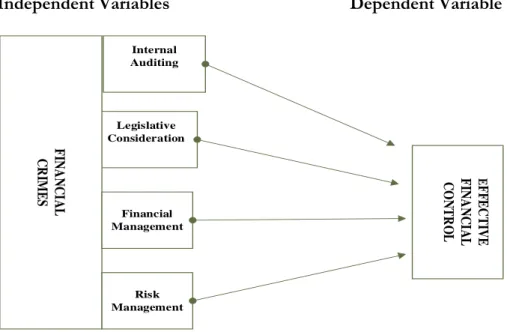
A conceptual framework is a combination of presumptions, convictions, concepts, viewpoints, and hypotheses that serve to guide and advance research (Varpio, Paradis, Uijtdehaage & Young, 2020: 989). Bharti, Agrawal and Sharma (2015:572) add that, a suitable conceptual framework includes findings from the literature as well as unpublished knowledge and information held by experts and other sources associated with the topic under inquiry. In this regard, this study developed a conceptual framework to combat financial crimes in South African municipalities that includes five key components (Internal Auding, Legislative Consideration, Financial Management, Risk Management, and Effective Financial Control). Effective financial contral was classified as the dependent variable, whereas these four essential components were classified as independent variables. Thus, the conceptual framework proposed in Figure 2 can be used, when properly implemented, to combat financial crimes in South African municipalities.
47
Independent Variables Dependent Variable
Legislative Consideration
FINANCIAL CRIMES
Financial Management
Risk Management
EFFECTIVE FINANCIAL CONTROL
Internal Auditing
Figure 2: Conceptual Framework for Financial Controls (Source: Authors)
The variables in figure 2 are discussed below, and these variables have been thought to have a significant impact in combatic financial crimes in municipalities.
Internal Auditing
To mitigate risk within an organisation, it is crucial to have effective internal control measures (Nerantzidis et al., 2020). An entity must have systems, procedures, and policies to ensure that potential risks are adequately addressed and that goals and objectives are achieved (Prinsloo & Von Wielligh, 2018). According to Arena et al. (2016), effective internal auditing in an entity can guarantee effectiveness and efficacy on the activities, operations, financial reporting, and compliance with policies. Therefore, it can be concluded that internal auditing has the following objectives.
Financial reporting and performance.
Operational effectiveness.
Legal Compliance.
48
In South Africa, the regulations that deal with financial controls are controlled by National Treasury, Internal Audit is explicitly established under this legislative framework (MFMA). The MFMA requires municipalities to establish an internal audit department or unit to prepare audit programs and audit plans for a particular fiscal year (Kurdi, 2016).
Legislative Consideration
The supreme law (Constitution) of the land requires municipalities to manage their financial resources prudently and promotes accountability in the realm of municipalities. Various statutes empower municipalities and provide a legal framework for municipalities and municipal entities.
MFMA is one of several legislative acts aimed at improving financial management and reducing maladministration in municipalities (Imuezerua and Chinomona, 2015). Adherence to the MFMA doctrines should result in municipalities providing quality services and thus improving residents' quality of life. The Municipal Financial Management Act (MFMA) focuses on developing and promoting financial management capability in municipalities and municipal entities.
It is the role and obligation of the council, as well as municipal managers and employees, to implement the MFMA (Koma, 2012).
Financial Management
Financial management is defined as the mobilization and appropriation of financial resources to cover assets and activities of an organisation to achieve its goals and objectives (Odero, 2017). Budgeting, expenditure and revenue management, accountability, auditing, cash flow management, and financial reporting are examples of financial management functions in municipalities. According to Pimpong (2017), effective financial management restricts misappropriation of financial resources, particularly in municipalities and public entities. The financial management practices in local government aim to avoid wasteful and ineffective spending, fraud and corruption, irregular spending, and unauthorized spending.
49 Risk Management
Municipalities should be aware of and adhere to all applicable laws and regulations of the government. Compliance with government laws and regulations must be controlled and monitored, including the risks of noncompliance and the steps that can be taken to avoid noncompliance.
To develop tolerance for risk and acceptance, municipalities must advocate and support an organizational culture that effectively manages risks (Nel, 2019). Risk management is an inevitable feature within a municipality because ineffective risk management can result in financial losses for the municipality (Meyer, 2014). To meet the requirements of the Municipal Finance Management Act, public entities and municipalities in South Africa have developed risk management systems (Meyer, 2014).
Effective Financial Control
South African municipalities have weak financial controls; this is evident from the increase in fruitless and wasteful expenditure from one financial year to another (Ntonzima, 2011). There should be concrete financial controls to improve financial performance in South African municipalities (Molobela, 2016). One of the most common issues facing municipalities in recent years has undoubtedly been the complete lack of effective and appropriate financial management and controls. Variables such as lack of competence in municipalities, financial mismanagement, systemic corruption, can all lead to serious problems for municipalities.
When it comes to determining the success or failure of the local government in South Africa, financial control is critical (Laubscher, 2012).
10. Managerial Implications
South African decision makers are grappling with fiscal issues as a result of the lack of organized financial management frameworks in municipalities. Despite the 25-year history of the South African Constitution, several municipalities still do not uphold it (Ndevu &
Muller, 2018). The supreme law of the republic requires municipal officials, including managers, to handle financial resources with diligence; as such, there should be an in-depth understanding of the importance of giving municipal management improvement more
50
attention (Odero, 2017). Municipal performance and improvement can be achieved by proper application and compliance with the relevant statutes governing financial management (Enofe, 2013).
According to the MFMA, a municipality must adopt a credible and realistic budget to ensure its financial viability and sustainability (Molobela, 2016). Municipal managers should be able to combat financial misconduct and crimes through the proper application of the conceptual framework suggested in this study. Furthermore, municipal managers and employees in general should adopt a culture of effective implementation of policies and statutes effectively to manage public resources. Sambo (2018) adds that, management of public financial resources must prioritize economy, efficiency, and effectiveness.
11. Recommendations and Concluding Remarks
The increase in financial crimes in South Africa committed by municipal officials and private companies poses a huge risk to the financial performance of municipalities. This calls for stricter measures and convictions from the National Prosecuting Authority to combat these corrupt relationships between municipal officials and civilians. In South Africa, it is a crime for anyone from the corporate sector to try to influence a government or municipal employee by trying to agree or planning to give any gratification. When these corrupters have a motive, they will use any available opportunity to ensure that their criminal or illegal will prevails, thus influencing government officials. In the case of VBS, municipalities that were affected by the scandal were some rural municipalities in Limpopo, North West, and Gauteng Province.
There should be consequences (e.g., disciplinary hearing, suspension, dsimisal, and trail actions) when municipal officials are found guilty of financial misconduct; very few officials and even private companies are held responsible for financial misconduct in South Africa. Thus, that will be a litmus test to see whether municipal executive and political leaders are serious about accountability or not. The environment that allowed financial crimes to occur must be closely monitored and closed by the government. There should be civil recoveries from the perpetrators; it is uncertain whether municipalities recover money lost due to financial crimes. These financial crimes have a censorious effect on the overall performance of municipalities; as such, the lives of citizens are negatively affected due to the lack of financial resources to provide basic
51
services. In most cases, it is difficult for municipalities to track financial crimes.
Thus, the following recommendations are based on the primary objective of this research, which was to develop a conceptual framework to combat financial crimes in South African municipalities.
Internal Auditing
Based on this variable, it is recommended that:
To enhance financial and municipal governance, the internal audit role should be efficient.
The iternal audit department should report to the audit commentee of the municipality regularly on any possible transgressions and deviations from that statutes.
The audit plans of the municipalities should be reviewed and updated every financial year.
Legislative Consideration
A municipality's overall performance, and its financial performance in particular, can improve with the effective implementation of the MFMA.
It is recommended that:
All municipal employees should get ongoing training in how to interpret and implement municipal statutes.
Municipalities should monitor the application of rules and regulations through its legal service department.
The legislation should be used as the legal foundation for budgeting and financial management in municipalities.
Financial Management
In relation financial management variable, the following recommendations are andvanced:
Municipalities should have financial management systems in place to improve financial management practices in order to delivery quality services to the resindents.
52
The roles and responsibilities of all the officials involved in financial governance should be clarified to them.
The should be a robust and more accountable financial management in South African municipalities.
Risk Management
Based on risk management it is recommended that:
The should be a detail risk management policy that would guid municipal officials on how to identify, mitigate, and manage riks.
The risk management commette continuously engage with municipal management to discuss possible financial risks and do financial analyses.
Risk management should be applied throughout the financial year.
Effective Financial Control
In relation to effectuve financial control, it is recommended that:
South African municipalities should improve financial controls by applying financial and non financial regulations in order to ensure financial sustainability.
References
Abreu, C. and Gomes, C. 2021. Human Rights in Angola. Update.
Amara, I. and Khlif, H., 2018. Financial crime, corruption and tax evasion: a cross-country investigation. Journal of Money Laundering Control. 21(4): 545-554
Arena, M. and Jeppesen, K. K. 2016. Practice variation in public sector internal auditing: An institutional analysis. European Accounting Review, 25(2): 319-345.
Beebeejaun, A. and Dulloo, L. 2022. A critical analysis of the anti-money laundering legal and regulatory framework of Mauritius: a comparative study with South Africa. Journal of Money Laundering Control. 1368-5201.
53
Boles, J. R. 2017. Anti-money laundering initiatives for the South African real estate market. Journal of Comparative Urban Law and Policy, 1(1):197-202.
Botha, A. E. 2018. Combating Financial Crime: Evaluating the prospects of a whole-government approach. Submitted in accordance with the requirements for the Doctor of Literature and Philosophy in Police Science. University of South Africa.
Breetzke, G. D., Landman, K. and Cohn, E.G., 2014. Is it safer behind the gates? Crime and gated communities in South Africa. Journal of housing and the built environment, 29(1): 123-139.
Budhram, T., Geldenhuys, N. 2017. A losing battle? Assessing the detection rate of commercial crime. SA Crime Quarterly. 61: 7-18.
Das, V. (2018), "Kleptocracy in Nigeria", Journal of Financial Crime, 25(1):
57-69. https://doi.org/10.1108/JFC-08-2016-0053. Accessed: 15 October 2022.
Durban Government. The Ombudsperson and Head of Investigation.
Retrieved from: http://www.durban.gov.za/City_Government/Ad ministration/city_manager/City%20integrity%20and%20%20Investi gations/Documents/ombuds.pdf. Accessed: 16 October 2022.
Chitimira, H. 2021. An exploration of the current regulatory aspects of money laundering in South Africa, Journal of Money Laundering Control, 24(4):789-805. Retrieved from: https://doi.org/10.1108/JMLC-10- 2020-0120. Accessed: 12 October 2022.
Chitimira, H. and Ncube, M., 2021. Towards ingenious technology and the robust enforcement of financial markets laws to curb money laundering in Zimbabwe. Potchefstroom Electronic Law Journal (PELJ), 24(1): 1-47.
Dearden, T. E. 2015. Trust: the unwritten cost of white-collar crime.
Journal of Financial Crime, 23(1):87-101. Retrieved from:
https://doi.org/10.1108/JFC-02-2015-0007. Accessed: 16 October 2022.
Enofe, A.O., Mgbame, C. J., Osa-Erhabor, V.E. and Ehiorobo, A.J.
2013. The role of internal audit in effective management in public sector. Research Journal of Finance and Accounting, 4(6).
Fafore, O., Adekoye, A. 2019. An Overview of the Effects of Organized Crime on Southern Africa. Journal of African Foreign Affairs. 6(1):107- 118.
Gottschalk, P. 2017. Convenience in white-collar crime: Introducing a core concept. Deviant Behavior. 38(5): 605-619.
54
Gottschalk, P. 2014. Financial crime and knowledge workers: An empirical study of defense lawyers and white-collar criminals. New York, NY: Palgrave Macmillan.
Hamman, A. J. 2015. The impact of anti-money laundering legislation on the legal profession in South Africa (Doctoral dissertation, University of the Western Cape).
Hasan, I. R., Agustang, A., Kahar, F., and Tahir, H. 2019. ―Super Service Delivery‖: an advanced conceptual model of one-stop service for wide administrative region. Problems and Perspectives in Management.
17(1): 190-201.
Heddell, G. S. 2005. The Evolution of Organized Crime and Labor Racketeering Corruption. The Journal of public inquiry.
Hollands, G. 2007. Corruption in Infrastructure Delivery: A South African Case Study. Retrieved from: https://repository.lboro.ac.uk/
articles/Corruption_in_infrastructure_delivery_South_Africa/94571 48/files/17080430.pdf. Loughborough University. Accessed: 16 October 2022.
Holtfreter, K. 2015. General theory, gender-specific theory, and white- collar crime. Journal of Financial Crime, 22(4): 422-431. Retrieved from:
https://doi.org/10.1108/JFC-12-2014-0062. Accessed: 16 October 2022.
IMF (International Monetary Fund). 2011. Financial System Abuse, Financial Crime and Money Laundering—Background Paper; IMF:
Washington, DC, USA.
Imuezerua, E., Chinomona, E. 2015. Analysing the concept of municipal budgeting and service delivery pattern in a South African Municipality. Mediterranean Journal of Social Sciences. 6(1): 359-367.
Jung, J., and Lee, J. 2017. Contemporary financial crime. Journal of Public Administration and Governance, 7(2): 88-97.
Kurdi, F. 2016. Good governance and its impact in improving administrative and financial performance: a case study of Nablus Municipality. International Humanities Studies, 3(4).
Koma, S. B. 2012. The Evolution of Developmental Local Government in South Africa: Issues, Trends and Options. Journal of US-China Public Administration. 9(1): 53-67.
Laubscher, L. H. 2012. Challenges on financial control and accountability in South African municipalities. Journal for New Generation Sciences, 10 (1): 63-79.
55
Lazarus, S. and Okolorie, G. U., 2019. The bifurcation of the Nigerian cybercriminals: Narratives of the Economic and Financial Crimes Commission (EFCC) agents. Telematics and Informatics, 40:14-26.
Legotlo, T. G., Mutezo, A. 2018. Understanding the types of fraud in claims to South African medical schemes. The South African Medical Journal. 108 (4): 299-303.
Machinjike, N. and Bonga, W.G. 2021. Effectiveness of the Office of the Auditor General in Enhancing Public Sector Accountability in Zimbabwe. Researchjournali’s Journal of Economics, 9(1): 01-20.
Matlala, M. and Dintwe, S. 2013. August. Procurement fraud red flags in the South African municipalities‘corporate governance. In Conference Proceedings published by the South African Association of Public Administration and Management (SAAPAM).46(3):1010-1022).
Department of Public Administration & Management, Tshwane University of Technology.
Meyer, N. 2014. A Critical Analysis of Risk Management Knowledge within the Sedibeng District Municipality, South Africa. Mediterranean Journal of Social Sciences. 5(7): 163-170
Mohammad, A., Abu, A., and Rahman, A. A. (2016). The impact of Jordanian anti-money laundering laws on banks. Journal of Money Laundering Control, 19(1): 70-78.
Molobela, T. T., 2016. The effect of revenue planning on municipal financial performance: A case study of the Polokwane local municipality in the Limpopo Province.
National Treasury. 2020. 2019/20 National Treasury Annual Report Vote 7. Retrieved from: http://www.treasury.gov.za/publications/a nnual%20reports/national%20treasury/nt%20annual%20report%20 2019-20.pdf. Accessed: 12 July 2022.
Ndevu, Z. and Muller, K. 2018. A conceptual framework for improving service delivery at local government in South Africa. African Journal of Public Affairs, 10(4):181-195.
Nerantzidis, M., Pazarskis, M., Drogalas, G., and Galanis, S. 2022.
Internal auditing in the public sector: a systematic literature review and future research agenda, Journal of Public Budgeting, Accounting &
Financial Management, 34 (2): 189-209. Retrieved from:
https://doi.org/10.1108/JPBAFM-02-2020-0015. Accessed: 16 October 2022.
Nel, D. 2019. Risk management in the South African local government and its impact on service delivery. International Journal of Management Practice.12(1): 60-80.
56
Net Guardians. (2019). A-Z of Financial Crime in Africa: The What, Why and How to Tackling Financial Crime in Africa. Retrieved from: https://www.temenos.com/wp-content/uploads/2019/08/Fi nancial-Crime-Africa-whitepaper-2019-Aug-21.pdf. Accessed: 16 July 2021.
Ntonzima, L. 2011. Public financial controls: can South African municipalities improve? Journal of Public Administration. 46(3): 1010- 1022.
Nzewi, O., and Musokeri, P. 2014. A critical Review of the Oversight Role of the Office of the Auditor-General in Financial Accountability. Africa’s Public Service Delivery and Performance Review, 2(1):36–55, March.
Obuah, E. 2010. Combatting Corruption in Nigeria: The Nigerian Economic and Financial Crimes (EFCC). African Studies Quarterly, 12(1).
Odero, E. E. 2017. Analysing the financial performance at the Municipality of Karibib. European Journal of Research and Reflection in Management Sciences. 5(2).
Ojukwu-Ogba, N., and Osode, P. C. 2020. The Legal Combat of Financial Crimes: A Comparative Assessment of the Enforcement Regimes in Nigeria and South Africa. African Journal of Legal Studies, 13(2):130-152.
Parliamentary Monitoring Group. 2018. VBS Bank impact on municipalities‘ finances; Municipal Councillors Pension Fund.
PAUL, S. O., and Ofuebe, C. 2020. Unabated Corruption in the Government of Nigeria Despite the Economic and Financial Crimes Commission: Who Bells the Cat? Society & Sustainability, 2(2): 45-58.
Pillay, P. 2016. Ethics and accountability in South African municipalities:
The struggle against corruption. African Journal of Public Affairs. 9(2):
115-126.
Pimpong, S. 2017. Public Financial Accountability and Independent Oversight Institutions in Ghana, 1993-2016. PHD Thesis. Collage of Humanities. University of Ghana.
Prinsloo, F., and Von Wielligh, P. 2018. Auditing Fundamentals in a South African Context. Oxford University Press. South Africa.
Raweh, B. A., Erbao, C., and Shihadeh, F. 2017. Review the literature and theories on anti-money. Asian Development Policy Review, 5(3): 140- 147.
Ryder, N. 2010. Financial Crime in the 21st Century: Law and Policy;
Edward Elgar Publishing: Gloucestershire, UK, 2010.
57
Sambo, V. T. 2018. Internal Audit and Financial Misconduct: The Case of the South African Social Security Agency (SASSA). International Conference on Public Administration and Development Alternatives (IPADA).
University of Limpopo.
Skenjana, N., Ngamlana, N., Mabhula, T., Mgwebi, G., Sokupa, T., Kimemia, P., and Afesis-corplan. 2010. Understanding the impact of corruption on service delivery in Local Government. Retrieved from: (https://www.ggln.org.za/media/k2/attachments/SoLG.2010 -Afesis-corplan.pdf). Accessed: 16 October 2022.
South African Local Government Association (SALGA). 2020. The regression in municipal audit outcomes highlights the need for intensified actions on extracting accountability and consequence management. Retrieved from: https://www.salga.org.za/Documents /Media%20Room/media%20statement/20/July/2018-19%20MFM A%20Audit%20Outcomes%20Media%20Statement.pdf. Accessed:
16 October 2022.
Storm, A. 2013. Establishing the link between money laundering and tax evasion. International Business & Economics Research Journal (IBER), 12(11): 1437-1450.
The Supreme Court of Appeal of Appeal of South Africa. (2014).
Judgement. Retrieved from: (http://www.saflii.org.za/za/cases/ZA SCA/2014/21.pdf). Accessed 14 July 2021.
Varpio, L., Paradis, E., Uijtdehaage, S. and Young, M. 2020. The distinctions between theory, theoretical framework, and conceptual framework. Academic Medicine, 95(7):989-994.
VBS Mutual Bank. VBS Mutual Bank (in Liquidation) ―the Bank‖.
Retrieved from: (https://www.vbsmutualbank.co.za/). Accessed: 16 October 2022.
Vitvitskiy, S. S., Kurakin, O. N., Pokataev, P. S., Scriabin, O. M., and Sanakoiev, D. B. 2021. Formation of a new paradigm of anti-money laundering: The experience of Ukraine. Problems and Perspectives in Management, 19(1): 354-363.
Vousinas, G. L. 2019. Advancing theory of fraud: the S.C.O.R.E. model.
Journal of Financial Crime, 26(1): 372-381. https://doi.org/10.1108/JF C-12-2017-0128. Accessed: 15 October 2022.