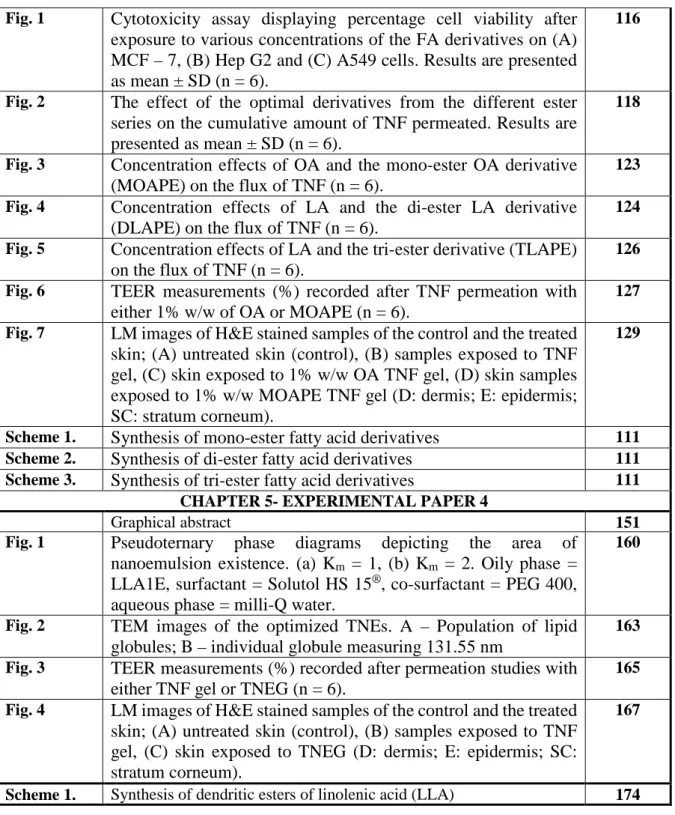
Rambharose contributed to the design of the project, modification and optimization of methods and synthesis of the linolenic ester dendritic derivative (LLA1E). 2 The effect of the optimal derivatives from the different ester series on the cumulative amount of TNF penetrated.
INTRODUCTION
- Background to this study
- Problem statement
- Aims and objectives of this study
- Chapter: 2
- Chapter: 3
- Chapter: 4
- Chapter 5
- Novelty of the study
- Chapter:2
- Chapter:3
- Chapter: 4
- Chapter: 5
- Significance of the study
- Overview of thesis
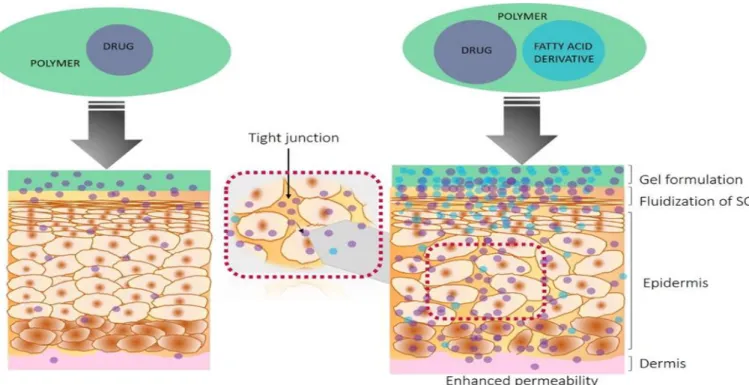
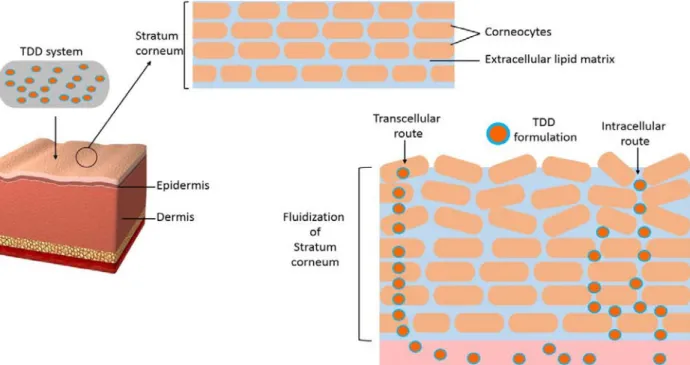
All proposed approaches for improving permeation could reduce the barrier properties of the skin, which should improve transdermal delivery of TNF. Cordero, J., et al., A comparative study of the transdermal penetration of a series of nonsteroidal anti-inflammatory drugs.
Experimental paper 1
Novel dendritic derivatives of unsaturated fatty acids as promising transdermal permeation enhancers for Tenofovir
Permeability of TNF in absence of enhancers
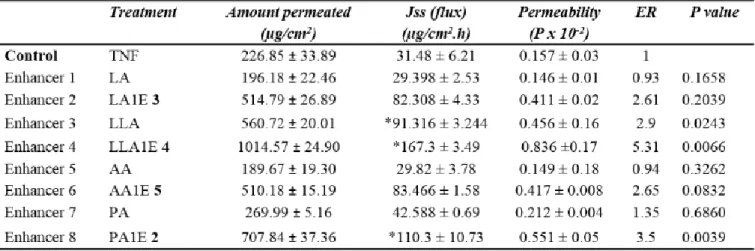
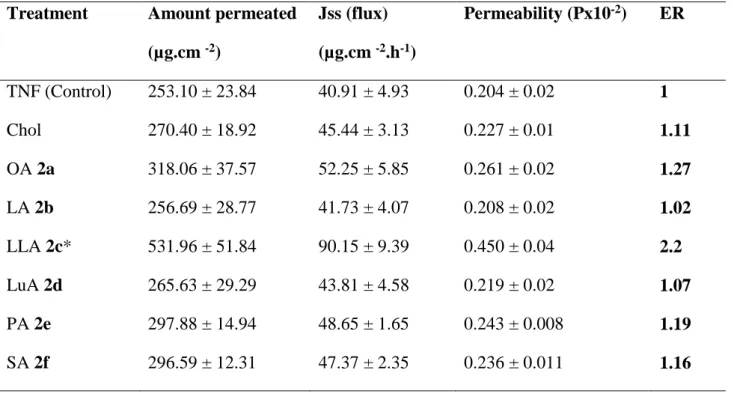
In this study, we report for the first time the transdermal permeability potential of TNF. Effect of different derivatives compared to their parent lipid on the transdermal permeability properties of TNF.
Effects of UFAs on TNF permeability
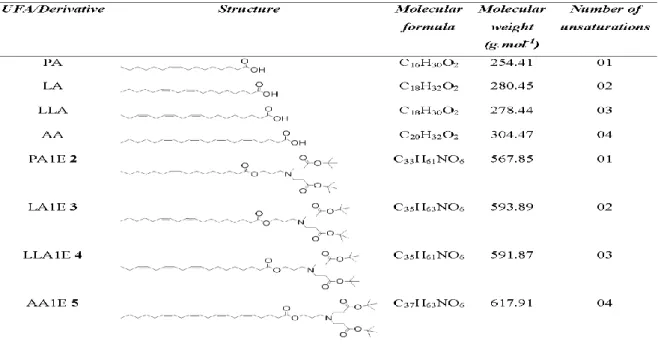
The number of kinks tends to increase with the number of double bonds in the UFA. Therefore, the permeation enhancing effect of UFAs is expected to increase with the increase in the number of double bonds.
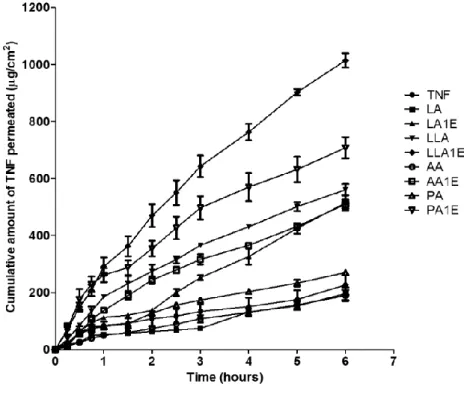
Effects of novel dendritic derivatives on TNF permeability
However, the increases shown by the derivative were not statistically significant compared to the control (p Table 1). This may be due to the increase in lipophilicity of FA with the addition of this functional group (Table 3).
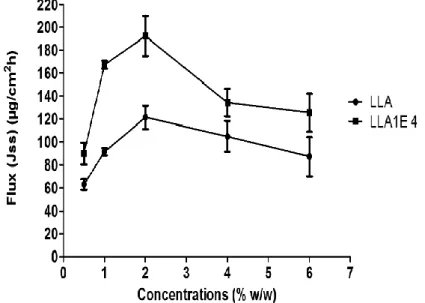
Concentration effect of LLA and LLA1E 4 on the permeability of TNF
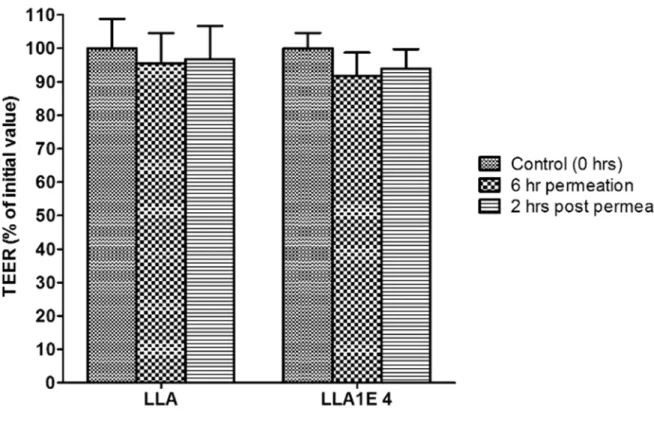
This represents a 28% recovery of skin barrier properties after removal of the gel formulation. These changes may be due to disruption of highly ordered lipids in the SC by permeation enhancers.
SUPPORTING INFORMATION
Graphical abstract
Exploring unsaturated fatty acid cholesteryl esters as transdermal permeation enhancers
Synthetic scheme for Chol esters
- Results and discussion
- Conclusions
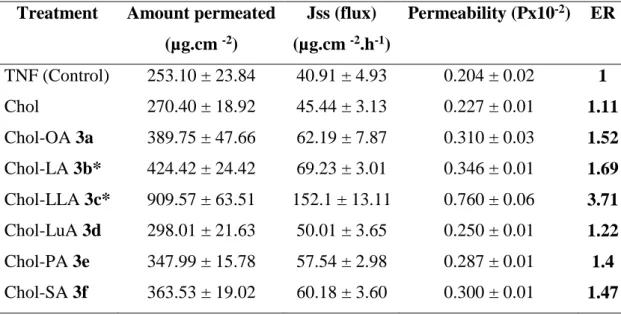
The integrity of the treated skin tissue sections (TEER measurements) was determined using a Millicell ERS meter (Millipore, USA) connected to a pair of chopstick electrodes (STX01). All the studied FAs at a concentration of 1% w/w; improved the permeability of TNF across the skin (Supporting Information Table S1). The increase in the lipophilicity of the esters due to the presence of Chol moiety (Table 3) could have resulted in the increase in transdermal permeation of TNF.
Effect of the different concentrations of LLA 2c and Chol-LLA 3c on the transdermal permeability properties of TNF. These changes are indicative of the disruption of the lipids in the SC by LLA 2c or Chol-LLA 3c respectively.
Supplementary Material
This manuscript reports the synthesis, characterization, biosafety, and in vitro permeation-enhancing effect of a new series of FA mono-, di-, and triester derivatives bearing a β-alanine t-butyl ester head group for transdermal delivery of TNF. Rambharose contributed to project conception, method modification and optimization, and synthesis and characterization of all new FA mono-, di-, and tri-ester derivatives. Jadhav helped with the overall project design and preparation and characterization methods and editing the paper.
Govender served as supervisor and was responsible for project conceptualization, paper editing, and abstract and general supervision of the study. Novel mono-, di- and tri-fatty acid esters bearing a secondary amino acid ester head group as transdermal permeation enhancers.
Novel mono, di and tri- fatty acid esters bearing secondary amino acid ester head group as transdermal permeation enhancers
Introduction
The numerous advantages of the transdermal route make the skin an attractive alternative to conventional oral dosage forms (Bavaskar et al., 2015; Vavrova et al., 2005). In general, FAs exhibit greater permeability compared to other classes of transdermal penetration enhancers (Babu et al., 2015). Although both unsaturated FAs (UFAs) and saturated FAs (SFAs) have been used as penetration enhancers for hydrophilic and lipophilic drugs (Williams and Barry, 2012), it is widely recognized that UFAs are more effective permeation enhancers (Babu et al., 2015; Oh et al. , 2001).
FA esters typically reduce the skin barrier by partitioning into ordered SC lipid domains (Babu et al., 2015). Although transdermal drug delivery (TDD) is an attractive alternative route of administration, the number of antirheumatic drugs investigated for this route is limited (Rambharose et al., 2015).
Materials and methods 1 Materials
Formulation scientists have explored different target sites such as vaginal, buccal, rectal and dermal routes for alternative delivery of TNF to avoid its side effects (Rambharose et al., 2015). Transdermal delivery of TNF could be the most attractive route of administration, as it presents several advantages that contribute to increased patient compliance. The natural barrier properties of the skin combined with the low CPE count limit the utility of this route for many drugs.
While new chemical entities are being discovered at a rapid rate, the number of new CPE molecules has plateaued (Karande et al., 2005). Therefore, the aim of our investigation was to investigate the use of new mono-, di- and tri-ester derivatives of FAs (SA, OA, LA and LLA) as prospective penetration enhancers for the TDD of TNF.
Synthesis of mono-ester fatty acid derivatives
Synthesis of di-ester fatty acid derivatives
Synthesis of tri-ester fatty acid derivatives
- Results and discussion 1 Cytotoxicity evaluation
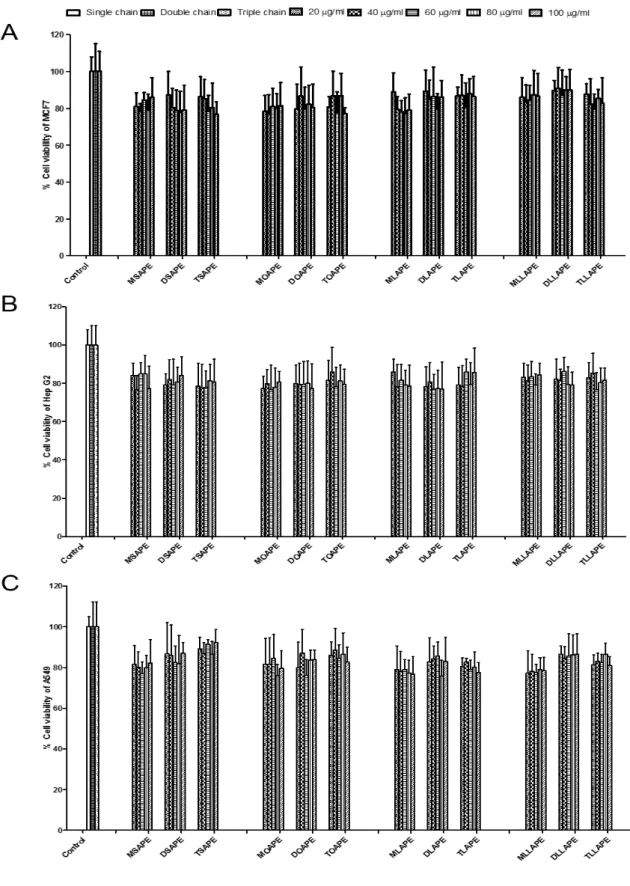
MTT cytotoxicity evaluation of fatty acid derivatives was investigated using human breast adenocarcinoma (MCF 7), hepatocellular carcinoma of the liver (Hep G2) and human lung carcinoma (A549) (Supplementary Information). The percentage of drug (TNF) permeability that entered or penetrated per unit area of skin tissue was plotted against time. The linear part of the permeability curve was used to determine the steady-state current (Jss) by linear regression analysis (Microsoft Excel 2010, USA).
A Millicell ERS meter (Millipore, USA) connected to a pair of chopstick electrodes (STX01) was used to determine the integrity of the treated skin tissue sections. The treated skin tissues were removed from the Franz diffusion cells at the end of the permeation study and fixed in 10% buffered formalin.
Log P Group 2 Log P Group 3 Log P Group 4 Log P
- Conclusions
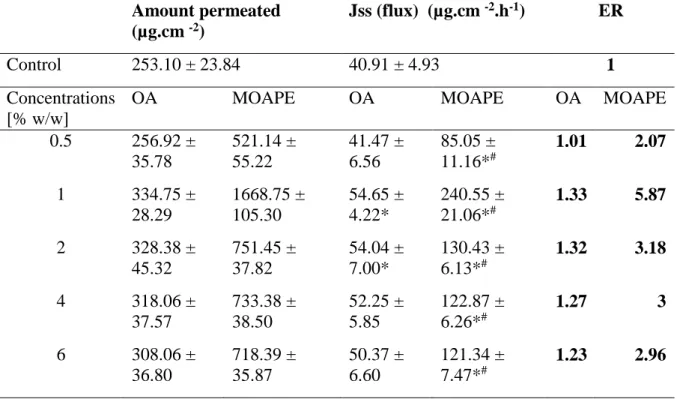
The findings of the LLA group in this study show a significantly higher ER compared to the PG LLA series (Ben-Shabat et al., 2007). ER derivatives and differences between derivatives and parent FA v. These observations indicate the superiority of the new OA ester derivative (MOAPE) over the parent FA (OA).
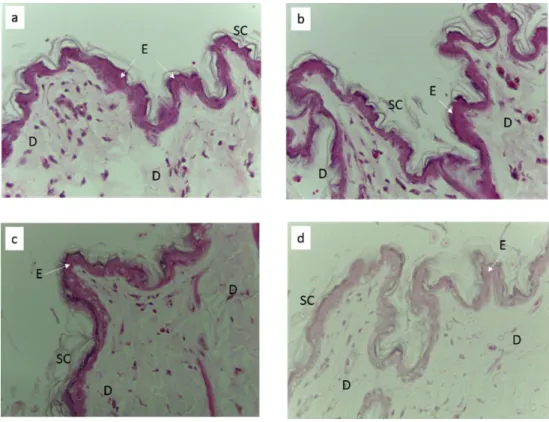
These findings suggest that the 1% w/w MOAPE treatment is able to reduce the resistance of the skin by 3-fold than the 1% w/w OA treatment. 7 LM images of H&E-stained samples from the control and the treated skin; (A) untreated skin (control), (B) samples exposed to TNF-gel, (C) skin exposed to 1% w/w OA TNF-gel, (D) skin samples exposed to 1% w/w MOAPE TNF-gel (D) : dermis; E: epidermis; SC: stratum corneum).
Supplementary Information
Synthesis and characterisation
The reaction mixture was stirred at room temperature for 24 h and worked up according to the given general procedure II to give MLLAPE 4 (IV) as a thick liquid (10.095 g, 85% yield) after purification by column chromatography. The reaction mixture was stirred at room temperature for 24 h and worked up according to the given general procedure II to give DLLAPE 7 (IV) as a thick liquid after purification (7.26 g, 86% yield). The reaction mixture was stirred at room temperature for 24 h and worked up according to the given general procedure II to give TSAPE 10 (I) as a thick liquid (15.22 g, 88% yield) after purification by column chromatography.
The reaction mass was stirred at room temperature for 24 hours and worked up according to the given general procedure II to give TLAPE 10 (III) as a thick liquid (7.36 g, 86% yield) after purification by column chromatography. The reaction mixture was stirred at room temperature for 24 h and worked up according to the given general procedure II to give TLLAPE 10 (IV) as a thick liquid (7.15 g, 84% yield) after purification by column chromatography.
In vitro cytotoxicity Cell culture
Stock solutions of the different series were prepared by dissolving in appropriate volumes of DMSO and purified water. After the 48-h incubation with the derivatives, the treatment media were removed and each well was supplemented with MTT reagent (100 µl of 5 mg/ml in PBS) and 100 µl of complete medium, and then incubated for another 4 h. LLA1E was selected as the oily phase for the TNF nanoemulgel formulation as it showed the highest enhancement ratio (ER = 6.11) among all new FA derivatives synthesized in this PhD study.
Rambharose also performed the experiments for the construction of the pseudo-ternary phase diagrams and prepared and characterized all NE and NEG formulations in terms of mean sphere diameter, polydispersity index, zeta potential, rheology, morphology and stability. Kalhapure assisted with the overall design of the project and the methods of preparation and characterization as well as editing the paper.
Nanoemulgel using a bicephalous heteolipid as a novel approach to enhance transdermal permeation of tenofovir
Results and Discussion
- TEER
- Conclusions
Changes in TEER images indicate associated changes in skin barrier properties [10]. A decrease in TEER can be associated with a decrease in the barrier properties of the skin [10]. Interestingly, there was an increase in TEER recordings from both experiments 2 h after the drug formulations were removed (Figure 3).
This study showed that TNEG exposure would only have temporary effects on the epidermal layer of the skin. TEER and histological studies revealed that the effects of TNEG on the skin were transient.

CONCLUSION
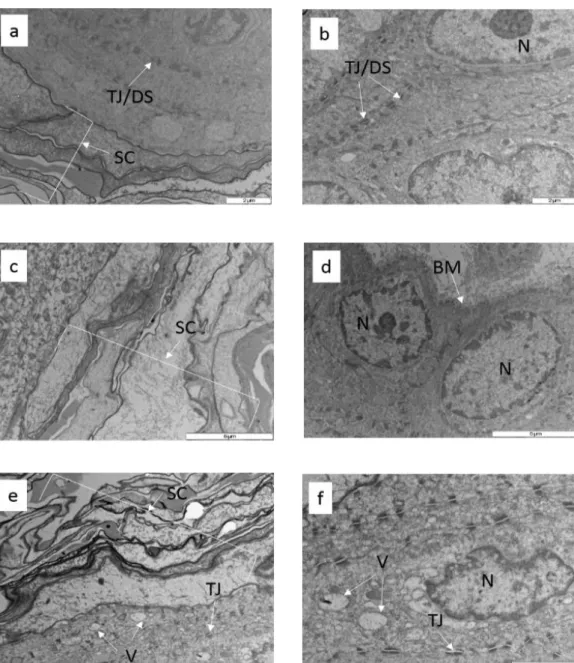
To achieve objective 1, the objectives were to: .. i) Synthesize new ester dendritic derivatives of palmitoleic acid (PA), linoleic acid (LA), linolenic acid (LLA) and arachidonic acid (AA) and characterize the derivatives using FTIR, NMR (1H and 13C ) and HRMS techniques. ii) Determine the lipophilicity and pH response as well as the in vitro biosafety of the new ester derivatives. iii) Explore the in vitro potential of the new UFA ester derivatives as transdermal permeation enhancers for TNF and assess the effects of the enhancer treatment on the skin using transepithelial electrical resistance and light and transmission electron microscopy. To achieve objective 2, the objectives were to: .. i) Synthesize cholesterol ester derivatives of oleic acid (OA), linoleic acid (LA), linolenic acid (LLA), lauric acid (LuA), palmitic acid (PA) and stearic acid (SA) and characterize the derivatives using by FTIR, NMR (1H and 13C) techniques as well as determination of their lipophilicity. ii) Explore in vitro the potential of the cholesterol ester derivatives as transdermal permeation enhancers for TNF and assess the effects of the enhancer treatment on the skin using transepithelial electrical resistance and light microscopy. To achieve objective 3, the objectives were to: .. i) Synthesize new mono-, di- and triester derivatives of FAs bearing β-alanine t-butyl ester head group using oleic acid (OA), linoleic acid (LA), linolenic acid (LLA) ) and stearic acid (SA) and characterize the derivatives using FTIR, NMR (1H and 13C) and HRMS techniques. ii) Determine the lipophilicity and in vitro biosafety of the new ester derivatives. iii) Explore in vitro the potential of the new ester derivatives as transdermal permeation enhancers for TNF and assess the effects of the enhancer treatment on the skin using transepithelial electrical resistance and light microscopy.
Investigate the ex vivo potential of the novel TNF nanoemulgel to enhance transdermal delivery of TNF and assess the effects of the nanoformulation on the skin using transepithelial electrical resistance and light microscopy. These findings therefore suggest that the use of the synthesized dendritic UFA ester derivatives in biological studies would be safe.