Ondersrepoorr J. Ver. Res. (1963), 30 (I), 95-l 18 The Government Printer, Pretoria
OBSERVATIONS ON CESTODE PARASITES OF GUINEA- FOWL FROM SOUTHERN AFRICA
R. J. ORTLCPP. Veterinary Research Institute. Ondcrstepoort
At Onderstepoort there are several collections of cestodes from guinen-fowl from various parts of Southern Africa. In mo:.t in'itanccs they were killed and fixed in either dilute formalin or alcohol. As no special precautions were taken lo flatten or straighten them the majority are much shrunken and coiled. rendering their study difficult. 1t is, however, possible to determine the more important characteristic~
of the several species present.
Guinea-fowl are gallinaceous birds indigcnou.., to Africa and Madagascar.
According to Roberts (1940) there are five genera, two widespread over the African continent, two confined to West Afnca and one to North East Africa. They are very popular game birds and have had their number ... reduced by gunmen. Recently.
however. it has been realised that they arc of value to the agriculturalist in the control of insect pc~ts and they now enjoy protection and man)' farmers are reluctant to allow ~hooting on their properties. As a result of thi~ and their prolific breeding habits it 1c; not unu'>ual to see huge nod.s on many farm.,,
In Southern Africa there are t\\o ~peeie~. \It. the crc~ted i:uinea-fowl. G111tera edo11artl1 (Hartlaub) and the cro\\ ncd guinca-fo" I. N11111ida meleagri.'I L111nacus. The former is a localised ~pecie.., occurring in the coastal and low-lying forc~ts from Durban northwar&.. and the latter 1!> widely d1.-.trihutcd throughout the ~ummer
rainfall area,
Se,enteen ;,pecies of cestodes have hccn reported from guinea-fowl. three of which may be considered as typical parasites of dome~tic fowls and turkeys, viz.
Raiflierina (Rail/ieri11a) retrago11a (Molin). R. (Skrjahinia) cestici/111.v (Molin) and Merrnliasrltes lucida Ransom. None of the~e three \pecie~ occurc; in the Onderc;te- poort collection from guineH-fo\\·I. Of the remaining
14.
which have been described from guinea-fowl only, seven are pre~ent in the collections studied. as also four '>pceies considered to be new0AVAINrlOAr
Davainca nana Fuhrmann, 1912
The only record of this parasite found in the literature available ic; the original description of Fulumann, which is ba!.ed on a single worm collected from Numida µtilorhync/ia from Northern Africa. In the Onderstcpoon collection there arc len specimens of this species. collected from a crested guinea-fowl from Northern Rhodesia. They occurred together with three other tapeworm species. As it was found that several cllaracters in the Northern Rhodesian material did not agree with ruhrmann·s observations the species is rcdcscribcd below. In this description
£uhrmann'" findings. where they disagree with ours. arc placed in brackets.
Rece1~ed for publication on 15 August, 196:?. Editor.
CESTODE PARASITES OF GUINEA-FOWL FROM SOUTHERN AFRICA
Five of the specimens are fully mature, i.e. the last segment of each contains fully developed eggs. In one specimen the eggs in the terminal segment are not fully mature while in the three specimens the end segments contain only partially developed eggs. 1n the posterior segment of the tenth worm. the genital organs arc still immature. The length varies from 5·0 to 7· S mm (10 mm) with a maximum breadth of 0 · 7 to 0 · 75 mm. Segmentation follows a very short neck and the number of segments for each worm 'aries from eight to 11 ( 15). The youngest segments arc broader than long, but when older th.ey are elongate. so that the terminal ones 3re much longer than broad (Fig. 1). The ripe segments in different worms vary in length from I ·5 to 3-9 mm \\ith a maximum breadth of 0·75 mm.
The head is acorn-shaped wl1en the rostellum is extruded und varies in thickness from 0 · 315 to
O·
4 mm (0· 32 mm), Thi: neck is 0 · 27 to 0 J mm broad. The four unarmed. circular suckers have a diameter of 0·062 to0· 078
mm (0·068 mm).The extruded rostellum varies in thickness from O· 15 to 0·21 mm (0· 128 mm): at its base it carrie~ two circles of h.ammer-shaped hooks. Many of these hooks on the extruded rostella have been lost, but in the retracted condition their number is estimated at about 160 (170 200): their size varies from 0·015 to 0·018 mm.
The musculature is poorly developed and consists of about 20 to 25 irregular, anastomosing, smal I bundles of longitudinal tihrcs.
Ftr.. I 3. Du1·uillea nano. I. Entire worm.
2. Malurc segment. 3. Cirrus sac.
The rudimentary stages of th.e genitalia make their appearance as darker staining areas in the 3rd or 4th segments (7th): mature genitalia arc seen in the 8th, 9th or
10th
segments. Only one segment in each strobila can be consid~red to be mature.In two instances the extruded cirri are bent sharply back and inserted into the adjacent vagina. The genital pores are located immediately anterior to the middle of the segment. In eight of the nine c;pecimens in wltich they can be located in a continuous series they alternate irregularly. rn the other specimen their alternation
is regular as is the case in Fuhrmann·s specimen. The elongate. tubular, thin-walled
96
R. J. ORTLEPP cirrus sac opens into a short genital sinus about 0·045 mm deep; the sac varies from 0·36 Lo 0·42 mm (0·34 mm) in length and has a diameter of about 0·05 mm throughout its length. In two mounted worms. however, its internal end is dilated and vesicular-shaped and about 0-06 mm thick and ils outer end is also thickened and somewhat pear-shaped with a maximum thickness of 0-075 mm (Fig. 2). A bundle of retractor muscles is attached to iti. inner end and these muscles extend obliquely forwards across the segment as far as the e>..cretory canal. The long cirrus. when not e'<truded, is coiled within the cirrus sac and armed with numerous small spines. o internal or external vesicula scminalis b present. The vas deferens after emerging from the cirrus sac passes in\\-anh aml backward:-. with only a few loose coils There are about 50 to 70 round to oval tc~tcs in each malUre <;cgment, located in a broad band between the e'\'.cretory canals and behind lhe ovary (Fig. 3).
The ovary is placed centrally. ll has lwo wing~ and consists of trant.versely elong:.ited lobules which stretch across the segment. filling the area hclween the excretory canals in front of the testes and behind the level of the genital pore. A large and somewhat triangular-sliaped. lobulated yolk gland is centrally placed behind the ovary and
in
front of the testes. The thin-walled vagina open~ into the genital sinus immediately behind the opening of the cirru<; sac.It
runs parallel lo the sac for nearly half its length and then bends backw~rds to end in a small centrally placed.circular receptaculum seminis in front of the anterior border of the yolk gland. Its internal lining stains deeply with haematoxylin. The uterus develops rapidly in the segment immediately following the mature one. taking the form of a ramifying sue with its branches visible between the testes which are still pre'ient. The ovary has virtually disappeared in this segment. The uterus fills the whole ripe ~egment
between the excretory canals and lhe eggs lend to be aggregated in groups within ils branches. The round to somewhat oval eggs,\\ ith pole!> :.lightly pointed, measure 0·013 to 0·016 mm by 0·012 to 0-15 mm. the shell is about 0·001 mm thick. The hexacanth hooks are 0·006 mm long.
Two well defined and relatively large ventral excretory canals are present.
They vary in diameter from 0·008 to 0·012
mm.
o signs of dorsal excretory canals can be seen.I-lost: Gullera eduuardi (Hartlaub).
t,ocalion: Intestine.
Locality: Northern Rhodesia (Mazabuku).
Donor: Dr. P. L. le Roux.
Cotugnia transvaalensis sp. nov.
This species from the crowned guinea-fowl
was
collected on two occasions from Northern Transvaal. The much contracted specimens reach a length of 25 mm with a maximum breadth of slightly over 2 mm at their posterior ends. Viewed en fal'e the head is quadrangular and measures 0·8 by 0·7 mm. The rounded suckers situated at the corners of the quadrangle have a diameter of O· 2 to 0 · 25 mm.The oval rostellum is about tv;ice as broad as deep: across its anterior face it measures 0·5 by 0·24 mm: it carries a double row of about 500 to 620 hammer-shaped hooks, 0·015 to 0·018 mm long. These are implanted roughly in the form of a rectangle. On four of the heads examined these rows of hooks are interrupted for a distance of about 0·012 mm in the middle of each short limb of lhe rectangle
<Fig. 4).
CESTODE PARASITES OF GUINEA-FOWL FROM SOUTHERN AFRICA
The segments are much broader than long and relatively thick; this thickness is probably due to the contracted nature of the specimens. Mature segments are about 1·5 mm broad, 0·15 mm long and l·O mm thick; ripe segments are slightly O\er 2 mm broad and 0·35 mm long. The strongly developed, longirudinal muscles arc arranged in three layers separated from each other by a thin layer of circular muscles: the innermost layer fills about a third to a half of the conical parenchyma and consists of somewhat irregular muscle columns of JO to 25 fibres each. The middle layer is about half as thick as the innermost and consists of irregularly arranged small groups of three to ten muscle fibres. The outermost layer consists of isolated fibres scallered between the middle luyer and outer lining of the segment (Hg. S).
The genital aperture~ are in the anterior third of the ~egment's margin; they lead into a long sinus, about 0·09 mm deep, with the genital ducts opening into its base. The cirrus sac is tubular and weakly muscular: its length varies from 0·21 to 0·28 mm with a diameter of about 0·03 mm. In general il reaches or crosscf. the nerve but does not reach the excretory caMls. The vas deferens after emerging from the cirrus sac. forms a dense mass of dorso-ventral loops both poral and aporal of the excretory ducts. Al least 100 testes arc present in each segment, forming a continuous band across the segmcnl Hnd extending outwards to beyond the excretory vessels (Fig. 6); they are arranged in a row posterior to lhe ovary
f1G. 4--6. Co111g11ia lr1111sm11/e11sis. 4. Scolex e11 fare. showing arrangement of rostellar hooks. 5. Transverse section of segment showing longitudinal muscle layers and
tci.tc~ ~urrounding excretory canal.
6. Horizonrnl section of mature segments.
98
R. J. 0RTLEPP and a ring round the excretory canals (Fig. 5). Between lhe ovaries the arrangement is two or three deep and fills the whole inter-ovarian area of the meduJlary paren- chyma: some are observed to be pushed in between the muscle columns of the innermost muscle layer; ancero-posteriorly they are arranged roughly in three or four rows. They are about 0·072 by 0·06 mm in size.
The vaginal opening is immediately behind and somewhat ventral to that of the cirrus sac; the vagina is slightly more muscular than the sac; its glandular outer surface is deeply stained. The vagina, and the vas defcrens, pass dorsally over the nerves and the excretory canals and terminate in the ovary as an oval receptaculum seminis. The two ovaries, each about 0· 18 mm broad and 0·075 mm deep, are coarsely lobed and situared immediately within the excretory ducts. The yolk glands, measuring ahout 0·09 by 0·05 mm occupy a ventral posiuon between the ovary and the excretory ducts. In its early stages the uterus develops as an irregular transverse sac which soon disappears. The eggs after release become embedded individually in a fibrous capsule. In ripe segments these capsules not only replace the mcdullary parenchyma but they also extend laterally over the excretory canals almost to the edge of the segment. They may even be pushed in between the longi- tudinal muscle bundles of the innermost muscle layer. as described by Fuhnnann ( 1909b) for his species C. crassa. The round to oval capsules measure 0 · 036 to 0·06 mm. The embryo with.in the capsule measures from 0·027 to 0·03 mm and the hexacanlh hooks aboul 0·01 mm.
Th.e excretory system is represented by two large lateral canals with large trans- verse connections: they attain a diameter of 0·05 mm and are situated about 0·35 mm from the edge in mature segments. No signs of the presence of dorsal excretory canals can be seen.
Host: Numida meleagris Linnaeus.
Location: J ntestine.
Locality: Transvaal (Zompansberg).
Types: Jn the Onderstepoort collection.
Specific diagnosis
Davaincidae: Contracted specimens up lo 25 mm long and 2 mm broad.
Rostellum oval, 0·05 by 0·24 mm across. Hooks 500 to 620. 0·015 to 0·018 mm long implanted roughly in the form of a rectangle. All segments broader than long. Longitudinal muscles strongly developed. in three layers. fibres of innermost layer in somewhat columnar groups of 10 to 25 fibres each. Testes about JOO or more in a conli11uou~ band, t::Xtt:ndiug laterally over excretory canals and present behind ovary, two to three layers deep. Cirrus sac tubular, its muscles weak and it does not cross lhe excretory ducts. Egg capsules fill whole segment and pass between bundles of longitudinal muscles. Dorsal excretory canals absent.
Discussion
Two species of Cotugnia have been described from guinea-fowl, viz. C. crassa Fuhrmann 1909, from Numida rikwae (=N. meleagris rikll'ae) from Lake Rukwa, Tanganyika and also reported from N. ptilorhy11cha from the While Nile (Fuhrmann, 1909) from Numida sp. S.W. Africa (Baer. 1925) and a guinea-fowl, East Africa (Hudson, 1934), and C. meleagridis Joyeux, Baer and Martin, 1936, from N.
meleagris from Northern Somaliland. C. 1ra11s1•aalensis resembles C. meleugridis in having a somewhat oval rostellum, and a comparable number of rostellar hooks
CESTODE PARASITES OF GUINEA-FOWL FROM SOUTHERN AFRICA
of about the same size. and the same number of testes; C. me/eagritlis differs from the present species, however, in that its longitudinal muscles arc not arranged in layers. its testes form a single horizontal sheet, its cirrus sac may pass over the excretory canals, its egg capsules do not pass into the cortical parenchyma: dorsal excretory canals are present; [no mention of these canals is made in the text by Joycux. Baer & Martin (1936) but they are shown in th.eir figure].
Cotugnia gutterae sp. nov.
This species is represented by three complete specimens collected from a crested guinea-fowl from Mo~ambique. The maximum length is 40 mm with a breadth of2·5 mm. The specimens are not as contracted as th.ose of the previously described species, but all segments, except the last, are broader than long; the largest last segment is I ·65 mm long and l ·4 mm broad.
The head is relatively large and square and measures from 0·54 to 0·6 mm across and about O· 36 mm long. The four rounded suckers have a diameter of
0· 18 to 0·21 mm. The rostellum is round and 0· 16 rnm in diameter: it carries
about 800 hooks. O·Ol to 0·012 mm long, of typical ~hape in two ranges: in all three specimens these ranges are in the form of a Maltese cross (Fig. 7). The dorsal and ventral ranges are separated lalerally by a break of about 0·04 mm where no hooks arc present.
rrnucn "'"'"
11111 '" '"''''' 110,,dunmwiWw!/11111111, 111! J 1//1JI111111111111111111 IL
Fig. 8
FIG. 1-8.- Cowguia g111teroe. 1. Scolex en face, showing arrangement of rostellor hooks. 8. Trans- ven.e section of segment showing muscle layers and testes in single. sheet.
A very short neck, about 0· 18 mm thick follows the head. As in the previous species the musculature is strongly developed; the longitudinal muscles are also arranged in three layers, viz. an outermost layer about 0· 11 mm thick of rela.tively few isolated fibres, a middle layer about 0·05 mm thick arranged in groups of from
R.. J. ORTLEPP
10 to 20 fibres each, and an inner layer about 0· 14 mm thick.
Inthe inner layer the fibres are aggregated in large groups of from 20 to 75: each group is somewhat columnar in shape. Thin layers of circular muscles separate these layers from each other as well as from the medullary parenchyma. (Fig. 8).
The genital openings on each segment are directed forwards and situated at about the middle of the segment's margin. The mature segments are about l ·7 mm broad, 0 ·
J 5mm long and 0 · 55 mm thick. The muscular cirrus sacs (Fig. 9) are elongate and somewhat pear-shaped, 0· Hi to O· 18 mm long and 0·054 to 0·08 nun thick: these do not reach. the excretory canals and are situated almost wholly in the lappet or collar portion of the
segment.The cirrus is unarmed and when not extruded the vas deferens forms a
fewcoils within the cirrus sac: no vesicula seminalis interna is present. The vas deferens after emerging from tb.e
sac,form
sa few conspicuous dorso-ventral coils in the medullary parenchyma on the poral
side ofthe excretory canals, and crosses them dorsally. As these coils are somewhat inflated
andfilled with
spermatozoa itcan be assumed that they function as
anexternal
vesicula scminalis. Thetestes occupy the whole area across the
segmentas in
C. 1ransvaafensis sp. nov. butdiffer from this species in that they are arranged in a single sheet: they pass beyond the
excretory canals,extend lateral ly as far
asthe inner margins of the cirrus sacs
and are present bothanteriorly and posteriorly to the level of these
sacs(Fig. 10). They number from about 50 to 60,
each witha diameter of about 0·09 mm
.In general the vagina, which is only about 0·01 mm long, opens ventrally to the male aperture; occasionally the opening is found dorsal
ly on one side and ventrallyon the other. The
vagina isfollowed by a relatively long and
inflatedreceptaculum seminis
,which undulates dorsally over the excretory canal and nerve, and then bends backwards to join the somewhat
smallovaries. The yolk gland lies ventral to and towards the poraJ side of the ovary.
Tl1e uterus soon disappears andeach egg is inclosed in its own fibrous capsule.
The distribution of the eggs in the ripe barrel-shaped segments, is simi lar to that found in
C. trans11aale11sis sp. oov. Each capsule measuresabout 0·045 mm; the embryo 0·024 mm
. Dorsal excretory canals are absent; the ventral canals, however.
are large and may reach a diameter of 0·04 mm; their transverse connections are very prominent.
F'JG. 9-10.- Cot11gnia guuerae. 9. Cirrus sac and
v11gina_ 10. Ho.r.i,ont.al <U".Cl..io1:t of mature. ~~gmenrs.
Hos/: Guttera edouardi
(H artlaub).
Location: lotestine.
Locality: Mo<;ambique (Amaramba).
Types:
In the Onderstepoort coUection.
Donor: Dr. J. A. Travassos Santos Dias.
CESTODE PARASITES OF GUINEA-FOWL FROM SOUTHERN AFRlCA
Specific diagnosis
Davaincidae. Length up to 40 mm; about 800 hooks implanted in form of Maltese cross on the scolex: hooks 0·01 lo 0·012 mm long. Segments broader than long. except hindmost, ripe segments which are barrel-shaped and longer than broad. Longitudinal muscles well developed, in lhree layers; innermost layer consists of large bundles each containing up to 75 fibres. About 50-60 testes in
•.ingle horizontal sheet extending laterally over excretory canals. Cirrus sacs up to 0·018 mm long and pear-shaped. lodged entirely in lappet portion of segment and not reaching exretory ducts. Eggs singly distributed in capsules which fil I whole segments and penetrate between longitudinal muscles. Dorsal excretory canals ubscnt, vcntra I canals large.
Discussion
This species is very similar to C. 1rans1•aafensi:; sp. nov in its size and general tiody shape. distribution of longitudinal muscles. penetration of egg capsules between tlte muscle bundles. and absence of dorsal excretory canals. They differ. however, in the shape of the rostel lum, number and size of rostellar hook~ and manner in which they arc implanted, and in that the testes in Cvtugnia guflerae sp. nov form a single horizontal layer.
ln C. crassa Fuhrmann 1909. the rostelJar hooks measure 0·011 to 0·013 mm long. and number from 250 to 300. According to Fuhrmann's figure, however.
they are arranged in a circular crown. The body musculature is strongly developed;
the testes number 150 to 200 embedded three to four deep in the medullary paren- chyma: the yolk glands are lateral and lie between the O\ary and excretory canals and not immediately behind the ovary. Fuhrmann does not mention the excretory
~ystem, but in his figure of a transverse section there is a large ventral but no dorsal canal. It i!> thus inferred that a dorsal excretory canal system is absent in C. crassa.
Fuhrman n's species agrees with the present species in that tbe testes form a continuous band across the segment passing laterally over the excretory canals. and egg capsules are also present between the muscle bundles in mature segments. The number and si1e of the hooks and their mode of implantation differentiate C. gutterae from C. 1ra11sraa/ensis and C. meleagridis.
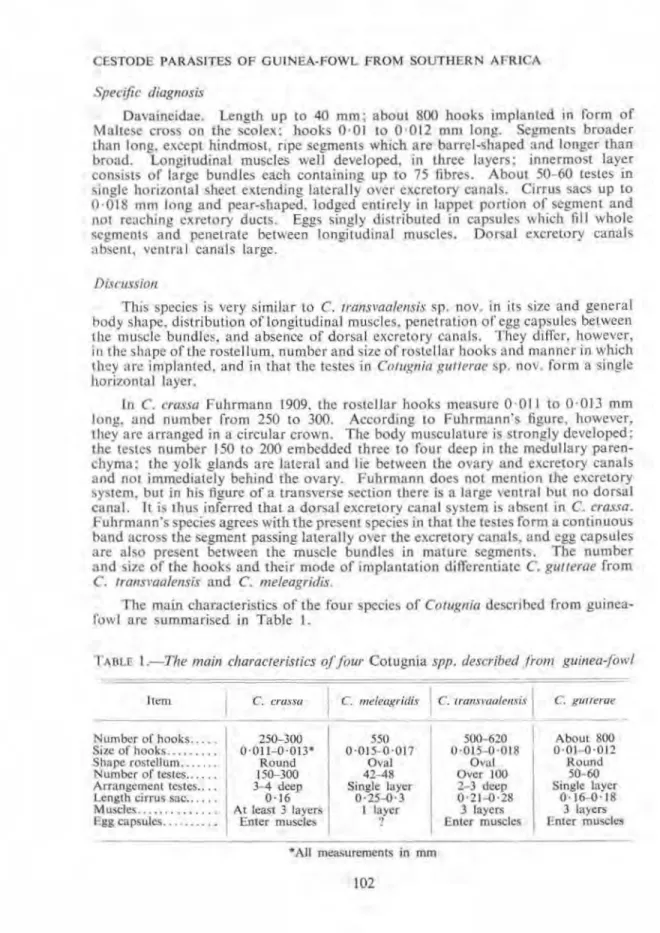
The main characteristics of the four species of Co111gnia described from guinea~
fowl are summarised in Table I.
TABLE I .-The main characteristics of four Cotugnia spp. described from guinea-fowl Item C. crussa C. 111e/(1{1gridis
I
C. trany1·aale11sisI
C. gwrerae- -- - - -
Number of hooks .... . Size of hooks ... . Shape rostcllum ... . Number of testes ... . Arrangement testes ... . Length cirrus sac ... . Muscles ... . Egg capsules... . .... .
250-300 0·011-0·013•
Round 150-300 3-4 deep
0·16 At least 3 layers
Enter muscles
550 0·015-0·017
Oval 42-48 Single layer
0·25-0·3 t layer
?
•All measurements in mm
500-620 0·015-0·018
Oval Over 100 2-3 deep 0·21-0·28
3 layers Eoter muscles
About 800 O·OJ-0·012 Round
50 60 Single layer
0· 16-0· 18 3 layers Enier muscles
R. J. ORTLEPP
Raillietina (Raillietina) steinhardti Baer. 1925
Several complete worms recovered from crested guinea-fowls are classified under the above species notwithstanding that they differ in several respects from the single specimen on which Baer based his description. The chief differences in the characteristics as noted by Baer and in the present specimens are briefly indicated
in Table 2. Jn the Onderstepoort material wel I extended, complete worms, carrying ripe segments vary in length from 65 to 135 mm with n mnximum breadth of l · 6 to 1 ·9 mm. The head varies in thickness from 0· 142 to 0·24 mm. but in one of the specimens the head with its roslellum everted and without hooks on its rostellum or suckers, has a thickness of0·3 mm. The four oval suckers. about 0·09 mm broad and 0 · 12 mm long, are heavily armed with about 15 rows of prominent spines. the largest of which reaches a length of 0·012 mm. The rostcllum ill retracted in most instances and has a transverse diameter of0·06 to 0·078 mm. Two circles of typical hammer-shaped hooks are present at its base. their number is estimated at about 160. Two of the heads have been squashed and as a resu It the rostellar hooks are detached and lie flat. The length of these hooks varies from 0·01 to 0·012 mm whereas hooks in situ on cleared heads appear to have a maximum length of only 0·008 mm. The larger measurements can be tuken to represent their normal size. The head is followed by a neck. 0·9 to I ·2 mm long and from O· l to 0· 18 mm thick. Well extended, mature segments are almost square, being from O· 58 to 0·6 mm long by 0·6 to 0·63 mm broad. Jn a slightly shrunken specimen the mature segments are twice as broad as long, being 0·3 mm long and 0·64 mm broad.
The unilateral genital pores are centrally placed or immediately posterior or the centre of th.c lateral margin.
A
short genital sinus. about 0·045 mm deep. leads to the openings of the genital ducts. The lobed ovary is centrally placed and is surrounded laterally and posteriorly by the testes (Fig. 11); it is about 0· 18 mm long and O· J2 to O· 15 mm broad: a lobulatcd yolk gland measuring 0·075 by 0·045 mm is situated at its posterior border. A small receptaculum seminis is!odgcd in the centre of the ovary; from it the vagina curves outwards to open immediately posterior to the male genital opening: its terminal portion, for about O· I mm, is thick-walled and has a diameter of about 0·024 mm. Jn general the testes form a single horizontal layer round the lateral and posterior margins of the ovary extending forwards to immediaceJy beyond its anterior level on the aporal side. Jn six stained and mounted complete specimens their number is found to vary from 25 to 32 and all are confined to the area between the excretory canals. The cirrus sac has a very characteristic struccure, being markedly muscular and thick- walled throughout its whole length and not tll.in along its inner curvature as in R. (R.) pi11111eri (Klaptocz) and its variety R. (R.) p. polyorchi.~ Baer (Fig. 12). Jt is somewhat pear-shaped, varies in length from
O·
126 co O· 18 mm with a maximum diameter of 0·07 to 0·09 mm; in the centre its musculature is thickened. thus constricting its cavity and giving it a somewhat hourglass-shape: here the wall reaches a thickness of 0·03 mm, whereas the rest of the wall including the inner curvature is 0·025 mm thick; it does not reach the excretory vessels. An internal vesicular seminalis is apparently absent. No fully extruded cirri were seeo. but those partially everted are 0·06 mm long and 0·007 mm thick, their ends being sUg.htly swollen: they appear to be unarmed. The genital ducts pass over the nerve between the excretory canals. The ventral excretory canals are relatively large and attain a diameter of 0·03 to 0·06 mm, while the dorsal vessels are only 0·005 to 0·009 mm thick. The latter are easily seen in the anterior segments in in ioto mounts; their presence is difficult to see in older and ripe segments but can be followed in some specimens. Both pairs of canals are united by transverse ves;)eJs.CESTODE PARASITES OF GUINEA-FOWL FROM SOUTHERN AFRICA
Ripe segments are slightly longer th.an broad and may become barrel-shaped; they measure from I · 5 to l · 7 mm long by I · I to J · 3 mm broad. Each segment carries from 23 to 34 egg capsules which extend over the excretory canals; each capsule encloses from 15 to 30 eggs. The embryos measure 0·01 mm.
Fl<•. 11 12. Raillieli11a (R.) stein·
ltard1i. I l. Ma1ure seg.mencs.
12. Cirrus sac and v:igina.
Jlosr: Gu11era edouardi (Hartlaub).
Location: Jntestine.
Locality: Northern Rhodesia and Mocambique.
Donors: Ors. P. L. Je Roux and
J.
A. Travassos Santos Dias.fn addition Lhis species was also recovered from Numidae me/eagris from Kaal- plaas, Onderstepoort.
r
ABLE 2.- Comparisnn of characteristics of R. (R.) Steinhardti as noted by Baer and by OrtleppItem
Si.:zc ... . Diameccr head ....•...
Sucker ...•... Sucker hooks ... . Rostcllum ... . Rost. hooks ... . Vent. Ex. C ... . Dorsal Ex. C ... . Testes ... . Distribution testes ... . Cirrus sac ... . Musculature sac ... . Cirrus ... . Vagina ... . Ovary ... . Yolk gland ... , .... . Egg capsules ... . Dist. egg. cap ... .
R. (R.) s1eilllrardti R. (R.) s1einltard1i (From Baer, 1925) (Present observations)
1
45 " I· 7• ... . 0·23 ... . 0·095 x 0·076(•) ....•...
Very smaJJ ... . 0·076(a), ... . 160. 0·006--0·007 ... . Diam. 0·32 ... . Diam. 0·011. ... . About 20 ... . Lat. & post. of ovury ....•...
O· J5-0· 17 ,,r. 0·06 ... . 0-·0076 thick(11) . . . .
Armed-0·03 thick ... .
? ... . Lobed, centrnl. ... . Central, behind ovary ... . Over 40, according lo figure .. . Do not extend over exc. canals:
confined to anterior portions of segment
•All measurements in mm
65 135 x 0·6-1·7 0· 142-0·3 0·09 .... 0· 12
Coarse-up to 0·012 Jong 0·06--0·078
About 160, 0·01-0· 12 Diam. 0·03-0·06
Diam. 0·005-0·009 25-32
Lal. & post.
or
ovary0·126-0·18 x 0·07-0·09 0 ·025--0 ·03 1hick Smooth-0·007 thick Tc:rminal portion muscular Lobed, central
Ccntrnl, behind ovary 23-34
Extend beyond exc. canals: dis- tributed over whole segment
{a) Baer gives ten times these sizes which figures must ~ u misprint
(b) As Baer states " Sa paroi est tres musculeuse" this figure is probably incorrect
R. J. ORTLEPP
Discussion
From the above description and Table 2 it can be seen that the significJn1 differences between the two sets of specimens concern the size of the rostellar hooks, number of testes, thickness of musculature of cirrus sac, nature of the cirrus and distribution of the egg capsules. The difference in size of the hooks is probably due to their positioning when measured. As Baer had only a single worm at his disposal his measurements are probably based on hooks in siTu. whereas the present measurements are based on detache(i hooks which are lying flat. The difference in the number of testes can be explained as due to species variation, although in the Onderstepoort specimens there are never less than 25. No explanation can be offered for the difference in structure of the cirrus sac and cirrus. nor for the differences in the number and in the distribution of the egg capsules: in all the specimens examined the capsules. even in their earliest development, tend to extend over the whole segment and beyond the excretory canals. However, it is considered that the differences are outweighed by the presence of a highJy muscular cirrus sac in both sets of specimens. by the absence in both of a small pouch near the tenninal portion of tlte cirrus, as desc1ibed and figured by Fuhrmann (1909) for R. (R.) pintneri (Klaptocz) and by the distribULion of the testes round the lateral and posterior margin of the ovary. The size of the hooks (0·0096 to 0·0112 mm) and the number of testes (25 to 30) appear to ally R. (R.) pintneri var. polyorchis Baer, 1925, with the present specimens; the anatomy of this variety, according lo Baer (1925b) is identical with that of R. (R.) pintneri except for lhe size of the rostetlar hooks and the number of testes. As Baer (1925a) figures the testes of this latter species as being absent behind Ute ovary, it is legitimate to assume that they are also absent from this area in his variety: also the weak muscular structure of the cirrus sac and presence of a small sac in the cirrus must be common to both for the same reason. Th,ese differences thus serve 10 differentiate the present material from Baer";
variety.
R. (R.) 1e1r<1go11a (Molin, 1858) differs from the R. (R.) steinhardTi in that it possesses only about 100 smaller rostcllar hooks arranged in an apparently single circle, the genital ducts pass dorsally over the excretory canals and the number of egg capsules in each segment varies from 50 to JOO, each of which carries only 6 to 12 eggs.
R. (R.) tetragonoides Baer, 1925, is very similar to R. (R.) 1etraK011a except that it carries more hooks ( 160 to 180) in two circles and the number of testes does not exceed 20 for each segment.
Railljetioa (Raillietina) pintneri (Klaptocz, 1906)
The original description of this species is not available; this identification is based on the data given by Furhmann (1909a), Joyeux: (1923), Baer (1925a) and the fuller description provided by Neveu Lemaire (1936). The Onderstepoort material, however, does not agree iu all respects with the description given by these authors.
SupcdicialJy the Onderstepoort specimens of this species resemble R. (R.) steinhardti although in general it may be stated to be slightly more slender. Complete worms may reach a length of 60 mm with a maximum breadth of l · 5 mm. The suckers are weJI armed, the spines reaching a maximum Length of 0·01 mm. Two circles of small hammer-shaped hooks encircle the base of the rostellum: they are from 0·006 to 0·007 mm long; their precise number was not determined but it is estimated that they num.ber about 200. Mature segments are much broader
CESTODE PARASTTES OF GUINEA-FOWL FROM SOUTHERN AFRICA
~han
long, their breadth varying from 0·9 lo l ·5 mm and their length from 0·24 o 0·26 mm. The unilateral genital pores are situated towards the anterior quarter of tbe segment, and give access to a small genital sinus about 0·05 mm deep. The rounded testes number from I 5 to 45 for each segment; they are generally arranged in Lwo groups, a poral group of five to seven and an aporal group of from 12 to 35.Sometimes the two groups are united by two or three testes in a row behind lhe ovary: they form two layers which are limited laterally by th.e excretory canals.
The cirrus sac is pear-shaped, from 0· 144 to 0· 18 mm long by 0·072 to 0·09 mm in maximum thickness: its outer wall is provided with a weak musculature and is nowhere thicker than 0·004 mm (Fig. 13). Fuhrmann (1909) figures it as having a thicker wall in its poraJ half, whereas aporally its wall is very thin. This weak structure of the cirrus sac is in marked contradistinction lo that found in R. (R.) steinltardti where the musculature reaches a thickness of 0 · 03 mm. The unarmed cirrus does not carry a small posterior pouch towards the rerminal portion of its canal- a feature to which Fuhrmann (1909) drew special attention. After leaving the cirrus, the vas deferens is slightly convoluted in the cirrus sac and its inner portion becomes much swollen and filled with sperm thu:. functioning as an internal vesicula seminaJis: after leaving the sac it becomes much coiled, these coils extending more than half-way across the segment in front of the testes. The centrally placed and slightly lobulated ovary occupies the anterior portion of the segment: the area immediately behind the ovary is occupied by the yolk gland. The female aperture is localed immediately posterior to that of the male. Porally the vagma is 5lightly thil.:kened and muscular and it takes a deep stain. The vagina and the vas deferens pass inwards between the excretory duels. The uterus extends across the segments~
it 'oon breaks down, the contained eggs becoming enclosed in fibrous capsules in groups of about 10 to 15 eggs each. These capsules, 22 10 32 in each segment.
eventually fill the whole segment extending laterally over the e\.cretory canali>. In the material from the crested guinea-fo\\ I from Northern Rhodesia, howe' er. there are only from 18 to 25 cap&ules in cacn seg.mem and in ripe .;egmcnts they do not C"<tend beyond the outer limits of the e\.cretory canals.
FtG. J J. Rai/lietina ( R.) pi11111er1. Cirrus s.ii.: and noral urgan~.
The usual two pain, of longiwdinal excretory canals are present, the vencrnl on~s nrc fairly large and reach a diameter of0·036 mm, whereas the dorsal. <tlthough easily seen. are only 0·006 to 0·008 mm across. A Lhinner transverse canal unites the two dorsal ducts in each segment.
Comparing the present findings with thoc;c of Fuhrmann ( l909a) and Baer (1925a) one notes that Fuhrmann stated that 30 to 40 testes are present in each -;cgment. He does not mention their distribution; neither docs Baer but his fil!ure of a mature segment ~hows only 15 Lestes arranged 111 two groups and n~ne connec~ting
R. J. ORTLEPP
the two groups behind tb.e ovary. Neveu Lemaire (1936) gives their number as 13 to 24. One thus concludes that their arrangement is as in th'! Onderstepoort material and that there is a considerable range of variation in their number. Baer also figures the vas deferens as heavily coiled anterior to the testes as in the present material: in addition the number and size of the rostellar hooks are about !he same in both sets of specimens.
Hosts: Guttera edouardi (Hartlaub).
Numida me/eagris Linnaeus. Locmion: Intestine.
Locality: Northern Rhodesia (Guttera).
Mo<;:ambique (Gutfera).
Republic of South. Africa [Pretoria, Potchefstroom Zoutpansberg (Numlda)
I·
Swaziland (Numida).
Raillietina (Raillietina) angusta sp. nov.
This species is represented by several fragments collected from crowned guinea- fowl from Kaalplaas, Onderstepoort. lts r1arrow strobila readily differentiates it from the other species of this subgenus. The largest fragment is about 100 mm long, the total body length probably does not exceed 200 mm. Ripe segments are less than
a
millimetre broad. Jna
number of fragments the segments are somewhat rounded and these fragments give the appearance of a row of small beads. Only two heads were recovered with sufficient of the strobila attached to identify to species level: these heads measure 0 · 3 and 0 · 27 mm across; they are somewhat rounded and each carries four slightly oval suckers which measure O· 15 mm long by 0·09 to 0 · 12 mm across: most of the armature have been lost, but a sufficient num bcr of hooklets remain on some of Lhe suckers to show chat they are relatively small and arranged in several rows. The rostellum is retracted in both heads and measures 0·075 mm across: each carries about 200 small hammer-shaped hooks. about 0·009 mm long and arranged in two circJes. The neck is relatively broad and measures 0·2 and 0·24 mm across in !he two specimens. In most instances the mature segments are broader than long; where the strobila has undergone some stretching, these segments are slightly longer than broad: apparently normal. mature segments are from 0·675 to 0·75 mm broad and 0·38 to 0·45 mm long; in stretched segments these measurements arc 0·45 and 0·48 mm respectively. The unilateral genital openings are situated immediately anterior to the middle of the segment's margin: a genital sinus is absent, the male and female aperture being practically flush with lhe surface. The pear-shaped cirrus sac is from 0· 15 to 0·18 mm long and 0·045 to 0·05 mm thick; it extends obliquely forwards. lo stretched segments it reaches the excretory vessels but Lhis does not happen as a rule. Its musculature is well developed, but by no means as well as in R. (R.) .~teinlrardri; the maximum thickness at about the middle reaches 0·015 mm and at its inner curvature this thickness diminishes to about 0·009 mm. The cirrus is comparatively massive and in many mature segments it is inserted into the adjacent vagina~ at its base it is 0·03 mm thick and its still inverted lumen is lined with small spikes. The vas deferens is thrown into several loops before emerging from the cirrus sac; after emerging it makes a few small loops in its course obliquely forwards towards the centre of the segment: here it makes a number of large ancero-posterior loops.The Lestes from 18 to 24 in number are arranged in a semicircle round Lhe lateral and posterior margins of the centrally placed ovary; aporally they extend forwards,
CESTODE PARASITES OF GUINEA-FOWL FROM SOUTHERN AFRICA
lo almost the anterior level of the vas deferens; porally they are present only as far as the hind margin or the vagina; in depth they form two or three layers. They rnawre before the ovary. The vagina opens immediately berund the apertures or the cirrus sac: its outer ex1remity is thickened and muscular for a distance or O· I mm: the rest of the vagina passes inwards in an arc and terminates in the centre of the ovary as a small oval receptaculum seminis. The ovary has equal lobes on each ide of the midline. The vitellarium is also centrally placed immediately behind the ovary and anterior lo the posterior row or testes. The uteru::. 1s soon replaced by 30 to 40 egg capsules in each segment: when ripe each capsule contains about 25 eggs. These capsules fil I the whole segment: it look!) a!> if they do not extend beyond the excretory canals but that they push Lhese outwards so tl1at they come in contact with the lateral body wall.
The ventral excretory canals are relatively thin and only about 0·003 to 0·005 mm in diameter: in some segments they suddenly swell out and may reacl1 a diameter of CHl3 mm. The minute dorsal canals can only be made out with difficulty. The genital canals pass inwards, apparently bctwccl\ the dorsal and ventral canals and c,wer the nerve trunk.
/lost: Numida meleagris Linnaeus.
Lotation: Intestine.
Locality: Kaalplaas. Ondcrstcpoort.
Types: Tn Ondcrstepoort collection.
Specific Diagnosis
Davaineidae. Slender thin worms probably not longer than 200 mm with a maximum thickness of one millimetre. Head up to 0 · 3 mm broad. Rostellar hooks about 200 in two ranges, each hook about 0·009 mm long. Suckers armed. Genital pores open level with surface. Cirrus sac up to 0· 18 mm long, moderately muscular.
Testes lateral and posterior to central ovary, 18 to 24 in number. Thiny to forty egg capsules in each dpe segment, each capsule with about 25 eggs.
Discmsion
The chief characters which serve 10 differentiate trus from other species of Rnillil'lina from guinea-fowl arc its slender strobila, moderately developed musculature of the cirrus sac and the arrangement of its testes lateral and posterior lo the ovary:
the last two characteristics ally this species with R. (R.) stein/l(lrdti but th.e marked difference in length. and thickness of its strobila and the moderate development of the musculature of it!> cirrus sac easily differentiate il from R. (R.) steinhardti
Raillietina (PuroniclJa) numida (Fuhrmann, 1912)
This species is represented by four lots of specimens. two from the Cape Province tind two from the Transvaal. l n addition some specimens identified as R. ( P.) 111ag11i11umida Jones, 1930. presented to this rnstitute by the United States Bureau of Animal Industry. are also available. All were collected from the crowned guinea-fowl.
In the Onderstepoort material these small cestodcs reach a maximum length of 35 mm with a posterior breadth of a little under I mm. Fuhrmann·s (1912) specimens are shorter, whereas Hudson (1934) found his specimens reached a length of 100 mm. Jones (1930) gives the length as JOO 10 I SO mm: her specimens were
R. J. ORTLEPP also broader. attam111g a breadth of I · 3 mm. The strobila in this species easily become abnormally stretched with the result that the segments are elongate. Nor- mally the segments. ex.cept for the posterior ones, are broader than long; in the .. arious worms examined the hindmost segment containing eggs, vary in length from 0·7 to 1 ·05 mm with a breadth of 0·65 to 0·95 mm.
The chief characteristics found by the various workers are indicated iu Table 3.
TABLF 3.- The characteristics o/' Raillietina (Paroniell<t) numida as recurded by Fulirma1111, Jo11e.1', lludson and Ortlepfl
llcm
Size ...•...
Head ...•
Sucker ... . Rostellum ... , .. . Rost. hooks ... , Size hook.~ ... . Cirrus sac ... . Hooklets of cirrus ... . restes .... ' ... ' ... .
ruhrmann
20 0·24•
0· 16 0·045 0·08 160 180 0·009-0·01 0•14--0·16
0·009 7-10
.Jones
150 ·" I ·3 0•21 0·06
150-160 0·008 0·01
O·J5 0·024 J3-J8
•AIJ measurements in mm
Hudson
JOO •· 0·8
9-18
- - - -
Ortlepp
35 I ·O
O· l~-0·11
0·06 0·072 0·54-0·06 0·065-0·09
160 200 0·01 0·012 O· IS-0· 165
0·015 7-10
The testes never number more than 10 in the Onderslepoort material. whereas in the United Stutes materiul the number reaches 18. The average number is 7 or 8. Except in lhe greater number of testes and in the larger cirrus sacs, Jones·
specimens agree with the Ontlerstcpoort specimens. Since Hudson, 1934, also found as many as 18 testes in his specimens from Uganda, he relegated Jones' J 930 specimens to synonomy with R. tP.) 1111111ida: tllis synonymity is supported by the present findings.
Hosts· N11111ida mclcagris Linnaeus.
lotallties: Cape Province (Grahamstown and Lady Grey). Transvaa I (Pretoria and Onderstepoon).
l'orogynia paronai (Moniez, 1892) Raill. & Henry. 1909.
This fairly large and characteristic cestode of guinea-fowls wa:. firsl described under the name Tae11ia purunoi by Monjez. Jn 1901 Fuhrmann had at h.is disposal a cestode without its head which he considered unknown; he describ::d it under the name Li11s1011·ia !ala: later (1908) when he was able to examine spel·imens with heads he found that the scolex was armed with typical davaineid hooks arranged in th.rce series; it thus belonged to the family Davaineidae and not to the Anoploce- phalidae and he placed it in a new genus and renamed it Polycoelia latct. As this generic name had already been used by King ( 1840) for a coelenterate. Railliet and Henry (J 909) Crea.led the genus Porogynia for its reception. They also showed that this species was the same Taenia paro11ai of Moniez.
The material at the disposal of the above workers originated from North African hosts. In 1934 Baylis examined cestodes from Uganda; among these were two
CESTODE PARASITES OF GUINEA-FOWL FROM SOUTHERN Al-RICA
specimens which he considered new and described as Rnillietinn (Pnrnniella) ll'OOd·
/a11di. A study of this description has convinced the writer that his specimens are co·spccific \\ ith those of Moniez and that his name mu<,l thus be considered syno- nymous to that of Moniez.
The present study is based on many mature and immature sp:!cimens of this species from \arious regions of Southern Africa: this abundant material allows of
a
study of it'> \ariations, especially those applying Lo the ammgement of its rnstellar hooks.Fuhrmann (1932) characterised the gerllls Porogynia
as:
davaineids armed with three cro\\ns of rostcllar hooks, segments generally broader than long. muscu- lature <;trongly developed. dorsal excretory vessels absent anu ventral:. \Cry large.ge111tnl pore!> unilaterul. female glands very poral in posil10n \Vtth yolk gland aporal of ovary, testes arranged in a single layer internal of female glands und eggs lodged singly in parenchymatous capsules.
Many of the Onderstepoort specimens are unfortunately
ml•Ch
shrunken and twisted. The length of the largest complete wecimcns i~ nearly 20 cm with a maximum breadth in the anterior third of abouL7
mm. [Fuhrmann {1901) gave tin.:size as 240 by 10 mm and 400 by 4·5 mm and Baylis (1934) as 270 by 6·5 mm]
The posterior half of complete worms becomes much attenuated and tail·liJ.,c. the breadth diminishe~ to less than 1 mm at the pol!terior end. Tlte anterior mature segments are much broader than long. being only about 0·28 mm long, whereas in the hindmost the breadth only slightly exceecb the length being I· 5 to I· 6 mm broad by about l ·O mm long. Jn Fuhrmann·:. ~pccimen~ the hindmost segments arc ~lightly longer.
Practically all the scolices ha\e retracted ro<.,tella: 10 these the scole\. ha'> a breadth of 0·5 to 0·66 mm: Fuhrmann gives itc; size a<. 0·45 :rnd 0·58 mm ..wd
Buylb
a~O·
7 mm. Tile four unarmed. oval sucker~ mea'iurcO·
15 to 0·18
mm long and 0· 135 to 0· 145 mm across. The retracted rostella measures 0·21 to 0·24 mm aero~~ in optical section at the level of the ltook~. Jn a scolc" (Fig. 14) \\ith extruded rostellum the measurements arc: scole>. 0·52 mm across, suckers 0 162 by 0·138 mm. rostellum 0·228 mm broad and 0·18 mm long. Several retracted~colices were halved transversely, cleared and mounted with their anterior fJccs upwards under slight pressure in either gurn arab1c, poly' inyl alcohol or canada babam~ a few heads were teac;ed to break up the rostella and release the hooks.
On these roscella the hooks number from 163 to 204; Baylis estimates 1heir number as not less than 240: they are relatively large and typically hammer.shaped \Fig. 148).
They vary in length from 0·054 to 0·066 mm. The hammer and claw measure 0·033 to 0·035 mm across and the claw about 0·012 mm. The arrangement of the hooks shows coni.iderable variations: on most rostclla they are all reguh~rly arranged in two circles. ln others, however, portions only of the rostellum carry two distinct circles, whereas on the other portions three circles can be seen (Plate l).
Jn two insta11ces portions of the roi.tellum in one head have three to four circles:
in the other head four or foe series can be seen. Of 11 heads thus examined en face seven have two regular circles each, two have two to three each, one has three to four and one has three to five series (Fig. 14C). The basic arrangement thus appears to be two series. Since the hooks are large and the space they occupy is limited, some of them especially those of the anterior circle. arc pushed forward and thrust out of alignment giving the impression of more than two series. 1t is a remarkable coincidence that such careful observers ns Baylis and Fuhrmann should independently have had at their disposn.I only specimens with three circles of hooks.
oo A - c
R. J. ORTLEPP
Fto. J4.- Porogy11ia paro11ai. A. Scolcx with extruded rostellum. B. Rostellar hooks.
C. Rostcllar hooks in 3 to 5 ranges.
PLAT£ 1.-Porogynia paro11ai. Ar- rangement of rostellar hooks chiefly in two ranges.
CESTODE PARASITES OF GUINEA-FO\\ L FROM SOUTHERN AFRICA
There is no1hing special to add to 1he de~crip1ions of the anatomy of the mature and npc segments gi'en by Fuhrmann (1902) and by Baylis (1934). excepl that in some of the present specimens the testes extend o'er the aporal excretory vessels and almost reach the large nerve chord \\ hich lies about midway between the edge of the segment and the excretory canal.
1 n fable 4 a summary is gi,cn of finding5 of the different ohservers.
TABU. 4.-Sun1111GtJ' of the findings o.f the differe111 ohserrers
Item
S11c .. , •...•...•• , Ripe segment ... , .... . S<.:nlcx ...... . Rostcllurn ... . Suckcri. ... . lloob. ··-···· "·
Mu~ch:~ ... ...•...
Bundles... _ •.•... D. f,. l .... _ .. . . . .. .
v.
l ~- <. ...•. Nerve. . ..•...• G. pore, ... . C. sac .. ... .Tc~1cs.. . ...... .
Oval)., ... ·-···· Yon, gt..
t(:J,l)
Hcl\. hook' ...•
Fuhrmunn 200 400 ' 4 5 6*
2·4 . I ·7 0·45 0·58
O·J8 0· 16-0·2 Large No.; 3
s~rics
0·044--0·056 Strong, inner bundles large /\bout 500 fibres
Absent large Large Unilateral
0·45
"
.,
)
J3aylis
'.!70 6·5 0·7
o-n
0· 16-0· 17 240: 3 ~cries
(1·0540·066
A~ under ruhrman
Ab~cnl LM!;C Large U111la1cral 0·2-0·24 lH h:~5 than 150
I J.1:,;er deep Bet. c>1c. canab Markedly poral Marl..cdl) rorOJI Aporal of ovary Arora! of o-.ary 0·036 0·032-0·04
0·018 0·02
•AJI mcasurem<!nt~ in mrr.
/losts: Gutlt'ra edouardi (Hartlaub).
Mazabuh1, N. Rltodcsia.
Numida 111eleagris Linnaeus.
Pienaars River_ Transvaal.
Zoutpansberg, Transvaal.
Molali, Transvaal.
Grahamstown. Cape Province.
Hoopstad, Orange Free State.
Kroonstad, Orange Free State.
Big Bend, Swaziland.
R:iillie1ina (Skrjahinia) deweti Ortlepp, 1938
50 3·7
0·81
o-:?J
0· 166 80 0·06
/\~ <.ndcr Fuhrman 50-80 librcs
Absent Large L1rgc
Mo~1l:r un1I.
0· 19 0\Cr 100 '.2 3 l.t)'Cr\ deer Bet. c,c. c.1nals
Ortlcpp
'.200 7 1 ·0 1 ·6 0·52-0·66 0·21 0·24 0· 15-0· II\
163 204, 2 scril>«
gen.
0·054-0·066 /\s under
Fuhnnan 40-90 fibres
Absent Large Lirgc Unilateral
0·~1-0·24
About 150-200 '.2-3 layer" tkep
May pass over aporal c,c. c.
\fa1l..1dly poral Marl..cdl~ poral Aporal ofO\ary -
I
/\11oral 0·036 0·04'.2 of01ary~ 0·018 0·0'.21
Ortlepp ( 1938) described th.is species from male rial recovered from a crowned guinea-fowl from Lady Grey. Cape Province. Since this description this species has not again been recovered. There is thus nothing to add to the published descnp- 1ion.
R. J. ORTLEPP
Ascometra numida (Fuhrmann. 1909) Baer, 1955
TlllS very common parasite of guinea-fowl is prc~ent in ulmos1 all Lhe collec1ions at Onder')h:poort: the e \\ere made from "1Jel;,. separated areas of Southern Africa.
It has abo been reported from variou5 area~ m onh and Cen1ral Afnc.t. In mo5t ca'cs thi' species was collected from cro,.,.ned guinea-fowb. bul one lot of worms M1giniated from J cre:.1ed guinea-fo\\ I from '\onhern Rhode .. ia. The study or the'e ~pcc1menlt shows considerable Yariation;; in morphology. The head thickness
\arie'> from 0·39 lo 0·54 mm and lhc oblonu ~udcr<> from 0· 18 LO 0·26 mm long by 0 · 16 to O· 24 mm broad. In some '"orm-; 1he sucl-cr lapr>els are very conspicuous.
"'hcrea<i in others 1hcy are recognised only wilh difficully. Complete. mature worm'>
vary in length from J7 to 90 mm and muximum hreaJlh from I ·Oto 2·0 mm. A stnl-ing vuriatinn i:, in tlic size of the cirrus "1c': the ,hortest ~acs arc found in the -.pecimens from th~ cre)>tcd guinea-fowl and in the sp..:c1m::11s collected from crowned guinea-fowl-. 1n the Pretoria district and al Kaulplau~. Ondcr:.tt:poort. In these wormi. the sacs vary in length from 0·24 to O· 33 rnm i.e. th~se mea'>uremcnts agree with tlHN~ given by Baer (1955) for A. x1111erae (Buylis. 1914). hut the heads arc much 'mallcr than the sizes given by Baer for this spcciei., nnmely 0·6 to 0·7 mm. Jn the rresent 5pecimens the lurgest head measures 0·54 mm ioL~ross, the majority of hea<.h being smaller: i.e. 0·4 to 0·48 mm: these siLes are more in agreement with Bae r's figures for A. 1111111itla viz. 0 · 5 to 0 · 53 mm. The lcngt h or the <;uckers in 1hc present specimens. viz. 0·21 to 0·2o mm arc also more in agreement with Baer's and Fuhrmann's (1909) measurement<:. viz. 0·2 and 0·21 mm respectively for l·uhrm:11111\ '>pecie~. 1 he specimens from the other crowned gumea-fowls have cirrus sacs which vary in length from O· 33 to 0 · 66 mm and the head thickness rs from 0·39 to 0·6 mm. The spatial arrangement of the testes in Onderstepoort 'ipcc1mcm i)> very similar and conform-. to the figure given by Fuhrmann for hi-.
)ipecics :ind by Baer for both species viL. A. 1111111idn and A. g1111en111. i.e. no testes extend tranS\crsely across the egment 1n front of the genital Juel\. Baylis ( 1914) in the dc:.cription of Ocropemlum g1111erae Ascomerra gmre1al!, \\rote that they occupied "practically Lhe \\hole of the space in all direction'> which is not taken up by the ducts and female organ<;". and in hi-; Figure 2 the Lestes are !>hown as encirclmg these organ!> excepc for a narrow poral passage through which the genital ducts pas:.. Baer ( 1955 rig. 9 and 10) !>hows the testes as absent across the segment :Interior to Lhcse ducts for both. his A. 1111111ida and A. gulll!ral!, notwithstanding that 111 his te.\t for A. gutterac he wrote Lhal they o;urround the female glands as in /1. 1·estita Cholodkovsky, 1913. In his Figure 6 for this species he show~ the testes us present across Lhe o;egment anterior to the ovary and va~ dcferens, as also featured in Baylis (I igurc 2) for his species. Funhcr Baylis Mute<; thal the coils of the vas dcfercns pass over the excretory vessel 10 enter the cirrus sac which is immediately lateral to the excretory duct, i.e. the cirrus sac docs no1 cross the excretory vessel.
Thi~ condtlion is figured in llis drawing (rig.. 2) where lh.c cirrus sac is shown as not passmg inward<> beyond this vessel. Baylis' specie~. A. glllterae. is thus charac- teri)>cd by the presence of testes round the 1>vary except for H poral passage and 1 he cirrus sac!> do not cross the excretory canal. Bacr's (1955) de~cription!> and figures do not satic;fy these criteria: his Figures 9 und 10 for A. 1:11/ferae and A. 11u111ida rcspccti.,,ely arc very similar except that in the latter figure the cirrus sac is longer and extends irl\\arJ:-. a~ f:lr ::is the middle of the segment. In both figures no teste~ arc 5ho\\n across the segment anterior 10 1he vas dcfcrcns and in both the cirrus sacs
cros~ the excretory canal". In view of the variations in length of the cirrus )lacs noted in the present study. it can be concluded 1hat Baer did not have rcpn:senlati\es of bo1h -.pecie~ at hi)> disposal and 1hat his de~criptiom. are ba:.ed 1)11 vananls of the same species, \IZ. A. 11u111ida.
CfSTODE PARASITES OF GUINEA-fOWL f ROM SOUTllLR1' AFRICA
The comparative study of the abundant muterinl from many c;ources leads to the conviction that all the Onderstepoort specimens arc referable to the same species, viz. A. numida (Fuhrmann. 1909). Further that 111 thb species the size of the worms and length of the cirrus sacs are subject to considerable variation. that the spatial arrangement of the testes is constant, none being prcl)ent anterior of the coils of the vas Jeferens and final!} that Baylis studied a rare species which ha'> not again been rcco\cred in Africa. Baylis' species shows .i resemblance to A. l'es1ita Cholod- kO\\sky, in that in both the:-e specie:. the te~tes prnctically c;urround the O\ary and the cirrus c;ac does not cross the excretory canul: they differ from one another.
however. in thut fewer testes, about 50 to 60. arc prt::scnt in A. !{lltlerae as against 200 to 250 in A. vestira.
l
n the diagnosis of the genus A.sc·omt•tra Baer ( 1955) stales that th'! genital ducts pa'>\ dorsally over the excretory cunuls and nerve. In the present c;pecimens these canals pass dorsally over the nerve, bul bcLwccn the dM-.,d and ventral canab.Hosts: Guflera ednuardi (Hanlauh).
Mazabuku, N. Rhodesia.
Mkuzi Game Reserve, Natal.
Nu111ida 111e/eagris Linnaeus.
Pretoria Zoo, Transvaal.
Pretoria District, Transvaal.
Rietvlci, Pretoria, Transvaal.
Kaalplaas. Onderstepoort. Tranwnal Zoutpansberg. Transvaal.
Potchefstroom. Transvaal.
Motali, N.E. Transvaal.
Hoopstad. Orange Free State Albany. Cape Province.
Fish River. Cape Province.
Big Bend. Swaziland.
South West Africa.
H) \I[ '0Lf PIOIOJ\I I lio;paniolepis multiuncinata sp. nm.
One complete specimen, six specimens complete except for their scolices and many fragments of this \ery delicate and membranous cc-.tode 111 one batch. and many fragments among which were ten with ::.coliccs entwined with other cestodeo;
collected from crested g11inca-fowls, were submitted f'or identification. rhc one complete specimen i" 66 mm long and the other -.ix varied from 60 to nearly 100
mm in length: their maximum breadth. excluding their uppcndagc~, i11 0·8 to 0·9 mm.
The heads have their rostella fully extruded (Fig. ISA): they are 0· 16 mm wide and O· 12 mm long; the four rounded. unarmed suckers have a diameter of 0 06 mm. The rostella are O\al in shape with a length of 0-06 mm and a maximum breadth of 0·04X mm; they are connc.:ctcd to the head by a stalk about O 02 mm thick. J\ -;triking feature is the manner in \\ h1ch the roc;tellar hoob are implanted which is quite different from that found in other member\ of thj~ family. Th~y urc arranged in four or fi\e circle!. covering the central half of the rostcllum. the anu:rior and posterior ponions being de' oid of armature. About 70 hooks arc present, giving an average of about 14 for each circle; the hooks lta\'c the shape of ..t primitive bone hsh-hook of\\ hich the shaft i-, embedded in the rostellum. the barb
R. J. ORTLF.l'P
he mg free (rig. I 5B): the length is about 0 ·007 mm and the shaft is sligh1 ly flattened lntnS\er!>cly. The oval rostellar sac in the head is 0·075 mm Jong and 0·06 mm
aero~::..
F1c., J 5. lfispn11inlc!piJ 11111/1i1111c111ma. A. ~colcx wilh l:)(lrndcJ rostcllum, shllWing arrnngcrncnt of hook~. 13. Rostcllar hooks.
A relatively long neck follows the head: this portion. up to the first signs of segmentation. is about 3· 5 mm long: it increases in breadth from about 0·06 mm behind 1he head Lu O· 12 mm. About I •5 mm behind the head the first signs of a developing appendage on the left side of each segment can be seen: these appendages increase in length tO\vards the pos1erior end of the \\Orm. In mature segment<;
their length b about O· l5 mm, and in ripe segment~ 0·45 to 0·53 mm. The firs1 ::.1gns of developing genitalia appear about 4·5 mm behind the head, wliere the segments are about O· 14 mm broad: when the segments attain a breadth of 0·4 mm they are mature. Here the segmcnti. are from 0·06 10 0·08 mm long. Ripe segment ... filled with mature eggs have a length 0· 12 to 0· 15 mm.
The unilateral and highly muscular cirrus sat· (Fig. 16C) ts oval to almo.sl tubular in <tlrnpe; it varies in length from 0·09 mm to 0· 16 mm, with a breadth of from 0·018 lo 0·042 nun: the change from oval to tuhular takes place gradually from the front 10 the rear. It extends inwards us far us lhc ventral excretory t:anab which it overlies hut does not extend further inwards. The cirrus canal is wavy to '>lraight dcpen<ling on the Ieng.th of the cirrus sat: no vcsicula ~cminalis interna b present. After emerging from the sac the vas deferen~ form'> a single loop, and then \\1de11s lo form a large transver-;e external \esicula scmtnalis. about 0·09 mm lung and 0·03 mm thick. Three rounded testes arc arranged in a row towards the po~terior border of each segment (fig. 16Al; they are about 0·036 mm in diameter and two are poral and one aporal in position. Between these two group" the balobed ovary de,elops with a slightly oval yolk gland. measuring 0·018 to 0·036 by 0·012 to 0·03 mm towards its posterior and vcmrnl aporal corner. It develop-;
C£STODE PARASlTES OF GUINEA-FOWL FROM SOUTHERN AFRICA
lo maturity only after the maturation of the testes. In segments in which it appears
10
be fully functional the testes consist of only an outer membrane enclosing a few cellular elements. An oval receptaculum seminis 0·06 mm broad by 0·03 mm long can be seen. The vagina is very weakly developed and extends outwards immediately behind 1hc cirrus sac and opens into the genital sinus ventral to the cirrus
~ac.The uterus develops as a transverse sac which passes over the e'cretory canal!> on 1he poral side und extends posterior to the cirrus sac: on the apornl side it
blimtted by the excretory ducts; in ripe segments (Fig. 161:3)
itfills 1he whole
<;cgmcnt
except
for aclear strip on the aporal side external lo the excretory ducts.
Mature
eggsarc large and round: the external covering ha:. a diameter of 0·06 0·07 mm, the intermediate covering measures about 0·036 mm across and tile embryo measures 0·018 to 0·02 mm. The hexacanth hooks arc !>mall and
incon- sp1cuou::. andattain a length of only 0·007 mm.
The cxcrerory sysrem consists of the usual two pairs of longitudinal canals united by
aring canal at the base of the rostellar sac.
In Hportion
ofthe strobila the dorsal canal is outside
theventral on
theporal side and its diameter only 0·002
mm;it passes under
thecirrus sac
atabout
the level of its internalthird. Aporally
itis situated internally to the ventral canal and has a
lmost tl1csame diameter (about 0·01to0·015 mm as against
adiameter of0·0
18 to 0
·021 mmfor the ventral canal).
The ventral canals are not regularly connected by transverse canals at the base of each segment.
Theseconnections in a portion of strobila embracing 50 segments are separated by the following number of segments: 2. 6. 0,
I. I.5, 6, 9. 0. 4. 2 and
2_The dorsal canals are connected by transverse canals
al