The different models for assessing interactivity, cyber democracy and the public sphere in the online newspapers used in this study indicate very low levels of interactivity, thus influencing the rest of the components. Interactivity, possibilities for cyber democracy and possibilities of a broader public sphere were found to be very low in Zimbabwe's online newspapers.
INTRODUCTION
Background: Zimbabwean online news
It will also provide an interpretation of the results within the context of interactive communication theories. It will also discuss the conclusions of each of the research objectives and highlight the limitations of the study and provide recommendations for future research.
Context and Motivation
The feasibility of cyber-democratic models of political communication is also affected by the limited accessibility of the Internet to ordinary Zimbabwean citizens. Despite the arguments against it, the Internet still plays a significant role in the dissemination of unfettered messages.
Key Research Questions
In the context of Zimbabwean online news distribution, it has even come to the attention of the current regime that the Internet is becoming a powerful tool of political communication and criticism, and so the fear and hostility prompted Mugabe to push for a "spy law" take. to monitor internet communications. There have been a number of studies done on computer-mediated communication and on interactivity in particular.
Statement of the Problem
The study itself is a content analysis of interactive options in Zimbabwean English-language web newspapers. A content analysis will give the study a specific analytical approach to this unique feature of new media.
Principal theoretical terms
- Public Sphere
- Virtual Communication
- Interactivity
He advocates abandoning Habermas' concept of the public sphere in evaluating the Internet as a political domain. Even in Habermas' classic argument, the public sphere has always been in abstract terms (Boeder, 2005).
Study Hypotheses
This study focuses on determining the availability of interactive options on news websites; this definition is undoubtedly appropriate and proportionate to the stated purposes and objectives. This study also assumes that Zimbabwean online newspapers do not provide space for citizens to interact with officials.
Significance of Study
In support of this point of view, Jensen (1998a) alludes to the internet's possibilities for ushering in democracy, political independence and individual freedom of choice. It is logical that those who are dissatisfied with information circulated in the mainstream media will look for alternatives; therefore, the Internet will fill the gap.
Research Methods and Data Analysis
A review of Zimbabwean online newspapers was conducted to determine the presence of interactive devices available to readers. The study focused on the availability of feedback tools such as email links and directories, chat rooms, blogs, online polls and discussion forums.
REVIEW OF RELEVANT LITERATURE
Introduction
The Internet and Public Discourse: The Emerging Public
According to Bohman in Crossley and Roberts, there is a generally accepted view that "the Internet 'decenters' the public sphere: it is a public of the public". The fact that the Internet provides an ideal public sphere promotes the idea of a decentralized public domain where censorship is difficult.
Interactive Online Journalism
The issue is whether the Internet provides the basis for free speech. The possibilities of interactivity in contemporary journalism are all packaged in the Internet as a medium.
Interactive Tools: The Promises of Online Journalism
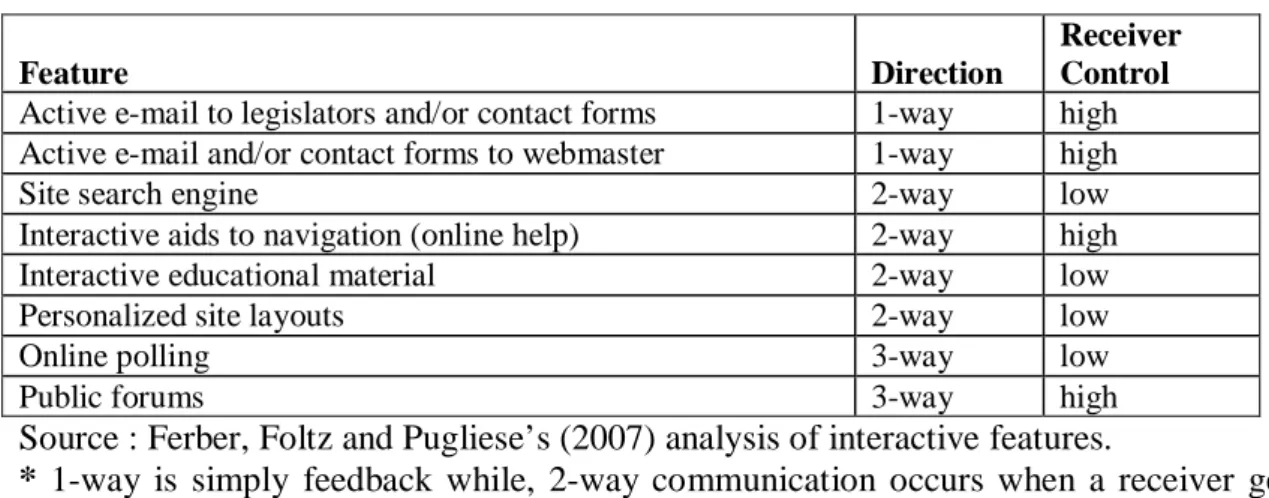
Website features that enable two-way communication and user control are synonymous with interactivity. Two-way communication occurs once messages flow bilaterally, while interactive communication requires subsequent messages to refer to earlier messages (Rafaeli and Sudweeks, 1997).
The Concept of Cyber Democracy and its Implications
Tsagaraousianou et al (1998) coined the term “electronic democracy” to describe the enabling power of new technologies to increase citizen participation in the political landscape. As stated by Tsagaraousianou et al (1998), both electronic democracy and cyberdemocracy, with their minor differences, have added to an expanded and accessible public sphere in the Western world. In explaining the political role of cyberdemocracy, Tsagaraousianou et al. emphasize that politics depends on the existence of public spaces and forums to which everyone has access.
Interactivity Models: A Theoretical Basis for Studying Cyber
- Heeter’s New Media Communication Theory
- The Measures of Perceived Interactivity (MPI)
This dimension gives an assessment of the role changes between the editor/reporter and the reader. One of the relevant theories of interactivity that would help unpack cyberdemocracy is the Measures of Perceived Interactivity (MPI) (McMillan and Hwang, 2002). These elements, which have appeared consistently in most of the interactivity literature, are central to the study of interactivity and thus cyberdemocracy.
Key Dimensions of Interactivity
- The Mediated Moderation Model
- The Three-Way Model of Cyber-Interactivity
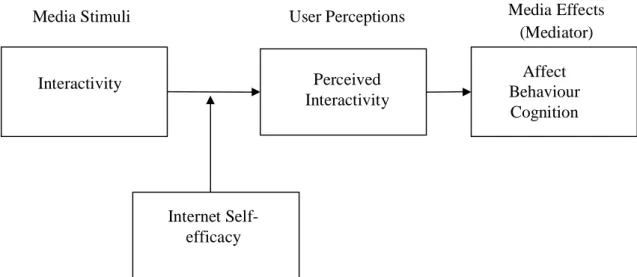
The moderated mediated model of interactivity as explained by Bucy and Tao (2007) focuses on bringing together ideas from different approaches to find commonalities between them. This study will adopt Newhgen, Codes and Levy's (1995) views on interactivity in using the MPI model. The gap between these approaches is closed by introducing a third variable in the form of a moderator variable in the study of interactivity.

The Interface Between Interactivity and Cyber Democracy
The mediating role of the media is what advocates of cyberdemocracy seek to enhance through interactivity. Based on the results of the study, Rosenberry (2005) agrees with previous researchers (Kartz, 1994; Newhagen, Cordes and Levy, 1995; Feber, Foltz and Pugliese, 2004) about the untapped status of the Internet's potential for improved political communication (cyberdemocracy). This may be because the internet's potential to promote democracy is not yet fully in place.
RESEARCH METHODOLOGY
- Introduction
- Quantitative Content Analysis
- The Research Sample for the Content Analysis
- Qualitative Research Methods: The Case of Self Completion
- Research Data Analysis
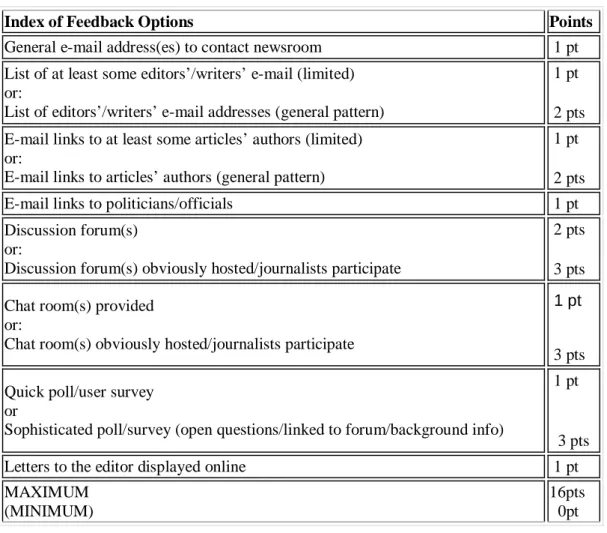
- Using Shultz’s index of feedback options
A content analysis was used in this research for both the study and the analysis of interactive devices. The qualitative research method used in this study was not limited to self-completed interview questionnaires sent to online editors, but also included notes that the researcher made during the content analysis of interactive options. Following Shultz's (1999) arguments on the analysis of interactive devices in an exploratory content analysis of 100 U.S.
RESEARCH FINDINGS
Introduction
Quantitative Content Analysis Research Findings
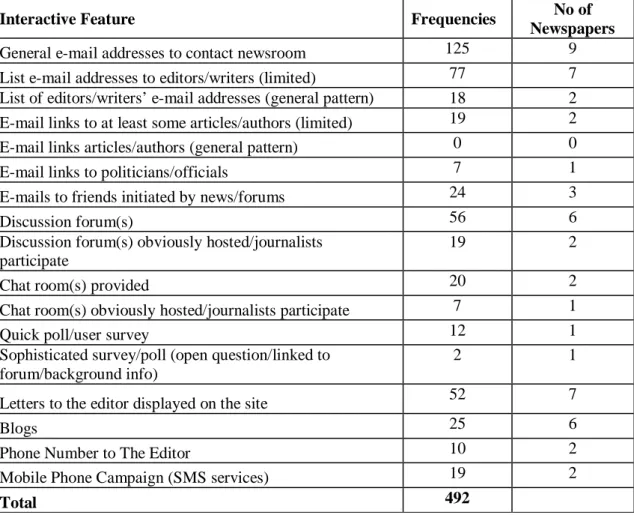
- Summary of Content Analysis Findings
- Discussion Forums
- Blogs
- Online Polls and Surveys
- Letters to the editor
- Other Interactive Features
Instead, some of the results of the discussion forums were transcribed into news articles. Four of the 22 Zimbabwean online newspapers in the sample studied featured letters to the editors on their website. The topic of letters was no different across all online newspapers that offered and featured letters to the editor.
Qualitative Research Procedures: Research Findings
- Questions on the Public Sphere
- Questions of Interactivity
- Questions of Cyber Democracy
This low response rate was not uncharacteristic of this approach, as noted earlier by Deacon et al that "the absence of personal contact limits the opportunities to persuade people to participate, and for this reason self-completion questionnaire surveys generally attract lower response rates ". The editor of Change Zimbabwe replied “The hope is that they get access in internet cafes and through the organizations they belong to that can give them access to the internet. Allows users to debate about) competing political agendas, the right way for change and. the websites carry) many articles on legislation, election issues. elections', 'elections' or 'watch' using the search function on the home page.”. the websites contain information on) candidate profiles, issues, search ring, announcements of meetings, parliamentary debates, etc.
DISCUSSION AND ANALYSIS OF RESEARCH RESULTS
Introduction
Using Shultz’ Index of analysis
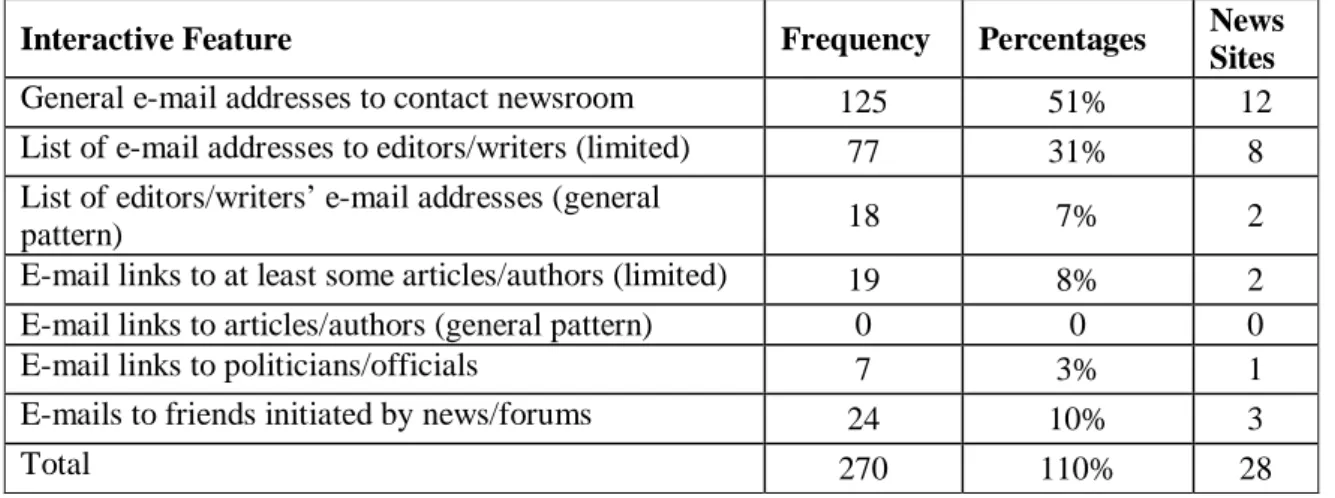
For the 22 news sites explored in this study, the maximum score attainable was 484 (achieved by multiplying . the number of sites studied and the maximum score each website could have received). Only interactive options that were comparable to those in the index were analyzed using this criterion. All interactive options from different newspaper pages were combined and the analysis index was applied.
The Role of Interactivity
The content analysis in this study identified all these interactive features in the explored 22 Zimbabwean online newspapers. An analysis of interactive features using these dimensions does not necessarily imply readers' actual use of the interactive tools. The content analysis of Zimbabwe's online newspapers in this study identified all the interactive features as sat.
Cyberdemocracy in Zimbabwe’s Online Newspapers
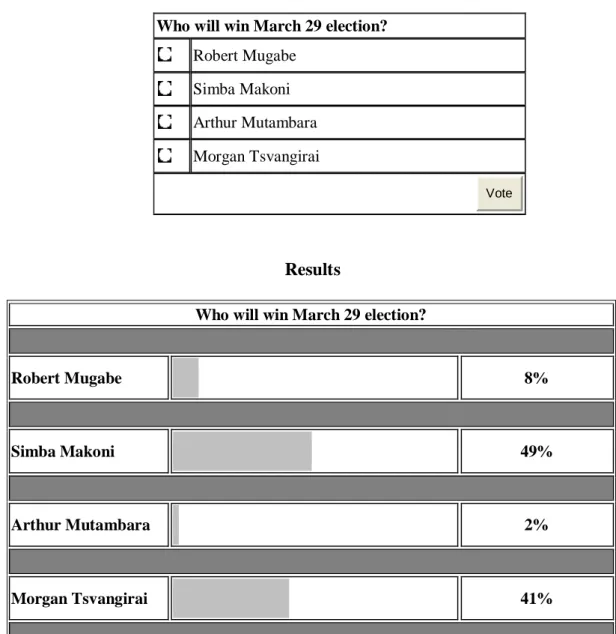
The most obvious limitation is the fact that only two of Zimbabwe's 22 online newspapers offered surveys. Chat rooms and discussion forums were available in only two of the 22 online newspapers surveyed. For example, in a discussion about the use of blogs in one of the Zimbabwean online newspapers, the blogger had his page on the main site.
The Internet as a Public Sphere
Theorists and researchers (Hartley, 1992; Fraser, 1987; Poster, 1995) have tried to place ideals of the Habermasian notion of the public sphere in modern media. This study uses this revised concept to discuss the results of the emergence of a new public sphere in Zimbabwe's online newspapers. According to Poster (1995), the concept of the public sphere is central to any critical assessment of democracy.
CONCLUSIONS AND RECOMMENDATIONS
Introduction
Interactivity on Zimbabwe’s Online Newspapers
An analysis of interactive devices using Schultz's (1999) analysis index revealed shockingly low levels of interactivity in Zimbabwean online newspapers. Out of 484 achievable points for interactive devices, Zimbabwean online newspapers scored a mere 54 points. Findings from the qualitative research process reveal that editors are reluctant to offer interactive options as it would mean more work for them.
The Potential for Cyberdemocracy
From the editor's point of view, some of the articles posted on the websites would not have been subjects for public consumption in the traditional media. The online newspapers provide political information about election candidates, parliamentary debates and news articles based on politics, as one of the editors pointed out. Although some of the editors are of the opinion that people in Zimbabwe gain access through the organizations they belong to or in internet cafes, this is a minority of the population.
The New Public Sphere
Therefore, online newspapers have stepped in to present an alternative public sphere that is free from the trappings of the current regime. One of the characteristics of an ideal public sphere is the potential to promote dialogue (Bohman in Crossely and Roberts, 2004). When users exchange views in discussion forums, send and receive messages using electronic mail tools, or use any of the interactive tools to influence each other's opinion, the result will be a dialogue.
Recommendations
Available from:
Letter to the Editors
Interview Schedule
The information contained in this survey is strictly confidential and will be used by the researcher for research purposes in the field of media and cultural studies at the University of KwaZulu-Natal. For further information contact: Joanah Gadzikwa, Department of Media and Cultural Studies, University of KwaZulu-Natal.
Informed Consent Form
Full names of participant) hereby confirm that I understand the content of this document and the nature of the research project and I consent to participate in the research project.
A list of Zimbabwean Online Newspapers
34;a non-political, non-civic, non-governmental, independent online newspaper which is an initiative of former Zimbabwean professionals now based in the UK, USA and Canada." Based in Chicago, Illinois. 34;Geoffrey Nyarota is an award-winning investigative journalist, newspaper editor and media entrepreneur,..." [He] "launched Zimbabwe's leading independent daily newspaper, the Daily News in Source: http://www.un.org/events/pressday/ 2006/nyarota.html The Zimbabwe Times is based in Massachusetts. Published in the UK by Wilf & Trish Mbanga with a Southern African edition produced in Johannesburg." http://www.thezimbabwean.co.uk.