
Changes in the Pattern of Worship in the Local Conte xt
My sincere thanks go to the members of Durban's Tamil community who kindly completed the questionnaires and willingly granted me interviews. My family tolerated my eccentricities in good humor during my studies. My sincere thanks go to my sisters Kogilam, Pragasvathie and Dhayaberi for their continued support and concern.
CHAPTER ONE
Methodology
A total of one hundred questionnaires were distributed evenly to a representative sample of members of the South African Tamil community. Care was taken to ensure that the interviewees represented a broad spectrum of the South African Tamil community in terms of age, religious affiliation, marital status, occupation, social and economic status, etc.
CHAPTER TWO
Religious Observances of Tamils of Kwa-Zulu Natal
The third is the worship of symbols which are reminders of the Supreme, and 4. There is a marked increase in the use of English and a decline in Tamil. The religious features of Tamilsin Kwa-Zulu Natal and the general degree of worship of the Hindus in Kwa-Zulu atal are mentioned.
CHAPTER THREE
It also stands for the orderly preservation and sustenance of the universe. The fire in the left backward ann is symbolic of destruction or. Lord Vishnu is considered to be one of the Thrimoorthy, the other two being Lord Sivan and Lord Brahman. The fame of this temple lies in the imprisonment of Lord Brahman by the young Lord Murugan for not knowing the meaning of the pranava Om (the mystical mantra).
On either side of the Kavady, devotees carry containers of milk, which is used in the ritual bathing of Lord Murugan's statue.
CHAPTER FOUR
- Introduction
- Definition of a Folk Deity
- Folk Culture of Ta mil Nadu
- Kshatriyas
- Vaishyas
- Sudras
- Reasons for the Worship of Folk Deities in South Africa
- Fear of the Natural Elements
- Spirits of the ancestors
- Tools of the ancestors
Here it appears that the body of the Folk Deity is the town itself and that the Deity is rooted in the town. The villagers are understood to reside within or on the body of the Deity. One of the significant characteristics of folk religion is that it is transmitted orally from generation to generation.
Therefore, in most cases, statues of the folk deities or symbols representing them are enshrined at the entrances to the village or on its borders. The ancient Tamil dynasties of the Sera, Chola and the Pandiyans belonged to the Kshatriya clan. This dominance and subordination of the female deity over the male deity is fully understood when one studies the various myths underlying the concept of folk deities.
The images of the gods are sometimes surrounded by imposing images of elephants, horses, tigers, etc. This probably explains how the origin of a single folk deity has so many variants and why it is difficult to point to the exact origin of the folk deities. Finally, an analysis was presented on the probable origin of the concept of folk god worship and its stages of development.
CHAPTER FIVE
Some famous Amman Temples in Tamil Nadu
- Naloor Mariamman Temple
- Samayapuram Mariamman Temple
This temple is located on the banks of river Kavery near the town of Thiruchy. The two temples above are examples of the most popular temples in honor of Mariamman. In some cases the image is made of black stone. The blackness of the goddess is representative not only of her wrath, but also of her fertility.
They told the king that it is therefore in the best interest of everyone to have the prince killed. This was a deception on the part of the astrologers. Since the king was a very compassionate man, he asked his men to leave the little prince in the forest instead of killing him. The servants did as they were told. Maduraiveeran then arrived on the banks of the Vaigai River in Madurai district, which was ruled by King Thirumalai Nayakkar.
Goddess Minakshi heeded the king's plea and restored him to his former self. He then stood at the feet of the goddess and beheaded himself, the head falling off. However, Maduraiveeran was still unhappy and displeased and he took possession of one of the king's men and then announced his satisfaction.
CHAPTER SIX
The Fame of the Isipineo Temple
Some even offer Urarupongal (cooking pongal) – for offering to the Deity – under extremely difficult conditions on the temple premises. Hand-baked bread (roti), pongal, nine types of beans, fruit, milk, opium, marijuana, cigarettes and alcohol are all part of the offering. Before the afternoon prayers, in accordance with the myth surrounding Maduraiveeran, the limbs of the rooster are prepared diagonally opposite each other and offered on roti.
If a shaman accompanies the worship, then the shaman receives the offerings and then distributes the rest to those present. It is believed that if Kaateri is not appeased, she will forcefully indulge her passion for a sacrificial life by taking the life of the newborn baby. The entrails of the chicken, in particular the reproductive organs, are considered particularly important offerings for the obvious reason that they are the animal's lifeline and provide the closest communion with the object of worship that is the baby.
During the two prayers, the baby is placed on the ground near the excavated sandbox for the duration of the prayer. Since Kaateri is a spirit that attacks children after birth or while they are still in the womb, it is easy to see the necessity of excluding children here. Nair believed that her neglect of her Kaateri worship was the cause of the turn of events in her son's life.
Summary
She immediately resumed the worship and swears that everything in her house is now back to normal. She says that she will never stop the worship for fear that her son will turn to his bad ways. My observation of the different religious practices in relation to folk god worship also made me aware of the impact of oral tradition in the preservation of this form of worship.
There are no written texts about the mode of worship, the sacrifices made, the purpose of worship, etc.
CHAPTER SEVEN
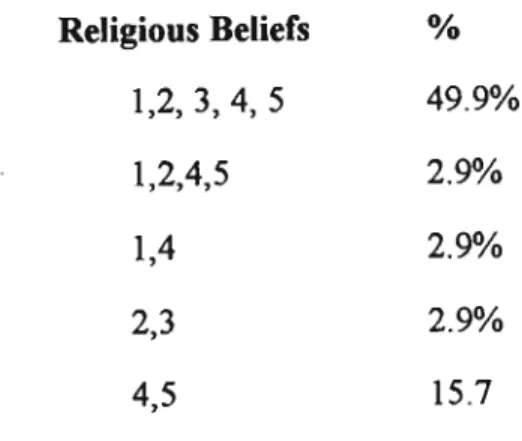
27.1% of respondents were single, 61.4% married, 1.4% divorced and 10% widowed. All respondents were born in Kwa-Zulu Natal. The percentages in the number of respondents who cannot speak, read and write in Tamil are evident. The survey shows that almost half of the respondents direct their worship to all the major religious beliefs of Lord Sivan, Lord Vishnu, Goddess Sakthi, Lord Murugan and Lord Ganesha.
When these celebrations are performed in temples, etc. where there are priests who officiate, 40% said that the priest explained the importance of prayer while 50% indicated that. It is a matter of great concern that 50% of the respondents who follow the worship of folk deities in temples are not educated about the importance of worship. 90% of the respondents believed that understanding the Tamil language would facilitate their understanding of their religious practices, while only 10% felt that this was not true.
This indicates that the oral tradition depends on the knowledge of the mother tongue. While better understanding is needed, the majority believes the practice should not be stopped. Furthermore, 94.3% of respondents indicated that they will encourage their descendants to follow worship, demonstrating the esteem and importance of worshiping folk deities in their lives. 97.1% of respondents also believe that worship of folk deities has contributed to religio-cultural continuity among South African Tamils.
CHAPTER EIGHT
Oral tradition played a very important role in maintaining the spread of worship, as it is clear that respondents' knowledge of folk deities is based on information passed down to them by previous generations. In this regard, research also showed that many slavishly followed the worship of folk deities. Certain aspects of worship that were important or appropriate in a certain period of time and that have no relevance today are still followed.
During the worship of Mariamman, at the end of morning prayers, the porridge and curries are first served to three women before being distributed to others. While serving the three women, precautions are taken to ensure that the utensils used to serve the women, who receive the porridge and curries in cupped hands, are not touched by their hands. In the beginning, this precaution was taken because the porridge and curries were given to members of the lower castes. Today we live in a caste-free society and yet we follow this ritual slavishly. In this regard, the researcher's intention is to inform those who follow the worship of folk deities by presenting them with all the factual information and allowing them to evaluate the importance of the worship.
It is also hoped that this will add to the body of knowledge concerning South African Indians.
SUMMARY
PERSONAL
- Place of Birth: City Suburb
- Which generation do you as a South Mrican citizen of Indian descent belong to?
- Is your family originally from India?
- Religious affiliation
- Education level
- English
Businessman/Businesswoman (self-employed) Home driver .. TamU teacher in a public school TamU teacher in a private school Other 'specify).
HERITAGE
- First family member to enter South Africa
KNOWLEDGE OF FOLK DEITIES
If the answer to the above question was yes, then are there any conflicting views between the religious beliefs of your organization and the worship of folk deities such as Mariamman, Kateri,. When the worship of these folk gods is observed, the person offering the prayer explains the meaning of the various practices. Do you believe that an understanding of the TamU language will facilitate the understanding of the religious practices.
Do you think that participating in the worship of folk deities affects your social status? Do you believe that the worship of folk deities has contributed to the religio-cultural continuity among the Tamils of the southern Mrikans?
