Partial Care Facilities and Early Childhood Development in Cato Manor
Xoliswa Keke
April 2006
Submitted in partial fulfilment of the requirements for the degree of Masters in Child Care and Protection •
University of KwaZulu-Natal, Durban.
Supervisor: Professor Carmel Matthias
School of Social Work
ABSTRACT
Partial care is the care of more than six children on behalf of their parents or caregivers for a temporary period during the day and could include overnight 'care. Acces·s-tOpartiafcaTe -and-EarIYChildhoodDevelopment··
(ECO) services .
are important for child development. South Africa does not have minimum standards for provision of ECO and funding for it is limited. A Children's Bill has been proposed to replace the Child Care Act no 74 of 1983. In the proposed Bill, both partial care and early childhood development will be regulated. This study attempted to explore partial care and early childhood development in Cato Manor, an informal settlement in the process of development.
The study was qualitative with a sample of twelve facilities selected from partial care facilities in the community. Interviews were conducted with facilitators from the facilities about their experiences and challenges of providing partial care in the community, using a semi structured interview schedule. Observation of the facilities was also made using an observation checklist to ascertain resources and the physical environment.
The findings showed that three categories of partial care facilities existed in Cato Manor. The different cateqorles had inequalities in resources, leading to differences in the nature of care and programmes children were offered. The findings indicated that there were problems associated with registration and monitoring of the facilities. Lack of funding was shown to be a big challenge for the facilities.
Community efforts of establishing facilities need to be strengthened. The registration process of facilities needs to be simplified and communication between government departments responsible for registration and the facilities improved. Facilitators need assistance to have access to available funding.
Declaration
This dissertation denotes original work of the author and has not been submitted in any other form to another university. Where use has been made of the work of other authors and sources, it has been accordingly acknowledged and referenced in the body of the dissertation.
The research for this dissertation was completed in the School of Social Work University of KwaZulu-Natal, Durban. Research was undertaken under the supervision of Professor Carmel Rose Matthias.
Opinions expressed and conclusions attained are those of the author and are not necessarily to be attributed to the School of Social Work.
~(~
... ~~ .
Xoliswa Keke
Acronyms
CMDA CMDP ECD ECEC GCMDF KZN MTCT NCOP NGO NIP NPA NPO OECD RDP RLRU SACECD SALC SAQA TREE UNCRC UNISA
Cato Manor Development Association Cato Manor Development Programme Early Childhood Development
Early Childhood Education and Care Greater Cato Manor Development Forum KwaZulu-Natal
Mother to child transmission of HIV National Council of Provinces Non Governmental Organization Nutritional Integrated Programme National Programme of Action Non-Profit Organization
Organization for Economic Cooperation Development Reconstruction and Development Programme
Early Learning Resource Unit
South African Congress for Early Childhood Development South African Law Commission
South African Qualification Authority
Training and resources for Early Education United Nations Children's Rights Convention University of South Africa
Acknowledgements
I am extremely grateful and thankful to a number of people who helped ensure that this dissertation was completed:
• God Almighty who has been with m~ aJ.I !h~_waY9nQLk!1ew that with His
. . nelplnisaay·would
c6me~- -· - -_· ·.
• My parents and sister, Nobabalo for their support and a special thank you to my father, who has always hoped that I would further my studies.
• My dearest sister, Bulelwa Keke for all the sacrifices, support and assistance, emotionally and otherwise, during my years of study. I could never find a better sister! My nephews and niece, for all the chaos, it made me laugh and warmed my heart.
• Dr. Carmel Matthias, my supervisor, for her dedication and much needed guidance. Thank you very much your valuable support and for being there for me. Thank you for reading those countless drafts and for your encouragement.
• Mrs.Joan van Niekerk for encouraging me to register this degree.
• Professors Anna Coutsoudis and Eleanor Preston-Whyte for their generosity and understanding.
• Zine Mathe and Sindi Mnikathi, colleagues and friends from Umkhumbane, for helping me through the interviewing process. No words can describe how grateful I am.
• My friend Ms. Babalwa Dano, who has been my source of support in many ways from the time I started studying for this degree. I really value and appreciate our friendship.
• Sindi Solopi and Lindiwe Sibeko for their support and being good friends and Sibongile Mkhize for keeping my spirits alive to the last minute. I could not ask for better friends!
• The study participants, from the child care facilities in Cato Manor, for allowing me into their facilities and their homes. Thank you for your time and patience.
TABLE OF CONTENTS
CHAPTER ONE 1
INTRODUCTION AND METHODOLOGY 1
1.1. tntroduction 1
1.2. The context of partial care in South Africa 2
1.3. Motivation for the study 4
1.4. Aims and objectives of the study 5
1.5. The Significance of the study 6
1.6. Key questions of the study 7
1.7. Research Methodology 7
1.7.1. Research Design 8
1.7.2.Methods of data collection 8
1.7.2.1.Observation 8
1.7.2.2. Semi-structured in-depth interviews 9
1.7.3. Sampling method 11
1.7.4. Analysis of data 12
1.8. Limitations of the study 12
1.9. Operational definitions 13
1.10. Ethical Issues 14
1.11.The Structure of the Report 15
CHAPTER TWO 16
LITERATURE REVIEW 16
2.1.Introduction 16
2.2. Theoretical framework 16
2.2.1.Micro-Systems 18
2.2.2. Meso-Systems 18
2.2.3. Exo-Systems 18
2.2.4. Macro-Systems 19
2.3. Children's Rights Framework 19
2.3.1. Section 28 of the Constitution of South Africa 19 2.3.2. The United Nations Convention on the
Rights of the Child 20
2.3.3. The African Charter on the Rights of the Child 21 2.4. An overviewofpolicies and programme initiatives
in South Africa 21
2.4.1.The National Programme of Action 22
a. Nutrition 22
b. Promotion and Expansion of ECD 24
2.4.2. The White Paper for Social Welfare (1997) 25
2.5. Legislative Framework 26
2.5.1. The Child Care Act no 74 of 1983 27
2.6. Registration Requirements 28
2.6.1. The current process of registration of child care facilities 28 2.6.2. Challenges with the current process of registration 30
2.7. Funding 33
2.8. Training of personnel 35
2.9. Early Childhood Development in South Africa 36 2.9.1.The importance of Early Childhood Development 36
2.9.2. The state of ECD in South Africa 37
2.9.3. Government's approach in dealing with ECD 39 2.9.4. ECD provision in the Department of Education 40
2.10. Innovative ECD programmes 41
2.10.1. Impilo Pre-School Project 41
2.11. International comparisons: Child care and ECD provision 43 2.11.1. ECD and Child care in GECD Countries 43
2.11.1.1. The English System 45
2.11.1 2. Pre-school education in Turkey 46
2.12. Conclusion 47
CHAPTER THREE
DATA PRESENTATION AND ANALYSIS 3.1. Introduction
3.2. Description of Cato Manor
3.3.The role of the Cato Manor Development Association 3.4. Description of partial care facilities
3.4.1. Informal Facilities
3.4.1.1.Category A Informal facilities 3.4.1.2. Category B Informal facilities 3.4.2. Formal facilities
3.5. Enrolment in facilities
3.5.1. Enrolment in informal facilities 3.5.2. Enrolment in formal facilities 3.6. Operating Times
3.6.1. Category A Informal facilities 3.6.2. Category B Informal facilities 3.6.3. Formal facilities
3.7. Aftercare services 3.8. Overnight care
3.9. Educational programmes
3.9.1. Category A Informal facilities 3.9.2. Category B Informal facilities 3.9.3. Formal facilities
3.9.3.1. School Readiness Programme 3.10. Space and play materials
3.10.1. Category A Informal facilities 3.10.2. Category B Informal facilities 3.10.3. Formal facilities
3.11. Records
49 49 49 49 51 52 53 53 54 55 57 57 58 58 59 59
60 60 62 64 64 64 66 69 69
70 70
71 71
3.11.1. Category A Informal facilities
3.11.2. Category B informal facilities and formal facilities 3.12.Registration
a. Masibumbane Association
b.
DepartmentofSocial Welfare and Population Developmentc. Ethekwini Municipality d. Durban Children's Society 3.12.1. Category A-Informal facilities 3.12.2. Category B Informal facilities 3.12.3.Formal facilities
3.13. Staffing
3.14.Training of staff
3.15.Salaries and fees structure 3.16. Health and Nutrition
3.17. Funding 3.18. General 3.19. Conclusion
CHAPTER FOUR
MAIN FINDINGS AND RECOMMENDATIONS 4.1. Introduction
4.2. The main findings of the study 4.2.1. Types of partial care facilities 4.2.2. Enrolment in facilities
4.2.3. Operating times
4.2.4. Educational programmes 4.2.5. Play materials
4.2.6.Registration 4.2.7. Staffing 4.2.8. Training
71 72 73 74
75 75 76 76 76 79 82
83 84 86 87 88
88
90 90 90 90
91
92 92
93 94 95 96 96
4.2.9. Salaries and fees 97 4.2.10. Vulnerable Children and Children with Disabilities 97 4.3. Summary of challenges facing facilitators 98
4.4. Recommendations 98
4.4.1. Registration of Partial Care Facilities 99
4.4.2. Funding 99
4.4.3. Educational programmes 100
4.4.4. Training 100
4.5. Recommendations for Further Research 101
4.6.Conclusion 101
List of Tables
Table 3.1. Types of Facilities
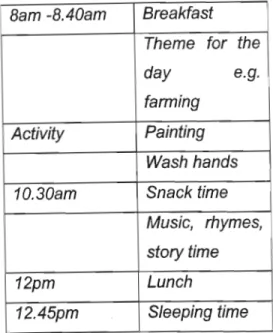
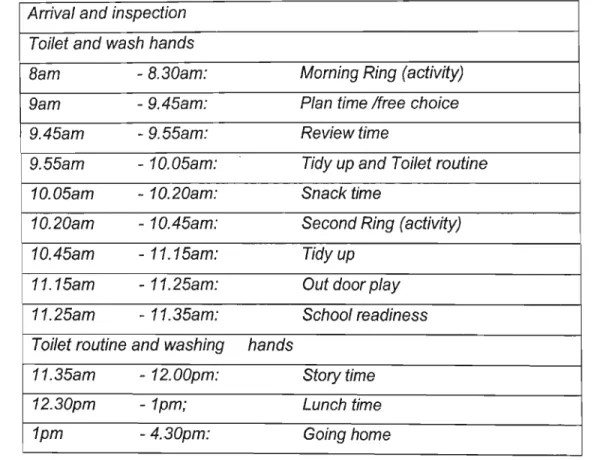
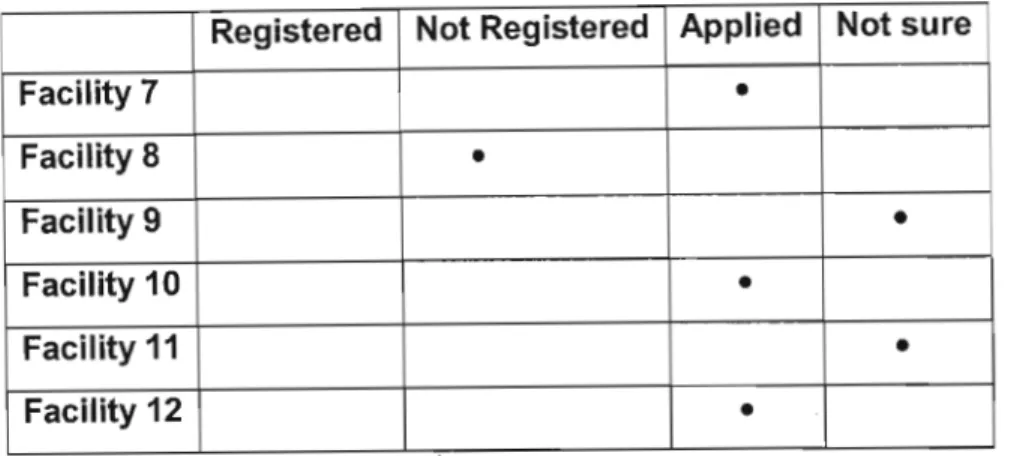
Table 3.2. An example of a daily programme (informal facility) Table 3.3. An example of a daily programme (formal facility) Table 3.4. Registration Status of Formal facilities
Table 3.5. Staff/Child Ratio
List of Figures
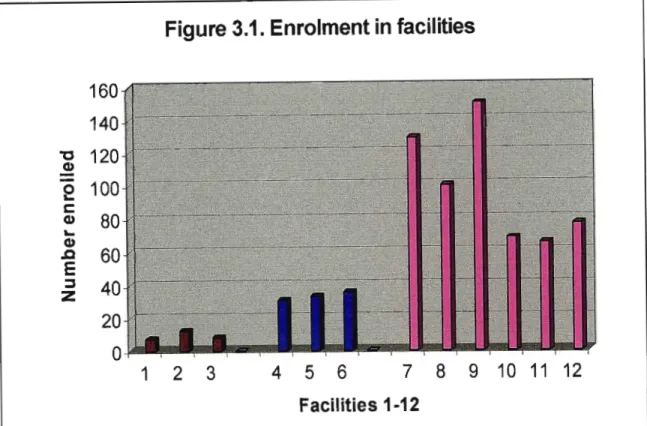
3.1. Enrolment in Facilities
Appendices
Appendix A - Interview Schedule Appendix B - Observation Checklist Appendix C - Consent Form
52 65 68 79
82
57
CHAPTER 1
INTRODUCTION AND METHODOLOGY
1.1. Introduction
In terms of clause 76 of the Children's Bill 70 of 2003, partial care is defined as the care of more than six children on behalf of their parents or caregivers for a temporary period during the day and could include overnight care. Partial care of this kind tends to be provided in creches, day-care, play groups, pre-schools, after-school or week-night care centres. They operate in terms of contractual arrangements usually involving payment by parents and provide care for children when their parents are away at work. The care provided is partial in the sense that it alternates with that directly provided by parents or other custodians (Zaal, 2001). This concept of partial care is proposed in the Children's Bill 70 of 2003 to replace 'place of care' which is current terminology in the Child Care Act 74 of 1983. For the purposes of this study the definition of partial care in the Children's Bill is utilized.
The care of children in partial care facilities should ideally include provision of Early Childhood Development (ECD) services. Early Childhood Development refers to a comprehensive approach to policies and programmes for children from birth to nine years of age with the active participation of their parents and caregivers, (White Paper 5, Department of Education, 2001:8). In terms of Section 3(1) of the South African Schools Act, children can attend school in the year in which they reach the age of seven. However, the early years of a child's life are significant for the child's development. This is the time when the child acquires language, cognitive, physical, social and emotional skills. The quality of care and ECO provision that the child receives at this stage is therefore of utmost importance as it can lay a foundation for future adjustment and preparedness for further learning and for life in general.
It is important to note that while there is an overall acknowledgement of the need to provide services for children in their earliest years, international research studies indicate that child care does not always receive the necessary attention it deserves. In South Africa, there is a history of government accepting minimal responsibility for children in the age group 0-6 years. The majority of ECD and partial care has been provided by non-governmental organizations, private individuals and institutions, and has been funded by national and international donors (Biersteker, 2003).
In the first part of this chapter, the context of partial care in South Africa and the motivation of the study will be provided. In the second part, the methodology of the study will be discussed.
1.2.The Context of Partial Care in South Africa
A situational analysis of the family in South Africa indicates that families have been particularly affected by the policies of the past, the inequitable distribution of resources, social changes, migration patterns, the growing subculture of violence, and the changes in the traditional roles of women (White Paper for Welfare, 1997). The well being of children depends on the ability of families to function effectively. Because children are vulnerable they need to grow up in nurturing and secure environments that can ensure their survival, development, protection and participation in family and social life. Increasingly, women have had to join the labor market for economic reasons and have had to rely on child care outside of home. It is in this context that partial care facilities become of utmost importance.
Partial care services cater for a wide variety of needs. The South African Law Commission (2001 :684-685) has compiled a number of instances where children need partial care facilities:
• "Children whose parents work full time;
• Children who need after school care;
• Children of parents who are seeking work or attend lectures, classes or any form of training;
• Children who need care in an emergency, such as the illness or hospitalization of a parent;
• Children in play groups and play schools. These groups are intended to bring together pre-school children in a stimulating environment and to give the children an opportunity to interact with others of their own age;
• Children whose parents need assistance for a short time;
• Children attending training camps and other organized recreational activities such as holiday camps, school tours, and church outings".
Partial care facilities could operate on full time basis, part days or extended hours (Tabata, 2000:1). These facilities include:
• Nursery school programmes- these are usually part day. These would include day care, creches, pro-schools
• Family day care in a home of a childcare provider.
• Programmes for school aged children outside school hours and during school holidays.
• Overnight care provided for children whose parents work shifts.
There is growing evidence from child development research that the largest part of brain development happens before a child reaches three years old and that it is during this period that children develop their abilities to think and speak, learn and reason and lay the foundation for their values and social behavior as adults.
There is also growing evidence that young children are capable learners and that suitable educational experience during the pre-school years can have a positive
impact on school learning. The Department of Education (2001 :6) cites compelling reasons for provision of services to children including Early Childhood Development. Some of these include the following:
• increased productivity over a lifetime and a better standard of living when a child becomes an adult,
• later cost-savings in remedial education and health care and rehabilitation services, and
• higher earnings for parents, especially women, and caregivers who are freer to enter the labor market.
1.3.Motivation for the Study
Interest in this Study was generated by observations I made when working in Cato Manor. Cato Manor is an informal settlement situated within the boundaries of the Durban Metropolitan area. It is an area that suffered greatly under the apartheid government's policy of forced removals of squatters (www.cmda.co.za/). The area has, however, benefited from the construction of low-cost housing, schools, libraries, community halls, roads and clinics in the last decade.
I am a social worker working in the Cato Manor area for an HIV/AIDS treatment and care programme (Mother to Child Transmission plus programme). This programme is run from the community clinic. Often I get exposure to childcare facilities in this community through following up certain child protection matters concerning children whose mothers/caregivers are involved in the MTCT Plus Programme.
Some of my concerns centered on the issues of programs. In particular, were programs in place for the children in these facilities; and if they were, what kind of programs, and whether the programs met the children's social, emotional and psychological needs.
In addition, I was concerned about whether there were systems in place to address children's needs, some of which may require external resources dealing with child protection matters. Issues around registration and registration processes were also of concern. The Department of Social Development has guidelines known as Standards that Places of Care must meet. The guidelines include such things as size of premises, health, safety, nutrition, equipment;
training and child/staff ratios. A partial care facility would need to have these in place before applying for registration. However, the concern was whether these standards are achievable for underdeveloped facilities, particularly the informal facilities as they usually operate from (sometimes one roomed) homes of the managers, and whether the inability to achieve those would deter these facilities from being registered. The concern was what implications this has on child development and protection.
The literature indicates clearly that children living in poor conditions have limited access to partial care services. It also indicates the gap in service provision for children under the age of two years. The significance of the study is that it would help establish whether there is a group of partial care facilities that should be monitored, assisted and supported to develop to the level of at least minimum standards required so as to protect and improve the lives of the children who obviously require their services.
This study would give insight into partial care practices in this resource poor community and would provide some understanding of the strengths and weaknesses of the facilities.
1.4. Aims and Objectives of the Study
The study aimed to determine the types of partial care for children under the age of seven in the Cato Manor area. These are children who are not of school going age and are therefore cared for outside of the school environment. The focus of
the study was on children who were cared for in groups of more than six, because these are facilities which require registration.The objectives of the study were:
• To document what partial care facilities and services are available for children under the age of seven in the Cato Manor area.
• To explore what Early Childhood Development activities are offered to children in the facilities being studied.
• To examine how educational, nutritional, emotional and physical needs of the children in the facilities are being met. This would be done through an examination of programmes being offered and whether those programmes adhered to minimum standards established by the Departments of Health, Social Welfare and Population Development and Education.
• To document the challenges faced by childcare service providers in the Cato Manor area.
. 1.5. The Significance of the study
The findings of this study will provide invaluable information to partial care service providers at different levels. Provision of partial care facilities and early childhood development is a responsibility that is shared by communities, non- governmental organizations, as well as local, provincial and national government departments. Individual child care facilities will be able to compare how they function and the problems they experience with other facilities in the area.
Community coordinating organizations that offer support and run child care facilities will benefit from the information provided about problems experienced by these facilities. The findings of the study will also inform local government of what is happening and how it can transform its role to facilitate better provision of partial care services and early childhood development. The findings will also provide provincial and national departments with information to improve existing and proposed policies and guidelines and thus improve service provision.
1.6. Key questions of the study
The main questions the research aimed to answer were as follows:
• What partial care facilities for children under the age of seven years existed inthe Cato Manor community?
• What services, including ECD were offered by these partial care facilities?
• How did these facilities function in terms of registration, monitoring, or affiliation to other organizations?
• How were the facilities funded?
1.7. Research Methodology
In the following section, the research design, the methods of data collection and the sampling method are discussed.
1.7.1. Research design
The research was qualitative and descriptive in nature. Descriptive research is research that describes a certain phenomena (Terre Blanche & Durrheim 1999).
Descriptive research presents a picture of the specific details of a situation, social setting, or relationship, (Neuman 2000:22). Some of the goals of descriptive research as described by Neuman (2000:22) are as follows:
• Provide a detailed, highly accurate picture
• Create a set of categories or classic types
• Classify a sequence of steps or stages
• Report on the-background or context of a situation
This study aimed to describe partial care provision in Cato Manor. This was done by describing partial care facilities as well as reporting the experiences of
managers/owners of these facilities in this community. While the purpose of this study was not to make comparisons between the different types of partial care facilities in this community, the differences, in terms of strengths and weaknesses of each type of facility have been documented.
The study used a qualitative approach. Qualitative research aims to provide an in-depth understanding of people's experiences, perspectives and histories in the context of their personal circumstances or settings. Among many distinctive features, it is characterized by a concern with exploring phenomena from the perspective of those being studied, with the use of unstructured methods, which are sensitive to the social context of the study (Terre Blanche & Durrheim 1999).
The study made use of both observation and semi-structured interviews, which are forms of qualitative research.
1.7.2. Methods of data collection
The study used both observation and semi-structured interviews, which are methods of data collection in qualitative research.
1.7.2.1. Observation
With observation, the researcher determines at the outset what behaviors are to be observed and uses a standardized checklist to record the frequency with which those behaviors are observed over a specified time period. Semi- structured observation schedules are important in investigating behaviors that are observable by researchers but difficult to discuss (Schensul, Schensul &
LeCompte, 1999). As with interviews, observations can be more or less structured, The objective
qf
semi-structured .oqserv?tip ns is to id~ntify items or attributes of variables that can be recorded systematically by presence/absence or degree (Schensul, Schensul & LeCompte, 1999).In this study observations were recorded while the researcher conducted interviews. An observation checklist schedule was attached to the interview schedule and the observations were recorded on the checklist schedule. Rubin and Babbie (2001 :394) describe four roles of an observer. These are complete participant, participant-as-observer, observer-as-participant and complete observer. The complete observer observes a social process without becoming a part of it in any way. The researcher's role was that of a complete observer.
Participants knew they and their facilities were being observed.
The observation checklist addressed the following:
(a)Appearance: this looked at the type of the building Le. institution, government subsidized home, shack; how much space was available inside, and whether there was a playground
(b)Hygiene: this looked at the cleanliness of the facility, both inside and outside and the demeanor of children in the facility
(c) Necessities: this looked at the availability of registers, first aid kits, menu, educational programmes, and registration documents
(d)Surroundings: this looked at the movement of children for the duration of the interview and association of children with facilitators
1.7.2.2. Semi-structured in-depth interviews
Semi-structured interviews combine the flexibility of the unstructured, open- ended interview with the directionality and agenda of the survey instrument to produce focused qualitative, textual data, (Schensul, Schensul & LeCompte, 1999). Semi-structured interviewing is based on the use of an interview guide. An interview guide lists in outline form the topics and issues the interviewer should cover in the interview, but it allows the interviewer to adapt the sequencing and wording of questions to each particular interview, (Rubin & Babbie 2001:407) Interviews were in-depth and open-ended. In-depth means that the topic is explored in detail to deepen the interviewer's knowledge of the topic. Open- ended refers to the fact that the interviewer is open to any relevant responses.
The purpose of in-depth, open-ended interviews is to explore undefined domains in the formative conceptual model; and to break down domains into component factors and sub-factors (Schensul, Schensul & LeCompte 1999). Open ended questions have the following advantages:
• they permit an unlimited number of possible answers;
• respondents can answer in detail and can qualify and clarify responses;
• unanticipated findings can be discovered;
• they permit adequate answers to complex issues;
• they permit creativity, self expression, and richness of detail;
• they reveal a respondent's logic, thinking process, and frame of reference, (Neuman, 2000:261).
The interview scheduled had the following sections:
(a) Descriptive information about the facility: type of facility, how many children, the children's ages and how the facility decides their enrolment numbers.
(b) Operating times: this question dealt with the hours and days the facilities operate. Itlooked at provision of aftercare and overnight services.
(c) Services and programmes: this section dealt with provision of educational curriculum, availability of play materials and playing space and school readiness programmes.
(d) Registration:this question addressed whether facilities were registered (e) Staffing and training: this section dealt with the number of staff, training of staff, payment of salaries and fees
(f) Health and Nutrition: this section dealt with nutrition, how facilitators addressed illness and injuries in the facilities
(g)Funding: how the facilities are funded
(h)General: this question addressed the involvement of community leadership in the facilities.
All the respondents were isiZulu speaking and the researcher also speaks isiZulu. The questions were therefore asked in the language of the participants.
The interviews took place in the facilities and thus the observations were also conducted. The researcher was accompanied by a colleague, who knows the community. The reason behind this was that the colleague was able to take directions to the 'informal' facilities as they were identified. The colleague also became very helpful where there was one staff member looking after the children. When the staff member was being interviewed, the colleague took over the care of the children and this proved to be very useful as the researcher could get the full attention of the interviewee.
1.7.3. Sampling Method
Sampling is the process used to select cases for inclusion in a research study.
The research included both probability and non-probability sampling. Probability samples are based on taking a given number of units of analysis from a list, or sampling frame, which represents some population under study (Bernard, 1994).
A basic principle of probability is that a sample will be representative of its population if all members of that population have an equal chance of being selected in the sample, (Rubin & Babbie, 2001 :259). In this study, a list of all 'formal' childcare facilities (see definitions) was compiled and six facilities were randomly selected to form part of the sample.Thus the method of sampling was simple random sampling for this type of childcare facilities. One facilitator from the original six declined the interview and another facility from the list was randomly chosen.
For informal child care facilitles (see definitions), non-probability sampling was used. With the 'informal' childcare facilities, availability sampling was used, but six facilities were chosen as well, to make a total sample of twelve facilities. The reason for the difference in sampling methods for the two types of facilities is that
the formal facilities were known and a list was available. However, the informal facilities are not so well known and there was no list available for them. The researcher obtained details of the facilities from community members, including other facilitators in formal facilities. The researcher conducted interviews with facilitators or managers of the selected childcare facilities. In this report, the term facilitator is used to refer to either the owners or managers of the facilities.
1.7.4. Analysis of Data
A qualitative researcher analyzes data by organizing it into categories on.the basis of themes, concepts or similar features. He or she develops new concepts, formulates conceptual definitions, and examines the relationships among concepts (Neuman 2000:420). The researcher organized the data into conceptual categories that created themes and concepts, which were then used to analyze the data. This is referred to as coding. Coding provides two simultaneous activities: mechanical data reduction and analytical categorization of data into themes, (Neuman 2000:421).Open coding was used to analyze the data. In open coding, the researcher locates themes and assigns codes or labels in an attempt to condense the mass of data. This helped the researcher with identifying emerging themes at a glance, and with building a universe of all themes which were then organized, sorted, combined,discarded or extended.
1.8. Limitations of the Study
The study was limited to the Cato Manor community and cannot be generalized to other geographic areas, for example from better resourced communities. The interviews were conducted in the middle of November at a time when facilitators said children had started to drop out because their older siblings were either writing or had completed examinations. The result of this is that children are looked after by their siblings at home. This could cause bias in the number of children enrolled in facilities.
1.9.Operational definitions
This section will provide definitions of the terms used in the report.
Place of care 'means any building or premises maintained or used, whether for profit or otherwise, for the reception, protection and temporary or partial care of more than six children apart from their parents, but does not include boarding school, school hostel or any establishment which is maintained or used mainly for the tuition or training children and which is not controlled by or which has been registered or approved by the State, including a provincial administration' (Section 1 of the Child Care Act No 74 of 1983).
Partial care is the proposed new concept to replace place of care in section 76 of the Children's Bill 70 2003. It refers to care 'provided when a person, whether for or without a reward, takes care of more than six children on behalf of their parents or caregivers during specific hours of the day or night, or for a temporary period, in terms of a private arrangement between the parents or caregivers and the provider of the service, but excludes the taking care of a child-
(a) by a school as part of tuition, training and other activities provided by the school;
(b) as a boarder in a school hostel or other residential facility managed as part of a school; or
(c) by a hospital or other medical or other medical facility as part of the treatment provided to the child'.
Partial care facility, as proposed in section 1 of the Children's Bill 70 2003 means 'any premises or other place used partly or exclusively for the partial care of six or more children, which place may include-
(a) a private home;
(b) other privately owned or managed premises; or
(c) a school, hospital or other state-managed premises where partial care is provided by a person other than the school, hospital or organ of the state';
For the purposes of this study, 'informal childcare' refers to the care, including overnight care of more than six children in a residential home owned/ rented by the manager of the facility or a residential home owned/rented by the employer of the manager of the facility.
'Formal childcare' refers to the care of more than six children in state-owned, or privately owned premises that are built and recognized for public use by the community for the day care of children under the age of seven.
1.10. Ethical issues
An application for ethical clearance was made to the Ethics Committee of the University of KwaZulu-Nat~1 and was obtained before the study commenced. A written consent letter, which explained the study and its purpose was presented and explained to each participant before the interviewing started. The letter explained that the study was voluntary.All the participants who participated in the study signed the consent letter before participating. Neuman (2000: 96) asserts that participants in research need to know what they are being asked to participate in so that they can make an informed decision. He states that informed consent is a fundamental ethical principle of social research.
The participants were also assured of anonymity. In this report, the facilities researched are referred to by numbers instead of names, to preserve anonymity.
The area where the research took place is however not anonymous in the report.
Anonymity protects "the identity of specific Individuals fromheing known (Neuman, 2000:99).
1.11. The Structure of the report
The report has four chapters. The first chapter discusses the motivation for the study and the methodology used. The second chapter discusses the theoretical framework of the study, looks at children's rights in relation to the partial care, both locally and internationally. It reviews the literature on partial care and early childhood development. The third chapter presents an analysis of the data collected and the fourth and last chapter provides a summary of the main findings and recommendations of the study.
CHAPTER 2 LITERATURE REVIEW
2. 1. Introduction
The concepts of partial care and partial care facilities have been introduced in the Children's Bill 70 of 2003 to replace 'place of care' which, is a term currently used in the Child Care Act 74 of 1983. It is widely accepted that when well nurtured and cared for in their earliest years, children are more likely to survive, to grow in a healthy way and to fully develop thinking, language, emotional and social skills.
The first part of this chapter provides the theoretical framework for the study and addresses the legal frameworks governing children, both locally and internationally.· Secondly, the chapter examines the types of care available for children from birth to the age of seven who are partially cared for outside their homes: It looks at current practices, in relation to policies and programs. Lastly, the Chapter reviews Early Childhood Development in the South African context and discusses the challenges thereof and how these are being addressed, if at all, and it also draws from experiences of other countries.
2.2. Theoretical Framework
The theoretical framework informing the choice and design of this research study is ecosystems theory and the ecological perspective. This theoretical framework provides understanding of the relationship that exists between partial care facilities and the environment in which they exist.
A system can be described as a unit of people who are connected through some form of relationship with one another in a particular context, space and time (Potgieter, 1998:54). As a dynamic living unit the system changes constantly in an effort to satisfy the needs of its members and is thus always in a state of
becoming (Crompton & Galaway, 1994, as cited in Potgieter, 1998). Hearn (1969) in Potgieter (1998) further argues that a system is structured through the arrangement of its parts in a hierarchy, which means that there are different ranks within the system and that each rank has its own specific tasks, roles and authority. He states that these tasks and roles are shaped by the system's membership in reference groups to which it belongs in the larger system (e.g.
racial, religious, gender, and work). Partial care facilities exist as an alternative for the care of children while their parents are away at work or seeking employment. However, because children spend a lot of time at the facility, the facilities do not just provide care for the children but also take on the role of socialization, which is normally a family responsibility.
A partial care facility is a system within a system of child care facilities that is a subsystem of a wider community system. Potgieter asserts that, from this, we can therefore formulate a principle that 'systems are always subsystems of other larger systems but can at the same time be divided into smaller subsystem units'.
Systems maintain their wholeness and integrity through the maintenance of permeable boundaries that allow the exchange of information through communication between the system and its environment. A core purpose of eco systems intervention is to promote adaptation between the system and their environment,(Healy,2005:137).
Ecology refers to the study of organisms which investigates the relationship between living organisms and their environment (Bronfenbrenner (1979) cited in Jack & Jack, 2000:95); Germain (1985) cited in Pramlall (2004:11). The ecological model is defined as a holistic, dynamic interactional systems approach, based on human ecology (Bronfenbrenner(1979) cited in Jack& Jack, 2000:95). Lornbard (2000) cited in Pramlall(2004:11) argues that ecology may be described as a science which studies the relationships between organisms and their environment and which describes, analyses and evaluates the
underlying interaction which occurs between organisms and their environment.
The ecological model has interacting systems and these are discussed below:
2.2.1 Micro-Systems Level
The immediate settings in which individuals develop are called micro-systems (Jack & Jack 2000:95). According to Fiedeley (1995) in Pramlall (2004), the micro systems level refers to the smallest ecosystem within which the system interacts, as well as the elements of the larger environment. A partial care facility is part of a number of micro systems, for example, the community organizations that the facility is affiliated to; the external organizations that provide monitoring, training and guidance, and government departments that make policies and laws for the facilities. All of these micro systems play a significant role in shaping the functioning of the facility.
2.2.2 Mesa-Systems
Interactions between the micro systems constitute a meso-system (Jack & Jack 2000:95). The Meso system does not only look at the nature and quality of relationships, but looks at the interconnections between the relationships. Partial care facilities provide care and educational programmes for children. However, one of the roles of the family is socialization. As a result of the relationships between the family and the facility, the latter also provides socialization as they are all subsystems of the same community system. Bronfenbrenner's theory (1979) argues that the stronger and more varied the links between micro- systems are, the more powerful is the effect on the individual.
Exo-systems can be described as one or more settings that do not involve the partial care facility as an active participant but in which events occur that affect or
are affected by what happens in the setting in which the facility exists, Bronfenbrenner (1979) cited in Pramlall (2004:13). Settings that influence a facility, but in which the facility is not directly involved are called exo-systems.
The government departments, local and provincial, donors, constitute a facility's exo systems.
2.2.4 Macro-Systems
The final level of influence, which consists of the cultural and societal environments in which all other systems are embedded, is known as the macro- system (Jack and Jack, 2000:95). Naidoo (2004) cited in Pramlall (2004:13) argues that the macro-system refers to the broader environment, consisting of systems with which facilities do not have a direct interaction, but nonetheless influence them greatly. National and international policies and legislation regulating partial care services, all form part of the facility's macro systems.
2.3. Children's Rights Framework
Children's rights in South Africa derive from the international conventions that the government has signed and from the Constitution of the country as well as South African legislation, as indicated in the macro systems theory. This part of the chapter will focus on the Constitution and Conventions, with specific reference to partial care facilities.
2.3.1. Section 28 of the Constitution of the Republic of South Africa
Section 28 of the Constitution creates some important basic provisions for children; Of particular relevance to this study is Section 28(1 ) (c). Section 28(1) (c) of the Constitution recognizes that every child has a right to basic nutrition, shelter, basic health care and social services. Provision of partial care services
for children addresses these basic rights and needs while children are in the care of people other than their parents.
2.3.2. United Nations Convention on the Rights of the Child (1989)
There are a number of international instruments, which assert the basic rights of children, including the right to childcare. The most important of them is the United Nations Convention on the Rights of the Child (the Convention). South Africa ratified the UN CRC in 1995, reaffirming its faith to fundamental human rights and in the dignity and worth of the person and a determination to promote social progress and better standards of life. By signing the Convention, South Africa committed itself to the realization that children are entitled to special care and assistance; to the recognition that the child, for the development of his/her personality, should grow up in a family environment, in an atmosphere of happiness, love and understanding. The following articles are relevant to the study of partial care facilities:
Article 3(3) of the CRC requires that:
"State Parties shall ensure that the institutions, services and facilities responsible for the care or protection of children shall conform to the standards established by competent authorities, particularly in the areas of safety, health, in the number and suitability of their staff, as well as competent supervision".
Article 4 of the Convention provides that the State should undertake all appropriate legislative, administrative and other measures for the implementation of the rights recognized in the Convention.
Article 18(3) of the Convention indicates that State Parties shall take appropriate measures to ensure that children of working parents have the right to benefit from child-care services and facilities for which they are eligible. This
.includesa right to good quallty'and affordable childcareprovision.
Article 27(1) of the Convention places upon the State the responsibility to provide appropriate environment for the child and specifically requires the State
to recognize the right of every child to a standard of living adequate for the child's physical, mental, spiritual, moral and social development.
The signing of the Convention by the South African government indicates a commitment by government to provide legislation for matters affecting children.
However, it is the progressive execution of the declarations made through the Convention into local legislation and then into programmes that in due course determines whether indeed the signing of the Convention translates to a better life for children.
2.3.3. The African Charter on the Rights and Welfare of the Child (1990)
The Charter was adopted in 1990 and entered into force in 1999. South Africa ratified the Charter in 2000, asserting the rights of African children. The Charter notes that the situation of most children in Africa remains critical due to the unique factors of their socio-economic, cultural, traditional and developmental circumstances, among other factors. Article 5 (2) requires State Parties to ensure, to the maximum extent possible, the survival, protection and development of the child. Article 11 (1) affirms the right of every child to education. Article 11 (2) (a) further states that the education of the child shall be directed to the promotion and development of the child's personality, talents and mental and physical abilities to their fullest potential. This obviously needs to begin in the early years of a child's life. Article 14 of the Charter deals extensively with health and health services for children, an important aspect of child development.
2.4. An Overview of Policy and Programme Initiatives in South .Africa
In the following section, the National Programme of Action for children and the White Paper for Social Welfare as they relate to partial care and ECO will be discussed.
2.4.1. The National Programme of Action for Children
The South African government provides for children under the National Programme of Action (NPA). The National Programme of Action (NPA) is the instrument by which government carries out its commitments to children. It is a mechanism for identifying all plans for children developed by government departments, non-governmental organizations and other child-related structures.
ECD is recognized as one of the key roles of the NPA. It also ensures that all these plans join in the framework provided by the Convention on the rights of the Child, the goals of the world Summit for children, and the Reconstruction and Development Programme (NPA, 1996). The NPA integrates the policies and plans developed by government departments and non-governmental organizations to promote the well being of children. These are all macro systems that the partial care facilities do not interact with directly but influence their functioning significantly.
The NPA identifies five policy priority areas for children. These are nutrition; child and maternal health; early childhood development and basic education and social welfare development (family environment, out-of-home care and social security). In the following section, the two policy areas of nutrition and early childhood development are discussed.
(a) Nutrition
Nutrition is addressed through the Department of Health's Integrated Nutritional Strategy (INP). Within the broader policy context the INP combines direct nutrition interventions such as nutrition, education and micronutrient supplementation with indirect nutrition interventions such as health care and provision of safe and clean water to address the causes of malnutrition.
Accordingto the Department of Health, the INP assists communities,groups and individuals affected by malnutrition. Special attention is given to children under 5
years, especially children under 2 years among other groups that need the intervention. Depending on the location of the target group and the nature of the interventions, the INP is implemented at any of the following points of delivery:
communities/community sites; households; health facilities and institutions;
schools, especially primary schools; care facilities and institutions (Government Communications Information Systems, last updated on 05/04/2005)
According to the South African Year book, 2003/2004 (Government Communications Information Systems last, updated on 05/04/2005), an estimated 5 million children have benefited from the Primary School Nutrition Programme. The South African Congress for Early Childhood Development (SACECD) and the Early Learning resource Unit (ELRU) made submissions to the Portfolio Committee on Social Development on the Children's Bill 70 of 2003 in July 2004. One of their comments about the Primary School Nutrition Programme was that it is inadequate in that it serves the needs of only those children in the Grade R classes attached to primary schools. They argued that an ECD nutrition programme is needed for the vast majority of children who are outside of the existing school based Grade R programmes. They further argued that nutritional support must go beyond ECO at schools and centre based facilities, and also serve the needs of vulnerable children in other ECO outreach programmes such as family programmes. In the province of KwaZulu Natal alone, there are 632 registered ECO sites in KZN, (Ewing 2005:26). But Ewing says there are approximately 6000 sites operating, of which 84 % are community-based or home-based. This would mean that the nutritional support programme benefits only a small fraction of the children who need it.
Biersteker & Newman (2003:3) state that the Department of Health funded nutritional support-was to be phased out of all ECO community based sites (ECD Sub-group Discussion for the Children's Paper). The ECO audit found that 7% of sites received this subsidy and only grade R classes in primary schools would receive feeding as part of the Primary School Nutrition Programme. Community
based sites would have a period to get registered and subsidized by the Department of Social Welfare and Population Development. As the majority of children at nutritional risk are not in centre based services,they remain excluded (Biersteker& Newman, 2003:3).
(b) Promotion and expansion of ECO
The National Programme of Action (NPA) maintains that Early Childhood Development (ECD) expansion and promotion is its key priority, including appropriate low-cost family and community based interventions. One of the NPA's goals is to expand universal access to basic education, and achievement of primary education by at least 80% of primary school-age children through formal school, or non-formal education of comparable standards, (NPA 1996:7).
The NPA has the following national strategies, through which it plans to achieve its goals:
• Development of policies and standards for curriculum, training, facilities and materials
• Development of subsidies, an information system, and training and other standards for early childhood development
• Education support services including school health, social work and psychological services
• Specialized education
• Monitoring and evaluation of education programmes, NPA (1996:7).
The National Programme of Action (NPA) for Children states that ECD and Learners with Special Education Needs appear to be particularly neglected.
While it commends the plans and the progress made by the Department of Education to provide comprehensive ECD programmes, it notes that attention to .the under 5 year age group seems to belacktnq (National Programme of Action
for Children in South Africa, 2001).
2.4.2. The White Paper for Social Welfare (1997)
The White Paper for Welfare identifies a range of vulnerable groups of children for special attention, including pre-school children from birth to six years; children in out-of-home care and disabled children. The Department of Social Welfare and Population Development has implemented programmes such as the 'Flagship programme' entitled "Developmental Programmes for Unemployed Women and Children under Five Years". The programme targeted unemployed women with children younger than five years and through this programme, several projects for unemployed women were started across the country. The objectives of this project include building women's capacity for economic independence and empowerment, as well as providing developmentally appropriate education for children aged 0-5 years. The programme provides access to ECD opportunities.
Children are either placed in an existing ECD centre or are cared for by trained women at the project site. Funding was made available for pilot programmes within each of the nine provinces that met the criteria. In the nine provinces, 1 448 women participated. In seven provinces (two unavailable), the programme reached 1 323 children (A Report on the State on the Nation's Children, 2001).
The literature which will be discussed in this Chapter, points to the fact that there are still inequalities in provision of partial care cervices and ECD in South Africa.
Children from rural areas and informal settlements are particularly deprived. The country has also come from a history of much disintegrated services for children.
However, efforts are being made to standardize services so that all the children can benefit. This will take some time and some working together by different stakeholders, such as government, the non-governmental sector and the communities at large, to strengthen the existing initiatives.
2.5. Legislative Framework
The child's rights to care, education, and health are enshrined in the Constitution of the Republic of South Africa as the main instrument that governs and promotes children's rights. The Constitution is then supported by national laws that deal specifically and in detail on children's matters. The Statute that currently governs matters relating to children in South Africa is the Child Care Act 74 of 1983. However, this Statute as it stands is inadequate as it does not cover a range of issues, for example, Early Childhood Development. In 1997, the South African Law Commission was tasked with the duty of reviewing the Child Care Act. A Children's Bill has been proposed to replace Act 74 of 1983 and is in the process of being signed and enacted as law.
The Children's Bill has been divided into two Bills: a Section 75 Bill and a Section 76 Bill. At the time of the writing of this report, the Section 75 Bill was passed by the National Council of Provinces (NCOP). Once the section 75 Bill has been signed by the President, the costing process completed and the regulations drafted the Bill will become an Act. The Section 76 Bill will then be tabled in Parliament. Both partial care and early childhood development are in the section 76 Bill.
With the Bill not law as yet, it means that all matters relating to partial care facilities are governed by the Child Care Act and that the Bill is just the proposed law at this stage. In the following sections the provisions in the Child Care Act will be discussed and then the proposals in the Children's Bill.
2.5.1. The Child Care Act no 74 of 1983 and the Children's Bill 70 of 2003
This Act defines a 'place of care' as:
"any building or premises maintained or used, whether for profit or otherwise, for the reception, protection and temporary or partial care of more than six children apart from their parents, but does not include any boarding school, school hostel or any establishment which is maintained or used mainly for the tuition or training of children and which is controlled by or which has been registered or approved by the State, including a provincial administration".
This definition tries to combine the concepts of temporary full-time care and partial care of children and thus takes under its wing such facilities as day-care and after-school centres and places of safety and shelters. Zaal (2001:) asserts that it is confusing to try and combine the notion of full time, temporary care with the very different situation of partial care. Zaal (2001 :212) supports the South African Law Commission's proposed use of the concept of 'partial care'. He argues that "care provided is partial in the sense that it alternates with that directly provided by parents or other custodians,"
As has already been noted, the concept 'partial care' is proposed in the Children's Bill 70 of 2003. Matthiasand Zaal, (2003:479) maintain that partial care as conceived in the Bill covers services provided for children at creches, nursery schools, day-care centres, pre-schools, play groups and privately run after-school centres. They maintain that the definition of partial care in the Bill is broad enough to cover some forms of overnight care and they also argue that the proposed definition would allow for the differentiation of temporary care facilities that contract with parents or other private care caregivers. This would therefore a.1I0~ for better-directed requlation ofsuch facilities that is not currently possible under the vague definitional provisions in the Child Care Act, as discussed above. The Children's Bill introduces a major difference with child care facilities in that it has a holistic approach to child care, child care facilities and ECO.
In relation to Early Childhood Education, the Child Care Act does not include any legal provisions.The Children's Bill will fill a gap in current legislation by including legal provisions on Early Childhood Development (ECD).
2.6. Registration Requirements
Section 30 of the Ch-ild Care Act of 1983; deals with registration of places of care.
Section 30 (2) states that "no child may be received in any place of care (other than a place of care maintained and controlled by the State) unless that place of care has been registered under this section, or otherwise in accordance with the conditions on which that place of care has been so registered". Section 30 (3);
further deals with the process of application for registration. The application is to be made to the Director-General who may require information in connection with the applicant concerned or the proposed place of care.
2.6.1. The Current Process of Registration of Child Care Facilities
Registration is a legal requirement for any facility that cares for more than six children, apart from their parents. The registration is dealt with by the provincial departments of Social Welfare and Population Development. The current registration process is detailed in the Guidelines for day care (Department of Social Development, 2001:35-37) as follows:
"aperson intending to establish an EGO facility has to contact the social worker at the district office in the region to arrange for an interview. The social worker will provide the applicant with an application form and any other relevant documents to use as gUidelines. The following documents, attached to the application form has (sic) to be completed by the applicant:
• Menu
• pf!ilyprQgr?fY