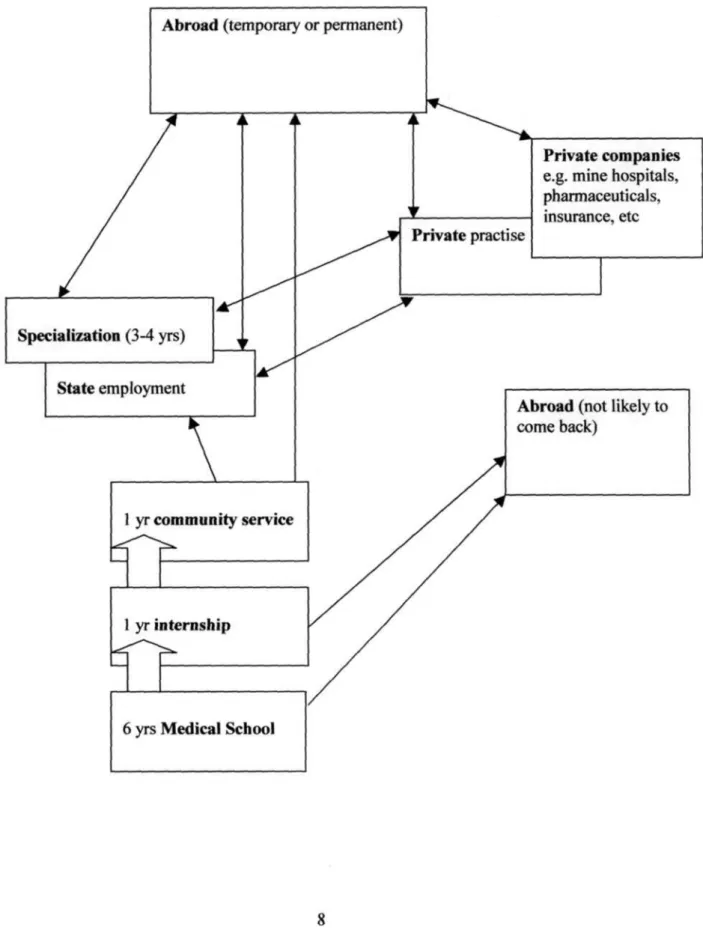
There are 8 medical schools in South Africa (Stellenbosch, Cape Town, Pretoria, Witwatersrand, Medunsa, KwaZulu-Natal, Bloemfontein and Transkei) with an average output of about 1250 students per year in total (Stuart, 2001). There is a lack of research into 'medical brain drain' from South Africa (Van der Vyver & De Villiers, 2002: 17).
Research question
Objectives
LITERATURE REVIEW
Literature sources
The labour market applicable to health workers
- Globalisation of health
- International migration
- The global labour market for health workers
- The new world labour market
- Brain drain' or brain circulation'?
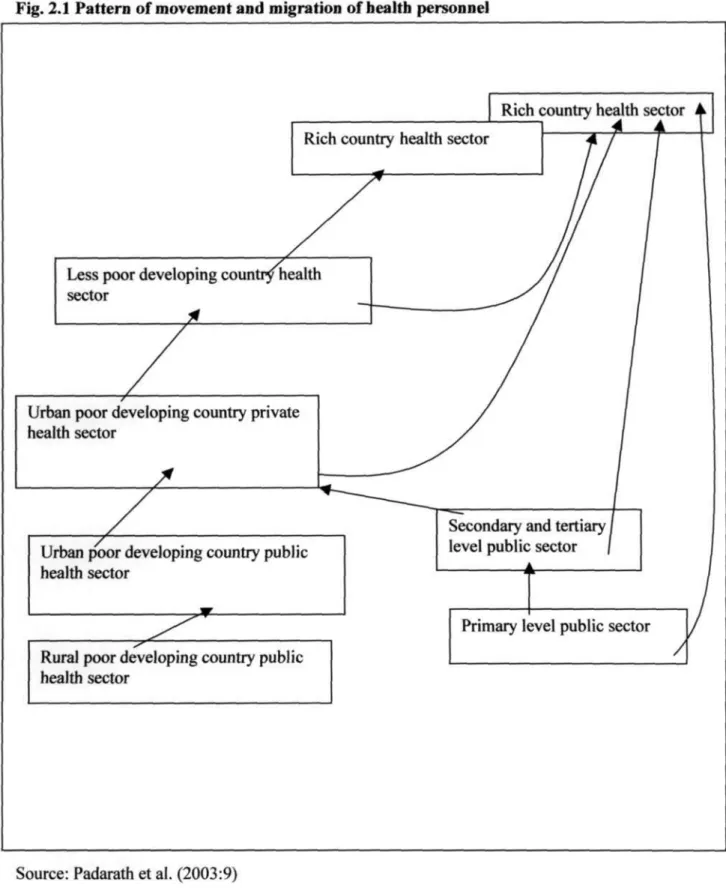
- Movement of health personnel
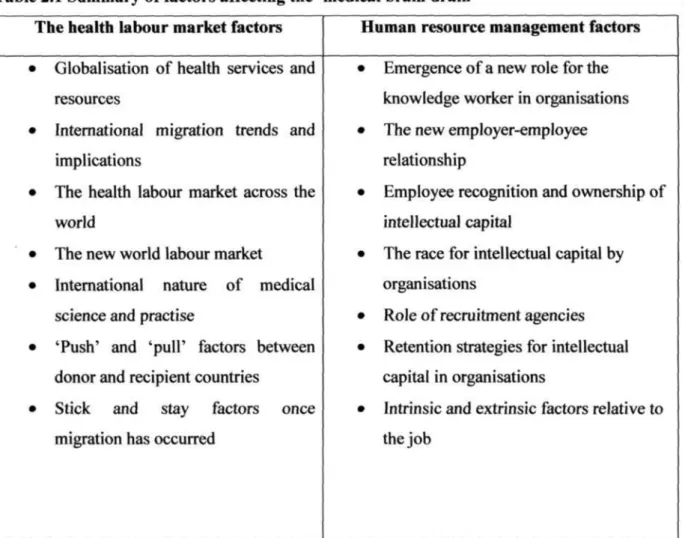
- Factors determining the movement of health personnel
The international movement of health personnel across borders has become an important component of trade in health services. The largest number of migrants in the world live in Europe (56 million), Asia (50 million) and North America (41 million).
Human resource factors
- Knowledge workers
- The new employment contract
- Brainpower: w h o owns it?
- W h o owns doctors' intellectual capital?
- The race for intellectual capital
- The role of recruitment agencies
- Retention of intellectual capital
- Career development
- T r a p p e d Employees'
- The role of Management in retention
- Retention of 'doctors* capital*
- Intrinsic and extrinsic factors
As Delany and Turvey (2004:29) argue, globalization, information technology and the expectations of the new generation of physicians are fueling the race. The aggressive marketing is a reflection of the severity of the global race for talent; this is consistent with Kaye and Jordan-Evans' (2002:34) observations that the race for talent is as hot as ever.
Cost and benefit analysis of 'brain drain 9
- Benefits of the brain drain*
- Costs and benefits to the health personnel
- Current knowledge of the -medical brain drain'
- Cited reasons for the 'medical brain drain'
- National intervention strategies
Although the exact cost of the 'brain drain' is not known, many authors believe that it is a huge loss of government investment in training doctors (Oyowe, 1996:59; Weiner, Mitchell & Price, 1998 :59). ). A survey by Jones found that only 65% of respondents were unlikely to leave in the next five years.
Summary of literature review
The government, along with other international organizations, medical associations and many foreign governments, is involved in many other efforts to address the 'medical brain drain'. It is against the backdrop of the above literature review that this study was conducted to see how the various issues mentioned above interact in influencing South African doctors to seek employment abroad.
RESEARCH METHODOLOGY
Research problem
Respondents' ranking of the importance of potential predisposing factors in their decision to seek work abroad.
Research design
Population
Sample
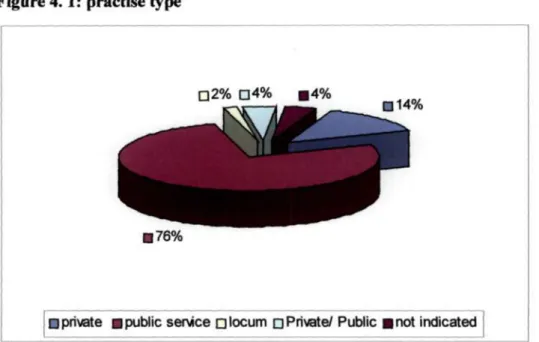
Out of this sample, 35 doctors described themselves as purely in the private sector, 3 were locums, 7 were in both the private and public sectors and 5 did not indicate their type of practice. The doctors who did not complete the questionnaires were away (10), fully booked (3) or declined (3). Those who did not wish to participate could refuse, keep the questionnaire or return the unfilled questionnaire in the checkout.
Research instrument
Pilot study
The trial run showed that respondents were easy to access, willingly completed the questionnaire in about 8 minutes on average. One respondent from this sample suggested including questions about whether respondents have a foreign registration, whether they have worked abroad, why they came back, and if they have a foreign registration but have not worked abroad, why not.
Data collection
For the tertiary centre, permission was obtained from the Chief Inspector and then the individual heads of each department were approached. Each physician was verbally requested to participate in the study after explaining the purpose of the study, confidentiality, and anonymity. If the respondent voluntarily provided verbal consent, the questionnaire was provided to be completed immediately and placed in a locked box.
Data analysis
A separate analysis was made to compare the respondents of the private sector with the public sector and others. A separate analysis was made to compare private sector respondents with 'public sector and other' respondents. The sample was further divided into private sector respondents and 'public sector and other' respondents (public sector, location, private/public sector) and analyzed for any differences.
Time frame
As this is exploratory research, trends between responses from total private sector participants and 'public sector and other' respondents have been identified, reported and discussed. At the outset of this study, no hypothesis was formulated regarding the differences between these subsamples and as such, the differences in the trends between these subsamples were not analyzed to determine statistically significant differences between them.
Assumptions
Research limitations
This survey is intended to serve as a pilot project for other researchers with better resources to conduct a larger nationwide survey.
Reliability and validity
Ethical considerations
The survey research design does not allow for follow-up probing questions to help gain greater clarification of respondents' responses. Research should not at any time prevent any doctor from attending an emergency. Research should not be structured in a way that encourages doctors to go abroad. . The overall report should be balanced and a true reflection of the issues reported by the sample of respondents.
RESULTS
- Introduction
- Demographic data .1 Practise type
- Gender
- Number of years since graduation
- Awareness of the 'medical brain drain 9
- Number of doctors known to respondents that left and those that returned to South Africa
- Foreign registration
- Foreign registration to practise abroad
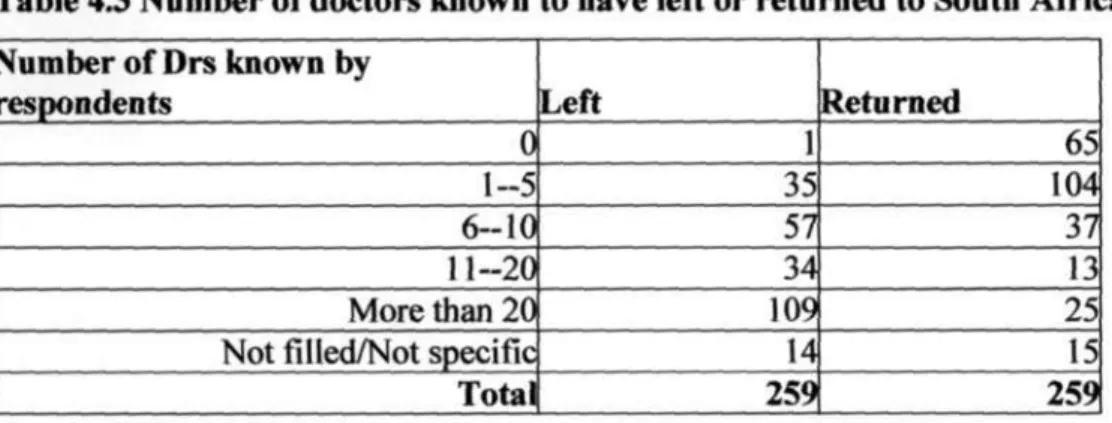
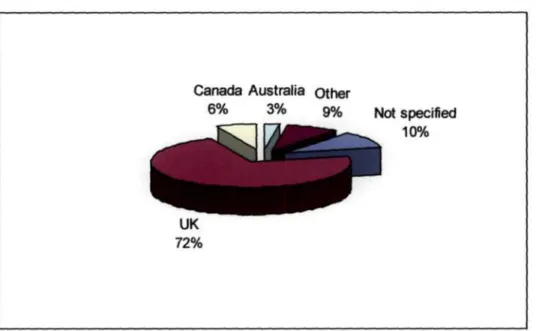
The total sample included physicians with a range of years since graduation from those in their first year (trainees) to those who had served for 54 years. The first question asked respondents to state the number of well-known doctors who had gone abroad (regardless of whether they returned as long as they went to work abroad). A separate question asked respondents to state the number of doctors they knew who returned from abroad to work in South Africa.
- Experience of work abroad
- Experience of work abroad
- Reasons for returning to South Africa
- Reasons why some respondents with foreign registration have not yet worked abroad
- Respondents' contemplation of work abroad
- Main reason for contemplating work abroad
- Other reasons for contemplating work abroad
- Reasons for not contemplating work abroad
- Degree of influence on decision to consider working abroad
A comparison has been made of the private sector with the public sector and other doctors (excluding trainees and CSO), as shown in table 4.6 and figure 4.9. The respondents from the “public sector and others” gave reasons similar to those of the total sample. Among the "public sector and other" respondents, more than 60% were likely to seek work abroad.
Factor
What employers should do to keep doctors in South Africa
The most frequently mentioned suggestions parallel the reasons given to consider looking for a job abroad; pay (26.4%), working conditions (18%), improvement of hospital facilities. The suggestions of the public sector and other respondents were consistent with those of the total sample. Improve hospital facilities, equipment and services. Reduce the number of working hours or pay for the additional hours worked. Improve health resources.
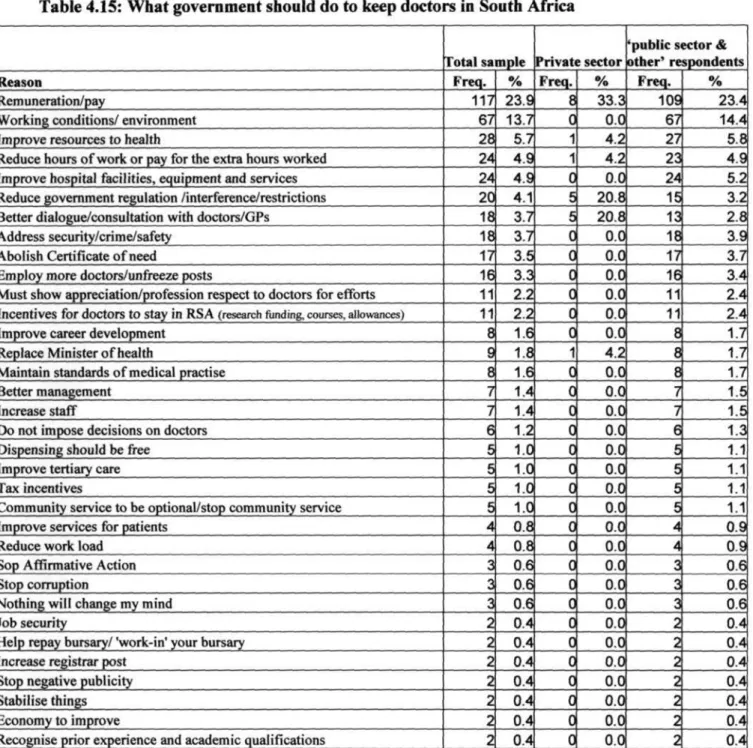
What government should do to keep doctors in South Africa
Must show appreciation/professional respect to doctors for efforts Incentives for doctors to stay in RSA (research funds, courses, allowances) Improve career development. Study time during working hours or special holiday for registrars Recognize doctors from other African countries. Incentives for GPs to enter public service Stop abuse of trainees and community doctors Unsort medical aids.
Summary of results
DISCUSSION
Introduction
Demographic distribution of sample
- Gender
- Number of years in practise
- Rank
- Practise type
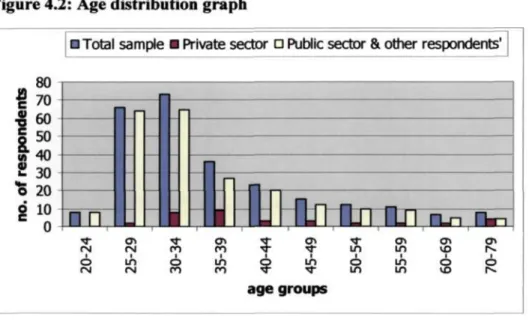
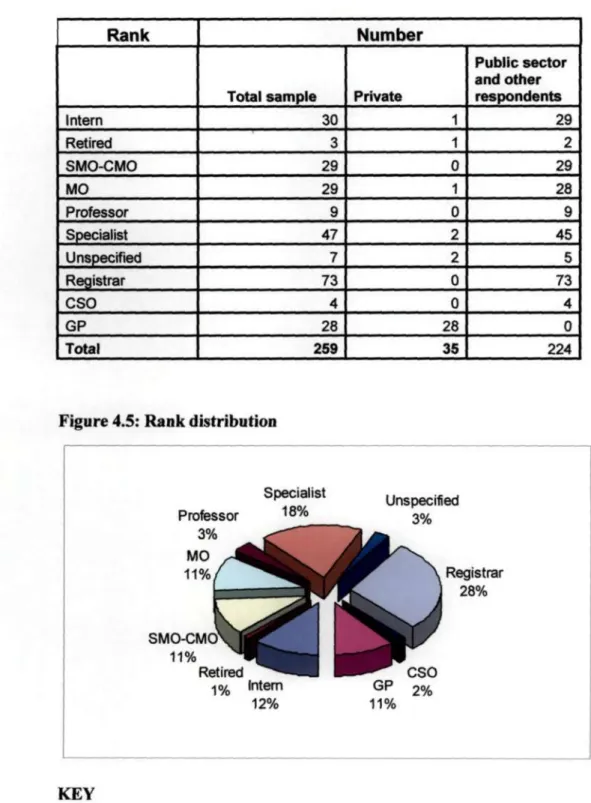
The predominant group had been in practice for 5 - 6 years, this was probably also partly a reflection of the high number of registrants, most of whom would fall into that category. There was a relatively high number of enrollees due to the tertiary center with a medical school. The predominance of public sector doctors was due to the inclusion in the sample of secondary and tertiary hospitals.
Awareness of "medical brain drain 9
- Awareness of movement of colleagues
- Awareness as reflected by intention
- Inferences based on level of awareness
The likelihood of going abroad in the next five years was much higher among the 'public sector and other' respondents (68%) compared to those in the private sector (23%). Apart from knowing colleagues who had left, a large proportion of the sample was actively or inactively involved or considering participating in the 'medical brain drain'. The situation appears to be much worse for the 'public sector and other' respondents. This means the respondents are not only aware, but are also participants in the 'medical brain drain' cascade.
Intentions to seek work abroad
- Foreign registration and experience of work abroad
- Reason for returning to South Africa
- Likely intentions within 5 years and beyond
- Inferences on intention to seek work abroad
A comparison of the private sector with respondents from the 'public sector and others' showed that only 26% of respondents from the private sector had a foreign registration, 68%. This is indicated by the very close percentages of those with foreign registration (57%) and those who might look for employment abroad in the next five years (55%). It seems that most of those with foreign registration are likely to take advantage of them by finding work abroad at some point.
Reasons for not contemplating work abroad
- Intrinsic and extrinsic factors
- Registration exams
- Litigation
- National patriotism
- Specialising
- Inconvenience
- Inferences on reasons for not contemplating work abroad
This means that the decision not to look for work abroad is usually not related to satisfaction with the current job or national competitiveness. High litigation was not cited by any respondent in the unstructured section as a reason for not considering work abroad. The need to change citizenship was the lowest (31) on the degree of influence to seek work abroad.
Main reason for seeking work abroad
- Financial factors
- Working environment
- Medical exposure to first world practise
- Political uncertainty
- Personal security and safety
- Certificate of need
- Dispensing regulations
- Other factors cited as main reasons
- Inferences on the main reasons
Private sector ratings for financial issues were similar to those of 'public sector and other' respondents. A comparison of private sector respondents with 'public sector and other' respondents showed that it was rated higher by the former (at number 2) than by the latter (number 7). These poor ratings may reflect the small number of GPs in the sample.
Other reasons for considering work abroad
- Working environment
- Financial
- Tourism and adventure
- Political uncertainty and government regulations
- Occupational safety
- Post for specialisation
- Recruitment agencies
- Frustration with medical aid claims
- Inferences based on the other cited reasons for seeking work abroad
No confidence in the current government/uncertain future in South Africa was responsible for 3.4% of the other reasons cited. It may also be a reflection of the uncertainties caused by recently introduced unpopular registration on certificate of need, dispensing and community service that leave doctors wondering what is to come. This was a relatively rare quote indicating that these issues may not be as big factors in doctors' decisions to seek work abroad, even though the doctors work in one of the most endemic countries for TB and HIV.
What employers should do to keep doctors in South Africa
- Working environment
- Improved resources to health
- Increased staffing
- Better management
- Dialogue/consultation
- Career development
- Incentives for doctors to stay
It is also not clear whether the salaries of doctors in the past were relatively better than now. It is clear from the foregoing that reimbursement affects physicians in both the public and private sectors. Promotion was mentioned by respondents in the context of merit-based promotion (1.5%); it was also cited as one of the top reasons why doctors consider seeking work abroad.
What government should do to keep doctors in South Africa
- Government regulations
- Personal safety and security
- Summary of suggestions to employers and government
A report by Physicians for Human Rights stated that the primary response to 'brain drain' must be to fix the second-rate health systems that reflect widespread violations of the right to health and other rights. It is the researcher's opinion that the handling of these so-called second-class health systems is dependent on qualified labor itself, so win-win solutions must be found for the benefit of the doctors and the source countries. Private sector respondents' suggestions to the employer or government were similar to those of "public and other" respondents, except for specific issues affecting the private sector such as disclosure and government regulation as discussed above.
Summary of discussion
As already mentioned above, police statistics show that there is a decrease in all categories of crime (SAPD, 2004). As already mentioned, the relative importance of crime may differ between respondents in the country and those who have already left. It is clear from the respondents' view that most issues that need attention have to do with financial, working environment and health services in general.
CONCLUSION
- Conclusions
Overall, there were few reasons cited related to satisfaction with the current job or a national competitive advantage for not considering a job abroad. Solutions related to financial issues are consistently mentioned most frequently as solutions that can curb 'brain drain'. The ratings from the respondents were closely related to the issues cited, which further confirmed the internal validity of the findings.
RECOMMENDATIONS
Recommendations
The working environment has many facets, from capital, management to the morale of healthcare workers. The business sector's efforts for the 'Homecoming revolution' must be encouraged and supported with practical solutions. The globalization of labor reinforces the already more complex nature of the modern worker (physician) who embraces the new career model as described by Cappeli (2000:11) and Stewart (1997:67) above.
Suggestions for future research
Policy on recruitment, employment and support of foreign health workers in the Republic of South Africa. Registration for doctors who have qualified in Australia, Hong Kong, Malaysia, Singapore, South Africa and the West Indies.
APPENDICES
Please read the notes below carefully
Rate the factors in the table according to how much they influence (positively or negatively) your decision to consider working abroad. Scarce skill grants introduced by DOH Insufficient opportunity for promotion in RSA Deterioration of my financial position over time No position for specialization. Patriotism / love for my country (South Africa) Recently increased rural grant for rural doctor To gain more experience abroad.
The Anaesthetists Agency