POLICING AFRICAN TRADITIONAL RELIGION AND CULTURE IN THE METHODIST CHURCH IN ZIMBABWE.
BY
GREENWELL CHIGOVA 215000256
Submitted in fulfilment of the academic requirements for the degree of Doctor of Philosophy in the School of Religion, Philosophy and Classics (incl. Theology and
Ethics), at the University of Kwazulu-Natal (Pietermaritzburg Campus).
Supervisor: Dr F. G. Settler
11 December 2017
ii
DEDICATION
To my dear parents Nobert and Catherine Chigova whose exemplary life has inspired me to move on.
To my wife Tsitsi, our Children Taonaishe Godwin, Tafara Sean, and Mutsawashe Leanne
iii
ACKNOWLEDGEMENTS
I would like to acknowledge the incalculable contribution of my supervisor, Dr F. G. Settler, who was very kind with me along the way. He read numerous drafts, giving insights and direction. He encouraged me when I was overwhelmed. Had it not been for him this work would not have been completed. I am grateful to the staff of the University of Zimbabwe who took part in moulding me, including professor Ezra Chitando, professor T. P. Mapuranga, Dr M. Ruzivo, professor N.
Taringa, Dr R. M. Gunda and Dr A. M. Moyo.
I am indebted to the World Methodist Church for granting me a scholarship that allowed me to study at the University of KwaZulu-Natal in South Africa. I am also grateful to the Methodist Church in Zimbabwe for granting me permission to study and for the continued support they rendered to my family and myself.
Lastly, I want to greatly thank my family for support, especially my dear wife Tsitsi, my two sons, Taonaishe Godwin and Tafara Sean, and our beautiful daughter Mutsawashe Leanne who came when I was away studying. I thank these for allowing me to be away from them.
iv
DECLARATION
I, Greenwell Chigova (215000256), declare that the research reported in this thesis, except where otherwise indicated, is my own original work. No portion of the work referred to in the thesis has been previously submitted in support of an application for a degree or qualification at this or any other University or institute of learning. All citations, references, and borrowed ideas have been dully acknowledged. Where other written sources have been quoted, their words have been rewritten but the general information attributed to them has been referenced. Where their exact words have been used, their writing has been placed in italics and inside quotation marks.
The thesis does not contain text, graphics or tables copied and pasted from the internet, unless specifically acknowledged, and the source being detailed in the thesis and in the references section.
---
Greenwell Chigova
11 December 2017
As the Candidate’s Supervisor I hereby approve this dissertation for submission.
---
Dr F. G. Settler
11 December 2017
v
ABSTRACT
This study explores the attitude of the Methodist Church of Zimbabwe (MCZ) towards African traditional religion and culture. It is mostly concerned with how the colonial missionary Methodist Church informs the attitude of the postcolonial Church. The church’s colonial history is framed as the basis of the negative approach of the postcolonial church toward inculturation, and it is argued to account for the lack of appetite for reformation and change in the ecclesiology and theology of the postcolonial Methodist Church. The study identifies and interrogates the theological and ideological reasons for policing and maintaining regimes of surveillance on African traditional religion and culture by both the colonial and postcolonial Methodist Church in Zimbabwe.
The study draws on Church documents, such as the Deed of Church Order and Standing Orders, minutes of conferences, organisational and farms policy documents, as well as archival material dealing with the historical relationship between the MCZ and African traditional religion and culture. The archival materials used in this research were found in two locations: the Methodist Church Archive (MCA) and the National Archive of Zimbabwe (NAZ), both of which are in Harare. A postcolonial approach to archival research was used to reveal and expose previously overlooked perspectives on the church, and to highlight the voices of subaltern resistance to church suppression of indigenous religions.
The research is guided by two theoretical frameworks, namely, postcolonial theory and Foucauldian analysis of governmentality. The two frameworks were ideal in achieving the objectives of this research. They were used, firstly, to highlight and examine how the colonial Methodist Church impacted or influenced the thinking and attitude of the postcolonial Church regarding the place and relevance of African traditional religion and culture in the Church.
Secondly, they were used to investigate and illuminate the tactics, techniques, strategies, and schemes used by the MCZ to govern people’s belief systems and to shut out African traditional religion and culture. Thus, this study argues that Church policies and regimes of discipline were primarily oriented toward excluding African traditional religion and culture, and that current efforts at inculturation and indigenising the Church rely on colonial representations of African traditional religion and culture. Further, a Foucauldian analysis of Church rules and policies reveal the extent to which orientation towards African traditional religion and culture remain unreformed.
vi
LIST OF ABBREVIATIONS
ABM
American Board MissionsBCU
Boys Christian UnionBSAC
British South Africa CompanyCDA
Critical Discourse AnalysisCMS
Church Missionary SocietyDA
District AdministratorDOC&SO
Deed of Church order and Standing OrdersDRC
Dutch Reformed ChurchGCU
Girls Christian UnionLMS
London Missionary SocietyMCA
Methodist Church ArchiveMCCA
Methodist Church in the Caribbean and the AmericasMCU
Men’s Christian UnionMCZ
Methodist Church in ZimbabweMMS
Methodist Missionary SocietyNAZ
National Archive of ZimbabwePEMS
Paris Evangelical Missionary SocietyRMS
Rhenish Missionary SocietySDA
Seventh Day AdventistTTL
Tribal Trust LandWMMS
Wesleyan Methodist Missionary Societyvii
GLOSSARY OF TERMS
Circuit:
The Circuit, in the Methodist Church in Zimbabwe, refers to two or more localChurches or societies united for mutual encouragement and assistance, under the supervision of a superintendent minister with other ministers.
Class meetings:
Class meetings are the basic unit and foundation of the structure of the Methodist Church in Zimbabwe. Church members are grouped together into classes for Christian fellowship, Bible study, prayer, pastoral care, and support in their discipleship, witness, and service.Conference:
The conference is the governing and ultimate authority of the Methodist Church in Zimbabwe, which has jurisdiction over all matters of doctrine, discipline, organisation, finance, land, and property. From time to time, the Methodist Church in Zimbabwe may make, amend, and revoke such standing orders or other rules or regulations as it considers desirable.Connexional:
Connexion refers to the structure and form of the whole of Methodism within a country under the authority of a conference.Society:
The society, also called the local Church, refers to the body of members of the Methodist Church in Zimbabwe connected with and attending one particular place of worship.The society is the most local expression of Methodism, a worshipping community in which members are spiritually nurtured, receive direction and mutual encouragement.
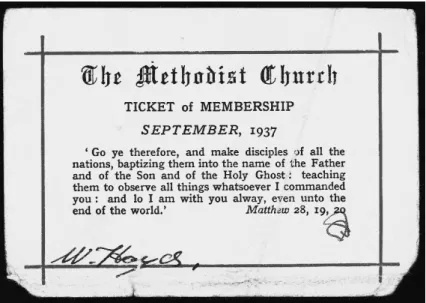
Membership ticket:
A membership ticket is a membership card given to Methodist members as proof of membership and is also used to record membership subscriptions, tithes, offerings, and pledges.Postcolonial Methodist Church:
Postcolonial Methodist Church refers to the Church after 1977, when it had attained an autonomous status from the British conference. The Church was now under black leadership and free to determine its own destiny through amending its policies, rules and regulations.Rhodesian Methodist Church:
The Rhodesian Methodist Church refers to the colonial Church from inception in 1891 to 1977, before the Church got independent from the British Conference.viii
TABLE OF CONTENTS
DEDICATION... ii
ACKNOWLEDGEMENTS ... iii
DECLARATION ... iv
ABSTRACT ... v
LIST OF ABBREVIATIONS ... vi
TABLE OF CONTENTS ... viii
CHAPTER ONE: INTRODUCTION ... 1
1.1 Introduction ... 1
1.2 Background of the study... 5
1.3 Statement of the problem ... 8
1.4 Research questions and objectives ... 11
1.5 Methodology ... 12
1.6 Theoretical tools ... 13
1.7 Significance and contribution of the study ... 15
1.8 Findings and recommendations ... 17
1.9 Limitations of the study ... 20
1.10 Structure of the dissertation... 21
CHAPTER TWO: LITERATURE REVIEW ... 23
2.1 Introduction ... 23
2.2 Mission and Missionary activities of Christianity in Southern Africa ... 23
2.3 Methodism in Zimbabwe (Southern Rhodesia) ... 26
2.4 Methodism after Independence ... 31
2.5 Inculturation and the Church in Sothern Africa ... 35
2.6 Church Governance ... 38
2.6.1 Methodist Church Governance ... 38
2.6.2 Government of the postcolonial Methodist Church in Zimbabwe ... 40
2.7 Chapter Summary ... 43
CHAPTER THREE: THEORY AND METHOD: INTERROGATING THE ARCHIVE ... 46
3.1. Introduction ... 46
3.2 Postcolonial Theory ... 49
3.2.2. Postcolonial Theory as a mode of literary criticism ... 52
3.3. The Foucauldian concept of Governmentality ... 54
ix
3.3.2. Pastoral power as both pastoral care and political power ... 56
3.3.3. Institutional discourse as discipline and restraint ... 58
3.3.4. Institutional discourse as violence of exclusion ... 60
3.3.5. Institutional discourse and surveillance ... 61
3.4.1 Research design ... 63
3.4.2. Postcolonial approach to Archival research ... 64
3.4.3 Research methods ... 65
3.4.4. Research procedures ... 66
3.4.5. Research instruments ... 67
3.4.6 The process and method of data analysis ... 67
3.4.6.1 Critical Discourse Analysis ... 67
3.4.7 Ethical considerations ... 70
3.4.8 Limitations of the study ... 71
CHAPTER FOUR: THE METHODIST CHURCH IN ZIMBABWE AND AFRICAN TRADITIONAL RELIGION AND CULTURE. ... 74
4.1 Introduction ... 74
4.3 Brief history of Missionary Methodism in Southern Africa ... 77
4.5 The Colonial Methodist Church’s attitude towards indigenous religion ... 82
4.5.1 Rules on general Church membership ... 83
4.5.2 Christian villages ... 87
4.5.3 Schools ... 91
4.5.4 Hospitals and clinics... 94
4.6 Postcolonial MCZ attitude towards African Traditional Religion ... 96
4.6.1 Rules and regulations that govern Church membership ... 97
The Class Meeting Regulations ... 98
4.6.2 The farm settlements\Villages ... 102
4.6.3 The Ruwadzano\Manyano ... 108
4.8.3 The Men’s Christian Union ... 110
4.7 Conclusion ... 115
CHAPTER FIVE: IDEOLOGICAL AND THEOLOGICAL ANXIETIES ABOUT THE INDIGENOUS IN THE MCZ ... 117
5.1 Introduction ... 117
5.2 Theological motives for policing African traditional religion and culture ... 118
5.2.1 Colonial and postcolonial MCZ’s understandings of Christian mission. ... 118
x
5.2.4 Ecclesial and juridical authority of the MCZ ... 121
5.2.5 Contemporary Methodist Church’s understanding of salvation ... 123
5.3 Ideological factors for policing African traditional religion and culture ... 125
5.3.1 Methodist self- understanding in the postcolonial era ... 126
5.3.2 Intolerance and misconceptions about African traditional religion and Culture ... 128
5.3.3 Extra- doctrinal techniques for conversion ... 130
5.3.4 Governance of member of MCZ ... 135
5.3.5 Retaining the uniqueness of Methodism?? ... 137
5.4 Chapter summary ... 140
CHAPTER SIX: ENGAGING THE INDIGENOUS: CONCLUSIONS AND RECOMMENDATIONS ... 143
6.1 Introduction ... 143
6.2 The persistence of colonial ecclesiology ... 144
Dislodging Colonial Ecclesiology ... 147
6.3 Contemporary MCZ ecclesiology and indigenous beliefs or practices ... 153
Policing and surveillance through pastoral care and church discipline ... 156
Pastoral care and the systematic violence of exclusion ... 157
Anti-indigenous rules and regulations ... 158
6. 4 Towards a reformed indigenous ecclesiology ... 160
6.4.1 Deconstruction and Reformation of MCZ Ecclessiology... 161
6.4. 3 Incorporation and inculturation of the indigenous ... 162
6.5 Chapter Conclusion ... 165
REFERENCES ... 167
APPENDIX 1: Ethical Clearance ... 168
APPENDIX 2: ‘The Rules of the Society of the People called Methodists’ drawn by John and Charles Wesley (1743) ... 168
APPENDIX 3: Presiding Bishop’s message to all tenants on prohibited activities on the Farms (14 June 2011). ... 168
APPENDIX 4: Letter from the Church instructing a tenant to vacate the Mission for failure to observe Church rules and regulations (21 June 2012). ... 168
APPENDIX 5: Letter from the Church reprimanding a tenant for failure to uphold mission rules and regulations (20 October 2015) ... 168
APPENDIX 6: Missionary Agreement of lease Form. ... 168
APPENDIX 7: Contemporary Agreement of lease Form (2015). ... 168
Source: Farms file, Projects office, MCZ Connexional office. ... 168
xi
APPENDIX 8: BSAC land adverts, and racial land distribution table 1930.... 168
1
CHAPTER ONE: INTRODUCTION
1.1 Introduction
The purpose of this introductory chapter is to summarize all the key information in this study through announcing my topic, providing the context and rationale of study, stating the problem, aim, scope and significance of the study. The chapter also briefly explains the methodological approach and the theoretical tools used to examine the research problem. Lastly, it outlines the limitations of the study and the structure of the thesis. In summary, the purpose of this chapter is to give an overview of the entire research project. As Creswell (2013:73) argues, the introductory chapter sets the stage for the entire project. The intentions of the study are spelt out in this first chapter through the aims and objectives of the study, and the research questions meant to provide the solution to the identified research problem.
The topic of this study is ‘Policing African traditional religion and culture in the Methodist Church in Zimbabwe’. The concern of the topic is to determine how the MCZ relates to African traditional religion1 and culture, through an analysis of the practices, regimes, and policies used by the Church to regulate aspects of the African worldview, religion and culture. I specifically analysed Church policies, rules, and laws used by the church to achieve its goal and to maintain surveillance on members. The thesis offers a postcolonial and Foucauldian critique of current MCZ’s policies and practices on African traditional religion and culture.
Postcolonial MCZ’s practices and policies related to African traditional religion and culture reveal intolerance and provincialism. The general rules of the Church, the rules and regulations in the mission settlements, the class meeting rules and regulations, and the Church organisations policies
1I am aware that the phrase ‘African traditional religion’ is debatable and there is no unanimous agreement whether it is religions in the plural or religion in the singular. Scholars are divided between those who think that the belief systems in Africa are closely identical and therefore can be taken as one (Mbiti 1990: 1-3), and those think that with the vastness of Africa and the differences in both traditional beliefs and practices, it is not possible to talk of traditional religions and cultural practices in the singular (Idowu 1973:103-104; Shorter 1975:1’ Maluleke 2001: 37; Magesa 2002: 16). I am also aware that in Zimbabwe there are many ethnic groups with different traditional beliefs and practices. However, I use traditional religion and culture in the singular form because the Missionaries, whose documents I investigate, did not differentiate among African beliefs and practices. There are also common traits that run across the ethnic groups in Zimbabwe. For instance, issues of customary marriage, the place and role of traditional and spirit mediums, beer brewing for traditional rites and ancestor veneration are found among most societies in Zimbabwe.
2
and rules, mitigate against African traditional religion and culture. Church members are disciplined for engaging in cultural and customary practices such as polygamy, ancestral worship, participation in traditional ceremonies, visiting traditional healers, and brewing and drinking traditional beer.
The MCZ came to Zimbabwe through the endeavours of missionaries (Hewson 1950:51, Zvobgo 1991a:1-2). The Methodist missionaries, like other missionary societies who carried out missionary adventures in other parts of Africa, brought Christianity as it was defined and understood in their own home countries (Waligo 1998:113). The missionaries also applied this understanding and their self-understanding as superior over Africans to define, classify and differentiate between what they considered true belief, and what they considered superstition and ungodly practices (Mucherera 2001:36; Chitando 2005:186; Haar, Moyo, and Nondo 1992:53).
When Africans converted to Christianity, they were expected to shun their past, including their traditional practices and culture as a sign of true conversion (Chitando 2005:185). However, many continued to practice and participate in African traditional rituals and culture (Thorpe 1951: 65;
Moyo 1987:67; Manyoba 1991:65). Christian missionaries brought with them and reproduced rules and laws that governed the Church system and everyday behaviour of its members as well as among African converts. African converts who continued to perform or participate in indigenous ritual or practices were disciplined through loss of church membership or expulsion from the Church.
The missionary Methodist Church was not comfortable mixing Christian beliefs with African beliefs and culture. As a result, practices such as brewing and consumption of traditional beer, visiting or consulting traditional healers (n’angas), African customary marriages, traditional rituals and ancestral worship were forbidden (Fry 2007:113). The missionary Methodist Church used instruments such as class regulations, Church organisations policies and rules, farm regulation policies for tenants on the farms, and the general rules that governed Church membership, to police and maintain surveillance on members who continued the practices condemned by the Church (Peaden 1970:19; Zvobgo 1991b, 1966; Madhiba 2000:28). This however, did not mean that these practices died down, instead, they went underground, and Africans continued to partake in them surreptitiously. Some African church members were prepared to be disciplined and to leave the Church, especially men who wanted to marry several wives (Zvobgo 1991a:115). Sensing that
3
many people were leaning back to African spirituality during times of need, the missionary Methodist Church used extra-doctrinal techniques to recruit and retain people into the Church (Njoku 2005:240, Saayman 1991:32, Madhiba 2000:28). These techniques included education, medical missions, Christian villages, and other forms of social responsibility (Zvobgo 1996:319;
1991a:113; 1991b:11, Madhiba 2000:29). The missionary activities discussed above were seen by some as assisting the African society and by others as unsettling of the African social order.
Ayandele (1966), for instance, alleges that missionary activity was disruptive to African traditional society through its denouncing of polygamy in favour of monogamy, detribalization of children through the mission schools, destroying the moral principles of the indigenous society through denunciation of traditional religion without any adequate substitute (1966:329). When the MCZ attained an autonomy in October 1977, it was accorded an opportunity to revise and reform its ecclesiology and theology, but to this day the Church has not done much to reform and adjust its policies concerned with African traditional religion and culture. The Church inherited a colonial ecclesiology and theology from the missionary church, which continues to provide social and moral parameters for the postcolonial Methodist Church (Makoti 2015:132). The contemporary Methodist Church’s official position is to denounce and punish members who participate in African traditional rituals and culture2. This study discusses some reasons why the contemporary Methodist Church in Zimbabwe appears reluctant or unable to reform or change its ecclesiology.
Although in its Conferences, the contemporary Methodist Church saw and continues to see the need for reform, it has not done much to revise colonial laws and rules that continue to be applied in mission farms, the failure to recognition of customary marriage and the general denial of African religion as legitimate.3 Due to the rigidity of some of the rules, some members are opting out of the Church to join most recently established Churches which are deemed flexible and accommodative of traditional practices and African culture (Minutes of Conference 2005, p. 37).
2The MCZ has been punishing and continues to punish and discipline those who are involved in polygamy and cultural practices, examples are letters written to tenants on Methodist Farm settlements and disciplinary cases in circuits, see appendix 3 (Presiding Bishop’s message addressing Farm tenants on prohibited activities) and Appendix 4 (letter of reprimand for failure to adhere to rules and regulation).
3The Methodist conferences have deliberated on issues of policy with pressure coming from the youth and men in the Church who were complaining that the current rules on marriage were leading to lose of membership. Conferences deliberate on the issues and made recommendations for Change of note is conference 2014 which resolved to redefine marriage and bless all men with monogamous marriages and do further research on polygamy. however, no significant changes in Church policy on traditional rites and culture have taken place.
4
The contemporary Methodist Church is not comfortable with such concepts as inculturation, it does not even accept the inclusion of positive aspects of the African worldview and culture.
To ascertain the MCZ’s position on African traditional religion and culture, the present study engaged archival material to access primary data from minutes of the Rhodesia Synod (1901- 1977), minutes of the MCZ Conference (1981- 2016), colonial missionary and postcolonial Church organisations’ constitutions and policies, and the colonial missionary and postcolonial farms documents. A postcolonial approach to archival research was utilized in this study to extricate relevant data from the material. The postcolonial approach to archival research is the critical use of colonial archival with the view to critically re-read records which offer space to the master’s voice and not the oppressed and voiceless (Bastian 2006). The aim is to decolonise and pluralise the Archive (McKemmish and Gilliland 2013: 79-112). The Foucauldian concept of governmentality was used to illuminate the MCZ’s system of government, specifically, how its discourse is used as a mechanism of discipline and surveillance, and to highlight all the techniques and strategies used by the Church to govern its members. This will be explained further in the chapter on Methodology.
The study will not only offer insight about the Methodist Church in Zimbabwe but to other missionary Churches as well. It will help them consider the need to reform their ecclesiology and theology and to adapt and accommodate African traditional religion and culture. The study encourages dialogue between the Christian faith and indigenous religion and continuous research on African traditional religion and on any new social issues so that institutions such as the Church may remain relevant to members and to the ever-changing society. The study dispels the colonial conviction that all aspects of African traditional religion and culture are evil and superstitious.
Churches and faith-based organisations will benefit from this study because it will assist them to deconstruct their organisational policies, rules and laws, and thereby make guided reforms of their relationship to indigenous or customary laws, rituals, practices and healing systems.
5 1.2 Background of the study
This thesis explored the attitude of the MCZ toward African traditional religion and culture. The study is concerned with the influence and impact of the attitude of the missionary colonial Church toward African indigenous religion and culture on the postcolonial MCZ. The activities of the Wesleyan Methodist Missionary Society (WMMS) from the Church’s inception in Southern Rhodesia (now Zimbabwe) from 1891 to 1977 were interrogated. The study also looked at the second phase of the Church’s history from 1977 to date when the Church became autonomous under the leadership of the Africans themselves. The study thus interrogates MCZ’s documents to ascertain the extent of the Church’s entanglement with, and against African traditional religion and culture. These documents include archival material on the MCZ and the African worldview, the Church’s organisational policy documents, and the minutes of conference.
The study looks at the activities of the MCZ in Zimbabwe, a country formerly called Southern Rhodesia4. Methodism came to Zimbabwe through South Africa and under the direct control of the British Methodist conference (Gondongwe 2011, Mawire 2015). This arrival of Methodism in Zimbabwe was not an isolated event, it was part of the expansion of Methodism to other parts of the world and part of the general missionary enterprise to Africa since the Methodist missionaries came at the same time as the missionaries of other missionary societies (de Gruchy 1991: 1;
Hallencreutz 1998:7; Zvobgo 1991a: 1-2). When the WMMS arrived in Zimbabwe, the territory was under the control of Britain, which exercised its influence through the British South Africa Company (BSAC)5. The WMMS and other missionary societies were allocated land by the BSAC on which they established themselves through the establishment of schools, hospitals and Christian villages (Hallencreutz 1998:29; Zvobgo 1991b:66). The establishment of schools, clinics, and Christian villages was considered a very effective evangelistic strategy by all missionary societies that operated in Africa (Zvobgo 1991a:86, Cox 1991).
The attitude of the WMMS toward African traditional religion and culture, like that of other missionary societies, was negative due to pre-conceived judgements on Africa and feelings of superiority by the European missionaries (Gray 1990:144, Wijsen 2016:195-196). The conviction
4During the colonial era, the Country now known as Zimbabwe was known as Southern Rhodesia taking this name from Cecil John Rhodes who was the leader of the pioneer column
5The British South Africa Company (BSAC) was a mercantile company incorporated on 29 October 1889 by a Royal Charter at the instigation of Cecil John Rhodes with the objective of Acquiring and exercising commercial and administrative rights in South- Central Africa (https:\\www.britanica.com\topic\British-South-Africa-Company)
6
that Africa was a dark continent and that African traditional religion was idolatry, superstition, magic, polytheism, ancestor worship, and a product of a lack of enlightenment was shared by both the missionaries and the colonialists (Zvobgo 1991a:6; Udeani 2007:82). Due to the above persuasion, the missionaries did not bother to understand the African worldview, instead, they took it as their mandate to bring light to the darkness that covered the African minds and hearts. There was general conviction among the missionaries that tenets of African traditional religion were not compatible with Christian beliefs and practices (Ibbotson 1933, The Kingdom Overseas, July 1933, pp. 150- 151). Breaking down African beliefs and customs became the objective of the missionaries and they did this without sifting for the best and life-giving practices from African traditional religion and culture (Kaplan 1995:9, Peel: 2000 88, Aguwa 2007:130). The Methodist missionaries were opposed to any manifestation of African indigenous religion and culture to the extent that they applied sanction on those who practiced or participated in traditional rituals and customs (Fry 2007:113).
Despite the efforts by the missionaries to subdue the power and effect of traditional religion and culture among Africans, these continued to have a grip and power over the hearts and minds of Africans. Effective evangelisation among Africans, who held deeply their traditional beliefs, was very difficult. Ranger (2005:18) compares the efforts to writing on the sand.
The Methodist missionaries did not only believe that it was not necessary and possible for African traditional beliefs and the Christian faith to co-exist, they also believed the continued adherence to these aboriginal beliefs by Africans was an impediment to the propagation of the gospel. This led to the missionaries developing strategies meant to harness and regulate African traditional religion and culture (Madhiba 2000:28, Zvobgo 1991a:74). The strategies were like political means of forcing or coercing Africans to convert, because there were material incentives to be gained or lost if one converted or did not convert respectively (Robinson 1915:32, Weller & Linden 1984:89).
The main aim of these extra-doctrinal techniques was to calm African traditional practices and customs. The strategies developed by the Methodist missionaries included the introduction of rules and regulations governing Church membership, the introduction of Christian villages, schools and health systems (Madhiba 2000:29, Zvobgo 1991a:110). The rules and regulations governing Church membership forbade, among other thing, beer drinking and beer parties, visiting or inviting traditional healers (n’angas), traditional rituals and all customary forms of marriage (Minutes of
7
the Rhodesia Synod 1902, Madhiba 2000:38, Zvobgo 1991a:113). Christian villages, which according to Chitando (2008:53), were like sacred spaces, were meant to shield converts from pagan influence and to be an example to the world (Peaden 1970:19; Zvobgo 1991a:127). Christian villages mitigated against African traditional religion and culture in that converts were required to abandon their traditional ways of life and sever relationships with unconverted relatives. There were specific rules and regulations that banned polygamy, ancestor worship, beer brewing and drinking and all traditional ceremonies (Peaden 1970:21; Mudavanhu, 2010:128). Education was also used as a tool to undermine African traditional religion, in that schools were platforms for proselytization meant to destroy traditional religion, culture and identity (Moyo 1987:62).
Medical missions were also used as a strategy to fight African traditional religion and culture, the motive behind the introduction of western medicine was to change the African’s understanding of medicine, which would make him opt out of his worldview (Peaden 1970:16, Minutes of the Rhodesia Synod 1909). According to Manyoba (1991;68), the introduction of western medicine was meant to bring competition between western medical practitioners and African practitioners (N’angas) who commanded respect in the African society. The strategies discussed above are a clear testimony that the Missionary Church was against African traditional religion and culture, although some scholars argue that not all missionaries employed these extra-doctrinal techniques as a bait to lure Africans to converts, but that some employed them to fulfil the Church’s missionary mandate of social responsibility and to uplift people’s living conditions as demanded by the gospel (Robert 2009:52). The Methodist Church in Zimbabwe became an autonomous Church in October 1977, which accorded her the opportunity to make own decisions independent of the British Conference (Madhiba 2000, Makoti 2012). This independence gave the Church an opportunity to Africanise by reforming her liturgy, theology and ecclesiology. However, the Church did not do much in changing the status quo (Makoti 2012).
The post-autonomy Church inherited many things from the missionary Church including structures, policies, rules and regulations (Madhiba 2000:78; Makoti 2012:132-133). The contemporary Methodist Church still maintains the missionary theology and ecclesiology, and these continue to provide parameters for the postcolonial Church despite calls for reform and the Africanisation of the Church in the Church’s conferences. The class, which is an important unit in the Methodist Church, still uses rules and regulations that mitigate against African traditional
8
religion and culture. The same applies to organisational rules and polices as well as the farms policy document. The same rules that governed these Church institutions during the colonial era are still applied with very slight changes and amendments (See figures 4.3 & 4.4, & Appendixes 6 & 7). Most have only changed wording but not content. The organisational rules and regulations, the class regulations, the general Church rules, and the rules governing farms still forbid African customary marriages, such as polygamy, beer brewing and drinking, participation in traditional rituals, visiting or inviting traditional healers (n’angas), and burying relatives on undesignated burial sites, in case of mission settlements. The above shows that the attitude of the missionary Church towards African traditional religion and culture has been carried over to the postcolonial Church and the MCZ looks comfortable to continue in that direction.
1.3 Statement of the problem
Research is always an attempt to find solution to an identified problem (Evans, Gruba and Zobel 2014:61). This section of the study seeks to make a statement of the problem, that is, to highlight the reasons for engaging in this research and what the research sought to address. Jacobs (2011) argues that problem statements serve an especially critical foundational role because they communicate formally the reasons for engaging in any research (2011: 132-146). I intend to do three things in this section, firstly, to describe and explain how the ideal situation should be regarding the contemporary MCZ’s relationship with African traditional religion and culture.
Secondly, I will describe the reality of the situation and the conditions that are hindering the MCZ from attaining what I perceive as the ideal situation and explain how the current situation falls short of what I consider the ideal situation. Thirdly, I will propose ways that are meant to improve the current situation so that it moves closer to the ideal situation regarding the relationship between the MCZ and African traditional religion and culture.
The MCZ has historically struggled with several issues stemming from the effects of her colonial past. The key issue that this study interrogates, is its relationship with African traditional religion and culture. The MCZ has not achieved much in Africanizing the Church, through revision and reform of missionary ecclesiology and theology which continue to guide and provide parameters for the Church’s relationship with African traditional religion and culture. For many years, the MCZ is directed by an ecclesiological system that discouraged the Africanization of the church and the contemporary MCZ appears to be comfortable with such an arrangement. Ordinary
9
members have, however, resisted the continued imposition of the colonial missionary theology and ecclesiology especially on its engagement with African traditional religion and culture. One method of resistance by the ordinary African members of the MCZ was by urging the Church in conferences to reconsider the place of African traditional religion and culture and its attitude toward African customary marriages, ancestor worship and rituals, and visiting or inviting traditional healers for divination (Minutes of conference 2005 & 2014). The contemporary MCZ denounces and punishes those who partake in the abovementioned acts through policies, rules, and laws. The Church discourse (policies, rules, and laws) which were crafted by the colonial missionaries and have unfortunately been maintained to this day, do not necessarily reflect the voice of the Methodist African members. African members were not represented in the crafting of the MCZ discourse but in most cases, they were misrepresented by the European missionaries who thought and spoke for them.
The restrictions imposed by the MCZ discourse as a way of policing and maintaining surveillance on African traditional religion and culture have a negative impact on the Church Kingdom Overseas Magazine, July – August 1962). Church membership has dwindled with disciplined and disgruntled members leaving the Church. People have become pretenders because they are torn between the African worldview, which they perceive to provide answers to their life problems and at the same time they want to remain members of the MCZ which does not tolerate traditional belief and culture. The rules and regulations of the Church concerning customary marriages have had an impact on men and young people most of whom cannot afford the affluent white wedding or so called Christian wedding (Minutes of Conference 2013, p.45). The restrictions on African traditional religion and culture in the MCZ have also been met with resistance from the ordinary members of the Church, examples can be seen in the refusal by tenants in the mission farms to bury their deceased relatives on designated cemeteries, and the continued practice of traditional rituals and ceremonies both in the mission settlements and elsewhere in the Church (Minutes of Conference 2014). The resistance by ordinary members paints a picture of an African Church that conflicts with itself and so there is need to work towards harmony within this conflicting institution.
The study therefore seeks to generate knowledge on what the policies and practices of the MCZ which originated in the Church’s colonial past disclose about the postcolonial Church’s desire to
10
incorporate African traditional religion and culture into its ecclesiology, ideology and theology.
The goal is to explore how and why the MCZ has resisted, and is still resisting, the integration of indigenous practices into its ecclesiological structure. The study looks at the MCZ’s activities that illustrate its effort to shut out aspects of African traditional religion and culture. Such activities include the introduction of rules specifically for the Methodist Church in Zimbabwe (Rhodesia) in addition to the general rules of society used by Methodists the world over, the introduction of missionary education, medical missions and mission settlements or Christian villages. Further, as a way of ascertaining why the MCZ resisted and continues to resist the introduction of African traditional religion and culture in its ecclesiology, the study attempts to unearth the theological and ideological reasons for policing and maintaining surveillance on the ways its members relate to aspects of African traditional religion and culture.
The purpose of this study is to understand, interrogate and critique how the postcolonial Church relates with African traditional religion and culture. The study proposes ways to improve the current situation and move closer to the ideal situation where the relationship between the Church and the African worldview is not tense and suspicious. Firstly, the study proposes that since the ecclesiology of the MCZ is no longer relevant to the needs of the postcolonial African Church, there is need to reform it. This is based on the observation that the rigid rules that the postcolonial Church is applying on her members are not enhancing the Church but scaring members away.
Secondly, the study proposes that the Church engages in a deconstruction of its theology and ecclesiology. Deconstruction of theology and ecclesiology should precede the process of reformation because deconstruction, which is an interpretive way of reading and examining texts, reveals hidden intentions of those who produced the document. Meaningful reformation in any institution should be informed by the process of deconstruction, whereby beliefs are not changed but are forced to reform and are reconfigured (Caputo 2007:27). Thirdly, the study proposes that the Church deliberately engages in the process of inculturation where there is genuine dialogue between the Christian faith and aspects of African traditional religion. The process of inculturation encourages the sifting and selecting of positive and life-giving aspects of any religious tradition and is against prejudice and dismissive attitudes (Osei – Bonsu 2005:21). This means that the process of inculturation enables religious traditions to co-exist and accommodate each other.
Fourth, I recommend that the Church engages in research on issues pertaining to African Spirituality. By engaging in research, the Church will come to a better understanding of aspects of
11
African traditional religion and culture, and this will assist with the process of inculturation because it is through research that an institution discovers that not all aspects of a religious tradition are good and not all aspects are bad. Fifth, I recommend that there should be a timeous response to contemporary social issues by the Church. Responding to contemporary issues and problems helps the Church or any institution to remain relevant and address the needs of the people. Society is very dynamic, it keeps changing, with new challenges coming up every day, and this requires institutions to equal the challenges. I believe that if the above recommendations are implemented, a better MCZ could be created with a less estranged relationship between the Church and African traditional religion and culture.
1.4 Research questions and objectives
The overarching objective of this study was to explore the place of African traditional religion and culture in the MCZ through an examination of the attitude exhibited by the Church toward these.
To achieve its main objective, the thesis answered the following questions:
The key research question is:
What does a postcolonial critique of the MCZ’s policies, rules, and laws reveal about the Church’s relationship with African traditional religion and culture?
In order to answer the central research question, I devised the following sub-questions:
- What is the current approach to African traditional religion and culture in the MCZ?’
- How do the MCZ’s ideological and theological discourses inform its policing of members’
engagement with African traditional religion and culture in contemporary Zimbabwe?
- What does the MCZ position on African traditional religion and culture reveal about the status of indigenous beliefs and practices, in this self-declared postcolonial Church?
In answering the above questions, the study, firstly, analyses the situation in the contemporary MCZ regarding the place of African traditional religion and culture. Secondly, the study identifies the ideological and theological factors that inform policies related to African traditional religion and culture in contemporary MCZ. Lastly, it makes an analysis of what the MCZ policy and practices related to African traditional religion and culture reveal about the desire to incorporate
12
indigenous belief and practices into the postcolonial Church. The thesis seeks to show how far the Church has gone or is prepared to go in the inculturation of the gospel of Christ.
1.5 Methodology
For this study, I have consulted written sources, including Church discourse and archival sources.
I have consulted church documents and policies from 1891 to 1977 and 1978 to 2016, because the documents in the first period (the missionary period) form the background of the contemporary MCZ documents and practices. The Church discourse, as used in this study, comprises the Standing Orders and Deed of Church Order (2011) (the constitution of the MCZ), minutes of conference (1981-2016), and organisational policy documents. Organizational policy documents include the Farms committee policy document (2011), the Ruwadzano\Manyano constitution (2013) and policy document, the MCU constitution (2013), and the MCZ class book (2014). The Deed of Church Order and Standing Orders (DCO & SO) is the constitution of the MCZ on all matters regarding doctrine, discipline, power and government. The organisational policy documents regulate the day to day, week to week behaviour of individual members, and they further interpret the constitution of the Church. Minutes of conference are detailed accounts of events, debates, amendments, and resolutions passed by conference. They are records of deliberations that take place when the Church sits to affirm policy, make new manifestations and agreements, interpret and adjust Church policy. The minutes of conference that this study interrogated were those that record the deliberations on the origins of the rules and regulations that govern Methodists and mitigate against African traditional religion and culture, and the debates on the relationship between the Church and the African worldview.
Since the attitude of the MCZ and the rules and regulations regarding African traditional religion and culture were handed down from the Church’s colonial past, the study used historical data on the development of the attitude of the MCZ and the crafting and reasons for the rules and regulations regulating aspects of traditional religion and culture. Two archives were visited for archival material on the relationship between the MCZ and African traditional religion and culture, these are: the Methodist Church Archive (MCA) in Harare, and the National Archive of Zimbabwe (NAZ) also in Harare. Details on the procedure of getting access to these institutions are discussed in full in Chapter 4. The study did not only depend on Church documents and archival material, it also utilised books, theses, and articles on the Church’s relationship with African traditional
13
religion and culture. I used the postcolonial archival approach as a way of reading archival documents. The Postcolonial archival approach is an attempt to decolonize and pluralise the archive (McKemmish and Gilliland 2013: 79- 112). Decolonizing and pluralizing the archive is done by approaching archival material with the conviction that colonial records offer the voice of the master more space and none to the voice of the oppressed (Bastian 2006). Postcolonial archival approach reveals that archival materials are not objective representations of the past, but a selection of objects and information preserved for a variety of reasons and do not give direct and unaided access to the past (Manoff 2004: 9- 25).
Having taken notes from both Church discourse and archival material, I carried out a critical discourse analysis (CDA). The aim of CDA is the analysis of exclusion, where some discourse excludes sections of people from speaking or being consulted, as long as it is in the interest of the originators of such discourse, to justify their dominance and supremacy (Leeuwen 2008:28). CDA was useful in this study since I dealt with both colonial and postcolonial discourse of the MCZ in which Africans were excluded and not consulted when the Church came up with the right belief and crafted the rules that governed the same belief. CDA as an analytical reading of texts helped me to identify instances where, in the MCZ, power was abused, where dominance and inequality were enacted, reproduced and resisted by the ordinary people, which, according to van Dijk (2001:352) is the main objective of CDA. CDA assists researchers to explore the opaque relations of causality and determination between discursive practices, events and texts (Fairclough 1995:132).
1.6 Theoretical tools
This study is guided by two theoretical frameworks, namely, postcolonial theory and the Foucauldian concept of governmentality. The two frameworks were deemed suitable by the researcher because this study is concerned with how the MCZ relates with African traditional religion and culture, how Church policies, rules, and regulations shape individual members’
behaviour, how these rules and regulations are a product of the Church’s colonial past, and how the members have resisted these over the years. This section shall briefly explore these two frameworks, defining and explaining how each of them was applied in this study and showing its
14
relevance. A comprehensive and detailed discussion of these theoretical frameworks is given in Chapter 3 which is dedicated to defining and explaining the conceptual tools of this study.
Postcolonial theory provides a framework that destabilises dominant discourse about the coloniser and the formerly colonised (Kwek 2003:128). It interprets events or texts to empower the previously colonised and marginalised (Venn 2006:129; Quayson 2000:2; Lye 1998:16). The theory was used in this study to examine the impact of the colonial missionary Methodist Church on the contemporary MCZ, especially on the production of its policies and standing orders.
Postcolonial theory was engaged to challenge the existing Church discourse and to formulate new discourse for the MCZ, especially non- western discourse as a means of challenging western missionary domination (Quayson 2000:2). Postcolonialism seeks to deconstruct the effects of colonialism in many aspects of life such as material, political, pedagogical, and textual domination (Kwek 2003:128). This study is more concerned with the deconstruction of the MCZ discourse that focuses on religious and cultural domination. Postcolonial theory is useful for this research because it makes visible the complex forces that were at work in the production of MCZ discourse.
It also enables African Methodists, who were formerly colonised, to produce alternative emancipatory discourse for the indigenous Church.
The Foucauldian analysis of governmentality was also used as a framework for this research, especially drawing on the notions of discipline, surveillance and power. In his analysis of governmentality, Foucault argues that there are various kinds of power that can be seen in social institutions (Carrette 2000:138). This study will focus on one type of power, which is pastoral power, and here, pastoral power is viewed as both political power and a power of care (Golder 2007:165). The Foucauldian analysis of governmentality is used here to illuminate the schemes, techniques, policies, and controls used by the MCZ to govern its members’ relationship with African traditional religion and culture. Church discourse in the MCZ is used to carryout surveillance on the Church members and has power to discipline and exclude non-orthodox members and to control their behaviour and conduct. When discourse is used in this manner, it becomes a political tool of control and a way to achieve goals by inducing fear in members through threats of punishment and loss, and members are forced to memorise the rules and regulations out of fear. When discourse is used to exclude errant members, it becomes systematic violence (Zizek 2009:1; Mayes 2010: 111-126). As a political tool, discourse is used to maintain order in an
15
institution, to carry out surveillance on members, to define correct belief for members, and remove those who threaten the unity of the institution. Members in this case should have their names written in registers, class books as a way of following them up and ensuring that they are always in check.
Apart from the political use discussed above, discourse is used as a power of care, whereby the goal is the salvation of members. The goal of discourse when it is applied as a power of care, is supposedly for the benefit of the members, and not just for the institution or the leadership. For instance, having members’ names in registers and having rules and regulations is not merely for purposes of surveillance and control but to ensure that no member is lost and at risk of losing salvation. The schemes, techniques, policies, rules and regulations used by the Church, including exclusion of members considered threats to the belief system of the organisation, are viewed as having the goal to save both the individual member and the entire institution. When viewed as a power of care, discourse is not something to be feared by members but to be embraced willingly because it benefits them. When they memorise the rules and regulations, they do not do it out of fear but as a way of clinging to something that is meant to give them life and protection.
1.7 Significance and contribution of the study
The study of the relationship between the Christian Church and African traditional religion and culture has been carried out by other scholars. However, this study makes a unique contribution by looking at Church discourse as a way of regulating and policing aspects of the indigenous. The study also contributes to the understanding that Church discourse should not be taken for granted and as guiltless, but as a political tool that is meant to pacify, control and dominate Church members. The research and discussion carried out in this study reveals that rigidly regulating and policing of aspects of African traditional religion and culture have an adverse impact on both the numerical and spiritual growth of the Church. The MCZ has lost members to new Churches that are not very particular about members being Christian and holding on to traditional beliefs and customs. The research helps to dispel the notion that all aspects of African traditional religion and culture are evil and ungodly.
The study encourages debate between the Christian faith and African traditional religion and culture. The debate should be genuine and should mostly listen to the input of the ordinary African members of the Church and not a monologue in which those in authority decide on what is
16
acceptable as true belief and dismiss what they consider as unorthodox belief and practice. If the debate is properly carried out, it will provoke the desire to do research on African traditional religion and culture so that the Church understands the African worldview. Research helps the Church to win the war over dismissive attitude toward all aspects of African traditional religion and culture which are prevalent in the MCZ even after the Church became an autonomous Church under black leadership. Genuine dialogue between African traditional religion and culture, and research on African spirituality helps the Church realise the need to revise and reform its ecclesiology and theology. The Church does not only discover the need for reform in its discourse but will also discover that inculturation is possible and necessary. The possibility of inculturation comes when the Church sifts through African traditional religion and culture and discovers that there are life giving aspects that could be used to make Christianity more meaningful in Africa.
The study encourages a relook at both Christianity and African traditional religion so that there is selection of the best aspects from the two religious traditions which can be blended together for the benefit of both the Church and the members.
The study has a direct influence and inspiration on the MCZ policy, that is, its Standing Orders, rules and regulations, in the sense that it encourages policy revision and expansion. MCZ policy that is not often reviewed, and this has become an impediment to change because it does not allow new insight or accommodate of anything that is deemed unorthodox. In this thesis I argue that the deconstruction of the MCZ ecclesiology will lead to the desired reformation in the Church’s policies toward African traditional religion and culture. Firstly, it helps to decolonize the Church and the minds of the people, so that they know and accept that there are positive facets in African traditional religion and culture. Secondly, it helps the Church to respond to and respect the needs of the people. MCZ members have for a long time encouraged the Church to consider positive elements of African traditional religion and include them in the Church system, but the Church did not implement that, despite coming up with resolutions around the subject in its conferences.
Thirdly, reformation helps the Church to move with time and in the process, mitigate against loss of members and risk being an irrelevant institution.
The findings of the study are useful not only to the MCZ but to other missionary Churches that are facing a historical struggle with the place and significance of African traditional religion and culture. Missionaries from across the denominational divide had the same conception regarding
17
the place of African traditional religion and culture, and this was made part of the doctrines of these Churches. Thus, the problem is not only bedevilling the MCZ but all former missionary Churches. The results of this study are also transferable to other fields apart from the Church. For instance, policy extension and revision, and deconstruction of institutional discourse can be applied to other social institutions such as political parties, governmental and non-governmental organisations. All institutions risk being redundant and irrelevant if they do not revise their policies from time to time.
1.8 Findings and recommendations
The study came up with findings from the analysis of the data which was collected from the various sources mentioned in the methodology of the research. This section only gives highlights of the findings, details are given in Chapter 6. The MCZ’s ecclesiology is informed by the missionaries’
self-understanding and conception of mission. The missionaries were influenced by their understanding of the universality and missionary nature of Christianity, and the superiority of their race. They were convinced that their goal was to uproot other religious traditions. Their approach to African traditional religion and culture was non-inclusive but to classify and condemn as evil and ungodly. The intolerance and misconceptions about African traditional religion and culture and the negative and derogatory categorisation were handed down from the missionary Church to the contemporary postcolonial MCZ. The MCZ inherited the colonial ecclesiology without reforms in several areas, the postcolonial Church did not develop its own liturgy, amend and expand its constitution. Organisational policies, such as the Ruwadzano\Manyano and MCU, the farms committee, and rules and laws governing the membership of the Church, are, in most cases replicas of the missionary colonial ones. Makoti (2012:133) argues that the continued preservation of the missionary ecclesiology is to maintain the characteristics of the founding Church to keep the unique identity of Methodism undiluted.
The patronising attitude of Christianity adopted by the MCZ from the missionary colonial Church makes dialogue and co-existence between the Christian faith and African traditional religion and culture impossible. The postcolonial MCZ has not shown much desire for inculturation, not much attempts have been made research African traditional religion to sift and select positive elements that could be used to enhance the Christian faith. The classifications and derogatory terms used during the missionary era, and the dismissive attitude continue to be used by the postcolonial
18
Church. The study also revealed that during the missionary era, the power and resurgence of African traditional religion and culture among African converts became an impediment to the smooth evangelisation expected by missionaries. African converts continued to lean back to the African worldview for solutions during times of need and this confirmed the indispensability of African traditional religion and culture. This was despite the dismissive attitude and attacks that African spirituality and culture continued to receive. The missionaries were forced to adopt other means of keeping the new converts in Church without being influenced by African beliefs. These were extra-doctrinal techniques or political methods of conversion. Incentives were used to induce conversions of Africans. The incentives included the use of medical missions, western education, Christian villages and the rules and regulations governing Church membership. Njoku (2005:240) argues that the Church resorted to extra-doctrinal techniques after preaching using threats of heaven and hell could not remove the influence of African traditional religion and culture. Africans converted for fear of losing the material incentives and facing punishment such as exclusion from the Church through loss of membership.
The material incentives did not yield serious conversions among the Africans. Conversions did not come from the heart but out of the need to get the material incentives and fear of victimisation and discipline. Those with children in school did not want their children to be expelled from school because they had participated in traditional rituals, those living in Christian villages did not want to be expelled from the settlements and then lose the safety, food security and other benefits that were a privilege of being a tenant on the Church farms. The study reveals that the rigid application of the rules and regulations that were handed down from the missionary Church has negative effects on the Church both spiritually and numerically. The Church is losing men and young people who are affected by the Church’s demand for the so called white wedding which most members cannot afford because of the expenses involved. Most of these young people and men end up joining other Churches that are accommodative to customary ways of marriage. Many who could not stand the humiliation of being named and shamed in Church meetings for participating in traditional rituals have also left the Church, and some tenants have been expelled from the mission farms for inviting other Christian denominations, especially those of apostolic orientation, and for participating in customary rituals. The continuous calls from the members of the Church and by the MCZ conference for reforms in many areas of the Church’s belief system, especially on matters
19
related to marriage, healing, and African traditional religion, is an indication that the ecclesiology and theology of the MCZ is no longer relevant.
Having analysed the data and arrived at the above conclusions, the study makes recommendations which could assist the MCZ or any other institution faced with the same predicament. The study suggests the need for deconstruction and reformation of the ecclesiology of the MCZ.
Deconstruction is an interpretive style which shows that there are no fixed meanings, challenges orthodoxy, and forces reforms. The MCZ must apply the interpretive style to her texts, which includes, literature, Church and organisational constitutions, rules and laws; and to her practices.
Deconstruction should inform reform, because, according to Ghosal (2011), poorly done reform may make things worse than they were, and if properly done, opens new possibilities and effective governance. There is need for the MCZ to consider having genuine dialogue between Christianity and African traditional religion and culture. The power and resurgence of African traditional religion in the postcolonial MCZ necessitates this dialogue. Dialogue helps the Church to identify the positive elements in African traditional religion and culture which can be blended with the positive elements from the Christian faith (Keteyi 1998:36). In carrying out the dialogue, the Church must engage the grassroots approach as opposed to the top-down approach which was used by the Christian missionaries leading to the problems faced by the Church today. Vanden Berg (2005:47) argues that the top-down approach ignores the concerns of the people while in the grassroots approach the concerns of the people are considered and members use their everyday and cultural experiences to forge integration. Genuine dialogue helps to Africanise the Church.
The MCZ must also conduct research pertaining to African spirituality. Research will help the Church which has a history of struggle with issues of African spirituality including customary marriage, ancestor worship, and traditional rites. Dismissive attitudes and preconceived conclusions about African traditional religion and culture will be dispelled by research and the Church will come up with new definitions of issues. The Church should respond timeously to contemporary social issues as this helps to avert problems such as loss of members and becoming an irrelevant institution. The Church took too long to respond to the thorny issue of the relationship between African traditional religion and culture. Society is changing, and the Church should have answers to contemporary issues such as homosexuality, gender identity, marriage, divorce,