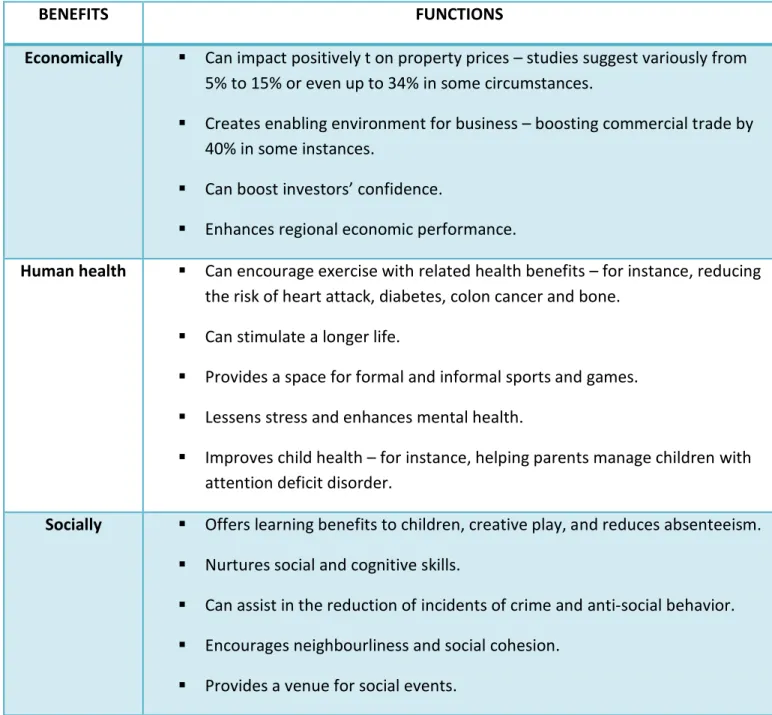
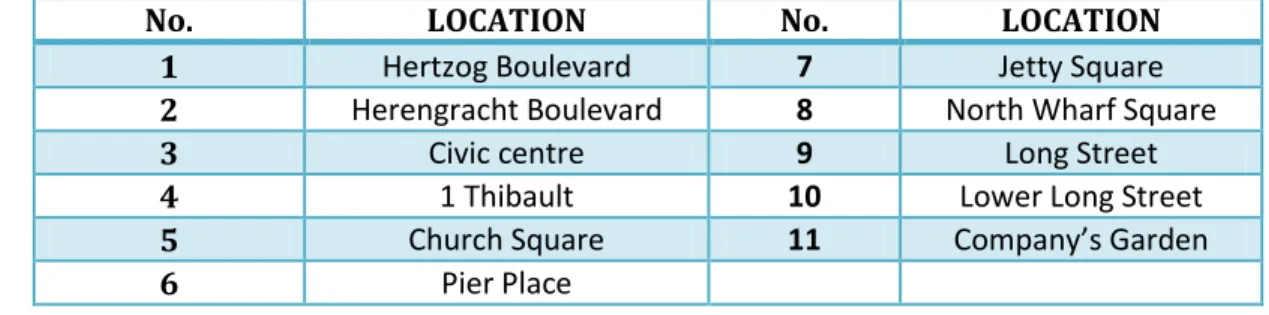
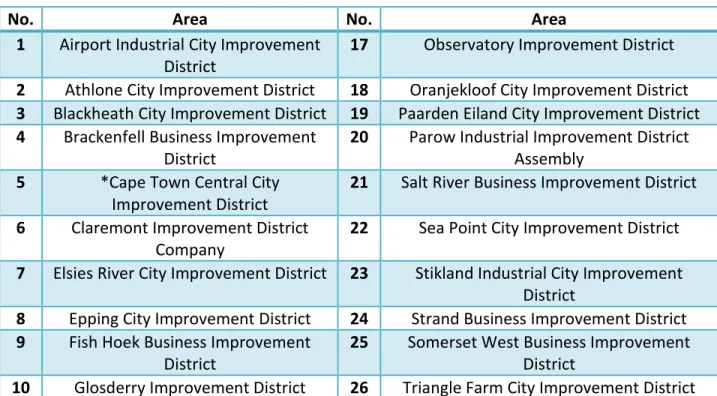
Using a qualitative research methodology, the study empirically attempted to identify the factors that contribute to privatization of public spaces. To achieve the stated objectives, the study examined 11 public spaces within the City of Cape Town's City Improvement Districts, using observational methods guided by Németh's index score sheet, and an interview schedule to gather information.
Research Background
In addition to POPS, another mechanism used in the management of public spaces is the Business Improvement Districts (BIDs) model, from which 'Friends of the park' emerges. While the financial sources of BIDs are the taxes levied on property owners, FOPs are largely funded through donations and participation in the management of public spaces (Murray, 2010).
Problem Statement
FOP is a group made up of residents of all ages and backgrounds with a common interest in the management of a local park. Zero tolerance policies such as the new form of restrictions endorsed in the CCIDs consider begging, vagrancy and street children as a threat to security (ibid.).
The Need for the Study
Research Hypothesis
Objectives of the Research
Questions to be answered in the Research
Organization of the Study
Page | 6 Chapter Seven: The chapter discusses limitations, summary of research findings, recommendations and conclusion of the study.
Scope of the Research
Introduction
Public Space
The Definitions of Public Space
Politically, public space is understood as an abstract space for public debate and reflects the strength of the political life of society (Houssay-Holzschuch, et al., 2009). From a judicial point of view, public space is defined as public land (land owned by public authorities) such as streets, squares, parks and gardens that fall under the domain of the government.
Types of Public Spaces
Neal (2010) added that from a legal point of view, public space seeks to answer the question of what is a public space and who pays for it. However, it seems that more often than not, discussions of public space tend to focus on what is outside.
The Role of Public Spaces in an Urban Environment
Kohn (2004) identifies ownership, accessibility and intersubjectivity as the three essential dimensions of public space. 2011) defines the intersubjectivity of a space as the type of interactions and chance encounters that a space can facilitate. Furthermore, Németh and Schmidt (2011) in their attempt to measure the public of a space identify ownership, management and use/users as the essential dimensions of public space.
Ownership of Public Spaces
Physical Configuration of Public Spaces
To make a place more public, the place must possess certain characteristics such as centrality and good connections, coupled with the ability to attract people; are visually permeable and connected to the public space outside the site itself and without explicit barriers, such as gates and fences; support and encouragement of animation, such as people's ability to sit, walk or actively interact with the environment (Varna, 2011). According to Gehl (1996), cited in Kelleci (2012), places with design features that support and encourage the use of space, mostly passive and active engagement and discovery, and exhibition are said to be 'more public' but 'less public'. ” when the design elements do not support or restrict/discourage the use of the space.
Animation of Public Spaces
However, Virahsawmy (2013) argues that the location of a place plays the most important role in terms of the public situation of a space, since a public space characterized by architectural elements with the aim of creating a good space may not serve. its purpose if it is not easily accessible to the public. Varna (2011) acknowledges that although every public space has its own particular characteristics and patterns of use, the main view is that a public space characterized by a variety of activities and often patronized by different groups of people is often said to that it is very public. while a public space which is deserted or sparingly used is less public.
Control of Public Spaces
Public spaces differ according to the degree of publicity they possess and exhibit: the greater the variety of people and activities that are permitted and manifested in the space, the greater its publicness. Page | 18 Németh and Schmidt (2011, p. 12) claim that "the greater the diversity of people and activities allowed and manifested in a space, the greater its public".
Civility in Public Spaces
Well connected and located within the movement system (on- . the beaten track); strong visual connection with external public realm beyond space; with implicits. Poorly connected/located within the locomotor system (outside the lane . lane); poor visual connection with external public realm; with explicit.
Historical Public Space: Greek Agora
Also, rights in the agora were strictly regulated, with only the privileged social group and a very limited number of people considered free. Hartley (1992), cited in Dray (2010), agrees with Mumford on the exclusive nature of the Greek agora, as the definition of citizenship did not include women, slaves or foreigners.
Contemporary Public Spaces
Betancourt (2011) attributes the shrinking nature of public spaces to the recent privatization of urban public spaces. Opponents of the privatization of public spaces complain about the exclusion of the poor from using public spaces.
South African Context: Apartheid and Post-apartheid Public Space
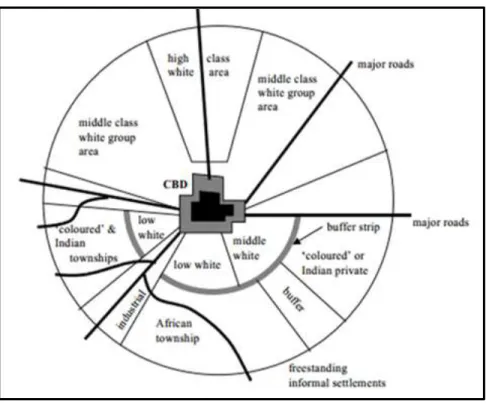
Inequality manifests, among other things, in the urban morphology of post-apartheid South African cities and towns. Furthermore, Landman and Ntombela (2006) raise concerns about the implication of the spatial trend in the post-apartheid era on the impact on the poor and their access to urban and well-developed areas as post-apartheid urban land forms persist. to assume exclusionary patterns that characterized apartheid land forms.
Conclusion
It is the focal point for the integration of strategic municipal spatial strategies in the areas of economy, physical infrastructure development, environment and society (eThekwini IDP Review. Although South Africa's constitution provides that ``every citizen has the right to enter, remain in and reside himself anywhere in the Republic'', one's ability to enjoy such a constitutional right depends mostly on affordability, and therefore people of equal social and economic standing are drawn together regardless of their racial background, and essentially there is the need for socio-economic integration beyond spatial integration.
Introduction
Definition of Concepts
- Privatization
- Globalization
- Neo-liberalism
- Modernism
- Post-modernism
Steel and Symes (n.d) cited in Murray (2010) argue that the spread of BIDs across the globe can be attributed to the dynamics that emerged in the social patterns of the latter half of the twentieth century. Page | 38 about forcibly removing the homeless from the inner city and dumping them in the outer part of the city (Dirk, Cape Times, July 20, 2016).
Conclusion
Post-modernism disregards universally accepted views, whether from the broader solutions embraced by comprehensive planning or from aesthetics of uniformity supported by modern architecture or any tendencies towards economic development (Goodchild, 1990). Post-modernism is stereotyped in that post-modernist cities are characterized by the growing segregation and inequality between social groups, with rising wealth for the few, as opposed to the many surviving on limited benefits.
Introduction
Contextual Analysis
Regional Context: City of Cape Town in National and Provincial Context
In a spatial and socio-economic sense, the city of Cape Town is no different from other South African cities. However, a major shift in the urban landscape of Cape Town occurred in 2014 and it is now considered a culturally diverse and dynamic city (The State of Cape Town, 2014).
Business Improvement District (BIDs)
South African Context: Business improvement Districts (BIDs)
The decline in urban centers contributed to a decline in office occupancy rates, culminating in a consumer shift from the wealthy and working class to the poor middle class that dominated the inner city (ibid). According to Heimann (2007), South Africa was the first country outside North America to introduce BID legislation, even though the concept was relatively new.
Legislative Framework of Public Spaces/Business Improvement Districts in South Africa 48
The CBD of the City of Cape Town is host to approximately 5286 residents with an estimated residential population growth of 76% between the years 2001 and 2010 due to the overall improvement of the area which has been enhanced with subsequent residential developments (South African Population Census, 2001 cited in The State of Cape Town Central City Report, 2012; The State of Cape Town Central City Report, 2013). The CBD has the highest concentration of economic activities within the Cape Town Municipality contributing up to 24.5% of business turnover to the entire Cape Town economy, and more than 30% of the city's employment sector (The state of Cape Town Central City Report, 2012, p.11).
Conclusion
Introduction
Research Approach
Sources of Data and Research Instruments
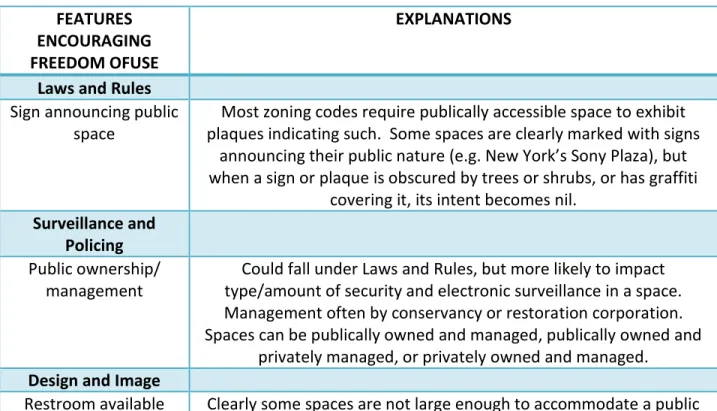
A total score is obtained by subtracting all marks obtained under "characteristics that discourage freedom of use" from the marks obtained under "characteristics that promote freedom of use". Signs, symbols, banners, umbrellas, plaques tied to the infrastructure of the space and not to immediate services (e.g. cafes, kiosks).
Sampling Techniques
Non-probability Sampling Technique
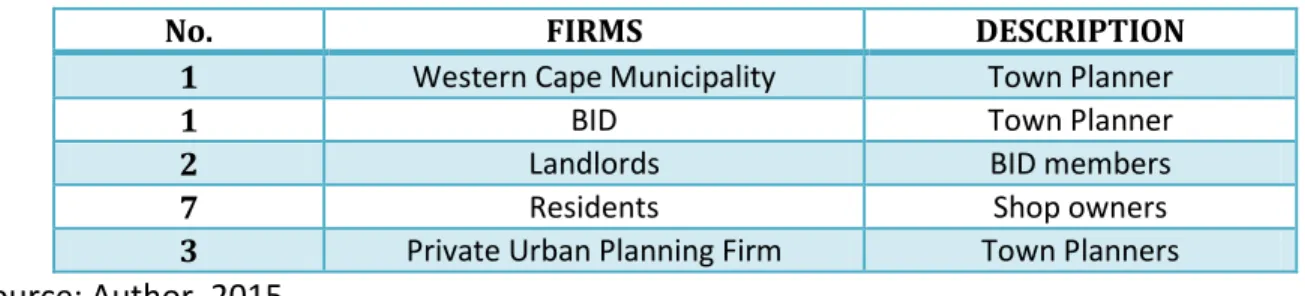
While some spaces are allowed to be closed at certain hours of the day, spaces that are not open 24 hours per se limit usage and clarity. Page | 57 In addition, a purposive type of sampling known as homogeneous sampling was used to select the public spaces listed in Table 7, as the main objective was to select public spaces with the same or similar characteristics.
Introduction
Presentation and Analysis of Interview
All CIDs in Cape Town are initiated by private property owners and are usually started by. Page | 60 on behalf of CID and it is used by CID to improve the subject area through the provision of additional services normally provided by the City Authority.
Situational Analysis of the Selected Public Spaces Using the Németh’s Index Scoring Sheet
Hertzog Boulevard
As with all CIDs/BIDs across the globe, the CIDs in Cape Town including the CCID are not private corporations but rather non-profit public-private partnership organisations. Furthermore, all CIDs, which have become an internationally recognized way of regenerating an urban area, are created to improve urban areas that have fallen victim to "crime and filth", resulting in urban flight to other suburbs and disinvestment in an area.
Herengracht Boulevard
The Fore Court of the Civic Centre
At the forecourt of the Civic Center Building, the Civic Centre's Knot of Red Tube Art provides a focal point, with the inscription on it indicating that it was commissioned in 1981 by Edoardo Daniele Villa, a notable South African sculptor of Italian descent. The square hosts a 35-storey modernist building, originally known as the BP Centre, which was recognized and recognized as one of South Africa's iconic buildings in 2008 by the South African Institute of Architecture (South African Property News Website, 2016).
Church Square
As a climax, eleven granite blocks were installed at the site, giving passers-by an indication of the names of some of the slaves traded in the square in the past (Cape Town Partnership Website, 2015). Currently the square is widely used by pedestrians (shown in the red circle, plate 10), camera crews (shown in the green circle, plate 11) and performance groups.
Pier Place
Jetty Square
The existence of the elegant bars and coffee shops around Jetty Square and Pier Place as well as their proximity to the center of the city's financial, commercial and publishing worlds make the areas more attractive. Consequently, from the researcher's observations, Jetty Square can be described as 'panoptic' space, a term coined by Jeremy Bantham and used by urban observers to qualify an environment saturated with various forms of security controls (Oc and Tiesdell, 2000 cited in Németh , 2009).
Lower Long Street
Long Street
In this sense, it can be concluded that Long Street is much safer and more attractive, as it often serves as a bohemian meeting place for most Capetonians. Page | 79 Plate 26: Invasion of public space and overuse of security (in red circle) in Long Street.
North Wharf Square
However, North Wharf Square is not easily seen as it is enclosed by buildings with public sidewalks. Source: http://za.hotels.com/ho239041/protea-hotel-north-wharf-cape-town-south-africa/ : Accessed February 2016.
The Company’s Garden
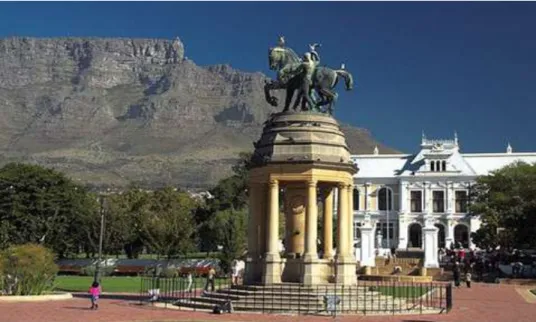
It is a symbol of the importance of water flow from Table Mountain and the origin of the Garden. According to Uys (2007), the use and activities of a space support the reason for its existence and contribute to the protection of the space.
Summary of the Score Sheet
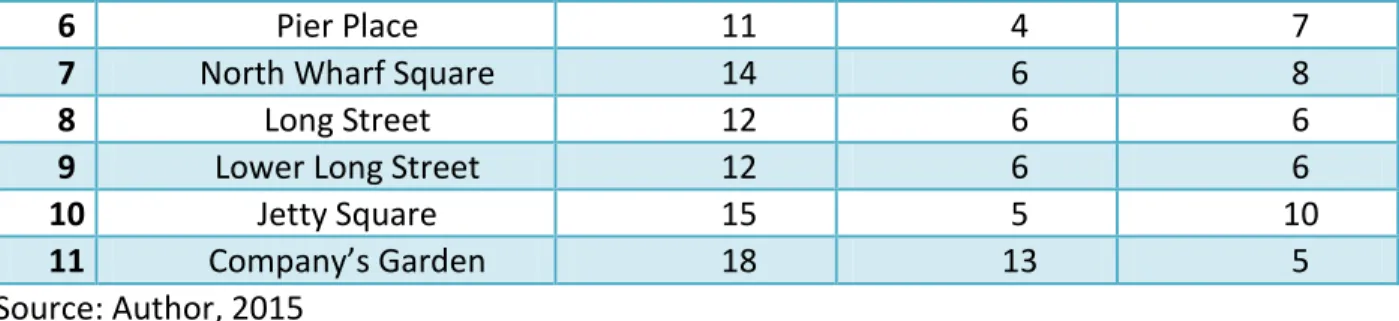
PUBLICITY SITUATION IN SOME SELECTED PUBLIC SPACES IN THE CAPE TOWN CENTRAL CITY IMPROVEMENT DISTRICTS. Page | 88 Graph 2: Overall score for the public situation of some selected public spaces in Cape Town's central urban improvement districts.
Conclusion
Introduction
Limitations to the Study
In addition, the researcher found that almost all selected public spaces attracted many users, especially Long Street from 5pm on Fridays and Saturdays. Relatively speaking, all public areas were quieter as most offices are not open on Sundays, with the exception of Long Street due to its restaurants and cafes and its location.
Summary of the Research Objectives and Findings
- Identified Characteristics of Privatized Public Spaces through BID Concept
- Contributory Factors to Privatization of Public Spaces
- Reasons Identified as to Why Government Privatize Public Spaces
- Reasons Identified as to Why Private Developers Invest In Public Spaces
The researcher found that governments often fall back on assisting private individuals through the BID or POP concept in providing and managing public spaces due to fiscal constraints. Meanwhile, NOCs that are ways of privatizing public spaces offer and manage urban open spaces in exchange for density bonuses and other incentives.
Recommendations
Further Studies
However, according to Hall (1998) cited in Carmona et al. (2008), commerce has been one of the main functions of public spaces throughout history and also in modern times. Therefore, it is recommended that future research be conducted to include commerce in the fundamental dimensions of public space.
Conclusion
Geography of fear: crime and the transformation of public space in post-apartheid South Africa. The Privatization of Public Space http://www.annaminton.com/privatepublicspace.pdf Accessed 10 June 2015.
Interview Schedule
How many properties are currently in your improvement district? (Depending on who is being interviewed). How does your City Improvement District (CID) work with the city or Depends on the person being interviewed).
Observation Schedule: Németh’s Index Scoring Sheet
The City of Cape Town Central Business District (in red)
The City of Cape Town Central City Improvement District
Page | 53 Interview schedule as indicated in appendix 1 was used in conducting the structured interview, while the index score sheet developed by Jeremy Németh as indicated in appendix 2 served as an observation schedule for studying and measuring the "publicity situation" of the randomly selected public spaces within the study area. Typically, the supplementary services provided are urban management functions that include public safety measures, cleaning services, infrastructure maintenance, environmental improvement and social services.
Tree lined at Herengracht Boulevard, Cape Town
A Statue Installation at Herengracht Boulevard, Cape Town
Page | 63 consists of a low Podium Block that houses the city government, while the 98-meter-high tower building with 26 floors (Emporis Website, 2016) houses the administrative offices of the municipality. The public space at the forecourt is less lively due to administrative purposes, but invites and encourages the free use of space due to design/visual elements such as diversity of seating, trees and good lighting systems.
The Civic Center Building in Cape Town
The Civic Centre's Knot of Red Tube Art
The Thibault Building and Sign Announcing a Public Space, Cape Town
The Skotness' Mythological Landscape Steel-and-bronze sculpture
Sadistic” Public Furniture with multiple arm rest at 1 Thibault Square
Sadistic Public Furniture type at 1 Thibault Square
The square was officially named "Kerplijn" on a map until the name was changed to Church Square in 1979 (Cape Town Partnership Website, 2015). With an outbreak of the smallpox epidemic in 1713 and 1755, the demarcation of the land of the square was reduced to provide space for a larger cemetery.
A Statue and ‘Slave’ Granite Blocks (in blue circle) at Church Square, Cape Town
A Camera Crew (in green circle) at Church Square, Cape Town
Life-like Statues (in red circle) and Private Security Guard (in blue circle) at Pier Place, Cape
Types of Bin (in red circles) and chairs at Pier Place
However, the site is characterized by two or more surveillance cameras as indicated in green circle on plate 14 and it is mostly monitored by private security patrols as shown on plate 16.
Fish Skeleton Structure (in red circle) and overtly use of CCTV (in green circle) at Jetty Square 71
Page | 71 pattern of stylized water eddies, designed by Diekie van Nieuwenhuizen to create a pixilated version of a microscopic pattern (RalphBorland.net, 2016 and Earthwork Landscape Architects Website, 2016).
Private Security Guard (in red circle) at Jetty Square
Cafés at the Jetty Square
Presence of small cafés, kiosks, carts or stands selling food, drinks at Jetty Square
The South African Revenue Service (SARS) Building
Private Security Post Stationed on Lower Long Street
Security Guard Personnel Stationed at Lower Long Street
Presence of Publicly Funded Police at Lower Long Street
Public funded Security at Lower Long Street
Secondary Security Personells type (in red circle) providing at Lower Long Street
Seating on the pedestrian walkway is mostly reserved for consumers, patronizing the bars and restaurants, a typical commodification of public spaces in contemporary public spaces. He claims that the dominant features of such public spaces include restaurants, bars and cafes that often encroach on public spaces, especially the pedestrian walkways.
A Victorian Architectural Building Style on Long Street
Uys (2007) argues that a street dominated by a row of shops is much safer and more attractive than a street with blank walls. Pedestrians are denied the right to sit unless they buy, as they cannot use the furniture on the pedestrian crossing unless they buy from restaurants or bars.
Invasion of Public Space and Excessive Security Usage (in red circle) on Long Street
Stationed Private Guard Post at Long Street
The use of a stationed BID security post, which Altman and Zube (2012) describe as permanent control, provides absolute control over the space. Such control measures ensure higher scores on the characteristics that discourage the free use of space.
Security Post (in red circle) stationed at North Wharf Square
Overt use of CCTV (in red circle) on Canal Walk at North Wharf Square
Seating at North Wharf Canal
The Protea North Wharf Hotel, Cape Town
The Southern Sun Collinan Hotel, Cape Town
Evidence of strict management control measures, including the use of surveillance cameras and legal measures to restrict users of the premises from activities such as loitering or disorderly behaviour, as shown in Plate 33, was readily apparent at the entrance to the premises. However, the impact of such control and design measures cannot be easily felt in the position of the public of the garden, as there are different activities and uses of the garden.
Disorderly behavioural control at the entrance of the Company’s Garden
Active control measures at the Company’s Garden, Cape Town
Installations at the Company's Garden, Cape Town
The politics of privatization of public space: the subsistence fishermen of Durban, KwaZulu-Natal (dissertation). Page | 103 http://www.capetownpartnership.co.za/old-programmes/public-space-for-public-life/thibault-square/.