UNIVERSITY OF KWAZULU-NATAL
MAPPING THE READINESS OF THE SOUTH AFRICAN INSURANCE INSTITUTION IN THE ADOPTION OF THE RETAIL DISTRIBUTION REVIEW
LEGISLATION: A CASE STUDY OF ABSA INSURANCE AND FINANCIAL ADVISORY, ABSA BANK
by
ROSEBUD NONDUMISO AMANDAH MCHUNU 9408185
A dissertation submitted in fulfilment of the requirements for the degree of Master of Business Administration
Graduate School of Business & Leadership College of Law and Management Studies
Supervisor: Dr W B Zondi
2016 I
DECLARATION
I, Rosebud Nondumiso Amandah Mchunu, declare that:
(i) The research stated in this dissertation, with the exception of where otherwise specified, is my original research.
(ii) This dissertation has not been submitted for any degree or examination at any other university.
(iii) This dissertation does not contain any other person’s data, pictures, graphs or other information, unless specifically acknowledged as being sourced from other persons.
(iv) This dissertation does not contain any other person’s writing, unless specifically acknowledged as being sourced from other researchers.
Where other written sources have been quoted, then:
a) their words have been re-written but the general information attributed to them has been referenced;
b) Where their exact words have been used, their writing has been placed inside quotation marks, and referenced.
(v) This dissertation does not contain text, graphics or tables copied and pasted from the Internet, unless specifically acknowledged, and the source being detailed in the dissertation and in the References section.
Signature:
Date:
II
ACKNOWLEDGEMENTS
I wish to express my sincere appreciation and gratitude to the following individuals, without whose assistance, this study would not have been possible:
a. My supervisor, Dr Wellington Bonginkosi Zondi, for his opinions, thoughts, guidance, understanding and support where I was falling short during this study.
b. My husband, Zipho and my children, Seneliso and Simangaliso who have encouraged and supported me for the past 3 years of study. They never complained about my absence at home.
c. My extended family whom I spent time away from while writing my dissertation, and who prayed for my safety on the many nights I studied on campus.
d. My formal and informal study (MBA 2016) group members for their support and encouragement during the challenging times over the past 3 years.
e. All my colleagues at ABSA who willingly participated in the study.
f. Miss Bongiwe Nyide for her input in analysing the data obtained from respondents and helping me with the proper referencing of the sources used in the literature review.
g. The editor, Dr Dorcas Ettang who edited this manuscript.
Finally, I would like to extend my heartfelt appreciation to the ABSA Leadership for approving the funds to undertake my MBA studies and for assisting me in various ways to ensure that I successfully complete my study.
iii
ABSTRACT
The Retail Distribution Review (RDR) legislation has commanded the attention of insurance institutions globally from the time it was first introduced in countries like the United Kingdom, United States and others in 2006. While the legislation was introduced with good intentions, the new regulatory atmosphere is likely to modify the distribution setting considerably; an outcome for which all insurers must adequately prepare for. With the introduction of the RDR legislation it is hoped that a refined new world of financial advice would prevail. This study focuses on the readiness towards the implementation of the RDR legislation in South Africa. The research was conducted within ABSA in KwaZulu-Natal Province. A case study of an ABSA division, namely Absa Insurance and Financial Advisory (AIFA) was investigated using a quantitative research method. The population of the study was made up of 96 advisers and they were all expected to attend the quarterly provincial meetings.
The questionnaire was used as the data collection technique for this study. The study was conducted during the quarterly provincial meetings in order to access all company advisers in one setting. A total of 73 advisers attended the meeting and all of them participated in the study. The findings from the study revealed that a significant number of advisers are aware of the RDR legislation and what it entails.
Based on the findings, the study concluded that, to a large extent, advisers with ABSA are not adequately prepared or ready for the implementation of RDR changes.
Furthermore, the study concluded that those advisers who are aware and prepared for the RDR changes achieved this through their individual efforts. The main recommendation of the study is that, there must be a deliberate effort by AIFA not only to make the advisers aware, but to also prepare and make them ready for the RDR changes. To that extent, AIFA must therefore provide a change leader whose main task will be to drive the readiness of advisers for this change.
iv
TABLE OF CONTENTS
DECLARATION ... II
ACKNOWLEDGEMENTS ... iii
ABSTRACT... iv
TABLE OF CONTENTS ... v
LIST OF TABLES ... ix
LIST OF FIGURES ... xi
CHAPTER 1: BACKGROUND AND OVERVIEW OF THE STUDY ... 1
1.1INTRODUCTION ... 1
1.2BACKGROUND ... 1
1.3PROBLEM STATEMENT ... 3
1.4JUSTIFICATION OF THE STUDY ... 5
1.5AIM OF STUDY ... 5
1.6OBJECTIVES OF THE STUDY ... 5
1.7RESEARCH QUESTIONS... 6
1.8SIGNIFICANCE OF THE STUDY ... 6
1.9SCOPE OF THE STUDY ... 7
1.10DEFINITION OF KEY TERMS ... 7
1.11CHAPTER OVERVIEW ... 8
1.12PILOT STUDY ... 9
1.13CONCLUSION ... 10
CHAPTER 2: LITERATURE REVIEW ... 11
2.1.INTRODUCTION ... 11
2.2THEORIES,MODELS AND FRAMEWORKS ON READINESS AND ORGANIZATIONAL CHANGE ... 11
2.3WHY THE NEED FOR ORGANISATIONAL READINESS?... 12
2.4CHANGE MANAGEMENT DEFINED ... 12
2.5THEORIES ON CHANGE MANAGEMENT ... 13
2.5.1 The ADKAR model ... 14
2.5.2 The Kotter’s 8-step model ... 14
2.5.3 Herscovitch and Meyers’ commitment to organizational change model ... 15
2.5.4 Lewin’s 3-Stage model of change ... 16
2.6APPROACHES TO CHANGE MANAGEMENT ... 17
2.7RESEARCH MODEL UNDERPINNING THE STUDY ... 19
2.8ORGANISATIONAL CHANGE MANAGEMENT ... 19
2.8.1 Communication creates Awareness and Insight ... 20
2.8.2. Sponsorship and Change Agents ... 22
v
2.8.3 Readiness as a measure of reality ... 24
2.9COMMUNICATION STRATEGIES ... 25
2.10TREATING CUSTOMER FAIRLY (TCF)FRAMEWORK... 26
2.10.1. The Retail Distribution Review - RDR Legislation ... 27
2.10.2 RDR Objectives and Delivery ... 29
2.11.THE NECESSITY FOR SOUTH AFRICAN INSURANCE TO CHANGE ... 31
2.11.1 Alignment with RDR ... 31
2.11.2. Awareness and Insight ... 32
2.11.3. Increase Readiness ... 32
2.12.IMPACTOFTHERDRINOTHERCOUNTRIES ... 33
2.12.1. The Scope and Size of the advisers and Firms ... 33
2.12.3. Adviser Professionalism ... 35
2.13.IMPACT OF RDR ON SOUTH AFRICAN INSTITUTIONS ... 35
2.13.1. Emotional Impact ... 35
2.13.2. Impact on Business models ... 36
2.14.POTENTIAL IMPACT OF RDR ON SOUTH AFRICAN ADVISERS ... 36
2.14.1. Independent versus Restricted ... 36
2.14.3. Adviser Numbers ... 37
2.14.4. Qualifications ... 38
2.14.5. Adviser Remuneration... 38
2.15.LESSONS LEARNT FROM OTHER COUNTRIES ... 38
2.15.1. Costs of servicing the client ... 39
2.15.2. New client servicing propositions: Client segmentation ... 39
2.16CONCLUSION ... 39
CHAPTER 3: RESEARCH METHODOLOGY ... 41
3.1INTRODUCTION ... 41
3.2RESEARCH DESIGN... 41
3.2.1 Selected research design... 42
3.3.THE RESEARCH METHODOLOGY ... 43
3.3.1. The Qualitative research methodology ... 43
3.3.2. Quantitative research Methodology ... 43
3.3.3. Mixed research Methodology ... 44
3.3.4. Selected Research Methodology for this study ... 44
3.4.LOCATION OF THE STUDY ... 44
3.5.POPULATION AND SAMPLE OF THE STUDY ... 45
3.6.SAMPLING STRATEGY ... 45
3.6.1. Defining the Population ... 45
3.6.2 Determining the Sample frame ... 46
3.6.3 Determining the sampling design ... 46
3.6.4 Non-probability sampling ... 47
vi
3.6.5 Sampling Technique Selected ... 48
3.7DATA COLLECTION INSTRUMENTS ... 49
3.7.1 Observation ... 49
3.7.2 Interviews ... 49
3.7.3 Use of available information ... 49
3.7.4. Written Questionnaire ... 50
3.8CONSTRUCTION OF THE RESEARCH INSTRUMENT ... 50
3.9ADMINISTRATION OF THE RESEARCH INSTRUMENT ... 51
3.10PILOT STUDY ... 51
3.11DATA ANALYSIS AND INTERPRETATION ... 51
3.12ISSUES OF RELIABILITY AND VALIDITY ... 52
3.13ETHICAL ISSUES ... 53
3.14LIMITATIONS OF THE STUDY ... 54
3.15CONCLUSION ... 54
CHAPTER 4: DATA PRESENTATION AND ANALYSIS ... 55
4.1INTRODUCTION ... 55
4.2CRONBACH RELIABILITY TEST ... 55
4.3DEMOGRAPHIC INFORMATION ... 56
4.3.1 Gender ... 56
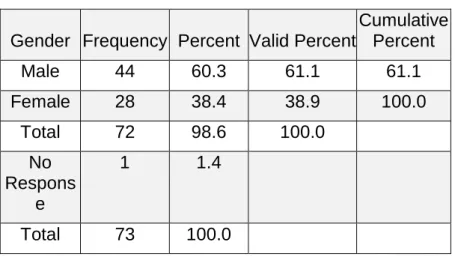
TABLE 3:GENDER OF RESPONDENTS... 56
FIGURE 1:GENDER OF RESPONDENTS ... 57
4.3.2AGE ... 57
TABLE 4:AGE OF RESPONDENTS ... 57
FIGURE 2:AGE OF RESPONDENTS ... 58
4.3.3 Occupation ... 58
TABLE 5:OCCUPATION OF RESPONDENTS ... 58
FIGURE 3:OCCUPATION OF RESPONDENTS ... 59
4.3.4MARITAL STATUS ... 59
FIGURE 4:MARITAL STATUS OF RESPONDENTS ... 60
4.3.5ACADEMIC QUALIFICATIONS ... 60
4.4RESPONSES TO QUESTIONNAIRE ... 61
4.4.1 Knowledge of RDR Legislation ... 61
4.4.2 RDR Knowledge through Reading ... 62
4.4.3 RDR Knowledge through Workshops and Training ... 63
4.4.4 Understanding RDR impact on Remuneration... 64
4.4.5 Awareness on level of education in RDR Legislation ... 66
4.4.6 Status on Qualifications required by RDR Legislation ... 67
4.4.7 How Remuneration Model Works ... 68
4.4.8 Fee Based Remuneration Model ... 69
4.4.8 Commission based remuneration model ... 70
vii
4.4.9 Understanding AIFA’s Strategy ... 71
4.4.10 Key Components of RDR Legislation ... 72
4.4.11 RDR Proposal Alignment with Strategic Goals ... 74
4.4.12 ATOM Journey and Implementation of RDR Legislation ... 75
4.4.13 Potential Resistance to the RDR ... 76
4.4.14 Potential system Barriers to the Implementation of the RDR ... 77
4.4.15 Change Strategy for RDR Implementation ... 78
4.4.16 AIFA’S Schedule Action Plan ... 80
4.4.17 RDR Change Leader ... 81
4.4.18 Leadership for Change... 82
4.4.19 Cross-Tabulation ... 83
4.5CONCLUSION ... 94
CHAPTER 5: DISCUSSION ON THE RESEARCH FINDINGS AND RECOMMENDATIONS ... 94
5.1INTRODUCTION ... 94
5.2REVIEW OFAIFA’S STRATEGY ... 95
5.2.1 AIFA’s Strategic Approach ... 96
5.2.3 AIFA’s Business before the Formulation of ATOM Strategy ... 97
5.2.4 AIFA’s goal of Implementing ATOM ... 97
5.2.5 AIFA’s House Solution ... 98
5.3.ANSWERS TO THE RESEARCH QUESTIONS ... 102
5.3.1 To what extent are financial advisers at ABSA aware of the changes brought about by the RDR legislation? ... 102
5.3.2 To find out the impact of the RDR legislation to financial advisers ... 103
5.3.3 Does the AIFA strategy mitigate the consequence of implementing RDR’s key components? ... 103
5.3.4 What gaps exist in the AIFA strategy and what recommendations can be proposed to address them?... 104
5.4ANALYSIS,DISCUSSION,IMPLICATIONS AND CONCLUSIONS ... 105
5.5RECOMMENDATIONS ... 110
5.6FUTURE RESEARCH DIRECTION ... 111
5.7CONCLUSION ... 111
REFERENCES ... 112
APPENDICES ... 118
APPENDIX 1: LETTER OF INFORMED CONSENT... 118
APPENDIX 2: ETHICAL CLEARANCE ... 120
APPENDIX 3: GATEKEEPERS LETTER ... 121
APPENDIX 4: RESEARCH INSTRUMENT ... 122
viii
LIST OF TABLES
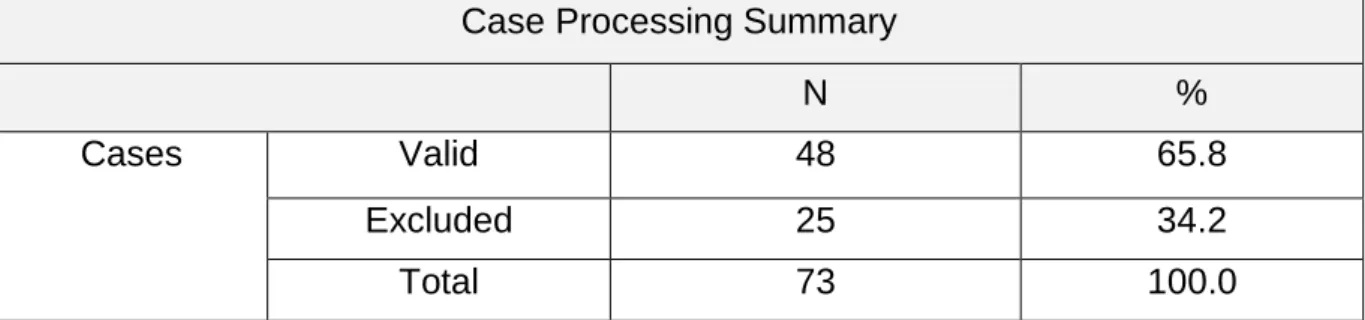
TABLE 1:FREQUENCY TABLE SHOWING CASE PROCESSING SUMMARY AND RELIABILITY STATISTICS ... 55
TABLE 2:RELIABILITY STATISTICS ... 56
TABLE 3:GENDER OF RESPONDENTS... 56
TABLE 4:AGE OF RESPONDENTS ... 57
TABLE 5:OCCUPATION OF RESPONDENTS ... 58
TABLE ... 59
6:MARITAL STATUS OF RESPONDENTS ... 59
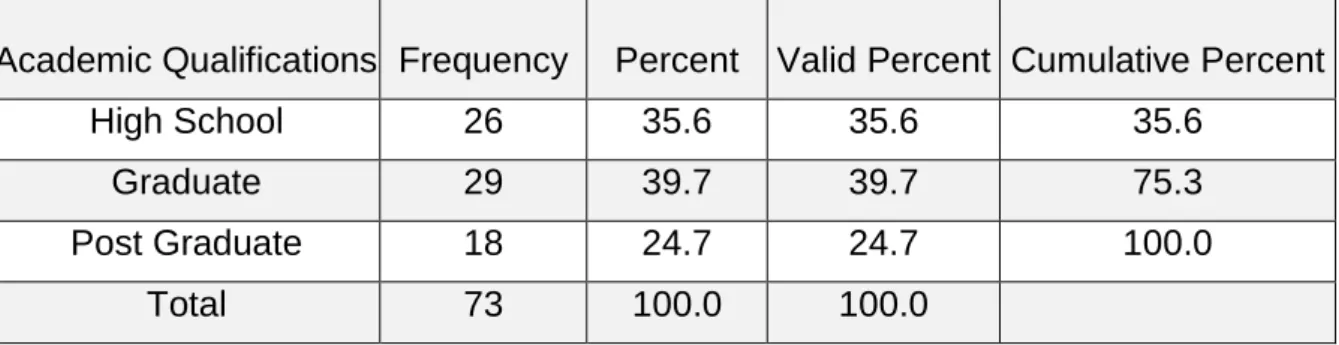
TABLE 7:ACADEMIC QUALIFICATIONS OF RESPONDENTS ... 60
TABLE 8:FREQUENCY TABLE SHOWING WHETHER OR NOT RESPONDENTS HAVE KNOWLEDGE OF THE RULES PROPOSED BY RDRLEGISLATION ... 61
TABLE 9:FREQUENCY TABLE SHOWING WHETHER OR NOT RESPONDENTS GAINED KNOWLEDGE ABOUT RDR THROUGH MY OWN READING ... 62
TABLE 10:FREQUENCY TABLE SHOWING WHETHER OR NOT RESPONDENTS GAINED KNOWLEDGE ABOUT RDR THROUGH WORKSHOPS AND TRAINING FROM THEIR ORGANISATION ... 64
TABLE 11:FREQUENCY TABLE SHOWING WHETHER OR NOT RESPONDENTS UNDERSTAND HOW RDR COULD IMPACT THEIR REMUNERATION MODEL THEY HAVE KNOWLEDGE REGARDING A CLEAR DISTINCTION IN THE TYPE OF ADVICE ... 65
TABLE 12: FREQUENCY TABLE SHOWING WHETHER OR NOT RESPONDENTS ARE AWARE OF THE LEVEL OF EDUCATION REQUIRED IN THE PROPOSED RULES OF RDRLEGISLATION... 66
TABLE 13:FREQUENCY TABLE SHOWING WHETHER OR NOT RESPONDENTS HAVE QUALIFICATIONS NECESSARY TO PRACTICE AS THE FINANCIAL ADVISER AS REQUIRED BY RDRLEGISLATION IN THE FUTURE ... 67
TABLE 14:FREQUENCY TABLE SHOWING WHETHER OR NOT RESPONDENTS KNOW HOW REMUNERATION MODEL WORKS ... 68
TABLE 15: FREQUENCY TABLE SHOWING WHETHER OR NOT RESPONDENTS ARE ON A FEE BASED REMUNERATION MODEL ... 69
TABLE 16: FREQUENCY TABLE SHOWING WHETHER OR NOT RESPONDENTS ARE IN A COMMISSION BASED REMUNERATION MODEL ... 71
TABLE 17:FREQUENCY TABLE SHOWING WHETHER OR NOT RESPONDENTS UNDERSTAND AIFA’S STRATEGY ... 72
TABLE 18:FREQUENCY TABLE SHOWING WHETHER OR NOT RESPONDENTS THINK THAT THE AIFA STRATEGY ADDRESSES THE KEY COMPONENTS OF RDR LEGISLATION ... 73
TABLE 19:FREQUENCY TABLE SHOWING WHETHER OR NOT RESPONDENTS THINK THAT RDR PROPOSALS ARE ALIGNED WITH THE STRATEGIC GOALS OF MY ORGANISATION ... 74
TABLE 20:FREQUENCY TABLE SHOWING WHETHER OR NOT RESPONDENTS THINK THAT THE ATOM JOURNEY HAS BEEN ABLE TO MITIGATE THE RESULTS OF IMPLEMENTING RDRLEGISLATION ... 75
TABLE 21:FREQUENCY TABLE SHOWING WHETHER OR NOT RESPONDENTS THINK THAT THERE IS POTENTIAL RESISTANCE TO THE RDR THAT MAY BE EXPERIENCED IN THEIR ORGANISATION ... 77
ix
TABLE 22: FREQUENCY TABLE SHOWING WHETHER OR NOT RESPONDENTS THINK THAT THERE WILL BE POTENTIAL SYSTEM BARRIERS THAT WILL HINDER THE IMPLEMENTATION OF THE RDR IN THEIR ORGANISATION ... 78 TABLE 23: FREQUENCY TABLE SHOWING WHETHER OR NOT RESPONDENTS ARE AWARE OF THE CHANGE STRATEGY OR METHODS WHICH WILL BE USED WHEN IMPLEMENTING THE RDR TO PROMOTE OWNERSHIP IN MY ORGANISATION ... 79 TABLE 24: FREQUENCY TABLE SHOWING WHETHER OR NOT RESPONDENTS KNOW OF AIFA’S SCHEDULE ACTION PLAN IN PREPARING FOR THIS UPCOMING RDR CHANGE ... 80 TABLE 25:FREQUENCY TABLE SHOWING WHETHER OR NOT RESPONDENTS ARE AWARE OF THE RDR CHANGE LEADER FOR THEIR ORGANISATION ... 81 TABLE 26:FREQUENCY TABLE SHOWING WHETHER OR NOT RESPONDENTS ARE AWARE OF LEADERSHIP THAT WILL EFFECTIVELY MANAGE THE CHANGE OF THE RDR LEGISLATION DURING IMPLEMENTATION ... 82
x
LIST OF FIGURES
FIGURE 1:GENDER OF RESPONDENTS ... 57
FIGURE 2:AGE OF RESPONDENTS ... 58
FIGURE 3:OCCUPATION OF RESPONDENTS ... 59
FIGURE 4:BAR CHART SHOWING MARITAL STATUS OF RESPONDENTS ... 60
FIGURE 5:ACADEMIC QUALIFICATIONS OF RESPONDENTS ... 61
FIGURE 6:BAR CHART SHOWING WHETHER OR NOT RESPONDENTS HAVE KNOWLEDGE OF THE RULES ... 62
PROPOSED BY RDRLEGISLATION ... 62
FIGURE 7:BAR CHART SHOWING WHETHER OR NOT RESPONDENTS GAINED KNOWLEDGE ABOUT ... 63
RDR THROUGH THEIR OWN READING ... 63
FIGURE 8:BAR CHART SHOWING WHETHER OR NOT RESPONDENTS GAINED KNOWLEDGE ABOUT ... 64
RDR THROUGH WORKSHOPS AND TRAINING FROM THEIR ORGANISATION ... 64
FIGURE 9:BAR CHART SHOWING WHETHER OR NOT RESPONDENTS UNDERSTAND HOW RDR COULD ... 65
IMPACT THEIR REMUNERATION MODEL THEY HAVE KNOWLEDGE REGARDING A CLEAR DISTINCTION IN ... 65
THE TYPE OF ADVICE ... 65
FIGURE 10:BAR CHART SHOWING WHETHER OR NOT RESPONDENTS ARE AWARE OF THE LEVEL OF ... 67
EDUCATION REQUIRED IN THE PROPOSED RULES OF RDRLEGISLATION... 67
FIGURE 11:BAR CHART SHOWING WHETHER OR NOT RESPONDENTS HAVE QUALIFICATIONS NECESSARY TO PRACTICE AS THE FINANCIAL ADVISER AS REQUIRED BY RDRLEGISLATION IN THE FUTURE ... 68
FIGURE 12: BAR CHART SHOWING WHETHER OR NOT RESPONDENTS KNOW HOW REMUNERATION MODEL WORKS ... 69
FIGURE 13: BAR CHART SHOWING WHETHER OR NOT RESPONDENTS ARE IN A FEE BASED REMUNERATION MODEL ... 70
FIGURE 14: BAR CHART SHOWING WHETHER OR NOT RESPONDENTS ARE IN A COMMISSION BASED REMUNERATION MODEL ... 71
FIGURE 15:BAR CHART SHOWING WHETHER OR NOT RESPONDENTS UNDERSTAND AIFA’S STRATEGY ... 72
FIGURE 16: BAR CHART SHOWING WHETHER OR NOT RESPONDENTS THINK THAT THE AIFA STRATEGY ADDRESSES THE KEY COMPONENTS OF RDR LEGISLATION ... 73
FIGURE 17: BAR CHART SHOWING WHETHER OR NOT RESPONDENTS THINK THAT RDR PROPOSALS ARE ALIGNED WITH THE STRATEGIC GOALS OF THEIR ORGANISATION ... 75
FIGURE 18:BAR CHART SHOWING WHETHER OR NOT RESPONDENTS THINK THAT THE ATOM JOURNEY ... 76
HAS BEEN ABLE TO MITIGATE THE RESULTS OF IMPLEMENTING RDRLEGISLATION ... 76
FIGURE 19:BAR CHART SHOWING WHETHER OR NOT RESPONDENTS THINK THAT THERE IS POTENTIAL ... 77
RESISTANCE TO THE RDR THAT MAY BE EXPERIENCED IN THEIR ORGANISATION ... 77
FIGURE 20:BAR CHART SHOWING WHETHER OR NOT RESPONDENTS THINK THAT THERE WILL BE ... 78
POTENTIAL SYSTEM BARRIERS THAT WILL HINDER THE IMPLEMENTATION OF THE RDR IN THEIR ... 78
ORGANISATION ... 78
FIGURE 21:BAR CHART SHOWING WHETHER OR NOT RESPONDENTS ARE AWARE OF THE CHANGE ... 79
xi
STRATEGY OR METHODS WHICH WILL BE USED WHEN IMPLEMENTING THE RDR TO PROMOTE ... 79
OWNERSHIP IN MY ORGANISATION ... 79
FIGURE 22:BAR CHART SHOWING WHETHER OR NOT RESPONDENTS KNOW OF AIFA’S SCHEDULE ... 81
ACTION PLAN IN PREPARING FOR THIS UPCOMING RDR CHANGE ... 81
FIGURE 23:BAR CHART SHOWING WHETHER OR NOT RESPONDENTS ARE AWARE OF THE RDR ... 82
CHANGE LEADER FOR THEIR ORGANISATION ... 82
xii
CHAPTER 1: BACKGROUND AND OVERVIEW OF THE STUDY
1.1 Introduction
This chapter presents the background of the study. It also introduces the problem statement, the aim of the study as well as the research objectives and questions.
The significance of the study will be clarified and lastly this chapter will present the scope of the study indicating what each of the subsequent chapters entail.
1.2 Background
South African Insurance institutions have employed different strategies informed by the enhancement of the legislation as well as changes in the economy. The Financial Services Board (FSB) regulates the activities and practices of the financial industry by introducing certain legislations that continuously regulate the activities of the banking and insurance industries. It is important that financial institutions are able to anticipate the implications which could be brought about by the enhancement in legislation, and be able to prepare accordingly, guided by the requirements that are governing that change. What normally encourages changes or enhancement of the legislation is the practices and the behaviours which are viewed by the authorities to be a disadvantage to clients while the adviser gains or vice versa.
The Retail Distribution Review (RDR) legislation is about to be introduced to insurers and it is left to be tested whether they are taking the warning of the FSB seriously in reaction to this new regulation. The RDR Legislation came into being in 2006 in the United Kingdom (UK), United States (US) and Australia but the actual implementation started years later in 2013.
A study conducted by Core Data in South Africa titled “Adapt or Die “is of relevance to this study. The research findings from that study revealed that despite the obvious concerns brought about by the requirements of the legislation, it seems many South African intermediaries are not completing the necessary adjustments to their business model in anticipation of the far-reaching changes in the industry globally (Core Data, 2013). Furthermore, the study revealed that there is a general absence
1
of preparation ahead of the RDR in South Africa, which could leave many advisers lacking when the legislation comes into effect (Core Data, 2013). It is therefore imperative that a test is done following the latter study to see if institutions like Absa Insurance and Financial Advice (AIFA), an insurance division of Absa bank are prepared to embrace the RDR regulation requirements.
In 2006, the Financial Services Authority (FSA) publicized the RDR for the first time.
The review was initiated by the FSA to address the existing challenges within the retail investment and advisory industries which have affected the value of advice and consumer effects (FSB, 2014). The financial service sector in South Africa is expected to be preparing for the RDR legislation. The RDR aims to make sure that customers are treated fairly when purchasing financial products, specifically, the insurance products. This is an initiative of the Financial Services Board (FSB). This legislation, already implemented fully in countries like the UK, US and Australia, has been found to create anomalies resulting in benefits as well as disadvantages to some firms and advisers. On that basis, this study will refer to the experiences in these countries. It has been stated that in the UK, the number of advisers reduced from 47000 in the year 2010 to 32000 in 2014. Due to this, some South African advisers have raised concerns regarding the possibility of advisers leaving the industry (Burns, 2015)
The legislation aims to ensure that financial advisers are transparent when offering advice in terms of how they will be charging their customers and what services will be included in their fees. This model will provide customers with a clear understanding of the fees that they pay, and the value derived from paying those fees for the services and products offered to them. There is also an emphasis on the high level of professionalism received from respective advisers (FSB, 2014).
The current remuneration model in most insurance institutions is commission based and some service providers pay commission to advisers upfront. Most advisers would sell products which will pay them the highest commission, a product which may not necessarily address the needs of customer/s entirely. The UK regulator’s focus was on investment products only, whereas the South African regulator which is the Financial Services Board (FSB) has proposed RDR regulation which includes advice on investment, risk as well as short term insurance products (Burns, 2015).
2
This goes to show that the South African regulator wants to leave no stone unturned.
This could also mean an impact in the South African insurance industry compared to UK and other foreign countries; hence, the South African insurance industry needs to check their strategic intent and activities if it is to build up towards the RDR proposed legislation requirements. The structure of the financial services distribution landscape in South Africa is categorized by a broad range of distribution models.
These are made up of various types of services delivered by intermediaries, relationships amongst product suppliers and intermediaries and intermediary remuneration models (FSB, 2014). Absa is one of many financial service institutions that distribute insurance products through financial advisers and financial planners.
The financial advisers are intermediaries who are allowed to carry and sell products from more than one approved service provider, referred to as Multi-tied, whereas financial planners are allowed to carry and sell products for Absa bank only, referred to as Tied.
In June 2012, AIFA, an insurance division for Absa bank, started an Adviser Target Operating Model (ATOM) journey. The ATOM is aimed at transforming the business, which was governed by the Independent Financial Adviser (IFA), into an institutionalized model (AIFA Executive, 2014). Before the introduction of the ATOM, the IFA model was characterised by the absence of a central hub and brokers solely controlled and managed their operations and the client’s fate. In addition, client’
views and perspectives were missing and there were low levels of trust amongst brokers and between brokers and bankers. There was very little training provided for brokers, hence, an inadequate level of professionalism which resulted in numerous losses due to claims for compensation. It is necessary therefore to look at the main building blocks of the RDR legislation as far as its expected outcomes are concerned and establish if the ATOM journey is in line with the RDR legislation requirements.
1.3 Problem Statement
The implementation of the RDR legislation is aimed at changing the distribution setting of the insurance industry in South Africa. A study conducted by Core Data (2013) in South Africa titled “Adapt or Die” revealed that despite the obvious concerns brought about the requirements of the legislation, it seems many South
3
African intermediaries are not making required groundwork to their business model in anticipation of the winds of revolution which are far-reaching in the industry globally (Core Data, 2013). Furthermore, the study revealed that there is a general absence of preparation ahead of the RDR under way in South Africa, which is possible to leave many advisers caught short when the legislation comes into effect (Core Data, 2013). The latter revelation by Core Data implies that ABSA as one of the financial institution which has an insurance division, may be ready for this change brought about by RDR legislation.
Another study, conducted by Clare, Thomas, Walgama & Makris (2013) in the United Kingdom (UK), revealed that, the number of UK advisors dwindled down from 40 000 in 2011 to around 20 000 in 2013 following the implementation of RDR. Other challenges noted by the firm (Clare et al. 2013) included:
a. determining the cost of servicing clients, b. setting up new client servicing propositions, c. establishing the potential revenue scenarios, and
d. considering the various operational changes that were necessary such as transitioning clients to new unit classes
According to EPL (2011), a central theme in all the FSA’s RDR consultancy papers, is that all parties that come under the radar of the RDR (Banks, IFAs, WMCs, Product Providers) must make sure that their prices for products and services are reasonable, understood and clear to the consumer (EPL, 2011). This should be a stark reminder to the South African industry and in particular ABSA insurance and financial advisory to prepare for RDR. Recent findings by Core Data Research South Africa (2013) showed that less than half of South African financial advisors are prepared for changes that are likely to come from the RDR. Of those surveyed, only 12.8% currently work on a fee-based model that would require no adjustment post- RDR (Core Data, 2013). Several authors such as Nagendran, Parkes and Vincent (2015) and Blackrock (2012) are of the opinion that these issues will be just as pertinent in South Africa; hence, readiness for change is tested at ABSA which is one of the South African insurance distributions.
4
1.4 Justification of the Study
The claim made by Core Data (2013) indicated that the introduction of the RDR legislation in South Africa could be problematic since some insurance institutions may have failed to prepare adequately, hence creating a need to investigate an untested theory. While the study is based on a case study of Absa’s division, its findings will benefit other financial service providers as well, since the legislation may be applied across the board. It must be noted that some of the financial advisers that participated in the study provide services to more than one financial institution. With particular reference to Absa, its leadership may make use of the knowledge and recommendations made in the study to shape the strategy and close the gaps which may still exist.
1.5 Aim of Study
The purpose of this study is to determine the extent to which Absa’s division, AIFA, is ready to implement the Retail Distribution Review (RDR) legislation. This will be done by examining the objectives of the study as stated below (section 1.6.).
Furthermore, the aim of the study will be achieved by focusing on how AIFA has been able to implement the components of its Advisor Targeting Operating Model (ATOM). The main goal of the model is to transform the business in preparation for the implementation of the RDR changes.
1.6 Objectives of the Study
This study will:
a. Identify the level of awareness of Absa financial advisers on the changes brought about by the RDR legislation.
b. Establish if the AIFA strategy mitigates the consequence of implementing RDR’s key components.
c. Find out the impact of the RDR legislation to financial advisers
d. Make recommendations that could help address the gaps identified by the previous objectives.
5
1.7 Research Questions
The following research questions will be explored by this study:
a. To what extent are financial advisers at Absa aware of the changes brought about by the RDR legislation?
b. Does the AIFA strategy mitigate the consequence of implementing RDR’s key components?
c. What impact do ABSA financial advisers believe the RDR changes will have on their work?
d. What gaps exist in the AIFA strategy and what recommendations can be proposed to address them?
1.8 Significance of the Study
This study conducts an analytical investigation into the readiness of South African insurance institutions for the RDR Legislation. The investigation will create an opportunity to explore the core requirements of the RDR legislation. The current ATOM journey which AIFA is embarking on will also be investigated in line with the requirements of the legislation. The knowledge acquired during the investigation will be applied when AIFA’S ATOM journey is examined. The knowledge gained will be applied to AIFA, an insurance division of Absa bank. This will provide in depth insight which can be beneficial to the bank.
The opportunities which the legislation brings will be identified, for example, there might be a need for advisers to deepen their knowledge through studying towards acquiring relevant qualifications. This new knowledge, gained through a combination of theory and practice, may improve the level of professionalism in the institution.
Identifying the gaps of the ATOM could give Absa’s senior management an opportunity to review and address the identified gaps sooner than later. The results may therefore influence the application of the ATOM and be used to plan interventions that are beneficial to AIFA.
The findings of the outcome may also be used as the building blocks of the strategic objectives of AIFA prior and post RDR implementation, for example, the
6
remuneration model of AIFA would need to be shifted away from commission to fees if not done already. This change may challenge the status quo of the current policy and may call for a review of current strategies. It is expected that problems will be identified and will require solutions in view of the need to change in line with the requirements of the RDR. The result of this research will provide an opportunity to explore different solutions and start change management initiatives so as to thoroughly prepare for the realities of the RDR legislation.
1.9 Scope of the Study
The total population of AIFA advisers in South Africa is approximately 774, all of whom could not participate in the study due to time and budgetary constraints. In addition, the researcher is based in the province of KwaZulu-Natal (KZN), thus it was convenient to conduct the study there. As a result, the 96 financial advisors based in KZN made up the population of the study. The researcher’s timing of data collection was aligned with the quarterly meeting that all the 96 financial advisers had to attend. Of the 96 only 73 advisers attended and participated in the study. It must be stated that all regional branches in the province were represented therefore the scope of the study could be deemed as covering the entire province. The study was of an exploratory nature since there was little information on the actual readiness of financial advisers and AIFA for the changes the RDR will bring.
1.10 Definition of Key Terms
a. Advisory Intermediary Financial Advice (AIFA): a division of wealth, investment and insurance (WIMI) distribution at ABSA (AIFA Executive, 2014).
b. Adviser Target Operating Model (ATOM): an institutionalized model of AIFA.
(AIFA Executive, 2014)
c. Financial Services Authority (FSA): an independent, non-governmental entity that receives its statutory powers through the Financial Services and Markets Act of 2000. (Investopedia, n.d.).
d. Financial Services Board (FSB): an independent institution established by statute to oversee the South African Non-Banking Financial Services Industry for the
7
interest of the public. Its mission and vision are to promote and maintain a sound financial investment in South Africa (FSB, 2014).
e. Intermediary: a firm or person who acts as a mediator or a link between parties to a business deal, investment decision or negotiation (Investopedia, n.d.).
f. QCF4 Qualification: a new qualification and credit framework which has replaced the National Qualification Framework (NQF) (Investopedia, n.d.).
g. Retail Distribution Review: a new set of rules that were enforced in the UK in early 2013. The rules were aimed at introducing more transparency and fairness in the investment industry (Financial Times, n.d.)
1.11 Chapter Overview
This dissertation is divided into five chapters. The outline of each chapter is presented below:
a. Chapter 2: Literature Review and Theoretical Framework
This chapter starts by introducing the current distribution landscape of financial insurance in South Africa, explaining how the current set-up looks like coupled with current practices in the insurance industry. The researcher highlights the Treating Customer Fairly (TCF) Framework as the origin of the RDR and other legislation under the TCF umbrella before unpacking the proposed Retail Distribution Review (RDR) legislation and the change that is expected in the South African insurance sector. This change which is still in the proposal stage in SA, has already been implemented in foreign countries like the UK, thus, the researcher discusses its impact on these countries. The researcher further introduces the research model used in this study to establish the readiness of South African insurance institutions in implementing the RDR legislation. Lastly the researcher unpacks the strategy for AIFA to test the readiness of insurance companies in implementing this change.
8
b. Chapter 3: Research Methodology
In this chapter, the researcher presents the research design and research methods used in this study. This includes a brief discussion of the different types of research methodologies, namely: qualitative, quantitative and mixed methods. Subsequently, the chapter examines the selected research methodology and the rationale for its selection. The chapter also focuses on the location of the study, the population and sampling strategy; the application of the data collection instrument; the pilot study;
issues of validity and reliability; and lastly ethical issues in relation to the study.
c. Chapter 4: Data Presentation and Analysis
The researcher introduces and presents the data using frequency tables, pie charts and bar charts. The first section of the chapter presents the reliability test, which is presented in the form of frequency tables. This is then followed by the presentation of the demographic information namely, age, gender, occupation, marital status and level of academic qualification. Demographic information spread is shown in both the frequency tables and pie charts. The last section of the chapter presents and categorizes the responses of participants in terms of their level of agreement and disagreement.
d. Chapter 5: Discussion on the research findings and recommendations In this chapter, the researcher responds to the research questions outlined in Chapter One. These responses are based on the literature reviewed in this dissertation and the findings emerging from the data obtained from respondents.
This is followed by discussions and a conclusion drawn from a holistic view of the study. The recommendations and further studies are proposed in the last two sections of this chapter.
1.12 Pilot Study
A pilot study was conducted by selecting 4 employees in the office and giving them questionnaires to complete. This was done to determine the level of effort in
9
completing the questionnaire and to assess if there would be issues when a larger group of respondents complete the questionnaire.
1.13 Conclusion
This chapter has been able to provide the background and overview of the study. It clearly indicated the aim, objectives and research questions that inform the study.
More importantly the chapter provided the problem statement, the selected population, and the significance of the study to Absa and its employees.
Furthermore, the researcher indicated the type of research instrument that was employed and how it was tested.
10
CHAPTER 2: LITERATURE REVIEW
2.1. Introduction
In this chapter, the researcher introduces and discusses key theories, models and frameworks on readiness and organizational change. The organizational change management methodology which is used to establish the readiness of South African insurance institutions in the implementation of the RDR legislation is introduced in this chapter. To that extent, the researcher introduces the pillars of organizational change management as the cornerstone that guides readiness to change. The researcher further unpacks the proposed Retail Distribution Review legislation (RDR) as the change that is expected in the South African insurance sector. This is achieved by firstly highlighting the Treating Customer Fairly Framework (TCF) as the origin of the RDR legislation. This change, which is still in the proposal stage in South Africa, has already been implemented in foreign countries such as the United Kingdom and the United States of America, thus, the researcher displayed how those countries have been impacted by this change brought by the RDR legislation.
The researcher also highlights potential impacts on South African firms and financial advisers and concludes the chapter by identifying the lessons to be learned from other countries who have implemented this change.
2.2 Theories, Models and Frameworks on Readiness and Organizational Change
As stated in Chapter One, the main focus of this study is the readiness of AIFA for the implementation of the RDR legislation. In view of this, the researcher examined a number of theories that are relevant to the subject matter and chose the most suitable for the scope of the study. Similarly, the researcher had to look at a number of models and frameworks on readiness and organizational change and selected the most suitable while noting the existence of such models and frameworks. The researcher gives an example of these theories, models and frameworks.
11
2.3 Why the need for Organisational Readiness?
Various authors such as Grady and Grady (2012), Weiner (2009), and Werkman (2009) argue that many organisations fail due to implementing change programs when they are not actually ready to implement such change. Authors such as Armenakis and Harris (2012) and Self and Schraeder argue that there is no need for an organization to embark on a change program unless it is ready and able to implement the change. Furthermore, authors such as Blackman (2014), Burnes and Jackson (2011) argue that readiness does not encompass only the readiness in terms of the change itself but requires that the organization is capacitated to work across organisations. Authors such as Beer and Nohria (2000) and Weiner and (2009) indicate that change has always been there and has been evolving so much that one would have imagined that organisations would be familiar with it by now, yet 70% of change initiatives still fail.
Grady & Grady (2012) and Burnes and Jackson (2011) also support this view and statistic. The authors argue that the main cause for such a high level of failure is lack of readiness hence a need for readiness. Other authors such as Morrisson and Miliken (2000), Wnberg and Banas (2000), Attaran (2000) and others argue that employees generally resist change and view it with cynicism and as a tool that organisations use to lay off employees. Readiness for change is viewed by these authors as “the necessity of overcoming potential disinterest, resistance or inability to change on the part of those involved” (Blackman, Flynn, and Ugyel, 2013:3). The authors go further to suggest that the first step towards achieving the readiness for implementing a change program is change management. As argued by Bourda (2013) managing change is essential since it is inevitable as our environment keeps on evolving.
2.4 Change Management Defined
Bourda (2013:4) defines change management as “a structured approach for ensuring that changes are thoroughly and smoothly implemented and for achieving lasting benefits of change”. Furthermore, the author indicates that change management is not synonymous to project management. In the view of the author,
12
project management focuses on the application of set tools and processes whereas change management focuses on the people side of change and targets everybody within the organization. Bourda (2013) further argues that when scholars talk about change management they talk about the change in people within the organisation not the change in the organization itself.
2.5 Theories on Change Management
As stated above, the researcher identified various models in the quest to understanding change management. These include the Adkar model; Kotter’s 8-step model; Lewin’s 3- stage model of change; Koberg, Uhlenbruck, and Sarason’s Life- cycle stage; product innovation model and others. These theories can be put into four broad categories namely: life-cycle theories, teleological theories, dialectical theory and evolutionary theories. Van den Ven (1995) provides a useful distinction between these theories. According to Van den Ven (1995) life cycle theories are characterized by change that is imminent and the manner in which the organization expresses itself is influenced by its external environment events and processes.
Teleological theories on the other hand argue that development in the organization occurs because there is a goal or an end state (Van den Ven, 1995).
In other words, the theory argues that development happens because there is a purpose. According to Van den Ven (1995), the dialectical theory assumes that an organisation exists in a world that is pluralistic with colliding events, forces or values.
The author also argues that since the organization exists in a world characterised by opposing interests, balance is a product of how these opposing forces engage the status quo. The author warns though that there is no assurance that the opposing interests always produce positive outcomes. Lastly Van den Ven (1995:518) states that the evolutionary theory assumes that “as in biological evolution, change proceeds through a continuous cycle of variations, selection, and retention”. Each of the models discussed below will fall in one of the four categories.
13
2.5.1 The ADKAR model
This model was developed by Prosci, one of the world’s leaders in research on change management and content creation. According to Prosci (2012), the starting point in change management is to be able to understand how to manage change in a single person. The author argued that for an individual to support the change program that individual must be aware that there is indeed a need for change. The author further states that not only does the individual need to be aware of the need for change but must also desire to be a participant in that change process and support it.
Prosci (2013) goes on to argue that the individual must obtain knowledge of how to change. Thus the author is of the opinion that the individual needs to know, to a certain extent, what aspects of their behavioural attributes need to change. The author also argues that it is not enough for an individual to know the skills and behavioural changes that are needed for change but must also be able to implement these attributes. Lastly, Prosci argues that there is a need to reinforce change so that it can be sustained. According to Bourda (2013), Prosci took these five attributes: Awareness, Desire, Knowledge, Ability, and Reinforcement to form the acronym ADKAR hence the name ADKAR model.
2.5.2 The Kotter’s 8-step model
Kotter (1995) argued that 8 steps need to be followed to manage change within an organization. He further argued that there has to be a sense of urgency where the organization examines market realities ranging from assessing the marker right up to assessing the competitors. The author argues that the organisation, informed by market realities, must then assemble a powerful group whose members would act as a coalition. This group, Kotter argues, must be empowered to lead the change while ensuring teamwork. As step number three, Kotter argues that the organization must then create a vision and come up with strategies to realize this vision. As a fourth step, the organisation must communicate the vision to other stakeholders, with the coalition group leading by example in terms of behaviour.
14
Step five focuses on empowering others within the organization by removing possible obstacles and where necessary changing systems or structures that could obstruct the realization of the vision (Kotter, 2013). Kotter, then suggests that the next step is to plan for short term wins and ensuring that these wins happen. At step seven, Kotter suggests that the improvements that have been made and the wins gained thus far must now be consolidated while continuing to produce more change.
According to Kotter the last step is to institutionalize new approaches giving staff an understanding of how the new behaviours have brought about corporate success. In short Kotter’s model suggests that most organisations do not succeed because they:
a. fail to establish a great sense of urgency outlined in the model
b. fail to establish a powerful coalition or group empowered to make decisions and drive change
c. do not have a clear achievable vision
d. they fail to communicate the vision if it does exist e. they fail to remove obstacles to the new vision
f. they fail to systematically plan for and create short-term wins
g. they declare victories too soon instead of first consolidating the gains and successes achieved
h. they fail to implement changes in the organisations’ culture
2.5.3 Herscovitch and Meyers’ commitment to organizational change model
Herscovitch and Meyer (2002) based their model on the individual employee’s commitment to change. The authors defined commitment to change as “a mind-set that binds an individual to a course of action deemed necessary for the successful implementation of a change initiative” (Herscovitch and Meyer, 2002: 186). The authors argue that the employee’s desire to participate in a change program emanates from a belief that there would be a benefit from the change process.
Furthermore, they argue that the desire by the employee to participate in the change program also emanates from a belief that there may be costs or negative consequences to those who do not support the change program. Thirdly, the authors
15
argue that there may just be a sense of obligation on the part of an employee to support the change program. Herscovitch and Meyer’s model (2002) identifies three types of commitments to organizational change namely affective commitment (AC), normative commitment (NC), and continuance commitment (CC). In terms of this model the authors argue that there is a positive relationship between all the three forms of commitment and the compliance with the requirements for organizational change.
2.5.4 Lewin’s 3-Stage model of change
According to Bourda (2013), Lewin’s model was developed many years ago in 1947.
While this is an old model, Bourda (2013) argues that it is still relevant even today.
Lewin’s model has three stages namely the unfreeze stage, the change stage, and the refreeze stage. Each stage has about five main components. According to Bourda (2013) the model works as follows:
a. Unfreeze stage: In the unfreeze stage the change agent has to provide justification that change is necessary. The next step is to look at the existing status quo and break it down so that new ways of driving operations are established. Once that has been completed, the change agent has to provide a compelling reason why the old way of doing things is no longer feasible and viable and why the new one is. There could be organizational beliefs, values, attitudes, and behaviours that need to be challenged for the new direction to be implemented. These must be challenged at this stage. Lastly, the unfreeze stage requires the change agent to appreciate the fact that there could be uncertainties going forward. Once these steps within the unfreeze stage have been carried out, the change agent must then move to the next stage, the change stage.
b. Change stage: According to Bourda (2013) at this stage people are starting to be certain of what is happening and employees are beginning to embrace the change i.e. new ways of doing things. Embracing the change in this stage involves people starting to act in ways that indicate support of the change process and participating proactively in change activities. It is in this stage that the change agent must make the people understand the benefit of embracing
16
the change process; must appreciate the fact that not everyone will embrace the change process and its benefits. At this stage, the change agent is about to enter the last stage which is the refreeze stage.
• Refreeze stage: Bourda (2013) presents Lewin’s argument that at this stage changes start to shape up and people embrace them. Furthermore, job descriptions are beginning to be more precise and consistent. A lot seems to start working as planned and people who contributed immensely towards the change process are being acknowledged culminating in the celebration of successes.
The models discussed above are not the only ones and there are others such as Werkman’s pluralistic approach and five patterns; Koberg’s life-cycle model; and Mckinsey’s 7-S model; but for the purposes of this study these are examples of a few that AIFA would have to consider when embarking on their change program.
2.6 Approaches to Change Management
There are a number of approaches that change agents need to bear in mind or consider when embarking on change management. One of the approaches is advocated by Gustavsen (1992). This approach encourages dialogue among employees so that different ideas and opinions which otherwise could not be attained are attained. Gustavsen (1992) is of the view that, since change is a joint process, then different actors must be brought together and exchange views resulting in the development of new values. In terms of this approach success is viewed as a product of the working together of managers and employees.
There is also an approach called a programmatic change approach advocated by authors such as Beer and Nohria (2000) and Boonstra (2004). This approach views change as a process that is iterate. These authors argue that change will only take place if there is a deliberate effort to change old patterns and normative orientations concerning such old patterns. In terms of this approach, change managers are expected to play a major role by creating support for change, encouraging the participation of employees in the change process, doing this in a step by step
17
manner and providing enough time for each step. There are approaches that are viewed as systematic. With these approaches, as argued by Vermaak (2002), change managers are unilateral in terms of designing, planning, and formulating the procedures to be followed in the change process.
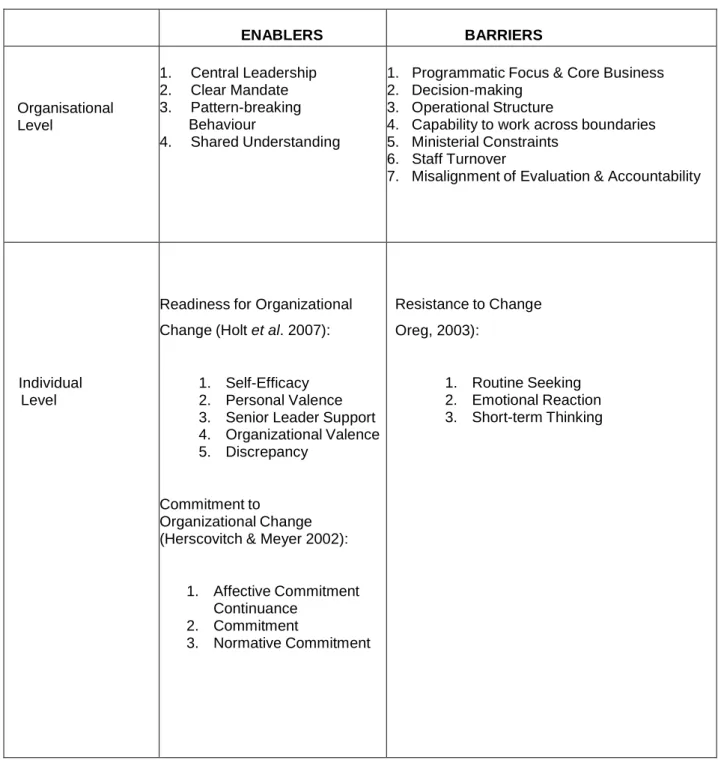
ENABLERS BARRIERS
Organisational Level
1. Central Leadership 2. Clear Mandate 3. Pattern-breaking Behaviour
4. Shared Understanding
1. Programmatic Focus & Core Business 2. Decision-making
3. Operational Structure
4. Capability to work across boundaries 5. Ministerial Constraints
6. Staff Turnover
7. Misalignment of Evaluation & Accountability
Individual Level
Readiness for Organizational Change (Holt et al. 2007):
1. Self-Efficacy 2. Personal Valence 3. Senior Leader Support 4. Organizational Valence 5. Discrepancy
Commitment to
Organizational Change (Herscovitch & Meyer 2002):
1. Affective Commitment Continuance
2. Commitment
3. Normative Commitment
Resistance to Change Oreg, 2003):
1. Routine Seeking 2. Emotional Reaction 3. Short-term Thinking
Figure 2: A Multi-Level Readiness Model reflecting Barriers and Enablers
18
2.7 Research Model Underpinning the Study
The researcher uses the “Readiness model” which was established in June 1993 by Armenakis, Harris and Mossholder (1993). This has since been reviewed by Armenakis, Field, Harris & Holt (2007). According to these authors, this theory indicates that, employee readiness is stimulated by the message conveyed via the strategies, the change agent qualities, and the interactive and collective dynamics of organisational members. The authors go further to argue that in accumulation to these planned efforts, employee readiness may also be influenced by at least three other factors, viz., unplanned media information, existing organisational circumstances, and implication of the change determination.
It is the view of Armenakis et al., (2007) that sometimes organisational changes are urgently desirable and need speedy implementation. In such cases, the authors argue that a readiness program that employs the most efficient and effective strategies have to be implemented, and in such cases the change agent may only apply a persuasive communication strategy. Armenikas et al., (2007) further argued that in other circumstances the required change may perhaps not be so urgent, allowing for a comprehensive and in-depth execution of readiness efforts. The authors argue that in such cases the change agent requires a program which may encompass persuasive communication as well as active partaking. Such programs among others include distance learning and the management of external information for example, press releases (Armenakis, et al 2007).
2.8 Organisational Change Management
Rajput (2013) argued that change starts from the level of the organisation, therefore organisational change can be influenced by a number of external and internal forces.
Rajput (2013) further explains that the macro-environmental forces such as political (which includes legislation), economical, technological and socio-cultural sources can explain the change that influences the organisation externally (Rajput, 2013).
According to the readiness guide of the Information Technology Leadership Academy (ITLA), Organizational Change Management (OCM) is referred to as a methodology of evolution for an institution and its cohorts that moves them from their
19