The Representation of South African Women Politicians in the Sunday Times during the 2004 Presidential and General Elections
Thesis
Submitted in partial fulfillment of the requirements for the MASTER OF ARTS DEGREE
in Journalism and Media Studies at
RHODES UNIVERSITY, GRAHAMSTOWN by
Tina Kabunda Katembo
December 2005 Mr. Angelo Fick
(Supervisor)
Dedication
To my husband Edwin Phiri and my daughter Chiluya
Acknowledgement
I am very grateful to my supervisor, Mr. Angelo Fick, whose guidance and support throughout the research process was invaluable.
Sincere thanks also go to the lecturers in the department of Journalism and Media Studies who were involved in the course work.
Special thanks go to Edwin for his support and for believing in me. I am also highly indebted to Chipo and Dolly for helping out with Chiluya while I pursued my Masters.
Thanks to my friend, Edna for the hours spent together in the computer lab.
To my brothers and sisters, I hope this sets your goals even higher, and to my late parents who cannot witness how far I have come, for instilling in me the value of education. Last but not least to God in whom I put all my trust.
Financial Assistance
I hereby acknowledge the financial assistance from the Open Society Initiative for Southern Africa (OSISA) for this Masters Degree.
TABLE OF CONTENTS
Abstract………ix
Chapter One: An Introduction To The Study 1.0. Introduction……….1
1.1. Background to the Study……….2
1.2. Statement of the Problem and Significance of the Study………...………...3
1.3. The Purpose and Goals of the Study………...4
1.4. Assumptions of the Study………....4
1.5. Theoretical Framework………....4
1.6. Methods, Procedures and Techniques of the Study………..…..….5
1.7. Thesis Outline………..6
Chapter Two: An Overview of the Historical Factors Affecting the Social, Economic and Political Positions of South African Women 2.0. Introduction……….8
2.1. Historical Perspectives on the Changing Social, Economic and Political Status of African Women ………...9
2.1.1. The Position of African Women in Pre-Colonial Society ………..……12
2.1.2. African Women in Colonial Society and the Effects of Apartheid on Black South African Women………..………...15
2.1.3. South African Women in the New Democratic South Africa ……….…23
2.2. Locating the Sunday Times within the Sociohistorical Context………...28
2.3. Conclusion………...30
Chapter Three: Theoretical Framework and Literature Review 3.0. Introduction……….31
3.1. Theoretical Perspectives………..31
3.1.1. Cultural Studies: A Brief Introduction………...………..31
3.1.1.2. ‘Culture’ in Cultural Studies………..………….36
3.1.1.3. The Question of Meaning and Power.……….………...39
3.1.1.4. Cultural Studies: Its Assumptions and Concerns………..40
3.1.1.5. The Choice between Culturalism and Structuralism……….44
3.1.1.6. The Nature of Cultural Studies’ Text-Based Studies ………...46
3.1.2. Discourse Theory and Media Texts………...48
3.1.2.1. Characteristics and Principles of Discourse Analysis ……….….51
3.1.2.1a. Focus on Naturally Occurring Expressions……….51
3.1.2.1b. The Role of Context ………...51
3.1.2.1c Discourse as Social Practice……….52
3.1.2.1d Attention to Meaning and Function………..53
3.2. The Use of the Terms Gender and Representation in the Study ………..54
3.2.1. Conceptualising Gender………...54
3.2.2. Theories of Representation………..56
3.3. The Media, News Construction and Representations of Women Politicians…...58
3.3.1. The Media and Women: A Brief Introduction……….…58
3.3.2. News Construction and its Effects on the Representation of Women Politicians………....59
3.3.2.1. The Sociology of News Production………...60
3.3.2.2. News as Discourse ………..……65
3.5. Conclusion ……….67
Chapter Four: Research Methodology - Data Collection and Analysis 4.0. Introduction………68
4.1. Research Methods………..68
4.1.1. The Nature of Quantitative Research………68
4.1.2. The Nature of Qualitative Research………..69
4.1.3. The Combination of Methods………70
4.2. Research Design and Methods………71
4.2.1. Content Analysis as a Research Technique……….72
4.2.1.1. Population, Sample and Analytical Categories..……….75
4.2.1.2. Data Collection and Analysis Procedures………...79
4.2.2. Discourse Analysis as a Research Technique ……….80
4.2.2.1. Critical Discourse Analysis: Fairclough’s Framework………...82
4.2.2.2. Analytical Procedure for the Description, Interpretation and Explanation of the Sunday Times’ Representation of Women Politicians ………..………83
4.3. Conclusion………86
Chapter Five: Content Analysis: Presentation, Interpretation and Discussion of Findings on the Representation of Women Politicians in the Sunday Times 5.0. Introduction ………87
5.1. Presentation and Discussion of the Main Findings from the Content Analysis…..88
5.1.1. Findings for the Assumption that Women Politicians Were Underrepresented in the Sunday Times during the Sampled Period………88
5.1.2. Findings for the Assumption that the Sunday Times Tended to Represent Women Politicians in Ways that Serve to Reproduce their Subordinate Status…95 5.1.3. Findings for the Assumption that Overall, the Sunday Times Represented Women Politicians in Ways That Perpetuate Their Subordinate Status ……....101
5.2. Discussion of the Content Analysis Findings………....102
5.3. Conclusion………..104
Chapter Six: Critical Discourse Analysis of the Representation of Women Politicians in the Sunday Times During the 2004 Elections 6.0. Introduction ………..105
6.1. A General Characterisation of the Texts under Analysis………..106
6.2. Prevalent Patterns in the Representation of Women Politicians That Frame the Readers’ Understanding and Interpretation of Women ………....108
6.2.1. Personalisation and the Construction of Negative Traits for Women Politicians ………..110
6.2.2. Women Politicians as Incompetent Political Leaders ………...113
6.2.3. Women Politicians as Dependents on Men politicians………..115
6.2.4. Women Politicians as Passive Patients and Benefactors of Men’s Actions...117 6.3. Interpretation and Explanation for the Gendered and Ideological Patterns of
Representation in the Sunday Times………..121
6.3.1. Analysis of the Discourse Practice: The Influence of Genres and Discourses Drawn upon in the Representation of Women Politicians ……….121
6.3.2. Social Economic Factors of News Production and Their Effects on the Representation of Women Politicians in the Sunday Times ………...123
6.4. Conclusion………....125
Chapter Seven: Discussion of the Study’s Main Findings and Conclusion 7.0. Introduction……….……….……..126
7.1. Material Existence of Women in Society and their Numerical Representation in the Sunday Times Election News………...126
7.2. Explanations Why Women Politicians are infrequently used as News Sources in the Sunday Times Political News……….…….127
7.3. The Role of the Sunday Times in the Reproduction of the Status Quo…..……129
7.4. Scope and Limitations of the Study……….130
7.5. Recommendations for the Sunday Times………131
7.6. Areas for Further Research………..132
7.7. Conclusion………...133
Tables Table 1: Number of news items per genre during the four-month period….………89
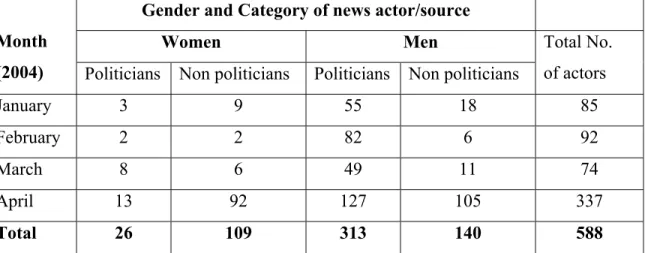
Table 2: Gender and total number of news actors/sources used…..……….90
Table 3: Distribution of news actors/sources during the four-month period………92
Table 4: Gender and frequency of prominently figured news actors/sources …….96
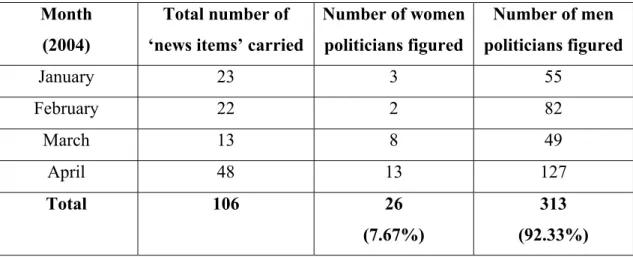
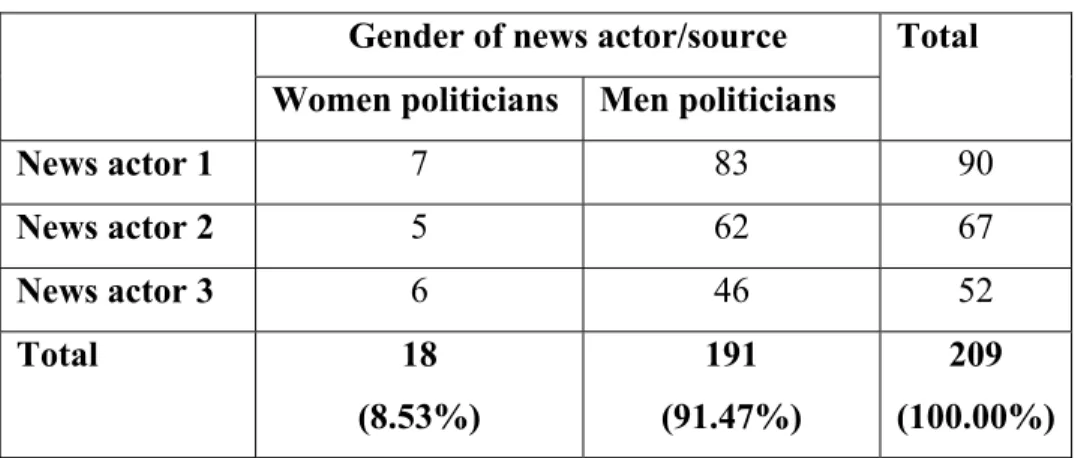
Table 5: Figuration of women politicians and men politicians in the news.………96
Table 6: Frequency of reference to selected subject matters in the presentation of women politicians………..……….98
Table 7: Frequency of reference to selected subject matters in the presentation of men politicians ……….………..98
Table 8: Reference to selected subject matters according to the gender of the news actor/source …...………99
Abstract
This study analysed the representation of South African women politicians in the Sunday Times’ election news during the 2004 Presidential and general elections, by drawing on perspectives from cultural studies, the constructionist approach to representation and the sociology of news production. Using content analysis and critical discourse analysis, the study found that very few women politicians were used as news actors/sources in the Sunday Times, and that when women politicians were figured, the paper tended to present them in ways that serve to sustain women’s subordinate status in society.
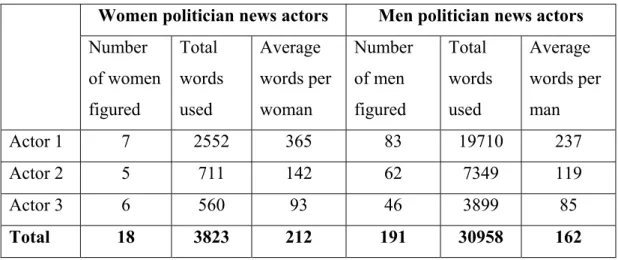
Using content analysis, the study analysed 106 news items published between January 1, 2004 and April 30, 2004, and found that of all the 588 identifiable news actors/sources counted, 135 were women and 453 were men. Of these, only 7.67% (or 26) were women politicians and 92.33% (or 313) were men politicians. On average however, the amount of words allocated to a woman politician was more than that allocated to a man politician.
The discourse analysis also revealed how the Sunday Times managed to reproduce textually the hegemonic power relations between women and men, by constructing different subject positions for women politicians and men politicians, which generally tended to be negative and positive respectively. In the representation of women politicians, the study revealed patterns that tended to ascribe them negative personality traits, accentuate their passivity and dependency on men, and construct them as
incompetent political leaders.
This study’s conclusions pose a challenge to the role of the national newspaper in the transformation of gender relations and the promotion of equal access to political and decision-making positions, and to the news media. News discourse, as a social practice, both determines and is determined by the social structure in which it is produced. By systematically reproducing subordinate subject positions for women in the news, the Sunday Times helps to further women’s subordinate status in society. Particularly, as part of the broader social cultural context that is embedded in patriarchal and gender ideologies, the Sunday Times does not merely reflect but actively and effectively constructs the reality it claims to be representing.
CHAPTER ONE
AN INTRODUCTION TO THE STUDY
1.0. Introduction
This study analyses the representation of South African women politicians in the Sunday Times during the 2004 Presidential and general elections, investigating the relationship between the representation of women politicians in the Sunday Times and their material existence in society, in terms of the percentage of the members of parliament they represent. Drawing on insights from cultural studies and working from a constructionist approach to representation (Fiske 1987; Hall 1997, 2001; Kellner 1995), the study looks at how the Sunday Times creates frameworks for understanding South African women politicians through the meanings it offers its readers in the news reports. In this study, I use the word politician to refer to anyone who had previously held or was currently holding an elected office, or who was a candidate on the electoral list at the national level during the 2004 elections. Consequently, such persons are referred to as a women
politicians or men politicians depending on their gender. By men politicians and women politicians, I am referring to men and women in state or government politics, and the terms men politicians and men in politics, or women politicians and women in politics will be used interchangeably in my discussions. However, I use the terms men and women, as opposed to male and female, to emphasise the study’s focus on gender as a social construction, as opposed to the biological construct sex.
The media, rather than passively reflecting reality, actively and effectively construct the reality they claim to be representing (Bennett 1995; Fiske 1994). Language, one of the representational systems of the media, is a social practice that is both socially shaped and socially shaping, such that it determines and is determined by the social structure (Fairclough 1992b, 1995; Dijk 1997). Thus, the media, as language users, both reflect and contribute to the shape of the social order, including the subordination of women in patriarchal society. These arguments also apply to the copy of the Sunday Times.
The first of seven chapters, this chapter provides a general outline of the research study, by briefly explaining the social historical context of South Africa (the country in which the study is being conducted) and highlighting the problem that the subordinate
status of women in society is also epitomized in the mainstream media representation of women politicians. The chapter also highlights the objective of the study, which is to further our understanding about how the Sunday Times creates frameworks for understanding South African women politicians, and briefly specifies the research
methods that were used. It also provides a brief summary of the study’s key findings and then ends with an outline of the structure of the thesis.
1.1. Background to the Study
Before the enfranchisement of white South African women in 1930, women were excluded from any parliamentary or provincial franchise, and were not regarded as partners in politics (Walker 1979) or as an electoral constituency until in the early 1990s (Hassim 2003). For a long time, indigenous, imperialist, colonialist and apartheid policies and practices rendered African (and black South African) women socially, economically and politically subordinate (Bernstein 1975; Imam 1997; Mama 1997;
O’Barr and Firmin-Sellers 1995; Poinsette 1985; Qunta 1987 and Staudt 1986). This had debilitating effects on black women’s political organisation and participation in national politics, and consequently, South African women constituted only 2.7% of all
parliamentarians during the apartheid era (Hassim 2003:105).
At the inception of the new South African democratic government in 1994, the state set up to restructure and transform the South African society and its institutions. One of these objectives was to advance the position of women and promote gender equality in all spheres, through constitutional and other deliberate measures (Hassim 2003; Goetz and Hassim 2003; Myakayaka-Manzini 1998). Within this framework, the government also aimed to increase access and participation of women to political power and decision- making positions, through such measures as affirmative action and quota systems in parliament, and by 2004, the government had achieved a 30% representation of women in parliament (Goetz and Hassim 2003:2).
The study on the representation of women politicians in the Sunday Times should therefore be understood within the context of the following.
(a) The year 2004 represents 10 years since the inception of the democratic state and 10 years since the ANC government put in place measures aimed at advancing the position
of women in society and increasing women’s participation in the political realm and in decision-making positions;
(b) The Sunday Times news texts being analysed represent four months’ coverage of electoral news prior to the presidential and general elections;
(c) During the 2004 elections, most of the major political parties, following the ANC’s lead, had increased the representation of women politicians on their candidate lists1.
1.2. Statement of the Problem and Significance of the Study
Worldwide, women have occupied positions of both political and social weakness in relation to men (Walker 1979). As alluded to earlier, this weak position is also
epitomised in the mainstream media representations of women. The media do not simply reflect but actively construct reality. There is a discrepancy between the number of women politicians in society and the number of women politicians in media
representations of that society. Furthermore, certain subject positions that serve to sustain women’s subordinate social status are constructed for them in the news. Given these kinds of presentation, the Sunday Times plays an active role in the reproduction and sustenance of women’s subordinate socio-political position.
Although relatively few studies have been conducted on gender and the media in South Africa (see MISA/GL 2003), studies that specifically analyse the representation of women in the media are scarce. The significance of this study, therefore, is that it attempts to contribute towards the existing literature on gender and the media, and specifically towards studies on the representation of South African women in South African media.
1For instance, on the ANC’s national list, 35.4% of the candidates were women, on the PAC’s list 33.64%, on the IFP’s list 31.82% and on the DA’s list 31.59%. Other parties, such as the ACDP and the Independent Democrats had about 31.8% and 30.33% women candidates respectively (Sunday Times, April 11, 2004 page 2).
1.3. The Purpose and Goals of the Study
The media create ‘frames for understanding’ issues, events or persons (Braham 1982;
Hall 1990). The purpose of this study, as alluded to above, is to further our
understanding about how the Sunday Times creates ‘frameworks’, through the repertoire of representations that it provides for its readers’ understanding of South African women politicians. The main goal is to investigate the relationship between the representation of women politicians in the Sunday Times and their material existence in society, and be able to state whether the Sunday Times’ representation of women politicians serves to sustain or transform the subordinate status of South African women.
1.4. Assumptions of the Study
There are two main assumptions guiding this study. Firstly, compared to their material existence in society - 30% of all parliamentarians in 2004 were women (Goetz and Hassim 2003) and 52.2% of the 2001 population were women (SSA 2003) - South African women politicians are numerically under-represented in the Sunday Times.
Secondly, when women politicians are figured, the manner in which they are represented serves to sustain women’s subordinate social and political status.
1.5. Theoretical Framework
This study draws mainly from the theoretical insights of cultural studies, the constructionist approach to representation and the sociology of news production.
Cultural studies’ insight that societies are divided unequally along lines of, among other things, gender (Fiske 1987; Kellner 1995; Storey 1996), and the view that gender is a social construction that brings to the fore issues of hierarchy and power, and is implicated in matters of representation (Baker 2000; De Lauretis 1987), are particularly useful for this study. Furthermore, cultural studies’ concerns with culture, meaning and power enable the exploration of the relations between media culture and society (Nelson et al.
1992). Since social struggles - including gender struggles between women and men - are played out in the texts of media culture (Kellner 1995), the cultural studies framework provides a very useful approach for identifying how the struggles for differences in
power between women politicians and men politicians are constructed in the Sunday Times’ news.
Texts, news texts included, draw upon the representational systems of society, such as language, to represent their interpretations of reality meaningfully. The constructionist theory of representation, which recognises the social character of language in conveying meanings (Hall 1997), is therefore useful for demonstrating how the Sunday Times, rather than passively reflect, actively and effectively constructs the social political reality it represents. The sociology of news production, and specifically the journalists’ use of the ideological and gendered news values in the selection and presentation of events (and sources) as news (Hartley 1994), is also important in explaining the active role that the Sunday Times plays in the representation of women politicians, and the implied social effects of such representations.
1.6. Methods, Procedures and Techniques of the Study
For this study a combination of quantitative and qualitative methodologies, specifically content analysis and critical discourse analysis (CDA), is used in a two-phase research process. As several scholars (Bryman 1988, 2001; Berg 1998; Deacon et al.1999; Denzin 1989) have outlined, the triangulation or combination of different methods is beneficial for any study since each method can reveal different aspects of the same phenomena.
Furthermore, the researcher may obtain a better and more substantial picture of the phenomena under study, and one method can strengthen the weakness of the other. So for instance, while the quantitative analysis indicated that women politicians were on average given more presence in the news, the qualitative analysis revealed how the substance of what was represented served to entrench further the differences in power between women and men politicians.
For the study, I sampled a four-month period - January 1, 2004 to April 30, 2004 - of election news coverage. All publications during the sampled period, apart from the three publications that were missing2, were read and their content analysed initially to identify and quantitatively code all news items that focused on the 2004 South African elections.
A news item is defined here as any ‘news story’, ‘editorial’, ‘feature article’ or ‘letter to
2 The three publications that were missing were for February 8 and 29, March 28 and April 25.
the editor’ that made specific reference to the 2004 South African elections and was locally produced with these elections being its main focus. Consequently, all such news items were coded for the variables of genre, space, gender and the amount of coverage or space allocated to men politicians and women politicians, including references made to such subject matters as personality, potential for office, physical traits and family relations. The significance of these variables for the study is provided in the methodology chapter.
This content analysis was followed by a critical discourse analysis (Fairclough 1989;
1992; 1995a) of two feature articles with typical-case representations of women
politicians for the meanings and frames that the Sunday Times provides for the readers’
understanding of South African women politicians. This analysis was mainly a qualitative expansion on the quantitative findings from the content analysis.
1.7. Thesis Outline
In the next chapter (Chapter 2) of the thesis, I discuss the historical context within which this study is conducted. The chapter gives a brief overview of some of the historical factors - indigenous patriarchal practices, the influences of imperialism, colonialism and apartheid - that affected and helped constitute the contemporary subordinate social political position of South African women politicians. It also provides an overview of some of the opportunities occasioned for South African women during the transition from apartheid to democracy, including the increased participation of women in politics. The chapter ends with a brief historical overview of the South African press to locate the Sunday Times politically and economically on the South African press landscape.
The third chapter explains the theoretical perspectives deriving from cultural studies and discourse theory that inform this study, and outlines my use of the terms ‘gender’ and
‘representation’ in this study. Furthermore, the ‘factual’ and ‘objective’ view of news is challenged by arguments that news is a social construction that affects and is affected by the social structure. The chapter shows, for instance, how journalists’ reliance on news values affects the representation - both the occurrence and the manner - of South African women politicians in the Sunday Times’ electoral news items.
A discussion of the methods and procedures used to analyse news items from the Sunday Times’ coverage of the 2004 elections is then presented in the fourth chapter.
This chapter discusses and justifies the research design - a combination of quantitative and qualitative research methods - adopted for the study, and carefully outlines the two- phase research process and techniques used. This is done in line with the objectives and goals of the study.
The fifth chapter presents and discusses the findings from the quantitative analysis.
The findings indicate that women politicians were numerically underrepresented or infrequently used as news sources in the Sunday Times electoral news even though on average, women politicians were given relatively more space than men politicians. The analysis also reveals that references to such subject matters as personality, potential for office, physical attributes and family relations were mentioned in the presentation of both men politicians and women politicians, but that there were more references to such topics in the representation of women politicians than in the representation of men politicians.
These findings provide the basis for the qualitative analysis in the sixth chapter.
A qualitative examination of two news texts from the sample is provided in Chapter 6 to establish the substance of what is represented about women politicians, given the fact that women politicians were given more space. Of importance, are the meanings and frames that the Sunday Times created for the readers’ understanding of women politicians. This is done in order to distinguish between the question of quantity and quality of representation. Here, I identify and discuss some of the main patterns of representation that were used. The analysis reveals that the Sunday Times tended to construct different subject positions for men politicians and women politicians that serve to sustain the status quo. It shows how, for instance, the Sunday Times tended to
construct women politicians as incompetent political leaders and as being dependent on men. The analysis also revealed that women were represented consistently as passive recipients and benefactors of men politicians’ actions.
The last chapter is the conclusion to the study. It presents a summary of the main findings and discusses the main issues arising from the study. In this chapter, I also suggest how the Sunday Times may change its representation of women politicians and suggest areas for future research.
CHAPTER 2
AN OVERVIEW OF THE HISTORICAL FACTORS AFFECTING THE SOCIAL, ECONOMIC AND POLITICAL POSITIONS OF SOUTH AFRICAN WOMEN
2.0. Introduction
Women, in most societies, represent the most oppressed segment, even though they constitute the majority of the population (Nkululeko 1987). This chapter provides a brief overview of the historical dimensions of the cultural, social, political and economic issues that affected African women’s social and economic lives and imposed limitations on their political authority. By ‘African women’ however, and following Mohanty (1991:5), I eschew any homogeneous configuration of African women who share a gender and a race, and therefore experience life equally. This is because even gender, as Daymond et al. (2003) assert, must always be defined through race, class, ethnicity, culture and other coordinates in order to achieve any meaning and consequently, the heterogeneity of women entails that they engage with social and political factors in different and complex ways. Nevertheless, this chapter also appraises the kinds of power that the historical circumstances occasioned for African women.
My discussion takes a historical approach to analyse the social, economic and political positions of African women in three different historical eras: the pre-colonial, colonial and post-colonial. This is important for the purposes of contextualising the study, and further offers an understanding of the contemporary subordinate social and political status of South African women, including how society and the media perceive them. The discussion begins with an overview of the impacts of European colonialism on the status of African women in general, with a particular focus on Southern African women. Given the subject matter of my study, I shall look specifically at how colonialism and apartheid affected both the social lives and political organisation of black South African women.
Imperial practices and apartheid policies, together with indigenous patriarchal tendencies, significantly altered the gender relations and contributed towards the subjugation and subordination of black women, by provoking both certain conditions and certain
perceptions and representations of women. Rather than institute new (or equal) forms of relations between black and white, men and women, apartheid practices, as du Toit
(1971) outlines, intensified and essentially continued imperial and colonial relations of domination of white over black, and of men over women.
An examination of a historical phenomenon like colonialism forms an important part of the study of gender and Third World politics (Waylen 1996). Moreover, as Bernstein (1975) outlines, the subject formation of South African women can only be understood within the context of the effects of apartheid. Thus, it is important that I provide such background, by tracing when, why and how African women came to occupy their contemporary status.
This chapter also explains how the new democratic government is attempting to transform gender relations and advance the social and political position of women in South Africa. It outlines some of the measures - constitutional and deliberate - that have been put in place to achieve this goal, and reveals how this has resulted in women representing 30% of all members of parliament. The chapter ends with a brief historical overview of the press in South Africa to locate the Sunday Times.
2.1. Historical Perspectives on the Changing Social, Economic and Political Status of African Women
Women across the globe have occupied positions of both political and social weakness in relation to men (Walker 1979). Since the late nineteenth century, women, worldwide, have fought for their inclusion and participation in government. Walker (1979:17-22) outlines that for South African women, this struggle started with the formation of the Durban based Women’s Enfranchisement league in 1902 when they demanded their political right to vote. This demand was met with the enactment of the 1930 Women’s Enfranchisement Act No.18, even though it only catered for adult white women, to the exclusion of black women (Walker 1979; Poinsette 1985:95). Prior to enfranchisement, the colonial South African government excluded women from any parliamentary or provincial franchise. Women were not regarded as partners in politics (Walker 1979) or as an electoral constituency until in the early 1990s during the transition from apartheid to the democratic state (Hassim 2003).
Several scholars (Hay and Stichter 1995; Imam 1997; O’Barr and Firmin-Sellers 1995) have outlined how the contemporary situation of African women has been shaped
by several historical forces, which include among others, the influences from colonial conquests in the fifteenth century. As mentioned earlier, an understanding of
contemporary gender relations in the Third world can only be complete with some analysis and discussion of the colonial period (Waylen 1996:47). The ‘enemies’ of African women, particularly in Southern Africa, as Qunta (1987:15) observes, are colonialism and imperialism, white racism, class and sexual oppression. This was especially true in South Africa where the apartheid regime used this combined form of oppression to preserve economic and political power in the hands of a white minority (Poinsette 1985; also see Marks 1987).
Bernstein (1975), O’Barr and Firmin-Sellers (1995), Qunta (1987) and Staudt (1986), attest to the devastating impact that colonialism and Western ideology had on the social and political position of African women. The word ‘ideology’ is used here according to Thompson’s (1990:56) definition to refer to meanings “which serve to establish and sustain relations of domination”. The processes of colonial occupation, the development of capitalism, and the ‘modernisation’ in Africa, as Imam (1997:7) asserts, have
frequently meant a decrease in African women’s economic autonomy, their access to resources, status and security. Furthermore, through the imposition of Western conceptions of state and society, and of women and their appropriate gender roles, colonial practices altered the status of African women and reduced their independence and freedom (O’Barr and Firmin- Sellers 1995:189; Qunta 1987:36). As Macdonald (1995) and Staudt (1986) outline, Western ideas about gender are most explicit in the public-private dichotomy in politics and the belief that women’s affairs belong in the private realm. The idea of separate realms is a key part in the process of securing female subordination, and the assumptions underlying the separation are very significant to the study of gender and politics (see Ballaster et al. 1991; Waylen 1996).
This Western gender regime is an effect of European modernity. Rowbotham
(1981:1-3) outlines how during the transformation of Europe from an agricultural society to an industrial society, the division and specialisation of labour began, and new kinds of social differentiation become marked. The new class and sexual division of labour which capital brought into existence had negative consequences for European women, as they were slowly forced out of trade and were restricted to the home.
In illustrating the many ways in which colonialism affected African women, many scholars (Daymond et al. 2003; O’Barr and Firmin-Sellers 1995; Waylen 1996; Qunta 1987) look comparatively, though not chronologically, at the social political conditions and positions of women in pre-colonial and colonial Africa. Daymond et al. (2003) subvert the linear chronological ordering of history by developing an understanding of African women organised around contestations of such issues as fertility and land, and by foregrounding the unevenness of the processes of change both over the whole region and in the lives of specific women. Similarly, O’Barr and Firmin-Sellers (1995) base their arguments around political processes to gain an insight into what happened, in general, to African women, why and how. Though not talking strictly in terms of pre-colonial, colonial, and postcolonial periods, the issues and processes with which these scholars are concerned can be traced to particular periods.
On the other hand, Waylen (1996) examines the varied nature of the colonial experience, and its varying and contradictory impact on gender relations. He explores both the varying characteristics of certain pre-colonial African societies and some of the numerous ways in which indigenous gender relations interacted with the new forms of social, economic and political organisation introduced by the colonisers to produce new patterns. These pre-colonial gender relations are the effect of the political struggle, power and resource distribution within pre-colonial African polities. With a specific focus on Ghana, Tsikata (1997) takes an historical mode to analyse the gender
implications of state policies and institutional arrangements by looking at the colonial state of 1901 and moves through the different state regimes to the present neo-colonial state. There is a tension, of course, between the written and the oral tradition that contains this historical record since there is, as Mohanty (1991) asserts, no apolitical scholarship. Most kinds of scholarship are not mere productions of knowledge about a certain subject but direct political and discursive practices, which are purposeful and ideological. The literature cited here is the feminist scholarship that, as Mohanty (1991:53) outlines, intervenes into particular hegemonic discourses and counters the totalising imperative of previous bodies of knowledge.
Drawing on the above and other scholars’ arguments, I shall briefly illustrate the changing position of African women regarding their diminished social status, their loss of
personal and economic autonomy, and more specifically their loss of political authority, from the pre-colonial through to post-colonial times. My discussion, accordingly, is organised chronologically around historical periods, which I consider useful for tracing the processes that reinforced the subordination of African women. As such, I shall be talking about pre-colonial, colonial and post-colonial (contemporary) societies. By pre- colonial societies, I am referring to indigenous African societies, those societies in which hunting, gathering and/or agriculture constituted the main mode of production. Colonial society is understood here in a broad sense to refer to the period characterised by the European occupation and political control of Africa, including the introduction and development of a cash economy. Given the legacy of apartheid in South Africa, and taking into account du Toit’s (1971) argument about apartheid above, postcolonial is understood here in a very limited sense to refer to the period following the election of the first democratic government. The grid I am using to divide African history into these periods is not derived from any scholar or writer in particular but from my own desire to provide a linear chronological outline of historical events.
2.1.1. The Position of African Women in Pre-Colonial Society
Staudt (1986), Qunta (1987), and O’Barr and Firmin-Sellers (1995) all attest to the autonomy, authority and control over their lives that African women had in pre-colonial society. African women on a continent-wide scale, Qunta (1987:23) argues, enjoyed great freedom and had both a legal and social equality, which, among other things, enabled them to become effective heads of state and military strategies. Much of this autonomy stemmed from their economic resources since they were economically productive and played a central role in agriculture in many parts of Africa (Qunta 1987;
Waylen 1996). Regardless of the kind of society they lived in, women derived their political status from the key role they played in production.
So for instance, indigenous Egyptian women, as Qunta (1987:29) asserts, participated in the public affairs of society. In Nigeria, women had their own structures of power, which dealt with issues that concerned them, including, among others, the regulation of markets (see Waylen 1996). And in countries like Swaziland, Botswana, Ghana, Zimbabwe and Congo, “[w]omen took part in public life and had the right to vote, they
could become queens and enjoyed a legal status equal to that of men” (Diop 1974, cited in Qunta 1987:41). Similarly, in South Africa, Nkululeko (1987:86) argues that women were active and prominent members of their societies and some of them were heads of state. From these statements, we can deduce that African women were active members of and played important roles in their societies.
The issue of gender, however, exists in most societies, with complementarities and competition pervading all levels of cultural and social life, including pre-colonial
societies (Assie-Lumumba 1997; Johnson 1986; Mama 1997). It should be noted though that no universal patriarchal framework exists that Western feminist scholarship attempts to counter and resist apart from, as Mohanty (1991) argues, a particular world balance of power within which any analysis of culture, ideology and socioeconomic conditions necessarily has to be situated.
The pervasiveness of gender inequality is discernible in the organisation of roles in pre-colonial society. Even in matrilineal societies with women in more powerful social positions, as Assie-Lumumba (1997) outlines, there were several indicators of gender inequality. Hence, while there was no continuous formal political leadership in the hunting and gathering societies of central and southern Africa, each sex had its own sphere of activity, over which its leaders exercised control (O’Barr and Firmin-Sellers 1995). Hafkin and Bay (1976), and Rosaldo and Lamphere (1974) have categorically pointed out that whether the society was matrilineal or patrilineal, African women usually
(1) had political control over some areas of activity, be it farming, marketing, trading, or household and family affairs; (2) had political institutions (usually councils) to decide how to rule their own affairs or to influence the affairs of men; and (3) were not subject to general control by men as much as they were autonomous in their own areas of responsibility (cited in O’Barr and Firmin- Sellers 1995:192, my emphasis).
This argument is corroborated by Bernstein’s (1975:19) argument that though “women occupied a subordinate position [they] attained a high degree of independence in some roles” (my emphasis). Waylen (1996) also notes the different but complementary roles played by men and women, and Staudt (1986) observes how other women exercised power and authority in many ways, both directly over women and indirectly over the whole community when their sphere of influence governed the behaviour of others.
Noteworthy is the fact that the European sex/gender system, which arose in modernity (Rowbotham 1981) did not easily apply to pre-colonial African polities. Hay and Stichter (1995) and O’Barr and Firmin-Sellers (1995) outline that unlike women in Western societies, African women were not confined to a ‘private’ realm and excluded from a
‘public’ realm. There were gaps also between what nineteenth century Western observers saw and what they understood about middle-class European women. For instance, they sometimes noted the independence of African women and other times their abject state of dependence. Western observers, as (Hay and Stichter 1995:191) observe, talked about how hard African women worked in the fields in contrast to the men, and wondered at their ability to maintain households and raise children while appearing to lack sufficient material resources.
The above statements undoubtedly point to the fact that women and men may have played different political roles. Since they had separate spheres of operation, it can be argued that certain kinds of ‘parameters’ within which each group would function were set. An examination of the organisation of contemporary politics would reveal similar tendencies where men and women are allocated to different political activities and roles, to those that are perceived as masculine or feminine respectively. Somehow, this relates to the gender regime of European polities before the separation between domestic and industrial life was clearly marked, and trades that related directly to the work of women in the household existed as part of the larger political economy (Rowbotham 1981).
As mentioned earlier, regardless of the gendered nature of these activities, in most of the matrilineal societies - the dominant social system in Africa - women were not excluded from participating in public life, and enjoyed a wide spectrum of powers and responsibilities (Nkululeko 1987; O’Barr and Firmin-Sellers 1995; Qunta 1987). As Mama (1997) outlines, the ideology of the domesticity of women is a Western ideology that the colonists imposed on Africans. Prior to that, as Assie-Lumumba emphasises,
“African women were not confined to a domestic domain” (1997:304). These remarks, however, do not preclude the existence of a gender system in pre-colonial Africa (Johnson 1986; Mama 1997; Waylen 1996). The point is that while gender relations in pre-colonial society were not characterised by equality, they often entailed greater interdependence than in modern societies, where women depend on men (Waylen
1996:50). Of course, women were subordinate to men in pre-colonial society, but they enjoyed a range of powers and responsibilities.
The advent of colonialism exacerbated the subordination of women, and through the enforcement of patriarchal tendencies and other practices, transformed the nature of pre- colonial gender relations in ways that seriously intensified the oppression and diminution of women’s pre-colonial prominent status (Johnson 1986; Mama 1997). The changes in African gender relations, as Mama (1997:69) emphasises, may well have been one of the most dramatic sites of struggle and change. The gendered position of contemporary African women can be examined against the domestication of the middle-class woman in European modernity, which has been assumed the norm for all women. The following section takes a critical view of the ideologies and policies that the colonists imposed on Africa, and outlines some of the negative consequences they imposed on the living conditions of African women and how these affected their political organisation.
2.1.2. African Women in Colonial Society and the Effects of Apartheid on Black South African Women
The advent of colonialism and Christianity profoundly altered the political, social, economic and cultural systems of pre-colonial society in ways that were detrimental to African women (Johnson 1986; Daymond et al. 2003; Mama 1997; O’Barr and Firmin- Sellers 1995). The colonisers, as several scholars (Mama 1997; Pereira 1997; Sobopha 2005; Waylen 1996) outline, brought with them different cultural constructions of gender that, together with missionary discourse, served to intensify the subjugation and
subordination of African women. Poinsette (1985:108) points out how European authorities had a profound belief in the limited capacity of women, which made them ignore women in power or those who shared power with men at the time of colonial occupation during the transfer of power from colonists to South Africa. Missionary discourse, on the other hand, found resonance with the ideology of domesticity
promulgated by colonists by emphasising patriarchal authority in the home as the basis of
‘family life’ (Pereira 1997). Within the new bourgeois family of Western European modernity, as Rowbotham (1981:3) outlines, the role of the woman was mainly supplementary, with the man supporting his wife from his wages. However, under the
racist hierarchies of colonialism, as Daymond et al. (2003:26) outline, the middle-class aspirations of the ideology of domesticity were impossible to fulfil where African women had various family positions in the extended family kinship structures of indigenous African polities and the poverty of many urban households prompted them to work outside the home.
In South Africa, colonialism also took the form of apartheid, a racial segregationist system that had devastating impacts on the social realities of African women and adversely affected their political organisation. Although apartheid is historically associated with the National Party, which came to power on a platform of separatist ideology in 1948, and over the next 40 years became a dominant aspect of every South African’s life
[t]he foundations of apartheid had already been laid well before 1948 by laws which deprived blacks of the franchise, set aside special areas for black occupation, restricted the right of Africans to enter urban areas, and obliged them to carry passes (Dugard 1978:55, cited in Poinsette 1985:95).
The legalisation of apartheid in 1948 ushered in an era in which a whole range of existing and new discriminatory legislative measures, which drastically altered the society and profoundly affected the social lives and political organisation of South African women, would be reinforced or established. As mentioned earlier, the apartheid state, rather than alter, actually strengthened and extended the social and political relations established under colonialism. Thus, apartheid South Africa was characterised by racial division, with the effect of privileging and prospering the politically dominant white minority over the majority blacks (Bernstein 1975; van Zyl Slabbert 1971). These changes had the consequence of subordinating and marginalising African women socially, politically, economically, and culturally.
During the apartheid era, black women were economically disempowered and lost their fundamental rights and freedoms. Several scholars (Bernstein 1975; Johnson 1986;
Nkululeko 1987; Poinsette 1985 and Waylen 1996) have elaborately documented the impact of apartheid, and all attest to the fact that the statutory controls of apartheid often affected (black) women more harshly than men. Because of apartheid, black South African women found themselves at the bottom of the economic, social and political
ladder (see Bernstein 1975; Poinsette 1985). Different Acts of apartheid legislation, in conjunction with colonial conceptions of women, worked together to effect the conditions under which black women lived. The lives of women on the reserves - the majority of the population but without any rights to farmland and regarded as ‘non-productive’ and
‘idle’ (Bernstein 1975; IDAFSA 1981; Poinsette 1985) - was characterised by extreme poverty and hardship. This instability forced women to exert greater strength and show higher qualities of character and endurance than the men, and saw the emergence of a single, independent black woman who began to support herself and become head of an independent household.
Embedded in colonial state structures and policies was a public-private ideological distinction derived from European modernity’s gender regime that meshed with pre- colonial gender relations (O’Barr and Firmin- Sellers 1995; Staudt 1986; Waylen 1996).
However, as mentioned earlier, this distinction was socially constructed as it developed during the industrial revolution when capitalism in nineteenth century Europe broke down the old forms of social relations both at work and between men and women in the family (Bernstein 1975:58; Macdonald 1995:48; Rowbotham 1981:55). As the division was entrenched, the public became identified with influence and power, and the private with moral value and support. In bourgeois discourse, this split developed gendered attributes, with men being thought of as ‘naturally’ occupying the public arena and women the domestic and private.
The political, within this dichotomy, is defined as masculine in a very profound sense that makes it hard to incorporate women on the same terms as men and excludes many of those activities that women engage in as not political (Waylen 1996:3). Men, as such, are public actors in the political process and economic breadwinners on whom women
depend, while women support men in the private domestic sphere, and stabilise a political process in which they have little direct stake (Staudt 1986:201). In this socially
constructed domestic domain, O’Barr and Firmin-Sellers (1995) observe, women are expected to be both silent and subordinate. The power to speak bestows upon the person authority to provide their own definition of issues or reality, while the silenced one is left at the mercy of the one with the power to speak. In patriarchal society, the man assumes the power to speak over the women.
The colonial gender ideologies of domesticity excluded African women from the colonial labour market and marginalised them from being absorbed in the colonial political state. The colonial state, according to Mama (1997:70), was almost exclusively male, and as it developed, replaced indigenous political systems, some of which had afforded women substantial participation in the political life of their communities.
Furthermore, the colonists formalised and privileged men’s institutions by establishing administrative systems through indigenous male authorities and their institutions, at the exclusion of pre-existing women’s political structures (Parpart and Staudt 1990; Waylen 1996). As African women were excluded from decision-making centres, they lost their institutional authority (O’Barr and Firmin-Sellers 1995; Walker 1975).
Colonial law also affected African women in various negative ways (Bernstein 1975;
Daymond et al. 2003; Nkululeko 1987). For instance, the state decreed by legislation, e.g. in the Black Administration Act No. 38 of 1927 and the repressive Natal Code of Black Law, that the African woman be considered a minor, no matter what her age actually is. Within these laws, women were regarded as feeble-minded, in need of protection from and always subject to the authority of the men (Nkululeko 1987:81;
Bernstein 1975:19). This perception prevented women from holding public office and they were not allowed to obtain professional qualifications.
There are several echoes between colonial discourse and apartheid discourse for African women in both education and labour. Apart from their political privilege, colonial African men were also privileged over women in areas such as employment and formal education (Assie-Lumumba 1997; also see Daymond et al. 2003). This was marked in the operation of the highly gendered homelands policy in apartheid South Africa, which relegated African women to reserves that had very limited employment opportunities and lacked basic facilities like schools and hospitals. The few women who could find employment mainly worked as labourers or domestic servants on nearby farms, and in both town and country, domestic service was the main occupation of African women (Bernstein 1975; IDAFSA 1981; Poinsette 1985). Very few black women were employed in the professions available to them in teaching and nursing.
Furthermore, black women were often allocated the labour that white women disavowed in their quest for liberation from the European sex/gender system.
The nature and magnitude of European policies and practices affected the social and educational realities of women in Africa (Assie-Lumumba 1997; also see Daymond et al.
2003). Western education was based on unequal gender relations, where boys received the education that prepared them for public life and girls received the education that made them good housewives (Assie-Lumumba 1997:304). As African conceptions of gender changed with the imposition of Western ideology, differential access to education
ensured and gender relations were demarcated in new ways as boys rather than girls were chosen to be educated (Daymond et al. 2003:15). For South African girls, the education made available to them was very limited and fraught with patriarchal ideologies (O’Barr and Firmin-Sellers 1995; UN 1978; also see Staudt 1986).
Girls’ education was useless to wage employment and instead confined women to occupations associated with family life and household economy (Poinsette 1985).
Inevitably, women’s access to employment was very limited, as even those jobs designated as ‘female’ work were reserved for black men (Meer et al. 1990:53; UN 1978:15). By denying them education, colonial legislation assured that women played only a secondary role in the emerging cash economy.
O’Barr and Firmin-Sellers (1995) and Waylen (1996) outline how the creation of a cash economy based on the control of indigenous, often migrant male labour contributed to the marginalisation of African women both economically and politically. The migrant labour system, replicated over much of Southern Africa, constituted the most important single factor in the lives of South Africans, more so especially for black women, living in the reserves (Bernstein 1975; Poinsette 1985). The central position of men in this cash economy was assured by an array of policy decisions.
The colonial legal system affected, among others, the economic order especially with regard to mobilising and controlling labour (Daymond et al. 2003:12). The apartheid government strategically used legislation such as the Bantu Urban Areas Act, the influx control and pass laws that implement the migratory labour policy to control wage labour (Bernstein 1975; Poinsette 1985). These laws, together with the artificially created housing shortages for women and the ban on migration (O’Barr and Firmin-Sellers 1995), also had the effect of restricting women’s freedom of movement to cities where there were more jobs. Even then, as Bernstein (1975) and Poinsette (1985) outline, the
jobs available to women in the cities were mainly occupations connected with household needs, such as the food and garment industries. This had the consequence of restricting women’s lives into one space, the domestic realm. Bernstein (1975), Poinsette (1985) and UN (1978) also outline how these laws had impact on political activism when they were used to relocate political agitators and those perceived to be dangerous to white control to the reserves.
The political activities and struggles of South African women can only be assessed within the context of the general national liberation struggle, i.e. from the innumerable campaigns in which both women and men participated. Several scholars (Bernstein 1975; Kuzwayo 1985; Lewis 1994; Nkululeko 1987; Pinnock 1997; and Poinsette 1985) have documented the women’s launch of the defiance campaign against the oppressive apartheid laws. Bernstein (1975:53-54) also notes the participation of women and their organisations in the underground resistance and the armed struggle to the end of
apartheid in 1961.
The pass laws, according to Bernstein (1975) and Pinnock (1997), were one of the most repressive apartheid laws. Consequently, when the colonial government first attempted to impose passes on them in 1913, urban African women, through their
numerous organisations, put up a lengthy and vigorous resistance, and fought against the curtailment of their freedoms and rights (Bernstein 1975; Cherryl 1996; IDAFSA 1981;
Lewis 1990, 1994; Poinsette 1985). Hundreds of women marched to the city centres in the Orange Free State in 1913 to reject the passes, and the intensity of this campaign forced the authorities to relax the enforcement of passes for women, and government’s attempts to enforce the pass laws among African women nationally was abandoned.
The formation of the non-racial Federation of South African Women (FSAW) in 1954 played an important role in the mobilisation of a wide range of women and the
consolidation of the anti-pass action (Bernstein 1975; Lewis 1994; Pinnock 1997). The 1913 demonstration, together with several others that followed, fed into the second historical march of August 9, 1956 (after the October 1955 march of 2,000 women) in which 20, 000 women marched to the Union Building to demand for the removal of passes for women and the repeal of the pass laws (Pinnock 1997; UN 1975). The
activities of this day have had a lasting impression on the political activities of South African women.
The Anti-Pass Campaigns, as Pinnock (1997:318) asserts, played a significant role in the re-emergence, after 40 years, of African women into the political arena. The 1955 March on Pretoria and the burning of passes in Winburg under the leadership of ANC Women’s League Lillian Ngoyi carried with them an important symbolic value, which contributed towards the construction of a new self-image by the women. These actions represented a kind of defiance, a rebelliousness, which contradicted the prevailing submissive, humble and ‘passive’ subordinate constructions of the ‘ideal’ women.
Several scholars (Driver 1988; Marks 1987; Pinnock 1997) have examined relations between African women and other subjectivities. Driver (1988) notes how white colonial women tended to operate on and reproduce a discourse of “civilised” and “primitive”,
“agent” and “victim”. Another scholar, Daymond (2003:18), notes how white colonial women saw themselves as rescuers of African women, but rarely questioned the impact of their foreign and profoundly disempowering attitudes towards African women, and usually failed to address the social and material contexts of African women’s lives. On the other hand, women were perceived as labour units by the colonial state, as harmlessly inferior by African men and as passive adult with rights of the minor in a traditional African social order especially in the reserves (Pinnock 1997:319). However, Pinnock (1995; 1997) also outlines how throughout the 1950s, and with the help of the media, African women succeeded in building a new gender identity through the mobilisation of thousands of African women and their participation in the political struggles.
It should be noted here that during the political struggles, women’s political
movements and activities were severely hampered by the apartheid legislation through the banning of political organisations and the banning, arresting or detaining of individual women. Also, unlike many organisations in the first world, black women’s movements in South Africa rarely evolved independently of race and class mobilisation (Lewis 1994), and in most of these movements, women participated as nationalists rather than feminists (O’Barr and Firmin-Sellers 1995; Waylen 1996). Though proportionately smaller in numbers than men and scarcely in top leadership roles, individual women played outstanding roles as organisers, speakers and leaders.
Given the nature of apartheid South Africa, the intensity of racial, class and gender differentiation also adversely affected the organisation of women in trade unions. A complex assemblage of factors worked against the employment and unionising of black women in the industry, and ultimately, the ‘organisation’ of women’s political existence was affected. The history of South African black women in industrial labour, as several scholars (Bernstein 1975; IDAFSA 1981; Meer et al. 1990) have noted, was characterised by the dual burden of race and sex domination, which excluded African women from a range of professional occupations, skilled trades and other industrial occupations.
Since the majority of African women were employed in agricultural and domestic work, they remained excluded both from the right to unionise, and from the protection of labour laws (Meer et al. 1990). In addition, because of their comparatively small
numbers in industry, black women in general lacked the experience in work-solidarity relationships that have often provided a training ground for men as political leaders (Bernstein 1975). The incentive for employing African women’s labour was their cheap wage rate. Meer et al. (1990:56) outline how in the limited range of industries that employed black women, management contrived to see women as ‘subordinate’ since they entered the labour market less equipped in comparison to men.
In trade unions, women were noticeably absent from executive and other positions.
Consequently, whilst the vast number of workers in the garment and leather industries in Natal were women, union bosses and officials were men, who assumed leaderships
“naturally”, and women almost as “naturally” tended to relegate that leadership to them (Meer et al. 1990:79). Despite their relative under representation in industrial
occupations, black women, especially in the garment and food industries where the majority of workers were women, were active and prominent in the field of labour organisation and the trade union movement (Bernstein 1975:38). Emma Mashinini for instance, played a central role in the founding of COSATU (Lewis 1990; Mashinini 1989;
Poinsette 1985). Still, in comparison to their male counterparts, women were paid less than men were even when doing equal work in equal jobs.
The classification of white and black women’s bodies also affected the industrial employment of black women, and the organisation and unionising of women. Black women’s bodies where classed differently from white women’s bodies, often using
imperial cultural constructions of Africans that were dehumanising. Mama (1997:66) outlines how racism in colonial South Africa enabled white women to acquire and enjoy
‘honorary male’ status, while African native women were defined as ‘primitive’ and
‘backward’. The construction of black women’s bodies is well exemplified in the manner in which Sarah Baartman’s physique was displayed and spoken about (Mama 1997). In a comparison aimed at proving that the African race was an underdeveloped human
species, Baartman’s physique was compared to the physical appearance of white women, and the race of African women depicted as inferior and that of white women as superior (Meena 1992:8, also see Lewis 1996:95-96).
With all the changes explained above, African women increasingly found themselves with reduced social status and diminished political authority. It is evident from the foregoing discussion that colonialism and apartheid played a crucial role in the subjugation and subordination of (South) African women. Postcolonial, independent governments did not reverse the marginalisation of women, even where women had been active participants in nationalist and liberation movements. Women in Africa today, O’Barr and Firmin-Sellers (1995:189) assert, remain politically underrepresented and economically disadvantaged. Nevertheless, the transition from apartheid to a democratic government in South Africa provided an opportunity for South African black women to engage effectively in their own struggle.
2.1.3. South African Women in the New Democratic South Africa
The inception of a democratic state in 1994 reshaped the terms under which South African women engaged with politics (Hassim 2003). Whereas women constituted about 2.7% of all parliamentarians during the apartheid era, they constituted 27.7% of all parliamentarians after the first democratic elections (Hassim 2003:105). Since 1994, women’s access to political power and decision-making has improved (GPF 2005), and presently, as a result of the government’s affirmative action measures and quota systems to increase the number of women in politics, 30% of parliamentarians are women (Goetz and Hassim 2003:2).
As Goetz and Hassim (2003) outline, most transitions towards democratic governance are accompanied by expectations of broader political participation and greater social
equity, which includes increased political participation of women. After a long struggle against an apartheid system of government characterised by institutional racism,
patriarchy and oppression, a new democracy was ushered in on 27 April 1994 with the mandate of advancing the country towards a democratic, non-racist and non-sexist society (GPF 2005). The democratic state of the Republic of South Africa is founded on several values, which include the achievement of equality and the advancement of human rights and freedoms, non-racism and non-sexism (http://thor.sabinet.co.za). From the opening of South Africa’s first democratic and representative parliament on 24 May 1994, South Africa embarked on a process of transformation. Through the South African Constitution (Act 108 of 1996), the new democratic government set out to restructure and transform South Africa’s society and its institutions. It set out to consolidate democracy by eradicating social and economic inequality, through legislative and other measures, and to redress gender discrimination in the political spheres.
The transformation of gender relations is one of the government’s key objectives (Myakayaka-Manzini 1998; GPF 2005). According to Myakayaka-Manzini (1998:1), the government undertook various measures to advance the position of women and to
promote gender equality in all spheres. These objectives can be traced back to the
emergence of the Freedom Charter in 1955 when the Congress Alliance called on people, including African women, to state their demands for equal rights and freedom in a
democratic South Africa (Lodge 1990; Pinnock 1995). Representing the first policy document of the mass movement of oppressed people to set out objectives for a non- racial democratic South Africa, the Charter reaffirmed the multiracial character of South African society and promised equal status for all national groups. These demands were finally realised in the 1996 Constitution.
Within this new environment, women played a remarkable role and ensured that gender equality, including clauses that affect women’s rights and lives, was inserted as a core principle of the new constitution (Goetz and Hassim 2003; GPF 2005; Myakayaka- Manzini 1998). Critical rights such as the right to equality, the right to freedom and security, as well as rights aimed at improving the quality of life for women in society, for instance, the right to education, the right to property, access to adequate housing and health care services, have all been included. Several legislative measures, such as the
National Commission on Gender Equality Act No. 39 of 1996, have been put in place to advance the objectives of the new government. Apart from the government’s measures, the increase in women’s political participation has also been fostered by the work of women in several movements. As political processes through which political leaders are elected, elections are an important aspect of politics, and the participation of women as electoral candidates enables us to see what advances have been made in the participation of women in politics.
Despite the efforts outlined above, women in contemporary Africa are both politically underrepresented and economically marginalized (O’Barr and Firmin-Sellers 1995).
They are underrepresented in the sense that numerically, very few of them hold political offices, or participate in formal political organisations. Representing about 52.2% of the 2002 South African population, only 30% of all 2004 members of parliament are women.
Furthermore, Goetz and Hassim (2003) outline how political parties remain male-
dominated at all levels, while women’s participation is often relegated to a feminised and marginalised ‘women’s wing’. We can document this invisibility at all levels, local and national. However, whether there are differences or not between white women and black women is outside the scope of the current study.
One of the factors that explain why there are very few African women in politics, according to O’Barr and Firmin-Sellers (1995:202), is because, “politics is viewed by most men and women as the [distinctive men’s] sphere of action, one in which women are both unwelcome and ineffective”. In addition, as Mama (1997:75) outlines, women in post-colonial Africa are continuously treated in ways that uphold the outmoded and colonial ideal of female domesticity, and so perpetuate the marginal and inferior status afforded to them by the colonial culture.
Nevertheless, the transition period from apartheid to democracy also opened up a space in which a more focused attention to issues specifically concerned with women’s oppression can