In this study, one component of long-standing peacebuilding practice—the elaboration of restorative justice—was examined in the unequal and transitional context of South Africa. Victim-offender mediation, as a form of restorative justice processing, was an embedded instrumental case (Yin, 1994) (Stake, 1995) which provided micro-level information about peacebuilding practice. Recommendations for education, training, and coaching, based on the conceptual argument and comprehensive model of findings, were developed to fill related gaps so that restorative justice practitioners can be better positioned to contribute to long-term peacebuilding in a structurally responsible way.
It enabled me to make donations to South African NGOs, provided travel money for most of the participants, and covered part of my accommodation and airfare to two provinces in South Africa.
INTRODUCTION
Introduction: Long-term Peacebuilding and trans-historical inequality
- Background: South Africa’s peace process
- Historic compromise/negotiated revolution
- Constitutional goals
- Negative peace and the pursuit of ‘national unity’
- Micro-macro linkages
- Conflict Resolution methods and restorative justice
- Examples of structural violence
- Some manifestations of direct violence
- Taking a deeper and wider view
- Immediate background to the research question
- Victim offender mediation - embedded/instrumental case
- Clarification of terms
- Overall research approach: ‘bricolage’
- Overall Objective and Specific Aims
- Macro level
- Micro level
- Process
- Integration
- Limitations
- Overview of chapters
The “winners” can cross borders and gain access to the spoils of the global village. The black majority has political freedom in the form of voting and the root of trickle-down economics. The combination of these expert opinions provided a more balanced picture of the context in which restorative justice processing (as a sub-process of long-term peace building) takes place in South Africa.
Triangulation in the form of a 360° research method and the choice of an instrumental case study method are explained.
UNEQUAL, TRANSITIONAL CONTEXT
Introduction: ‘The whole is more than the sum of its parts’
- Concept-centric, multi-perspectival approach to literature
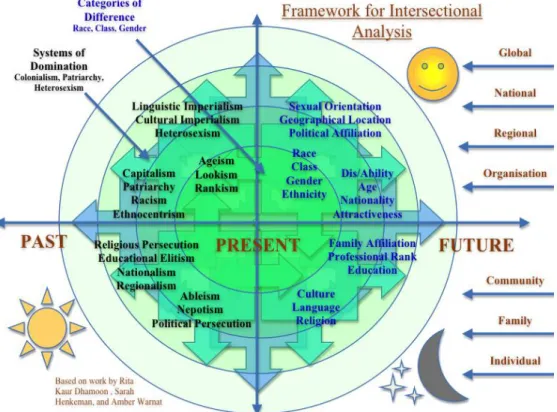
- Intersectional foundations of the conceptual framework
- Resonance with existing research
- Constructing the conceptual framework
- In-country, long-term Peacebuilding
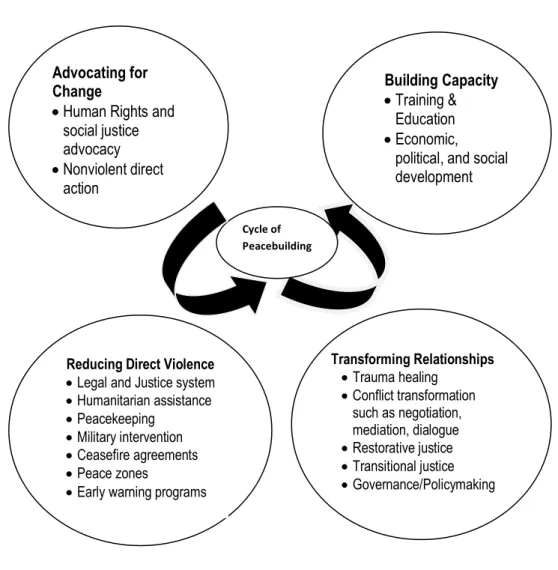
- Peacebuilding as concept
- Peacebuilding and Justice
- Peacebuilding and Transitional Justice
- Peacebuilding and unorthodox criminology
- Existing multiple conceptions and definitions of Peacebuilding
- Peacebuilding and Structural Violence
- Peacebuilding and Silence
- Peacebuilding and the goal of Structural Peace
- An intersectional conception of long-term peacebuilding
- Peacebuilding practice: The problem-solving workshop
- A concise history of peacebuilding practices in South Africa
- Traces of nascent long-term peacebuilding
- Local and imported conflict resolution models
- National Peace Accord structures
- The Criminal justice system
- Community Police Forums
- Truth and Reconciliation Commission
- Present peacebuilding efforts
- Conclusion
These goals form some of the normative foundations that peacebuilding and restorative justice share in South Africa's Constitution (1996). The criminal justice system is left to deal with what lies in the shadows of the 'miracle nation' master narrative. Trauma complicates the relationship between past and future, where what seems to belong to the realms of the past has ontological weight in the present.
This means that there is no break in the thinking that underpinned the establishment of the TRC on the one hand and the adoption of restorative justice principles and practices within the criminal justice system on the other – at least at a policy level.
Introduction: The personal is political
- Conceptions of restorative justice
- Interplay between restorative justice theory and practice
- Constructions of crime
- Crime as conflict
- Crime as harm
- The rise and policy transfer of contemporary restorative justice
- Individual and/or structural levels of analysis and action
- Maximalist-minimalist or continuum of agendas?
- Indigenous and ‘non-state forms of justice’ in South Africa
- Restorative justice, truth and reconciliation
- Restorative justice as peacebuilding practice
- Victim offender mediation practice
- Conclusion
This resonates with a modest view of restorative justice which focuses only on the intra- and interpersonal levels. Sherman & Strang (2007) conducted a meta-analysis and quantitative review of the impact of restorative justice research based on 36 international reports. According to her, restorative justice is based on the notion that an event determines right and wrong.
She argues that restorative justice ignores the past, and 'the social causes of all events'. It has been argued that restorative justice is characteristic of traditional African jurisprudence which is infused. Boyes-Watson puts her finger on the issue that is at the heart of the logic of an expanded view of restorative justice processing.
The elements incorporated into the constructions of crime and the criminal through various restorative justice positions are displayed in the exhibition. Many restorative justice theorists trace the roots of restorative justice to indigenous and religious practices. In particular, this study sought to gain a clear understanding of whether restorative justice processing responds to the consequences of restorative justice.
Micro-level restorative justice practices as exemplified in the pre-trial and pre-trial process. The concepts of victim-offender mediation and restorative justice are used interchangeably in the literature (Miers, 2001, Latimer, Dowden & Muise, 2005; Sherman & Strang, 2007), as restorative justice is a theory and processes such as victim-offender mediation, family group conferences, circles and other processes constitute his practice (Daly, 2002, Gavrielides, 2007).
Introduction: Rendering trans-generational and lifespan inequality visible
- Social Justice as positive peace
- Social Justice in the South African context
- Contextual background: Inequality and transition in South Africa
- Trends in historical writing
- History and positional inequality
- Accounts of the Pre-colonial period
- The seeds of inequality through constructed invisibility
- Inequality through a divisive gaze
- Inequality through asymmetry of power
- Inter-group inequality
- Colonial period: unequal constructed identities
- Inequality and murder
- Racial Inequality
- Inequality through destruction of political economy
- Inequality in death
- Inequality enforced by law
- Resistance to inequality
- The Apartheid period: legislated inequality
- Spatial Inequality
- Inequality and the Criminal justice system
- Embedded inequality
- Inequality and violence
- Widening racial inequality
- Some effects of inequality and violence
- Inequality and denial
- Early transition period: Attempts to address inequality
- Unity in diversity
- Growing inequality gap
- Intergroup and intra-group inequality
- Moral high ground
- Trans-historical inequality and the two worlds thesis
- Economic Policy implicated in cultural-structural-direct violence
- Some constitutive elements of inequality
- Post apartheid continuities
- Inequality and crime in post-apartheid South Africa
- Towards social justice – inequality on the agenda
- Application of the conceptual framework
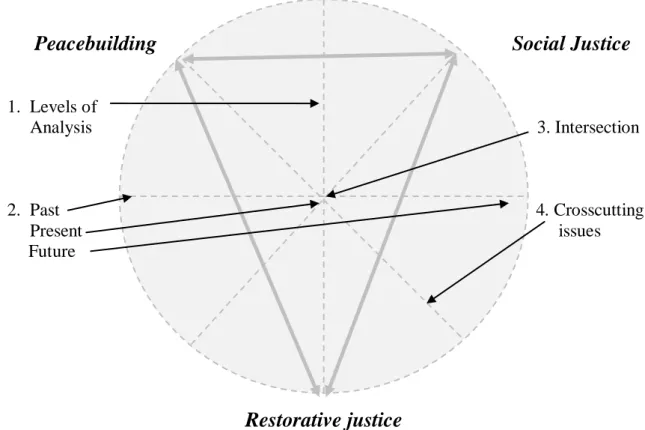
- Vertical: levels of analysis
- Horizontal: past, present, future analysis
- Cross-cutting analysis
- Intersections
- Visual display of the conceptual framework
- Display of core features of a multi-perspectival analysis
- Self awareness and default perspective
- The conceptual argument
- Conclusion
The adoption of this concept of social justice served as the guiding 'general idea of the good society' for this research (p.3). In a chapter entitled "The Atavism of Social Justice", Hayek (1978:58) suggests that the phrase is commonly used as a synonym for the term "distributive justice". He argues that the absolute emptiness of the phrase 'social justice' is revealed by the fact that there is no consensus about it.
In a similar vein, Novak (2000) argues that it is the precise meaning of the term “social justice” that is problematic. He argues that this has led to the destruction of the Xhosa political economy (Wilson 2007, web reference 11). He suggests that the 'peace settlement inscribed racial discrimination into the foundations of the new South African state'.
I vaguely remember we had to move because of the 'Group Areas' as it were. Regardless of the obvious answer, no one in South Africa escaped with their full humanity intact. The South African Constitution (1996) contains the society's high-level intentions in written form.
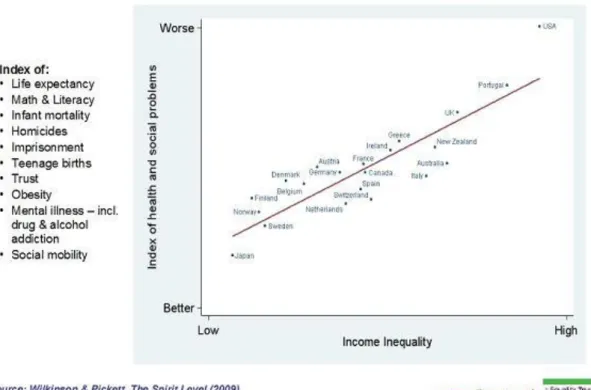
According to the government website, the coat of arms is the state's highest visual symbol. South Africa would fit into the first four countries as one of the most unequal countries in the world. The intersection of the horizontal dimension with the vertical and transversal dimensions has helped me understand the inherent nature of inequality in South Africa.
An inversion of the notion of social justice was used to guide a descriptive analysis of key constitutive aspects of South African history.
RESEARCH METHODOLOGY
Introduction: Nested case design and research methodology
- Reflexivity, positionality and research philosophy
- Qualitative research as ‘radical democratic practice’
- Contradictions, paradoxes, dilemmas
- Holistic, embedded and instrumental case study design
- Embedded sub-units
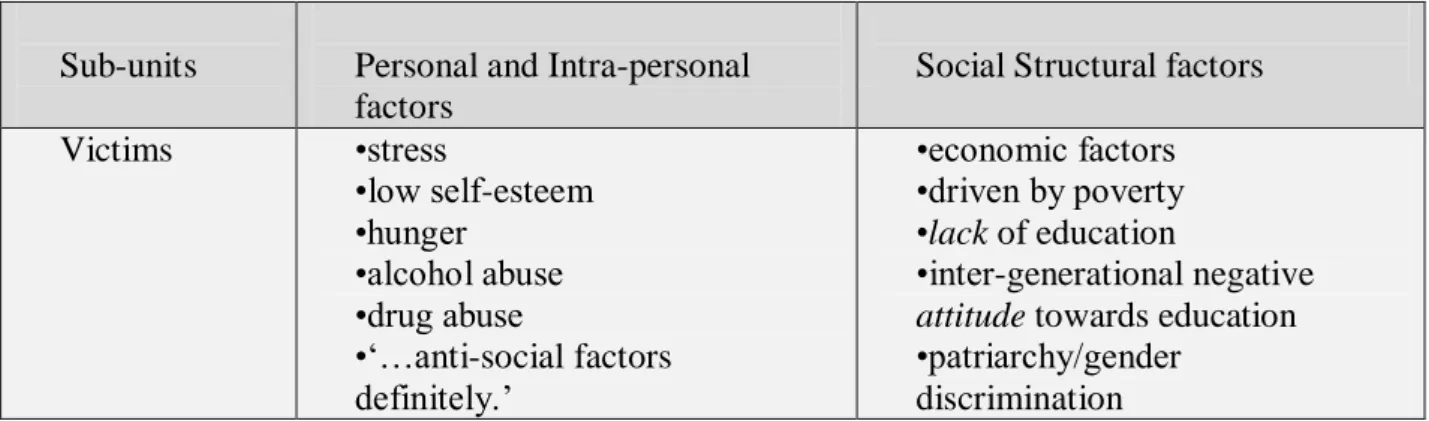
- Victims
- Offenders
- Prosecutors
- Mediators
- Key experts
- External sub-unit
- Sources and categories of information
- Journey of discovery
- The 360° degree research method
- Access granted
- Access denied
- Access delayed
- Serendipitous access
- Hard to reach participants
- Group Interview
- Paired and individual face to face interviews
- Observation
- Continuous contextual data gathering
- Desk Study
- Conclusion
Following Shohat & Stam (2005:14), I understand that an idealized idea of the west organizes knowledge in ways that are flattering to the Eurocentric imaginary'. Kincheloe, McClaren & Steinberg say, 'the bricolage consists of respect for the complexity of the lived world and the complications of power. Minimal post hoc quantitative methods were used to assess the relevance of some of the themes and ideas in the data (for example, in chapter nine, race-based prison statistics were used to pose questions about trans-historical constructions of 'the criminal'. South -Africa).
What is the mediator's role during and after the agreement phase of restorative justice treatment. Where it became clear that the questions on the research form were off limits. The use of the embedded and instrumental case provides insight into peacebuilding practices in unequal transitional contexts.
Each sub-unit in the 360° formation was chosen because of the unique perspectives that participants in that sub-unit can offer about restorative justice processing. Triangulated data collection methods were used to gain a nuanced understanding of the case and to find an answer to the research question. After receiving clearance, I had a meeting with the deputy director and the newly appointed national manager in charge of the Western Cape Province.
Secondary data sufficed and added depth and breadth of perspectives on the Norse sub-unit. Due to the fact that one of the parties arrived late, a mediation was postponed.

Introduction: Complex problem, complex analysis
- The analytical interviewing process
- The process of recording and transcribing
- Multiple methods of analysis
- Accumulated knowledge
- Member checking
- Another window on the ongoing reflection process
- The coding process
- Open coding
- Axial coding
- Selective Coding
- Data Displays
- Conclusion
The table for the group interview with six prosecutors and three paired interviews had three columns: the first to identify the speaker and sequence, the second for open coding, and the third for questions and answers. At this stage I did not consciously code a priori, but simply worked with the data as it was presented and with my impressions during interviews, within the broad parameters of the conceptual framework. In this regard, Dey (1993:65) argues that 'the exhortation to beware of prejudice is not an injunction against previous thought' and that we need 'accumulated knowledge' to enable us to use the data we have collected to analyse.
On the other hand, I found the many themes heuristically generated by the conceptual framework and the perspectives of different sub-units useful as they provided a deeper and broader understanding of the interrelationship between peacebuilding, restorative and social justice and the significance of South Africa's unequal, transitional context to the way peacebuilding and restorative justice are practiced. Black young men' are considered the 'face' of crime in South Africa and make up the majority of inmates in its prisons. Interdisciplinary literature and knowledge gained from qualifications within four disciplines (psychology, education (guidance and counselling), criminology and international conflict analysis) with one common thread – the pursuit of the positive.
Inductive methods such as theme analysis, combined with some general, less rigid ideas based on Charmaz's (2006) approach to grounded research, helped me become familiar with the smallest details to 'finer' the themes of this case ( Ryan & Bernard , 2003:95). Following Dey, before beginning the open coding process, I reviewed the original research proposal with my general knowledge of the research data in mind. Following Charmaz (2006:9), I adapted some practices of grounded theory by applying thematic analysis using in vivo and a priori codes.
In the two-week period, before transcribing the final interviews, I "tilted" (Ryan & Bernard 2003:88) the coded interviews on a daily basis. This denial is rooted in the mainstream 'miracle/rainbow nation' narrative that results in many South Africans turning a blind eye to anything that does not 'fit' the miracle/rainbow metaphor.
EMPIRICAL FINDINGS AND DISCUSSION
Introduction
- Comprehensive model of findings
- Deductive and Inductive analysis
- Findings based on deductive analysis
- Findings based on inductive analysis
- Triangulating and displaying the data on which findings are based
- Knowledge about crime in context
- Knowledge and restorative justice practice
- Opening the ‘black box’ of the victim offender mediation process
- Victim offender mediation in Norway as a ‘keyhole’ lens
- Country contexts
- Criteria for referral to a restorative justice process
- Victim offender mediation process – South Africa and Norway
- Conclusion
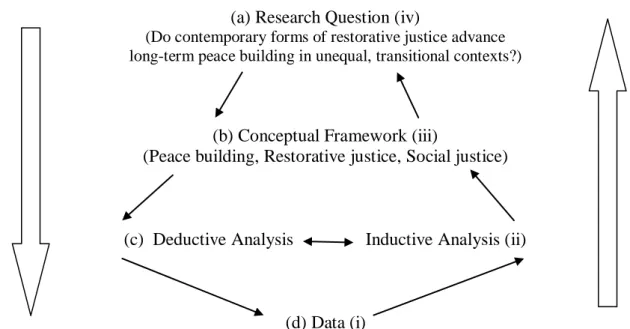
These broad themes are embedded in the data and relate to (i) knowledge about crime in context, and (ii) knowledge and restorative justice practice. These excerpts (a) amplify the voices of participants, (b) deepen understanding (of victim-offender mediation as a form of restorative justice processing, and of restorative justice processing as a sub-process of peacebuilding). The findings are based on excerpts from accounts about sub-units, from participants' knowledge and experience of the restorative justice process, as well as my own observation of victim offender mediation process.
In the South African context, there is a gap between restorative justice treatment and participants' tacit and explicit knowledge of the interplay between individual and structural factors that produce crime. From the accounts of all victims and offenders who participated in this study, they were generally impressed with the mediators and the restorative justice process. I begin with a keyhole comparison of victim-offender mediation in Norway and South Africa based on participants' accounts of what restorative justice treatment, specifically victim-offender mediation, entails.
I then move to outline the phases and stages of this form of restorative justice processing from participants' combined narratives and observation of a victim-offender mediation process. The basic mediation model used in victim-offender mediation as a restorative justice process does not respond to the interaction between individual propensity and South Africa's unique mix of historical, political, economic, legal, social and cultural context(s). The idea of partnership obscures the actual workings of restorative justice processing within the criminal justice system.
Judging from the perspective of the head of the restorative justice program quoted earlier, he seems unaware of the distinction. From my observation of a victim-offender mediation process in South Africa, the mediator approached the parties together to explain what restorative justice processing is all about.
Introduction: Diagnosing the problem
- Micro-level ‘interplay’ findings
- We know, but …
- Knowing and not-seeing
- Knowing and not-hearing
- Knowing and not-acting
- Knowing and a ‘Conspiracy of Silence’
- Flipping the lens: macro-level denial
- Conclusion
Introduction: Multiple and simultaneous intersections
- Answering the research question
- Why restorative justice processing does not address structural violence
- Possible reasons for denial
- Factors leading to interlinked gaps in restorative justice processing
- The case for interaction between inequality and crime
- De facto societal criminalisation of (poor) black people
- Locating the findings in multidisciplinary theoretical and research literature
- Implications for restorative justice practice
- Towards structurally responsive restorative justice
- Dealing with the conceptual and contextual gaps
- Dealing with the training and practical gaps
- Restorative justice within a peacebuilding and social justice framework
- Further reflections on the overall findings
- Limitations of the study
- Access to participants
- Literature related limitations
- Methodology
- Further research
- Conclusion
CONSCIOUSNESS AND CHANGE
Introduction: Agency/structure, nature/nurture, micro/macro
- Overall objective and specific aims
- Broader theme: peacebuilding in unequal, transitional contexts
- Sub-theme 1: knowledge about crime in context
- Sub-theme 2: knowledge and restorative justice practice
- Denial: procedural blindness, substantive deafness, complicit silence
- Concluding remarks
- Research methodology
- Conceptual/theoretical framework
- Implications for training and practice