Two of the ITS studies evaluated the implementation of an advertising ban and one study evaluated the lifting of such a ban. A meta-analysis of the two studies evaluating the implementation of a ban showed an overall mean non-significant increase in beer consumption in the general population of 1.10%. The included studies did not address other pre-specified outcomes (including economic loss or hardship due to reduced alcohol sales) and no adverse effects were reported in any of the studies.
We found four studies that evaluated the restriction or ban of alcohol advertising via any format. Two of the three ITS studies evaluated what happened after an advertising ban was introduced by two different Canadian provincial governments. One such strategy is the restriction or ban on all forms of advertising of alcohol.
The first part of the tool allows for a description of what was reported to have happened in the study. We used criteria recommended by the Cochrane EPOC Review Group to assess the methodological quality of ITS studies.
Health-specific databases
Economic and marketing databases
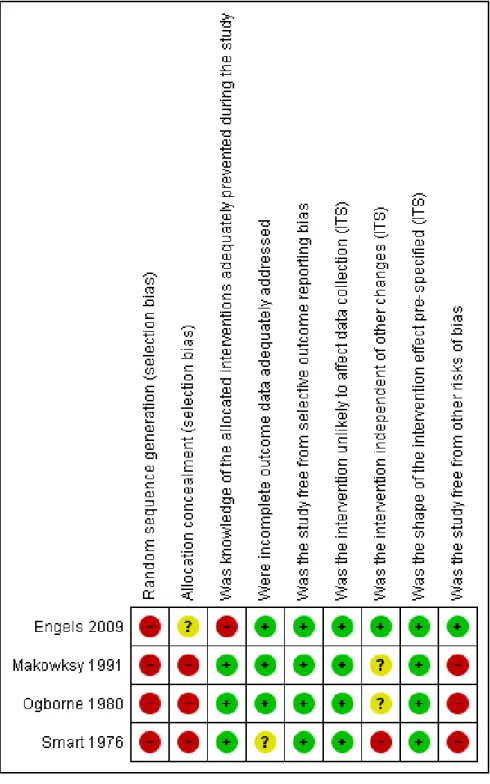
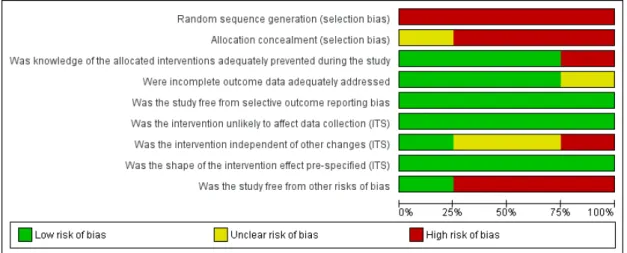
The blanket ban on advertising for spirits, which was part of the 58-year ban, continued and was not lifted. We assessed risk of bias using the combination of the standard assessment for RCTs and the EPOC assessment specific to ITS studies (see Appendix 5 and Appendix 6). We provide a full description of the risk of bias for each included study in the Characteristics of included studies table, which is summarized in Figure 2 and Figure 3 .
In the three ITS studies, we assessed the risk of efficacy and detection bias to be low, as the outcomes were objectively measured by routine data collection and the results were unlikely to be influenced by knowledge of the intervention groups. We considered that none of the studies were at risk of selective reporting bias. There is a possibility that other political or social changes may have coincided with the period of prohibition, so we rated this study as having a high risk of bias.
Using the GRADE approach to assess the overall quality of the evidence, we rated the quality of the evidence generated from the RCT as very low for the alcohol consumption outcome (summary of findings for the main equation). This was due to a serious risk of bias, the severe indirectness of the included population, and the severe inaccuracy in the results, mainly caused by the small sample size. A meta-analysis of the two studies evaluating the implementation of a ban showed a non-statistically significant average percentage increase in beer consumption among the general population after the ban.
When we used the GRADE approach to assess the overall quality of the evidence, we rated the quality of the evidence generated by the RCT as very low for the outcome of alcohol consumption (Summary of findings for the main comparison). This was due to the risk of bias, indirectness of the included population and inaccuracy present in the results, mainly driven by the small sample size. The three ITS studies were well conducted and met most of the criteria outlined by the EPOC 'Risk of bias' assessment.
Unclear risk No report of historical or political reasons supporting the decision to lift the ban Was the form of the intervention effect. Risk unclear No report of historical or political reasons supporting the decision to implement the ban Was the form of the effect of the intervention. It is likely that other political or social changes coincided with the period of prohibition.
No numerical data was presented in the report, only a graphical representation of the stimulus-response curve and therefore we were unable to extract any useful data. The report states that alcohol consumption in France fell before the prohibition law was introduced and that internal surveys have produced conflicting results.
Low-alcohol content movies versus high-alcohol content movies
Non-alcohol commercials versus alcohol commercials
High-alcohol content movies versus low-alcohol content movies adjusted for clustering effects
Alcohol commercials versus non-alcohol commercials adjusted for clustering effects
Total advertising ban versus Partial advertising ban Abrupt permanent model
Total advertising ban versus Partial advertising ban Gradual permanent model
Alcohol ban versus no ban
Comparison 1 Low-alcohol content movies versus high-alcohol content movies, Outcome 1 Total alcohol consumption in number of glasses
Comparison 2 Non-alcohol commercials versus alcohol commercials, Outcome 1 Total alcohol consumption in number of glasses
Comparison 3 High-alcohol content movies versus low-alcohol content movies adjusted for clustering effects, Outcome 1 Total alcohol consumption
Comparison 4 Alcohol commercials versus non-alcohol commercials adjusted for clustering effects, Outcome 1 Total alcohol consumption
Comparison 5 Total advertising ban versus Partial advertising ban Abrupt permanent model, Outcome 1 Volume of alcohol (beer, wine and spirits) sales in kilolitres
Comparison 5 Total advertising ban versus Partial advertising ban Abrupt permanent model, Outcome 2 Volume of beer sales in kilolitres
Comparison 5 Total advertising ban versus Partial advertising ban Abrupt permanent model, Outcome 3 Volume of wine sales in kilolitres
Comparison 5 Total advertising ban versus Partial advertising ban Abrupt permanent model, Outcome 4 Volume of spirits sales in kilolitres
Comparison 6 Total advertising ban versus Partial advertising ban Gradual permanent model, Outcome 1 Volume of alcohol (beer, wine and spirits) sales in kilolitres
Comparison 6 Total advertising ban versus Partial advertising ban Gradual permanent model, Outcome 2 Volume of beer sales in kilolitres
Comparison 6 Total advertising ban versus Partial advertising ban Gradual permanent model, Outcome 3 Volume of wine sales in kilolitres
Comparison 6 Total advertising ban versus Partial advertising ban Gradual permanent model, Outcome 4 Volume of spirits sales in kilolitres
Comparison 7 Alcohol ban versus no ban, Outcome 1 % Change in beer consumption
PubMed search strategy
EMBASE search strategy
Cochrane Library search strategy
PsycINFOsearch strategy
S5 THE Wyn* OF AB Wyn* OF THE Drank* OF AB Drank OF THE Spirits OF AB Spirits OF THE Bier* OF AB Bier*.
Risk of bias’ criteria for RCTs, CCTs and prospective observational studies
Blinding of participants and providers and it is unlikely that blinding was broken. There is no blinding or incomplete blinding, and the result is likely to be affected by lack of blinding. Blinding of participants and key study personnel was attempted, but it is likely that blinding could have been broken and the outcome likely affected by lack of blinding.
No blinding of outcome assessment, but the review authors estimate that the outcome measurement is probably not affected by lack of blinding. Blinding of outcome assessment ensured and unlikely that blinding could have been breached. No blinding of outcome assessment and outcome measurement likely to be affected by lack of blinding Blinding of outcome assessment but likely that blinding could have been broken and outcome measurement likely to be affected by lack of blinding. Incomplete outcome data No missing outcome data, reasons for missing outcome data unlikely to be related to true outcome, or missing outcome data balanced in number across groups.
For dichotomous outcome data, the proportion of missing outcomes compared to observed event risk is not enough to have a clinically relevant effect. Reason for missing outcome data is likely to be related to true outcome, with either imbalance in numbers across groups or reasons for missing data. For dichotomous outcome data, the proportion of missing outcomes compared with observed event risk is enough to induce clinically relevant bias in intervention effect estimates.
For continuous outcome data, plausible effect size (difference in means or standardized difference in means) among missing outcomes is not sufficient to have a clinically relevant impact on observed effect size. For continuous outcome data, credible effect size (difference in mean or standardized difference in mean) among missing outcomes sufficient to cause clinically relevant bias in observed effect size. The study protocol is not available, but it is clear that the published reports include all expected outcomes, including those pre-specified (persuasive text of this nature may be unusual).
One or more outcomes of interest to the review are reported in full, so they cannot be included in the meta-analysis. The study report does not include results for the key outcome that we would expect to be reported for such a study. Allocation was by community, institution or practice and the control group was unlikely to have received the interventional randomized controlled trial. It is possible that there was communication between the intervention and control groups.
Risk of bias’ criteria for ITS studies
Exposure Assessment The information in the study was obtained from a secure record (for example, clinical records or a structured interview). The authors explicitly state that the primary outcome variables were assessed blindly, or that the outcomes are objective, e.g. Primary outcomes are those variables that match the primary hypothesis or question as defined by the authors. If some primary outcomes were blinded or influenced by missing data and others were not, each primary outcome can be scored separately).
It is unlikely that the missing outcome measures affected the results (eg, the proportion of missing data was similar in the pre- and post-intervention periods, or the proportion of missing data was less than the effect size, meaning that the study is unlikely to be rejected again ). sult). There is no evidence that results were selectively reported (eg, all significant results in the methods section are reported in the results section).
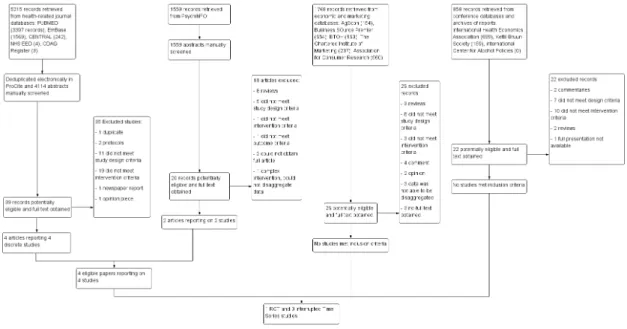
May 2014 search: records retrieved per database
Results of searches of economic and marketing databases
Results of conferences and manual report archives searched
The oral and poster presentations were published in the journal, Alcoholism: Clinical and Experimental Research and therefore should have been identified in the journal database searches.