A qualitative, case-based study of the existing and proposed South African electricity supply industry was conducted. If the restructuring is successfully implemented, customers in the South African electricity supply industry can expect high quality electricity at a competitive price.
INTRODUCTION
BACKGROUND
Precisely in the above context, the government has insisted that the restructuring of the electricity sector should continue. Within this policy context, the Government again identified four primary objectives for reforming the institutional structure of ESI.
RESEARCH OBJECTIVES
The rationale behind the proposals is that the optimal area for efficient performance and sustainability of electricity networks is much larger than the area of any single municipality.
STRUCTURE OF STUDY
It describes the South African ESI and the reasons for the transformation of this sector. Chapter 5 analyzes the South African ESI using the strategic tools and techniques discussed in Chapter 2 and the information presented in Chapter 4.
METHODOLOGY
According to Yin (1999), the main feature of a case study is its focus on a single phenomenon within its real-world context. Leedy and Ormrod recommend that the sources of data collection for a case study methodology should include interviews, textbooks and conference papers, journal articles, and Internet websites.
TRIANGULATION
As this study uses interviews, informal discussions, archival analysis of textbooks, brochures, journals, online articles and conference proceedings, triangulation of sources will be used to check the consistency of the results. Theory/perspective triangulation will also be used to determine how findings are affected by different assumptions.
EVALUATION OF STUDY
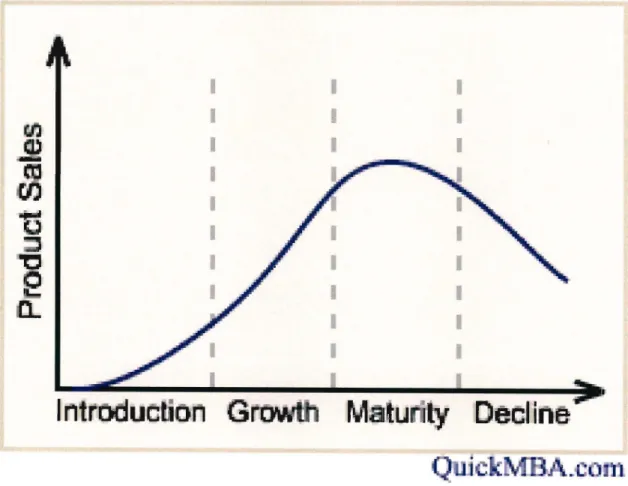
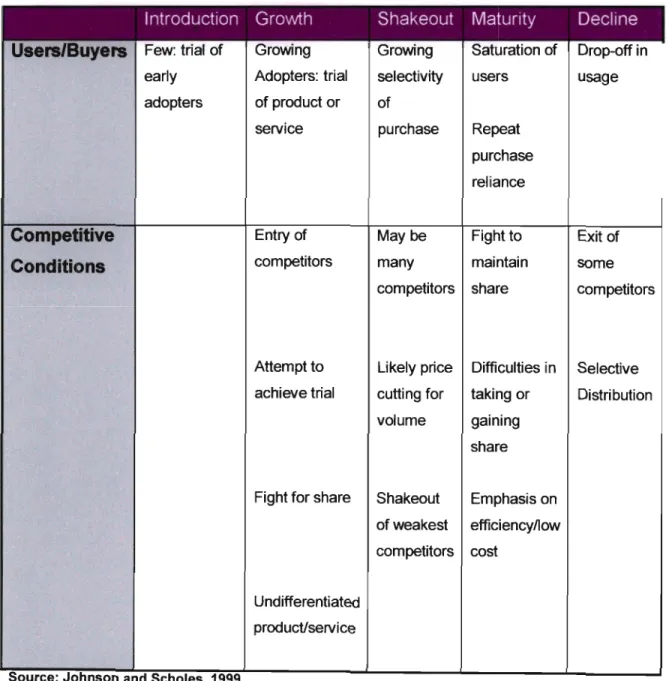
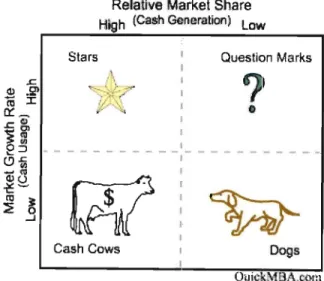
The qualitative data set derived from the PEST analysis, Porter's Diamond, Porter's Five Force analysis, Industry Lifecycle analysis and Competitor analysis will be applied to multiple theories such as the SWOT matrix, Grand Strategy Matrix, Model of Grand Strategy Clusters, Lifecycle Model and Generic Strategies. . This research will use source and theory triangulation to increase credibility and internal validity.
LIMITATIONS
The researcher will also have a clear data analysis process and use skeptical peer review to increase reliability. The use of triangulation and skeptical peer review in the research will also increase its confirmability and objectivity.
CONCLUSION
INTRODUCTION
WHAT IS STRATEGY?
Johnson and Scholes define strategy as the direction and scope of an organization over the long term: what benefits the organization through its configuration of resources within a changing environment, to meet the needs of markets and to meet stakeholder expectations to meet Chandler (1962) defined strategy as the determination of the long-term goals and objectives of an organization, and the adoption of actions and alignment of resources necessary for the achievement of these goals.
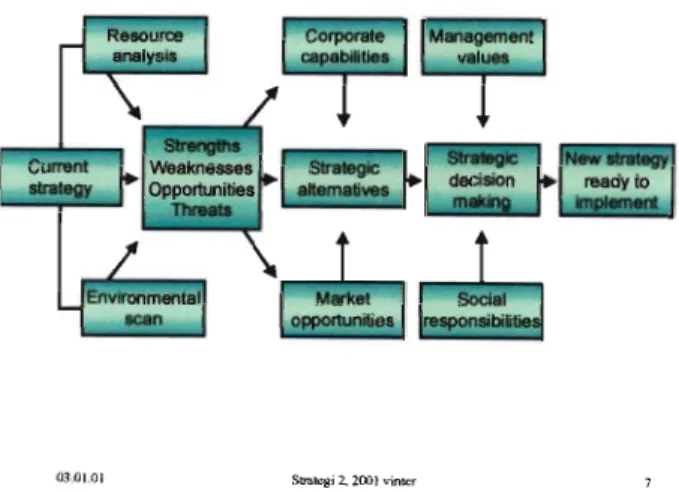
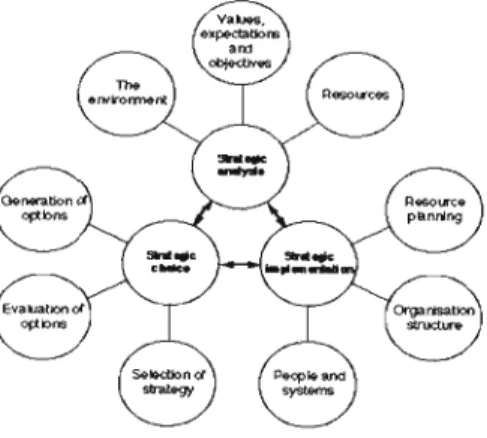
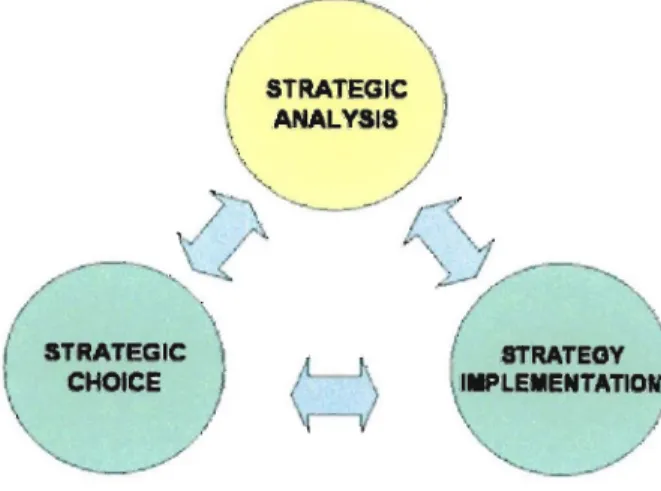
STRATEGIC MANAGEMENT PROCESS
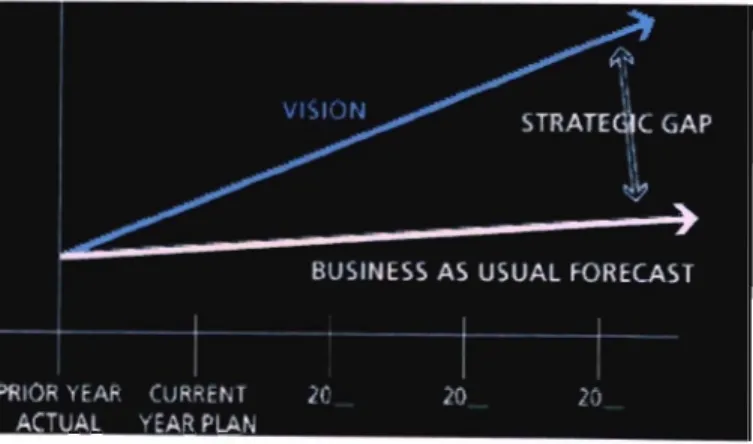
The objectives are the precise statements of the purpose of the organization (Johnson and Scholes, 1999:12). Strategic planning is used as a formal planning system for the development and implementation of the strategies related to the mission and objectives of the organization (Lynch, 2000:780).
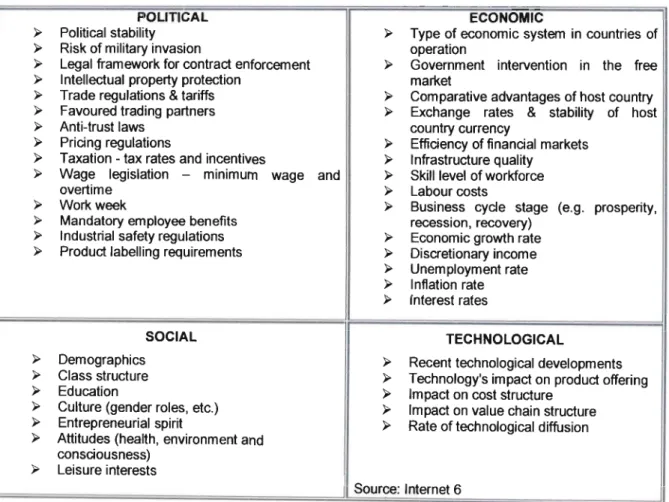
ENVIRONMENTAL ANAL VSIS
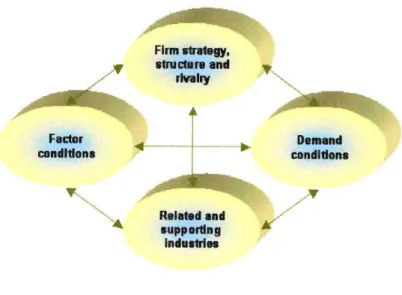
PORTER'S DIAMOND
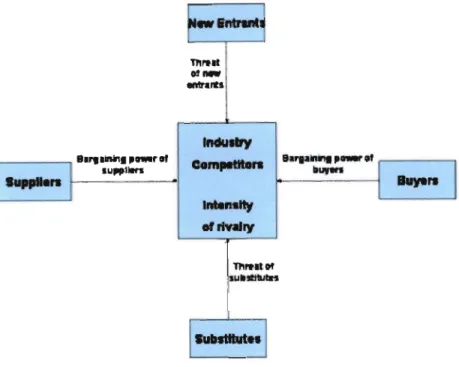
Industry analysis can be done using a framework developed by Michael Porter known as Porter's Five Forces Model (see Figure 2.6). Exit barriers – when the barriers to exiting an industry are high (e.g. the cost of closing factories) – competitors tend to be more competitive (Internet 6).
INTERNAL ANALYSIS
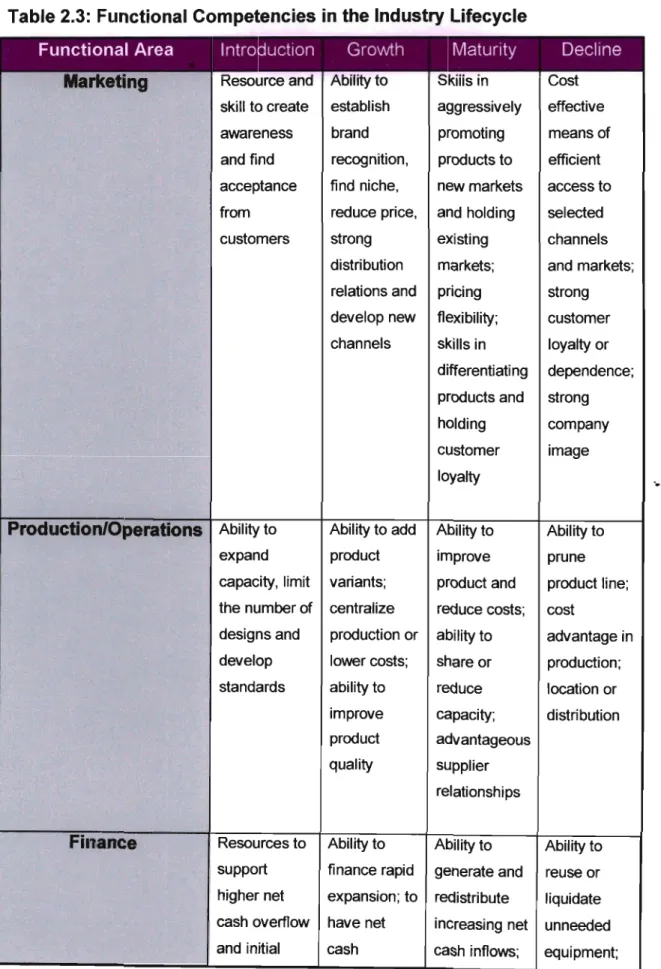
The value chain includes all the information and physical activities that flow within and between an industry and its suppliers, distributors, and customers. Financial resources to assets to assets to assets to support financing, rapid generation and reuse or higher net expansion; to redistribute the cash overflow, increasing the net unnecessary and initial cash inflow; equipment;. Staffing flexibility in the ability to add Ability to add cost capacity to staff and effectively trained; reducing and training new staff; reduce work, reallocate management; motivated strength and workforce;
Engineering ability for ability in ability for ability to make quality and reduce costs, to support the new engineering function to develop other increased changes, development; variants and fields or have the ability to start differentiating apply technical products in product development to it.
IDENTIFICATION OF KEY ISSUES
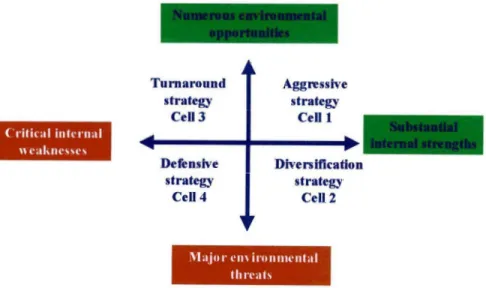
In the grand strategy choice matrix, the main purpose of the grand strategy (to overcome weaknesses or to increase strengths) is compared with the choice of an internal or external focus for growth and profitability (Pearce and Robinson, 1997:265). One of the goals is to extend the life cycle of existing products or to take advantage of the brand. The second phase of the turnaround strategy is recovery and involves creating new strategies.
The market penetration strategy is less risky, as it makes use of many of the firm's existing resources and capabilities.
STRATEGIC EVALUATION
The acceptability of a strategy is about the expected performance results if the strategy were implemented and the extent to which they would fit the stakeholders' expectations (Johnson and Scholes, 1999:319). Returns can be analyzed using profitability analysis, cost-benefit analysis and shareholder value analysis. Risk can be analyzed using projections of financial ratios, sensitivity analysis and simulation modeling (Johnson and Scholes, 1999:337).
Stakeholder mapping can be used to assess stakeholders' likely responses to new strategies, the ability to manage these responses and thus the acceptability of a strategy (Johnson and Scholes, 1999: 348).
CONCLUSION
The acceptability of strategies can be assessed according to three aspects: the expected return of the strategy, the level of risk and the likely response of stakeholders. Game theory can also be used to evaluate the likely response of competitors to a change in strategy (Johnson and Scholes, 1999:350). Feasibility refers to whether the organization has the resources and competencies to implement the strategy (Johnson and Scholes, 1999:319).
Some of the different analytical approaches to assess feasibility include asset flow analysis, break even analysis and resource utilization analysis (Johnson and Scholes, 1999:350).
INTRODUCTION
INTERNATIONAL TRENDS IN ELECTRICITY MARKET REFORM
In the monopoly model, the generation, transmission and distribution of electricity to the final customer is carried out by one vertically integrated utility company. The system operator addresses the limitations, largely by adjusting the dispatch schedule, and supporting services (e.g., reactive power and voltage regulation) are purchased by the system operator. System balancing is managed by the system operator based on separate price lists for increases or decreases in actual generation production or consumption (balancing market).
The costs for system operation and balancing are added to the pool price as a withdrawal payment.
CONCLUSION
INTRODUCTION
BACKGROUND
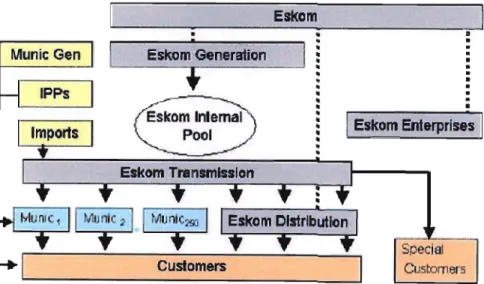
The legislation requires anyone wishing to generate, transmit or supply electricity to apply to the NER for a licence. This is issued on the basis of criteria aimed at promoting and maintaining a viable electricity supply industry. In September 1999, NER unveiled its restructuring plan, outlining a new structure and several key strategic regulatory issues.
These include a regulatory framework for independent power producers, the restructuring of the distribution sector, the promotion of the promulgation of an Electricity Regulatory Bill and the further development of the wholesale electricity tariff (DME, 2000).
REASONS FOR THE EOI RESTRUCTURING
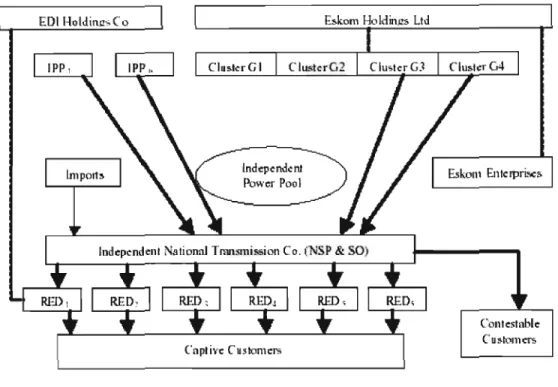
The current agreements in the ESI are the result of the historical development of the sector and do not form a coherent pattern. Major differences in tariff structures, caused by the high degree of fragmentation of the sector (domestic tariffs of municipalities ranging from 16 to 60 c/kWh). As a result, many of the sector's fundamental economies of scale are lost.
Many of the companies are too small to invest in developing the specialist skills and training required for a modern distribution business.
OBJECTIVES FOR THE SOUTH AFRICAN ENERGY SECTOR
CONCLUSION
The government believes that industry operations will need to be continuously optimized to maximize the potential for adequate, reliable and low-cost electricity to serve the people and industry of South Africa. To ensure this result, the rationalization of the distribution sector of the electricity economy by reducing the number of distributors to a much smaller number will be necessary as an initial goal. As investigations have shown, it is the distribution sector that most urgently needs reform.
Eventually, however, these measures must translate into an electricity supply industry that is financially sustainable, technically sound and well managed.
INTRODUCTION
VISION AND OBJECTIVES FOR THE SOUTH AFRICAN ELECTRICITY SUPPLY INDUSTRY
These measures will ensure that the electricity supply industry is able to be the engine of growth, development and prosperity for South Africa. One of the most widespread confusions about market reform is the perception that it is always designed to reduce electricity prices. Maximize the financial and economic return to the state, both from the point of view of increased opportunities for debt reduction and increased tax revenue.
To protect public benefits such as greater access to the poor, energy efficiency, continuous research and development and environmental sustainability (Internet 15).
ENVIRONMENTAL ANAL VSIS
The level of income inequality in South Africa, as measured by the Gini coefficient, is one of the highest in the world. Technological changes related to metering and billing have also opened the possibility for a range of companies to compete in the final retail sale of electricity to consumers. Lewis (2000:3) also refers to these specific issues when he suggests several objectives that a system of regulation and competition must meet in the context of South Africa.
Porter's diamond is used to analyze factors of national advantage (or weakness) in the South African electricity supply industry.
COMPETITIVE ENVIRONMENT - FIVE FORCE ANAL VSIS
Currently there is not much competition, but this would change with the introduction of competitive markets. Due to the introduction of competition, electricity suppliers will also have to deal with generic substitution by other private electricity suppliers. The main factor determining the increasing bargaining power of electricity users is the high volume of standardized product consumed.
Suppliers can exert their bargaining power over participants by threatening to raise prices or lower quality.
IDENTIFYING COMPETITIVE POSITION .1 Market Segmentation
A problem with the distribution system is that prices do not accurately reflect relevant costs and a differentiated pricing system is in use. For example, mining operations pay from 9 to 17 cents per kWh in the Gauteng province, and anywhere from 23 to 32 cents per kWh in the Mpumalanga province. Average distribution costs (including purchased energy) range from 23.9 cents per kWh for distributors of less than 1 gigawatt hour (GWh) in annual sales to only 13.4 cents per kWh for distributors of more than 1,000 GWh in annual sales, a 46%.
COMPETITOR ANALYSIS
In addition to the extensive use of coal in the domestic economy, large quantities are exported, with South Africa being the second largest exporter of steam coal. South Africa is recognized globally as having one of the most cost-effective electricity energy solutions and as a country developing breakthrough new technologies to support economic growth. The SWOT analysis focuses on socio-political, economic, technological and environmental factors in South Africa as they impact the sector.
South Africa has extensive coal resources and Eskom's generation strategy and technology have resulted in one of the world's cheapest electricity producers.
Weaknesses
- EVALUATION OF STRATEGIC CHOICE
- SWOT MATRIX
- CONCLUSION
- INTRODUCTION
- CONCLUSION
- RECOMMENDATIONS
Organizations in the South African electricity supply industry pursued major vertical and horizontal integration strategies. This involves introducing competition into the failing monopolistic electricity supply industry and divesting parts of the industry to ensure sustainable economic viability. South Africa boasts a modern electricity supply industry that is equal to the best in the world.
The start of the new millennium signals the end of an era and the beginning of a new era in the electrification of South Africa.