Aims of the Study
Specific Objectives of the Study ........................ "
Study Approach
To investigate the desirability of using a labour-based longman system as an alternative to the existing capital-intensive methods of rural maintenance in Zambia.
A unit of currency reduction in road maintenance expenditure can increase the cost of vehicle operation by more than one unit of the corresponding currency. In his book, Thagesen (1996) writes that the main causes of the road maintenance problem in most developing countries are; insufficient funds, lack of foreign exchange, lack of qualified staff, lack of machinery and spare parts, deficient institutional arrangements and poor management capacity.
Rural Road Maintenance and Labour-Based Methods
Basic Maintenance Operations of Rural Roads
- Routine Maintenance
- Periodic Maintenance
- Emergency Maintenance ..... . ... . . .. ..... .. ... ........ .... ,,"",
Rural Road Routine Maintenance Activities
Malawi became aware of the district council's inability to maintain rural roads in the mid-1970s. A large part of the road network (both paved and unpaved) was constructed in the decade between 1965 and 1975. The management and operation of the road maintenance programs is generally handled through power accounting.
Zambia has gained experience in using labour-based methods for road repair and maintenance during the first two pilot projects. a) The District Road Improvement and Maintenance project, as mentioned above, and b) The Road Maintenance Programme, supported by the Finnish Development Agency. Two major policy areas were identified, namely strategies and operational: .. provision of adequate funds for road maintenance .. establishment of an appropriate institution for the management of the roads sub-sector b) Operational policies. rationalization of available resources to ensure optimal implementation of maintenance programs. identification and subsequent application of appropriate technologies to ensure minimal costs. the application of purely labor-based methods on roads with little traffic. a mixed technology of labor-based methods and tractor-pulled graders for more heavily used roads. the use of tractor-based equipment in areas where labor is not available. Both the Government of Lesotho (GOL) and the Lesotho Highlands Development Fund (LHDF) provide support to CWS. d) The Lesotho Highlands Development Authority (LHDA).
Improve DISS capacity to enable more visits to the Des site; and finally .. the awarding of large maintenance contracts to encourage smaller contractors, especially those based on work, a better opportunity so that the shows are outsourced to DISS or DC. e) Mobilization of local resources is an important element for future operations in the maintenance of rural roads, especially in the face of a constant lack of finance and trained manpower.
Labour-Based Routine Maintenance of Rural Roads under the Lengthmen System
The Original Concept of the Lengthmen System
Country Background
The length of the road network increased but there was little money for road maintenance (MeT, 1997). It has also been found appropriate to concentrate most of the interview in the wet season (Taylor, 1992; \LO ASIST, 1996).
Past and Current Perfonnance ..... _
Transport Policy
- Rural Travel and T ransport
To produce suitable motorized and non-motorized means of transport aimed at improved mobility in rural areas. Encourage the development of industries for the design, manufacture, repair and maintenance of medium motorized and non-motorized transportation equipment in rural areas; And.
The Road Sector
- Financing of Road Rehabilitation and Maintenance
- Government
- The Road Fund
- Shortfa ll in Funding
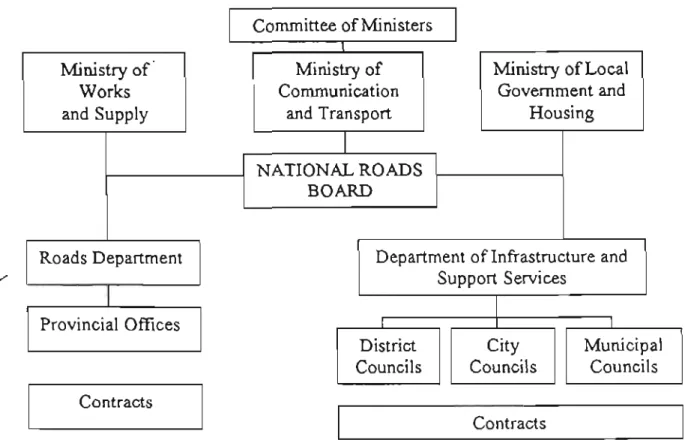
- The N ational Roads Board - Its Role and Functions
- The Road Sector Investment Pro gramme (ROADSIP)
- Road Mnintenance and ROAD SIP .. ............................................. .. .4 1
- Comments
It is financed by a tax on fuel, which amounts to 15% of the wholesale price of fuel and flows into the Road Fund for financing road maintenance. The result in Zambia was the establishment of a road fund and the National Roads Board (NRB).
Existing Structures and Procedures for Rural Road Management
- Department of Infrastructure Support Services
- National Roads Board
- Zambia National Tender Board
- Current Co mmunication and Pl anning Procedures
- Communication Procedures
- Planning Procedures
- Functions and Linkages in the Planning Phase
- Provincial Plarming and Supervision Consultants................ . .. 5 I
- Contract Managem ent Units .............. "
- Capabilities of Existing Staff
- Availability of Facilities
- Existing Rural Road Maintenance Constraints
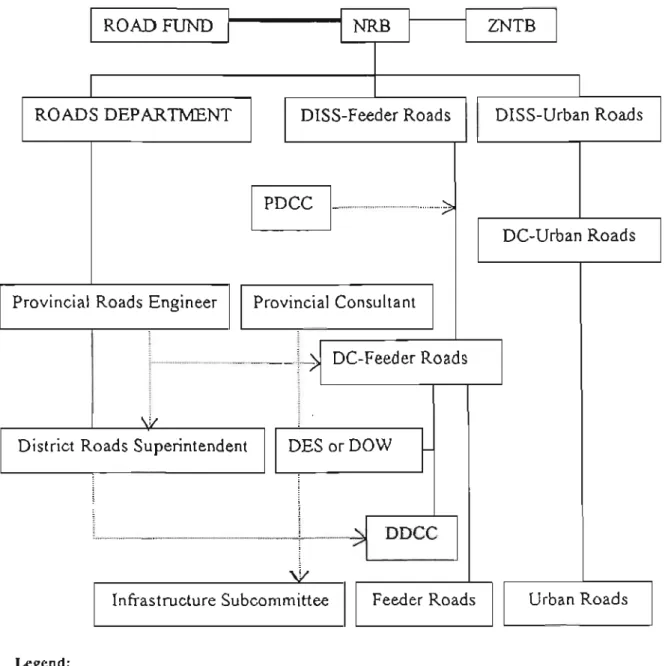
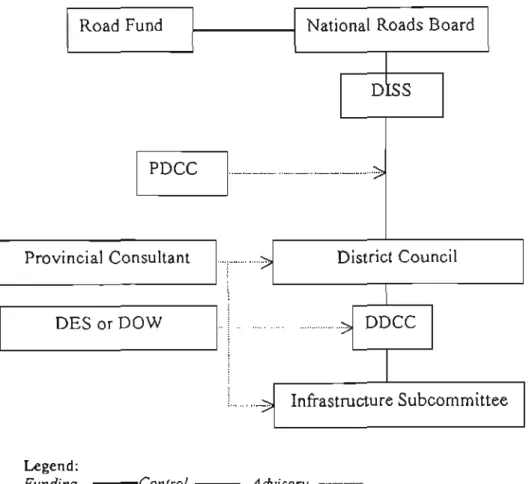
The communication channels for the management units for mam rural roads are shown in Figure 3.5 on the next page. However, recent contract management activities in UNDP rural road projects (work-based) in the Eastern Province show that the councils can competently manage most steps. However, the reality is that there are few small contractors in many of the rural areas (MLGH, 1999).
Labour-Based Road Works in Zambia
- Introduction
- Previous Projects
- Current Labour-Based Pi lot Projects
- Chongwe-Kanakantapa .. . .... . . .... ... _
- Kasisi-Ngwerere
- Rehabi litation and Maintenance of Feeder Roads in the Eastern
- Comments
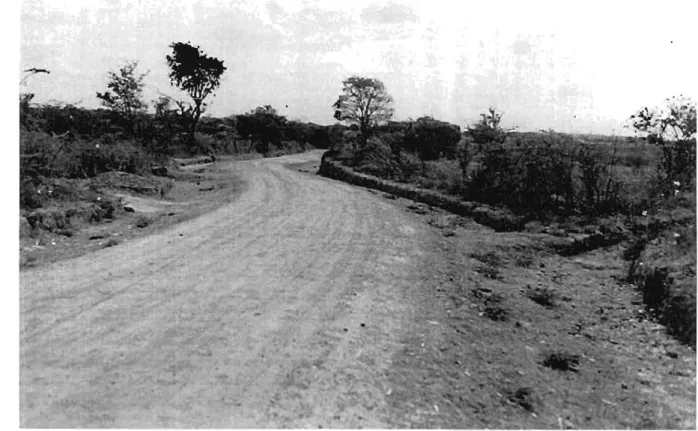
The site was opened as a demonstration site for small contractors attending rehabilitation, improvement and maintenance work courses. This road serves as a demonstration site for the training of small-scale contractors from the Eastern Province of Zambia (see next section). Supervisory personnel at the construction site were trained to effectively supervise and inspect labor rehabilitation and maintenance works carried out by the private sector (GRZ-UNDP, 1999).
Introduction
Basic routine maintenance of the entire network is inadequate due to a series of financing, equipment and manpower constraints. One person is responsible for all manual routine maintenance work on a section of road, typically 1.5 to 2.0 km long. The system depends on the mobility of the supervisors for routine maintenance and top priority is given to the purchase and maintenance of their motorcycles.
The routine maintenance supervisor's supervisory workload is eased by setting the appropriate driver adjustments. High priority should be given to the mobility of Routine Maintenance Supervisors and Maintenance Officers in Charge. Under routine maintenance, each workshop was given a section of road, about 1.5 km long, to maintain.
This figure is an average and subject to fluctuations depending on the condition of the road to be maintained.
The Road Network and Maintenance Problems
Kenya's ' Roads 2000' Concept and the Future
Outline of the 'Roads 2000' Approach
Routine Maintenance of Minor Roads and the Lengthmen System in Kenya
- Lengthmen Contract System in Kenya and Its Key Features
- Maintenance Objectives of the Minor Roads Programme
- Technical Standards
- Maintenance Organisation and Responsibilities
- Organisation Structure
- Responsibilities
- Routine Maintenance - Organisation and Management
- Comments
Approx. 75% of the direct costs of the system are estimated to be paid directly to the contractors. The system also makes it possible to carry out maintenance throughout the year on each part of the road. The long-term contractor is ideally someone who has worked on the construction or improvement of the road.
Country Background
Major Problems Facing Rural Communities in Lesotho
There is a continuous brain drain of technical staff in Lesotho who prefer to work in other countries for better pay.
Government Policy
Privatization of all activities that can be done efficiently by the private sector is also highly valued by the government.
Road Sector Activities and Organisation
As previously mentioned, LeU has been involved in work-based works since 1977 and is one of the most experienced organizations in the world in this type of activity. Kenya and Lesotho have adopted the labour-based long man system for routine maintenance of rural roads. There are nevertheless pilot projects in the Eastern Province (see section 3.6.3.3) involving smaller labour-based contractors. b) Equipment.
Based on the above information, a work-based length system has the potential to improve the maintenance of rural roads in Zambia and is therefore a desirable solution. The prevailing situation in Zambia (see Section 7.4) shows that maintaining rural roads through labor is feasible.
The Labour Construction Unit (LCU)
LCU Objectives
LCU Establishment
Responsibilities
Current Status ofLCU
Funding
Existing Challenges
The daily wage rate is a very important factor in assessing whether labor-based methods are economically appropriate.
The Use of Consultants
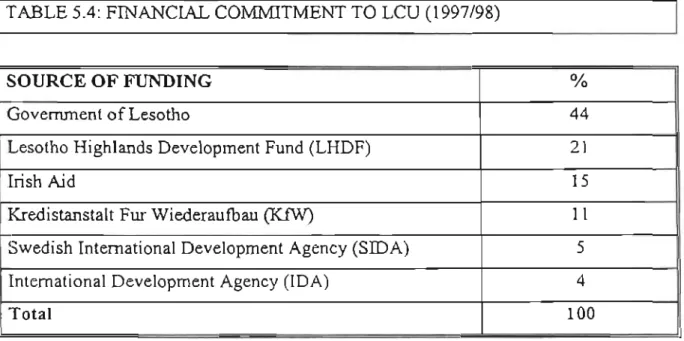
Since 1980, KfW has been helping LeU with the main goal of promoting the labor-intensive upgrading of rural roads in order to create jobs and rural infrastructure for rural communities. It has funded four phases so far and is currently funding phase 5 as shown in Table 5.2 on the next page. There are other projects funded by the Lesotho Highlands Revenue Development Fund (LHRDF) as shown in Table 5.3 below.
Activities of the Technical Section
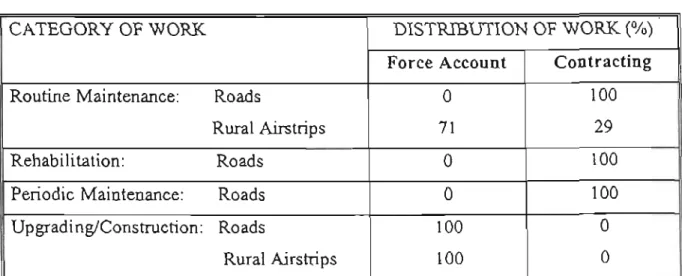
Leu has a large fleet of equipment and vehicles used for the construction and maintenance of roads. LeU's main field activities are maintenance of roads and airstrips, rehabilitation of roads, upgrading and construction of rural roads and airstrips using labor-based methods through force accounting and contracting.
Routine Maintenance
Genera!
Technical standards have been developed and detailed in the MRP road maintenance and technical manuals. This factor did not affect the viability of labour-based construction in Zambia (see section 7.4). A comparison of institutional strength and management of rural road maintenance reveals a similar problem in funding in relation to availability and adequacy in the three countries.
Operations of the Lengthmen System in Lesotho
Lesotho's experience of eschewing the traditional capital-intensive routine maintenance operations in favor of labour-based long-man system by small-scale contractors is worth repeating. It focuses on general information, performance parameters, institutional strength and management, existing constraints in rural road maintenance programs, and finally routine maintenance techniques and work methods. a) General. Most of them lack equipment and are hampered by high .. established and supplied contractors, who handle each with the necessary tools. routine maintenance of.
Introduction
The effect on operations in the road sector with its traditional dependence on foreign equipment, skills and goods has been devastating. At the same time, job opportunities, especially in the agricultural sector, are declining. Experience around the world has shown that it is important to develop appropriate organizational arrangements to achieve optimal use of the available local resources.
General
All three countries are in SSA, with Kenya being the only one with access to the sea. Agriculture is undoubtedly a major contributor to the economy of the three countries, with Kenya leading the way. A common limitation in all three countries is the insufficient funding as mentioned in the previous sections.
Kenya and Lesotho rely on hand tools (locally made) for routine maintenance of rural roads. A large, distributed, labor-based maintenance operation IS very fragile and will disappear without motivation in the form of steady cash flow.
Indicators of Road Agency Perfonnance
Institutional Strength
The general policy environment, i.e. general government objectives and strategies for national development, in which rural road agencies operate is favorable for Kenya and Lesotho (see Sections 4.3 and 5.3 respectively). On the contrary, the organization of rural roads in Zambia is characterized by duplication and problems related to communication and planning processes. In Kenya, workers are employed on a contract basis (see Appendix G), while LCU in Lesotho has a well-established contracting department that awards a large number of contracts to small contractors to carry out routine maintenance of rural roads.
Constraints in Rural Road Maintenance Programmes
The report further states that labour-based rehabilitation of rural roads under suitable conditions has been found to be 15% cheaper than using equipment with a 40% saving in foreign exchange. Zambia's population density per square kilometer of 26 people (smaller forests and wildlife sanctuaries) is a viable indication that work-based routine maintenance is possible. Note that the 25 people per square kilometers recommended by the ILO are not used for labour-based construction). The daily wage of US$1.5 is below US$5, which is a limit for labour-based jobs.
Because routine maintenance requires a small but continuous deployment of resources over many discrete points, labor-based maintenance is cost-effective when population density is high enough that workers living along the road eliminate the need for expensive transportation. Labour-based methods, particularly the length man system, provide a very good opportunity to involve local communities in maintenance programs so that they can see the costs and benefits associated with maintaining rural roads.