We propose a generalization of the Riccati sequence and investigate its properties in terms of singularity analysis. I also thank Professor Leach and Dr. Euler for thorough proofreading of drafts.
Sophus Lie
In 1871 he became an assistant at the University of Kristiania, in the same year he submitted his work 'On Complexes, especially Line and Spherical Complexes, with Applications to the Theory of Partial Differential Equations' for his doctorate, which was duly obtained . awarded in July 1872. Therefore, Lie began to investigate partial differential equations, hoping that he could find a theory analogous to that of the Galois equation theory.
Invariance
This work, based essentially on Pl¨ucker's theory of complexes and Monge's geometric interpretation of partial differential equations, is an excellent blend of Lie's new ideas with the results of his contemporaries in projective geometry, contact transformations, and the theory of partial differential equations. During the winter of 1873, Lie began to systematically develop what became his theory of continuous transformation groups, later called Lie groups.
Outline of Thesis
It is well known, as mentioned earlier, of the connection between the Riccati equation and a second-order equation of maximum symmetry that motivated the work in Chapter Seven. We define the product associated with the Lie algebras as that of the Lie bracket, ie.
The Lie Analysis
- Infinitesimal Transformations: Elementary Considera-
- Infinitesimal Transformations: Dependent Variables
- Symmetries of Differential Equations
- Types of symmetries
- Using Symmetries to Solve Differential Equations
- Complete Symmetry Groups
In the case of a function f(x, y) the application of the infinitesimal transformation can be written as. 8 We need to extend the symmetry to take care of the higher derivatives in the equation.
Discussion
Most differential equations do not have solutions in terms of known functions, despite many innovative approaches to inventing new functions, and indeed are not even integrable, although their solutions exist. The exact meaning of solving a system of differential equations can be cast in several ways:. i) The existence of a sufficient number of functionally independent explicit first integrals;. ii) the existence of a set of explicit functions that describe the variation of the dependent variables with the independent variables;. iii) the existence of a sufficient number of Light Point symmetries that enable the reduction of a system of differential equations to a system of algebraic equations and. iv) the possession of the Painlev property.
The ARS Algorithm
We detect possible singular behavior in the solution of a differential equation by means of the leading-order analysis of the equation. In the philosophy of the ARS algorithm, we require that it, and all subsequent terms, be compatible with the Laurent series imposed by the analyticity criterion.
Example of a scalar equation
In terms of the ARS algorithm, the next step is to locate the powers introducing the arbitrary constants needed to make the solution a general solution. Equation (3.3.3) not only specifies the values of α, but in this case introduces the existence of two Laurent series of the form.
Discussion
The main problem is finding the recursion operator for a given system or showing that an infinite number of Lie-Backlund symmetries exist or do not exist (the latter is the most demanding task). A recursion operator can be realized using the linearized equation (4.1.6) associated with the (generally) nonlinear equation (4.1.1).
Proper Differential Sequences
Recursion Operators for Ordinary Differential Equations 37
Sequences are fully compatible if the general solution for E¯j provides a general solution for Ej for all terms of the sequence, i.e. for all j = 1,2, ..m. To obtain the third member of the replacement sequence, we repeat the above procedure as follows. We can conclude that the general solution ¯E2 gives the general solution E2, where c1 is one of the integration constants for E2.
Generators of sequences
We now check whether the two series (4.3.13) and (4.3.14) are compatible or fully compatible with Definition Six in mind. Comparing E2 and ¯E2, we note that a first integral for E2 is given by E¯2 in the form. 4.3.15). We can conclude that the general solution of E3 yields the general solution of E3, where c1 and c2 are the two constants of integration for E3.
Discussion
When (5.1.1) acts on 3 y (which can be denoted as G0), it generates, in succession, all members of the sequence which we denote by Gn,videlicet. In this chapter we report the apparent properties of members of the Riccati sequence. In the case of the second-order equation thus formed, the properties are known for a long time.
Symmetry Analysis
In Section 5.5 we present the complete symmetry group of the general member of the sequence after first considering the results for G4 to provide a concrete basis for the theoretical discussion. Note that in the proof we used the fact that ˜Gm contains derivatives only up to y(m). Remark: Note that in the proof above we again used the fact that ˜Gm contains derivatives only up to y(m).
Singularity Analysis
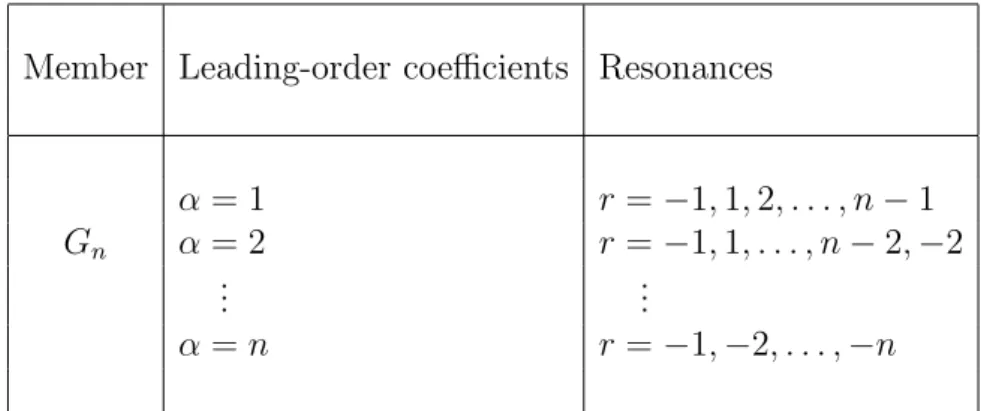
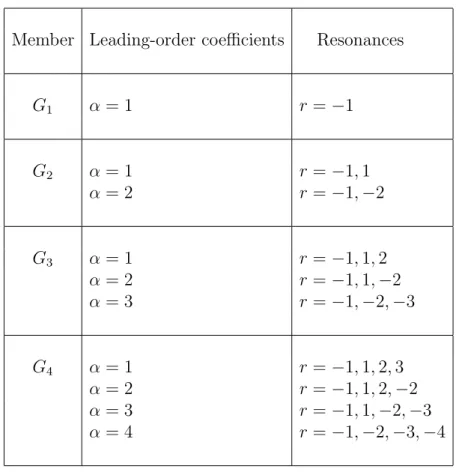
In Table 5.2 we proceed from [42] and present properties in terms of singularity analysis for the general member of the Riccati sequence. Tables 5.1 and 5.2 show that all members of the Riccati sequence pass the Painlev´e Test and each one is integrable in terms of analytical functions [31]. Proposition: The general solution of the nth member of the Riccati sequence, n≥1, is given by.
Invariants and First Integrals
We wish to identify all invariants and first integrals, as defined above, of each member of the Riccati sequence. We calculate the fundamental integrals and invariants of that equation, and by reversing the transformation one can derive the entire set of invariants for the second member of the Riccati sequence, videlicet. An interesting aspect arises in the symmetry properties of the first integrals, which we note briefly.
Complete symmetry groups
Proof: We recall that Gn stands for the second member of the Riccati sequence and ˜Gn for the left side of Gn. It is essential for the notation required in this proof to introduce the joint generator of the sequence, G.S.α =D−y, which generates the joint Riccati sequence, videlicet. Remark: We note that there is a reflection here between the Riccati sequence and its set in that the formula for the sequence is reflected in the formula for the adjoint sequence.
Discussion
The Painlev´e-Ince equation is the second member, after the Riccati equation, of the Riccati series. As a by-product of these considerations, we see that the elements of the Riccati series occupy a special position. One remembers that in the generation of the Riccati series we had the operation (D +y)(y0 + y2) which leads one to the Painlev´e-Ince equation.
Singularity Analysis
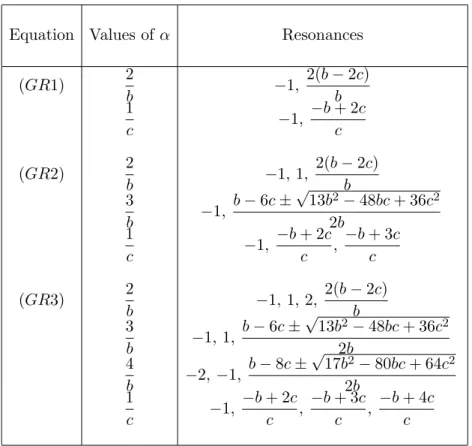
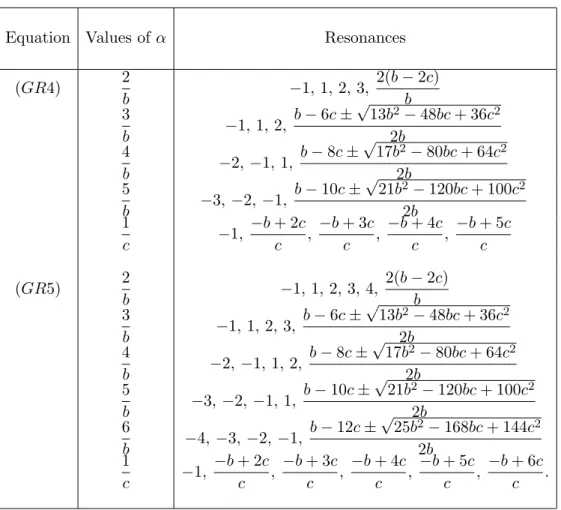
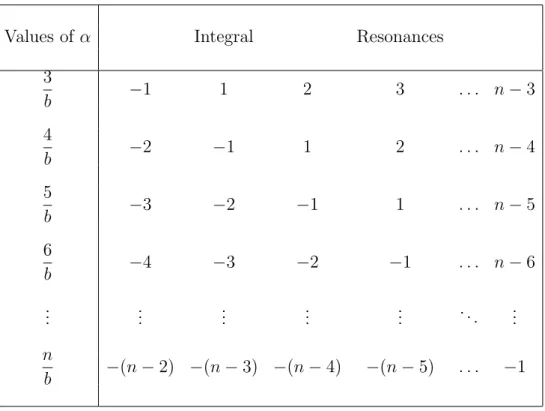
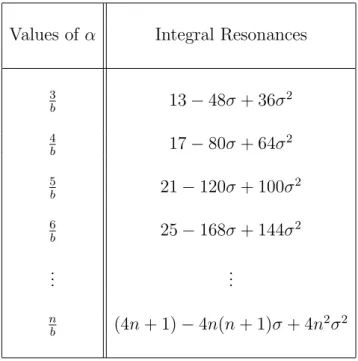
The possible coefficients of the leading-order term of the nth element of the sequence are. For an element of the sequence to possess the Painlev´e Property or its weak form, σ must be rational. When the coefficient of the leading-order term isn/b, the algebraic resonance is given by.
Discussion
The effect of this is to change the definition of the (n + 1)th element from (D+y)n(y0+y2) to (D+by)n(y0+by2) after removing a redundant one. In both groups, the gross behavior of the elements of the sequence is influenced by the value of the ratio σ. We demonstrate that the leading-order behavior and the resonances exhibit regular patterns as we consider higher members of the sequence.
The Elements of the Differential sequence
Our interest in the elements of the resulting differential sequence is in the patterns found when the equations are examined for their singularity properties. Furthermore, we find that a sequence generator run leads to a sequence with essentially the same properties. In this set of equations we have a sufficient number to enable us to deduce the general properties of the members of this differential sequence.
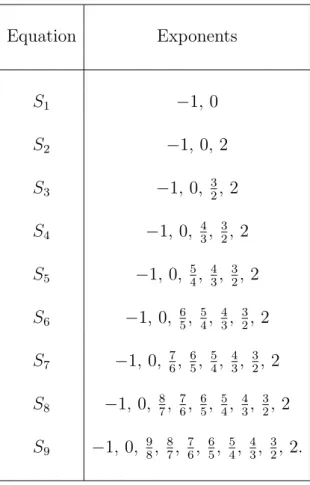
Exponents for the Leading-order Terms
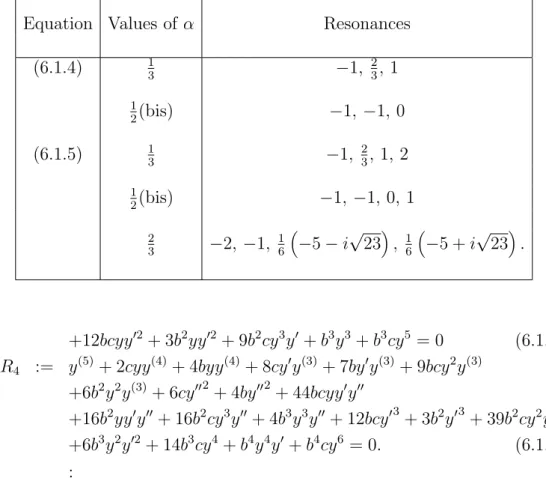
7.1.1) (which we denote as S1), it successively generates all members of the set, videlicet. However, the other fractional powers offer candidates for the possibility of possession of the weak Painlev´e property.
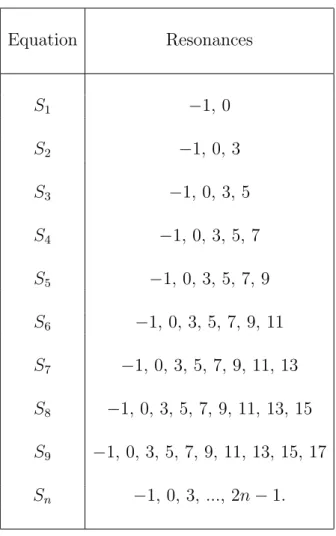
Resonances
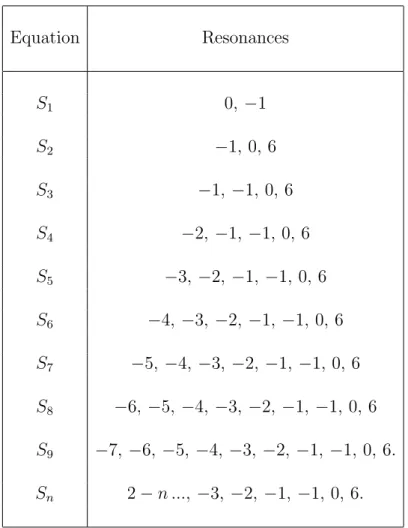
We follow with the values of the resonances for the fractional exponents in Tables 7.4 and 7.5. The resonances for the fractional exponents of the leading order term tell a completely different story. Third, for the highest fractional exponent, all resonances are non-negative except the generic −1.
Alternate sequence
Discussion
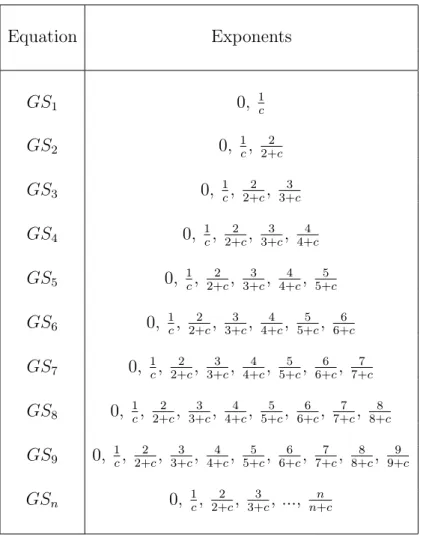
For rational values, there is a possibility of owning Weak Painlev´e property. The second term of the sequence is the Painlev´e-Ince equation, which is a second-order ordinary differential equation with maximum symmetry [90]. However, all is not lost, as all members of the Riccati sequence pass the Painlev´e test.
Future work
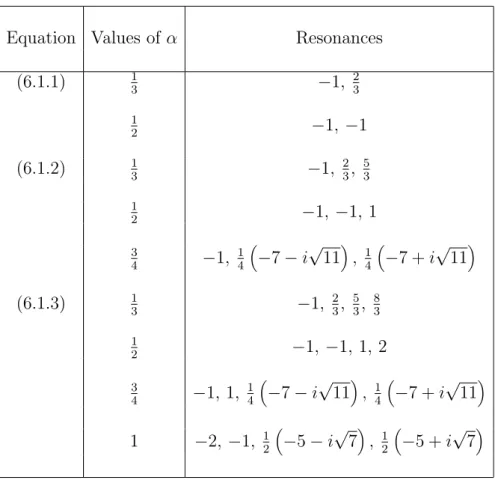
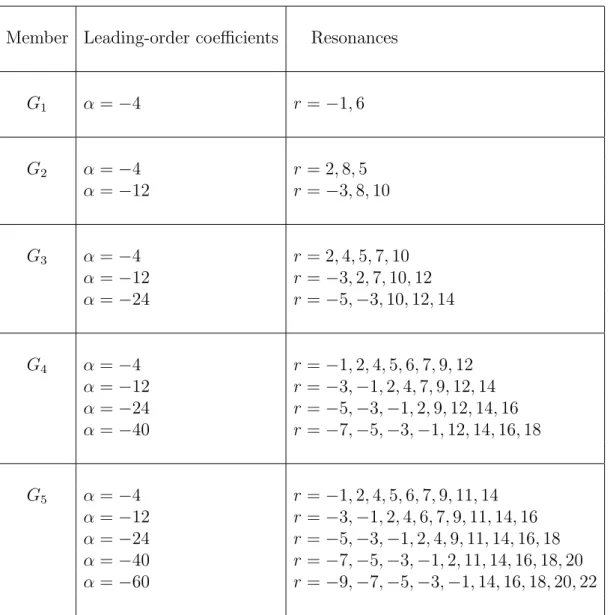
As already mentioned, each member of the Riccati sequence is integrable using the Riccati transformation (5.3.1) with α = 1. For all elements of the sequence, the leading order behavior is αχ−2 with possible values listed in Table 8.1. The singularity analysis for the first five terms of the sequence is shown in Table 8.1, in which the −1 resonance has been omitted.
Implementation of the method of reduction of order
Therefore, the system (A.1.20) reduces to a second-order linear differential equation plus a first-order differential equation, i.e. From (A.2.19) we deduce that the system (A.2.18) is no longer periodic in nature and that identification of (A.2.13/A.2.14) with the reduced form of the Kepler problem is in general not possible is. To preserve periodicity the angle variable cannot be changed, so the only possibility to identify (A.2.13/A.2.14) with the reduced form of the Kepler problem is if (A.2.13) can be put into the normal form written. form U100+U1 = 0 using a transformation of only u1 and the required normal form requires that. A.2.20) You can view this condition as a differential equation that a given b must satisfy.
Complete Symmetry Group of the Two-dimensional Ermakov
We summarize the first part of the transformation resulting from the reduction of order and introduction of a new independent variable axis. To verify that the symmetries are in fact a representation of the complete symmetry group system (A.3.6/A.3.7), we apply them in turn to the general system. We now turn to the general case, which we have to handle somewhat differently since not all transformations are explicit.
Complete Symmetry Group of the General Two-dimensional
76] Leach PGL & Nucci MC (2004) Reduction of the classical MITZ-Kepler problem to a two-dimensional simple harmonic oscillator Journal of Mathematical Physics. 88] Maharaj A & Leach PGL (2007) The order reduction method and linearization of the two-dimensional Ermakov system Mathematical methods in the applied sciences. 102] Nucci MC & Leach PGL (2005) Jacobi's last multiplier and the full symmetry group of the Ermakov-Pinney equation Journal of Nonlinear Mathematical Physics 12305-320.