08
Fall
AFRAPIX
SOCIAL DOCUMENTARY PHOTOGRAPHY IN 1980s SOUTH AFRICA
Amy McConaghy
Acknowledgments
I would like to thank Paul Weinberg, Eric Miller, Don Edkins, Graham Goddard, Zubeida Vallie and Omar Badsha for taking the time to be interviewed and for all being so incredibly obliging, kind and helpful. I thoroughly enjoyed meeting all of you and listening to your incredible stories.
I would also like to express my gratitude to my supervisor, Sean Field, for his excellent guidance, support and patience throughout this thesis.
Abstract
This thesis examines the development of the Afrapix collective agency throughout the 1980s. It argues that despite often being confined within the context of ‘struggle photography,’ Afrapix produced a broad body of social documentary work that far exceeded the struggle. However, within the socio-political milieu photographers were working, there was limited space for a more nuanced and complex representation of South Africa. Resisting this narrow visual format, Afrapix photographers in the 1980s faced the challenge of documenting the struggle and an extended repertoire of social issues whilst expressing a nuanced and complex point of view that countered the predominant narrative.
Table of Contents
INTRODUCTION ... 1
AFRAPIX IN CONTEXT ... 7
FISTS AND FLAGS PHOTOGRAPHY in the 1980s ... 14
EVERYDAY PHOTOGRAPHY in the 1980s ... 17
COMMUNITY CONNECTIONS AND REPRESENTING AGENCIES ... 24
PHOTOGRAPHIC ECONOMY ... 28
THE PHOTOGRAPHIC ESSSAY ... 32
THE END OF AFRAPIX ... 42
SOCIAL DOCUMENTARY PHOTOGRAPHY, CONTRASTS AND CONTINUITIES in POST-APARTHEID ... 43
CONCLUSION ... 49
INTRODUCTION
Apartheid is Violence. Violence is used to subjugate and to deny basic rights to black people. But no matter how the policy of apartheid has been applied over the years, both black and white democrats have actively opposed it. It is in the struggle for justice that the gulf between artists, writers, and photographers has been narrowed.
- Omar Badsha, South Africa: The Cordoned Heart1
According to Christopher Pinney, the power of photography lies in its ‘indexicality,’ a reference to the theory of Charles Peirce, who writes that an index is distinguishable by its ‘physical relationship of casual contiguity with its referent’2. In the context of photography, the entrance of light through a lens suggests the transfer of reality onto a photograph, with the image produced therefore being of a ‘stern fidelity’3. In apartheid South Africa the indexicality of photography was used as a means to denounce the apartheid regime, counter state propaganda and stimulate political change in the country. Emerging in 1948, alongside the formation of the Apartheid state and the implementation of oppressive, overtly racist politics, social documentary photographers like Peter Magubane, Alf Khumalo and Eli Weinberg documented the political events of the time4. However, it was the 1980s that firmly established this approach, with a surge in political activism inspiring photographers to document and record South Africa as a means to expose the brutal nature of the apartheid regime.
This concept proved to be the founding ethos of the Afrapix collective, a multi racial photographic agency formed in 1981 by Omar Badsha, Paul Weinberg, Leslie Lawson, Biddy Partridge and Mxolise Mayo. The collective brought together a group of likeminded photographers, unified by the intent to commit to the anti-apartheid resistance through the use of documentary photography. As Weinberg recalls:
‘Many of us came from diverse places and backgrounds and we shared a common position, we shared common viewpoints about
1 Cordoned heart, p. xv
2 Christopher Pinney, “The Prosthetic Eye: Photography as Cure and Poison”, The Journal of the Royal Anthropological Institute, vol. 14 (2008), pp. 534
3 ibid, pp. 535
4 Ernest Cole, House of Bondage (New York: Random House, 1967); Peter Magubane, Soweto (Cape town: Dawn Lindberg, 1978); Eli Weinberg, (1981) Portrait of a People: A personal photographic record of the South African liberation struggle, (International Defence and Aid Fund for Southern Africa: London, 1981)
how photography could be, its role it could be playing in South Africa and the world5.’
The disparate group of social documentary photographers soon gained momentum, drawing in other members, and by the mid 80’s the full cohort of Afrapix photographers included Eric Miller, Zubeida Vallie, Graeme Goddard, Don Edkins, Steve Hilton-Barber, Guy Tillim, Chris Ledochowski, Santu Mofokeng, Jeeva Ragjopaul and Paul Grendon amongst numerous others. By the mid 1980s Afrapix photographers had become a constant presence on the apartheid’s political and social landscape; capturing strikes, riots, boycotts, festivities, church activity and the occurrences of everyday life under apartheid.
Focusing on Afrapix and the collective’s individual members, this thesis intends to uncover how documentary photographers’ perceptions of a changing South Africa intertwined with their photographic work. I relied primarily on oral history- a dialogue between the speaking interviewee and the questioning interviewer- for gaining information and exploring certain themes, shedding light on events as well as Afrapix photographer’s interpretations, motivations, memories and reflections of their work during and after apartheid South Africa. The interviews were semi-structured, which meant that whilst I had a general idea of the questions and themes that I wanted to address, the interviewees discussed various other aspects of their photographic approaches and interpretations of their work that veered away from the predominant narrative of ‘struggle photography’ that had been perpetuated in my research. This was significant in providing a more nuanced insight into social documentary that countered the predominant narrative structures around South African photography in the 1980s. Photographs were often used as a discussion point, with interviewees referring to their more outstanding images, the background behind them, and what was outside the frame of reference. This provided further insight into the contrasts and continuities of Afrapix photographers’ work and, according to Freund and Thompson, encouraged the interviewees to ‘make sense of their lives by weaving
5 Paul Weinberg, interviewed at the University of Cape Town, 12th April 2013
stories around and inscribing meaning into photographs in the situation of the interview6.’
Afrapix social documentary photographers are a rather atypical focus for the oral historian, whose attentions are usually on the experiences of ordinary people and how their lives were shaped by the social and political structures under which they lived.
Afrapix photographers do not fit this category, providing insight into the representations, as opposed to first hand experiences, of ordinary people under apartheid. Photographing the human condition beneath the overarching strictures of apartheid, this group of photographers are most notable for documenting apartheid and the life of the oppressed within it, experiencing history unfold through the lens of a camera. Consequently, social documentary photographers can be seen as similar to the oral historian, both of whom are inspired by the intent to give a voice to the under- classes and challenge the predominant narrative. Therefore, alongside their own personal story, interviewees were able to construct a narrative around their role as social documentary photographers from a relatively retrospective, reflective and analytical position that was extremely significant is understanding the way in which South Africa and the oppressed have been represented and the way in which apartheid is remembered now.
What has further been emphasised in these interviews in that fact that to understand social documentary photography in the 1980s, it is necessary to take into account the diverse range of photographers in Afrapix. In talking with the six Afrapix members that I interviewed – Paul Weinberg, Omar Badsha, Eric Miller, Don Edkins, Graham Goddard and Zubedia Vallie - it is clear that Afrapix consisted of a variety of people, of different races and social and cultural backgrounds. Each had their own interests, aesthetic sensibilities, their own style and their own interpretations of their role as social documentary photographers within and outside of the struggle.
Founder Paul Weinberg grew up in Pietermartizburg, moving to Johannesburg and teaching photography at the Open School to township youths after studying at photography Technicon University in Durban. Describing himself as a ‘reluctant war
6 Alexander Freund and Alistair Thomson, Oral History and Photography, (London: Palgrave Macmillian, 2012), p. 11
photographer,’ Weinberg was more interested in working in a soft way, telling stories that veered away from news events7. Cofounder Omar Badsha grew up in a Gujurati Muslim family in Durban. Labeled ‘coloured’ under the apartheid regime, he was a self taught artist and trade unionist before his entry into photography8. Similarly to Weinberg, he veered away from news photography focusing primarily on straight social documentary. However, Afrapix also brought in more news driven photographers: Eric Miller, who joined in the mid 80s and was working in Johannesburg’s corporate sector before discovering photography9; and Zubeida Vallie, who grew up in Cape Town in a Muslim family and became involved in documentary whilst studying photography at Pentec University10. Don Edkins, provided another dimension to the Afrapix agency, providing anti-apartheid resistance images from outside South Africa after going AWOL in 1976 in response to being drafted to the Angolan civil war11. Finally, Graham Goddard, labeled ‘coloured’ under the apartheid regime, grew up in the Cape Flats. He enrolled in a part time photographic course at Ruth Prowse Art school and worked as a freelance photographer for social events before becoming involved in Afrapix, working with the agency as a photographic printer of black and white exhibition prints12. Thus, Afrapix comprised of an incredibly diverse group of people. As a result, it seems rather simplistic to make sweeping statements about social documentary photography or Afrapix photography, as each photographer provided a new and different dimension that can only be accounted for through emphasis on individuals rather than the group.
Despite the variety and diversity of Afrapix, the collective has nevertheless been simplistically labeled solely as the leading advocates of ‘struggle photography.’ This label of ‘struggle photographer,’ was inspired by Afrapix’s contribution to the culture of struggle photography, which provided a visual dimension to the anti-apartheid resistance movement and aimed to mobilize local and international response against
7 Paul Weinberg, interviewed at the University of Cape Town, 12th April 2013
8 Omar Badsha, interviewed at his home in Cape Town, 5th September 2013
9 Eric Miller, interviewed at his home in Cape Town, 3rd May 2013
10 Zubeida Vallie, interviewed at her office at Cape Town University of Technology, 30th August 2013
11 Don Edkins, interviewed at his office in Cape Town, 28th May 2013
12 Graham Goddard, interviewed at his office and Cape Peninsual University, 20th August 2013
oppression in South Africa. Subsequently, their images have primarily been associated with the production of a grand narrative of emotive, political sights:
funerals, fists and banners, protests, camaraderie. This has resulted in various accounts that have formed a simplistic depiction of 1980s social documentary photography, generated by the belief that it can be reduced solely to spectacular instances of repression and suffering from the frontline. Consequently, it has come to be a common misconception that social documentary photography in the final decade of apartheid reduced the complexities of the South Africa experience to one of continual struggle, forming a one-dimensional and dehumanizing depiction of black life in South Africa. Svea Josephy, for example, affirms that ‘in the apartheid era the documentary image was typically over coded, reinforcing a didactic public message,13’ whilst photographer Zwelethu Mthethwa claimed that township subjects, were twice victimized, ‘once by the political and social oppression and again by their one dimensional representation in the media14.’ French philosopher and art historian, Georges Didi-Huberman has also adopted this perspective, arguing that in South Africa,
‘Documentary realism was always at the ready to link the iconic and the impoverished with little recourse to examining its spectral effects on social lives. Because of this, documentary realism generated an iconographic landscape that trafficked in simplifications, in which moral truths were posited without the benefit of proven ethical engagement15.’
Whilst this critique is directed more at South African social documentary in general, Afrapix were one of the groups unfairly caricaturized in this critique of ‘struggle photography,’ placed within a similar category as the Bang Bang Club and their fellow news photographers16.
However, whilst Afrapix were working within a milieu epitomized by socio-political turmoil, documenting a country on the verge of civil war, the way in which the
13 Josephy, S in Grundlingh, G The Cape Town Month of Photography 2005 p 6
14 Paul Weinberg, The Past is in the Present: Mediating documentary photography and the archive in South Africa
15 Prison Photography (2010), Zwelethu Mthethwa vs. Prison Photography, available at
http://prisonphotography.org/2010/07/16/zwelethu-mthethwa-vs-afro-pessimism/ (accessed: 24th October 2013)
16 See Greg Marinovich and Joao Silva, The Bang Bang Club: Snapshots from a Hidden War, (Arrow Books: London, 2001)
collective approached photography cannot be understood solely within a ‘struggle’
context. The two overarching objectives epitomizing the Afrapix collective were ‘to be an agency and a picture library, and to stimulate documentary photography17.’
Thus, beyond the context of apartheid and their political affiliations, the core approach of Afrapix’s photographic work was simply social documentary, to use the camera as a means of recording society and create a platform for which to express themselves in relation to various issues. As Weinberg explains:
I come from a school that has looked at society and sees society as its kind of backdrop. This is what documentary photographers essentially do. They look at society and raise issues and they try to make a difference, they try bring about change, they try be advocates of new thinking18.
Thus, as social documentary photographers, Afrapix was not confined within a mode of photography that focused primarily on the struggle and many were compelled to explore a far broader range of issues surrounding the human condition and the various social issues at play in South Africa. Whilst apartheid and the intensifying resistance cast a discernible shadow over South Africa’s social landscape that could not be overlooked, this was only one dimension of the country’s history and one aspect of the collective’s broader focus. Drawing on a synthesis of interviews and secondary sources, I will argue that although Afrapix’s body of work far exceeded that of
‘struggle photography,’ producing a broad body of social documentary work, the socio-political milieu photographers were working within meant that there was limited space for a more nuanced and complex visual representation of South Africa.
Resisting this narrow format, Afrapix photographers in the 1980s faced the challenge of documenting the struggle and an extended repertoire of social issues whilst expressing a nuanced and complex point of view that countered the predominant narrative.
17 Paul Weinberg, ‘Beyond the Barricades,’ Full Frame, vol 1 , no. 1 June, 1990 editorial
18 Paul Weinberg, interviewed at the University of Cape Town, 12th April 2013
AFRAPIX in CONTEXT
South Africa in the 1980s was characterized by a mood of defiance against the apartheid regime that was translated into the ideology of the Afrapix collective, with intensifying resistance drawing photographers and artists alike into the struggle.
Consequently, the photography that emerged in the 1980s South Africa was considerably intertwined with the country’s history and although it cannot be defined solely in terms of political and social context, neither can it be separated from it.
The growing tensions and strengthening of resistance in 1980s apartheid South Africa can be attributed to a number of issues. In the second half of the 1960s, resistance against apartheid had been quelled, with most of the anti-apartheid organisations banned and their leaders either in jail or exile. However, by the early 1970s, the resistance against apartheid was regaining momentum. The growing grievances amongst the majority of South Africans over the brutal nature of the apartheid regime came to a fore in the 1976 Soweto Uprising, an event famously characterized by Sam Nzima’s iconic photograph of a dying Hector Pieterson being carried by another student after having been shot by police, while his sister runs by their side, her face contorted in horror and agony. The uprising was offset by the Apartheid government’s attempt to implement an education policy that made Afrikaans the compulsory medium of interaction in black schools. However, whilst this move was the principal catalyst, the uprising was also generated by a number of other factors. The Black Consciousness Movement had emerged amongst a new generation of radical intellectuals and activists, propagated by Steve Biko, who was inspired by theories of Frantz Fanon, Aime Cesaire, Leopold Senghor and the Black power Movement in the United States19. The aim was to advocate a sense of black pride and an African self- awareness that counteracted apartheid’s creation of an environment dominated by a sense of fear and inferiority amongst the oppressed20. The 1968 European student revolts in Europe and the collapse of the Portuguese colonies in Angola and Mozambique in 1974 acted as further inspiration and encouragement for the movement. These were significant factors in stimulating the rousing discontent that lead to the Soweto uprising, an event that came to signify the turning point in South
19 Andries Walter Olifant, South African Photography 1950-2010 (Hatje Cantz 2010) p 79
20 ibid, p. 79
Africa’s history of resistance, escalating into a revolt against the apartheid system and its racist rule.
It was within this turbulent environment of resistance and social turmoil that the Afrapix photo agency emerged, reflecting the shift away from the individualist approach adopted by the likes of Ernest Cole, Eli Weinberg, Peter Magubane and David Goldblatt, towards a collective approach that came to epitomize the 1980s cultural movement. Most Afrapix members met through the Staffrider, the cultural magazine that ‘legitimized photography as an art form and recognized it as being equal in expressive significance to prose, poetry and art21.’ It was an important springboard for documentary photography at the time, providing support for a genre that was developing within a cultural context that offered minimal support to the production of social documentary images. This lack of support was primarily due to the oppressive nature of apartheid and the increasing restrictions placed upon the use of photography by the apartheid state, the government’s reaction to the growing international condemnation that had been stimulated by images depicting the brutality of apartheid. Within this context, documentary photographers were increasingly constrained by the general media restrictions, denied the possibility of photographing in conflict situations and subject to police brutality on a regular basis.
Ironically it was this same context that stimulated social documentary photographers, providing inspiration to use the camera as a means of prevailing against the apartheid state’s suppression of information and exposing the brutal reality of apartheid that had been obscured by the state propaganda apparatus which attempted normalize its racist regime. Desmond Tutu once wrote:
‘I believe that when the Germans were asked how they could possibly have permitted Hitler and the Nazis to perpetrate the horrors of the holocaust, they replied that they had not know that those things were happening. It is possible for many South Africans and others to plead a similar ignorance about the evil consequences of apartheid and the polices being applied against black people.22’
21 Joyce Ozynski, Ten Years of Staffrider 1978- 1988, vol. 7 no. 3 and 4 p 163
22 Omar Badsha, Imijondolo: A Photographic Essay on Forced Removals in the Inanda District of South Africa, (Afrapix: Durban, 1985), p. 7
It is this analogy - highlighting the power of ignorance in the perpetration of evil- that Afrapix members have often referenced to when explaining what motivated them as documentary photographers in Apartheid23. Recording the apartheid government’s worst offences and bringing the realities of apartheid to the forefront of people’s imaginations was therefore seen as a means of fighting against the larger system, with the hope that these images that could expose the unjust nature of the regime and encourage political pressure from within and outside South Africa.
With the aid of Staffrider, by the end of the 1970s ‘a remarkable visual and graphic aesthetic engaged with the social actualities of South Africa had been established,24’ setting the scene for Afrapix and their unique style of social documentary photography in 1980s South Africa. This emergence of a politically aligned culture of resistance and collective photographic movement was cemented in the 1982 Culture and Resistance Festival in Botswana. Organised by Medu Art Ensemble and hosted by the Botswana National Museum, the conference drew in hundreds of participants from a variety of cultural activities25. Many Afrapix members including Paul Weinberg, Omar Badsha and Peter Mckenzie were closely involved in the organizing of the Festival and the photographic compartment. It was here that the ideological concept of culture as a weapon in the liberation struggle was legitimized, supporting the belief that ‘any person who stands behind a pen (or brush, camera, or saxophone for that matter!) must be just as effective as any person who stands behind a gun26.’ The aim was to raise awareness around issues such as the cultural boycott whilst simultaneously conscientising South Africa communities. Afrapix member Peter Mckenzie delivered a keynote paper on photography, subsequently published in Staffrider, where he called on photographers to set aside any romanticized notion of the individual artist and ‘realize the undeniable responsibility of all photographers in South Africa to using the medium to establish a democratic Anzania27.’ He argued for a dual focus in ‘struggle photography’: firstly, it should show the conditions under
23 Zubeida Vallie, interviewed at her office at Cape Town University of Technology, 30th August 2013;
,Eric Miller, interviewed at his home in Cape Town, 3rd May 2013
24 Olifant A.W, South African Photography 1950-2010 (Hatje Cantz 2010) p 79
25 Newbury, D. Defiant Images: Photography and Apartheid South Africa. (Pretoria: University of South Africa Press, 2009), p. 238
26 ibid, p. 238
27 Peter Mckenzie, ‘Bringing the Struggle into Focus,’ Staffrider
which the oppressed were forced to live in South Africa, as a means to ‘awaken the sleeping consciences of those who haven’t realized their oppression and the danger of non commitment’; and secondly, social documentary photography must not be governed by negative portrayals of South Africa, but must also ‘show the hope and determination of all committed to freedom28.’ His ideas reflected the socio-political climate and the subsequent vocabulary of the time, with the brutal political and social policies of apartheid inciting those to action through whatever means possible.
Consequently, a growing number of photographers and other artists were organised and mobilized for resistance alongside the broader liberation movement. Shaped by the ideological structures of the time, social documentary photography in the 1980s was increasingly inclined towards tackling the socio-political issues plaguing the country, taking a stand against system through the documentation of the apartheid environment and its associated evils. Subsequently, Afrapix photographers emerged as the ‘taking-sides’ generation, adopting an overtly political and transparently partisan approach in their photography that identified with the liberation movement and reflected its views. Their role as activists in the struggle preceded their individual work as a photographer and aesthetics and art were to be cast aside in the attempt to strategically document the country and expose the atrocities of the apartheid regime.
This ethos is clearly justified in in a 1983 edition of Staffrider magazine, featuring Afrapix’s first exhibition South Africa Through the Lens, where photographers reflected upon the rationale behind the exhibition:
‘The camera doesn’t lie. This is a myth about photography in South Africa in the Eighties that we will not swallow. In our country the camera lies all the time- on our TV screens, in our newspapers and on our billboards that proliferate our townships. Photography cant be divorced from the political, social and the economic issues that surround us daily29.’
The traditional view of an objective and impartial journalistic stance, as supported by eminent South African photographer David Goldblatt, was overshadowed by the
28 ibid
29 “South Africa through the Lens,” Staffrider Magazine, 1983
impetus to denounce the apartheid system and stimulate change30. Caught up in the social, political and economic issues of apartheid South Africa, photographers could no longer be objective, choosing to play a part in the way they made their statements.
As Zubeida Vallie, a social documentary photographer who often supplied images to Afrapix, observed: ‘[photography] was very much contributing to the cause of politicizing people. Also not just politicizing but just generally informing about the atrocities. So I think that in itself tells you that it definitely was not from a mutual point.’
These sentiments are reflected by Eric Miller, who recalls:
‘“People used to say ‘you are a journalist, you are supposed to be objective, and I would say ‘its not about being blindly objective its about telling the truth, actually. And I choose to be on a particular side of this struggle…’” 31
Along side this approach was the intention to train photographers, with the mantra
‘each one, teach one’ becoming a key phrase during this period. Training and supporting emerging artists was an important part of the photographer’s involvement in the struggle. As Omar Badsha recalls:
‘You are working in the political movement and in the underground, training people, talking to people, convincing them, empowering them, was a natural thing for us. Very natural.’
Afrapix’s involvement in the struggle was further intensified on June 14th, 1983, when the United Democratic Front (UDF) was launched, arising in reaction to the minimalist reforms introduced by the Apartheid government’s suggestion of a tri- cameral system that aimed to co-opt people of mixed descent, classified as
‘coloureds’ or ‘Indians,’ that were not accommodated in the homelands dispensation.
Parliamentary representation was extended to these communities, although power remained in the hands of the white minority whilst the black majority was excluded all together, treated as subjects of the autonomous and semi-autonomous homelands that were situated in South Africa’s rural areas. The UDF responded to this haphazard attempt of inclusion by galvanizing civic, trade union, church, women’s, conscious
30 Newbury, p. 238
31 Eric Miller, interviewed at his home in Cape Town, 3rd May 2013
objectors and sport and cultural organisations into a popular front aimed at exerting that final force to dismantle the apartheid government. From 1983 onwards, South Africa was in the heat of resistance, with boycotts, labour strikes, mass demonstrations and student revolts maintaining a constant presence of South Africa’s political scene.
The government responded to the growing resistance by declaring a partial State of Emergency in 1985, with cameras banned from emergency areas, intensifying the already oppressive conditions under which photographers were working. In 1986, they were tightened even more so in a further attempt to control the flow of information and rising global denunciations of apartheid.
It declared:
4. (1) No person shall without the prior consent of the Commissioner or a member of a security force serving as a commissioned officer in that force take any photograph or make or produce any television recording, film recording, drawing or other depiction (a) of any unrest of security action or of any incident occurring in the course thereof, including the damaging or destruction of property or the injuring or killing of persons, or (b) of any damaged or destroyed property or injured or dead persons or other visible signs of violence at the scene where unrest or security action is taking place or had taken place or of any injuries sustained by any person in or during unrest or security action (from the Government Gazette of the Republic of South Africa, Vol. 276, no.
11342)32
Paul Weinberg recalls the consequent effects:
‘Every time you went into a township you could be fined, or your film could be confiscated. Or if you went into a situation that was deemed part
32 Hill, I.T. & Harris, A. Beyond the Barricades: Popular resistance in South Africa in the 1980’ s.
(London: Kliptown Books, 1989), p. 7
of the State of Emergency and it was proclaimed, you were also there illegally.’ 33
Working within this progressively militarized, segregated South Africa, documentary photographers found themselves in an environment where they felt ‘quite threatened and embattled34.’
Despite these constraints the Afrapix collective developed an expansive network, becoming a significant resource for socially concerned groups, the local alternative media, and the international media. This was aided by their link with Khotso House, the headquarters the South African Council of Churches (SACC), where their office was based. Bernard Spong, head of the media division at SACC, agreed that Afrapix could use the space in the building and receive some form of administrative assistance, and in return they would supply the SACC with images for their distribution35. The Afrapix agency were also involved with a number of NGO’s, many of which were also run in Khotso House. A symbiotic relationship and sense of mutual support formed between Afrapix and these NGO’s, with Afrapix meeting the photographic requirements of the organisations whilst in turn being taken along by NGOs to document issues and their daily endeavors36. Most notably, Afrapix supplied the media demands of the UDF. As the only archive of images, Afrapix was the perfect source for the organisation’s media requests, photographing their rallies and meetings as well as the poverty and repression of South Africa37. These images were also fed into the anti-apartheid movement on an international level, most notably through the publicity section of the International Defence and Aid Fund (IDAF) in London, whose aim was ‘to keep the conscience of the world alive to the issues at stake’ in South Africa38.’ Furthermore, Afrapix photographs of South Africa’s political situation were supplied to a number of publications in support of the anti- apartheid movement, including Sechaba, ANC News, Anti-Apartheid News, Morning
33 Paul Weinberg, interviewed at the University of Cape Town, 12th April 2013
34 ibid
35 Omar Badsha, interviewed at his home in Cape Town, 5th September 2013
36 ibid
37 Newbury, p. 241
38 ibid, p. 241
Star, South Magazine, The Guardian and Tribune as well as international mainstream media outlets such as Reuters, Agence France Presse and Associated Press.39
Consequently, as Weinberg recalls, Afrapix were incredibly involved in providing a visual dimension to the resistance:
‘Afrapix was very vibrant, we were feeding into the anti apartheid struggle within the country, outside the country, churches, human rights organisations. So we were right inside the artery of political consciousness40.’
‘FISTS AND FLAGS’ PHOTOGRAPHY in the 1980s
Within this context of apartheid, repression, resistance and conflict, the South African scene one of chaos and dramatic events, overshadowing the more innocuous aspects of society. In his article, The Present is in the Past, Weinberg quotes Pofessor Njabula Ndebele, writer, cultural activist and academic, who states:
Everything in South Africa has been mind boggedly spectacular: the monstrous war machine developed over the years; the random pass raids; mass shootings and killings; mass economic exploitation, the ultimate symbol of which is the mining industry; the mass removals of people; the spate of draconian laws passed with the spectacle of parliamentary promulgations; the luxurious life style of whites, servants, all encompassing privilege, swimming pools, and high commodity consumption; the sprawling monotony of African locations, which are the very picture of poverty and oppression. The symbols are all over: the quintessence of obscene exhibitionism41.
It was this spectacular environment that formed the predominant narrative of South Africa and as the country verged on civil war, the various dynamics of the conflict held a primary position in the lens of the social documentary photographer. Casting a dark shadow over South African society, it was a dimension that could not be ignored, and provided a focus that was very much in line with the photographer’s role as a
39 ibid, p. 241
40 Paul Weinberg, interviewed at the University of Cape Town, 12th April 2013
41 Paul Weinberg, The Past is in the Present: Mediating documentary photography and the archive in South Africa
cultural worker. Consequently, on one level, Afrapix photography was shaped around a narrative of resistance that is most commonly associated with ‘struggle photography’ and the collective’s position as the ‘taking sides’ generation, adopting a
‘fists and banners’ approach that produced images from the front line.
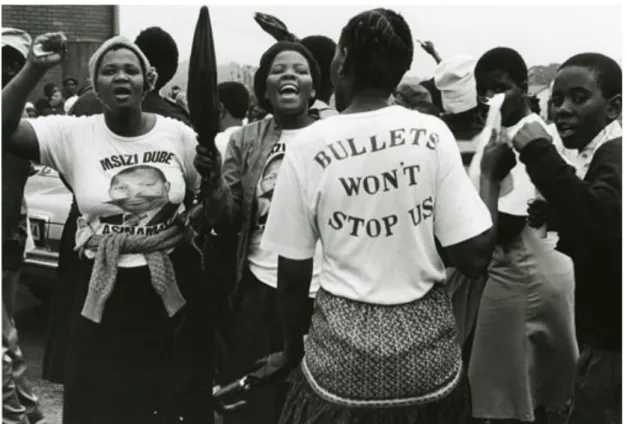
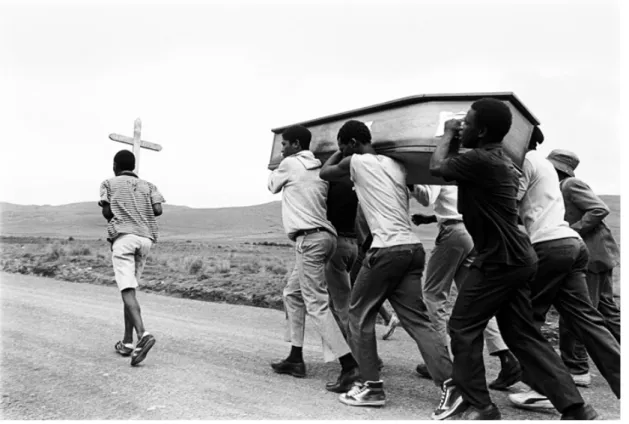
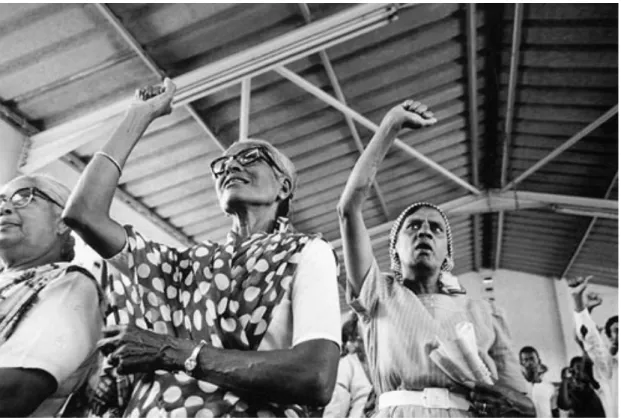
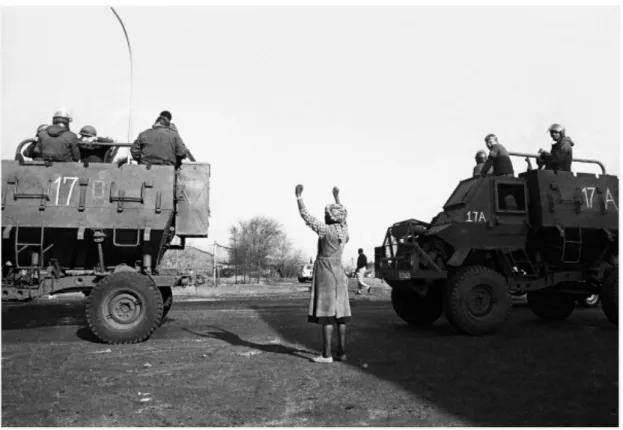
Thus there emerged a body of overtly political imagery that exposed the harsh, dehumanizing effects of poverty and oppression imposed by apartheid onto the lives of South Africans, conveyed a clear anti-apartheid message. Accordingly, topics were predominantly centered on forced removals, marches, meetings, rallies and as the struggle intensified, funerals. Funerals were particularly central to the iconographic emblems of the anti-apartheid struggle, representing an environment that stimulated radical opposition to the struggle. Another significant trope of the struggle imagery was the protest sign, significant in shaping the meaning of the image and the audience’s response to apartheid. As Okwui Enwezwor explains, the protest sign
Figure 1: Jeeva Rajgopaul
Comrades from Lamontville at the memorial service for Dabi Sookoo, 1981
‘enunciated the boundary between presence and absence, visibility and invisibility42.’
Documenting forms of popular resistance against the injustice propagated through apartheid as well as the violent state responses to this challenge, this approach produced some of the most iconic imagery of the time.
Afrapix’s close affiliation with the left wing movements and anti-apartheid organisations meant that they were also able to look beyond the basic news stories and record the meetings, discussions and the general goings-on of the resistance movement and local avenues of change that were generally regarded as more innocuous. For many, these smaller proceedings were just as significant as the bigger, mainstream news events. Vallie, in 1990, stated:
42 Okwui Enwezor and Rory Bester, Rise and Fall of Apartheid: Photography and the Bureaucracy of Everyday Life, (International Centre of Photography: New York, 2013), p.37
Figure 2:Cedric Nunn
Funeral of two comrade youth abducted and killed in the “Natal War,” 1987
‘It’s very important documenting things, just the ordinary union meeting. Like the weekend it would be women’s festival and to some people its like small events but its important because it brings people together and by having the photos, documenting them, will surely be of historical value43.’
This approach, motivated by attempts to rouse support in favor of the oppressed and document the unfolding history of South Africa, was founded on Manichaean stereotypes, creating a dichotomy between the ‘good guys’ and the ‘bad guys,’ black and white, in South Africa. Weinberg recalls:
‘Looking back, retrospectively and with hindsight, I do think it is quite crude. You know, to judge people just in terms of are you with us or are you against us, are you a comrade or not a comrade44.’
However, given the times, it was a necessary position to take. As Graham Goddard, darkroom specialist for Afrapix, recollects:
‘They were fighting a war, they were on the front line with many other people fighting a battle and pushing against the apartheid regime in their way and contributing because of what they believed in.’
Given the socio-political turmoil of the time and spurred on by the injustice of apartheid and the impetus to stimulate change through the use of the camera, this approach was deemed a necessary one to take.
EVERYDAY PHOTOGRAPHY in the 1980s
However, South African social documentary photography was not limited to the front lines. Along side the spectacular nature of apartheid and the struggle, people continued to live out their everyday lives, going through the universal rhythms of life irrespective of the chaos around them. This environment was one that Afrapix members, as South Africans growing up and living within the everyday, were deeply connected with. Resisting the prevalence of the spectacular in South Africa’s visual narrative perpetuated by the media and liberation struggle, a number of Afrapix photographers explored a more personal approach, documenting the everyday and life
43 Images in Struggle, DVD and VHS, B. Feinberg, IDAF:UK, 1990
44 Paul Weinberg, interviewed at the University of Cape Town, 12th April 2013
in between the cracks. Drawing on their daily experiences, many photographers moved away from the front line to document the ordinary, representing the everyday realities of their communities and the way in which people constructed life out of difficult situations. As Santu Mofokeng stated:
‘In terms of the idiosyncrasies of life in the eighties whereby we want to show that apartheid is bad, I’m making pictures of ordinary life. Football, shebeen, daily life… When the world becomes tired of seeing… sjamboks or whatever, they come to you they start to ask what is daily life like45?’
As a result, 1980’s social documentary also saw the emergence of lyrical, nuanced work that went against the more iconic ‘fists and banners’ approach, celebrating the ordinary within the context of the spectacular.
Perhaps this incentive to use the camera as a means to document the everyday was partly stimulated by the emotional stress of documenting the violence and grief that was characteristic of photography on the front lines. Weinberg recalls:
“There would be a funeral and then you would go and photograph the funeral and then people would go and protest and resist and dance and run through the township and then the police would shoot again and then there would be another funeral. And so it was this cycle of funeral and resistance and funerals and you know, just never stopped. And you got to a point where you just thought ‘I cant do another funeral, I cant do this any more46.’”
Constantly working within such a repressive environment was cause for fatigue and burn out amongst many photographers. Thus, several Afrapix members sought to break away from the ideological constraints that they had placed upon themselves that were centered on the incentive to participate in the struggle and ‘make a statement against this awful system called apartheid47.’
As Lesley Lawson, one of the founding members of Afrapix recalls:
There were very strict ideological principles that governed people.
We were all struggling for meaning and for political relevance and so an aesthetic of fists and flags developed, which is fine, it was
45 Patricia Hayes, “Santu Mofokeng, photographs: ‘The violence is in the knowing,’” History and Theory, No. 48, 2009, p. 34-51
46 Paul Weinberg, interviewed at the University of Cape Town, 12th April 2013
47 ibid
important and it was needed but it became an overwhelming, dominating thing48.’
By photographing the ordinary photographers were able to escape from the pressures associated with their involvement in the anti-apartheid resistance, documenting the aspects of everyday life that, whilst innocuous, were not removed from the overarching context of apartheid.
However, the documentation of the ordinary was also of central interest to a number of Afrapix photographers even prior to their involvement in the struggle, reflecting a core aspect of social documentary photography. For many, the allure of the documenting the everyday was the fact that it provided a means to explore the world around them. Young and inquisitive, many Afrapix photographers have described the camera as a ‘passport’ that allowed them to cross the boundaries structured by apartheid and gain greater understanding of different environments and societies in their country. As Nunn recalls, ‘I had a natural curiosity and photography allowed me to exercise that curiosity through using photography as a passport to enter into various different scenarios and societies49.’ Similarly, Weinberg was ‘simply exploring the world around me, using the camera as an open book.’ As he recalls:
‘Weekends and afternoons I would just walk around the suburbs of Johannesburg and take photographs and meet people and have a beer, a cup of tea. And they weren’t particularly threatened by me and I wasn’t threatened by them because I was sort of a fellow traveller.’
Thus, for many photographers, the camera was a means to gain insight into the complexity of life in South Africa in a variety of communities, particularly amongst the oppressed. As Badsha explains:
‘As a photographer you’re also entering into any territory and you are photographing everything with a sense of wonderment. Because you also walk into communities and you don’t know what those signs and rituals mean sometimes, or everyday events mean. You don’t know the class differences or caste differences. They all might look alike but there are differences, until you begin to interrogate
48 Images in Struggle, DVD and VHS, B. Feinberg, IDAF:UK, 1990
49 The Road to Then and Now, Interview
but and then you photograph accordingly and you start exploring those50.’
This inquisitiveness of the everyday reflected the more individual interests of social documentary photographers, outside their professional and political responsibilities.
Consequently, Afrapix’s body of work also incorporated more personal projects that provided in-depth insight into communities, shifting away from the ‘fists and banners’
imagery. Focusing on the ordinary nuances of society, this approach transformed the way in which South Africa and the oppressed communities were perceived, questioning the predominant stereotypes perpetuated by the media and liberation groups. As Mofokeng said:
‘You look at the photos of people in a township that have been made. They are poor, they are angry, they are not normal, they are not people in a sense, they are victims. [sync] If I take photographs that show a certain section of the people, maybe the oppressed, in a way that makes them human, makes them normal, it might convince the other section which is maybe more right wing. If they look at that photograph and see they are just people like us, they want the same things we do51.’
Therefore, this focus on the everyday was in part a reaction to the popular representation of the oppressed as ‘victims,’ a representation that often obscured the humanity of the photographer’s subjects. Through the documentation of the everyday, the intention amongst photographers was to encourage empathy towards the oppressed by narrowing the divide between the subject and the audience, illustrating the fact that people are simply people, fundamentally and empathically universal and deserving of equal dignity and respect. As Badsha said:
‘For us, the every day was a way of affirming the very human side of life.
In one way, we are saying we are no different from you. We have our good days our bad days, we have our rituals, whatever. From birds to debts, why are you treating us differently52?’
50 Omar Badsha, interviewed at his home in Cape Town, 5th September 2013
51 Images in Struggle, DVD and VHS, B. Feinberg, IDAF:UK, 1990
52 Omar Badsha, interviewed at his home in Cape Town, 5th September 2013
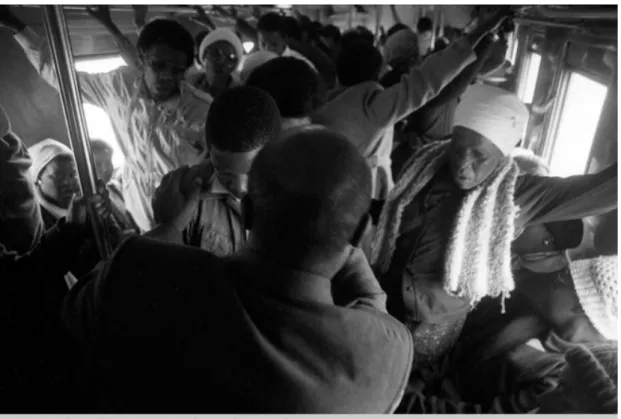
Thus there emerged a number of projects the reasserted the humanity of the oppressed through everyday imagery. In Mofokeng’s Train Church series, for example, he captured the prayer and church activities in commuter trains from Soweto to Johannesburg, drawing from everyday urban life and the routine of commuting alongside the prevalence of spirituality. This was incredibly unusual given the fact that it was produced at the height of the political struggle.
The everyday was further documented by Mofokeng and Weinberg in a joint photo- essay called Going Home53. The photo-essay juxtapositions life in the white suburbs with life in black townships, by exploring the worlds of Paul from Pietermaritzburg, and Santu from Soweto. As Mofokeng described it, ‘This means that the worlds which lie beyond the routine of going home had to be looked at in an honest and exploring fashion54.’ Delving into ordinary life in South Africa, the project was a concerted attempt steer away from the black-white images perpetuated by the media,
53 Full Frame vol 1 , no. 1 June, 1990 editorial
54 ibid, p.
Figure 3: Santu Mofokeng Train Church, 1986
and created a personalized depiction of their understanding of the world that drew attention to a number of great divisions in apartheid that had not been explored.
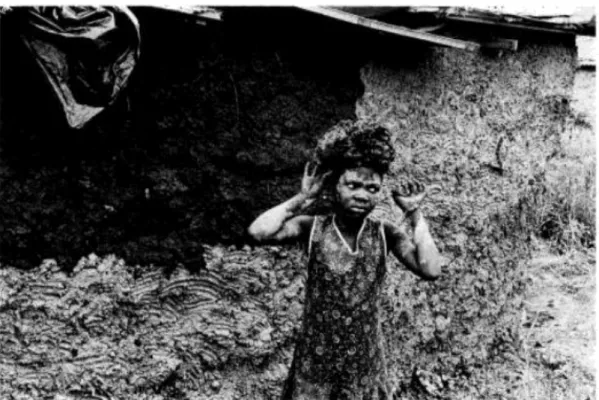
Omar Badsha has also produced powerful work centered on the everyday. Letter to Farzanah55, for example, documents the lives of black and white South African children, illustrate the ordinary lives of children under apartheid whilst exposing the more universal issue of disparity and racial divides through the juxtaposition of wealthy children with those living in squatter camps. Badsha’s later publication, Imijondolo56, is another example, documenting the everyday lives of the impoverished Inanda residents, representing the subjects with dignity whilst exposing the harsh effects of apartheid on the community.
55 Omar Badsha, Letter to Farzanah, (Institute for Black Research, 1979)
56 Badsha, Imijondolo, 1985
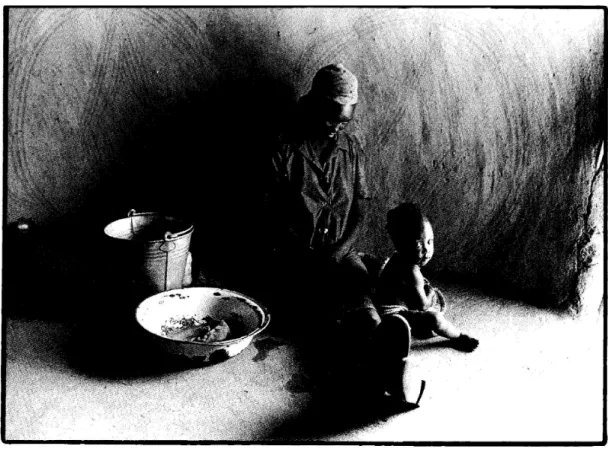
Figure 4: Omar Badsha
Plastering home with Mud in Inanda, 1982
Further works centered on everyday life can be seen is Cedric Nunn’s Blood Relatives57, in which he explored his identity a South African with mixed origins, classified by the apartheid regime as ‘coloured;’ Don Edkins Gold Widows58, which documented life in the frontline state of Lesotho, exploring the destructive effects of migrant labour on the family structure; and Chris Ledochowski’s long-term project, beginning in the late 1970s, that documented the life of Petros Mulaudzi, a migrant worker and close friend employed by his parents59.
These are just a few examples from the large body of work produced by Afrapix members in the 1980s that explored the everyday effects of oppression, providing a
57 Cedric Nunn, Blood Relatives, http://www.cedricnunn.co.za/ (accessed 24th October 2013
58 Ganter, E and Edkins, D. Marotholi: Theatre for Another Development (Lesotho: The Village of Information Service Christian Council of Lesotho, 1988)
59 South African History Online, Chris Ledochowski, Petros Mulaudzi of Nthabalala Village,
http://www.sahistory.org.za/category/image-galleries/exhibitions/bonani-africa/2010/chris- ledochowski/petros-mulaudzi-nthabalala, (accessed: 24th October 2013)
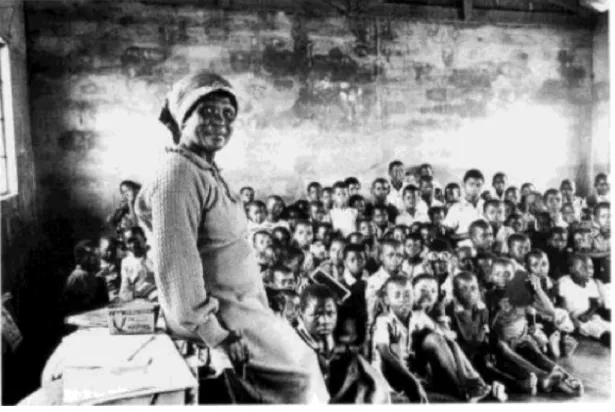
Figure 5: Don Edkins Gold Widow, 1988
dimension to Afrapix’s body of work that was intrinsic to creating a more lyrical, complex depiction of South Africa. Today many photographers, when questioned about their work in the eighties, show the most pride in these images, veering away from the sensational and reflecting a more nuanced and intimate vision of the everyday that highlights the dignity of ordinary life.
COMMUNITY CONNECTIONS, REPRESENTING AGENCIES
Afrapix found themselves straddled between two worlds: the turbulent world of resistance, protest and violence and the ordinary world, in which they lived out their day-to-day lives. The collective’s body of work subsequently oscillated between the struggle imagery and the imagery of the everyday, the sensational and the ordinary, the intense and the intimate, the professional and the personal. Whilst ostensibly different, these two photographic focuses both reflected life in South Africa at the time, the everyday (as seen through the exploration of the ordinary) and the explosion of forces that had accumulated in the everyday (as seen through resistance and protest). As South Africans, whose everyday experiences were the very ones that they were documenting, Afrapix photographers’ consequent work was produced from a very personal perspective. As Zubeida Vallie recalls:
‘I was doing hard news but from a completely personal angle…
you are part of the community. You are not coming in fresh—you are not just coming in to do a story. The things that were happening, it was people that I grew up with, schooling, childhood, grew up, with connected with, neighbors, familiar of the neighborhood60.’
A similar sentiment in reflected in a statement by Badsha, who recalls: ‘we were inside those communities, so we began to photograph them as people that you knew and people that you interacted with.’ Afrapix photography therefore expressed a personal connection to local communities that encouraged a much more sensitized and subjective understanding of issues around them, an insight that was consequently translated into their imagery.
This personal connection with South Africa and its communities suggests the factors such as race, class or gender did not restrict photographers in creating a successful
60 Zubeida Vallie, interviewed at her office at Cape Town University of Technology, 30th August 2013
representation of the communities other than their own. As Peter Magubane said,
‘irrespective of colour, the good photographer will succeed and the bad one will fail.
Its like with any other artist who represents what he sees, to the best of his ability.61’ Living and experiencing the nuances and complexities of daily life under apartheid, Afrapix photographers had an insider’s view of South Africa and apartheid that helped overcome the distance between the photographer and the subject, encouraged by their sensitivity towards the problems and needs of the various communities. Thus, breaking down the insider-outsider division that is often associated with photography, Afrapix photographers effectively represented what it was they saw, expressing an in depth understanding of the country and its people that captured the complex scenarios South Africans lived through. This personal connection is a significant thread that runs throughout Afrapix’s work, representing humanity and the specific realities of the human condition through the documentation of the political struggle and the everyday struggle of apartheid. This is where the power of Afrapix’s imagery lay, with Afrapix’s personal insight into South Africa encouraging a representation of the oppressed that reinforced the human agency, inspiring mobilization and defiance against the regime. Afrapix images conveyed this on two levels: Political agency and personal agency
Images of defiance were particularly significant in portraying the concept of political agency. Perceived as a means to motivate those with a sleeping conscience by portraying the subjects as active agents, working against the apartheid state and the oppressive system. They were presented not only as victims of history, but also as the makers of it. As Badsha observes:
‘…you see those people in meetings, you see them in discussions, they are engaging with each other, they are building organisations, they are fighting in the streets. They are going on strike, these are acts of defiance in that period, major acts. And each one of those acts grows in and becomes a movement62.’
By exposing images of meetings, rallies and protests that showed the oppressed fighting against the apartheid regime, the black communities are shown not just as
61 Andrew Walter Oliphant, Quest for Appropriate Representation, Two Tone: South Africa’s First Jazz Magazine, pg 8
62 Omar Badsha, interviewed at his home in Cape Town, 5th September 2013
victims but also as active agents, people who are shaping the way in which history unfolds. These images aimed to inspire others to act, encouraging them to believe that they had the power to stimulate change. This was particularly significant at the time as censorship and the oppression of apartheid suppressed memories of the struggle and revolutionary politics. Images of Mandela or the ANC flag, for example, could not be published. Thus Afrapix’s images of defiance were significant in reviving the memories of the resistance and instilling a sense of political agency that had been quelled by apartheid censorship.
On another level, the exploration of the everyday in photography exposed the power of personal agency within apartheid, emphasizing human autonomy and individualism. By documenting the nuances and complexities of daily life, Afrapix illustrated the different ways in which the oppressed communities constructed their own narratives within the overarching context of apartheid in which they lived. Thus, Afrapix formed a visual representation of the oppressed that affirmed the dignity and self-possession of black communities despite being confined within a framework of inequality and oppression. As Goddard explains:
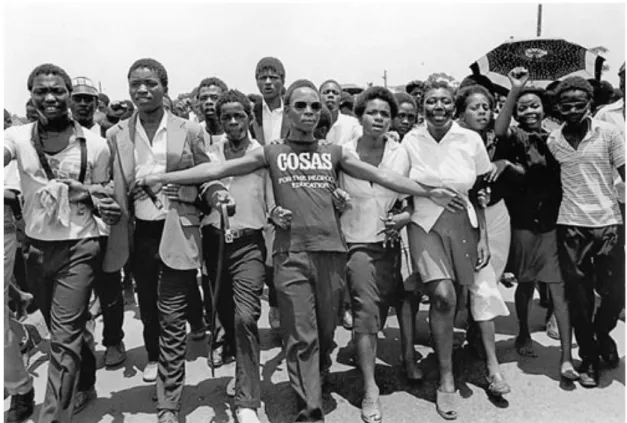
Figure 6: Omar Badsha
Students marching to funeral of COSAS member, 1981
“There’s more than just victims, people weren’t just lying around like ‘ah we’re suffering.’ People are living, they’re partying, they’re having a good time, they’re procreating and whatever it is, getting on with their lives… no matter how bad the situation is, you can not say people are not going to laugh…63”
It was this sentiment that shaped the way in which Afrapix documented apartheid and its communities, highlighting a sense of personal agency amongst the oppressed population, as conveyed through their daily endeavors. This further encouraged a shift away from the stereotypical association of the black communities solely as victims of apartheid, to show that the oppressed were not confined within the structure of apartheid. As Badsha said: ‘you want to try and move away from that we are just victims. To say that we are, each one has dignity and must be approached with dignity and photographed with dignity64.’
Thus, Afrapix provided a representation of the oppressed that reinforced their various agencies, reacting against the popular cliché depicting the black oppressed as victims
63 Graham Goddard, interviewed at his office and Cape Peninsual University, 20th August 2013
64 Omar Badsha, interviewed at his home in Cape Town, 5th September 2013
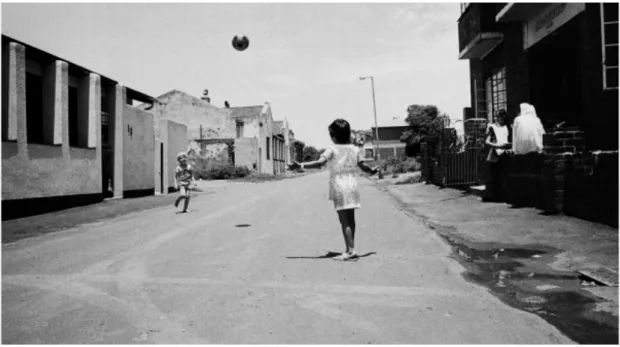
Figure 7: Paul Weinberg
Pageview, Johannesburg, at the time of apartheid removals, June 1982.