
To the social workers from South Africa and the United Kingdom who participated in this study for their valuable time and effort. CHAPTER FOUR: SOCIAL PROBLEMS IN SOUTH AFRICA AND INFRASTRUCTURE SUPPORT WITHIN THE SOCIAL.
ABSTRACT
During the focus group interviews, social workers in Great Britain were able to share their experiences of relocation. Social workers must be presented as valued and crucial players in our newly developed democracy.
CHAPTER ONE INTRODUCTION
Introduction
The new paradigm shift for social work in South Africa is the social development approach, which is clearly rooted in government policy and the White Paper on Social Welfare (1997). South African social workers have become the latest target of international social work recruitment agencies (The Star, 24 January 2000).
Motivation
Have there been changes in the fundamental attitudes of social workers in the provision of their services. Why the remaining social workers continue to provide services and remain within the social work profession in South Africa.
Theoretical approach to the study
Gitterman & Germain (1984) assert that people's needs, problems, or difficulties fall into three interrelated domains: (1) life transitions involving developmental stages, status role changes, and crisis events; (2) unresponsiveness of the social and physical environment, which may be that of the social worker. High caseloads in agencies, frustration with lack of resources, and the constant impact of diverse and daunting/complex problems encountered in the field all contribute to the problems experienced by the social worker.
Aims and Objectives
In this study, the research will assess the problems, frustrations and needs of social workers in South Africa and the UK. The study included two phases: (1) Phase 1 - Research on social workers in South Africa; (2) Phase Two - Research into Social Workers in the UK.
Key Questions
This sample group consisted of thirty social workers who had recently moved to Britain. a) What are the problems encountered by social workers who have left South Africa to work in Britain? What are the needs and benefits experienced by social workers who have moved to Britain?
Explanation of Key Concepts
Terminology of the Committee for Social Work (1995) defines community work as planned action by members of a community and a social worker to promote the social functioning of the community as a whole. Promotion of the social functioning of the community as a whole can be achieved by increasing knowledge and ability to cope at a micro level, to ensure at a mezzo level that effective resources exist that are directed to the needs of the community and , finally, to possible democratic participation by the community at the macro level in the formulation of welfare policy. i) Social development work.
Limitations of the Study
The reactions could have been exaggerated to justify their departure. e) Another issue is that working in different settings can affect the delivery of social workers' services, as there can be unequal distribution of resources and services and differential exposure to racial groups.
Division of the Report
The literature includes a discussion of the historical context of social welfare services in South Africa. Chapter Four: Social problems in South Africa and infrastructural support within the social work profession.
CHAPTER TWO
RESEARCH METHODOLOGY
- Introduction
- Research Method
- Research Design
- Sampling
- Research Tool
- Questionnaires
- Focus Groups
- Data Analysis
Furthermore, the researcher qualitatively explored the social workers' problems and needs through the two phases. In this study, the researcher assessed the problems, frustrations and needs of social workers working in South Africa and the UK.
CHAPTER THREE
SOCIAL WELFARE SERVICES IN SOUTH AFRICA
Introduction
Providing the researcher with new ideas and approaches to the problem under consideration that may not have occurred to him/her is another benefit of a literature review. It is also able to enable the researcher to gain access to his/her own research efforts by comparing these efforts with those of other researchers (Leedy.
Historical Context of Welfare Services in South Africa
Dlamini (1995) argues that social workers reinforced the policies of the former state through their implementation of its social policies. The state also realized the importance of the relationship between economic and social development for the white community. In South Africa there could be little doubt that welfare policies suppressed the development of the majority of the population.
Post-Apartheid Era Changes in South Africa
The forum can be seen as a link between the state and civil society on specific issues relating to welfare, acting as one of the organized and coherent structures for policy and restructuring of issues affecting social welfare (Mazibuko, 1996:11). Working groups were set up to examine a national welfare development strategy, comprehensive welfare legislation and the establishment of social welfare programmes. The new development paradigm was adopted in legislation and included in welfare programs (Van Eeden et ai, 2000).
Theoretical Framework for Developmental Social Welfare in South Africa
In 2000, the Department of Social Development identified the unemployment rate at approximately 33% of the total potential labor force (cited in Drower, 2002:10). The first event was the signing into law of the new South African Constitution in December 1996, and the second was the transition from the people-led Reconstruction and Development Program (RDP) to the neoliberal Growth, Employment and Redistribution (GEAR). macroeconomic policy (Drower, 2002: 11). However, the government continues to reiterate its commitment to the RDP principles, and these principles have remained highly influential in shaping policy within the welfare sector.
New Social Welfare Policy
While the White Paper on Social Welfare proposes that social welfare services should be available to all South Africans, it specifically mentions those who should be prioritized. In achieving this integrated service, it was emphasized that there would be restructuring of the social welfare delivery system towards a holistic approach. 34; objectives, offers, Social Welfare Policy Indicators (SWIP), objectives, results, criteria, strategies, intermediate priorities and key performance indicators, the Social Welfare Action Plan document (1999) provides a strategic plan to convert the White Paper on Social Welfare into reality".
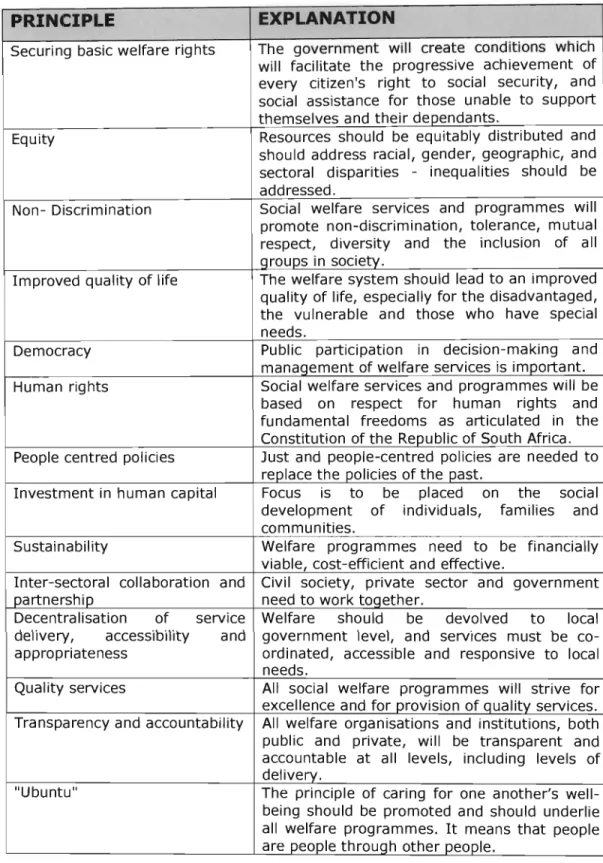
Implications for Social Work - The White Paper for Social Welfare
- Strategies of Social Development
To achieve the vision outlined in the White Paper for Social Welfare, the social work profession must guide social workers towards accepting their development role. In this context, it is advocated that social development strategies rely on social work interventions. Gray (1998) agrees that social work focused on the individual remains an essential part of social development.
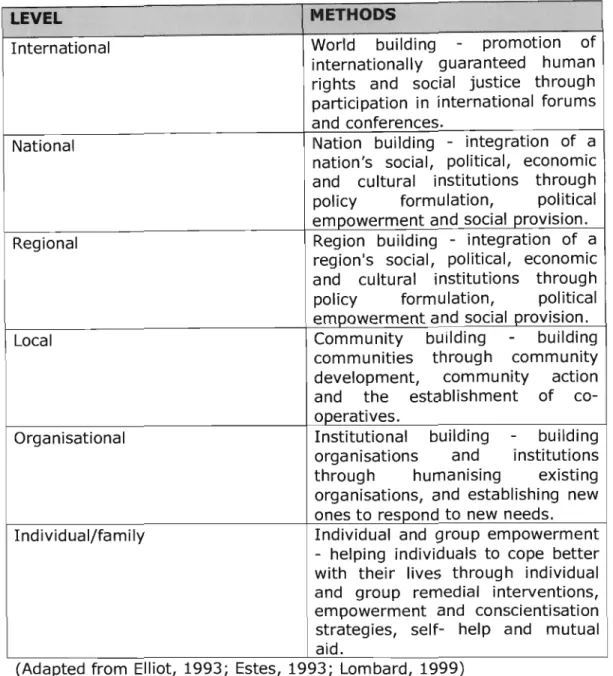
The Consequence for Social Work
The concept of de-professionalism has led to the marginalization of social workers in South Africa, the withdrawal of government support, the undermining of the social work profession and the questioning of the relevance of social work. The researcher agrees that these latter characteristics have contributed to the marginalization of social work. Whatever the regional confusion, there is a deep-seated marginalization of social work in the implementation of the new welfare policy.
CHAPTER FOUR
SOCIAL PROBLEMS IN SOUTH AFRICA AND THE INFRA -STRUCTURAL SUPPORT
WITHIN THE SOCIAL WORK PROFESSION
Introduction
- Poverty
- Crime and Violence
- HIV IAIDS Pandemic
However, the question that must be asked is: do social workers in South Africa have the self-confidence to meet this challenge. Next to poverty and crime, one of the most important social issues facing social workers in South Africa today is that of violence. Social workers will have to allow themselves to move in the same direction as these forces.
Section B
- Social Work Education in a changing socio- political dispensation
- Past social work Education and Training and its Impact on present Practice
- The Transformation of Social Work Education
- Attempts to transform social work Education
- The Input of Welfare Organisations in the Training and Education of Social Workers and Social Work
How the social work profession and welfare organizations can best serve the community. Therefore, social work departments in universities will have to take seriously the power that welfare organizations are gaining. Staff members of social work training institutions serve on government committees and planning teams (Joint Universities Committee for Social Work, 2001).
Supervision in Social Work
- The Importancel Benefits of Supervision
In South Africa, it has recently been suggested that supervision is seen as an unnecessarily expensive service, ineffective and encourages social workers to become and remain dependent (Botha, 2000; Botha, 2001). For the majority of social workers in the study cited by Simpson (2002), supervision was not a source of support and encouragement. Added to this are the demands of social workers to meaningfully participate in the changing political and social environment.
Professional Associations
The South African Black Social Workers' Association (SABSWA) was established in 1945 to act as a "mouthpiece" for black social workers, to make representations to government or any other body on any matter relating to social welfare in black communities, and to ensure that black social workers maintain a high standard of conduct and integrity in accordance with the code of ethics (Mazibuko, 1998:31). In May 1989, Concerned Social Workers, Society for Social Workers (Witwatersrand), Johannesburg Indian Social Welfare Association (JISWA), SABSWA, Social Workers' Forum (Cape Town) and. In the same year, the Society for Social Workers (Wits), SABSWA and concerned social workers issued a joint statement calling on welfare agencies to act in accordance with social work ethics by challenging apartheid policies and providing services not racial (Society for Social Workers Bulletin, 1989).
South African Council for Social Service Professions
One of the key tasks was to make recommendations to the Minister of Social Welfare regarding the composition of the new South African Social Work Council. This Act provided for the establishment of the South African Social Service Professions Council to replace the South African Interim Social Work Council. After the election and appointment of council members, the first SA Council for Social Professions began functioning in June 1999.
Remuneration and Service Conditions for Social Workers
- Remuneration
- Service Conditions/Personnel Benefits
Despite this, the current situation in the public service is that persons with a four-year social work professional qualification are paid at entry level 6 (Le. R62558,00 per annum). Social workers employed by non-governmental organizations (NGOs) are paid significantly less than their counterparts in the civil service. There are a number of reasons for the discrepancies in remuneration and service conditions between the NGO sector and the public service.
SOCIAL WORKERS' EXODUS FROM SOUTH AFRICA
Introduction
- UK Recruitment Drive
This provided an initial opening for South African social workers to apply for social work positions. At the same time, the recruitment drive for social workers was also directed abroad for South African social workers (The Star, 2000; Roberts, 2001). According to Local Authorities in the UK, the integration of South African social workers is not a problem.
Social Work in the United Kingdom (UK)
- Social Work Services in the U.K - Past to Present
- The Educational Basis of Social Work
- Comparison of Practice Methods in the UK and South Africa
According to Adams & Shardlow, social workers in the UK act as assessors to help clients (known as service users) identify their needs. Social interventions in the UK are short-term and aim to achieve measurable results. It can therefore be inferred that the practice methods of social workers working in the South African context are very different from the practice methods in the British context.
ANALYSIS AND DISCUSSION PHASE 1
Introduction
