Our strategy for leveraging our geographic advantages in marine and Antarctic research must be based on these commitments. The research focus of this strategy will also ensure that the expectations and outcomes coming from the Operation Phakisa Oceans Economy initiative are achievable through the provision of a research agenda as set out in the aspirations. There is a clear need to strengthen South Africa's marine and Antarctic research and its research capacity through strong leadership and coordination.
In this strategy, marine and Antarctic research is considered to include all research conducted in the estuaries, coasts, oceans, islands and Antarctica. Mission: Build the national marine and Antarctic research system to develop human capital, maximize South Africa's international profile for research in this area, achieve transformation in the sector and contribute to innovation and economic growth around the oceans economy .
STRATEGIC OBJECTIVES
Vision: A high-quality marine and Antarctic research system that is responsive to relevant national strategic imperatives and has both regional and global reach.
SCOPE OF THE STRATEGY
The strategy presented here represents a top-down strategic consolidation of the two plans, driven by the National Research Foundation in consultation with the DST and DEA. There are a number of interested and affected groups, many of which are already established as sectors in government departments (for example the Department of Environmental Affairs [DEA]: Division of Oceans and Coasts; and the Department of Agriculture Forestry and. Since the beginning of Thanks to the Antarctic Treaty System (ATS), South Africa has played a leading role in a number of major international oceanographic, astro- and biophysical projects in which African partnerships are well embedded.
The South African government has indicated its commitment to continued research in Antarctica and the oceans through major financial investments in new, state-of-the-art platforms, including a new base on Marion Island and the renovation of SANAE IV, a state-of-the-art research and supply ship, the SA Agulhas II, ocean robotics, small ships such as uKwabelana and other investments that provide a solid platform for scientific endeavors. The establishment of SAEON and Centers of Excellence – for example the Center for Invasion Biology at the University of Stellenbosch, and the Percy FitzPatrick Institute of African Ornithology at the University of Cape Town (UCT) – and the CSIR's Southern Ocean Carbon - Climate Observatory (SOCCO) program have enabled outstanding academic research at several South African institutions, some of which focused on Antarctica and the Southern Oceans. The Marine and Antarctic Research Strategy will enable the exploitation of the opportunities for greater economic and energy security from marine and subsea resources.
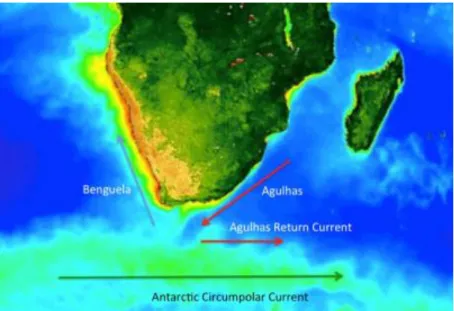
Furthermore, this combination of physical, chemical and biological oceanographic processes in the waters bordering and surrounding South Africa provides unique advantages for science in advancing the understanding of the regional marine environment, which is affected by global scales of variability and change and provides feedback. into the Earth system. Prediction of global changes in the Southern Ocean and Southern Africa, because the region plays a key role in global heat and carbon exchange through e.g. the formation of intermediate and bottom water and ocean/atmosphere carbon fluxes. The expanded Prince Edward Inland EEZ claim will exceed mainland South Africa in area.
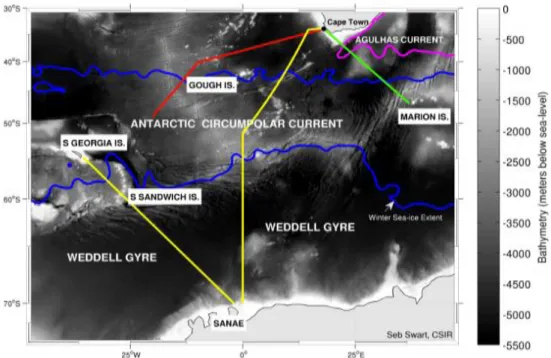
As it happens, PEI's location is considered to be strategically critical to the island's ecosystem and can enable monitoring of the impacts of global change on the surrounding dynamic marine current systems. This strategy will integrate all these investments to take advantage of the emerging global importance of the comparative geographical advantage of the Southern Ocean and South Africa. The blue lines represent the northern and southern extent of the Antarctic Circumpolar Current, while the purple line represents the position of the Agulhas Current and Retroflection.
RESEARCH THEMES
It is important that South Africa further develops the ability to understand and predict the state of the ocean and its ecosystems, and the capacity and systems to integrate such knowledge into policy and management. Gaining a better understanding of the origins and impacts of space weather is crucial to efforts to meet the TYIP Grand Challenge of Space Science and Technology. The National Space Strategy has prioritized ocean and coastal zone management as one of the tools to harness the benefits of space science and technology for socio-economic growth and sustainable development.
Airborne geophysical surveys over parts of both continents over the past decade have allowed a reinterpretation of the geological evolution of both continents, especially in the broader areas inland and adjacent to the contact along which the two continents separated. Interest in the geology of the ocean floor is also mandated by the United Nations Convention on the Law of the Sea, which has a ten-year period during which countries can claim an extended continental shelf that, if validated, gives it exclusive rights on resources on or below the seabed of that vast shelf area. Such studies will also gather valuable information about potential resources on the Antarctic ocean floors, in the event that the moratorium on the possible exploitation of such resources is lifted when the Antarctic Treaty expires.
An understanding of ocean dynamics is essential to predicting and adapting to global change. Maintaining the long-term prosperity and sustainability of marine fisheries is not only of political and social importance, but also of economic and ecological importance, and as such innovation in this area will be important. South Africa is one of the twelve founding members of the 1959 Antarctic Treaty and was therefore a player from the inception of what would later become the Antarctic Treaty System (ATS).
There is little information about artistic, literary, and architectural artifacts that reflect the human endeavors of the Southern African Antarctic region, whose oceans and adjacent landmasses have both ancient and modern human histories.
DELIVERING THE STRATEGY
In addition, however, several critical supporting and cross-cutting interventions must also be serviced for the successful implementation of the strategy - these can be perceived as horizontal priorities or interventions that are essential to deliver on the strategy. The National Marine Environmental Management (NEMO) White Paper stated that responsibility for marine management would lie within the economic cluster of cabinets. Com will also establish a system to ensure that logistical needs for researchers are managed to align with the receptive capabilities of line departments and research units.
The DST has finalized its Human Capital Development Strategy in response to the urgent need in South Africa to develop high-level capacity in the sciences and to ensure transformation in the demography of the national research system. The scope and emphasis of the high-level objectives of the HCD Strategy are determined by the need to develop postgraduate research training and research and development outcomes, in accordance with the mandate of the DST and its entities. As South Africa implements Operation Phakisa activities to unlock the economic potential of the ocean, it is important to take note of the socio-economic impacts in coastal areas and in the ocean.
The human impact on climate change and on the marine environment drives the need to engage the wider South African public as a key player in ocean issues and the inhibiting challenges. Instruments must be developed to educate the general public about the environmental state of the oceans and how research, exploitation and other activities affect their lives and how their general behavior can affect the marine ecosystems. The state of observations and modeling south of Africa is not as developed as it is in other regions of the world's oceans.
Even with the improved sampling to adequately address key challenges; year-round, full-depth, multi-disciplinary monitoring of the oceans around South Africa is essential. Building the technical expertise is also crucial in the ability to provide maintenance to the various instruments. As part of the data dynamics of the ocean and Antarctic Research, the Antarctic and Ocean data management system should be established in line with the large data center that will be established.
Resourcing the Strategy
Such centralized data management would be invaluable in maintaining and advancing scientific research and would undoubtedly increase opportunities for learning and innovation. This will enable tracking of all relevant data and information sources, and in doing so will serve as a virtual central information portal for the various digital and physical materials available. This virtual center will coordinate the management of all data and information collected and produced by South African researchers.
With the advent of Operation Phakisa, industry is also interested in helping with data collection and access to infrastructure, and this will require a coordinated process that also has the potential to reduce duplication that tends to strain already limited resources. available. The Center will act as a single portal for all ocean and Antarctic related data to ensure that these data can be found, shared and interpreted efficiently and effectively. A database proves its value only after assessment and evaluation, and if the data in it is used to its fullest extent.
A central access point to all Southern African oceans and Antarctic-related data sources will facilitate the use of databases that might otherwise have been overlooked. The Center will verify that the listed databases comply with various national and international standards for data collection format and documentation. The center will also act as a platform to provide the necessary information for the marketing of South African activities in the oceans and Antarctic regions.
CONCLUSION