STAKEHOLDER VALUE CREATION AND FINANCIAL PERFORMANCE OF SELECTED JSE FIRMS
By
MUSA BRYAN SONO
DISSERTATION
Submitted in fulfilment of the requirements for the degree of MASTER OF COMMERCE
In
ACCOUNTING In the
FACULTY OF MANAGEMENT AND LAW (School of Accountancy)
At the
UNIVERSITY OF LIMPOPO
SUPERVISOR: Prof. M.B. FAKOYA 2021
II | P a g e
DECLARATION
I declare that the “stakeholder value creation and financial performance of selected JSE firms” dissertation submitted to the University of Limpopo for the degree of Masters in Accounting is my own work and all sources used or recited, have been indicated and acknowledged by complete references and this work has not been submitted before in any other institution.
Full names ……… Date ………
III | P a g e
DEDICATION
I dedicate this dissertation to my lovely wife Sono MV, my daughter Sono MS, my mother Shiphamele BE and my siblings.
ACKNOWLEDGEMENT
First, I would like to give thanks to the Almighty God for giving me strength to complete this degree and for his guidance and protection.
I would like to thank the School of Accountancy together with the African Centre of Sustainability Accounting for allowing me the opportunity to undertake this degree.
The National Research Fund through Risk and Vulnerability Science Centre for their funding and encouragement.
I would like to pass my uttermost gratitude to the following individuals for the role they played in my study:
My wife Mrs Sono MV for motivating, encouraging and supporting me from the beginning to the completion.
My mother Shiphamele BE for supporting and teaching me to never give up.
My late supervisor Prof Fakoya MB for his guidance, mentorship, supervision and support.
Prof CC Ngwakwe for overseeing and advising on the completion of this dissertation.
My brother Shiphamele NT for always encouraging me to do better from a very young age.
Mr Chireka T for his never-ending guidance, motivation and mentorship.
Dandane KD for his advice, support and guidance
Nakeng MV for showing me how research is done when I had no clue.
VI | P a g e
Table of Contents
DEDICATION ... III DECLARATION ... II ACKNOWLEDGEMENT ... IV ABSTRACT ... IX
CHAPTER ONE: GENERAL INTRODUCTION ... 1
1.1 BACKROUND OF THE STUDY ... 1
1.2 PROBLEM STATEMENT ... 1
1.3 RESEARCH HYPOTHESES ... 3
1.4 OBJECTIVES OF THE STUDY ... 2
1.5 SIGNIFICANCE OF THE STUDY ... 3
1.6 DEFINITION OF TERMS ... 4
CHAPTER TWO: LITERATURE REVIEW ... 6
2.1 INTRODUCTION ... 6
2.2 THEORETICAL FRAMEWORK ... 6
2.2.1 Stakeholder Theory ... 7
2.2.2 Value Creation Theory (Value creation model) ... 9
2.3 REVIEW OF LITERATURE ... 10
2.3.1 Shareholders’ value and Return on Assets ... 10
2.3.2 Revenue and Return on Assets ... 17
2.3.3 Interest cover and Return on Assets ... 20
2.3.4 Environmental, Health and Safety and Return on Assets ... 23
2.3.5 Community projects (Corporate Social Responsibility) and Return on Assets ... 27
2.3.6 Summary of the chapter ... 31
CHAPTER THREE: RESEARCH METHODOLOGY ... 33
3.1 INTRODUCTION ... 33
VII | P a g e
3.2 CHOICE AND RATIONALE OF RESEARCH DESIGN ... 33
3.3 RESEARCH METHOD AND JUSTIFICATION ... 34
3.4 STUDY POPULATION AND JUSTIFICATION ... 34
3.5 SAMPLE, SAMPLING METHODS AND SAMPLE SIZE ... 35
3.6 DATA COLLECTION APPROACH AND JUSTIFICATION ... 35
3.7 DATA ANALYSIS AND JUSTIFICATION ... 36
3.8 RELIABILITY AND VALIDITY OF THE DATA ... 41
3.9 ETHICAL CONSIDERATIONS ... 42
CHAPTER FOUR: DATA ANALYSIS, RESULTS AND DISCUSSION ... 44
4.1 INTRODUCTION ... 44
4.2 DATA PRESENTATION AND DESCRIPTIVE ANALYSIS ... 44
4.3 DATA ANALYSIS ... 45
4.4. DISCUSSION OF RESULTS ... 61
4.5 SUMMARY OF THE CHAPTER ... 64
CHAPTER 5: SUMMARY, RECOMMENDATIONS AND CONCLUSION ... 66
5.1 INTRODUCTION ... 66
5.2 SUMMARY OF FINDINGS ON RESEARCH OBJECTIVES ... 66
5.2.1 Summary of Findings on Research Objective 1 ... 66
5.2.2 Summary of Findings on Research Objective 2 ... 67
5.2.3 Summary of Findings on Research Objective 3 ... 68
5.2.4 Summary of Findings on Research Objective 4 ... 68
5.2.5 Summary of Findings on Research Objective 5 ... 69
5.3 CONTRIBUTION TO THE BODY OF KNOWLEDGE ... 70
5.4 RESEARCH LIMITATIONS ... 70
5.5 RECOMMENDATION ... 70
5.5.1 Industry and Economy ... 71
5.5.2. Future Research ... 71
VIII | P a g e
5.6 CONCLUSION ... 72 REFERENCES ... 74 APPENDIX 1: RAW DATA FOR PANEL DATA ANALYSIS ... 83
IX | P a g e
ABSTRACT
For organisations to be successful, they need key stakeholders like shareholders, customers, employees, banks and the community. These stakeholders are essential in any profit-based organisation. All stakeholders have needs, which have to be balanced. However, it is difficult to balance the needs of different stakeholders as they have different preferences. This study seeks to determine how different needs of stakeholders can be balanced and which of these stakeholders an organisation can prioritise to create value in the organisation. The study used a quantitative method to extract secondary data from the Johannesburg Stock Exchange. The judgemental sampling method was utilised to selected 68 organisations from the JSE, which were utilised to determine which stakeholder has an impact on the value of an organisation.
The study did not choose any industry but generalised. The results of the study indicate that shareholders, customers and banks (debtholders) have no effect on the financial performance of the organisation. This means that stakeholders do improve value in an organisation. However, the results further revealed that the community and employees have a positive influence on financial performance. Future researchers can choose one industry to determine how these particular stakeholders influence the financial performance of organisations in a particular industry. In addition, more stakeholders can be identified that are key to organisations.
Key words: stakeholders, organisational value, financial performance, stakeholder value.
1 | P a g e
CHAPTER ONE: GENERAL INTRODUCTION 1.1 BACKROUND TO THE STUDY
In measuring their value, organisations try to ensure that stakeholders are satisfied in all respects. It is essential to understand how organisations create and measure value and how these values meet the needs of their stakeholders. The proficiency in meeting the needs of stakeholders through sustainability reporting is crucial in the value creation chain (Foerstl, Azadegan, Leppelt & Hartmann, 2015). Stakeholders now require better knowledge about the economic, environmental and social responsibilities of organisations and how their business strategies and decisions affect them.
Moreover, the level at which stakeholders expect firms to detail their long-term sustainability strategies has increased (Anderson & Varney, 2015). When stakeholders are well informed about an organisation's sustainability strategies, they tend to have a positive attitude towards business sustainable activities and performance. Moreover, being well-informed about organisations' sustainable business strategies helps them to maintain a positive image from its stakeholders, thereby enhancing their value.
Additionally, Carnevale and Mazzuca (2014) indicate that improving communication delivery is part and parcel of sustainability reporting. This means that the moment an entity reports sustainably, it should be able to communicate in a way that satisfies and meets its stakeholders’ interests. However, there is a challenge in meeting the needs of different stakeholders due to their different preferences. This study examines how organisations can effectively communicate their sustainability activities to their stakeholders. Despite the fact that it is essential to communicate an organisation's activities and performance to its stakeholders, it is vital to understand their information needs and how well these needs are met (Fernandez-Feijoo, Romero & Ruiz, 2014).
1.2 PROBLEM STATEMENT
Organisations that are listed on the Johannesburg Stock Exchange are required to comply with sustainability requirements, which is about the full disclosure of how the organisation takes care of the community it operates in, for instance. An essential
2 | P a g e
aspect of sustainability reporting is how to inform stakeholders about the sustainability impact of organisations (Willis, 2003). Different stakeholders have different needs which are challenging to balance, and organisations need to find different ways of meeting the different needs of different stakeholder groups to impact the organisational performance positively through value creation. However, the challenge is in mapping and meeting different needs and to keep different stakeholders satisfied for improved overall organisational performance. The need for organisations to satisfy the needs of different stakeholder groups is informed by the evolution of traditional reporting models that require that organisations report on the non-financial data like their responsible business practices (Krivačić, 2017). However, one reporting model cannot satisfy the information needs of every stakeholder because of different preferences that they expect organisations to satisfy. As such, Kuzey and Uyar (2017) argue that satisfying the needs of different stakeholders through sustainability reporting by publishing them is done to value the enhancement of an organisation.
Failure of proper understanding of the stakeholder concept and formation of a stable relationship between internal and external stakeholders is the reason most entities fail to create value to their stakeholders through sustainability reports (Susnienė &
Vanagas, 2015). However, the ability of stakeholders to influence and enhance financial performance, which is measured by the Return on Assets has often been neglected when organisations communicate their sustainability reports (Pokhariyal et al., 2013). It is, therefore, essential to examine how corporate sustainability reports can help to create value for different stakeholder groups. Hence, this study explores how value is created to meet different needs of different stakeholder groups within organisations through the effective communication of sustainability reports.
1.3 AIM OF THE RESEARCH
The study examines the relationship between shareholders’ value, revenue, interest cover, environmental health and safety, community projects and return on assets.
1.4 OBJECTIVES OF THE STUDY
This section addresses the objectives of the study:
3 | P a g e
To determine the relationship between shareholders’ value and return on assets.
To examine the relationship between revenue and return on assets.
To evaluate the relationship between interest cover and return on assets.
To investigate the relationship between environmental health and safety and return on assets.
To study the relationship between community projects (CSR) and return on assets.
1.5 RESEARCH HYPOTHESES
The research hypotheses are stated in the null form as follows:
There is no relationship between shareholders’ value and return on assets.
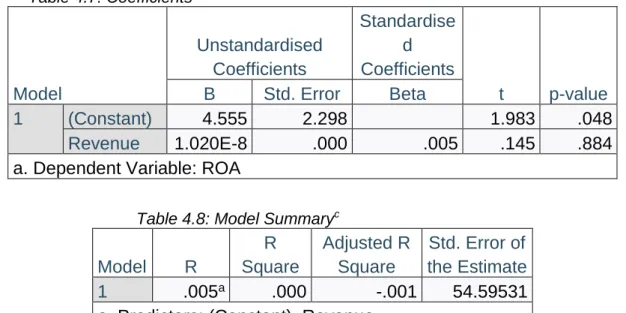
There is no relationship between revenue and return on assets.
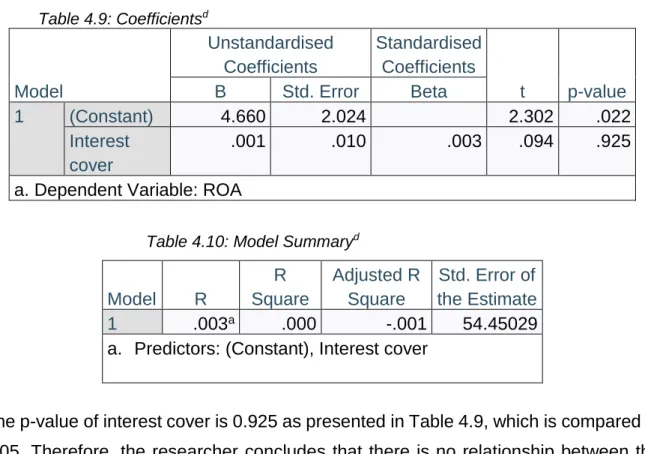
There is no relationship between interest cover and return on assets.
There is no relationship between environmental health safety and return on assets.
There is no relationship between community projects (CSR) and return on assets.
The research hypothesis are stated in the alternative form as follows:
There is a relationship between shareholders’ value and return on assets.
There is a relationship between revenue and return on assets.
There is a relationship between interest cover and return on assets.
There is a relationship between environmental health safety and return on assets.
There is a relationship between community projects (CSR) and return on assets.
1.6 SIGNIFICANCE OF THE STUDY Society
4 | P a g e
This study assists the society in which the organisation operates in order to improve their trust, and to believe more in the organisation by supporting their activities since the organisation can improve its accountability for their impacts on the society.
Academia
Academics can benefit from the literature by adopting some of the suggested solutions on how an entity can meet the needs of stakeholders through sustainability reporting.
Firms
Firms can be able to enhance their value since they can be more aware of what should be done to keep stakeholders happy by meeting their needs.
1.7 DEFINITION OF TERMS
Sustainability reporting- the practice of weighing, divulging and being liable to all stakeholders of an organisation for financial performance against specific environmental, social and economic metrics that support sustainable development (Aktas, Kayalidere & Kargin, 2013).
Stakeholders- group of people who are directly or indirectly influenced by results of an organisation. These stakeholders are the drivers of any organisation (McGrath &
Whitty, 2017).
Organisational value- is an economic measure that shows the market value or wealth of the business. This can be seen as a reflection that the organisation is performing (Sucuahi & Cambarihan, 2016).
Return on assets- this is a finance ratio which is used for analysis. It shows how the resources of an organisation are efficiently used to make income (Manyo & Ogakwu, 2013).
Stakeholders’ needs- these are described as requirements of stakeholders IN the organisation (Salado, 2021).
5 | P a g e
1.8 SUMMARY OF CHAPTER
This chapter discussed the research background, research problem, hypotheses and objectives of the study. It further looked at the significance of the study and defined key terms that are used throughout the research. The next chapter discusses the literature review of the study.
6 | P a g e
CHAPTER TWO: LITERATURE REVIEW 2.1 INTRODUCTION
This chapter discusses literature review about how value is created for different stakeholder groups and how it affects the financial performance of the organisation.
The chapter also reviews the stakeholder theory and discusses the theory of value, both of which are about how to identify stakeholders’ preferences to ensure that they are satisfied, and to figure out how value can be channelled from stakeholders to the organisation without compromising their needs.
2.2 CONCEPTUAL REVIEW
Organisations comprise stakeholders. These stakeholders have needs that have to be balanced. To balance these needs, organisations are required to publish their corporate activities in their sustainability reports so that all stakeholders can be able to see how their investments in the organisations are performing (Guziana & Dobers, 2013). The fact that stakeholders have different needs shows that they need to be understood in a way that the organisation can cater for all of them. In so doing, Tang and Shen (2013) suggest that the use of the stakeholder concept assists the organisations in evaluating how they can meet the different stakeholder needs in a way that can enhance organisational value.
Aktas, Kayalidere and Kargin (2013) suggest that sustainability reporting is aimed at letting all stakeholder groups, even potential ones about the background and performance of the organisation and how organisations look after the communities they operate in. Sustainability reporting underlines this research. However, stakeholder groups also take a big role in this research as this study focuses mainly on how to capture stakeholder groups by finding different ways to create value for them. The reason is that different stakeholders have different expectations on how they expect the value to be generated for them (Davis, 2014).
Organisational value is linked with stakeholder value creation because as value is created for the stakeholder groups, it needs to translate to organisational value. As such, managers must be able to derive value from the operations of an organisation by aiming for better financial performance (Sucuahi & Cambarihan, 2016). Moreover,
7 | P a g e
return on assets is the financial management ratio which can be utilised as a measure of evaluating the financial performance. Manyo and Ogakwu (2013) agree that ROA can determine whether the use of assets in an organisation can bring income that yields better organisational value. Therefore, organisations need to look after their stakeholder groups and ensure that sustainability measures are not neglected by publishing them in sustainability reporting.
2.3 THEORETICAL REVIEW
This section contains the theoretical review of stakeholder theory.
2.3.1 Stakeholder Theory
The stakeholder theory is described as a theory that allows industry managers to manage their organisations and to address ethics of managing organisations. Harrison and Wicks (2013) state that the stakeholder theory is significant in aiding organisations to understand the needs of its different stakeholder groups. Nonetheless, not enough attention has been devoted to satisfying the needs of different stakeholders and their concerns about what values they derive from the organisation. Although stakeholders have different information needs and expectations, the stakeholder theory aids organisations in understanding and meeting stakeholders' expectations. Hörisch, Freeman and Schaltegger (2014) contend that the stakeholder theory is used often in the social, environmental and sustainability management research because it promotes mutual understanding and commitment by organisations to satisfy the yearnings of its different stakeholders. This is because the stakeholder theory aims at ensuring that relationships between management of organisations and different stakeholder groups are genuine, and the value shared between them translates into the value of organisations (Fakoya & Nakeng, 2019). The stakeholder theory was used by Fakoya and Nakeng (2019) in a study about board characteristics together with the sustainable energy use, who conducted their study based on banking and retail companies listed on the Johannesburg Stock Exchange, which they analysed through the multiple linear regression. The theory was deemed relevant in the study because it involved members of the board of directors, which have different needs and preferences that need to be balanced in retail and banking companies. The researcher considers the stakeholder theory applicable in this study because the study
8 | P a g e
concentrates on satisfying the needs of stakeholders to create value for both the organisation and the stakeholder. In addition, the stakeholder theory helps the organisation in understanding how different needs of stakeholders can be satisfied.
Wang, Dou and Jia (2016) argue that the stakeholder theory helps organisations in making decisions that are in line with the expectations and needs of different stakeholder groups, which can influence organisational financial performance.
However, these stakeholder groups cannot be equally treated because of their different needs. So management of organisations can use the stakeholder theory to identify what each stakeholder group is interested in (Hörisch, Freeman &
Schaltegger, 2014). Furthermore, Hörisch et al. (2014) explain that the stakeholder theory guarantees that value is formed for different stakeholders after the management of the organisation has used it to categorise mutual interests of stakeholders and work on achieving them. Therefore, if organisations do not see the importance of using the stakeholder theory to develop relations with its stakeholders, the likelihood of the organisation to improve its performance is low, which means that it may result in its failure in the future (Brower & Mahajan, 2013).
A study by Samant and Sangle (2016) shows that organisations used to focus on the maximisation of shareholders’ wealth, which is just one set of stakeholders. But recently, organisations are pressured to cater for all stakeholders' needs. Most importantly, the stakeholder theory adds value to stakeholders, which translates into organisational value. For this purpose, Vidal, Berman and Buren (2015) argue that organisational managers are making use of the stakeholder theory to identify which value is the most appropriate to address a stakeholder interest. Additionally, managers need to know the different needs of different stakeholders so that they can enhance the value of the organisation and that of different stakeholders. Freeman and Moutchnik (2013) further state that for a business to be successful, it needs to ensure a mutually beneficial relationship between different stakeholders.
As such, the stakeholder theory is considered applicable in this study as it seeks to examine how organisations' understanding of different stakeholders’ expectations and satisfaction thereof can translate into value creation. Additionally, the theory can be used in this study because it constitutes different stakeholders of which organisations need to understand what they prefer for their value to increase.
9 | P a g e
2.4 THEORETICAL FRAMEWORK
This research relies on the Value Creation Theory as this research aims at establishing how value can be created for stakeholders.
2.4.1 Value Creation Theory
The value creation theory is described as the utilisation of labour together with other resources in order to generate value in the organisation (Bowman & Ambrosini, 2000).
This study makes use of the value theory because it (the study) explores how organisations create value to meet the needs of stakeholders via effective communication of sustainability reports. However, Bowman and Ambrosini (2000) argued that value can as well mean how different stakeholder groups respond to organisational performance. If different stakeholder groups are satisfied with the organisational performance, they are likely to respond positively. This may lead to the financial growth of the organisation. Additionally, the value creation model helps in creating value for different stakeholder groups (Vidal, Berman & Buren, 2015). This value creation model by Vidal et al. (2015) is divided into two categories, the broad and narrow value creation. Narrow value creation focuses on fewer stakeholders, mainly on customers and shareholders, while the broader value creation model focuses on broader stakeholder groups, including employees, communities, financiers and suppliers. By using the qualitative content approach, organisations may prefer the broader value creation than the narrow value creation because it caters for the majority of stakeholders.
Value creation for stakeholders positively affects the financial performance of the organisation. Garriga (2014 ) believes that in creating value for stakeholders, organisations need to understand how the theory of value can be linked to the stakeholder theory as stakeholders expect value from the organisation. In this sense, it is empirically clear that the theory of value works hand in hand with the stakeholder theory.
As such, the value creation model or theory of value is suitable in this study as it aims to discover how value can be created for different stakeholder groups because these stakeholders expect organisations to meet their needs through effective communication of sustainability reports. Hence, creating value for different
10 | P a g e
stakeholder groups can positively affect organisational performance, especially its financial performance.
2.4 EMPIRICAL REVIEW
2.4.1 Shareholders’ value and Return on Assets
An organisation aims to create value for shareholders by way of maximising their wealth. This occurs when shareholders get a higher return on their investment.
Sharfman (2014) states that wealth maximisation by shareholders is a way to encourage management in the organisation to make decisions concerning new investments, dividend strategies and deliberate decisions with shareholders’ needs in mind in the essence of organisational value creation through shareholders’ value.
Cohen and Wang (2013) argue that managers need to work closely with other stakeholders to create value in the organisation. They further contend that if managers have a positive attitude towards the dividend relevance theory, it can have a positive impact on the shareholders' value.
2.4.1.1 Effect of dividend policy on shareholders' value
The dividend policy discussed by Baker and Weigand (2015) shows how different groups of shareholders react to dividends or how they view them. Dividend policy is a tool used to gauge the benefit accrued to shareholders in return for their investment risk. Additionally, Ajanthan (2013) found that dividend decisions are essential in the organisation because they assist in determining what part of earnings to allocate as a dividend or retained earnings by the organisation. Moreover, dividend decisions provide information to stakeholders about organisational performance. The dividend policy debate has been ongoing since Miller and Modigliani’s (1961) theory, which argues that dividends are immaterial to organisational value because they assume no taxes, no transaction costs or agency costs. However, with time, financial researchers have argued that dividends impact positively on organisational value. Moreover, the policy has different types of theories (Miller and Modigliani, residual theory, bird in hand theory and the tax preference theory), which explain the relevance and irrelevance of dividends of shareholders towards organisational performance and shareholders’ value.
11 | P a g e
Ouma (2012) conducted a study with regards to dividends and organisational performance, which suggests that paying out dividends to shareholders may lead to a decline of the organisation's fund, resulting in reduction in available funds for reinvestment. Furthermore, dividends pay-out could mean an improved managerial performance resulting in wealth maximisation. Besides, shareholders' wealth maximisation could translate into value maximisation of the firm, where shareholders get a fair return on their investment (Mokaya, Nyangara & James, 2013).
According to Akbar and Baig (2010), the share price is a key variable of firm value, with shareholders’ wealth maximisation dependent on organisations’ rate of return paid out as a dividend. This implies that if dividends are critical determinants of the share price, shareholders would prefer to be paid dividends as it can impact positively on the share price of the organisation, thereby enhancing value. Shareholders’ value maximisation is not only dependent on the dividend policy of the organisation, but is also influenced by financing and investing decisions (Ofori‐Sasu, Abor & Osei, 2017).
Additionally, this means that an organisation's retained earnings have an impact on shareholders’ wealth through beneficial investment decisions. Moreover, the reaction of share prices on dividend announcement has the power to increase or decrease the agency problem between shareholders and management (Akbar & Baig, 2010).
Ofori‐Sasu et al. (2017) claim that the use of a dividend policy in an organisation maximises the share price, resulting in shareholders’ wealth maximisation. However, dividends do not influence organisational performance because organisational performance depends on the selection of optimal assets, which is likely to yield a positive net present value (Modigliani & Miller, 1961). Therefore, the dividend policy does not influence shareholders’ wealth if it does not influence performance to create value for both the shareholders and the organisation.
Besides, Habib et al. (2012) state that Miller and Modigliani (1961) indicated that the determinants of the increased financial performance of an organisation depends on the risk that the organisation undertakes and the basic income which comes from the use of assets. This increase in financial performance means that if an organisation partakes in higher-risk investment, it creates a possibility of receiving good financial returns, which allow the organisation to meet the needs of shareholders, leading to
12 | P a g e
increased value. Gul, Sajid, Razzaq, Iqbal and Khan (2012) mentioned that the theory of bird-in-hand, which was presented by Gordon and Walter in 1963 stipulates that if an investor is a minimum risk person (referred to as risk-neutral), they prefer dividends now rather than capital gains in future. Therefore, it is expedient to create value for the shareholder and to improve the financial performance of the organisation.
An organisation needs to know which dividend policy to use to pay dividends to shareholders (Masum, 2014). A study by Masum (2014) indicates that paying a high dividend can be excellent and beneficial to shareholders. However, a high dividend payout may lead to the company to remain with few earnings, and this means not having enough funds to invest in projects which can bring more value to the company.
Furthermore, Masum (2014) reveals that lenders of money to the company are interested in how much dividends the organisation pays its shareholders as they need assurance that the organisation is able to meet the obligations after paying the dividends. However, Zakaria et al. (2012) argue that the distribution of dividends by an organisation is most likely to attract more potential investors to buy the shares of the organisation, which increases its capital, resulting in enhanced value of the organisation.
Ramadan (2013) proposes that dividend can have two methods: managed dividends and residual dividends in the unlikely event of dividends and share price volatility.
Residual dividends are dividends paid after considering all the appealing investments that are determined using the net present value. Managed dividends are used when the managers of the organisation believe that dividends play a role in the interests of shareholders, and affect the share price of the organisation (Ramadan, 2013; Patra &
Dhar, 2017). Furthermore, Ramadan (2013) suggested that the proper management of dividends by an organisation influences the share price positively. Ramadan (2013) used the multiple regression in combination with the correlation research design.
However, it is not in all cases that a dividend policy positively affects the share price to create value for the shareholders; it depends on how the managers implement the dividend policy.
Patra and Dhar (2017) argue that if an organisation pays low dividends, it increases its assets, thereby improving the chances of management selecting more beneficial investments that reduce the organisation’s financing investments risk. Hashemijoo,
13 | P a g e
Mahdavi-Ardekani and Younesi (2012) argued that organisational value is derived from its earnings, which flow from its investment policy in well-paying investments.
This shows that shareholders' value does not arise from the distribution of dividends because dividends may lead to a reduced share price. After all, the organisation is likely not to have enough money to invest in well-paying investments. Hashemijoo et al. (2012) further state that dividends have no strong influence on an organisation’s share price, which is the value of the organisation. This conclusion was reached through the application of correlation analysis and multiple least square regressions by using 84 selected organisations over a period ranging from 2005 to 2010.
Additionally, debates on the influence of dividends towards organisational value and shareholders’ value are continuing. Al-Hasan et al. (2013) say it is questionable if paying a dividend affects the value or the retention of funds or a combination of dividend payout and retention positively. However, a study by Al-Hasan et al. (2013) contends that dividend payments has more influence on the market price than retention using secondary data analysed through descriptive analysis and a combination of correlation and multiple regression models.
2.4.1.2 Market share price on shareholders' value
Sharfman (2015) explains that the primary goal of managers is to maximise shareholders’ wealth, which translates into maximising organisational value, which is in turn measured by the price of the stock. Gul et al. (2012) propose that the common stock (shares) market price influences the wealth of shareholders. Organisations' share value may increase due to consistent increase in earnings that managers generate and pay shareholders returns in the form of dividends (Zakaria, Muhammad
& Zulkifli, 2012). Masum’s (2014) study shows that dividends and earnings play a role in determining the share price of an organisation, and conclude that there is a strong relationship between dividends, earnings and share price using a panel data analysis.
This means that when an organisation has improved earnings and dividends, the share price is positively affected, resulting in increased shareholders' value.
Additionally, for shareholders who have long term interests, their value can be enhanced positively as the share price increases consistently. Moreover, shareholders can enhance their value just by being on the lookout for fluctuations of the share price, hoping that if shares increase, they buy more; otherwise they quickly sell the shares
14 | P a g e
to ensure that they do not lose their investment (Buigut et al., 2013). However, Malik et al. (2012), who undertook a study on determinants of share price using linear and no linear methods, found that shareholders can make decisions based on the availability of information on share fluctuations.
Shareholders’ value can be measured in some instances through the cost of capital in a way that if the organisation is considering investing in a new project, the managers can ensure that the return on assets is more than the cost it takes the organisation to finance operations (Baker & Wurgler, 2015). This means that if managers undertake a project with a return more than the cost of financing, shareholders of the organisation are going to benefit, thereby increasing shareholders' value. Shareholders’ value and organisations' value positively affect each other because the higher the ROA, the improved the management and the better managed the organisation, and the higher the value of the organisation improves (Lins, Servaes & Tamayo, 2017).
Manab and Ghazali (2013) contend that shareholders’ value has the most significant impact on enterprise risk management (ERM) implementation. Managers can initiate risk management to ensure the safety of an organisation's assets, thereby positively impacting on the shareholders' value through better use of assets in generating improved income that maximises the shareholders' value (Gatzert & Martin, 2015).
The effective execution of ERM rests on the effectiveness and efficiency of managers of the organisation. ERM assists in identifying prospective risk as well as assure accomplishing set goals and targets (Commission of Sponsoring Organisations of the Treadway Commission, 2013).
2.4.1.3 Agency problems (agency costs) on shareholders' value
Shareholders appoint managers with the expectation that they put the needs of all shareholders as a priority. However, when managers drift away from considering the interests of shareholders, it creates a problem. A study by Rizqia and Sumiati (2013) finds that an organisation's effort to lessen the agency problem between managers and shareholders can create problems between the managers and lenders of the money. This is because shareholders are demanding high dividend payout which leads to the organisation running the risk of using external finance if there are no available funds. This can lead to an increased financial risk for the organisation.
15 | P a g e
However, a study by Balagobei (2013) contends that payment of dividend by organisations reduces agency costs. In line with this, managers are supposed to make decisions that lead to value enhancement for the organisation and stakeholders. This means that for managers to run the business and ensure value creation, they need to focus on shareholders’ wealth maximisation and not only look after their interests. For this reason, Abor and Fiador (2013) proposed that the introduction of a decent organisational governance is to ensure that managers do not renege on the objectives of maximising shareholders’ wealth.
Furthermore, Sajid et al. (2012) suggest that if an organisation has a weak corporate governance structure, it can face serious agency cost problems because managers might not be alerted by the board when they derail from the goal of value creation for the organisation and other stakeholders. Moreover, Sajid et al. (2012) contend that a good corporate governance approach that considers the separation of the CEO's function as the chairperson of the board can affect the level of agency costs, the board size, and directors' remuneration. Besides, Saltaji (2013) states that agency costs in the organisation need to be minimised and managed with care to avoid a company running the chances of bankruptcy so as not to threaten its financial stability. Saltaji (2013) argues that for shareholders to ensure that their value is not compromised by managers not acting in their best interest, shareholders should consider increasing executive bonuses so that decisions that managers take can be of value. Additionally, in the South African corporate finance context, to reduce agency costs, shareholders should consider two ways - incentive and performance plans - to ensure that an organisation's value is maximised (Du Toit, Erasmus, Kotze, Ngwenya, Thomas &
Viviers, 2014).
Moreover, Park and Jang (2010) state that bonuses are not the only way to ensure adherence to performance plans, but through the transfer of part ownership of the organisation to managers to ensure that decisions benefit all. The spreading of ownership is an incentive plan (Du Toit et al., 2014). Park and Jang (2010) are of the view that for well-developed businesses, an incentive plan of awarding managers a portion of the company's shares at a certain market price is the best incentive with a higher chance of reducing agency costs. As such, managers are compelled to put the
16 | P a g e
needs of shareholders as top priority as they are part owners of the organisation, ensuring that wealth is maximised.
Extant literature on agency costs shows that an owner-managed organisation is likely to have minimal agency costs since the shareholders are managers. Rashid (2016) believes that when managers hold some stake in the organisation, they ensure that value is enhanced. Rashid (2016) used the regression model analysis to reach the conclusions that managerial ownership does reduce the agency costs. He used the asset operation ratio to measure costs incurred by managers. However, reducing agency costs through managerial ownership depends on how much stake the owners have because if it is not enough to create value for the managers as it does for the main shareholder, agency costs can still occur and not reduced despite incentive plans. This situation arises because in modern business, both managers and shareholders take as much chance as they possibly can.
Rashid (2016) argued that to keep the issue of agency cost at a minimum, shareholders need to monitor managers closely by constantly changing the directors and managers. High agency costs result from lack of goal congruence which means that managers and shareholders are not going the same direction, and there is no consistency (Wellalage & Locke, 2012). In this regard, the contrary relationship between shareholders and managers of the organisation leads to an agency problem, resulting in a decline in shareholders’ value (Gong, 2011). Hence, if shareholders’
value increases, there cannot be any adverse relationship between the stakeholder and the manager because the needs of different stakeholder groups would be met.
Habib, Kiani and Khan (2012) state that according to Miller and Modigliani (1961), conflict between shareholders and managers does not exist as managers are the best agents of the business. So agency costs do not influence shareholders’ value.
However, it is not always the case that shareholders and managers do not have conflicts as managers might be focusing on enhancing their wealth.
Hence, this study proposes that:
H1- There is no relationship between shareholders’ value and return on assets.
17 | P a g e
2.4.2 Revenue and Return on Assets
Revenue comes from sales that the organisation makes to its customers. Sun and Kim (2013) found that when customers’ needs are satisfied, the organisational performance and its value are affected positively. As such, customer satisfaction is vital for organisations because it is an essential principle for retaining them. Customers have the power to influence the revenue of organisations positively or negatively by sharing their experiences with other people, which can affect the organisation's value when they are satisfied (Agrawal & Rahman, 2015). Moreover, the involvement of customers leads to growth in the revenue, which is likely to influence organisational value (Hilton, Hughes & Chalcraft, 2012). Agrawal and Rahman (2015) believe that a customer is the co-beneficiary or user of the goods or services because he or she can play different roles in the value chain of organisations or growth of revenue and ROA.
Hence, it is plausible that satisfied customers add value and the organisation benefits financially through increased patronage.
2.4.2.1 Customer satisfaction and financial performance
ROA exists because revenue, which makes up the net profit to calculate the ratio of ROA, measures the performance of managers (McGowan & Stambaugh, 2012).
Mohammadhossein, Ahmad, Zakaria and Goudarzi (2015) found that customer relationship management is essential because it helps managers to understand how they can respond to the needs of their customers. Agrawal and Rahman (2015) reflect that the value of an organisation flows from managers to customers. Although recent studies show that value creation is a joint process between customers as revenue generators and the organisation which aims to have a better ROA through strategic decisions of managers, this affects customers' attitude towards organisational performance (Wang, 2012). However, without customers, there is no financial growth that reflects on the revenue of the organisation if stakeholders perceive that managers are underutilising the resources of the organisation.
A study by Yu, Jacobs, Salisbury and Enns (2013) state that the combination of customer satisfaction and financial performance is that organisations need to keep up customers’ needs to ensure that they are satisfied at all times. Yu et al. (2013) believe that the proper satisfaction of customers might be linked to financial performance
18 | P a g e
because meeting customers' expectations increases loyalty, resulting in increased transactions and revenue for the organisation. However, if an organisation needs to have a positive financial performance, it needs to ensure that customers are well satisfied, which translates into value creation to both customers and the organisation.
Additionally, Sun and Kim (2013) explain that customer satisfaction does not just come through giving them excellent products; it starts from how far the organisation tries to market itself to customers. The reason is that customers need persuasion before patronising goods or services of an organisation. Besides, Sun and Kim (2013) reveal that when organisations market themselves to customers, it comes at a cost. As such, the more an organisation attempts to enhance customer value through effective marketing and unique product offering, the more costs they incur in meeting expectations. They further contend that it is more costly to draw a new customer than to retain a new one. However, appropriate marketing results in positive outcomes, which leads to new and existing customers buying the products and increasing the revenue.
Moreover, customer satisfaction starts with knowing what customer expectations are;
hence Khan (2012) reflects that customer satisfaction can be an excellent foundation to retain them. Using self-administered electronically distributed questionnaires and regression analysis, Khan (2012) concluded that customer satisfaction has a more significant influence on customers’ loyalty to the organisation. Lin and Wu (2011) opine that customers who are dissatisfied with the organisation start being unfaithful to it.
However, it is conceivable that customers can be dissatisfied and no longer loyal to the organisation with no other options but to purchase from it. Lin and Wu (2011) suggest that it is crucial to ensure that customers are satisfied, thereby creating value for them and the organisation. Kursunluoglu (2014) states that it is important to ensure that customers are satisfied by the organisation as this leads them to stay loyal.
Besides, customer satisfaction ensures that value is created by meeting their needs when the purchase is completed. In this vein, it is safe to say that if customers are satisfied, it leads to an improved financial performance by the organisation (Finn, 2012).
19 | P a g e
2.4.2.2 The impact of customer referral on customer value and financial performance A study conducted by Garnefeld, Eggert, Helm and Tax (2013) suggests that in order for organisations to grow existing customer value to increased revenue, they need to implement customers' referral programme (CRP) so that existing customers can give referrals to potential customers. Moreover, organisations reward customers that make referrals. This enhances the value of the organisation as it leads to increased revenue.
By so doing, the organisation rewards existing customers for bringing others to purchase products or services perceived as creating value for both customers and the organisation. The CRP is a programme aimed at getting existing customers to spread the word about the organisation's activities, and to ensure that it rewards the existing customers who spread the word (Garnefeld et al., 2013). Furthermore, when existing customers participate in these referrals, they share their recommendations about the organisation, which assists management to understand customers and organisations' value as a whole.
Lobel et al. (2016) argue that referrals happen in modern businesses and replace the traditional advertising approach. Moreover, referrals work better through online sources because it is easy for an organisation to create an online link where existing customers can make referrals and receive rewards which can be used for the next purchase in the organisation. This is supported by Wentzel et al. (2013, 2014), who argue that organisations have recently been improving their revenue through customer referrals. Nevertheless, Wentzel et al. (2014) state that most organisations focus on customer referral while neglecting employees in the referral programmes.
Furthermore, it is impotant for organisations to make use of employees as they have a better understanding of the company's products and services, and to increase the revenue by rewarding these employees after successful referrals (Wentzel et al., 2014). Besides, prior research shows that organisations can use their employees to make referrals to gain more customers as a great marketing strategy by offering their employees bonuses based on the number of customers they bring to the organisation (Stockman et al., 2017). A study by Stockman et al. (2017) used the credibility theory and the multiple inference model to assess the dark side of using employee referrals.
The study concluded that apart from being a great marketing strategy, it had failed at some point to yield any success. Consequently, customer referrals are likely to
20 | P a g e
improve an organisation's revenue or financial performance if employees who make the referrals are indeed putting a good word of mouth to convince non-customers to become regular customers of the organisation. In addition to the fact that an organisation can either get referrals from existing customers or its employees, customer retention is the organisation's responsibility. In this regard, it is important for organisations to give their customers a pleasant experience pertaining the goods and services that they offer (Joshi, 2014). This can ensure that converted customers remain loyal, thereby consistently increasing the organisation's revenue. Therefore, if there is appropriate customer management, the organisation can create value in the organisation.
Hence, this study proposes that:
H2- There is no relationship between revenue and return on assets.
2.4.3 Interest cover and Return on Assets
Organisations require financing to make specific investment decisions. Financing can be done using either equity or debt. The interest coverage is a widely used ration which organisations make use of to determine their ability to pay back the loan. In this sense, Ojiako and Ogbukwa (2012) show that the need for credit facilities is due to the constraints of funding that organisations can have internally. However, organisations that use credit facilities are not only forced to use loans from banks, but they can also use bonds as another type of debt depending on the capacity to issue these bonds, often referred to as debentures (Colla, Ippolito & Li 2013). Despite the loan and debentures being all types of debts, the difference is how they can be acquired and issued as the loan is from external finance while the organisation issues debentures.
Organisations need to ensure that they meet their interest obligations to ensure that value is created. For instance, they can acquire a loan from a bank and finance their activities or purchase an asset, which can, in turn, bring income. However, organisations that use debts to purchase assets can either be positive or negative depending on what and how they use the assets for. Akhtar, Javed, Maryam and Sadia (2012) state that the purchase of assets through debts does not guarantee the creation of value through the generation of income in the utilisation of these assets. However,
21 | P a g e
Akhtar et al. (2012) further reflect that it depends on the industry in which the organisation can be operational, and a particular demand in that sector. It is therefore clear that financial institutions take risks in allowing credit to organisations. This risk can be to the organisation, and if it fails to honour the credit, it might be tarnishing its image. There are some organisations that make use of loans to make investments.
Miller and Modigliani's (1963) study shows that loans are cheaper compared to equity because interest is tax-deductible, meaning that an organisation can pay less and therefore enhance their value. However, Ali (2014) argues that because loans have lower interest, they can turn to be harmful to the organisation. This harm results from increased financial risk to the organisation. Furthermore, Ali (2014) argued that once there is an increased financial risk, shareholders tend to request for higher return as they are not sure how this financial risk affects the organisation. Furthermore, the request for higher returns by organisations lowers down their financial performance, and the organisation might not have enough money to invest for more income. A study by Mande, Park and Son (2012) about whether to use debt or equity concluded that organisations go the route of using the pecking order. The pecking order theory was described by MM 1963 as a theory that ranks financing from internal to external sources. Following conclusions made by Mande et al. (2012), it is empirically clear that most organisations avoid using debts so that they do not have high-interest expense to pay.
Organisations need to meet the needs of financiers through the payment of interest, and the principal amount as financiers influence the financial performance of organisations (Stephen, Sunday & Eugene, 2016). This means that organisations need working capital to finance their day-to-day operations. When they do not have such working capital available, they approach banks to get funds to operate and improve the financial performance (Kouvelis & Zhao, 2012). As such, the financier as a stakeholder has created value in the organisation, which creates value in return for the financier by paying the interest amount, as it is due. Additionally, prior studies show the difficulty in acquiring funds from banks because they require security for the risk that they are keen to take (Kouvelis & Zhao, 2012). Besides, Berríos (2013) contends that failure by organisations to pay back their debts make acquiring loans from banks challenging. In this vein, banks introduce complexity in loan acquisition to protect their risk of losing their money. Because if the organisation cannot pay back the loan, they
22 | P a g e
would have failed to meet their obligations, thereby eroding value. Berríos (2013) studies the connection between bank credit risk, profitability and liquidity. The study found, through a robust regression model, a negative relationship between less lending of money by banks to organisations and interest expense. However, when banks are not giving loans, the rate at which they collect interest expense is low. As a result, if the flow of money is limited. There is no value creation chain.
When an organisation is deprived of access to funding by banks to finance its operations because, for example, they do not have collateral assets to put in front, they seek alternative finance. Casey and O'Toole (2014) argued that organisations issue bonds that often are referred to as debentures. These debentures are in the form of debts, and have an interest obligation attached to them. Therefore, organisations put this to the public, and the public buys hoping to get returns in the form of interest payment depending on the payment frequency agreed. However, the option whereby an organisation issue bonds to the public is only for organisations that are publicly listed. This way, the bondholders become stakeholders for the organisation. Their needs are to be met through value creation, which can be seen as their value being maximised. In turn, as they purchase more bonds in the organisation, the value is created for the organisation as its financial performance gets better as they have enough working capital to run the operations of the business as well as to make optimal investments, which bring good returns.
Additionally, Del Viva and El Hefnawy (2019) conducted a study in which they looked at why organisations prefer to issue convertible debentures, which is debt to the issuance of direct shares. Using the theoretical model, which they developed, they concluded that organisations prefer the issue of the convertible debt because it brings cash flow advantage. At the same time, it has options of making it equity at the end of the term rather than having an obligation to pay the face value to the holders. In this regard, organisations benefit, as they get to have money at their disposal as well as the holders. They receive interest which, in a way, creates value for them. However, if the option of not receiving face value is not within their powers, they tend to lose out.
In support of this, Yang and Zhao (2015) argue that the issue of convertible debentures creates value in the organisation in a way that they now prefer debentures that they can convert to equity at a later stage than a direct equity issue. Following this, it is
23 | P a g e
more convenient for big organisations to issue debentures because the issuing costs are not too much and the interest that is paid is tax-deductible. As a result, it is more beneficial to enhance the value of the organisation while satisfying the needs of debt holders who purchased the debentures (Honková, 2016). A study by Honková (2016) was conducted using surveys through questionnaires. The study looked at how organisations opt for the use of different external sources and how this influences organisational performance. The conclusion confirmed that different external sources of finance could not be used equally at the same time. As such, organisations need types of financing, which they are certain to administer, satisfy and meet the needs of stakeholders involved. This means that organisations need to know that holders of debentures are interested in the interests paid to them, the principal amount or the equity shares if they have an option of being converted.
Hence, this study proposes that:
H3- There is no relationship between interest cover and return on assets.
2.4.4 Environmental, Health and Safety and Return on Assets
Employees, as some of the most significant stakeholders, take care of the day-to-day operations of the organisation. As such, they need to be assured that the environment that they are operating in is safe. If not, they need to know that the organisation has taken safety precautions in advance to ensure that their health is properly taken care of in case of any danger that might occur (Dodo, 2014). Nordlöf, Wiitavaara, Högberg and Westerling (2017) reveal that organisations must create a functioning environmental health and safety management system to safeguard the health and safety of employees during working hours. Furthermore, if employees are happy with the safety and healthy environment offered by managers of organisations, it means that the performance of the organisation is likely to be outstanding, which also means the ROA of the organisation improves. Hence, the relationship between employees and managers can improve (Bekaert & Engstrom, 2017). Therefore, it is probable that when organisations guarantee the safety of its employees around the work place, it shows that it is complying with safety procedures.
24 | P a g e
2.4.4.1 The health of employees on financial performance
Employers are of the view that investing in the health of the worker in an organisation is of uttermost importance as it leads to an improved productivity inside the organisation, and employees themselves get to gain more from performing efficiently (Jinnett, Schwatka, Tenney, Brockbank & Newman, 2017). Furthermore, Jinnett et al.
(2017) reflected that employees may be absent from the workplace due to health problems that their employers are not taking into consideration, which lowers productivity, and leads to low-value creation for both employees and the organisation as a whole. However, they contend that employees can be available at work, but their availability does not lead to efficiency in productivity, which does not result in any value enhancement.
Lax (2016) argues that unhealthy employees contribute to lower productivity regardless of their availability or absence from work. Therefore, it is clear from the empirical literature that the health of workers can influence the organisation either positively or negatively. It is clear that employers need to understand what their employees go through daily. However, it is not the responsibility of employers only to ensure that employees are of good health. It is also employees' responsibility to monitor their health by exercising, avoiding substances which affect their health, and many other things which can deteriorate their health (Lax, 2016). However, it does not permit the employers not to implement health awareness in the organisation to ensure that the needs of employees are well catered for (Howard, Chosewood & Hudson, 2016).
Furthermore, organisations that put effort in ensuring the health of their employees happen to do better as organisations and employees in general (Grossmeier, Fabius, Flynn, Noeldner, Fabius, Goetzel & Anderson, 2016). However, some employers are not keen to implement the wellness programme for their employees because they are confident that a great return can come out of it or it just increases the costs spent on the health wellness of employees (Conradie, Van Der Merwe Smit & Malan, 2016). As such, managers pay attention to other organisations to determine if there is any link between employees’ health and financial performance.
25 | P a g e
Even though some managers are sceptical about investment in the health of employees, a study by Goldstein and Noyce (2013) shows that a well-planned programme to look after the health of employees that have good investment is beneficial to the organisation. However, Morgia (2014) argues that it is not a matter of good money invested. Instead, it is a matter of organisations identifying the riskiest health factors, and then to focus on them to ensure that needs are met; and to create value for organisations and employees who need health to ensure that there is increased financial performance. Additionally, Loeppke, Hohn, Baase, Bunn, Burton, Eisenberg, Ennis, Fabius, Hawkins, Hudson and Hymel (2015) conducted a study on incorporating health and safety into the workplace where they proposed that safety precautions for employees in the organisation are improved through risk assessment.
Any organisation can create a wellness programme for environmental, health and safety of employees to ensure increased productivity. But the major factor is ensuring that organisations can control the costs, which come with this programme (Horwitz, Kelly & DiNardo, 2013). Also, Baicker, Cutler and Song (2010) state that well-managed wellness programmes in the workplace can lead to improved health, and that this positively influences employees to become more efficient and avoid being absent from work. This enhances the performance of the organisation as employees' needs are met and satisfied. However, being able to control the costs spent on wellness programmes does not guarantee an organisation to have met the needs of employees as stakeholders. As such, Horwitz et al. (2013) have highlighted the fact that if employees’ behaviour corresponds with the expense of the organisation on the wellness programme, there is no way value can be generated.
It is crucial to educate employees and managers or supervisors about the importance of health and safety, which is First Aid. For this reason, the Occupational Health and Safety Act was implemented to protect the workers about the use of plant and machinery in industries that use these plants and machinery in the daily output production (Zanko & Dawson, 2012). Robson, Stephenson, Schulte, Amick III, Irvin, Eggerth, Chan, Bielecky, Wang, Heidotting and Peters (2012) argue that prioritising employees' health and safety can empower employees to become more conscientious in the work environment. This can help in bringing change in the workplace, thereby influencing organisational performance positively. This may result in the improvement
26 | P a g e
in the ROA of the organisation, as it continues to meet the needs of these employers, which is a true reflection of organisations' value creation processes and employees' value. Moreover, Benatar (2013) states that the organisation must ensure that employees have access to basic healthcare. This can, however, be seen as a contribution from employers to the medical benefits of employees. As such, an organisation must satisfy the health needs of employees to impact the financial performance of the organisation. Organisations need to understand what their employees are suffering from, if any, and put measures in place to ensure that their health problems do not hinder productivity.
2.4.4.2 Effect of working environment on employees and financial performance
When employees are content with the work environment, they become more fruitful, thereby becoming productive. In addition to this, Bushiri (2014) affirms that better outcomes from employees come from a good working environment where they are at ease and have self-importance of working for the organisation. Furthermore, she argues that the working environment should be designed in a way that suits employees' needs and preferences so that their productivity is improved, which translates into more value in the organisation. However, the problem of employees as stakeholders having different needs can be a challenge if the organisation is not able to strategise their needs by forming a familiar working place for them. Bushiri (2014) conducted her study about the effect of the working environment on employees’
performance using the descriptive analysis method and the random sampling technique. The study found that the work environment has an impact on employees.
According to Qureshi, Iftikhar, Abbas, Hassan, Khan and Zaman (2013), a study on the impact of job stress, workload and work environment on the turnover indicates that a good working environment comprises an organisation having an efficient communication system from the higher management to employees, a relationship between colleagues and a good political environment. Additionally, using self- administered questionnaires with a sample of 250 participants where only 109 responded, Kainkan (2015) shows that organisations need to create an enabling working environment. Kainkan (2015) reiterates that where there is a good relationship between employees and managers, and an enabling work environment, employees become more committed to their jobs with little push.
27 | P a g e
Additionally, Olufunminiyi (2019) and Noah and Steve (2012) state that money spent to improve the work environment does not guarantee good performance. However, there is a substantial correlation between the working environment and the attitudes of employees towards the work. Findings by Noah and Steve (2012) were reached through a questionnaire conducted on 120 participants. Mike (2010) argues that a well operational working environment brings out outcomes of which managers of the organisation expect to correspond with plans set for the organisation to be achieved.
This is achieved when the managers ensure that the environment is friendly to employees in a way that they can stay focused. It should be a conducive environment for all. Besides, this is the reason why organisations should understand employees’
expectations in relation to their environment so that they can combine all the needs of employees in order to achieve them.
Hence, this study proposes that:
H4- There is no relationship between environmental health safety and return on assets.
2.4.5 Community projects (Corporate Social Responsibility) and Return on Assets
Community projects are an essential tool for organisational performance that represents the community as a stakeholder of an organisation. There have been studies about the relationship between community projects and organisational performance, which show either negative or positive correlation from different researchers (Inoue & Lee, 2011; Lioui and Sharma, 2012; Rodriguez-Fernandez, 016). As such, determining whether good corporate citizenship of organisations through community projects enhances organisational performance is critical.
Moreover, using the Global Reporting Initiative (GRI) guidelines in preparing sustainability reports could well assist in satisfying the needs of the community. Saeidi, Sofian, Saeidi, Saeidi and Saaeidi (2015) contend that the link between the organisation being responsible and its performance is full of twists and turns. This happens due to not knowing the outcome of undertaking community projects in terms of its effect on organisational performance. A study by Saedi et al. (2015) focused on determining whether corporate social responsibility contributes to financial