THE STRATEGIC PROCESS IN NON-PROFIT ORGANISATIONS A CASE STUDY: The South African National Blood Service
BY
BRONWYN EUNICE BLADES
Submitted in partial fulfillment of the requirements for the degree of MASTERS IN BUSINESS ADMINISTRATION
Graduate School of Business University of Natal, Durban
Supervisor: Professor Elza Thomson
September 2003
September 2003
TO WHOM IT MAY CONCERN:
RE: CONFIDENTIALITY CLAUSE
Due to the strategic nature of this research it would be appreciated if the contents remain confidential and not be circulated for a period of five years.
Sincerely
BRONWYN EUNICE BLADES
991100969
DECLARATION
This research has not been previously accepted for any degree and is not being currently submitted in candidature for any degree.
Signed
Bronwyn Eunice Blades
Date /5/'
/2003ACKNOWLEDGMENTS
This thesis is the culmination of more than two years of study and there are a number of people to whom I owe my gratitude.
To my husband, Andrew. I remember when I first spoke to him about undertaking this Masters degree, which was before we were married, knowing that it mean sacrifices for both of us. Even then, his commitment to me was evident, and this commitment continued during my studies. He has supported me throughout this process, in so many ways, with love and encouragement. My love for him knows no bounds.
To my mother, Beryl Klotz, who throughout my undergraduate and postgraduate studies has so supportive and encouraging, who would have taken the exams for me if she could have, and has supported me throughout my life. She has shaped my values and is an example to me in every facet of my life. I aspire to be as great a woman as she.
As I embarked on my undergraduate studies, my father, Henry Klotz, always said that he wanted me to complete an MBA. I used to nod my head in agreement, not knowing the enormous sacrifice that this would be. This thesis, and the incumbent degree, is partly in tribute to him. He afforded me so many opportunities in my life.
He died over a decade ago but I hope that in completing this that I have made him proud.
I would like to further acknowledge the support of my extended family, my friends and my colleagues. Their encouragement is embodied in the pages that follow.
Finally, a thank you to my supervisor, Professor Elza Thomson, whose determined
manner and enduring words of encouragement were always appreciated. She has
guided me in her unique way to complete this thesis, in a year that was difficult and
ABSTRACT
This research paper documents the process of strategic management, incorporating the five distinct tasks within that process. Each of the tasks is defined and explored within the context of the strategy-making process. The Balanced Scorecard is highlighted as a tool for implementing and executing strategy. The emphasis in this study is on the strategic process in non-profit organisations. Many strategic processes and initiatives appear to be confined to the profit sector, but with the advent of modern strategic theories such as the Balanced Scorecard, there is now an expectation that non-profit organisations can also follow sound business principles and practices.
The research paper is of a qualitative nature incorporating a case study approach.
The case study is the South African National Blood Service (SANBS), which is an organisation in transformation, following changes in the Health legislation in South Africa. The organisation was formed from seven independent services and went through its first true strategic management process in late 2002, ready for its 2003- 2004 financial year.
In the first chapter, an overview of the study is given. Strategic theory is presented
and discussed in the second chapter, with the case study being presented in the third
chapter. Chapter four includes an evaluation of the theoretical information compared
to the practical implementation in SANBS. Chapter five concludes with
recommendations on the way forward for SANBS.
CHAPTER ONE: INTRODUCTION 1
1.1 Introduction 1
1.2 Background of the study · ··· ··· .. · 2
1.3 Motivation for the project 4
1.4 Value of the Research · · ·.. · · 5
1.5 Problem Statement.. 5
1.6 Objectives of the study ·.. ·.. · · · 5
1.7 Research methodology ··· 5
1.8 Limitations of the project · 6
1.9 Structure of the study 6
1.10 Summary 7
CHAPTER TWO: STRATEGIC PROCESS 8
2.1 Introduction 8
2.2. Developing a Strategic Vision and Business Mission 9
2.2.1 Characteristics of the Vision 11
2.2.2 The Elements Of A Strategic Vision 12
2.3 Establishing Objectives 14
2.3 Crafting a strategy: translating words into actions 18
2.3.1 Building a capable organisation 21
2.4 Implementing and executing the chosen strategy 23 2.5 Evaluating performance and initiating corrective adjustments 26
2.6 Factors that shape a Company's Strategy 26
2.6.1 Societal, Political, Regulatory and Citizenship Considerations 27 2.6.2 Competitive Conditions and Overall Industry Awareness 27 2.6.3 The Personal Ambitions, Business Philosophies, and Ethical Beliefs of
Managers 28
2.6.4 The Influence of Shared Values and Company Culture on Strategy 29 2.7 Strengths, Weaknesses, Opportunities and Threats (SWOT) 30
2.7.1 Limitations and Pitfalls 30
2.7.2 Aim of a SWOT analysis 31
2.7.3 Benefits of the SWOT analysis 32
2.7.4 Conclusion 32
2.8 Core Competencies 32
2.8.1 When is a core competence not a core competence? 33 2.8.2 Finding the core competence of an organisation? 34
2.8.3 Core Competence of a Service Provider 36
2.8.4 Using Core Competences for Strategic Planning 36
2.8.5 Conclusions on Core Competence 37
2.9 CULTURE 37
2.9.1 The concept of culture and the cultural web 38
2.9.2 The value of Cultural mapping 40
2.9.3 Value of remapping the organisational culture 40 2.9.4 Building a Strategy-Supportive Corporate Culture 41
2.9.5 Strong versus Weak Cultures 45
2.9.6 Unhealthy Cultures 46
2.10.2 Origins of the Balanced Scorecard 48
2.10.3 The Role of the Balanced Scorecard 51
2.10.4 The Balanced Scorecard and Strategy 53
2.10.5 The Balanced Scorecard and Existing Management Control Systems 55
2.10.6 The Balanced Scorecard and Culture 56
2.10.7 The Balanced Scorecard and the Missing Elements 58
2.10.8 Conclusion 59
CHAPTER 3 CASE STUDy 60
3.1 Background 60
3.2 SANBS Structure 63
3.3 The Environment 63
3.3.1 Procurement. 64
3.3.2 Processing and Testing 64
3.3.3 Distribution and Issue 65
3.3.4 Natal Bioproducts Institute 65
CHAPTER FOUR: EVALUATION 67
4.1 SANBS Strategic Process 67
4.1 .1 Environmental Scanning 67
4.1.2 Developing a Strategic Vision and Business Mission 72
4.1.3 Setting Objectives 74
4.1.4 Crafting a strategy 78
4.2 The SANBS Balanced Scorecard 86
4.3 Strategic Self-assessment - Strategy development questionnaire 91
4.3.1 The Strategic Development Questionnaire 92
4.4 Conclusion 97
CHAPTER FIVE: RECOMMENDATIONS 98
BIBLIOGRAPHy 104
LIST OF TABLES
Table 4.1.
Table 4.2 Table 4.3 Table 4.4 Table 4.5 Table 4.6 Table 4.7 Table 4.8 Table 4.9 Table 4.10 Table 4.11 Table 4.12 Table 4.13 Table 4.14 Table 4.15 Table 4.16 Table 4.17 Table 4.18
International Opportunities and Threats National Opportunities and Threats Internal Opportunities and Threats Strategic statements
Expanded Strategic statements 1 Expanded Strategic statements 2 Expanded Strategic statements 3 Expanded Strategic statements 4
Medical Objectives, activities and action plans PTI Objectives, activities and action plans
Procurement Objectives, activities and action plans Human Resources Objectives, activities and action plans Finance Objectives, activities and action plans
IT Objectives, activities and action plans
Quality Objectives, activities and action plans SANBS Balanced Scorecard
Strategic Development Dimensions
Results of Strategic Development Questionnaire
LIST OF FIGURES
Figure 1.1 Figure 2.1 Figure 2.2 Figure 2.3 Figure 2.4 Figure 2.5 Figure 2.6 Figure 2.7 Figure 2.8 Figure 2.9 Figure 3.1 Figure 3.2 Figure 4.1 Figure 4.2 Figure 4.3 Figure 4.4 Figure 4.5 Figure 4.6
The Strategic Process and the Balanced Scorecard The Strategic Management Process
Strategic Implementer's Action Agenda Building a Capable Organization Shared values and Company Culture
Unraveling Core Competence: The Top Down Approach The Cultural Web
The Balanced Scorecard
The Role of the Balanced Scorecard
The Balanced Scorecard and the Missing Elements
The Relationship between the Department of Health and SANBS SANBS Structure
The Strategic Process - Developing a Vision and Mission The Strategic Process - Setting Objectives
The Strategic Process - Crafting Strategy
The Strategic Process - Implementing and Executing Strategy SANBS Balanced Scorecard - the Dashboard
SANBS Balanced Scorecard - linking objectives and perspectives
CHAPTER ONE: INTRODUCTION
1.1 Introduction
The term business strategy concerns the approaches and actions crafted by management to produce successful performance in one specific line of business, the central business strategy issue is how to build a stronger long-term competitive position. For a single business company, corporate and business strategy are one and the same1.
The central thrust of business strategy is to build and strengthen the company's long- term competitive position in the marketplace. Therefore, business is concerned primarily with forming responses to changes under way in the industry, the economy at large, the regulatory and political arena and other relevant areas crafting competitive moves and market approaches that can lead to sustainable competitive advantage building competencies and capabilities uniting the strategic initiatives of functional departments and addressing specific strategic issues facing the companl.
A good strategy is well matched to a company's external and internal situation; as the situation changes, adjustments to strategy are needed. Some changes in a company's external and internal environments requires little or no response, whilst others call for significant strategy adjustments.
The most successful business strategies aim at building uniquely strong or distinctive competencies in one or more areas crucial to the strategic success of the organisation. Business strategy must also aim at uniting strategic initiatives in the various functional areas of the business. Strategic actions are needed in each functional area to support the company's competitive approach and overall business strategy. Business strategy also extends to action plans for addressing strategic issues relating to company competitive position and internal situation.
IThompson, A and Strickland, AJ (200 I). Crafting and Executing Strategy: Text and Readings - International Edition, McGraw-Hill, ChI
21bid
1.2 Background of the study
The subject of the study is the South African National Blood Service (SANBS), which is an organisation in a state of transformation. The organisation, a Section 21 not-for- profit company, was formed from the seven independent blood transfusion services due to changes in the legislation (in 1999, the government stated that they were moving to a one-license for blood transfusion in the new National Health Bill, which will now be tabled in late 2003). The Service underwent its first true strategic process last year, in readiness for its 2003-2004 financial year. This was an intense process, and a learning curve for the Board, executives and management that participated. It is the opinion of the writer that the strategic process had some flaws, particularly in the implementation, execution and evaluation of the strategy. There has been no formal review of the process in SANBS since the completion of the exercise.
This study therefore examines the strategic process in terms of theories and methodologies. The starting point is the basic strategic tasks that combine to make a strategic management process3. These tasks are identified as follows:
1 Forming a strategic vision of what the company's future business makeup will be and where the organisation is headed - so as to provide long-term direction, delineate what kind of enterprise the company is trying to become, and infuse the organisation with a sense of purposeful action.
2 Setting objectives - converting the strategic vision into specific performance outcomes for the company to achieve
3 Crafting
a
strategy to achieve the desired outcomes4 Implementing and executing the chosen strategy efficiently and effectively.
3Thompson A and Strickland AJ (200 I) Crafting and Executing Strategy: Text and Readings - International edition, McGraw-Hill, Ch I
5 Evaluating performance and initiating corrective adjustments in vision, long-term direction, objectives, strategy, or implementation in the light of actual experience, changing conditions, new ideas and new opportunities
These five steps are termed strategic management and each step will be discussed in detail in the study. Strategy is the approach used to accomplish the mission and implement the organisation's vision. Strategy exists at different levels within the organisation and is to be embraced by all staff within an organisation in order to achieve success.
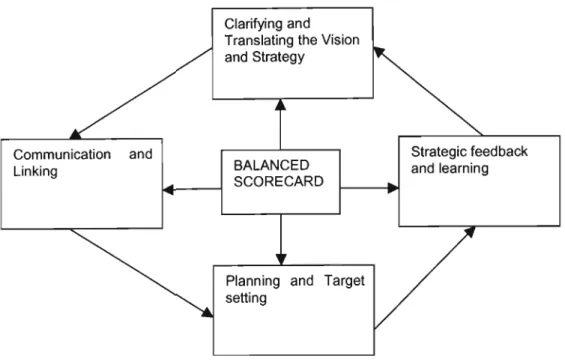
Also included, as the tool for implementation and execution is the examination and discussion of the Balanced Scorecard, as pioneered by Kaplan and Norton in the 1990s. SANBS has attempted to implement this Scorecard with some difficulty.
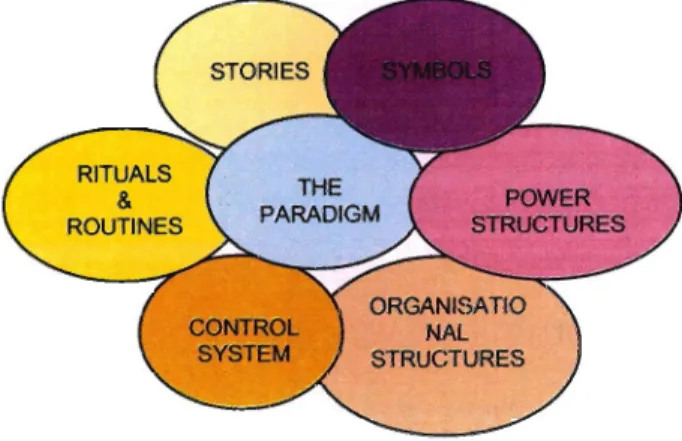
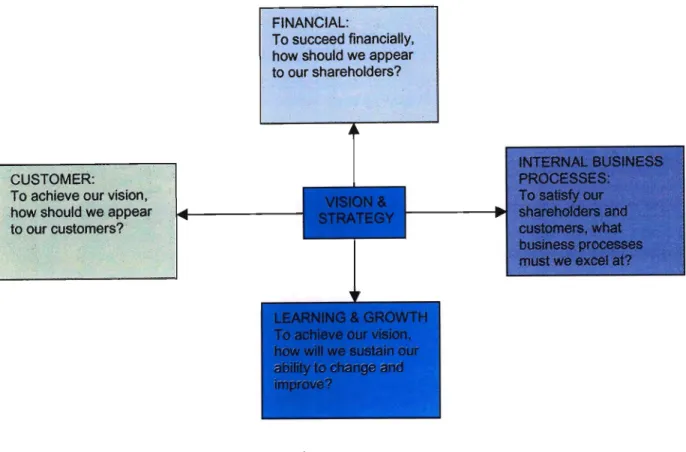
The Balanced Scorecard is a Performance Management system that can be used in any size organisation, commercial or not-for-gain, in order to align vision and mission with its operational activities. It aims to translate strategy into identified, measurable objectives that can be evaluated and monitored. These measures are defined in terms of financial objectives, customer requirements, internal business processes (operations) and learning and growth.
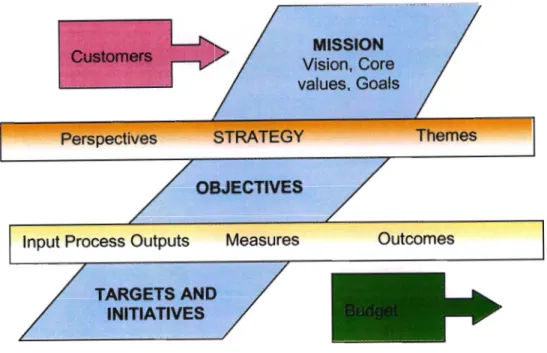
The following diagram shows the relationship between strategic process and the Balanced Scorecard, which will be discussed within the study.
MISSION Vision, Core values. Goals
Perspectives STRATEGY Themes
OBJECTIVES
Measures
TARGETS AND INITIATIVES
Outcomes
Figure 1.1 Strategic Processes and the Balanced Scorecard
Internet 2: www.balancedscorecard.org taken from Rohm. H. "A Balancing Act", Perform Magazine (2) (2), page 6
1.3 Motivation for the project
The South African National Blood Service is an organisation in transformation. It been formed from the merger of seven independent blood transfusion services, resulting in a blend of people, processes, cultures and ideas. In addition to this, the emergence of current trends such as Corporate Governance have forced the organisation to take account of its position and implement appropriate business practices and structures.
The strategic process undertaken in 2002 was the first process of its kind in the new organisation. It was an intensive process incorporating the principles of strategic thinking beginning with the mission and vision of the organisation through to the development of the SANBS scorecard.
The strategic process was completed, but there has been no evaluation of whether the process achieved the results intended, or how the participants perceived it. The
intention of this research is to evaluate the SANBS process, before the organisation embarks on the review process in the next financial year.
1.4 Value of the Research
Since this will be the first evaluation of the strategic process, SANBS can take into account the observations and recommendations of the research when implementing review processes and strategic initiatives.
1.5 Problem Statement
SANBS as a non-profit organization has been through a strategic process, as laid out in the accepted strategic theories. The question is whether SANBS has achieved what it intended, and how successful it has been in this process.
1.6 Objectives of the study
The study has the following objectives:
• To evaluate the SANBS strategic process against accepted strategic theories and models;
• To determine the successes and failures within the process
• To establish a way forward for SANBS in terms of both strategies and strategic processes and models.
1.7 Research methodology
The research methodology is qualitative in nature and will be presented in the form of a case study approach.
1.8 Limitations of the project
SANBS (incorporated as a Section 21 company in terms of the Companies Act) is a non-profit organisation, whose mission it is, to provide patients of South Africa with safe, quality cost-effective blood and blood products. SANBS operates on a fee-for- service basis, on the principle of cost recovery. One of the major differences between the two regions of SANBS is the pricing of blood and blood products, and the costing of these products.
Due to its non-profit nature and the nature of its business, comparison with similar organisation is limited, and comparison with profit driven organisations is meaningless. Hence, no financial analysis will be included in this research.
As a result of the nature of the organisation and the differences in the regions, financial information and cost models will not be included in the study.
1.9 Structure of the study
The study will be structured with the following chapters:
Chapter two
The study is based on strategic process and this chapter will focus on strategic theories and models.
Chapter three
This chapter will focus on the case study, a detailed review of SANBS, including its history, products and services, processes and strategic planning.
Chapter four
The strategic theories and models from chapter two will be evaluated against the case study information in chapter three.
Chapter five
A conclusion will be drawn on whether SANBS has successfully completed and implemented its strategic plans. The future processes and plans to address the shortfalls will be developed as well as recommendations for and benefits of these processes.
1.10 Summary
A brief theoretical background on strategic theories and the Balanced Scorecard was presented, together with a background for the subject of the case study, the South African National Blood Service. A motivation for the study was documented, together with the value that the research will add. The problem statement and objectives of the study were also considered. Finally a summary of the content and plan of this research was given. Following this brief introduction, the next chapter discusses strategic theories and tools.
CHAPTER TWO: STRATEGIC PROCESS
2. 1 Introduction
A company's strategy is the "game plan" management has for positioning the company in its chosen market arena, competing successfully, pleasing customers, and achieving good business performance. Strategy must be recognized as a process rather than a set of independent and unrelated tasks. Strategy does not begin and end with forming a plan but extends to full implementation and review of that plan.
There are five recognized tasks in the strategic process4, all of which are interrelated.
These are identified as follows:
1. Forming a strategic vision of what the company's future business makeup will be and where the organisation is headed - so as to provide long-term direction, delineate what kind of enterprise the company is trying to become, and infuse the organisation with a sense of purposeful action.
2. Setting objectives - converting the strategic vision into specific performance outcomes for the company to achieve
3. Crafting a strategy to achieve the desired outcomes
4. Implementing and executing the chosen strategy efficiently and effectively.
5. Evaluating performance and initiating corrective adjustments in vision, long-term direction, objectives, strategy, or implementation in the lightof actual experience, changing conditions, new ideas and new opportunities
4Thompson A and StrickJandA.J (200 I) Crafting and Executing Strategy: Text and Readings - International edition, McGraw-HiIl, Ch 1
These five steps are termed strategic management and each step will be discussed in detail below.
Developing a Setting Crafting a Implementing Evaluating
strategic vision _---I~ objectives ---I~ strategy to and Executing _H~ Performance
and business achieve the the strategy taking action
mission objectives
.. ..
~..
III I I I
i
L..---.---.i---.---.-.---~-- . ._. -i ._. .1r._.--- Figure 2.1 The Strategic Management Process
Thompson, A.A, Strickland, A_J and Kramer, T.R(1999). Strategic Management - Concepts and Cases, Irwin McGraw-Hill, Ch 1
2.2. Developing a Strategic Vision and Business Mission
As a first step in the process of strategic management, very early in the strategic process, management need to pose the question "What is the vision of the company - where should the company be headed, what kind of enterprise are we trying to build, what should the company's future business make-up be?"
What a company is currently seeking to do for its customers is often termed the company's mission. A mission statement is useful for putting the spotlight on what business a company is presently in and the customer needs it is presently endeavoring to serve. However this does not say anything about what the company's future should be nor what its long-term objectives are. There is an even greater need for management to consider what the company should do to meet its customers needs in the future and whether the company can evolve to meet those needs. Thus managers are obliged to look beyond the present business mission and
think strategically about the impact of new technologies, changing customer needs and expectations, the emergence of new markets and competitive conditions etc.
They have to make fundamental choices about where they want to take the company and form a vision of the type of enterprise they believe the company needs to become. The faster the changing conditions, the greater the management need to consider the future strategic path should be in the light of these conditions.5
Management's view of the kind of company it is trying to create and the kind of business position it wants to stake out in the years to come constitutes a strategic vision. The mission and vision can merge into one if the mission sets out what the business will become i.e. a strategic vision and a future-oriented business mission are one and the same. In practice, actual company mission statements tend to exhibit more concern with "what our business is now" than "what our business will be later"; hence the conceptual distinction is relevant. Forming a strategic vision is a prerequisite to effective strategic leadership. A manager cannot succeed as an organisation leader without having first drawn a reasoned conclusion about where the enterprise needs to head, the changes in business makeup that are required and the organisational capabilities it will take to meet future customer needs and compete successfully. With a clear, well-conceived strategic vision, a manager has a beacon to truly guide managerial decision-making, a course for the organisation to follow, and a basis for shaping the organisation's strategy and operating policies. A strategic vision indicates a management's aspirations for the organisation. It spells out a direction and describes a destination.6
Forming a strategic vision is thus not an exercise to create a catchy slogan, rather it is an exercise in thinking strategically about a company's future, forming a viable concept of that future and putting the company on the strategic path that management is committed to. When the company's vision conveys something substantive about what business position it intends for the company to stake out and
5Thompson A and Strickland AJ (2001) Crafting and Executing Strategy: Text and Readings - International edition, McGraw-Hill, Ch I
6Thompson A and Strickland AJ (2001) Crafting and Executing Strategy: Text and Readings - International edition, McGraw-Hill, Ch I
what course of action the company is going to follow, then the vision is truly capable of guiding managerial decision-making, shaping the company's strategy and impacting how the company is run. Such outcomes have real managerial values.
2.2.1 Characteristics of the Vision
7• STRATEGIC VISIONS CHART A COMPANY'S FUTURE
The term strategic vision is inherently more future oriented than the terms business purpose or mission statement. The statement of mission or business purpose that most company's include in their annual reports tend to deal more with the present rather than with the organisation's aspirations and long-term direction. As a rule a strategic vision should have a time horizon of a decade or more.
• STRATEGIC VISIONS ARE COMPANY SPECIFIC, NOT GENERIC
Strategic Visions and Company Mission statements ought to be highly personalized - unique to the organisation for which they were developed. There is nothing unusual about companies in the same industry pursuing significantly different strategic paths. The whole idea behind developing a strategic vision/mission statement is to set an organisation apart from others in its industry and give it is own special identity, business emphasis and path for development.
Generically worded statements have no management value nor can they set direction. The statements should not be ambiguous or vague, as they do not communicate useful information about the company's future business makeup.
The best vision statements are worded in a manner that clarifies the direction in which an organisation needs to move.
• THE MISSION OR VISION IS NOT TO MAKE A PROFIT
Sometimes companies couch their business purpose or mission in terms of making a profit. This is misguided - profit is more correctly a result of what the company does. The desire to make a profit says nothing about the business
7Thompson, A and Strickland AJ. (2001) Crafting and Executing Strategy: Text and Readings - International Edition, McGraw-Hill
arena in which the profits are to be sought. Missions or visions based on making a profit are incapable of distinguishing one type of profit-seeking enterprise from another. A company that says it mission and vision is to make a profit leads to the question of what the company will or can do to make that profit, and for whom.
2.2.2 The Elements Of A Strategic Visions
There are three distinct pieces to the task of forming a strategic vision of a company's business future:
• Defining what business the company is presently in
• Deciding on a long-term strategic course for the company to pursue
• Communicating a vision in ways that are clear, exciting and inspiring
Defining what business a company is presently in
Coming up with an insightful definition of what business an organisation is presently in is not as simple as it might seem. These definitions can be product-oriented, customer-oriented or a technology-based definition, all to describe the same business. A company's business is defined by what needs it is trying to satisfy, by which customer groups it is targeting, and by the technologies it will use and the functions it will perform in serving the target market.
Deciding on a long-term strategic course for the company to pursue
Coming to grips with the current business and then where a company should be in 5 to 10 years is a daunting task that requires rational analysis of what the company should be doing to get ready for the changes that are coming in its present business and to capitalize on the opportunities in the market. It requires entrepreneurial instincts, creativity and an intuitive sense of what the company is capable of. A strategic vision is not supposed to be a fantasy, but rather it must be compelling enough to shape the company's actions and energize its strategy. A well-chosen vision and long-term business mission prepare a company for the future.
8 Thompson, A and Strickland A.J. (2001) Crafting and Executing Strategy: Text and Readings - International Edition, McGraw-Hill
Communicating the strategic vision
A well-articulated strategic vision creates enthusiasm for the future course management has charted and poses a challenge that inspires and engages members of the organisation. Communication is almost as important as the strategic soundness of the business concept and future direction. People need to believe that management know where its trying to take the company, where the company's markets are headed and what changes lie ahead. When management can paint a picture of the company and its future in inspired words, then the vision and mission is a powerful motivational tool. Employee buy-in and a sense of organisational purpose are vital. It is particularly important that employees understand why a change needs to happen and what the compelling rationale is for a particular direction. Failure to so this creates resistance to change.
A well-worded strategic vision and mission has real managerial value:
• It crystallizes senior management's own views about the firm's long-term direction and future business makeup
• It reduces the risk of visionless management and rudderless decision-making
• It conveys an organisational purpose that arouses employee buy-in and commitment and motivates employees to go out and make a contribution to making the vision a reality
• It provides a beacon that lower-level managers can use to form departmental missions, set departmental objectives, and craft departmental and functional strategies that are in sync with the company's strategy.
• It helps an organisation prepare for the future.
In summary, the vision is a road map of the company's future - providing specifics about technology and customer focus, the geographic and product markets to be pursued, the capabilities it plans to develop, and the kind of company that management is trying to create.
It is a panoramic view of 'where we are going'.
A company's mission statement is typically focused on its present business scope - 'who are we and what we do'; mission statements describe an organisation's present capabilities, customer focus, activities and business makeup.
A strategic vision has much greater direction setting and strategy-making value.
There is an ever-present managerial imperative to look beyond today and think strategically about the impact of new technologies on the horizon. Armed with a clear, well-conceived business course for the organisation to follow, managers have a beacon to guide resource allocation and a basis for crafting strategy for where the company needs to go.
Once the company has established its vision and mission, the second task is relevant, that of setting strategic objectives. This is the translation of the vision and mission into action.
2.3 Establishing Objectives
Setting objectives converts the strategic vision and directional course into specific performance targets.
Objectives represent a managerial commitment to achieving specific outcomes and results. Unless an organisation's long-term direction and business mission are translated into specific performance targets and measures and management is pressured into realizing these targets, then the vision and mission statements are nice words and window dressing rather than a strategic tool. Companies whose manager set objectives for each key result area and then press forward with actions aimed at achieving these performance outcomes typically outperform companies whose managers exhibit good intentions, try hard and hope for the best9.
For objectives to function as yardsticks of organisational performance they must be stated in quantifiable terms and they must contain a deadline for achievement. They
9 Thompson, A and StricklandA.l. (2001) Crafting and Executing Strategy: Text and Readings -International Edition, McGraw-Hill
have to spell out how much of a performance and by when. This means avoiding generalities like 'minimize' and 'maximize'. Spelling out organisation objectives in measurable terms and then holding managers accountable for reaching their assigned targets within a specified time frame substitutes purposeful strategic decision making for aimless actions and confusion over what to accomplish, and provides a set of benchmarks for judging the organisation's performance and progress.
In summary, the purpose of setting objectives is to convert managerial statements if strategic vision and business mission into specific performance targets - results and outcomes that the organisation wants to achieve. They function as a yardstick for tracking organisational performance and progress. Strategic objectives relate to outcomes that strengthen an organisation's overall business performance and competitive vitality.
Objective setting is required of all managers. Company-wide objectives must be broken down at organisational unit level to encourage a results-oriented culture, with accountability through the levels. Objective setting needs to more of a top-down than bottom-up process in order to guide lower level managers and organisational units towards outcomes that support the achievement of overall business and company objectives.
There are two distinct types of performance yardsticks required - financial performance, and those relating to strategic performance. Therefore, there must be financial and strategic objectives. Without adequate profitability, a company's pursuit of its vision, as well as its long term health is jeopardized. This is not enough.
Managers must pay attention to strategic well-being - its competitiveness and long- term business position.
A company's strategic objectives are important because they indicate strategic intent, the "big, hairy, audacious goal, or BHAG,,1o. The time horizon for strategic intent is long-term. The goals are normally over the top and beyond the immediate capabilities of the organisation.
Even though an enterprise places high priority on achieving both financial and strategic objectives, situations arise where a trade-off has to be made. A company that consistently passes up opportunities to strengthen long-term competitive position in order to realize better near-term financial gains risks diluting its competitiveness, losing momentum in its markets and impairing its ability to stave off market challenges from ambitious rivals. The surest path to sustained future profitability is to pursue strategic actions that strengthen a company's competitiveness and business position. Absent a strong position from which to compete, a company's profitability is at risk11.
Experience shows that companies whose managers set objectives for each key result area and then press forward with actions aimed at achieving these performance outcomes typically outperform companies whose managers exhibit good intentions, try hard and hope for the best.
For objectives to function as yardsticks, they must be stated in quantifiable, or measurable, terms and they must contain a deadline for achievement. They have to spell out how much of what kind of performance by when. "You cannot manage what you cannot measure...And what gets measured gets done,,12
One of the dilemma's facing companies in the strategic process is what kind of objectives should they set?
10Thompson, A and Strickland AJ. (2001) Crafting and Executing Strategy: Text and Readings - International Edition, McGraw-Hill
11 Thompson, A and Strickland AJ. (2001) Crafting and Executing Strategy: Text and Readings - International Edition, McGraw-Hill
12Bill Hewlett, co-founder Hewlett Packard, Thompson and Strickland (1999), Strategic Management- Concepts and Cases, Irwin McGraw-Hill
Objectives must contain 'stretch' and a disciplined effort. As Mitchell Leibowitz said,
"If you want to have ho-hum results, set ho-hum objectives"13
Objectives are needed for each key result that managers deem important to success.
There are two types of key result areas: those relating to financial performance and those relating to strategic importance. Achieving acceptable financial performance is a must; otherwise the organisation's financial standing can alarm creditors and shareholders, impair its ability to fund needed initiatives and perhaps even put its survival at risk. Achieving strategic performance is essential to sustaining and improving the company's long-term market position and competitiveness. Strategic objectives need to be competitor-focused, often aiming at unseating a rival considered to be the best in a particular category.
The question arises as to whether strategic objectives take precedence over financial objectives or vice versa. What happens if a trade-off arises? The pressures on managers to opt for better near-term financial performance and to sacrifice or cut back on strategic initiatives aimed at building a stronger, more competitive company is more pronounced when (1) an enterprise is struggling financially, (2) the resource commitments for strategically beneficial moves will materially detract from the bottom line for several years and (3) the proposed moves are risky and have uncertain competitive or bottom line payoff. Yet there are dangers in succumbing to the lure of immediate gains of profitability when it means foregoing strategic initiatives that would build a stronger business position. A company that consistently passes up opportunities to strengthen its competitive position in order to realize short-term financial gains risks diluting its competitiveness, losing momentum in its markets and impairing its ability to stave off market challenges from ambitious rivals. It is a well- known strategic management principle that building stronger long-term competitive position benefits shareholders more lastingly then improving short-term profitability.
The surest path to protecting and sustaining a company's profitability is for its managers to pursue strategic actions that strengthen competitiveness and business position.
13Mitchell Leibowitz, CEO of The Pep Boys, Thomspon and Strickland, (1999), Strategic Management- Concepts and Cases, Irwin McGraw-Hill
2.3 Crafting a strategy: translating words into actions
14Once managers have decided on a strategy, the emphasis turns to converting it into actions and good results. Putting a strategy into place and getting the organisation to execute it well call for different sets of managerial skills. This task calls for the organisation to draw on its resources, strengths and capabilities.
Crafting strategy is a market-driven activity whilst implementing strategy is an operations-driven activity revolving around the management of people and business processes. Strategy implementation depends on doing a good job of leading, working with and through others, allocating resources, building and strengthening competitive capabilities, installing strategy-supportive policies and shaping how the organisation performs its core business activities.
A company strategy consists of the competitive efforts and business approaches that managers employ to please customers, compete successfully and achieve organisational objectives. A strategy thus reflects the managerial choices amongst the alternatives and signals organisational commitment to a particular product, market, and way of operating the enterprise15.
Strategy making is the critical issue of how to achieve targeted results in the light of the organisation's prospects. The objectives are the ends and the strategy is the means. The 'hows' of company strategy are a blend of (1) deliberate and purposeful actions, (2) as-needed reactions to unanticipated developments and market conditions and (3) the collective learning of the organisation over time.
Common sense instructs that a company's actions (planned and reactive) should bear a close relationship to its competencies and competitive capabilities.
14 Thompson, A and StricklandA.l. (2001) Crafting and Executing Strategy: Text and Readings -International Edition, McGraw-Hill
15Thompson, A and Strickland AJ. (2001) Crafting and Executing Strategy: Text and Readings -International Edition, McGraw-Hill
The strategy-making task thus involves developing an intended strategy; adapting it as events unfold (adaptive and reactive strategy); and linking the firm's business approaches, actions and competitive initiatives. Strategy is both proactive (intended and deliberate) and reactive (adaptive).
Company strategies are partly visible and partly hidden to the outside view. Strategy making is fundamentally a market-driven and customer-driven entrepreneurial activity. The essential qualities are a talent for capitalising on emerging market opportunities and evolving customer needs, a bias for innovation and creativity, an appetite for prudent risk-taking and a strong sense of what needs to be done to grow and strengthen the business.
Executing strategy is an action-oriented, make-things-happen task that test a manager's ability to direct organisational change, motivate people, develop core competencies, build valuable organisational capabilities, achieve continuous improvement in business processes, create a strategy supportive corporate culture and meet or beat performance targets.
Companies don't implement and execute strategies, people do. Every manager has an active role in the process of executing the firm's strategic plan and all employees are participants. One of the keys to successful implementation is for management to communicate the case for organisational change so clearly and persuasively to organisational members that there is determined commitment through the ranks to carry out the strategy and meet performance targets. Management's handling of the strategy implementation process can be considered successful if and when the company achieves the targeted strategic and financial performance and shows good progress in realizing long-range strategic vision.
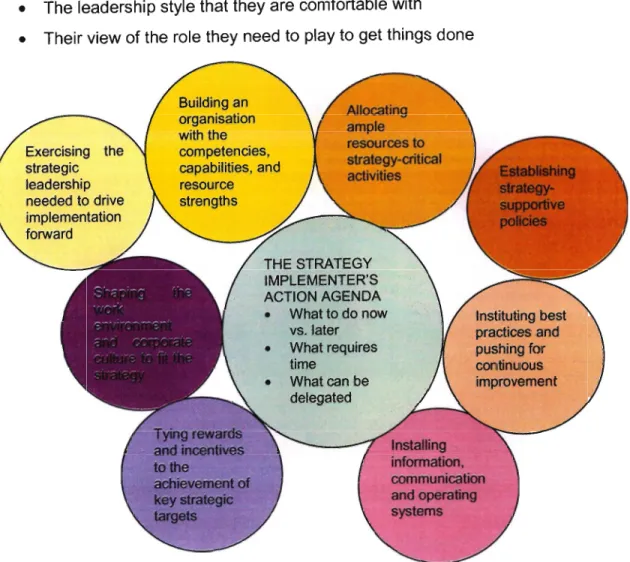
How managers lead the strategy implementation and execution is a function of
• Their experience and knowledge of the business
• Whether they are new to the job or veterans
• Their personal relationships in the organisation
• Their own diagnostic, administrative, interpersonal and problem-solving skills
• The authority they've been given
• The leadership style that they are comfortable with
• Their view of the role they need to play to get things done
Exercising the strategic leadership needed to drive implementation forward
Figure 2.2 The Strategic Implementers Action Agenda
Thompson, A and Strickland A.J. (2001) Crafting and Executing Strategy: Text and Readings - International Edition, McGraw-Hill, Ch 11
Middle and lower-level managers are not only responsible for initiating and supervising the execution process in their areas but are instrumental in getting subordinates to continuously improve on how strategy-critical value chain activities are performed. How successful middle and lower-level managers are at using the resources at their command to strengthen organisational capabilities determines how proficiently the company executes its strategy on a daily basis.
2.3.1 Building a capable organisation
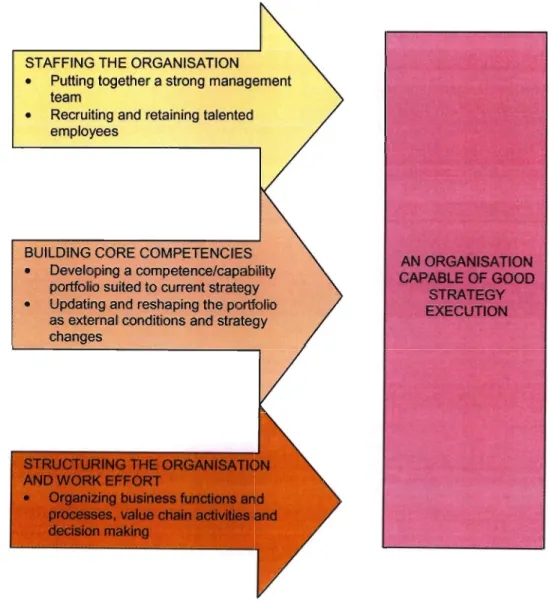
In order to implement and execute strategy, the organisation needs competent personnel, competitive capabilities and efficient internal organisation. Thus building a capable organisation is a priority in strategy execution. There are three types of organisation-building actions, which are paramount to the strategy:
STAFFING THE ORGANISATION
• Putting together a strong management team
• Recruiting and retaining talented employees
BUILDING CORE COMPETENCIES
• Developing a competence/capability p()rtfolio suitedtQcurre~t strat~y
• l.J'Pdating and reshaping the p6rtfolio as external conditions and strategy changes
Figure 2.3 Building a Capable organisation
Thomp~on, A ~~d Strickland A.J. (2001) Crafting and Executing Strategy: Text and Readings _ International Edition, McGraw-Hill, Ch 11
Staffing the Organisation16
Includes putting together a strong management team, recruiting, and retaining employees with the needed management experience, technical skills and intellectual capital. This includes a mix of personal chemistry and mix of skills. Talented people in possession of superior intellectual capital are not only a resource that enables proficient strategy but is also a prime source of competitive advantage.
Building Core Competencies and Competitive Capabilities17
This will enable good strategy execution and then keeping the competence Icapability portfolio updated as strategy and external conditions change.
Core competencies don't come into being or reaching strategic fruition without conscious management attention. Building capabilities takes time, conscious effort and considerable organizing skill.
Core competencies rarely consist of narrow skills or the work efforts of a single department. More often, they are bundles of skills and know-how growing out of the combined efforts of cross-functional work groups and departments performing complementary activities at different locations in the firm's value chain.
Building and nurturing the core competencies is a senior management responsibility.
Competencies and capabilities that grow stale can impair competitiveness unless they are refreshed and modified, in response to ongoing customer-market changes and to shifts in company strategy. Continuously refining competencies allows the sustainability of effective strategy execution and competitive advantage.
16 Thompson, A and Strickland AJ. (2001) Crafting and Executing Strategy: Text and Readings -International Edition, McGraw-Hill, Ch 11
17Thompson, A and StricklandA.l. (2001) Crafting and Executing Strategy: Text and Readings -International Edition, McGraw-Hill
The key to leveraging a company's core competencies into competitively valuable capabilities with potential for long term competitive advantage is concentrating more effort and more talent than rivals on deepening and strengthening these competencies.
A company's selected bases of competence thus need to be broad enough and flexible enough to respond to an unknown future.
Structuring the organisation and work effort18
Organizing business functions and processes, value chain activities and decision making in a manner conducive to successful strategy execution
2.4 Implementing and executing the chosen strategy
There are few hard and fast rules for organizing the work effort to support strategy.
Every firm's organisation chart is unique, reflecting prior organisational patterns, varying internal circumstances, executive judgments about reporting relationships, and the politics of who gets which assignments. Every strategy is grounded in its own set of key success factors and value chain activities. Therefore a customized organisation structure is appropriate. However, there are some common considerations.
• Identify strategy-critical value chain activities
• Decide value chain activities to perform internally and which to outsource from partners
• Make internally performed strategy-critical value chain activities the main building blocks in the organisation structure
• Decide how much authority to centralize at the top and how much to delegate to down the line managers and employees
18Thompson, A and Strickland A.J. (2001) Crafting and Executing Strategy: Text and Readings - International Edition, McGraw-Hill
• Provide for cross-unit co-ordination and collaboration to build/strengthen internal competencies and capabilities
• Provide for necessary collaboration and co-ordination with outsiders
These steps make for an organisation structured to the requirements of successful strategy execution. In addition, outsourcing non-critical value chain activities can produce many advantages - lower costs, less internal bureaucracy, speedier decision-making, more flexibility and heightened strategic focus. Matching structure to strategy requires making strategy-critical organisational units the main building blocks in the organisation structure.
The challenge in implementation and execution is to create a series of tight fits
• Between strategy and the organisation's competencies, capabilities and structure
• Between strategy and budgetary allocations
• Between strategy and policy
• Between strategy and internal support systems
• Between strategy and the reward structure
• Between strategy and the corporate culture
The tighter the fit, the more powerful strategy execution becomes, and the more likely targeted performance can actually be achieved.
The task of implementing and executing the chosen strategy entails seeing what it will take to develop the needed organisational capabilities and to the targeted objectives on schedule. There is a need to "figure out" what must be done to put the strategy in place, carry it out proficiently and produce good results19.
This is a hands on process and largely an administrative task that includes the following principle aspects:
• Building an organisation capable of carrying out the strategy succesfully
19 Thompson, A and Strickland AJ. (2001) Crafting and Executing Strategy: Text and Readings -International Edition, McGraw-HilI
• Allocating company resources so that organisational units charged with performing strategy-critical activities and implementing new strategic initiatives have sufficient people and funds to do their work.
• Establishing strategy supportive policies and procedures
• Putting a freshly chosen strategy into place
• Motivating people in ways that induce them to pursue the trarget objectives energetically and, if need be, modifying their duties and job behaviour to better fit the stratefy requirements of successful execution
• Tying the reward structure to the achievement of targeted results
• Creating a company culture and work climate conducive to successful strategy implementation and execution
• Installing information, communication and operating systems that enable company personnel to carry out their strategic roles effectively day-in, day-out
• Instituting best practices and programs for continuous improvement
• Exerting the internal leadership needed to drive implementation forward and to keep improving on how the strategy is being executed.
Good strategy execution involves creating a strong 'fit' between the way things are done internally and what it will take for the strategy to succeed. The most important fits are between stratgy and organisational capabilities, between strategy and the reward structure, between strategy and the internal support systems and between strategy and the organisation's culture. Fitting the organisation's internal practices to what is needed for stratefic success helps unite the organisation behind the accomplishment of strateglo.
The implemtentation/execution is the most complicated and time-consuming of the tasks in the strategic process. It goes across all facets of managing and must be initiated from many points.
20Thompson, A and Strickland A.J. (2001) Crafting and Executing Strategy: Text and Readings - International Edition, McGraw-Hill
2.5 Evaluating performance and initiating corrective adjustments
The strategic process does not end with the implementation and execution of the plan. There needs to be a final step in the process which allows for ongoing monitoring and evaluating of performance. This allows the company to make corrective adjustments and be proactive in its strategy making process.
It is incumbent on management to evaluate an organisation's performance and progress. Management must stay on top of the company's situation, deciding whether things are going well internally, and monitoring outside developments. Too little progress, changes to the environment will require analysis and corrective action and therefore adjustments to the long- term direction, objectives and business model as laid out in the chosen strategy.
Whilst the strategic management process may have successfully gone through each of the accepted steps, there are factors within any organisation that can have an effect on the type of strategy that evolves, the communication of that strategy, its implementation and therefore its success or failure. One of these key factors is that of corporate culture. It is such an important factor, with far-reaching consequences for the organisation, that it merits further discussion here21.
2.6 Factors that shape a Company's Strategy
Every company has its own unique culture, one that is shaped by its business philosophy and principles, the way it approaches and solves problem and to put it colloquilly "the way things are done". Corporate culture refers to a company's values, beliefs, traditions, operating style and internal work environment. As a result of this, culture, or the lack thereof, can have a distinct impact on the strategies of the organization.
21 Thompson, A and Strickland A.J. (2001) Crafting and Executing Strategy: Text and Readings - International Edition, McGraw-Hill
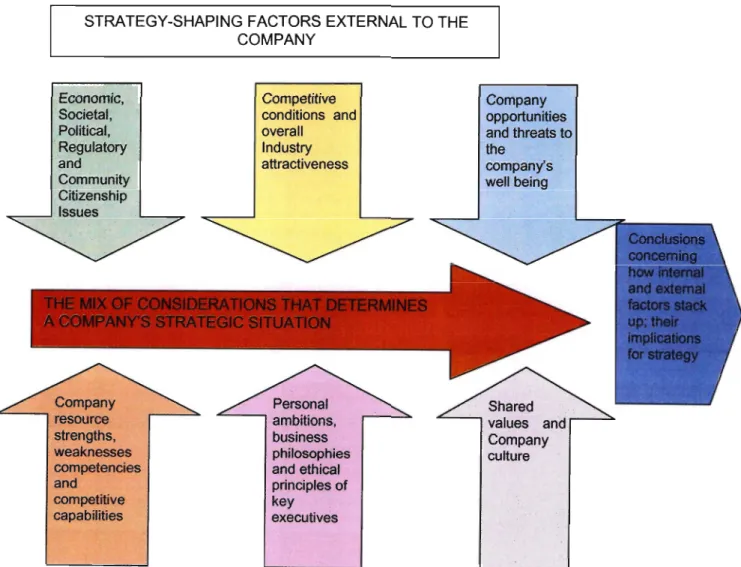
In discussing culture, various factors have to be considered, as well as the effects of competitive conditions, the industry in which the organization operates, the influence of personal ambitions of the people within the organization and finally the impact of shared values on corporate culture22.
According to Thompson and Strickland23,there are many factors to be considered when reviewing culture.
2.6.1
Societal, Political, Regulatory and Citizenship ConsiderationsAll organisations operate within the broader scope of the community. A company is constrained by what is legal, what complies with governmental policies and regulatory requirements, by what is considered ethical and by what is accorded by societal's expectations, as well as the standards of good community citizenship.
Factoring in societal values and priorities, buisiness ethics, community concerns and the potential for onerous legislation and regulatory requirements is a regular part of external situational analysis at more and more companies. Economic, societal, politcal, regulatory and citizenship factors limite the strategic actions a company can or should take. A company's strategy should be tailored to fit industry and competitive conditions.
2.6.2
Competitive Conditions and Overall Industry AwarenessThe industry's competitive conditions and overall attractiveness are big strategy- deetermining factors. A company's strategy has to be tailored to the nature and mix of competitive factoris in play - price, product, quality, performance features, service, warranties and so on. When competitive conditions intensify, the company must be able to respond with strategic actions to protect its position. A company's strategy can't produce real market success unless it fits the industry and competitive situation.
A well-conceived strategy aims at capturing a company's best growth opportunities
22Thompson A and Strickland AJ (2001) Crafting and Executing Strategy: Text and Readings -International edition, McGraw-Hill, Ch 1
231bid
and defending against external threats to its well-being and future performance. This usually means crafting offensive moves and defensive moves to adjust to opportunities and threats.
2.6.3 The Personal Ambitions, Business Philosophies, and Ethical Beliefs of Managers
Managers do not dispassionately assess what strategic course to steer. Their choices are typically influenced by their own vision of how to compete and how to position the enterprise, and by what image and standing they want the company to have. Studies indicate that managers' ambitions, values, business philosophies, attitudes towards risk and ethical beliefs have important influences on strategy. 24
Sometimes the influence of a manager's personal values, experiences and emotions is conscious and deliberate; at other times it is unconscious. "People have to have their hearts in it". These beliefs are stamped on the strategies crafted by management.
Attitudes towards risk have a big influence on strategy. Risk avoiders favour conservative strategies that minimise downside risk, have a quicl payback, and produce sure short-term profits. Risk-takers lean more towards opportunistic strategies where visionary moves can produce a big payoff over the long term. Risk takers prefer innovation to imitation and bold strategic offensives to defensive moves aimed at protecting the status quo.
Managerial values also shape the ethical quality of a firm's strategy. Managers with strong ethical convictions take pains to see that their companies observe a strict code of ethics in all aspects of business.
24Guth William D. and Tagiuri Renato, 'Personal Values and Corporate Strategy', Harvard Business Review, (43), no 5 (September - October 1965), pp 123 -32.
2.6.4 The Influence of Shared Values and Company Culture on Strategy
All organisation's policies, practices, traditions, philosophical beliefs, and ways of doing things combine to create a distinctive culture. Typically, the stonger a company's culture, the more the culture is likely to shape the company's strategic actions. This is because culture-related beliefs are embedded in management's strategic thinking and actions that they condition how the enterprise does business and responds to external events. Such firms have a culture-driven bias about how to handle strategic issues and what kinds of strategy moves it will consider or reject.
STRATEGY-SHAPING FACTORS EXTERNAL TO THE COMPANY
Company opportunities and threats to the .i!'
company's well being Competitive
conditions and overall
Industry attractiveness
Personal ..e:.-_-.ambitions,
business philosophies and ethical principles of key
executives Company
< C - _... .resour~
strengths.
weaknesses competencies and
competitive capabilities
Figure 2.4 Shared Values and Company Culture
Thompson, A and Strickland A.J. (2001) Crafting and Executing Strategy: Text and Readings _ International Edition, McGraw-Hill, Ch 2
2.7 Strengths, Weaknesses, Opportunities and Threats (SWOT)
The SWOT analysis is a popular tool used by management as an organising framework for intuitive information and as a means of summarizing and integrating more formal analyses about the external operating environment and an organisations current resources and capabilities. Ideally it should be used as preliminary environmental scanning tool to enable management to review the organisation internally and externally with respect to identified strengths, weaknesses, opportunities and threats.
The strengths and weaknesses can be defined as statements of the internal capabilities of the organisation whilst opportunities and threats exist outside of the organisation in many different areas. Strengths are internal resources that would enable an organisation to seal effectively with its business environment. An internal weakness would leave opportunities poorly accounted for, or not addressed at all. It is related to the available resources, the competence of the organisation in undertaking its activities and the balance of its resources and mix of activities.
Opportunities and threats are typically the same for all competitors - the issue that will vary will be their ability to capitalise on them.25
2.7.1 Limitations and Pitfalls
There are limitations and pitfalls of any SWOT analysis:26
• A SWOT analysis can yield long lists of observations which provide little insight or clarity about required action
• There are no mechanisms to ensure that managemenUparticipants challenge their own frame of reference or their organisation's paradigm
• Management can conceive of strengths and weaknesses in terms of the strategy they conceive to implement rather than that which currently exists. Strengths and
25Ambrosini, V, Johnson, G and Scholes, K (1998) Exploring Strategic Management - Exploring Techniques of Analysis and Evaluation in Strategic Management, Ch8
26[bid
weaknesses must be considered in terms of current realized strategy rather than just future intended strategy
• Evidence suggests that management see environmental changes as threats rather than opportunities (solution: label environmental changes as opportunities rather than threats)
2.7.2
Aim of a SWOT analysisAim of the SWOT is to match likely external environmental changes with internal capabilities, to test these out and challenge how an organisation can capitalise on new opportunities or defend itself against future threats. The analysis challenges the
"robustness" of the organisation's current strategy and highlight areas that need to change in order to sustain or develop its competitive position. There is no right or wrong way to undertake a SWOT analysis. The most common methods are the PEST analysis (Political, environmental, social and technological) or the famous Porter's Five Forces model27.
A basic SWOT analysis would consider the following28:
• Environmental changes that are most critical
• Internal strengths that will remain as such, or become weaknesses in the changing environment
• Internal element that is most influenced by each external change
27Amb.rosini V, Johnson.G and Sc?oles K (1998) Exploring Strategic Management - Exploring Techniques of AnalysIs and EvaluatIOnInStrategIc Management, Prentice Hall, Ch8
281bid
2.7.3 Benefits of the SWOT analysis
29• Thinking through when future changes might occur and the resultant opportunity or threat
• Challenging management's mindset about when an environmental change is an opportunity or threat
• Matching external changes with internal repercussions and attempting to gauge the size of the internal impact and identify key priorities for strategic attention
• Providing a format for thinking about competitive positioning by comparing the impact of changes on the organisation with that on competitors
2.7.4 Conclusion
After a SWOT analysis, the organisation would have a picture of both its internal and external environment. From the outcome, threats could be transformed into opportunities, with the correct application of resources. Likewise, there is a possibility of turning weakness into strength. In addition, the outcome of the SWOT analysis puts the organisation in a position to further define its core competencies, those areas that provide a source of competitive advantage.
2.8 Core Competencies
Organisations that understand their strengths are better able to compete successfully in a rapidly expanding and competitive global economy. Core competence analysis enables them to see past their end products and services and their sources of competitive advantage3o.
291bid
30Ambrosini, V, Johnson, G and Scholes, K (1998) Exploring Strategic Management - Exploring Techniques of Analysis and Evaluation in Strategic Management
According to Prahalad and Hamel core competence of an organisation lies in the collective learning in the organisation, more especially "to co-ordinate diverse production skill and integrate multiple streams of technologies".31.
The skills of the organisation are embodied in different areas namely: administrative, technical and institutional. John Kay has attributed corporate success to four distinct capabalities: innovation, architecture, reputation and strategic assets. The combination of theses contributes to the capability of the organisation.32
Core competence of an organisation is its enabling culture and is considered essential to the corporate survival in the short and long term. These are invariably unique to the organisation and should be invisible to competitors and difficult to imitate, even when their existence is understood and known to competitors. The core competence is greater than the competence of the individual or department.
Traditionally, core competence has been built through acquisitions and mergers. This is often not successful, as the acquirer does not have the skill to manage the new business. Attempts to impose its own culture lead to an erosion of the value of the acquired organisation. Core competencies need to be matched in order for mergers and acquisitions to survive. If organisations concentrate on core competences, this enables organic growth by building on own strengths and unique capabilities.
2.8.1 When is a core competence not a core competence?
According to Ambrosini33
, it is easy to mix core competence with sources of competitive advantage Le. differentiators that enable organisations to achieve unique market positions. It is also easy to mix core competences with key or main products.
They are often confused with strategic assets. Core business is not necessarily core competence.
31 Prahalad, C.K and Hamel, G. (1990). 'The core competence of the corporation', Harvard Business Review, May - June 1990
32Kay, J. (1993).The Foundations ojCorporate Success, Oxford
33Amb.rosini V,John~onG andSc~olesK (1998) Exploring Strategic Management - Exploring Techniques of AnalySIS and EvaluatIOnInStrategic Management, Prentice Hall, Ch 1
2.8.2
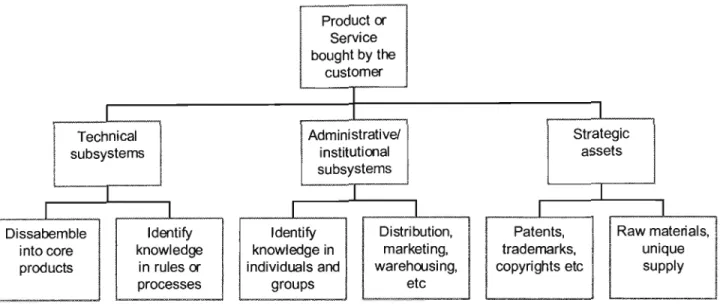
Finding the core competence of an organisation?In most cases the core competences of an organisation are hidden from competitors and from the organisation itself. In order to find core competence, we must trace steps from the known to the unknown. This can be done with a bottom up approach or a top down approach34.The first aggregates various materials and processes. The second is a decomposition of products and services into their constituent parts.
Product or Service bought by the
customer I
I I I
Technical Administrative! Strategic
subsystems institutiooal assets
subsystems
I I I
I I I I I I
Dissabemble Identify Identify Distri bution, Patents, Raw materials,
into core knowledge knowledge in marketing, trademarks, unique
products in rules or individuals and warehousing, copyrights etc supply
processes groups