i
SUPPORTING LEARNERS WHO EXPERIENCE BARRIERS TO LEARNING: A CASE STUDY OF A FULL-SERVICE SCHOOL AT UMLAZI DISTRICT
COLLEGE OF HUMANITIES
MASTERS OF EDUCATION
SIBUSISIWE NDINISA
2016
ii
DECLARATION
I, Sibusisiwe Ndinisa declare that:
a) The research reported in this dissertation is my original research work.
b) This dissertation has not been submitted for examination at any other university.
c) This dissertation does not contain other people’s data, graphs, or pictures.
d) This dissertation does not contain other people’s writing, unless acknowledged and referenced accordingly in the reference section.
e) This dissertation does not have texts, graphics or tables copied and pasted from the internet.
Signature: Date:
--- ---
I ……… the candidate supervisor hereby agrees to the submission of this
dissertation.
Signature: Date:
--- ---
iii
DEDICATION
I dedicate this dissertation to my family; my husband, Thami for being there for me, for his support and encouragement, and for all those sleepless nights and to my sons, Lihlithemba, Tobe and daughter, Akilah, for their understanding and patience.
iv
ACKOWLEDGEMENTS
I wish to acknowledge my supervisors Prof S. Ntombela, for her guidance, patience, understanding and support throughout this study and Mr P. Mweli for his support and attention. I also wish to acknowledge the principal and teachers for allowing me to do my research and for their support. I could not have been able to do my field work if they did not open their doors to me. Thank you very much.
v
ABSTRACT
Education qualifies and equips us to move forward in life with confidence and skills to manage ourselves. It is, therefore, imperative that everyone accesses it whether they have a disability or not. Education is a right, not a privilege that is why all of us should be able to enjoy it without fear or favour. Some of us, if not all of us, experience barriers to learning one way or the other. This study investigated what teachers consider as barriers to learning, how teachers support learners who experience barriers during teaching and learning, and lastly, it identified strategies that teachers use in supporting these learners.
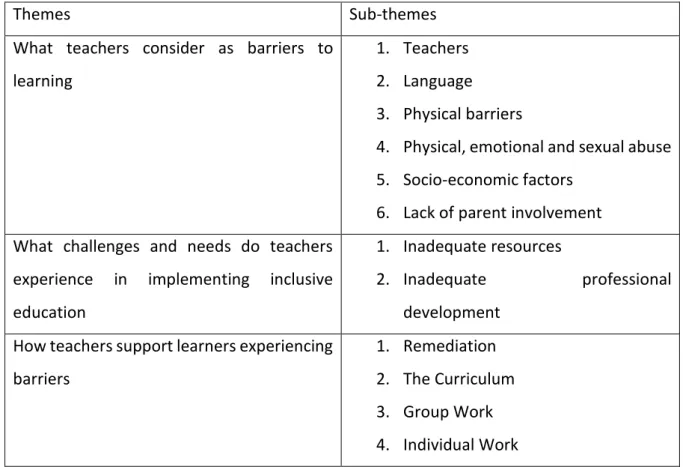
Using a qualitative methodology and an interpretive research paradigm, the study employed focus group interviews and questionnaires to gain insight into how teachers support learners experiencing barriers to learning every day in the classroom. Barriers these teachers deal with include academic barriers (language), physical barriers, socio-economic factors, physical, emotional and sexual abuse, psychological problems, lack of parental involvement and minimal or inadequacy of resources. Teachers, therefore, use different strategies in supporting learners and these include remediation, extra tuition, individual attention and/or group work.
The approach that was chosen for this study is a case study. Purposive and convenience sampling were employed to select the six participants who participated in this study voluntarily. Questionnaires and focus group interviews were the data collection techniques employed. The findings show that although teachers are willing to support learners, they experience challenges when it comes to implementing this policy because of resource scarcity as well as minimal support from the Department of Education and parents. This is a major challenge for them in properly supporting learners because they themselves need support.
vi
TABLE OF CONTENTS
DEDICATION ... iii
ACKOWLEDGEMENTS... iv
ABSTRACT ... v
CHAPTER 1 ... 1
INTRODUCTION TO THE STUDY ... 1
1.1 Background to the study ... 1
1.2 Motivation for the study ... 3
1.3 Objectives of the study ... 4
1.4 Significance of the study ... 4
1.5 Statement of the problem ... 5
1.6 Research methodology and trustworthiness issues ... 6
1.6.1 Research methodology ... 6
1.6.2 Trustworthiness issues ... 7
1.6.3 Ethical considerations ... 8
1.7 Definition of concepts ... 9
1.8 Limitations of the study ... 10
1.9 Conclusion ... 10
CHAPTER 2 ... 12
LITERATURE REVIEW ... 12
2.1 Introduction ... 12
2.2 What are barriers to learning? ... 12
2.3 Education in a non-democratic South Africa ... 13
2.4 What is Inclusive Education? ... 13
2.5 Why Inclusive Education? ... 15
2.6 Successes and challenges in the implementation of Inclusive Education in South Africa ... 18
2.7 International perspective on Inclusive Education ... 20
2.8 Inclusive Education in the South African context ... 24
2.9 Support in a Full-service/Inclusive School ... 29
2.10 Support for learners in a Full-service/Inclusive School ... 30
2.11 Support for and from teachers in a Full-service/ Inclusive School ... 32
2.12 Support for and from parents in a Full-service/Inclusive School ... 34
2.13 Support from the Institutional Level Support Team ... 36
vii
2.14 Support from the District Based Support Team ... 37
2.15 Theoretical framework ... 39
2.16 Conclusion ... 42
CHAPTER 3 ... 43
METHODOLOGY ... 43
3.1 Introduction ... 43
3.2 The design of the study ... 43
3.2.1 Research design ... 43
3.2.2 Sample and sampling methods ... 44
3.2.3 Data generation method ... 45
3.2.3.1 Questionnaire ... 46
3.2.3.2 Focus Group Interview ... 47
3.2.4 Case Study ... 48
3.2.5 Research Paradigm ... 49
3.2.6 Ethical Considerations ... 49
3.2.7 Trustworthiness Issues ... 50
3.3 Conclusion ... 51
FINDINGS ... 52
4.1 Introduction ... 52
4.2 What do teachers at this school consider as barriers to learning? ... 53
4.2.1 Teachers ... 53
4.2.2 Language ... 54
4.2.3 Physical barriers ... 56
4.2.4 Physical, emotional and sexual abuse ... 57
4.2.5 Socio-economic factors ... 58
4.2.6 Lack of parent involvement ... 59
4.3 Challenges teachers experience in implementing Inclusive Education ... 61
4.3.1 Inadequate Resources ... 61
4.3.2 Inadequate professional development ... 63
4.4 How teachers support learners experiencing barriers ... 66
4.4.1 Remediation ... 67
4.4.2 The curriculum ... 67
4.4.3 Group work ... 68
4.4.4 Individual work ... 69
4.5 Responses from questionnaires ... 70
4.6 Conclusion ... 72
viii
CHAPTER 5 ... 73
RECOMMENDATIONS AND CONCLUSION ... 73
5.1 Introduction ... 73
5.2 Overcoming barriers to learning through support ... 73
5.3 Limitations to the study ... 76
5.4 Recommendations for further research ... 77
5.5 Conclusion ... 77
5.6 References ... 79
5.7 APPENDICES ... 83
5.7.1 APPENDIX A: Ethical clearance certificate ... 84
5.7.2 APPENDIX B: Permission from the school ... 85
5.7.3 APPENDIX C: Informed consent form (sample) ... 86
5.7.4 APPENDIX D: Questionnaire ... 89
5.7.5 APPENDIX E: Focus group interview ... 93
1
CHAPTER 1
INTRODUCTION TO THE STUDY
1.1 Background to the study
South Africa has acknowledged that there are many factors that interfere with learning. These factors have been termed barriers to learning and development. Barriers to learning and development can be found in the learner (chronic illness or disability), in the school (inaccessible buildings or lack of resources), the education system (lack of teacher and school development), or in the broader social system (negative attitudes and inadequate resource allocation) (DoE, 2001). It is because of the existence of these barriers that a policy of inclusive education was adopted in July 2001. The inclusive education policy has called for the development of three types of schools, namely, mainstream, full-service and special schools which will offer varying levels of support to ensure that all learners can participate meaningfully in their learning (DoE, 2001). Learner placement in each of these schools is determined by the intensity of support required, with mainstream schools offering moderate levels of support and special schools offering intense levels.
The Department of Education acknowledges that if barriers to learning are not addressed, they lead to learning breakdown and/or exclusion (DoE, 2001). Thus, the focus of the policy is to identify these and, where possible, remove them completely or minimise them by providing the necessary support to individuals or the system (DoE, 2001).
Inclusive education is important now since it allows for equality and belonging to those who have been segregated before. Those segregated were blacks, segregated by the apartheid system of government. The Bantu Education Act enforced racially separated educational facilities for blacks and whites (Africa, 1953). Segregation became unconstitutional after the introduction of the Interim Constitution in 1994 and most of the sections of the Bantu Education Act were repealed by the South African Schools Act (RSA, 1996). The major national force that led to an inclusive education in South Africa was the establishment of the democratic state founded on democratic values in 1994 (Phasha, 2010). These democratic values required that everyone is treated equally and every person’s rights are respected.
2
Concerning education, every child has a legal right to attain it and that education is for all persons.
After the 1994 elections, it was imperative to address the inequities in the education system and to align education with the principles of democracy. Inclusive education, therefore, creates a sense of balance in the education system since it does not discriminate no matter the disability. Inclusive education aims for physical togetherness, social belonging and circular cohesion (Baglieri, 2012). This study is motivated by the Department of Education’s reasons to promote inclusive education. The Department of Basic Education (DoE, 2001) promotes inclusive education which is defined as outlined below:
A system of education which acknowledges that all children and youth can learn and that all children and youth need support (p6)
It seeks to create enabling education structures, systems and methodologies to meet the needs of all children (p6)
It is concerned about changing attitudes, behaviours, teaching methods, curricula and environment to meet the needs of all learners (p7)
From what is outlined above it is clear that education is the driving force of every human being and every nation. That is why therefore it is very important to make sure that all persons are educated because a nation that is not educated, currently, is a broken, dysfunctional and unproductive nation.
This study looked at barriers that learners encounter daily at school, through the eyes of teachers. It explored what teachers considered to be barriers to learning (that their learners face), how teachers dealt with such barriers and what strategies did teachers enforce in dealing with these barriers.
This chapter provides the background of the study by outlining its motivation, the objectives of the study, problem statement, significance, research questions, the research methodology, trustworthiness issues, ethical considerations and limitations.
3
1.2 Motivation for the study
I chose this study based on personal experience of working with learners who experienced barriers to learning at a Full-Service School where I used to teach. I realised the need to find out possible ways and means of assisting learners experiencing barriers to learning and development and to look at support structures that are available for them which in most cases are not utilised, especially by schools, structures like people in the community (retired teachers), NGOs and private companies. It is very important that the lives of learners be impacted and moulded in a positive manner, meaning all stakeholders need to support children in their pursuit of education. Teachers need to be mindful of the challenges that learners experiencing barriers go through and be willing to support them in any way they can.
Teachers need also to bear in mind that they are teaching these learners not for the now but for the future because at the end of it all they must lead productive lives as adults.
Theoretically, I realised that inclusive education has a deeper meaning than what I initially thought and wanted to explore more. I was interested in knowing how inclusive education seeks to support learners experiencing barriers and whether these learners get the appropriate support from the full-service schools that they are placed in. Inclusive education is not just about the inclusion of learners who have been excluded but also nurturing them and preparing them for their future endeavours. I also wanted to get a clear understanding of inclusive education in that it is not just about letting learners fit in within an already established system but recognising learner differences and therefore finding a way forward on how to support and assist learners with these differences. I wanted to find out whether policies set out by the Department of Education on inclusive education are implemented in supporting learners. I was also interested in finding out how teachers at this full-service school understand inclusive education to be (in terms of its meaning, application and significance), how they implement different policies set out by the Department of Education and which methods do they use in making sure that learners get the support they need.
My review of literature also showed that education systems all over the world are working tirelessly in ensuring that all learners are included and that all are given necessary support (UNESCO, 1994). Reviewing the literature also gave me an understanding that inclusion does not only end with learners in terms of the support they must receive from teachers and
4
parents but also emphasises the fact that teachers and parents themselves need to be supported for them to offer appropriate support to learners (DoE, 2001).
1.3 Objectives of the study
Learners need to be supported in every way and it is up to different stakeholders such as, teachers, parents, Department of Education, community members, specialists and professionals, to see to it that learners receive this support and that these stakeholders understand the role they must play in supporting learners. They must also be aware of the significance of their participation by understanding that it is not just about supporting a child but future generations. To make these learners become part of a bigger community they need to be supported and encouraged.
There were three objectives that this study sought to achieve. These objectives were:
1. To investigate what teachers, consider as barriers to learning.
2. To explore challenges and needs teachers experience in implementing Inclusive Education.
3. To establish how teachers, at this school support learners experiencing barriers to learning during teaching and learning.
1.4 Significance of the study
This study is significant in so far as it brings to light how inclusive education is implemented in the form of a full-service school. It also highlights the support that teachers and learners require in such schools, something that the Department of Education, in this case, the District Office, should pay attention to. Most importantly, it is hoped that the findings of this research will assist teachers in all schools with insights into how to support learners experiencing barriers. The study is also very significant to the Provincial Department of Basic Education in that it highlights the reality of teachers lived experiences in as far as the implementation of this policy is concerned. The findings will assist the department to strengthen teacher development and school support in line with the dictates of Education White Paper 6.
5
There is a need for understanding the role parents need to play and the extent to which they need to go in making sure that their children are supported and get the education they deserve. Parents also need to find out what structures are there to support learners (UNESCO, 1994). This is important if parents are to ensure that their children get to schools where they can be properly supported and to enable parents to know how to support their children at home. One needs to be able to understand and be sympathetic to their different barriers and knows that these children deserve all the attention and love for them to succeed in life.
1.5 Statement of the problem
Most teachers working for the South African Department of Education were not trained to work in the inclusive learning environment. Before 2001, most of us believed that learners who did not fit in mainstream schools for whatever reason should be referred to special schools where specialist teachers and other personnel were better prepared to address their learning needs. The introduction and adoption of Education White Paper 6 as policy (DoE, 2001) demanded a paradigm shift in how all of us think and work. This policy also brought about changes in how schools are organised and resourced. As per Education White Paper 6, Inclusive Education acknowledges that all learners can learn and need support to do so. This has implications for teacher attitudes and competencies in every classroom.
My study focused on a full-service school which is expected to support learners experiencing barriers to learning, taking into consideration what they consider as barriers and offering appropriate support. The support that teachers offer to these learners means that they engage themselves in intense research, reading and attending workshops to make certain that they offer this support accordingly. Teachers need to work and support learners taking into consideration inclusive policies to offer appropriate support. Teachers need to be well versed with these policies because they are the core of teaching since the school is a full- service one. Teachers at this school understand that they need to work closely with the Department of Education to be able to support learners and equip themselves with knowledge and skills on teaching and support.
Learners at the Full-Service School I chose are faced with learning barriers on an on- going basis. These barriers hinder their learning and they are not able to cope with the demands of
6
the curriculum, which is extensive, demanding, centrally designed and rigid (Timmons, 2010).
Learners require support for them to be able to cope with the demands of learning and life in general. It is vital that learners get support from different stakeholders, like teachers, parents, peers, Department of Education, health care practitioners and the community in order that they handle the stress brought on by the barriers.
The following are research questions that the study sought to answer:
1. What do teachers consider to be barriers to learning?
2. What challenges and needs do teachers experience in implementing Inclusive Education?
3. How do teachers at this school support learners experiencing barriers to learning during the teaching and learning process?
The answers to the above questions will guide other teachers not only in full-service schools or inclusive schools on what to consider and do in dealing with learners experiencing the kind of barriers outlined in this study.
1.6 Research methodology and trustworthiness issues 1.6.1 Research methodology
This study used qualitative research design to gather data. (McMillan, 2006) define qualitative research design as a systematic study that emphasises gathering data on naturally occurring phenomena and this data is in a form of words. The goal of choosing this research design was to gather from teachers, as per research questions, what they consider to be barriers to learning or what they understand them to be, what challenges and needs do they experience in implementing inclusive education and how do they support learners experiencing barriers during the teaching and learning process. All the responses and ideas were going to be relayed in answering the research questions thereby gaining insight from the teachers’ point of view.
Since I wanted a specific group of teachers to participate in this study because they were familiar with teaching learners experiencing barriers, I chose purposive sampling as my tool in choosing these teachers. (Bertram, 2014) define purposive sampling as meaning specific choices that the researcher makes about which people, group or objects to include in the
7
sample and it relies on the judgement of the researcher when it comes to selection. Purposive sampling also increases the range of data disclosed (McMillan, 2006). The school that the study was conducted at was chosen because it had the characteristics that were relative to the study as it is a full-service school. As it is the main goal of purposive sampling to focus on characteristics of a population that is of interest in enabling the researcher to answer the research questions, (Bertram, 2014), the school selected has the kind of learners that the study required, learners who experience barriers to learning that are found in full-service schools and sought to gather data from the teachers that deal with these learners daily in the quest to support them.
I used questionnaires and group interviews as a technique of collecting data from participants.
The interview guide approach has been used since it allows the interviewer to decide on the sequence and wording of the questions (Fraenkel, 2008). The research paradigm used is the interpretive paradigm which seeks to emphasise the kind of support learners with barriers to learning need in order that they can be able to cope with their learning. This paradigm focuses on how people make meaning on their own and in interaction with others (Woolfolk, 2007).
The study also used the Sociocultural Theory of Lev Vygotsky as the theoretical framework. In this framework, Vygotsky posits that learning begins on what he called an interpersonal plane which depends on interactions we have with others as well as the intrapersonal plane where individuals internalise concepts (Woolfolk, 2010) He argued that humans master themselves through external symbolic, cultural systems rather than being subjugated by and in them (Daniels, 2008). For a child to master what is being taught, it is important that she/he is supported. That support can be offered by teachers, peers, parents and professionals.
1.6.2 Trustworthiness issues
There are four issues of trustworthiness that were considered in the completion of this study, namely, confirmability, transferability, credibility and dependability.
Confirmability is based on the acknowledgement that research is never objective, it is also based on the perspective that the integrity of findings lies in the data and the researcher must adequately tie together the data (Morrow, 2005). Confirmability is the confirmation of data
8
by someone else other than the researcher (Conrad, 2011). Confirmability, therefore, eliminates biases and subjectivity on the side of the researcher. Data will be tied together through an analysis of questionnaire and focus group interviews.
Credibility is the internal consistency where the core issue is how rigour in research will be ensured. It can be achieved by prolonged engagement with participants, persistence observation in the field, validation and co-analysis. Credibility is established if participants agree with the constructions and interpretations of the researcher, meaning the description of the case is exactly based on the understanding of the participants (Conrad, 2011).
Credibility will be achieved through engagement with teachers during the study and through focus group interviews.
Transferability refers to the extent to which the reader is able to generalise the findings of a study to his or her own context (Morrow, 2005). A case can be deemed transferable if it is applicable to another group or setting (Conrad, 2011). As the study is about supporting learners with barriers to learning it can be generalised into the reader’s own context through common strategies that teachers use in supporting learners and can also have common things that they consider as barriers to learning.
According to (Smit, 2010), dependability refers to stability over time, the consistency through repetition and the extent to which findings can be reciprocated by another inquirer. The study can be consistent because learners can experience the same barriers even though they are not in the same school. Barriers experienced can be one and the same as the ones that have been experienced over many years.
1.6.3 Ethical considerations
People do and believe in different things. Since this is the case it is important to be considerate of people’s values and cultural background. It was important to ensure that my behaviour as the researcher was not harmful or offensive to my participants. It was important, as a researcher, to make sure that I did not impose my views on the participants but allowed them freedom to speak their mind and express their views without fear or being intimidated. Ethical issues, during the study, needed to be taken into consideration because I was dealing with
9
people as participants. Permission to conduct research was obtained first from the University of KwaZulu-Natal’s research office (Ethical certificate reference number: HSS/1365/015M, Appendix A), then from the school Principal of this full-service school (Appendix B). Informed consent was obtained from all participants, prior to conducting the study. I ensured that no harm was done to people’s emotions, dignity and/or privacy. The rights of the participants were not violated in any way, as per the Bill of Rights and the Constitution of S.A. The right to dignity was maintained as much as possible per section 2 (5) the Bill of Rights. The participants’ rights to privacy were maintained as per the Bill of Rights, section 2(32).
1.7 Definition of concepts
There are different concepts that are used throughout this study. It is imperative therefore that they are explained for a clear understanding of the study.
Barriers to learning – Difficulties that arise within the education system in its totality, the learning sites and or within the learner himself or herself which prevents access to learning and development for learners (DoE, 2010).
Learning disability – A condition in which a student has a dysfunction in processing information typically found in language-based activities, resulting in interference with learning (Friend, 2012).
Inclusive Education – An educational system in which learners are accepted and fully integrated both educationally and socially promoting equal participation and no- discrimination within a single system (Bornman, 2010).
Full-service school – A school that is equipped and supported with, among other things, physical and material resources as well as professional development for staff, to provide for the full range of learning needs among all learners (DoE, 2001).
10
Special Education – A customised instructional programme designed to meet the unique needs of an individual learner with a disability or a special need and is incapable of benefiting from mainstream education (Gargiulo, 2012).
1.8 Limitations of the study
The limitations that I, as the researcher anticipated was time, as to the actual time teachers were to be available for me to do the focus group interviews with them and time in terms of days they were going to offer me to conduct the interviews. The availability of teachers, how they were going to accommodate me in their busy schedules. I was going to try and avoid these limitations by working as per the schedule that the teachers were going to give me and work around it. Limitations were also to be avoided through communication with the teachers. Communicating extensively with teachers so that the study run as planned.
1.9 Conclusion
This chapter has provided an overview of the study by taking into consideration the discussion on the motivation of the study which was discussed in detail. The objectives, as well as the research questions, were clearly presented. The research methodology and trustworthiness issues were presented. For clear understanding and internalising of the study, concepts were defined in detail. The study is further outlined as follows:
Chapter 2 looks at the literature around Inclusive Education, support that is available for learners, educators and parents in making sure that its principles are met and implemented.
Chapter 3 looks at the methodology: in particularly, the design of the study, sample and sampling methods, data collection method, research paradigm and ethical issues that the study took care of.
Chapter 4 presents the findings, what the participants had to say about the barriers that learners experience in the teaching and learning environment, the challenges that emerged from the data.
11
Chapter 5 discusses the findings, identifies limitations of the study, suggests recommendations and makes a conclusion of the study.
12
CHAPTER 2 LITERATURE REVIEW
2.1 Introduction
People are unique and in their uniqueness, they are sometimes labelled either negatively or positively. It is imperative therefore that we, as a people, refrain from labelling one another because we all are different. There is a thin line between what we consider as ‘normal’ and/or
‘special/abnormal’ therefore labelling people negatively is not wise. The World States came up with Inclusive Education which seeks to include all persons: able or disable, normal or abnormal, in one school and in one classroom. This chapter looks at the international perspectives of inclusive education, inclusive education in the South African context, support that is available for learners in the inclusive schools, support available for teachers, support available for and from parents, the teams that offer support and the theoretical framework.
2.2 What are barriers to learning?
Barriers to learning are difficulties that arise within the education system the learning site and or within the learner himself or herself which prevents access to learning and development for learners (DoE, 2010). There are many factors that contribute and/or manifest themselves as barriers to learning. Here I will just highlight some of the factors that literature diagnose as barriers. Chapter 4 will go into detail pertaining to those that teachers experience in their school and which are much prevalent. One of the most crucial barrier in inclusive education is the curriculum in that it is not flexible in terms of content that is taught, medium of instruction that is used, methods used in teaching, pace and teaching time that is available to complete the curriculum, learning material and how learning is assessed (DoE, 2010).
Overcrowded classrooms affect learners who experience barriers to learning negatively because there is less individual attention that is offered to them (Materechera, 2014). These classrooms become a barrier because learners with barriers need individual attention and support to be able to cope with what is being taught in class. Physical abuse, drug abuse and emotional abuse place learners at risk because they end up missing school time and subsequently drop out of school (DoE, 2001). Learners end up being drop outs because they
13
cannot cope with the pressure of work that has been missed. This barrier leads to a lot of illiterate people who become dependent on others because they cannot take care of themselves. Negative attitudes in terms of race, class, gender, culture, disability, religion and sexual preference become barriers when they are directed to the learner in the education system (Donohue, 2014).
2.3 Education in a non-democratic South Africa
Prior to the 1994 Democratic government, the education system in South Africa was ruled by apartheid laws. In 1948 the National Party came to power; it was confronted by the growing need for black education and in 1954 black education was introduced which was controlled by the government in terms of the apartheid policy. Blacks had to accept the financial, administration maintenance and expansion of their own schools (Booyse, 2010). Blacks had it tough in those days.
The introduction of Bantu Education led to the substantial increase in government funding to learning institutions of black Africans but it did not keep up with population increase and their education was not free, even schools reserved for while learners were of Western standards whereas the one for black learners, only a limited few had plumbing, electricity and running water (Africa, 1953). Bantu Education was received with reservation by most of the black community. It was opposed because it was not offered the same way as in white schools, which were more privileged and received the best recourses than those of blacks. Protests manifested and school boycotts broke out, in 1955, to established an alternative education system. Further entrenchment of apartheid law was enforced because of boycotts and this lasted for decades.
2.4 What is Inclusive Education?
Inclusive education is a system of education which seeks to normalise education in terms of allowing learners to be taught in one school and in one classroom. Bridging the divide between what is considered “normal” and “special/abnormal”, allowing all learners to be socialised together and be taught together and not look at the disability but look at a person
14
and support accordingly with love and respect for him or her and for his or her rights and for the total well-being of all learners in the inclusive school.
Researchers and writers have come up with different definitions of inclusive education because no one definition is the definition but they all depend on the context in which the term is used. The following are but a few of the definitions of inclusive education.
(DoE, 2001) define inclusive education and training in different ways, first and foremost as acknowledging that all children and youth can learn and that all children and youth need support, as enabling education structures, systems and learning methodologies to meet the needs of all learners, as acknowledging and respecting differences in learners, whether due to age, gender, ethnicity, class, disability, HIV or other infectious diseases, as a system that is broader than formal schooling and thus acknowledging that learning also occurs in the home and community, and within formal and informal settings and structures, as a change in attitudes, behaviour, teaching methods, curricula and environment in order to meet the needs of all learners and finally as a way of maximizing the participation of all learners in the culture and curriculum of educational institutions and uncovering and minimising barriers to learning.
It is clear from the above statements that inclusive education is very broad and it touches upon all spectrums of education and of educating learners. It does not only look at one aspect, which is mainstreaming of learners or including them in what we call “normal” schools, but it touches upon all aspects of education including the learner himself or herself. It is also important to note the fact that inclusion does not only happen in a school setting but also at home as that is where children are brought up from an infant stage. Homes can also exclude learners in a way that the child is not included in any conversations or tasks that are done at home just because he or she has a disability, of which it is important to note that they also need to be included because they are part of the communities and families they are born into.
Inclusive education is the policy for achieving educational gain for all learners (Phasha, 2010).
All learners gaining access to education irrespective of their disability but being motivated by the eagerness to learn. (Timmons, 2010) defines inclusive education as the provision of educational services of students with disabilities in schools where their non-disable peers attend, in age-appropriate general education classes under the teachers’ supervision. Making sure that each learner is not excluded because of the disability but included because of his or her abilities and what he or she can achieve. Inclusive education speaks of a single system and closure of dual special-ordinary education system (Naicker, 2001).
15
On the other hand, (Bornman, 2010) and (Savolainen, 2000) define inclusive education as, not only about including learners who have been excluded but also the transformation of educational system thereby accepting all learners and fully integrate them both educationally and socially thus promoting equal participation within a single system that does not discriminate. Integration can be achieved through support as learners need this support for diverse educational needs to be attained. Not forgetting that they also need to be socialised with other people for them to have confidence in themselves and their capabilities.
Inclusion cannot only be defined in perspective of disability issues but also issues related to, emotional, social, spiritual and sexual identities and in its totality, is not a solution but a means to discovery (M. A. Shuttleworth, 2012). Learners discovering for themselves what they can achieve thus giving them a sense of pride in themselves. (Menzies, 2008) looks at inclusive education as an attempt to normalise disability by eliminating the divide between special and general education in order that the cultural view of how we interpret the meaning of disability be changed. This, in turn, makes other people look beyond the disability but at a person per se and what he or she can do and achieve. It is important also to note that inclusion is defined in terms of the context in which it is to be implemented.
If inclusion is defined in terms of the context to which it is to be implemented it is also vital to note that in South Africa, with the diverse and indigenous languages it can be summed up to mean, acceptance with love and respect (Phasha, 2010). One needs to accept these learners, embrace them and show them love and most importantly respect them because they are people they deserve to be treated right. They also need to be socialised well in order that they are to feel a sense of belonging within their families and the communities they live in.
2.5 Why Inclusive Education?
The World States met in Salamanca, Spain, in 1994, to discuss Education for All, whereby all learners were to be included regardless of the disability and be taught in one school and in one classroom with non-disabled peers. It is recommended that educational planning by the government should concentrate on education for all persons, in all regions of a country and in all economic conditions, through public and private schools (UNESCO, 1994).
16
The goals of Inclusive Education are therefore to firstly, improve learning, where learning is improved for learners with disabilities when they are placed in regular classrooms because they learn to interact with ordinary learners socially and academically (Baglieri, 2012). They can perform tasks that are performed by their abled counterparts and not be afraid even if they fail but keep on in order that they improve their learning. Secondly, allow growth for peers whereby, peers without disabilities learn the skills of living with people with disabilities, learning not to ridicule them or pity them, but treat them with care and support (Baglieri, 2012). They learn to interact with their peers and this socialises them better because they become part of a school society. This also helps their peers in learning to live with people with disabilities and know that they are human beings just like them, who go through life and experience things just like them. They go through all life processes just like they do because they are human. Learners learn through peers in the same age group irrespective of their developmental or performance levels (Rose, 2010).
Thirdly, develop friendship: Peers with and without disabilities learn to live together and be friends despite their differences. Developing of friendship is important because if it is not encouraged it may lead to withdrawal, anxiety and shyness (Deiner, 2005). Making friends also make them be confident about themselves. They learn to interact, play, making sense of their lives and learn that there is life outside of their disability which they need to embrace and live it to the fullest. Lastly, prepare for an adult living: The goal of education is to prepare individuals with special needs to be contributing members of society (Baglieri, 2012). Schools should provide them with skills needed in everyday life, these skills include social and communication skills, training in technology, support to enter higher education and specific transitional programmes for life outside school (UNESCO, 1994). Learners are not included just for learning but also to prepare them for adult life because there is life after schooling.
They need to work and be productive members of society.
It makes it clear why there was a need to introduce inclusive education. That is why also the delegates of the World Conference on Special Needs Education believed and proclaimed that:
..every child has the fundamental right to education and must be given the opportunity to achieve and maintain an accessible level of learning, every child has unique characteristics, interests, abilities and learning needs, education systems should be designed and educational programmes implemented to take into account the wide diversity of these characteristics and needs, those with special educational
17
needs must have access to regular schools which should accommodate them within a child-centred pedagogy capable of meeting these needs and regular schools with this inclusive orientation are the most effective means of combating discriminatory attitudes, creating welcoming communities, building an inclusive society and achieving education for all; moreover, they provide an effective education of children and improve the efficiency and ultimately the cost-effectiveness of the entire education system (UNESCO, 1994).
The above points are the driving force of inclusive education and education for all. If they are adhered to and implemented effectively the world will see a major shift in education, especially the developing countries of the world who are usually seen as lagging in innovations and development.
Regular schools with this inclusive orientation are the most effective means of combating discriminatory attitudes, creating welcoming communities, building an inclusive society and achieving education for all (UNESCO, 1994). It is crucial that the school considers the fact that every child has diverse and unique learning patterns and that that diversity should not be a course for segregation. It is also important to note ad taken into consideration that barriers are not always intrinsically linked to the disability of the learner, but very often linked to circumstances arising from his or her living and learning context (DoE, 2010).
Inclusive schooling can be successful if implemented with close attention to each school’s unique context (Menzies, 2008). It is therefore important that each school looks at its individual needs and makes sure that each learner is assisted accordingly, making sure resources are put in place in order that support is offered to learners, take time in supporting them and not forget that they need all the love and support they can get in order that they succeed in life. The school also needs to look at its infrastructure, checking whether it is suitable for physically disabled learners to move around without any fear of falling over especially the ones who are using wheelchairs. It also needs to check its policies whether are they in line with those of the Department of Education. The school’s committees need to outline their working policies in making sure that goals are set and need to work towards achieving those goals. Every teacher needs to have a positive attitude in helping learners achieve their goals and working together with the community to support learners. The school has the responsibility of developing and sustaining a place of learning that enables every child to exercise the fundamental right to education and learning, a right to an equal place in
18
society, including all right that are dependent on learning, including the right to vote, to work and to participate in the society (Rioux, 2007).
Teachers need to be taught the value of collaboration, cooperation, participation and to listen to marginalised voices (M. A. Shuttleworth, 2012). The onus is on teachers because they are the driving force behind the implementation of inclusive education and they are also facilitators and shapers of young minds. They are the core of inclusive education because without them there is no education and this education system would not function. Since they are drivers of this system they need to be on point and clearly understand the reasoning behind inclusion and embrace it.
The move to inclusive education was to make segregation difficult (Lovey, 2002). Difficult in a sense that no learner was left behind and that no child will be segregated because of his or her disability.
2.6 Successes and challenges in the implementation of Inclusive Education in South Africa
Inclusive Education in South Africa was piloted in three of the nine provinces, that is, Eastern Cape, North West and KwaZulu-Natal (Savolainen, 2000). The Department of Education worked hand in hand with the Denmark Government through the Danish International Development Assistance (DANIDA), working on the project that was introduced in South Africa in the above provinces in 2001-2002 and this pilot project was called the ‘Resource and Training Programme for Educator Development: Building an Inclusive Education and Training System’ (an Inclusive Education Pilot Project) and this project was funded by DANIDA (Phasha, 2010). The Inclusive system of education came with a lot of challenges, especially for teachers since they were the ones who were going to teach learners experiencing barriers to learning.
There was much uncertainty from the teachers since they had no idea what was expected of them, in terms of how they were going to teach such learners and how to handle them and the stress of doing something that they did not know. The biggest challenge of preparing teachers for inclusive education is to help them understand what inclusive education is and how to put it into practice in their own classrooms and schools (DoE, 2002).
19
The challenge of implementing inclusive education in South Africa is mainly in the different ethnic and language groups together with the apartheid past and poverty, this is also compounded by the fact that parents are unable to send their disabled children to school due to lack of funds as they have other able children that need to go to school thus the ones that are disabled suffering because they are left at home and do not attend school (Donohue, 2014). Teachers were worried because they had not been trained to teach learners who experience barriers to learning thus feeling that they fall short and see themselves as being inadequate (DoE, 2002).
Teachers were also of the opinion that they did not possess the adequate training, skills, time or support networks to ensure quality education for all (Swart, 2002). This was a challenge to them since they did not feel confident enough to teach learners with barriers. The results of the inadequate training and skills created a sense of uncertainty for the teachers. Other challenges that teachers experienced were the teacher-learner ratio which was too high.
Classes were overcrowded which did not allow for individual attention (Savolainen, 2000).
Inclusive education requires that learners be given individual attention since they have barriers and if the class is overcrowded it does not allow teachers to give enough time to every learner in class thus they end up not being appropriately supported and given the individual attention they need. Most learners with disabilities who attend school are still in separate “special” schools for learners with disabilities, they are still in these schools after a decade of the introduction of inclusive education (Donohue, 2014).
Teachers were made to believe that learners experiencing barriers to learning had to be taught by teachers with special qualifications when in fact they were the ones who were going to teach them. This posed a big challenge because teachers felt inadequate and out of place.
Other challenges were inaccessible buildings (for those on wheelchairs), lack of transport for the learners and resistance to change (Swart, 2002). It is always difficult for any individual to adapt to change easily, and for teachers as well, it was difficult for them to adapt to this new system of teaching and learning for fear of failure more than anything, being unsure of the result.
A way forward in making sure that inclusive education was a success in South Africa was to run capacity building workshops. The South African Finnish Co-operation Programme in the
20
Education Sector (SCOPE), one of the Department of Education’s initiative to inclusive education, aimed to make sure that Learners with Special Education Needs (LSEN) achieve an optimal level in mainstream schools, and that teachers adapt teaching methods, material and classroom management to support LSEN (Savolainen, 2000). Learners were to achieve at their optimal since teachers had to undergo workshops in order that they capacitate them and equip them with skills and knowledge on how to teach learners with barriers. SCOPE hoped to achieve these goals by emphasising capacity building workshops at different levels and through training programmes to be organised for teachers, personnel of Education Support Services, members of the SGB and management at provincial, regional and district levels (Savolainen, 2000). After teachers had been workshopped they were then expected to put all the training into practice in their individual classrooms. These workshops emphasised for teachers that they needed to plan what they want to teach and how they want to do it, teach in a way that they have planned to, reflect on what they did, how they did it and how well it worked for learners (DoE, 2002). By reflecting they could identify areas that needed to be improved in that lesson particularly and others that were still to be taught. (Materechera, 2014).
The inclusive education of a diverse body of children allows children who are different to become acquainted with one another thus helping them to discover common grounds and this acquaintance happens in schools where they learn to interact without any boundaries (Donohue, 2014). Other challenges that become barriers to learning range from schools fail to implement Screening, Identification, Assessment and Support (SIAS) to poor infrastructure caused by poor workmanship (Materechera, 2014).
2.7 International perspective on Inclusive Education
The introduction of inclusive education sought to develop self-sufficient members of society and not look at the disability. Education is influenced by a variety of factors, including, social, economic, environmental and commitment on the education system in general. Different approaches need to be applied in making sure that education takes place accordingly and without any infringement of people’s right and freedom.
21
The French physician, Jean-Marc Gaspard Itard (1774-1838), was the pioneer of special education for his efforts at educating Victor, ‘the wild boy of Aveyron’, who was discovered by hunters in the forest, who was without language and exhibit animal-like behaviour, to master the basic social and self-help skills, his work and other pioneers helped to establish a foundation for many contemporary practices in special education (Gargiulo, 2012). The very first special education classrooms were self-contained, students were grouped together and segregated from other pupils and children with significant intellectual or physical disabilities did not attend school at all (Gargiulo, 2012). Labelling children based on perceived capacity to learn resulted in exclusion from schooling which was unjust and unjustifiable (Rioux, 2007).
In Britain, the first special schools were set up in the late 18th century. Very few children with disabilities, in the past, had access to education, especially in developing regions of the world, thus millions of adults lack even the rudiments of basic education (UNESCO, 1994). The reason for this was in the belief that these children were uneducable and not expected to lead independent and productive lives (Huerta, 2008). Special education programmes were available in many schools by the 1950s. In 1965 Special schools were intended to provide for children with severe hearing and visual difficulties that could not learn in general schools using methods and materials available there (Frederickson, 2011). The Education Act of 1970 removed the legal distinction between those who were not educable in schools (Gargiulo, 2012).
Inclusive education in the United Kingdom and the United States of America came with challenges because it was not easy to determine which disabilities were suitable for special schools and which ones were suitable for inclusive schools. Professionals argued that children with disabilities need small groups and a highly structured, environment which is difficult to attain in a general education classroom and that inclusion was not a sound educational practice (Friend, 2012). These reservations were mainly because they understood that these learners need specialised care but did not take into consideration the fact that they also needed to be socialised accordingly as socialisation plays an important part in a person’s life.
Mixing with other people, by sharing ideas, communicating with them is also important.
Giving them freedom and allowing them to live. Learners need to be taught based on their abilities, by looking at what they are capable of learning and not their disabilities, whereby
22
one looks at the disability thus concluding that there is nothing that he or she can learn or is incapable of learning because of the disability.
Segregation came in different forms; some were segregated by their disabilities and some by race. Some parents had to seek the assistance of the court for their children to be accepted in mainstream schools, taking into consideration the, Brown v. Board of Education of Topeka (1954), which was race based and Eaton v. Brant County Board of Education (1995), this one was disability based, a child with cerebral palsy, (Huerta, 2008), (Rioux, 2007). In the case of Brown v. Board of Education of Topeka, the U.S. Supreme Court ruled that it was unlawful to discriminate against any group of people (Friend, 2012). The Court also applied this ruling to the education of children, African American, thus the Court introduced the concept of integration into public education, this also applied to children with disabilities.
Disability rights activists began to advocate for children with disabilities and took the matter to the U.S. Supreme Court where it was concluded that separation of students by race generated feelings of inferiority and stigmatisation and as such the segregation policies violated the constitution thus the composition of school populations was altered forever (Huerta, 2008). These parents were fighting for the rights of their children, wanting them to be educated with their peers as per the laws of the IDEA.
The separate but equal clause is not allowed with regard to race either should it be allowed to separate students because of their disabilities thus the Congress in the U.S. enacted the first generation of education laws relating to students with disabilities (Huerta, 2008). This showed segregation and it was not going to be accepted because all people are equal before the law. Another serious problem that the Congress in the U.S. had to take care of was:
minority students who were placed in special schools not because of their disabilities but because of their limited English proficiency, and the Congress resolved that these students should have access to the general curriculum to the maximum extent possible with appropriate support (Huerta, 2008).
This shows without a doubt that the education department in the U.S. had their work cut out for them because this shows that students were not placed in special schools because of their inability to grasp the content but because of language which could have been dealt with within the general classroom. In this way, a lot of resources were wasted on students who, in
23
my opinion, did not necessarily need special school facilities and this also had racial undertones because if a language of teaching and learning is not your mother tongue, of course, you are going to have a problem understanding but as you become acquainted with the language, by speaking it more often and reading people speaking it you become familiar with it and it is easy for you to speak and understand the language. There was, therefore, a need to introduce inclusive education because these learners would have spent almost their entire learning lives confined in these special schools wasting resources which would have been spent on other more important issues.
What happened thereafter was that children with disabilities were given the opportunity to participate in societies and recognised as people capable of living normal lives and were no longer housed in institutions but were returned to local communities and local schools. In 1975, the U.S. enacted their Education for All Handicapped Children Act (EAHCA), which ensured that all children with disabilities would receive a free and appropriate public education (Ntombela, 2013a).
The Individuals with Disabilities Education Act (IDEA, 1990) requires that teachers working with students having exceptionalities or disabilities, provide a free and appropriate public education, educate children in the least restrictive environment, protect against discrimination in testing, involve parents in developing each child’s educational programme and develop an individualised education programme of study for each student. IDEA has affected every school in the United States and has changed the roles of teachers in the general education and special education (Eggen, 2010). In 1997 IDEA was revised and it recognised that most students with disabilities must spend all or most of their time in the general education setting (Friend, 2012). Spending most of their time in general education setting will make them have an ability to socialise with their peers and gain confidence in themselves and learn to interact well with them.
Both the United State of America and Britain were required by law that they educate students in the least restrictive environment (Friend, 2012). This may, therefore, come as a justification that learners need not be confined to special schools just because they have disabilities but rather need to be taught together with abled learners in general schools so that they can learn freely and be socialised better. In the USA, the inclusive education system was enacted and
24
its purpose was to ensure that all handicapped children have a free appropriate public education which emphasises their unique needs and to provide for their education (EAHCA, 1975).
The Education for All Handicapped Children Act, EAHCA (1975), mandated the states to put in place programmes that allow them to identify and evaluate learners who needed extra help and that they identify and evaluate them without any form of discrimination. In the USA as well as the UK, inclusion became an answer to concerns about the effects of segregated services in schools (Ntombela, 2013a).
Even though there has been so much talk about inclusion, to some access to education is still a distant goal and the chance of being denied schooling is greater for some children than others, with girls and those with disabilities having much less chance than others even within the same economic class (Rioux, 2007). This shows that much still needs to be done in order that the gap of segregation that exists in the education system of the world be bridged. There is a growing recognition of the importance of professionals working together as this co- operation and partnership are the keys to delivering services in an efficient and integrated manner (Gargiulo, 2012).
2.8 Inclusive Education in the South African context
In South Africa, the right to education is entrenched in the Bill of Rights in the Constitution (RSA, 1996). This means that all South Africans should have access to education, not just a selected few. Prior 1994 elections, special schools were mainly for white learners who had special educational needs and very few, if any, for black learners thus learners with special needs attended regular schools where teachers were not experts and the teaching and learning environment was not supportive at all (Ntombela, 2013a). Segregation in education that was based on race and disability were the order of the day during the apartheid system (Nel, 2013). The system of government did not see any need in teaching a black child because they saw it as nothing but a labourer, a maid and a garden boy who will not end up anywhere in life.
25
When the Government of National Unity came to power, in 1994, it committed itself to social transformation (Booyse, 2010). New policies were introduced and were aimed at unity and equality. The new system of government sought to provide a nondiscriminatory school environment, which included all learners disabled or abled in one school and in one classroom.
With this background in mind, the Department of Education saw it fit to change the system of education and include learners who have been excluded before because of their special education needs. The introduction of inclusive education in South Africa was influenced by the Salamanca Conference, which urged all governments to: give the highest policy and budgetary priority to improve their education systems to enable them to include all children regardless of individual differences or difficulties, adopt as a matter of law or policy the principle of inclusive education, enrolling all children in regular schools, unless there are compelling reasons for doing otherwise, develop demonstration projects and encourage exchanges with countries having experience with inclusive schools and lastly, establish decentralised and participatory mechanisms for planning, monitoring and evaluating educational provision for children and adults with special education needs (UNESCO, 1994).
The rationale behind the introduction of Inclusive Education in South Africa was that segregation and discrimination deprived learners of experiencing the same curriculum and limited their opportunities to know, appreciate and understand each other (Phasha, 2010).
Learners were segregated because the then apartheid government was afraid that if blacks were educated it would be easy for them to dethrone them and take over the government and the country since they were the majority anyway (Phasha, 2010).
In South Africa, inclusive education seeks to redress the imbalances created by the apartheid system of education (Phasha, 2010). These imbalances were caused by the fact that black education in South Africa was primarily controlled by the government in terms of the of the policy of apartheid, which aimed at maintaining the white’s cultural and social way of life and the protection of their national integrity in the face of a common mass of black people thus subjugating them to white dominance (Booyse, 2010). Whites placed themselves on high regard at the expense of black people.
26
The results of decades of segregation and systematic under-resourcing are apparent in the imbalance between special schools that catered exclusively for white disabled learners and those that catered exclusively for black disabled learners, it is, therefore, imperative that the continuing inequities in the special schools sector are eradicated and that the process through which the learner, educator and professional support services populations become representative of the South African population, is accelerated (DoE, 2001). It is important also to note that even though there is much talk about learners being included irrespective of their disabilities, one should also bear in mind that the mere inclusion is not enough if there is no support that is in place. (Savolainen, 2000) affirms this by pointing out that, the physical inclusion of learners with disabilities is not enough to ensure the meaningful development of their relationships with others, which makes it crucial that teachers structure education and social environment for learners develop skills and attitudes required to interact across perceived differences and disabilities.
Another rationale that influenced the introduction of Inclusive Education was mainly to right the wrongs of the past, with regards to education in South Africa. The Department of Education sought to rectify firstly, specialised education and support that have predominantly been provided for the small percentage of learners with disabilities within ‘special’ schools and classes; secondly, where special education and support were provided on a racial basis, with the best human, physical and material resources reserved for whites; and lastly, the fact that most learners with disability have either fallen outside of the system or been
‘mainstreamed by default’ (DoE, 2001).
The National Commission on Special Needs in Education and Training and the National Committee on Education Support Services recommended that the education and training system should promote education for all and enable learners to participate actively in the education process so as to develop and extend their potential and participate as equal members of society (DoE, 2001). In South Africa, Full-service or Inclusive Schools were introduced in order that learners with barriers to learning be accommodated in these schools without them being accommodated in special schools only. A Full-service or Inclusive School is a school which, strives to achieve access, equity, quality and social justice in education by promoting a sense of belonging so that all learners, staff and families experience a sense of