A case of Vulindlela and Impendie Traditional Areas
MTHANDENI ERIC DLUNGWANA 962114819
Submitted in partial fulfillment of the requirements for the degree of Master of Social Science in the Department of Applied Environmental Studies, University of KwaZulu-Natal Pietermaritzburg
2004
ABSTRACT
Approximately three-quarters of the population in South Africa live in rural areas and are under the governance of traditional leadership, whose practice has been the source of controversy in the post-apartheid era. The institution of traditional leadership has been historically regarded as the main ruling system closest to and accepted by the people at grassroots level.
The aim of this research is to investigate the role of traditional leaders in local government in the Vulindlela and Impendle areas, Pietermaritzburg. The objective is to present a historical overview of the role of traditional leaders and to analyse the role traditional leaders have to play in development. The research examines whether the tension between traditional leaders and municipal councillors hinder development to the masses in Vulindlela and Impendle areas. The methodology adopted for this study was a qualitative research approach, which was used to analyse the roles played by traditional leaders in rural local government development.
The main findings of the study reveal that traditional leaders and authorities are essential political, social and economic structures for maintaining the socio-political order that is a prerequisite for rural development. Any endeavor to create a full democratic society in South Africa must utilize the intrinsic strengths of traditional leaders. The institution of traditional leaders should be transformed to move with the times. Many traditional leaders accept the role they have to play as part of the new order as well as the resulting challenge associated with the process of transformation. In principle, traditional
authorities should not be drawn into party politics and their role should remain one of neutral leadership. Traditional authorities are seen in their communities as the
institutional form of government closest to the people and therefore need to be preserved.
ACKNOWLEDGEMENTS
The accomplishment of this research would not have been possible without the co- operation and support of a network of people. I would like to express my gratitude to the following people:
o My supervisor, ProfessorB. Maharaj for his tolerance, constructive advice and guidance. "Have you bought yourself a casket"? This was the first thing Prof.
Maharaj asked when I presented my research proposal. I am particularly thankful to him for his eagerness to assist me by always making himself available. He made my studies enjoyable and understandable. He has been a cheerful, generous and
considerate person. I can highlight the visit to France, enjoyable seminar in OPE and many more. Thank you very much.
o Special thanks should also go to Sbusiso Khuzwayo, Director of the Department of Local Government and Traditional Affairs in Pietermaritzburg for finding time in his crowded schedule to hold a discussion with me. Furthermore, the staff ofthe
Department of Local Government and Traditional Affairs should be thanked for their time and understanding. They provided me with transport and access to traditional leaders of both Vulindlela in Pietermaritzburg and Hlanganani in Impendle.
o Due thanks should also go to Traditional Leaders, Local councillors, and the
community ofVulindlela and Impendle for their support and time. Although the issue of traditional leaders in rural local government has been a very sensitive issue, they have been very cooperative during my study.
o Special thanks should also go to Dr Mike Sutcliffe, Chairperson of the Municipal demarcation Board for his support. He gave me an opportunity to research for the Board on the Traditional Leadership and Institution in South Africa. The exposure and information I gathered in that research has been very instrumental in my study.
Thank you very much.
o Finally, my family is dearly thanked for the role they have played in encouraging me to continue with my studies.
DECLARAnON
Except where explicitly indicated to the contrary, this study is the original work of the author. This thesis has not previously been submitted in any fonn to another University.
TABLE OF CONTENTS
Abstract. . . . .. . .. . .. . .. . .. . . .. . . .. . .. . .. .. . . .. .. . . .. .. . .. . .. . .. . .. . . .. . . .. . . 11
Acknowledgements... 111
Declaration... IV
Pages
CHAPTER ONE:
CHAPTER TWO:
INTRODUCTION
THEORETICAL FRAMEWORK
2.1
Introduction 52.2
Definition of Traditional Leadership 62.2.1
Who is a traditional leader? 72.2.2
Hereditary or Appointed8
2.2.3
Powers/ Functions of Traditional leaders 102.3
Theoretical Context II2.3.1
The invention of the Tradition Approach 112.3.2
The Traditionalist Approach 132.3.3
The Modernist or Eurocentrist Approach14
2.3.4
Feminist Theory18
2.4
African Historical Experience of Traditional Leader's Role inLocal Government
21
2.4.1
Ghanaian Experience22
2.4.2 Namibian Experience 24
2.4.3 Zambian Experience 25
2.4.4 Botswana Experience 25
2.4.5 Malawian Experience 27
2.4.6 Zimbabwean Experience 28
2.4.7 Mozambican Experience 29
2.5 Conclusion 31
CHAPTER THREE:
TRADITIONAL LEADERS, LOCAL GOVERNMENT AND THE CONSTITUTION
3.1 Introduction 34
3.2 Traditional Leaders and Local Government in South Africa 36
3.2.1 Pre-colonial Era 37
3.2.1.1 Functions/ Powers 37
3.2.2 Colonial Era 38
3.2.3 Apartheid Era 40
3.2.3.1 Black Administration Act, 1927 42
3.2.3.2 Black Authorities Act 42
3.2.3.3 The KwaZulu Amakhosi& Iziphakanyiswa
Act, 1990 43
3.2.4 Post-Apartheid Era 44
3.2.4.1 Local Government Municipal Structures Act 47 3.2.4.2 Local Government Municipal Demarcation Act 49 3.2.4.3 The White Paper on Local Government 49 3.2.4.4 Traditional Leadership and Governance
White Paper 51
3.2.4.5 Bill of Rights and Traditional Leaders 52
3.2.4.6 Communal Land Right Act, 2004 52
3.2.5 Traditional Leaders and Party Politics 55
3.3 Conclusion 57
CHAPTER FOUR: RESEARCH METHODOLOGY
4.1 Introduction 59
4.2 Aim 59
4.3 Objectives 60
4.4 Study Area 60
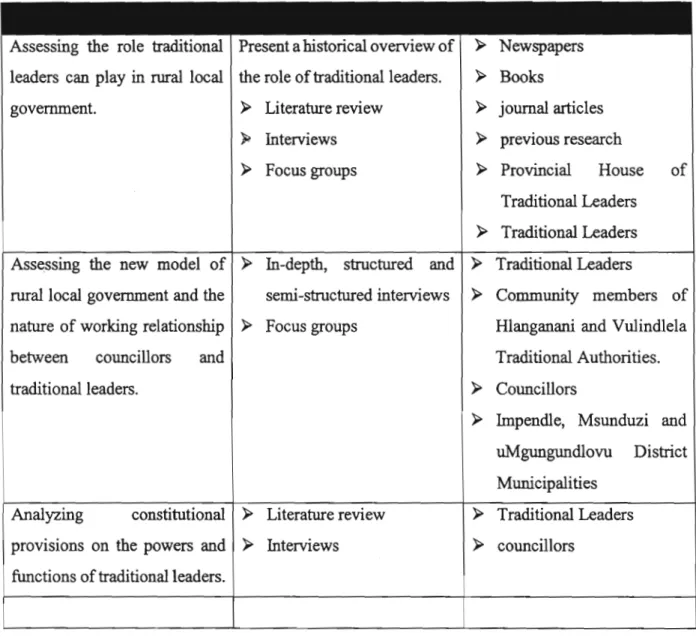
4.5 Methodology 63
4.5.1 Qualitative Methodology 63
4.5.2 In-depth interviews 65
4.5.3 Semi-structures interviews 65
4.5.4 Sampling 66
4.5.6 Focus Group 67
4.6 Interview Technique 68
4.7 Logistics/ Problems 68
4.8 Data Sources 69
4.9 Conclusion 70
CHAPTER FIVE:
IMPENDLE
TRADITIONAL LEADERS IN VULINDLELA AND
5.1 Introduction 71
5.2 History of Chieftaincy 71
5.3 Functions of Traditional Leaders 76
5.3.1 Previous functions vs. contemporary functions 82 5.3.2 Traditional Leaders, Development and Delivery 88
5.3.3 Municipal Incorporation and Rates 90
5.4 Relationship between traditional leaders and councillors 93
5.5 Representativity 100
5.6
Government legislation104
5.7
Traditional leaders and gender issues107
5.8
Traditional Leaders and Party Politics111
2.9
Conclusion112
CHAPTER SIX: EVALUAnON AND CONCLUSION
6.1
Introduction114
6.2
History of Chieftaincy115
6.3
Overview of the role of traditional leaders117
6.4
Traditional leaders and development119
6.5
Relationship between traditional leaders and councillors123 6.6
Traditional versus democratically elected leaders126
6.7
Recommendations129
6.8
Conclusion130
REFERENCES
APPENDIX
135
145
List of plates
Plate I:
Plate 2:
Plate 3:
Plate 4:
Plate 5:
List of tables
Table I:
Table 2:
Table 3:
Table 4:
Map of KwaZulu-Natal showing Vulindlela and Impendle Traditional Authorities.
Map showing Impendle Traditional Authority in Impendle Local Municipality within uMgungundloVll District Municipality.
Map showing Vulindlela Traditional Authorities in The Msunduzi Local Municipality within uMgungundloVll District Municipality.
Electricity supply as part of infrastructure development in the area.
Nadi community gardening and poultry.
Summary of data sources and methodology.
History of traditional leaders.
The hierarchy in the Traditional leadership.
Relationship between traditional leaders and councilors.
CHAPTER 1
1.1 Introduction
South Africa's transformation from an undemocratic, unrepresentative and unaccountable apartheid system necessitated that all structures of governance, practices, institutions and values be revived in the light of the new non-racial, democratic order. The institution of traditional leadership cannot escape this transformatory process in order to adapt with the evolving democratic order. Ever since the multiparty negotiations that preceded the enactment ofthe interim Constitution in South Africa, much controversy has surrounded the institution of traditional leadership. Inparticular, there has been disagreement about the role of chiefs in the new democratic dispensation.
The institution oftraditional leaders is not new in South Africa or in Africa as a whole.Ithas existed and worked hand-in-hand with colonial and apartheid governments in South Africa for almost a century. During the apartheid era the institution of traditional leaders served as local government in various rural areas. The subjugation and manipulation of the institution of traditional leadership, its powers and functions, has been the staple of successive administrations since colonization. Such manipulation has distorted the role oftraditional leaders in administration and development to such an extent that there is a view that the development of rural areas would be acceleratedi~traditional
leaders were excluded from the process (Botha, 1994).
Tribal authorities exercised governmental functions, which ranged from the provision of services to the preservation of law and order, settling of disputes and to the allocation of land. Approximately 16.5 million people in South Africa live in rural areas and they are under the governance of traditional leadership (Mtimkulu, 1996).Incontemporary South Africa, significant sectors of rural society still cherish the institution of traditional leadership and it is still regarded as a symbol of African nationalism. Inmost parts of rural South Africa, for example, in KwaZulu-Natal and the Eastern Cape, chiefs have strong relationships with political parties, especially with the Inkatha Freedom Party (!FP) and the African National Congress (ANC). This is because ofthe influence that
chiefs have in rural and tribal communities. These political parties regard chiefs as allies in the process of political mobilization and recruitment.
A public debate is currently taking place in South Africa over the powers of chiefs and the role they can play in the development of a democratic society. In particular, the draft White Paper on Traditional Leadership and Institution (2002) is aiming at clarifying their position, powers and functions. A key issue is whether they can help reduce the socio-spatial inequalities ofthe apartheid era. Some see no role that chiefs can play in bringing about socio-political changes in this country, for example, Sbonelo Mbanjwa, the journalist (Natal Witness, 12 October 2000). Others, like Chief M. Mzimela, argue that chiefs have an important role in rural areas. Many in the latter category claim that the authority wielded by chiefs today is ''traditional'' powers, that is, it has not been changed over the years. Historical evidence, however, indicates that the powers which chiefs wield over their subjects today were widely shaped and reshaped by successive colonial and apartheid governments (Thabethe,2000).
However, with the advent of colonialism, African traditional government was systematically weakened, and the bond between traditional leaders and their subjects was gradually eroded.
Apartheid and colonialism deprived African people not only of their land and property but also of their dignity and culture. The ancient African societal system, which was the basis of its humanity and mutual co-operation and protection(ubuntu), was destroyed. The policies ofsuccessive colonial, apartheid ·and homeland governments completely distorted the institution of traditional leadership through co-option. Through a complex web oflegislation, the institution was transformed into a toll through which cultural differences of the black people were emphasised and used as a basis to Balkanise the country. This was done in terms of laws such as the Bantu Administration Act (1927), which established a framework for the administration ofAfrican people separately from other racial groups.
In the post-apartheid era there have been fears amongst rural people that they will have to pay property rates. Since the municipal demarcation process began, there has been an outcry from
traditional leaders, who believed that the reason behind the delimitation of wards was aimed at taking away their powers, especially with regard to land allocation and conflict resolution.
People have different views on the issue of traditional leadership and institution. This has been summarized by the Natal Witness (12 October 2000:4) as follows: What powers do traditional leaders want from the government? Are they happy with the ongoing exploitation of rural people who are forced to respect their Chiefs? Rural areas have not received anything from a chief or his lieutenants(headmen/izinduna), but a lot ofmoney has been spent by families towards activitiesthat benefit the chief.
While chiefs rule primarily over their people, there is a distinct territoriality to their jurisdiction.
From a geographical perspective, this study will examine if and how traditional leaders can contribute to the reduction of socio-spatial inequalities of the apartheid era Issues relating to traditional leaders reflect deeper debates that have real impacts in the political, economic and social realms in South Africa. The issue of the institution oftraditional leadership is very important because it touches on the critical issue of a model for rural local government. This sphere ofgovernment has a direct bearing on the prospects for development in the country. There are about 800 traditional leaders in South Africa who are governing about 16.5 million people. Botha (1994) believes that these 800 traditional leaders together control approximately 17 million hectares ofland. Most oftheir land is very underdeveloped, that is, they lack basic services like water, electricity, etcetera, and have high population densities.
There is a view that active participation of traditional leaders in local governance will facilitate development, thereby ensuring poverty relief and improving the quality oflife of the rural populace.
Ithas not been clear as to what role traditional leaders should play in facilitating socio-spatial and economic development of rural areas. The South African constitutionhas signaled the advent of a democratic system able to respond to the socio-economic problems created by apartheid. The current legislation such as the Municipal Structures Act and the Mumcipal Systems Act, while indicating the role and powers oftraditional leaders in rural development in the context of municipalities, reserves
more powers and functions for municipalities as compared to traditional leaders. As such, the Integrated Development Plans (IDPs) for rural areas have been made without consultation with traditional leaders.
The aim of this study is to examine the role of traditional leaders in rural local government in post apartheid South Africa with specific reference to Vulindlela and Impendle tribal areas. The research will try and establish if the powers, functions and status of traditional leaders influences their capacity to deliver services to the rural masses. The relationship between traditional leaders and local and national government will be considered. The study will also outline the history of rural governance and structures and traditional leaders. The researchwill also reflect on the future of traditional leaders in South Africa.
This dissertation is divided into six chapters. Following the introduction in chapter one, chapter two presents the theoretical framework and literature review. Chapter three analyses the constitutional provision and policy guidelines for local government, with particular reference to traditional leadershipinSouth Africa. Chapter four focuses on the methodological approaches and techniques, which were used in executing the fieldwork. The data is analyzed in chapter five. The evaluation, recommendations and conclusion to the study are presentedinchapter six.
CHAPTER TWO
THEORETICALFRAMEWORK ANDLITERATURE REVIEW
2.1 Introduction
South Africa and its neighbours are undergoing a process of fundamental political, economic and social restructuring. The debate on the role and future oftraditional leaders in the 1990s is perhaps an indication of the strength of the institution. Throughout Africa the institutions of traditional leaders has managed to survive the quest for modernity and state control imposed on it by colonial and postcolonial rulers (Scheepers, 1996).
InSouth Africa, and other African countries, there is a consensus that the institution of traditional leadership needs to be changed. However, there have been problems in deciding exactly what needs to be changed in traditional leadership and how. This is because mostruralcommunities believe that the institution of traditional leaders is one of the most important elements oftheir society. There is a belief by traditional leaders and some researchers, like Shubane (1998),thatthe institution of tribal authorities essentially comprise political, social and economic structures, andthatthey symbolise and maintain socio-political order, which is necessary for rural development. The institution of traditional leadership represents the conservation of traditions, customs and values of the African people.
The institution of traditional leadership is seen by many as an inherently undemocratic and patriarchal institution and it is often argued that it can have no place in an open and democratic society founded on human dignity and the advancement of human rights and freedom. Onthe other hand, it is also recognised that the system of traditional leaders is part of the rich cultural heritage that cannot be allowed to go to waste (pieterse, 1999).
The aim ofthis chapter is to examine the theories and concepts, which attempt to analyse and explain the role and functions of traditional leaders in local government. Definition of traditional leadership is debated in the first section. The theoretical framework is presented in the second, and the focus is on the invention of tradition in an African context. This section is followed by a definition of a traditional leader. Thereafter, a historical overview of African experience of the role of traditional leaders in local government is assessed.
2.2 Definition of Traditional Leadership
The emergence of the traditional leadership could be traced back to the pre-colonial era when traditional systems of leadership were either hereditary or achieved through recognition of benevolence and loyalty to the clan. While it is believed that the chieftainship is hereditary, there are many instances where it has been usurped or acquired in some other way by trickery or force (Welsh, 1974). Parker (1995) believed that traditional leadership could also be assumed through bravery, especially in territorial acquisitions as a result of tribal warfare. However, as the rule, the chief succeeds automatically to his office by right of birth.
Inmost of the African continent, the tribe has been the basic unit of the people's organisational structure. Schapera (1996) defmes a tribe as the body of people organised under the rule of an independent chief. Each tribe has its own name, occupies its own territory, manages its own affairs, and acts as a single unit, for example, in instances like war. It is through people's allegiance to the same chiefthat the members ofa tribe are conscious of their unity. A chief rules over his people, and not over the territory they inhabit, although the territory forms an important component of the chieftainship. Membership of a tribe is determined more by allegiance to a chief than by birth.
Hence, the unity of the tribe depends fundamentally on the common loyalty ofthe tribesmen to their chief. A popular chief can gradually enlarge his or her tribe by recruiting members from other tribes, while unpopular ones can lose their adherents and become what is called 'chiefofthe pumpkins' (Schapera, 1966:69).
AB the base source for agricultural and other resources within a tribe, the chief's ability to allocate land was critical to sustain an effective leadership. The inability to provide followers with adequate land could well see a chief's subjects effectively shifting their allegiance and choosing to live under the leadership ofanother chief. The possibility ofthis degree offluidity reflects the fact that a chief's authority was not primarily from coercive power but rather derived from patronage, ritual and symbolism (Butler, 2002).Itis, therefore, clear that the tribal community effectively gave a chiefthe authority to rule.
A tribe is not a closed group like the clan. This is because several different tribes can be incorporated under the rule of one chief. A tribe can also be split because of quarrels among members ofthe royal family. Schapera (1966) believes that a tribe is, therefore, an association into which people may be born, or which they may voluntarily join, or into which they may be absorbed by conquest, and which they may, for one reason or another, leave again.
2.2.1 Who is a traditional leader?
A traditional leader can be defined as a person who, by virtue of his ancestry, occupies the throne or stool of an area. This should be a person who has been appointed to the throne or stool in accordance with the customs and tradition of the area and has traditional authority over the local people. A traditional leader can also be any other person appointed by instrument and order of the government to exercise traditional authority over an area or a tribe (de Villiers, 1997).
Each traditional leader ruled independently and enjoyed unlimited and undefined power over the tribe or territory under his jurisdiction. A traditional leader was also a custodian of the land.
Traditional leaders functioned as supreme natural rulers who reigned for life and could only be removed from office through natural death (parker, 1995).
2.2.2 Hereditary or Appointed?
There is a belief or perception that most chiefs are born or are hereditary leaders. Welsh (1974) believed that not all or most chiefs in Natal were hereditary. This was because in an appendix to the Natal Native Commission of 1881-2 there were one hundred and two (102) tribes under the charge of one hundred and seventy three (173) chiefs or headmen in Natal.Ofthose chiefs 99 were hereditary, 46 were created or appointed, and 28 were headmen appointed and recognised by the government (Welsh, 1974). There were a number of ways inwhich appointed chiefs originated. For Welsh (1974), Sherpstone encouraged the fragmentation of tribes, thereby destroying hereditary traditional authorities. Most appointed chiefs came into power because they were principled indunas or headmen of the government of the day. The system of power to promote commoners or ordinary people to therankofchief was often used as a form ofpatronage. Africans who had performed some useful services could be rewarded by being made chiefs.Insome cases, government could appoint what we can call 'governmentinduna' to take temporaV permanent charge of the tribe/area. The Zashuke chieftaincy is a classic example. The appointment of chief Zashuke took place as follows:
ChiefUsidoi who lived south ofthe Mkomazi River attacked chiefUmshakangubo's people, who lived sixteen miles away. The attack was because of the quarrel that aroused out of the celebrations at a wedding between a man of Usidoi's people and a woman of Umshukangubo's people. Usidoi invaded Umshukangubo, defeated his forces and then killed and mutilated the vanquished chief. This was an act, which, according to Sherpstone, was the prerogative of an independent chief. Forces of 400 men each were assembled at Upper and Lower Umkomazi and were ordered to seize all castles, horses and guns, together with Usidoi andhis principal men. Usidoi fled the Colony and the Government punished the tribe very severely by seizing 90 percent of its cattle. Sherpstone declared to the Usidoi family that neither Usidoi nor any of his family would any longer be chief and appointed what he described as a 'Governmentinduna' to take permanent charge ofthe tribe. This was Zashuke, his great grandson is a hereditary chief at present, Chief Nyanga Ngubane (Welsh, 1974:
121).
During the colonial and apartheid periods a number ofpeople were appointed and some deposed if
they were seen as not serving the government of the day. South Africa has 839 traditional leaders, of those 63 are acting, 25 are landless, and about 73 appointed. This shows that not all traditional leaders are born, or leadership inherited (Welsh, 1974). However, traditional leadership is hereditary.
There are many instances, like the one mentioned above, where traditional leadership
has
been usurped or acquired in some other way by trickery or force, but as the rule, chiefs succeed automatically to office by right of birth.One ofthe central challenges in getting to grips with the current issues of traditional institutions and leadership is that of succession and legitimacy. While there is an abstract characterisation of traditional authority being hereditary down the dominant male line, the reality appears to be often more complex. Shaka's claims to Zulu leadership were contested on the grounds of both legitimacy and rights of succession (Welsh, 1974).
In South Africa between 11 and 18 million people fall under the jurisdiction of approximately 839 traditional leaders (de Villiers, 1997). These traditional leaders do not exercise their functions alone.
A single traditional leader may be assisted by up to ten more subordinate leaders, resulting in a total of some 10 000 traditional leaders. This makes the issue of traditional leadership quite complex.
This is simply because when one talks of traditional leaders in South Africa, one needs tothinkof more than ten thousand (10 000) people. Traditional leaders or authorities are social leaders and systems rather than actual government institutions (de Villiers, 1997).
Traditionally, the chief's powers were only exercised through a collective traditional council.
Structurally, councillors were, and continue to be, drawn from the ranks of headmen, sub-headmen and prominent members of the community who are acknowledged for their skills and leadership qualities. These together form what we call a traditional council.Itis, however, imperative to note that in some areas headmen were elected by the community while others ascended to power through hereditary lineage.
The institution of traditional leadership is per definition hereditary and therefore not subject to the
electoral process. However, traditional leaders in South Africa are able to stand for a political office without relinquishing their traditional functions.
Although local leadership engendered a cohesive form of traditional government, with tribal councillors assisting their natural rulers in various forms of decision-making, there was no form of unified government across tribal lines or territorial boundaries. Before the advent ofcolonial rulein Africa, traditional governments in various local jurisdictions appeared fragmented as tribal warfare was still prevalent, and thereforo they could only exercise limited power within the domain of their leadership (de Villiers, 1997)..
2.2.3 Powers and Functions of Traditional Leaders
An incorrect impression has been created that the South African democratic government has reduced the powers of traditional leaders.Itis almost impossible to deal with thefullrange of functions still performed by chiefs in South Africa. This is precisely because chiefs continued to perform administrative functions as they had done under colonial and apartheid eras. They served as a link between the government and the people, they performed ceremonial and religious functions, and they chaired tribal courts (Bekker, 1993).
The powers of traditional leaders can be classified roughly into three categories. Firstly, the power to participate in service delivery such as the establishment, maintenance and management of schools, bridges, roads, dams, etc. Although traditional leaders may be empowered through government intervention to perform these functions, it is not their direct responsibility. Secondly, they have the power to create and maintain a safe and secure community environment. These are generally powers to maintain law and order and involve reporting to the magistrate on matters such as the protection of lives. The third level of power is judicial and is assigned to traditional leaders by the Minister of Justice. Traditional leaders have the authority to preside over minor criminal offences committed in areas under their jurisdiction (Natal Witness, 24 February 2000: 8).
Their primary function is to regulate and control relationships and social behaviour within a traditional community. They are in essence people oriented and not service oriented as local government structures. The authority of a traditional leader is derived from tradition and is exercised in consultation with senior advisers without being regulated by legislation (de Villiers, 1997). A traditional leader is further responsible for maintaining law and order throughout the tribal area. He must protect the right of his subjects, provide justice for the injured and oppressed, and punish wrongdoers. A traditional leader is the supreme judge, whose decision is final.
A traditional leader, as the head of the tribe, occupies a position of outstanding privilege and authority. For Schapera (1966) a traditional leader is the symbol of tribal unity, the central figure around whom the tribal life revolves, he is at once ruler, judge, maker and guardian of the law, repository of wealth, dispenser of gifts, and leader in war (Schapera, 1966). The chief is the executive head of the tribe. Nothing of any importance can be done without his knowledge and authority.
23 Theoretical Context
Many traditions and customs are the product of codification, petrifaction and coercion under modernist projects of colonial rule, missionary activity and postcolonial state formation.Itcan also be argued that tradition is a specific construction at a specific time for specific purposes (van Nieuwaal et al, 1999). Tradition and custom in Africa have become culturally specific historical phenomena. (van Nieuwaal et aI, 1999:1) argues that "the codification of certain practices as authentic traditions by colonial rulers and missionaries led to many instancesinwhich local leaders themselves began trying to legitimize their position along such lines."
2.3.1 The Invention of the Tradition Approach
Chieftaincy in Africa can be understood in terms of the development and invention of tradition.
Three perspectives have emerged out of the invention of the tradition approach in attempting to
understand the primordialness of chieftaincy in Africa. The first position argues that chieftaincy existed, in most cases in Africa, prior to the arrival of the European rulers and missionaries. The arrival of colonial rule had all sorts of ramifications in terms of internal divisions, alliances, bureaucratic arrangements, and aboveall, co-option of chiefs into a'system of indirect rule ((van Nieuwaal, 1999). Colonialism favoured the codification ofone line ofpower in local society, which was then fortified against rival or more fluid forms of power brokering, ultimately creating an artificial tradition of hereditary power. This was the creation of something that seemed to resonate deeply with locally held cultural perceptions.
The second approach in the invention of the tradition perspective emphasizes that in cephalous societies, colonial rulers did not hesitate to impose an African form oftraditional rule (van Nieuwaal et al, 1999). Here colonial administrators randomly selected individuals to serve as a channel of communication with locals, and gradually started calling them chiefs. Tradition here was truly a colonial and modernist invention.
The third position deriving from the invention of the tradition approach focuses on the situation in which modernist projects of power were absent and therefore did not impose such invented traditions. Some remote areas remained unaffected by colonial and missionary endeavors, and no externally inspired traditions and customs were created. However, it was not just in Western modernizing projects that traditions were invented, such inventions took place in other, non-Western hegemonic projects as well, such as the influence of the expansion of Islam (van Nieuwaal et al, 1999).
The main problem with the invention of the tradition approach is the question of acceptability and legitimacy. There have been concerns about how something that is imposed can be acceptable to a local population. This is because inventing and creating a structure is one thing, but it is entirely something else to give meaning and significance to it and imbue it with respect (van Nieuwaal et aI, 1999).
Tradition is a form of legitimatization which is based on a construction of history (frotha, 1996).
This means that tradition underlines the meaning of the past for the identity of people and the constitution of traditional institutions. However, legitimacy by tradition is not sufficient to guarantee the future of the institution of traditional leadership.Itneeds to be 'complemented by the idea that the chief is an agent ofthe present and is a guarantor and agent for the future (Trotha, 1996). Tradition is not a rigid preservation of the past, but a continuous dialogue with the past directed towards the challenges of the present and the future. Therefore, traditional leaders must ground their understanding of tradition on the dynamic character of the community they represent.
2.3.2 The traditionalist approach
The way African communities live today is not the same as they did some 150 years ago. Since their contact with the outside world, especially after the partitioning of Africa into spheres of different colonial influences, and the introduction of westem values, the practices of government, education and religion have changed drastically in the continent. The colonialists, through their education and religious systems, made a wholesale condemnation of almost all-African cultures and institutions which they termed as primitive and unchristian (frotha, 1996).
InAfrican society, traditional leadership was regarded as the custodian ofthe people's cultural values that bond them together and made sense out of their lives. Kayila (1995 :65) argues that "resistance made by certain communities were often met with the force of government machinery, oppressive laws that were meant to safeguard the interests of the colonial governments and their foreign ideologies, and their religious beliefs."
One school of thought that has emerged out of the debate on traditional leadership is the traditionalist approach, which believes that the institutions of tribal leaders are at the heart of rural governance, political stability, successful policy implementation, and hence, rural development. Botha (1994) argues that the institution of chieftaincy in Southern Africa is an integral part of the rural African community. Itis argued that traditional leaders act as symbols of unity, maintain peace, preserve
customs and culture, allocate land to people, and resolve disputes and conflicts. For them, the institution, despite past policies and practices, commands substantial support and legitimacy to justify extensive formal participation in the management of society (Botha, 1994).
..
In traditional structures, the chief of an area has ultimate authority, although he often governs according to tradition by consultation with senior members of the tribe and tribal council. The traditional leaders regard this as a form of African democracy, on the basis that the local area or a tribe is not "one-persotl-centred". Traditional leaders have powers to call meetings and set agendas, as well asappointIzinduna and traditional councillors. They may establish community committees, which traditional leaders may feel are necessary for overseeing and managing their area.
Onthe gender issue, for example, some traditionalists agree with the feminists that women's position in rural life should be improved, but propose that it be done within the existing framework and structure. This type of reform would, however, do little towards making the institution more gender sensitive. Hence, the feminist appeal for the complete restructuring of the institution and the 'customs' and 'traditions' on which it is built (KeuIder, 1998).
It is worth noting that traditionally, most communities had a clear division of responsibilities between men and women, based on each community's cultural beliefs and practices. Traditionally, women were responsible for bringing up the family, which involved looking after children, preparing meals, production of food, and generally ensuring that the home was as comfortable for the family as possible. Under exceptional circumstances some women were allowed to play roles not associated with them, for example, being accorded eldership status to be consulted when major decisions requiring their expertise were at stake. Men were always the head of the family (Botha, 1994).
Keulder (1998) points out that there is agreement between modernists and traditionalists that the institution of traditional leaders, its composition, functions and legal manifestation should change in order to adapt to transformation in the social and political environment. They disagree, however, on the nature and scope of the perceived changes (Keulder, 1998).
2.3.3The Modernist or Eurocentrist approach
The second school of thought is the modernist or Eurocentrist one, which calls for a transformation of the institution of traditional leaders to meet the requirements of a modern, non-sexist and non- racial democracy. Mamdani (1996) points out that modernists believe that the problem is that civil society is an embryonic and marginal construct in Africa. The basic premise behind this approach is that African societies are in the process ofbecoming modern rational entitiesinwhich efficiency and scientific logic replaces traditional values and belief systems. Social change and education are undoubtedly important targets, but the focus on these issues tended to overlook the ongoing roles of traditional institutions and norms (van Nieuwaal et al, 1999).
Modernisation often refers to the transformation which takes place when a traditional or pre-modem society changes to such an extent that new forms of technological, organisational, or social characteristics ofadvanced society appear (Coetzee, 2001). Democratization is one aspect or variable that can be enhanced in the transition, from traditionality to modernity. Modernisation is the process where different societies tried to bring their own level of development to be in line with those of the advanced or more modern societies. While modernisation is associated with transformation or progress, there are no clear and mutually exclusive categories of modernity and traditionality.
Modernity creates its own traditions. Most of the time modernity includes forms of traditionality.
According to Coetzee at al (2001:42) "traditions often provide strong stimuli for the process of modernisation".
Keulder (1998) argues that the institutions of traditional leaders are believed to be the basis of rural patriarchy. He argues that the institutions of traditional leaders are not in accordance with the precepts of democracy.Inoriginal African tradition, leadership is hereditary and is not subject to an electoral process (Mokgoro, 1994). The hereditary nature of traditional leadership removes any direct accountability to a tribal community. This has opened up the institution of traditional leadership to
corruption and political manipulation (Mokgoro, 1994).
The modernist or eurocentrist approach argues that during the colonial and apartheid eras traditional authority acted as a unique linkage between the contemporary state and civil societyinthe areas of democratization and development.Itfurther argues that these linkages are, however, often ignored, misunderstood and not recognized.
In terms of the madernist approach the chieftaincy needs to be transformed, together with the postcolonial state, into an intermediary, administrative institution. Ray and van Nieuwaal, 1996) believe that this administrative chieftaincy should be transformed into what they call 'civil chieftaincy' which would be more just, responsive and responsible.
However, Trotha (1996) believes that this kind of administrative chieftaincy was used by colonial and apartheid governments who sought to impose a more homogenous pattern of chieftaincy by utilizing chiefs as part of the process of building the new colonial state. He further argues that the reliance of the colonial and post-colonial states upon chiefs to act as instruments of intermediary administration between these state forms and local people, demonstrate the weakness of the organizational power of those state forms (Trotha, 1996).
The modernist approach suggests that despite the various attempts to write off the chieftaincy, it is likely to be part of the process of democratic renewal of African states. According to this view neither chiefs nor the state are going to disappear in the near future, but they do need to be transformed.Assuch, there are eight principles that this approach has suggested in the evaluation of transforming chieftaincy (Trotha, 1996).
First, the modernist approach argues that the state has to recognize de facto legal pluralism and to institutionalize the chiefs as an independent component of the legal system. While acknowledging that this may perpetuate the injustice of the local order, this approach suggests that local autonomy is preferred. The second principle is that of local autonomy.Itis believed that local problems must be
solved locally. The legal pluralism of state and local systems of dispute resolution must be recognized as leading to healthy legal competition that urbanization will not undermine. This is the third principle. Traditional leaders need not only be guardians of tradition but they must also be active agents of the present and future by promoting the well-being of the community. Trotha (1996) believes that this is what can validate traditional leadership where they will have to deal with modem economic, administrative and political challenges. This fonns the fourth and fifth principles of agency and competence, respectively (Ray and van Nieuwaal, 1996).
The sixth principle calls for chieftaincy to become a civil chieftaincy. Here the chieftaincy needs to become a forum where issues can be debated and resolved, and local interests can be articulated. The chieftaincy will also serve as defender of local interests in discussions with others spheres of government. The seventh principle calls for the integration of the chieftaincy into constitutional structures of government. The last principle calls for mechanisms which need to be developed to ensure that traditional leaders and other spheres of government are subject to the democratic practices of checks and balances. This will restrain the abuse ofpower by both the formal structures of local government and traditional leaders (Ray and van Nieuwaal, 1996).
The above context can result in the development ofwhat can be termed the zero-sum kind of theory.
The zero-sum game is any competition /situation where the losses equal the winnings. This can be exemplified in sports where for every winner there is a loser, and winners can only exist if losers exist, what the winning gamble wins, the loosing gambler must lose (Thurow, 1980). Before dealing with the zero sum game within the local government context, it is worth looking at the issue of power and authority. This is important because the issue ofpower and authority are at the heart ofthe debate of the role of traditional leaders in local government.
The concepts of power and authority are at the centre of any study of local government and traditional leadership. Upon closer examination it proves rather difficult to make an analytical distinction between the concept ofpower and the authority. Power is usually conceived as the ability of one person to impose his/ her will on others using physical or psychological violence or the threat
of it (Ray and van Nieuwaal, 1996). Authority, on the other hand, is seen to be based on the shared conviction of the subjects that the state authority imposes its will in a legitimate way. Ray and (van Nieuwaal et al, 1996) try to exemplify this point by suggesting that violence can be used in the implementation of both power and authority, not only to subjugate citizens but also to provide them collectively with goods and services. They further argue that the very fact that the authoritative ruler provides them with goods and services, makes subjects believe that hislher position of power over them is founded on a legitimate base. It is within this context that the relationship of modern authorityandtraditional authority is fundamental.
Chiefs and states are profit-maximizing actors who constantly strive to expand or to at least stabilize their power. The very important issue of the zero-sum theory is the nature of resistance that the parties make in a given environment. Chiefs and the state, as mentioned above, will resist any attacks made on it. The resulting effect will be competition between the two actors in order to perpetuate or consolidate their position of power. The interesting point is that should neither actor be out to perpetuate or consolidate hislher position of power and both are seeking the status quo, the competition will be eliminated. The result will be a well-balanced and stable relationship. A problem arises when one tries to expand his! her power, since this will be at the expense of the other. In general terms, this means that if both actors who seek power operate within the same domain, the expansion of one's power will always pose a threat to the other's position.
Ray and van Nieuwaal et al, 1996) argue that competition is not the only factor that binds the two actors together, but they also need each other for various other things. This can be seen where, on the one hand, government depends on traditional leaders for the implementation ofits policy, as well as the flow of specific information about the local community over which the traditional leaders exert authority.Onthe other hand, traditional leadership has been dependant on government since colonial times for the recognition ofits legitimacy as the representative ofthe people, as well as for obtaining economic and/or political favours to satisfy their subjects. Ray and van Nieuwaal et al, 1996) believe that this situation of mutual dependence is at least as important as the competitive atmosphere between the two actors. The main problem with this situation is the danger that one of them may use
his indispensability to consolidate his! her position and to achieve certain goals. Traditional leaders habitually use Africanism and respect for indigenous culture as a means of justifying patriarchal controls over women and young men.
'.
2,3.4 Feminist Theory
Not only is traditional leadership insulated from the electoral process, it is also fundamentally patriarchal and discriminatory against women. Customary law does not recognize gender equality and favors males with respect to marriage, property, maintenance, etc. (prinsloo, 1995). This is in direct conflict with the precepts of human rights as contained in the Bill of Rights of South Africa, and as the constitution points out, everyone is equal before the law.
There is a belief which is shared by most feminists that women suffer injustices or oppression because of their sex. The way in which gender roles are assigned also depends on the ways in which such relations are institutionalized and played out in a community or society (Coetzee, 2001).
According to Walker (1995) tradition is not gender neutral. As a result, dominant men are very keen to promote their views of culture as the only correct perspective, and given their subordinate position, women found it difficult to challenge this male dominant view of tradition.
Development implies improvement in the quality of life and well-being of individuals living in a particular locality in a previously colonized country (Coetzee, 2001). Development is not only measured in terms of income, but also the quality of life, knowledge and standard of living. This is particularly relevant when dealing with issues relating to gender in the institution of traditional leadership. The level of life for some womeninmost rural areas under traditional leadership is not satisfactory (Coetzee, 2001).
Traditionalism is viewed by many feminists as one obstacle in the process of the emancipation of women in most parts of rural areas. South Africa is defined as a non-racial, non-sexist and democratic country but at the same time patriarchy is at its best in most rural areas. Walker (1995)
noted that one of the biggest obstacles for rural women is the contradiction between the government's commitment to gender equality and its persistent engagements with the politics of traditionalism. The continued engagement ofthe South African government with traditional leaders has given credence to traditionalists because of the need of government to gain political control over traditional leaders.
Traditional leaders were assisted by councillors who were drawn from the ranks of headmen, sub- headmen and prominent elders in the community known for their skills and leaderShip abilities. As such, the hereditary process is fundamentally male dominant and by nature excludes women. Ray and van Nieuwaal et al (1996) believes that the transfer ofpower in traditional leadership appears to be an anachronism, since traditional institutions are structured on the hereditary devolution ofpower.
Costa (2000) argues that in the institution of traditional leadership the chieftainship passes from father to son. This, however, does not happen to each and every son of the chief. As Schapera (1966: 175) puts it "the rightful heir is the eldest son of the chief's great wife, the woman for whose lobola cattle have been contributed by members of the tribe".
The hereditary title, its racial and tribal nature are serious obstacles to democracy (Keulder, 1998).
This school of thought includes both feminist and liberal scholars who are primarily concerned with gender equality in rural areas. The scholars believe that in order to redress the disadvantages associated with this system, not only do key institutions in rural society have to be radically transformed, including the institutions oflocal government, but also the legitimating discourses of 'tradition', 'custom' and 'African culture'. According the Coetzee at al (2001: 170) "the democratic transformation of local authority and land allocation institutions would deepen the process of political democracy in the countryside and create an enabling environment for gender equality and women's empowerment".
One of the strategies for rural transformation is for the women's movement to adopt a concept of tradition as dynamic and constantly changing, and an understanding that tradition is never pure or pristine, but complex and malleable.Inother words, accepting that tradition has been refashioned in
relation to the changing needs of the past and that it is perfectly capable of being refashionedagain, in order to realise contemporary goals of a non-sexist and non-racial society (Coetzee, 2001).
The feminist contribution to the current debate has a somewhat rather limited focus, namely, to make rural local government more accessible to women, both as office bearers and as subjects. They pay little attention to issues such as service provision, financial viability and a range ofother issues that are an integral part of the rural local government debate. There have been assumptions by some researchers, like Mokgoro (1994) that greater representation of women in all structures in our societies would lead to more gender-sensitive policies. According to Mokgoro (1994: 16) "a more constructive approach would be to have adequate women's representation on all structures of traditional authority-national, provincial and local. This would inject these structures with an element of representivity and enable them to find common ground on views and recommendations to be submitted to legislature".
2.4 African Historical Experienceof Traditional Leaders' Role in Local Government
Inseveral parts ofthe African continent chiefs are probably the most recognizable local personalities because of the myriad religious, social, administrative, and judicial functions they perform. The knowledge that people, particularly non-natives, have of chiefs comes largely from the ceremonial functions they see them perform in public. Inthe eyes of strangers, chiefs seem to enjoy a life of luxury and privilege.Inreality, however, they have to artfully negotiate around several strictures that could potentially destroy them. People expect their chiefs to diligently observe local tradition and uphold high moral standards in their personal lives (Fatton, 1992).
An ironic element in African political behavior is the institutional checks on the power of chiefs.
Chiefs in their respective roles as traditional representatives oftheir towns or villages epitomize local government at its most practical and democratic form. As an integral part of local government administration in many countries, the institution ofchieftaincy has by far been the best representation
of grassroots government in rural communities. Before colonial administrators came to the shores of Africa, local chiefs were already in charge ofwell-established governmental systems (Elkeh, 1975).
Over the years, some chiefs became- despotic, but citizen groups have always tried to maintain vigilance over chiefs to ensure that they do not abuse their power. The system of checks and openness that is exhibited in traditional government has been an integral part ofthe system from the beginning. However, recent discussions of African politics hardly recognize those values in local government administration or even attempt to separate them from the despotic tendencies of some leaders (Matlala, 1995).
African political observers, drawing from the examples that leaders such as Mobutu, Banda, and Mengistu have set, have customarily drawn the inevitable conclusion that all African leaders and the institutions they represent are autocratic. Chiefs, who have been among the prominent personalities in sub-national politics, have also had their leadership style singled out for criticism. By criticizing African traditions and religions as being savage and superstitious, European colonialists succeeded in weakening and undermining them, leading to the conversion of several Africans to Islam and Christianity (Manning, 1988).
Today, chiefs themselves have inadvertently helpedtoperpetuate this perception of autocracy and arrogance that outsiders have had of them. They generally present themselves to visitors only in their resplendent native costume and in the company of attendants. The exhibition of such opulence against the backdrop of extreme rural poverty, portrays an institution that appears to be out of touch with the people that it is supposed to serve (Manning, 1988).
The next section briefly discusses the experience of traditional leaders in different African countries.
It looks at how some of the countries have dealt with the issue of traditional leadership and institutions. Itwill show, among others that South Africa is not the only country faced with issues relating to traditional leadership and that there are lessons to be learnt from elsewhere in the continent.Itwill also reveal that the institution is not an unchanging facet of society and that it can
adapt.
2.4.1 Ghanaian Experience
Ghana is a post-colonial state containing political structures known as chieftaincies that are rootedin the period of pre-colonial states. When Britain imposed itself over the various pre-colonial policies of Ghana by means of direct and indirect force, it created and administered a colonial state. Chiefs were, on the one hand, brought into the colonial state when needed and, on the other hand, encapsulated when not needed by those who controlled the colonial state. Since independence in 1957, the Ghanaian post-colonial state has faced a situation in which political legitimacy is divided or shared between the state and the chiefs (Ray, 1986).
In Ghanaian politics traditionalism is both powerful and influential. The Ghanaian government believed that in order to ensure genuine participationinthe decision-making process, the issue of chieftaincy had to be taken into account. According to Owusu (1996) a member of Ghana's 1978 Constitutional Commission admitted that when one talked about grassroots democracy one was already making overtures to the chieftaincy. He pointed out that this was because in Ghana one could not realistically implement a programme of empowerment successfully without the involvement of chiefs (Owusu, 1996).
InGhana, chiefs are very important in facilitating participation of all the people in government and they are used from grassroots to the national level. This is because chiefsinGhana have popular support at the grassroots level. The whole institution of chieftaincy is so closely bound up with the life of Ghanaian communities that its disappearance would spell disaster (Owusu, 1996). The 1949 Constitutional Commission in Ghana argued that chiefs and what they symbolisedinthe society were so vital that the subject of their future must be approached with great caution. However, the status and position of chiefs in modem Ghana remains controversial. There are those who on doctrinal grounds believe that such institutions impede the development of a vibrant, prosperous, democratic,
and just society, and that traditional leaders have no place in any progressive society (Antubam, 1963). Ithas been argued that the representation or active participation of chiefs in decentralised institutions, for example, new district assemblies or organs ofpopular power, was both undemocratic and even counter-revolutionary: However, Ghanaian chiefs do not, as a rule, see central authority as their adversary but as a partner (Bourrett, 1969).
2.4.2 Namibian Experience
InNamibia the issue of traditional leaders and their roleingovernance became part ofpublic debate with the introduction of a Traditional Authority Bill in 1995 (Keulder, 1998). The focus of the debate was on the past and not the future. During the pre-colonial period, the autonomous chiefs governed most communities. As the legislators and policy makers of their communities, chiefs and their subordinate headmen had functions such as allocating land, defence, peace and order, coordination of agricultural activities as well as looking after the general welfare of the group, including the poor.
They were performing all the functions that the current local government councillors were performing. Colonialism and other forces of modernity not only disrupted and destroyed most ofthe moral economy, but also, at the same time, undermined the social and political authority of traditional leaders (Du Pisani, 1986).
Most of the traditional leaders were co-opted by the colonial rulers. During the period when German South West Africa (Namibia) was placed under South African administration, several pieces of legislation, to bring traditional leaders under state control, were introduced. The 1968 Development of Self-government for Native Nation in South West Africa Act No. 54 provided for a system of government for each ofthe ethnic groups, comprising a legislative council, an executive council and local authorities (Keulder, 1998).
The modem state of post-independence Namibia attempted to enhance its autonomy by marginalizing traditional leaders in the political process and to effectively replace them with organs of the state, and to establish itself as the primary (and ultimately the only) source of social control in
Namibia. Shortly after independence Namibia was redivided into constituencies from which the members of the regional councils are elected for a peJj.od of six years (Werner, 1987).
The Local Authorities Act' of 1992 identifies three fonns of local government. These are municipalities, town councils and village councils. However, the 1992 Act makes no mention ofany structures for traditional leaders, nor does it specify any role for traditional authorities. Instead, all local government functions are to be perfonned by the designated administrative institutions (Keulder, 1998).
As to the relationship between traditional leaders and the modem state, the 1992 Act makes it very clear that the policies, structures and authority of the modern state will prevail with regard to law, order, planning and implementation of development programmes and customary law and principles.
Powers of traditional leaders in the allocation ofland have apparently been reduced (Diescho, 1994).
As it stands, like in many other African countries, the position status and role of traditional leadership in Namibia is still not clear and very vague. Functions previouslyperfonned by traditional leadership during the colonial state have now been transferred and are now performed by the state.
2.4.3Zambian Experience
InZambia, under the system of indirect rule, traditional institutions catered for local needs under the guidance and control of central government officials. These traditional institutions were given legal recognition in 1930, when native authorities were established to administer or control tribal areas.
They acted primarily as agents of the central government. After the Second World War, the native authorities ceased to be purely traditional bodies consisting ofchiefs and their traditional councillors, and were expanded to include non-traditional elements (Vosloo et al, 1974).
Many of the inherited rural local authorities were based in traditional units that were too small to be either administratively or financially viable. They were therefore amalgamated into groups of two or three to form largerunits, which often embraced people of different tribes.
2.4.4 Botswana Experience
Inmany respects Botswana's political situation is 1.U1iqueinthe African political context. The country has experienced political stability unknown in the other states of southern Africa.Ithas a political system based on free elections and an economy that has grown progressively since independence. At the time of independence traditional authorities were established as powerful role players in all aspects of rural life. Tribal structures adapted well to the European influence. This not only ensured their survival, but also maintained their legitimacy (Bouhen, 1987).
Five options were presented in this regard during thefirstround ofconstitutional negotiations. The first option was that they maintain the existing system with no special arrangements. Second, the setting up of a council of chiefs, consisting of heads ofprincipal states to advise the government on tribal matters. Third, to reserve seats for chiefs in a unicameral legislation. Fourth, the establishment of bicameral legislation composed of chiefs. The last option was to establish a federal system in which tribal administration would function as regional government.Itwas generally agreed that the first option was unacceptable as the institution of traditional authority was too influential to be denied a special place in the new order. Its incorporation was crucial for the political and social stability of the new system.Itwas also agreed that the chieftainship should be isolated from party politics. The chiefshould remain above party politics. Thefifthoption was regarded as unsuitable for a country with such a small and relatively homogenous population and expensive for its limited resources. The only mutually accepted option was the establishment of an advisory council, which was fonnally endorsed by the chiefs (Lekorwe, 1997).
The recognition of traditional leaders at the national level had important benefits for the new government. They secured expert advice on tribal institutions and tribal life.Anacceptable channel through which tribal needs and grievances could be articulated was established. To deny them
participation would sever the links between the central government and rural areas.Itwas hoped that the chiefs would facilitate modernisation through their ability to influence the more traditionally minded people. According to the Constitution, the House of Chiefs had no capacity to make laws.
This right was vestedinthe democratically elected parliament. Chiefs were dissatisfied when they realised they had no real powers (Keulder, 1998).
The traditional leaders were reluctant to surrender their powers and influence to the new structures, and the relationship yemains conflictual. The new local government had very little faith in the traditional leaders ' ability to promote modernisation and as a result much was done to strengthen the influence and control of the modem structures over the traditional ones. However, it was very clear that a positive relationship with traditional leaders was pivotal to achieve successful institutionalisation. Hence, a syncretic blending of traditional and modem institutions can be found in Botswana (Keulder, 1998).
2.4.5 Malawian Experience
InMalawi the population is largelyruralas over ninety percent liveinvillages and on agricultural smallholdings. Malawi was fonnerly the British Protectorate ofNyasaland, and became independent in 1964 (Vosloo, 1974). The first official provision for rural administration in the former Protectorate of Nyasaland was the District Administration Ordinance of 1912. The districts, administered by district commissioners, were simply demarcated into administrative sections controlled by principal headmen. There was no intention that the sections should coincide with tribal areas or other accepted traditional political boundaries. The principal headmen were not necessarily traditionally acknowledged heads, and considerations were to be given to the appointment of other persons of good standing. A large munber of tribal heads were nominated as principal headmen (Vosloo at al, 1974).
This system was tantamount to employing local African leaders to facilitate the administration of districts.Itcan be described as a system of direct administration controlled by officials ofthe central
government. According to Vosloo at al (1974) this system was substituted by the Native Authority Ordinance and the Native Court Ordinance of 1933. Here the chiefwas not recognised as tribal head- in council but as sole native authority. Chiefs still had their traditional councils which continued to function and the councillors assisted them in an advisory capacity. Native authorities rendered neither important local service nor carried out any important development projects. Their main contribution was the maintenance of peace and order (Vosloo at al, 1974).
In 1955 the Native Authority Ordinance of 1933 was substituted by a new Ordinance in terms of which the constitution of the native authorities was now more similar to that of traditional tribal councils and that the recognised chief was an ex-officio member, and usually chairperson of the authority. The reasons for the abolition of native authorities and replacing them with tribal heads individually responsible for tribal control were two fold. Firstly, tribal control simplified the political power over theruralpopulation, and secondly, placed the tribal heads in a stronger personal position for consolidating political hegemony.Itwas also felt that the authorities had become redundant after the elected district councils had taken over the rendering of local services (Vosloo at aI, 1974).
2.4.6 Zimbabwean Experience
Zimbabwe has a long history of colonial occupation that culminated in a war of liberation.
Traditional leaders, as in Namibia, were used by the colonial administration to maintain control over the African population and to implement unpopular policies for modernizing peasant production.
The first form of local government was the Sanitary Board set up by the British South Africa Company (BSAC) in 1891 (Keulder, 1998).In1897 the civil service was organized into departments.
The Native 'department' established by the proclamation ofNovember 1898 handled native affairs.
All the political powers relating to native affairs were placed in the hands of the administrator and his council who were responsible for the appointment of chiefs and the amalgamation of tribes.
Native commissioners asstuned many of the functions previously performed by traditional leaders like allocation of land, etc. In1910 they were given full criminal and civil jurisdiction over Africans
(Keulder, 1998).
This marked the beginning of the period of direct intervention in traditional political and administrative'systems.Itwas also the first step taken by the colonial power to extend social control over the African population and to subordinate traditional authorities to modem forms of government. Chiefs were now appointed as government officials and their term ofoffice depended on their good behaviour and fitness. They were answerable to the administrator for the conduct of their communities, and were by law obliged to notify him of crime and other issues of coocern in their area ofjurisdiction (Ranger, 1985).
The Zimbabwean constitution as adopted after independence recognizes the institutions of chieftainship. Section 111 (1) states that there shall be chiefs to preside over the different tribes in Zimbabwe (Kuerlder, 1998). As in Namibia and Botswana, the chiefs in Zimbabwe were appointed by the president, which in effect means that they were controlled by government. The modem state thus achieved victory over the traditional power configurations, which have now been incorporated into its structures and have to function within its political parameters.InZimbabwe these parameters were laid down to exclude traditional leaders from the modem administrative structures. To some extent these leaders have therefore been eliminated or sidelined from the post independence state delivery machinery. However, while the institution of traditional leadership has been eliminated or rather sidelined, their existence is still felt in some rural communities (Keulder, 1998).
As in Botswana, the incoming government, in line with its policy of national reconciliation, recognized the importance of traditional leaders in maintaining political stability. To optimise their influence at a central policy level, a council of Chiefs was established and chiefs were brought into the Senate. The Council of Chiefs has advisory powers only. As a part of the Senate, the chiefs would comment and advice on legislation that originated in the House of Assembly, and could propose new legislation. But all the legislation could be accepted or rejected with or without their comment and advice (Bennett, 1982).