i
A TRANSFORMATIVE APPROACH TO EMBRACING LESBIAN, GAY, BISEXUAL, TRANSGENDER AND INTERSEX (LGBTI) COMMUNITIES
AT A UNIVERSITY CAMPUS
By
SUNDAY ADESOJI DARE 212558320
B.Sc (UAdo-Ekiti), BEd Hons, MEd (UKZN)
Thesis submitted in fulfilment of the requirements for the degree
DOCTOR OF PHILOSOPHY (PhD)
in
EDUCATIONAL PSYCHOLOGY
in the
SCHOOL OF EDUCATION COLLEGE OF HUMANITIES UNIVERSITY OF KWAZULU-NATAL
PROMOTER: PROF. DJ HLALELE
2019
ii
TABLE OF CONTENTS
THESIS COVER PAGE I
TABLE OF CONTENTS i
THESIS DECLARATION Xvii
AKNOWLEDGEMENTS xviii
DEDICATION Xix
LIST OF KEY CONCEPTS Xx
LIST OF ACRONYMNS AND ABBREVIATIONS Xxi
LIST OF APPENDICES xxiii
LIST OF TABLES xxiv
ABSTRACT xxv
CHAPTER ONE
OVERVIEW OF THE STUDY ON A TRANSFORMATIVE APPROACH TO EMBRACING LGBTI COMMUNITIES AT A UNIVERSITY CAMPUS
1.1 INTRODUCTION AND BACKGROUND TO THE STUDY 1
1.2 PROBLEM STATEMENT 4
1.3 AIMS AND OBJECTIVES OF THE STUDY 5
1.4 CRITICAL QUESTIONS 5
1.5 RATIONALE FOR THE STUDY 6
1.5.1 Self-constructed incident 1 6
1.5.2 Self-constructed incidents 2 And 3 7
1.6 THEORETICAL FRAMEWORK 7
1.6.1 Bronfenbrenner ecological systems theory 8 1.7 RESEARCH METHODOLOGY AND APPROACH TO
THE STUDY
9
1.7.1 Selection of participants 10
1.7.2 Participatory action research as a data generating method
11
1.8 PREVIEW OF LITERATURE 12
1.9 TRUSTWORTHINESS OF THE STUDY 15
iii
1.10 ETHICAL CONSIDERATIONS 16
1.11 LAYOUT OF CHAPTERS 17
1.12 DELIMITATIONS 18
1.13 LIMITATIONS 18
1.14 CHAPTER SUMMARY 18
CHAPTER TWO
THEORETICAL FRAMEWORK INFORMING A TRANSFORMATIVE APPROACH TO EMBRACING LGBTI COMMUNITIES AT A UNIVERSITY CAMPUS
2.1 INTRODUCTION 19
2.2 DEFINITION OF OPERATIONAL CONCEPTS 19 2.2.1 Lesbian, Gay, Bisexual, Transgender and Intersex
(LGBTI) communities
19
2.2.2 Transformative approach 20
2.2.3 Embracing 21
2.2.4 University campus 21
2.3 THEORETICAL FRAMEWORK 22
2.3.1 Exploration of psychological theorists for the study 23 2.3.2 Selection of a theoretical framework for the study 25 2.3.3 Bronfenbrenner ecological systems theory 25 2.3.4 Ecological systems theory and human dignity 26 2.3.5 Ecological systems theory implications 27 2.4 ONTOLOGY AND ECOLOGICAL SYSTEMS THEORY 28 2.5 EPISTEMOLOGY AND ECOLOGICAL SYSTEMS
THEORY
28
2.6 AXIOLOGY AND ECOLOGICAL SYSTEMS THEORY 30 2.7 THE RELEVANCE OF ECOLOGICAL SYSTEMS
THEORY TO THE CURRENT STUDY
30
2.8 THE ROLE OF THE RESEARCHER 31
iv
2.9 CHAPTER SUMMARY 32
CHAPTER THREE
REVIEW OF LITERATURE INFORMING A TRANSFORMATIVE APPROACH TO EMBRACING LGBTI COMMUNITES AT A UNIVERSITY CAMPUS
3.1 INTRODUCTION 33
3.2 A SITUATIONAL ANALYSIS INTO TRANSFORMATIVE APPROACHES FOR EMBRACING LGBTI
COMMUNITIES AT A UNIVERSITY CAMPUS
33
3.2.1 Hostile campus climate for LGBTI communities 33 3.2.2 Tacit and subtle rejection of LGBTI communities at
university campus by peers and staffs
34 3.2.3 Lack of parental/family support for LGBTI
communities
34 3.2.4 Difficulties to sexual disclosure for LGBTI
communities at a university campus
36 3.2.5 Heterosexuals majority dominance 37 3.2.6 LGBTI Communities’ engagements and
disengagement at a university campus
38
3.3 THE NEED FOR A TRANSFORMATIVE APPROACH TO EMBRACING LGBTI COMMUNITIES AT A
UNIVERSITY CAMPUS
39
3.3.1 Abuses of LGBTI communities 39
3.3.2 Bullying of LGBTI communities 39
3.3.3 Harassment of LGBTI communities at a university campus
41
3.3.4 Isolation of LGBTI communities at a university campus
42
3.3.5 Labelling and stigmatisation of LGBTI communities 42 3.4 KEY ELEMENTS (TRUSTS) OF A TRANSFORMATIVE
APPROACH TO EMBRACE LGBTI COMMUNITIES AT A UNIVERSITY CAMPUS
43
3.4.1 Mutual engagement among LGBTI communities and heterosexuals
43
v
3.4.2 Mindfulness behaviour to embrace LGBTI communities
44
3.4.3 Tolerance to embracing LGBTI communities at a university campus
45
3.4.4 Willingness to embrace LGBTI communities at a university campus
46
3.4.5 Freedom of participation for LGBTI communities at a university campus
47
3.4.6 Cooperation to embracing LGBTI communities at a university campus
48 3.4.7 Empathy to embracing LGBTI communities at a
university campus
48 3.5 CIRCUMSTANCES/CONDITIONS UNDER WHICH A
TRANSFORMATIVE APROACH CAN BE USED TO EMBRACING LGBTI COMMUNITIES AT A
UNIVERSITY CAMPUS
49
3.5.1 Lecturers’ attitudes towards LGBTI communities at a university campus
49
3.5.2 Changing of attitudes towards LGBTI communities at a university campus
50
3.5.3 Promoting good self-esteem for LGBTI communities at a university campus
51
3.5.4 Changing of prejudice about LGBTI communities at a university campus
52
3.5.5 University campus implementation of anti-bullying program to embracing LGBTI communities
54
3.5.6 Psychosocial support for LGBTI communities 54 3.5.7 Provision of improved safe university campus to
embracing LGBTI communities
55 3.6 HINDRANCES/BARRIERS TO A TRANSFORMATIVE
APPROACH TO EMBRACING LGBTI COMMUNITIES AT A UNIVERSITY CAMPUS
57
vi
3.6.1 Dominance of heterosexuals over LGBTI communities at a university campus
57
3.6.2 Different perspectives on embracing LGBTI communities
58
3.6.3 Insufficient knowledge about LGBTI communities 59 3.6.4 Limited spaces for debate/dialogues on LGBTI
communities issues
60
3.6.5 University capacity to provide necessary intervention strategies to embrace LGBTI communities
60
3.6.6 Absence of campaigns and rallies to embrace LGBTI communities
62
3.6.7 Religious beliefs on LGBTI communities’ differences at a university campus
62
3.6.8 Inconsistencies in policies regarding LGBTI communities
64
3.7 CHAPTER SUMMARY 65
CHAPTER FOUR
METHODOLOGY AND DATA GENERATION METHODS FOR A TRANSFORMATIVE APPROACH TO EMBRACING LGBTI
COMMUNITES AT A UNIVERSITY CAMPUS
4.1 INTRODUCTION 66
4.2 RESEARCH DESIGN AND METHODOLOGY 66
4.2.1 Qualitative approach 67
4.2.2 Sampling techniques 68
4.2.3 Selection of participants 69
4.2.4 Critical paradigm 70
4.3 DATA GENERATING METHODS 71
4.4 ETHICAL CONSIDERATIONS 71
4.5 PROFILES OF RESEARCH TEAM 75
4.5.1 LGBTI communities 75
4.5.2 Heterosexual students 75
4.5.3 University lecturers 75
vii
4.5.4 University SRC 76
4.5.5 LGBTI communities from outside university 76
4.5.6 On campus faith thrusts 76
4.5.7 University students services practitioner 76
4.6 RECRUITMENT OF RESEARCH TEAM 76
4.6.1 Organizing the first meeting 76
4.6.2 Research project meetings 77
4.6.2.1 First research project meeting 79
4.6.2.2 Second research project meeting 80
4.7 CRITICAL DISCOURSE ANALYSIS 83
4.9 CHAPTER SUMMARY 86
CHAPTER FIVE
DATA PRESENTATION AND INTERPRETATION ON A TRANSFORMATIVE APPROACH TO EMBRACING LGBTI COMMUNITIES AT A UNIVERSITY CAMPUS
5.1 INTRODUCTION 87
5.2 RESEARCH OBJECTIVES 87
5.3 THE CURRENT SITUATION REGARDING TRANSFORMATIVE APPROACHES TO EMBRACING
LGBTI COMMUNITIES AT A UNIVERSITY CAMPUS
88
5.3.1 Hostile university climate for LGBTI communities 89 5.3.2 Tacit and subtle rejection of LGBTI communities at
university campus by peers and staffs
90 5.3.3 Lack of parental/family supports for LGBTI
communities
92 5.3.4 Difficulties to sexual disclosure for LGBTI
communities
93 5.3.5 Heterosexuals majority dominance 94 5.3.6 LGBTI communities’ engagement and disengagement 101 5.3.7 Negative stereotype towards LGBTI communities 103
5.4 THE NEED A TRANSFORMATIVE APPROACH TO EMBRACE LGBTI COMMUNITIES AT A UNIVERSITY
CAMPUS
105
viii
5.4.1 Abuses of LGBTI communities 105
5.4.2 Bullying of LGBTI communities 107
5.4.3 Discrimination of LGBTI communities 109
5.4.4 LGBTI communities harassment 111
5.4.5 LGBTI communities’ name-calling 112
5.4.6 LGBTI communities isolation 114
5.4.7 LGBTI communities state of stigmatization 116 5.4.8 Labelling and stigma of LGBTI communities 117
5.5 KEY ELEMENTS (THRUSTS) OF A
TRANSFORMATIVE APPROACH TO EMBRACE LGBTI COMMUNITIES AT A UNIVERSITY CAMPUS
118
5.5.1 Mutual engagement among LGBTI communities and heterosexuals
117 5.5.2 Mindfulness behaviour to embrace LGBTI
communities
120 5.5.3 Tolerance to embracing LGBTI communities 121 5.5.4 Love to embrace LGBTI communities 123
5.5.5 Freedom of LGBTI communities 124
5.5.6 Cooperation to embracing LGBTI communities 126 5.5.7 Friendships to embracing LGBTI communities 127
5.6 CIRCUMSTANCES/CONDITIONS UNDER WHICH A TRANSFORMATIVE APROACH CAN BE USED TO
EMBRACING LGBTI COMMUNITIES AT A UNIVERSITY CAMPUS
128
5.6.1 Staffs’ lack of support for LGBTI communities 128 5.6.2 Changing of attitudes towards LGBTI communities 129 5.6.3 Promoting good self-esteem for LGBTI communities 132 5.6.4 Changing of prejudice about LGBTI communities 134 5.6.5 University campus implementation of anti-bulling
program to embracing LGBTI communities
136 5.6.6 Psychosocial support for LGBTI communities 138 5.6.7 Provision of improved safety at university campus to
embracing LGBTI communities
139
ix
5.7 HINDRANCES/BARRIERS TO A TRANSFORMATIVE APPROACH TO EMBRACING LGBTI COMMUNITIES
AT A UNIVERSITY CAMPUS
142
5.7.1 Dominance of heterosexuals over LGBTI communities
142 5.7.2 Different perspectives on embracing LGBTI
communities
143 5.7.3 Insufficient knowledge about LGBTI communities 145 5.7.4 Limited spaces for debate/dialogues on LGBTI
communities Issues
148 5.7.5 Capacity to provide necessary intervention strategies
to embrace LGBTI communities at a university campus
149
5.7.6 Absence of campaigns and rallies to embrace LGBTI communities
153 5.7.7 Religious and beliefs on LGBTI communities’
differences at a university campus
154 5.7.8 Inconsistency of policies regards LGBTI communities 156
5.8 CHAPTER SUMMARY 158
CHAPTER SIX
DATA DISCUSSIONS AND ANALYSIS ON A TRANSFORMATIVE APPROACH TO EMBRACING LGBTI COMMUNITIES AT A UNIVERSITY CAMPUS
6.1 INTRODUCTION 159
6.2 THE CURRENT SITUATIONAL ANALYSIS REGARDING TRANSFORMATIVE APPROACHES TO
EMBRACING LGBTI COMMUNITIES AT A UNIVERSITY CAMPUS
159
6.2.1 Hostile university climate for LGBTI communities 159 6.2.2 Tacit and subtle rejection of LGBTI communities at
university campus by peers and staffs
161
6.2.3 Lack of parental/family supports for LGBTI communities
163
6.2.4 Difficulties on sexual disclosure for LGBTI communities
165
x
6.2.5 Heterosexual majority dominance 166
6.2.6 LGBTI communities’ engagement and disengagement 169 6.2.7 Negative stereotype towards LGBTI communities 170
6.3 THE NEED FOR A TRANSFORMATIVE APPROACH TO EMBRACE LGBTI COMMUNITIES AT A
UNIVERSITY CAMPUS
172
6.3.1 Abuses of LGBTI communities 172
6.3.2 Bullying of LGBTI communities 174
6.3.3 Discrimination of LGBTI communities 175
6.3.4 LGBTI communities’ name-calling 176
6.3.5 Stigmatization and labelling of LGBTI communities 177 6.4 KEY ELEMENTS (THRUSTS) OF A
TRANSFORMATIVE APPROACH TO EMBRACE LGBTI COMMUNITIES AT A UNIVERSITY CAMPUS
179
6.4.1 Mutual engagement among LGBTI communities and heterosexuals
179
6.4.2 Mindfulness behaviour to embrace LGBTI communities
180
6.4.3 Tolerance to embracing LGBTI communities 181 6.4.4 Love to embrace LGBTI communities 182 6.4.5 Friendly cooperation to embracing LGBTI
communities
183
6.5 CIRCUMSTANCES/CONDITIONS UNDER WHICH A TRANSFORMATIVE APROACH CAN BE USED TO
EMBRACING LGBTI COMMUNITIES AT A UNIVERSITY CAMPUS
185
6.5.1 Staffs lack of support for LGBTI communities at a university campus
185
6.5.2 Changing of attitudes/prejudices towards LGBTI communities
186
6.5.3 Promoting good self-esteem for LGBTI communities 188 6.5.4 University campus implementation of anti-bullying
program to embracing LGBTI communities
189
6.5.5 Psychosocial support for LGBTI communities 190
xi
6.5.6 Provision of improved safety at university campus to embracing LGBTI communities
192
6.6 HINDRANCES/BARRIERS TO A TRANSFORMATIVE APPROACH TO EMBRACING LGBTI COMMUNITIES
AT A UNIVERSITY CAMPUS
194
6.6.1 Dominance of heterosexuals over LGBTI communities
194
6.6.2 Different perspectives to embracing LGBTI communities
195
6.6.3 Insufficient knowledge about LGBTI communities 197 6.6.4 Limited spaces for debates/dialogues on LGBTI
communities Issues
199
6.6.5 Capacity to provide necessary intervention strategies to embrace LGBTI communities
200
6.6.6 Religious and beliefs on LGBTI communities’
differences at a university
203
6.6.7 Inconsistency of policies regards LGBTI communities 204
6.7 CHAPTER SUMMARY 206
CHAPTER SEVEN
SUMMARY OF FINDINGS, CONCLUSIONS AND IMPLICATIONS FOR A TRANSFORMATIVE APPROACH TO EMBRACING LGBTI COMMUNITIES AT A
UNIVERSITY CAMPUS
7.1 INTRODUCTION 207
7.1.1 Research team demographic data 207
7.2 SUMMARY OF FINDINGS ON THE CURRENT SITUATION REGARDING APPROACHES TO
EMBRACING LGBTI COMMUNITIES AT A UNIVERSITY CAMPUS
207
7.2.1 Present university climate on LGBTI communities 207 7.2.2 Attitudes of university community members on LGBTI
communities
208
7.2.3 Low measure of peers and management supports 210
xii
7.2.4 Fear of disclosure of sexuality based on stereotype for warm acceptance
211
7.2.5 Beliefs of heterosexual’s dominance to relate with LGBTI communities
211
7.2.6 Marginal disengagement of LGBTI communities at a university campus
214
7.2.7 Direct verbal hardships imposed from heterosexual peers on differences
216
7.3 THE NEED FOR A TRANSFORMATIVE APPROACH TO EMBRACING LGBTI COMMUNITIES AT A
UNIVERSITY CAMPUS MAY BE JUSTIFIED
217
7.3.1 Verbal /sexual abuse confrontation from heterosexuals
217
7.3.2 Unending arguments related to LGBTI communities on a change of personality
219
7.3.3 Scepticism of university community about LGBTI communities
221
7.3.4 Empowering inclusion of all students from classrooms
222
7.3.5 Removal of social exclusion on LGBTI communities 224 7.3.6 Educating for change around university campus 225 7.3.7 Creation of peaceful university campus 227 7.3.8 Societal non- conformity over LGBTI communities 228
7.4 SOME KEY THRUSTS OF A TRANSFORMATIVE APPROACH TO EMBRACE LGBTI COMMUNITIES AT
A UNIVERSITY CAMPUS SHOULD BE BORNE IN MIND
229
7.4.1 Collaborative engagement among LGBTI communities and university populace
229
7.4.2 Conscious understanding of LGBTI communities 231 7.4.3 Liberating individual minds about humanity values 232
xiii
7.4.4 Care application to embrace LGBTI communities at a university campus
233
7.4.5 Retreat for a change of habit on diversity 234 7.4.6 Create a welcoming/friendly atmosphere 235 7.4.7 Maintain neutrality to human sexuality/gender
differences
236
7.5 THERE ARE SOME CIRCUMSTANCES/CONDITIONS UNDER WHICH A TRANSFORMATIVE APROACH TO
EMBRACING LGBTI COMMUNITIES AT A UNIVERSITY CAMPUS MAY THRIVE
237
7.5.1 Managements/ staffs eagerness to support LGBTI communities
237
7.5.2 General changing of attitudes towards LGBTI communities
238
7.5.3 Embracing indiscriminating association of every students
240
7.5.4 Readiness to accept transformative approach for life 242 7.5.5 University implementation constant awareness
debates, rallies and campaigns of anti-abuse program to embracing LGBTI communities
244
7.5.6 Provision of secured residences/ facilities to embracing LGBTI communities
245
7.6 WE SHOULD BE CAUTIOUS REGARDING SOME HINDRANCES/BARRIERS TO A TRANSFORMATIVE APPROACH TO EMBRACING LGBTI COMMUNITIES
AT A UNIVERSITY CAMPUS
248
7.6.1 Heterosexual sovereignty over LGBTI communities 248 7.6.2 Uncirculated possibilities that LGBTI communities
are human beings
249
7.6.3 Unsupported spaces to debate/dialogues on LGBTI communities issues
251
xiv
7.6.4 University capacity to provide prompts intervention strategies to embrace LGBTI communities
252
7.6.5 Religious and beliefs against LGBTI communities at a university campus
253
7.6.6 Societal indoctrination about heterosexuality/homosexuality
255
7.6.7 Schools/tertiary institutions policies exemption or neutrality on LGBTI communities
256
7.7 CONCLUSIONS DRAWN FROM THE STUDY 257
7.8 CONTRIBUTIONS OF THE STUDY: THEORETICAL, METHODOLOGICAL AS WELL AS CONTRIBUTIONS
TO PRACTICE
259
7.9 LIMITATIONS OF THE STUDY 260
7.10 RECOMMENDATIONS 261
7.11 IMPLICATIONS FOR FURTHER RESEARCH 262
7.12 CHAPTER SUMMARY 262
CHAPTER EIGHT
THE PROPOSED TRANSFORMATIVE APPROACH TO EMBRACING LGBTI COMMUNITIES AT A UNIVERSITY CAMPUS
8.1 INTRODUCTION 263
8.2 THE CONDITIONS FOR SUCCESSFUL IMPLEMENTATION OF A TRANSFORMATIVE APPROACH TO EMBRACING LGBTI COMMUNITIES
AT A UNIVERSITY CAMPUS
263
8.2.1 Changing of attitudes towards LGBTI communities 264 8.2.2 Promoting good self-esteem for LGBTI communities 264 8.2.3 Changing of prejudice about LGBTI communities 264 8.2.4 University campus implementation of anti-
discrimination program to embracing LGBTI communities
264
8.2.5 Psychosocial support for LGBTI communities 265 8.2.6 Provision of improved and safe university campus 265
xv
8.3 KEY ELEMENTS (THRUSTS) OF A
TRANSFORMATIVE APPROACH TO EMBRACE LGBTI COMMUNITIES AT A UNIVERSITY CAMPUS
265
8.3.1 Mutual engagement among LGBTI communities and heterosexuals
265 8.3.2 Mindfulness behaviour to embrace LGBTI
communities
265 8.3.3 Tolerance to embracing LGBTI communities 266 8.3.4 Care to embrace LGBTI communities 266 8.3.5. Cooperation to embracing LGBTI communities 266 8.3.6 Good friendships to embracing LGBTI communities 267 8.3.7 Managements support for LGBTI communities 267
8.4 A TRANSFORMATIVE APPROACH TO EMBRACING LGBTI COMMUNITIES AT A UNIVERSITY CAMPUS
268 8.4.1 Concepts of proposed transformative approach 268
8.5 SUMMARY OF THE STUDY 272
8.6 IMPRESSIONS FROM THE STUDY 273
8.7 CONCLUDING REMARKS 275
9 REFERENCES 276
LIST OF APPENDICES 306
APDX 1
Ethical clearance letter
306APDX 2
Gatekeeper permission letter
307APDX 3
Permission to conduct study at the university campus
308
APDX 4
Turnitin report
309APDX 5
Certificate of language editing
310APDX 6
Informed consent to the LGBTI
311APDX 7
Invitation to students
313APDX 8
Informed consent to the lecturers
315APDX 9
Informed consent to the on campus faith thrust
317xvi
APDX 10
Informed consent to the students representative council (SRC)
319
APDX 11
Informed consent to the university students services practitioner
321
APDX 12
Informed consent to the LGBTI outside campus
323APDX 13
Informed consent to the psychologist
325APDX 14
Invitation to LGBTI communities
327APDX 15
Invitation to LGBTI communities outside
328APDX 16
Invitation to lecturers
329APDX 17
Invitation to the on campus faith thrust
330APDX 18
Invitation to students representative council (SRC)
331
APDX 19
Invitation to university students services practitioner
332
APDX 20
Invitation to the LGBTI outside campus
333APDX 21
Invitation to the psychologist
334APDX 22
Letter of re- editing
335xvii
THESIS DECLARATION - PLAGIARISM
PhD and MED theses and dissertations should include the full declaration as follows:
DECLARATION – PLAGIARISM
I, SUNDAY ADESOJI DARE, declare that:
1. The research reported in this thesis, except where otherwise indicated, and is my original research.
2. This thesis has not been submitted for any degree or examination at any other university.
3. This thesis does not contain other persons’ data, pictures, graphs or other information, unless specifically acknowledged as being sourced from other persons.
4. This thesis does not contain other persons' writing, unless specifically acknowledged as being sourced from other researchers. Where other written sources have been quoted, then:
a. Their words have been re-written but the general information attributed to them has been referenced
b. Where their exact words have been used, then their writing has been placed inside quotation marks, and referenced.
5. This thesis does not contain text, graphics or tables copied and pasted from the Internet, unless specifically acknowledged, and the source being detailed in the thesis and in the References sections.
Signed: Date: 23rd July, 2019.
xviii
ACKNOWLEDGEMENTS
My gratitude goes to the following personalities who supported and encouraged me to the complete this research:
My promoter, Professor Dipane Joseph Hlalele, for his positive attitude, inspiration, untiring support and directives from the study’s inception to the end;
Sincere thanks also goes out to the LGBTI communities, and entire research teams, who participated in this study;
I am grateful to the Churches I attend; Ayegun Baptist Church, Ogbomoso, Oyo State Nigeria and Winners Chapel International Durban South Africa for their continued support. Ebun Olorun society, Ayegun Ogbomoso; VPAN Ogbomoso. Oke-Alapata Landlord Association; Peaceway Professional Photos Ode-Abese Ogbomoso.
Thanks to Daddy Joseph Oladipo, for the mentorship as I was trained under his establishment. Gratitudes to Rev. Dr. and Mrs Olutayo/Olusayo Oladejo, Rev. Dr. and Mrs Paul Olaleye, Pastor and Mrs Kayode Akindeji, Rev. & Mrs G.O Olasehinde and many others who encouraged me, My children, Esther Olakristi, Cornelious Ayokristi and Huldah Siphosetu Ifekristi Dare, my step-mother, Mrs Dorcas Dare;
My appreciation goes to the teachers/lecturers who taught me at Ayegun Baptist School 1 & 2, Ogbomoso Baptist High School and Gbede Community High School, Gbede, Ogbomoso, the University of Ado-Ekiti, Nigeria and the University of KwaZulu-Natal South Africa for their academic investment which feuled me this far in education and actualize my dream in life; Pa. Joseph Oyelade and Pa. Oladosu Ogundeji, thank you so much. My friends; Mr. Adegbola Ogundeji, Mrs Ruth Abiola, Mrs Olalekan Akintara, Mrs Janet Adepoju, Bro John Afolabi, Mr Adekunle Aderinto, Rev. Olufemi Onifade. Also Mr & Mrs Victor Nandozie and Mr. Abraham Edokpolor for their supports. I acknowledge Mr. Mukesh Kemrajlr who is the Subject Librarian for his support. My brothers and sister-in-law, Alhaj Olalekan Adegbite, Mrs Fadesere Asafa, Mr Adeniyi Adegbite, Mr Adeyemi Adegbite and Mr Dauda Adegbite. I am grateful to the University of KwaZulu-Natal’s Edgewood Campus for the support in order to make this research a success and also to the Dean’s conference local funding and strategic funding, which were privileges that I enjoyed during the course of this study. I also appreciate Pastor Olusegun Ajani for his ever relenting prayer and supplication through the difficult times. to Dr. Joseph Edimo, Mr. Simeon Owolabi, Pastor Emmanuel Igben, Pastor Kayode Akindeji and Dn. David Ogunmola;
thanks to Caitlin Martins, Lynn Sibanda, and Denise Wodak for editing my work;
Finally, I am eternally grateful to my creator, The Almighty God, who provided me with all required resources to complete this study.
xix DEDICATION This thesis is dedicated to:
My wife, Folasade Monilola Dare, for her tireless sacrifices, support and reinforcement during this study;
My father, Pa. David Adebayo Dare, my mother, Ma. Alice Faramade Dare, for their part of life that has brought me thus far. For being my sources of power though they passed on
but their efforts remain infallible and their zeal they gave me to persevere in order to accomplish any given task is still relevant;
My mother-in-law, Alhaja Ralibat Adegbite who prayerfully motivated me to study towards the completion of this degree despite the hard times experienced during the study
period; she stood by me with words of encouragement and helped me to the end of this course.
xx
LIST OF KEY CONCEPTS
Embracing
LGBTI communities Transformative University campus
xxi
LIST OF ACRONYMS AND ABBREVIATIONS
AIDS Acquired Immunodeficiency Syndrome
APA American Psychological Association BED Bachelor of Education
CDA Critical Discourse Analysis
CW Chat on WhatsApp
DBE Department of Basic Education DoE Department of Education
DUT Durban University of Technology ECD Early Childhood Development FET Foundation Educational Training Gi Government
GLSEN Gay, Lesbian, and Straight Education Network KJV King James Version
HIV Human Immunodeficiency Virus
HREC Higher Research and Ethics Committee
LGBTI Lesbian, Gay, Bisexual, Transgender and Intersex
LGBTIOC Lesbian, Gay, Bisexual, Transgender and Intersex outside Campus LGBTI Co Lesbian, Gay, Bisexual, Transgender and Intersex communities LGBTQ Lesbian, Gay, Bisexual, Transgender and Queer
LGBTQIA Lesbian, Gay, Bisexual, Transgender, Queer, Intersex and Allies NGO Non-Government Organisation
ODE Online Dictionary of Education OCFT On Campus Faith Thrust PAR Participatory Action Research
xxii PGCE Postgraduate Certificate in Education PHD Doctor of Philosophy
PTA Parent Teacher Association UGA University of Georgia UL University Lecturer
UNESCO United Nations Educational, Scientific and Cultural Organization UNISA University of South Africa
USA United State of America
USSP University Students Services Practitioner RMS Resourced Management Services
RSA Republic of South Africa SH Student Heterosexuals
SRC Students Representative Council STU Student
TP Teaching Practice TV Television
WHO World Health Organization WPFP White Paper on Foreign Policy
xxiii
LIST OF APPENDICES
APPENDIX 1:
Ethical clearance letter 306
APPENDIX 2:
Gatekeeper permission letter 307
APPENDIX 3:
Permission to conduct study at the university campus 308
APPENDIX 4:
Turnitin report 309
APPENDIX 5:
Certificate of language editing 310
APPENDIX 6:
Informed consent to the LGBTI 311
APPENDIX 7:
Invitation to students 313
APPENDIX 8:
Informed consent to the lecturers 315
APPENDIX 9:
Informed consent to the on campus faith thrust 317
APPENDIX 10:
Informed consent to the student representative council (SRC) 319
APPENDIX 11:
Informed consent to the university students services practitioner 321
APPENDIX 12:
Informed consent to the LGBTI outside campus 323
APPENDIX 13:
Informed consent to the psychologist 325
APPENDIX 14:
Invitation to LGBTI communities 327
APPENDIX 15:
Invitation to LGBTI communities outside 328
APPENDIX 16:
Invitation to Lecturers 329
APPENDIX 17:
Invitation to the on campus faith thrust 330
APPENDIX 18:
Invitation to students representative council (SRC) 331
APPENDIX 19:
Invitation to university students services practitioner 332
APPENDIX 20:
Invitation to the LGBTI outside campus 333
APPENDIX 21:
Invitation to the psychologist 334
APPENDIX 22:
Letter of re-editing 335
xxiv
LIST OF TABLES
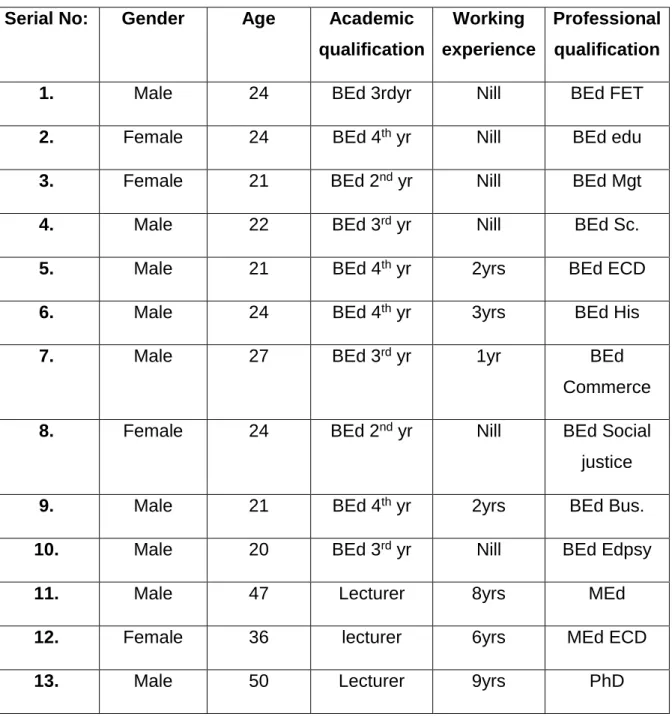
Table 4.1 Research team demographic data 74
Table 4.2 Research plans 80
Table 4.3 Participant’s reflexive essay 81
Table 8.4.1 Concepts of proposed transformative approach 268
xxv ABSTRACT
The current issues of homophobic and discriminating acts by heterosexuals against Lesbian, Gay, Bisexual, Transgender and Intersex communities has necessitated critiques to constructively drive to gain a transformative approach in order to embrace the LGBTI communities. The objective of this study is to propose a transformative approach that could embracing LGBTI communities at a university. The recruitment of a research team was done through a purposive method. The study’s sample size was reduced from 17 to 15 as two participants declined to participate in the study. The critical paradigm was used for data generation and PAR was used as an approach coached “Bronfrenbrenner ecological systems” theory. The “Ecological systems” theory in this study draws collective perspectives in order to allow responsive action towards maintained values, respect and morality for humanity by giving relative acceptance. The literature review was used, Ethical consideration sought from the university; gatekeepers and informed consents sent to the participants and the ethical clearance released by the higher degree ethics office. Data generation was obtained from meetings; focus group discussions, conversations, deliberate dialogues as well as free attitudes interviews/scripts/writings. Data was audiotaped and transcribed verbatim and it addressed each objective accordingly. Findings were from data generated, and the trustworthiness of this study was triangulated by the reflexive essay and the researcher’s field notes and reflections through the participants’ body language. Firstly, transcriptions were done by an expert and the researcher in order to maintain congruence and accuracy of data management. Data findings were further analyzed accordingly.
Therefore, findings from this study showed that despite the awareness, campaigns and talk shows about the LGBTI communities, the majority of the heterosexual students as well as the management also need orientration to support LGBTI communities to be an active part of the University. This study discovered that more research needs to be done to embrace the LGBTI communities at a university campus. The limitations to this study were; 1). The religious practitioners such as pastors, imams, traditionalists, Hindus and other faith based groups could be part of this study. 2). The timeframe had a great influence on the efficiency of this study 3).
Keywords: Transformative approach, embracing, LGBTI communities, university campus
1
CHAPTER ONE
OVERVIEW OF THE STUDY ON A TRANSFORMATIVE APPROACH TO EMBRACING LGBTI COMMUNITIES AT A UNIVERSITY CAMPUS
This chapter presented the overview study of a transformative approach to embracing LGBTI communities at a university campus. It presented problem statement, aims and objectives of the study, theoretical framework, research methodology and approach to study, preview of literature review, trustworthiness of the study and rigour, ethical consideration and layout of chapters, delimitation, limitations and chapter summary.
The next discussed introduction and background to the study.
1.1 INTRODUCTION AND BACKGROUD TO THE STUDY
This study intends to explore a transformative approach to embracing Lesbian, Gay, Bisexual, Transgender and Intersex (LGBTI) communities at a university campus.
Globally, LGBTI communities have arisen from point of debate, such that countries like USA, Australia, Canada and Europe have been taking some measures into consideration to ensure a level of acceptance by formulating policies within the system which invariably annul discrimination or violence against LGBTI groups at homes, schools, universities and workplaces (The Council for Global Equality, 2012). The restrictions and policies, in countries like Russia, Uganda, Zimbabwe and Nigeria do not support LGBTI in any form. However, South Africa has been passively learning to attend to the urgency of the human rights violations especially on LGBTI communities like in her counterparts in the world, which called for an intense education to pave way, rather than to be more practical in inclusivity in the attention to unaware/alarming issues at the school and university levels.
In Uganda, a study reveals that heterosexist continues to be deeply shaped by notions of the patriarchal system that promotes heteronormativity (Boyd, 2013:704). In the midst of the struggle and despite the death of many of the country’s LGBTI youth, the Ugandan government has taken strides to further criminalize homosexuality (Rusnak, 2014:09). The circumstances has posed unpredictable occurrences on the LGBTI communities. As Nyanzi (2013) articulates that the rhetoric of Uganda’s Anti- Homosexuality Bill reveals something of the paternalistic and myopic protectionism of
2
homogenised, static and illusory African culture characterized by an imagination of a certain cherished traditional heterosexual family. However, in United Kingdom, Sonja (2008) survey study unveils the experiences of LGBTI students has been worrisome on the mainstream idea of diversity for inclusivity among the university students.
O’Higgins-Norman (2009) exploration of homosexuality and the tense homophobia in secondary schools of Ireland demands conscious measure to alleviate education standard for all students. Nonetheless, another study at Washington DC by Graham, Bradford, de Vries and Garofalo (2011), emphasized on the importance of LGBTI communities’ health and social wellbeing state along their academic engagements at a diversify school environment.
Research has found that despite advocacy for equity, and the non-discriminating rights of all to education, a vacuum remains unattended to, and there is a need to redress (Msibi, 2012; Bhana, 2012; Francis and Msibi, 2011; Brikkels 2014). The core urgency of inclusive education implementation as stated on Department of Basic Education (DBE, 2013), which have not been seeing and responding to discriminative precedencies against the rights of all students to equal education. This contributes to the type of experiences and stigma that LGBTI students encounter at schools and universities. Gokcek and Baki. (2013) support that Teachers were challenged to develop an accommodative insight from the existing curriculum to address individual needs of students by adopting from a hidden curriculum to support socially marginalized students for effective participation in teaching and learning activities.
The Stonewall International (2014) noted the needs for inclusive education, and an urgency to provide a worthwhile intervention through initiatives which aim to eradicate poverty and inequality before 2030. One of the vital issues mentioned in the “No One Left Behind Project”, was the need to include LGBTI communities in education which challenged authorities to support all students equally. This initiative may be useful as a supporting tool in developing a transformative approach designd to empower and effect as desired change for LGBTI communities – particularly to achieve the sustainable development goals and LGBTI inclusion (Booth & Ainscow, 2011). As that initiative continues, this study provides a transformative approach to alleviate stigmatisation, which may hinder effective participation of LGBTI individuals and communities at a university campus.
3
Studies by Msibi (2012), Bhana (2012), Brikkels (2014) and Dare (2015) emphasise that the comprehensive education system should accommodate all students, irrespective of their gender, sexuality, status, race and ethnicity, in order to build a reliable nation. To promote a non-discriminating and non-stigmatising university environment that could accommodate all students and enhance their rights to participate in school activities, without fear of any threat, which enhances cooperative engagement at all times. This research may contribute to new knowledge to strengthen those LGBTI communities that might be struggling to accept themselves and their rights to education, by escaping from daily negative experiences of the past which have been influencing them on a daily basis. The researcher found this study that it is imperative, to identify the need for transformative urgency that might cater to embrace LGBTI communities at a university campus on the assumption that continuous exposition make rapid changes of behaviours to the reality.
The purpose of this study is to explore and explain how we can, through a transformative approach, embrace LGBTI communities at a university campus.
According to Hornby (2013), defined LGBTI as a lesbian, gay, bisexual, transgender and intersex (LGBTI) community through the act of dating within the “same sexual sexes; gay is a male who sexually attracted to his fellow male; lesbian is a female who sexually attracted her same sex, while bisexuals refer to be sexually attracted to both opposite and same sexes alternatively, transgender is a person who chooses to be either male or female, through makeup of appearance to suite their gender identity.
Intersex is a human born with both male and female organs that make one confused of his/her identify to make his/ her preferred choice of gender and vice versa” (Hornby, 2013). Msibi, 2012, p. 516) stated that heterosexual dominance has been silencing LGBTI students due to an unclear statement of the school’s constitutional policy on education. Subject Educators seem to feel less or no concern about any discrimination reports from LGBTI students (Msibi, 2012, p. 522). For this research, the researcher attended a meeting on LGBTI issues and the turnout was impressive – the first dialogue had 12 representatives of LGBTI communities at a university campus.
According to LGBTI campus representatives;
…there is a stigma going on underneath at university campuses in which our members are subjected to name calling and all sorts of verbal abuses all over
4
campuses. In addition, it seems as if we are alone in a cold room, because if we report any case against our members, it took time to respond, and at times we took steps by ourselves by reporting the incidences before university intervened. We are being judged as everyday experiences, why? Life is a choice and university is for all…we would be happy if there is any input to make our voices heard to improve the climatic environment we are in.
Drucilla, and Muvangua (2011) contend that social adaptation embraces diversity among people and encourages respect to live with love and harmony within a systems ecology. Msibi, 2012; Bhana, 2012; Hlalele, 2012; Göransson and Nilholm, 2014;
echoed on advocacy for inclusive education opportunities at schools, to accommodate differences within the schools and universities levels to provide equal access for all.
1.2 PROBLEM STATEMENT
The university campus is a wider space of learning that seeks to accommodate all students irrespective of their background, religion, ethnicity, status and identity.
Current cultural contexts and audiences indirectly contest this importance of acceptance. The researcher was priviledged to teach students at a university and witness the reactions of the majority of the class to a gay student. Also, informed by his interest to maintain a peaceful atmosphere in his faith to show love to all without condemning nor judge anyone with their personalities. The researcher noticed that despite the initiative to support LGBTI communities, the gap between homosexuals and heterosexuals is large, and the non-tolerance of LGBTI communities at a university campus is becoming alarming. Based on fairness to humanity, the research considered if there could be a transformative approach that could embrace LGBTI communities at a university campus.
5
1.3 AIMS AND OBJECTIVES OF THE STUDY
Main objective: To explore a transformative approach to embracing LGBTI communities at a university campus.
Objectives:
To explore the current situation regarding approaches to embracing LGBTI communities at a university campus.
To examine the need for a transformative approach to embracing LGBTI communities at a university campus.
To explain key elements (thrusts) of a transformative approach to embracing LGBTI communities at a university campus
To examine circumstances/conditions under which a transformative approach to embracing LGBTI communities at a university campus may be successfully implemented.
To identify hindrances/barriers to embracing LGBTI communities at a university campus and suggest how these may be circumvented.
To propose a transformative approach to embracing LGBTI communities at a university campus.
1.4 CRITICAL QUESTIONS
The main critical question is: ‘How can we, through a transformative approach embrace LGBTI communities at a university campus?’
Secondary critical questions include:
Are there any current understanding of approaches to embracing LGBTI communities at a university campus?
Why do we need a transformative approach to embracing LGBTI communities at a university campus?
Under which circumstances/conditions would a transformative approach be implemented successfully to embrace LGBTI communities at a university campus?
Can there be some key elements (thrusts) to embrace LGBTI communities at a
6 university campus?
What are the hindrances/barriers against embracing LGBTI communities at a university campus and how can these be circumvented?
In which ways a transformative approach can succeed to embrace LGBTI communities at a university campus?
1.5 RATIONALE FOR THE STUDY
This topic was inspired by stigma experienced by gay and lesbian students at a university. The intensity of marginalisation noted by Dare (2015) indicated the need for further study; the study investigated the experiences of gay and lesbian learners in a high school within the Durban metropolis of KwaZulu-Natal, South Africa. The study used social learning theory of Bandura (1997), which did not fully capture experiences encountered by gay/lesbian learners. This study left a gap, as it was limited to high school learners and suggestions on interventions were limited. In addition, the study was limited to only two of the LGBTI communities: gays and lesbians. Therefore, the researcher hopes that considering different theories into actions will make a difference and find a solution to negative school and university campus experiences for LGBTI students. To find a way out of societal stereotyping against LGBTI communities and bring about social justice, social inclusion and identity equality drove the focus on a transformative approaches to embrace LGBTI communities at a university campus.
1.5.1 Self-constructed incident 1
As a tutor, (2012-2017), the researcher witnessed an example of prejudice and discrimination at a university while teaching. A student answered a diversity-related question during class to define ‘who I am’. The student stated that he was gay, and other students responded loudly and began to yell at this student. The researcher intervened by cautioning them, telling them of the importance of the activity, as there can be no hate of any sexual orientation or gender, status, religion, race and other identification and that no students should be discriminated against Department of Basic Education (DBE, 2013). This step taken supported the student in this situation but provided little intervention to alleviate stigmatisation and victimisation against
7
LGBTI communities on campus overall. The researcher noticed that particular students still felt their peers did not tolerate them. With the sensitive nature of their group, the researcher saw a need to address homophobia and related prejudices among university students.
1.5.2 Self-constructed incidents 2 and 3
Another incident was a case of a lesbian student who was name-called by peers due to her sexual orientation thus subjecting her to loneliness. She indicated that she was thinking of dropping out for the semester. Another scenario was a gay student who revealed that his partner was being bullied by another student at the university residence. He was thinking of killing himself because of his experiences and felt powerless. He was not comfortable talking about the whole story and left the discussion. This proves that LGBTI communities are being neglected and untold stories make these students vulnerable to any form of abuse within the university environment. These influences and experiences can lead to gay students lacking concentration in the academic environment and may end up cultivating bad habits.
Sadly, instead of LGBTI communities finding a confidant who can give them counselling or formulate coping strategies, they remain secretive for fear of harassment. It seems a difficult issue to address, yet it is affecting LGBTI communities at a university campus where students’ lives are in danger and affected by everyday life experiences (Barber, 2012). In order to combat the status quo, there should be a transformative approach to embrace LGBTI communities at a university campus. This will help to control the unusual threat that may contest a good university climate for all students, especially LGBTI communities.
1.6 THEORETICAL FRAMEWORK
Theory is a crucial tool that upholds the phenomenon under study to work effectively with the help of literature review, which serves to prevent the researcher from being grounded (Dunne, 2011, p. 117). The researcher explored psychological theorists such as; Bandura (1997) social theory, Bronnefrenbrener (1989) ecological systems theory and Metz (2012, 2014), Ubuntu theory, the chosen theory may help to navigate the inter-related on the research objectives and questions within a framework to
8
achieve a credible study. However, Bronfrenbrenner ecological system theory originated from psychological school of thought shared similar ideas with Ubuntu theory, only that Ubuntu gained its root from humanistic philosophy, therefore researcher decided to apply psychological theory alternatively by chosen Bronfrenbrenner ecological systems theory for this study.
The literature (Msibi, 2012; Bhana, 2012; Hlalele, 2012; Göransson and Nilholm, 2014) indicated that despite the efforts of few scholars on advocacy for inclusive education opportunities at schools, to accommodate differences within the schools and universities levels to provide equal access for all. On this account, Futhwa (2011), Elechi, Morris and Schauer (2010), ecological system theory seek to address this imbalances occurrences along the circular flow of friction related to differences and execute equity through substantive concepts that could help individual students, managements and university on the approach to accept all against stigma place on certain group of peoples. These peoples are; HIV/AIDS and LGBTI communities as heterosexuals behaves indirectly or indirectly disengaging these groups of people from their expected involvement on their daily school activities. The theory has provided findings to could bring normative insights to maintain uniformity against discrimination and stigma which has create classism on LGBTI communities to their groups differently (Drucilla & Muvangua, 2011). As such, ecological systems theory try to inculcate circular flow of communication not minding status/barriers to learning thus restore unity among students irrespective of any identification thus create safe university campus for all students according to inclusive education. The next is the Bronfrenbrenner ecological systems theory.
1.6.1 Bronfrenbrenner ecological systems theory
A relationship of belonging evolves by forming our relational bonds within ecological system (Ahmed, 2006). Ubuntu comes in different languages of the world for the appreciation of cultural values (Idang, 2015). McNulty (2013) affirms that ecological systems theory strengthens human personalities that help people to embrace themselves, understand and show love for one another.
9
Ecological systems theory offers a framework that foster community psychologists to examine individuals' relationships within communities and their wider society which they lived (Bronfrenbrenner, 2005). This theory identifies five environmental systems components through which an individual interacts for development.
The researcher found that Bronfrenbrenner ecological systems theory would be able to go beyond expressions of ecological components but assimilating advocacy for individual social transformation which centred on collectivism, unity and love for a normative communication intervention (Selhub, 2009). The reseacher considers that learning of difference would be applicable to LGBTI students because oppression encounter and stigmatization at the university is not limited to others but from heterosexual peers. The theory appeared to strengthen collectivism and idealism in order to implement social justice and change some oppressive measures against humanity. By considering relational factor which coupled by world views and beliefs, as well as opinions and how they can be interpreted and studied (Denzin & Lincoln, 2008). The researcher used the component on learning and adaptivity medium to design a transformative approach in order to embrace the LGBTI communities at a university campus with the hopes that address the related issues in order to ensure inclusivity and humanity.
1.7 RESEARCH METHODOLOGY AND APPROACH TO THE STUDY
For this study, the researcher employed a selection of research teams (participants) as the study will be trying to propose a transformative approach to embracing LGBTI communities at a university campus by contacting those who this study may be helpful to. Patton (2015) suggests that in research, participants/respondents should be selected in accordance to the significance of their involvement on the study. This study employed participatory action research which deals with the participants’ collective suggestions to formulate an approach to embrace LGBTI communities at a university campus (Ratsoy, 2013).
10
1.7.1 Selection of participants
The study took take place in one of the tertiary institutions in South Africa. In this study, the selection of participants involved those at the university and outside. Therefore, the selection of participants for this study was anchored on Bertram and Christiansen (2014) who emphasise research data selection procedures for sampling methods by acknowledge purposive and convenience sampling techniques in qualitative research.
The researcher recruited participants for this study through purposive sampling in order to get individuals from the LGBTI communities as well as heterosexual participants. The total number of participants was 17. There were (5) participants from the LGBTI communities within the university; (3) Lecturers, (5) heterosexual students, one (1) SRC member, (1) LGBTI representative from outside the university, one (1) student Counsellor and development practitioner, as well as one on campus faith- based community representative. Only those who were willing and available were part of the study. The selected (17) participants were based on the assumption that they would add value in terms of their input to this study because the LGBTI communities’
issues are not in isolation but involve others around them.
To gain participants’ attention, the researcher firstly placed an advertisement on the notice boards over the campus on the nature of the study, stating that anyone who is interested to participate is free to contact them through email or phone. Through the advert, the researcher got a student, who through snowball sampling led him to four other members from the LGBTI community who were willing to participate in the study.
In support to the participants’ recruitment process and in line with Krista and Mark (2010), who argue that a participant serves a prominent role as they can recruit other participants in a sensitive type of study such that participants were difficult to find. The researcher identified one member of LGBTI communities to help getting other members for this study (Krista & Mark, 2010). Other participants were selected based on the assumption of either they would add value to this study.
The researcher decided to allow only those who agreed to cooperate and adhere with the terms to participate in the study, as recommended by Palys and Atchison (2008).
The tools used to gather information include focus group discussions, collages, dialogues, conversations and meetings. The researcher audiotaped the meetings,
11
conversations and dialogues in order to generate rich data. The study participants were gathered through snowball sampling and convenience techniques, meaning that the results of this research can be applicable to the same population size. However, transferability of the results is possible for similar groups or contexts. The researcher found that with Bertram and Christiansen (2014) that a good qualitative research possess basic rigors which include transferability, confirmability, dependability and credibility. On the importance by Silverman (2013) that states that research can be verified through triangulating evidences on the process of qualitative data process and management. It therefore imperative to ensure that the coordination of the study follows the authentic process of qualitative research, as a researcher must maintain a subjective participation role.
1.7.2 Participatory Action Research as a data generating method
The researcher sees this study as participatory, because it is qualitative research that appreciates the input of the collective view of participants towards developing a transformative approach that will seek to embrace LGBTI communities at a university campus. In support to my approach, Punch (2009) defines a paradigm as an essential set of philosophies or viewpoints, which guides action or serves to direct the research.
Individuals’ different perspectives on something influence their construction of realities around of a particular issue, place or thing. Hennink, Hutter and Bailey (2011) also defined paradigms as ways of looking at reality, or frames of reference used to organise observations and reasoning.
The Participatory Action Research (PAR) paradigm is suitable for this study because it involves diverse views and opinions of people on how to develop a transformative approach to embrace LGBTI communities at a university campus. Moreover, the study is an action research study that will involve different representation of groups as stated to draw an approach that is transformative in embracing LGBTI communities at a university campus through the ‘Bronfrenbenner’s ecological systems’ theory.
Participatory action research is an, approach with flexibility influence to accommodate participant’s involvement on the research (Kumar, 2012). PAR is a democratic, equitable, liberating, and life-enhancing qualitative inquiry that remains distinct from other qualitative methodologies (Kach and Kralik, 2006). In this research, the research
12
team were allowed to produce knowledge on their own, which was then shared with the researcher.
In addition, PAR works within a timeframe, and knowledge of the participants’, sensitivity to the topics covered is vital, and it is also important for the researcher to acknowledge participants’ intentions of doing the study (Young, 2006). Consensus around social issues, such as LGBTI intolerance and the timeframe anticipated for the change might be difficult (McNiff and Whitehead, 2006). PAR encourages a small number of individuals in a focus group to facilitate a relaxed atmosphere for participants, thus enabling useful data generation. During a focus group, it is the researcher’s duty to create a supportive environment in which discussion, conversation and differing points of view are strengthened (Marshall and Rossman, 2006). Therefore, PAR empowers triangulation of findings since there are different kinds of data generation procedures.
1.8 PREVIEW OF LITERATURE REVIEW
Clarke (2012) defines a transformative approach as a drastic improvement of the present situation of events/experiences in a different paradigm. The author argues that change must be applied in a systems way in order to better a current situation. The White Paper on Foreign Policy (2011) supports that tolerance should be maintained by making education free for everyone and avoid discrimination by encouraging love, empathy, equity and unity to promote nation development. This research used a transformative approach of social change, through ‘ecological systems’, to empower the targeted LGBTI communities at university campus.
Taylor (2008) defines the transformative approach as a process of constructing and appropriating new and revised interpretations of the meaning of an experience in the world. This indicates a bringing in of innovation that allow social change and empowerment. Dirkx (2006) proposes that the transformative approach helps LGBTI communities to learn with heterosexual students and to use the contexts of their lives experiences to construct and reconstruct personal meaning for future empowerment.
Bajaj (2011) argues that the transformative approach is a paradigm shift from
13
transitivity to a transformative state that enables all students to consider changes as necessary tools to appreciate unity in diversity among all students at a university.
Illeris (2014) states that transformattion creates opportunities for students to enjoy a peaceful university environment with their peers without fear of any threat that could inflict danger on their relationships with others. This approach cultivates inclusive attitudes to recognition of the value for others, in order to reinforce good behavious and mould our society in a more positive way. The transformative approach is a lens through which changes occur in a systematic way towards democratic engagement between LGBTI communities and heterosexual students at a university campus (Wals, 2010). The transformative approach may provide LGBTI communities with a model with the values, knowledge and skills needed for creating a sustainable university campus environment (Burns 2009). Wyandotte and Huh (2012) assert that the transformative approach will serves as an intervention to promote emotional wellbeing, psychological competence and promote intellectual development of LGBTI communities at a university campus.
Ainscow, Booth and Dyson (2010) argue that the transformative approach be understood as a new paradigm which bypasses the medical approach and the concept of academic deficiency, in order to promote inclusive environments that embrace diversity. In the case of LGBTI communities at a university, there is no recorded transformational approach to challenge these issues which are occurring on a daily basis. In addition, Adamczyk and Pitt (2009) suggest that changing of attitudes of the majority of the community, in regard to their behaviour to LGBTI communities in a schools and universities environment, involves the process of embracing diversity.
The Department of Education, White Paper 6 in 2001 (DoE, 2008), states that the main objective of any education system in a democratic society is to provide quality education for all learners so that they will be able to achieve their lives’ objectives. One of the main objectives of a teacher is to provide adequate interventions to support learners experiencing barriers to reading and learning (p.53). The document ensures promotion of home/school/community partnerships of all in education. The Education White Paper 6 on Inclusive Education (2001) describes the intention of the Department of Education to implement inclusive education at all levels in the system by 2020. Such