TRANSFORMATIVE IMAGINARIES:
STRATEGIES FOR INCLUSIVE ARCHITECTURAL DESIGN IN DURBAN
TOWARDS A MAKERS LAB IN WARWICK
Submitted in partial fulfillment of the requirements for the Degree of Master of Architecture (M. Arch)
to the
The University of Kwa-Zulu Natal School of the Built Environment
by
Phumelele Mkhize Supervisor: Juan Solis
February 2017
ii
“One of the tragedies of colonialism has been to erase that element of multiplicity which was a resource for social development in pre-colonial Africa and which was replaced by the paradigm of ‘the one’, the kind of monotheistic paradigm. So how do we recapture the idea of multiplicity as precisely a resource for the making of the continent, its remaking, but
also for the making of the world?”
(Mbembe, 2013)
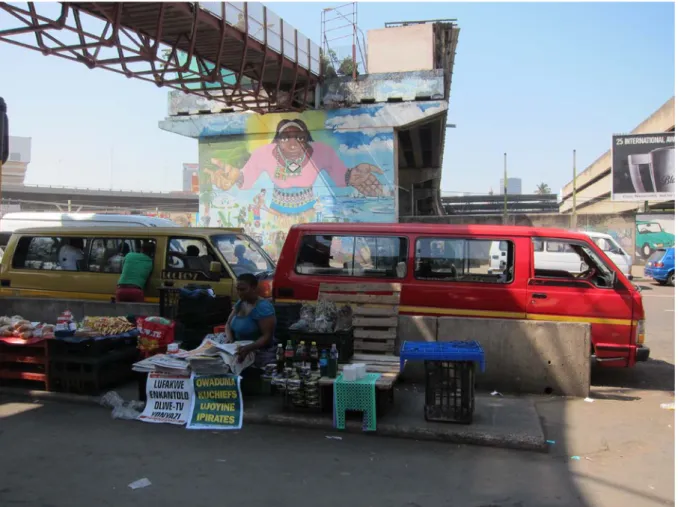
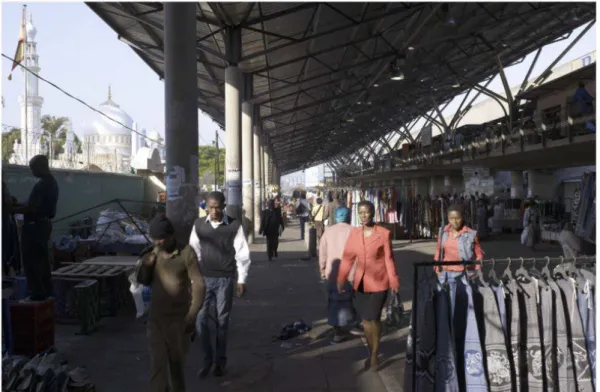
Figure 1 The Herb Traders Market, Warwick Junction, South Africa. Source: Author.
iii
Acknowledgements
To my supervisor Juan Solis, thank you for your continued support and guidance in writing this document.
To my family, thank you for your generosity and encouragement throughout my studies.
My deepest gratitude for all that you are and have done for me.
To Thomas, thank you for your enthusiastic attitude, insights, advice and friendship.
You have encouraged my sincere appreciation of the vibrancy and life that exists in the cities of my continent.
To Asiye eTafuleni, you have given me eyes to see the “real city”.
I am truly grateful.
______
Soli Deo Gloria
iv
Abstract
The ‘regeneration’ of materially degraded areas in African cities, such as the Point Development in Durban, has become microcosms of global development practices, where local identities of social capital and built form are overlooked in the expression of place-making, in favour of urban imaginaries that aspire to those of Eastern mega cities. In doing so, a vast majority of the inhabitants of the city, the urban poor, are rendered invisible in these exclusively represented ‘regenerative’ developments.
South African cities present an already spatially fragmented urban context, due to the burdensome legacy of the apartheid regime. Approaches to the urban regeneration that defer to globalised fantasies and aspirations, as opposed to being locally grounded, are not only politically problematic, but can substantively exacerbate social, economic and political striations, as well as impede the future development of these cities. There is therefore an urgent need to reconceptualise the approach that we as Africans take in conceptualising our own rapidly urbanising and future-imagined cities. The rendered images we devise project values of urban lifestyles we imagine to be ideal. This study holds that there needs to be a critical realisation and evaluation of the readily available local resources found in our cities, of both material and social capital, which present a grounded local platform on which our cities might be built. The problem becomes the means through which the local values of a particular city, which reflect current and diverse urban practices of its people, as well as their collective aspirations, can be expressed in local identity and become materialised in architectural form. Such language of inclusion, once engaged, becomes the seed from which deteriorating urban sites can be spatially transformed to include the poor in development, instead of ‘regenerating’ the urban aesthetic. This thesis argues that in the case of South African cities engaging urban phenomena as a need for transformation in our theoretical conceptualisation of the future city. It contends the need for architectural design to affirm local identity in the face of globalisation. Its research aim to make an inquiry on the tools necessary to begin to build inclusive or transformed urban environments, examining the discourse presented by urban scholars of the Global South, including Jennifer Robinson, Edgar Pieterse, Abdou Malique Simone, and Achille Mbembe.
v
Table of Contents
Acknowledgements ... III Abstract ... IV Table of Contents ... V List of Figures ... VIII
1 CHAPTER 1: INTRODUCTION ... 1
1.1 Introduction: Background to Research ... 1
1.1 Definition of Problem, Aims and Objectives ... 3
1.1.1 Definition of terms ... 3
1.1.2 Definition of the Problem... 4
1.1.3 Aims and Objectives ... 4
1.2 Scope ... 4
1.2.1 Research assumptions ... 5
1.2.2 Hypothesis ... 6
1.3 Key Question ... 6
1.3.1 Secondary Questions ... 6
1.4 Key Theories and Concepts ... 7
1.4.1 Theories ... 7
1.4.2 Concepts ... 9
1.5 Methodology and Materials ... 10
1.5.1 Primary data collection ... 11
1.5.2 Secondary Data collection ... 14
1.6 Conclusion ... 15
2 CHAPTER 2: LITERATURE REVIEW ... 16
2.1 Introduction ... 17
2.2 A Critical Regionalist Theoretical Approach to Transformative Urban Development18 2.2.1 The popular approach to upgrade and development ... 18
2.2.2 Alternative post-colonial and Critical Regionalist approaches to Urban Change. ... 24
2.2.3 South African Cities and the Need for Urban Transformation ... 26
2.3 An African Logic to South African City Transformation ... 32
2.3.1 Translating African urban logic into architecture ... 32
2.3.2 Alternative methodologies of public engagement ... 33
2.3.3 Community Driven Spatial Visions ... 39
2.4 Conclusion ... 48
vi
3 CHAPTER 3: PRECEDENTS ... 50
3.1 Introduction ... 51
3.2 Manguinhos Complex: Inclusive Planning At Urban Scale ... 52
3.2.2 Alternative stakeholder engagement processes ... 52
3.2.3 Removing physical and psychological barriers ... 53
3.3 Elemental Social Housing: Incremental Architecture ... 56
3.3.1 Approach: ... 56
3.3.2 Incremental Growth ... 56
3.3.3 Providing opportunity to formalise ... 57
3.4 Conclusion ... 58
4 CHAPTER 4: CASE STUDIES ... 59
4.1 Introduction ... 60
4.2 Warwick Junction Case Study ... 61
4.2.1 Post-1994: Warwick Junction Urban Renewal Plan ... 62
4.2.2 African Theoretical Framework for Local Urban Values ... 63
4.3 Corner House Shopping Arcade ... 80
4.3.1 Background ... 80
4.3.2 Building Structures ... 80
4.3.3 Constricting and Releases ... 81
4.3.4 The space in-between ... 81
4.4 Conclusion ... 87
5 CHAPTER 5: STRATEGIES OF INCLUSIVE ARCHITECTURE ... 88
5.1 Introduction ... 89
5.2 Architecture as Agency in South African Cities ... 89
5.3 Strategies Towards Locally Responsive and Inclusive Design ... 90
5.3.1 Mobility & Connectivity ... 91
5.3.2 Function ... 94
5.3.3 Public Space ... 97
5.3.4 Urban Form Typologies ... 98
5.4 Conclusion ... 100
6 CHAPTER 6: RECOMMENDATIONS AND CONCLUSIONS ... 102
6.1 Introduction ... 103
6.2 Strategies towards inclusive architecture & negotiation ... 103
6.2.1 Engagement with relevant urban stakeholders (active &passive) ... 103
6.2.2 Contextual design principles ... 104
vii
6.2.3 Working towards common spatial objectives for development ... 104
6.3 Conclusions ... 104
7 REFERENCES ... 108
7.1 Bibliography ... 108
7.2 Articles ... 109
7.3 Reports ... 112
7.4 Websites ... 113
7.5 Appendices: Interview Transcripts ... 116
viii
List of Figures
Figure 1 The Herb Traders Market, Warwick Junction, South Africa. Source: Author. ... ii Figure 2 Warwick Junction, South Africa. Source: Author. ... 16 Figure 3 African Annual GDP rate. Source: www.africa-me.com/will-kenyas-ambitious-konza-city-project- prove-doubters-wrong/ ... 19 Figure 4 (A-C). Victoria Island Lagos, existing context. Source: www.ghettyimages.com. ... 21 Figure 5 Eko Atlantic Renders, Nigeria, Victoria Island Development Proposal. Source: www.ekoatlantic.com. 21 Figure 6 Proposed development of Point Waterfront, Durban. Source:
http://www.timeslive.co.za/sundaytimes/stnews/2015/07/19/Planned-Durban-skyscraper-proves-sore-point ... 22 Figure 7 Real issues of urban exclusion and xenophobic attacks, in proximity to the proposed development precinct. Point area, Durban. Source: www.ewn.co.za ... 22 Figure 8 Jeppestown evictions show the poorer urban residents in and around the area, excluded from the benefits of regeneration. Source: https//www.dailymaverick.co.za/article/2015-09-30-in-photos-jeppestown- eviction/ ... 23 Figure 9 Maboneg precinct in JHB. ‘Rise of the creative class type regenerative urbanism.
Source:http//propertuity.co.za/Johannesburg ... 24 Figure 10 The critical mobility of goods people and services in the city. Lagos, Nigeria. ... 25 Figure 11 Durban City Apartheid Group Areas Act Spatial planning.’Natives’ living furtherest from the city center. Source: http://www.sahistory.org.za/article/apartheid-legislation-1850s- ... 28 Figure 12 Spatial inequality illustrated in neighboring residential areasin Durban, separated by road.
Source:http//unequalscenes.com/Durban-metro. ... 28 Figure 13 People accessing the city by foot, along motor dominated route into city. Source: Google, 2015 ... 29 Figure 14 Separate entrances for blacks and whites at train station. Source:
https://artasculturaldiplomacy.wordpress.com/2011/07/08/for-europeans-only-pre-european union/ ... 29 Figure 15 Informal sector contribution to SA’s GDP. Source: https://www.slideshare.net/mobile/africancc/the- informal-economy-current-realities ... 31 Figure 16 Brook Street Market, Warwick Junction. Source: http://informalcity.co.za/brook-street-2 ... 33 Figure 17 Architects of apartheid spatial planning. Source: http://www.sahistory.co.za ... 34 Figure 18 Punitive apartheid law enforcement on black urban citizens at Warwick Junction, Durban. Source:
http://sahistory.org.za/durban-1970 ... 35 Figure 19 Informal trader market in Nigeria earmarked for demolition. Source:
http://digest.bellafricana.com/some-major-markets-in-lagos-nigeria/... 35 Figure 20 Contrasting realities. Cape Town World Cup stadium foregrounded by an informal settlement.
Source: Google ... 36 Figure 21 ... 38 Figure 22 Storage containers made using locally sourced pallets, used by informal traders to store goods due to the lack of formal storage infrastructure provision. Source: Author. ... 40 Figure 23 Makoko Slum in Lagos with minimal government provided infrastructure was established since the 18th century andsupports about 30000 people. Source: www.newyorktimes.com ... 43 Figure 25 Taxi drivers play pool whilst waiting for commuters, the pavement becomes a space for socializing usually unplanned by urban designers. Durban. Source: Author ... 47 Figure 26 Elemental Social Housing. Source: www.archdaily.com ... 50 Figure 27 Manguinhos, Precinct Design Framework Source:
https://www.moma.org/interactives/exhibitions/2010/smallscalebigchange/projects/manginhos_complex.ht ml ... 54
ix Figure 28 Manguinhos, Public Space beneath raised railway. Source:
https://www.moma.org/interactives/exhibitions/2010/smallscalebigchange/projects/manginhos_complex.ht
ml ... 54
Figure 29 Manguinhos, District and railway border between formal and informal neighbors. Source:https://www.moma.org/interactives/exhibitions/2010/smallscalebigchange/projects/manginhos_com plex.html ... 55
Figure 30 Elemental Social Housing. Source: www.archdaily.com ... 57
Figure 31 Informal trading, in public space- Brook Street Market. Warwick Junction. Source: Author ... 59
Figure 32 Downtown Kampala,Uganda.Source:Author ... 60
Figure 33 Taxi washing occupying pedestrian route, Warwick Junction.Source: Author. ... 64
Figure 34 Trolleys used by porters wich are transported along roads to storage hubs, and clutter the pavements during the day, Warwick Junction. Source: Author. ... 66
Figure 35 Current interaction of formal and informal activity in Warwick Junction. Source: Author ... 68
Figure 36 Water sourced from public toilets, due to a lack of provision of water points. Source: Author ... 73
Figure 37 Informal traders sell and services within a ‘formal’ train station concourse provide a contextually responsive market typology. Berea Station, Warwick Junction. Source: Author ... 75
Figure 38 Traditional Herb Market, built on a disused freeway spur, innovatively created a typology, which responded to local context and local cultural practises. Warwick Junction. Source: Author ... 76
Figure 39 Self provided informal trader infrastructure, which allows flexible adaptation, but is unsustainable. Source: Author ... 77
Figure 40 Downtown Kampala, Uganda. Source:Author ... 82
Figure 41 Growing, mall typology. Kampala, Uganda. Source: Author ... 82
Figure 42 Corner House, Kampala Stairs, voids and enclosures. Source: Author ... 83
Figure 43 Corner House, Kampala Section collage: stairs, consumerism. Source: Author ... 84
Figure 44 Corner House, Kampala, Elevations: advertisements, no people. Source: Author ... 85
Figure 45 Corner House, Kampala Elevation: people on the streets. Source: Author ... 86
Figure 46 Early Morning Market, Warwick Junction. Source: Author ... 88
Figure 47 Plan view. Hard edge created by private property boundary. Source: Author ... 92
Figure 47 Plan view. Improved visial and physical connectivity to street. Source: Author ... 92
Figure 49 Section. Public Transport commuters, isolated from traders, who are prohibited from occupying BRT Station platform. Source: Author ... 93
Figure 50 Section. Alternative option, which is adapted from current contextual reality. Source: Author ... 93
Figure 51 Section. Diverse stakeholder representation, including market porters/barrow operators into design of urban mobility routes. Source: Author ... 94
Figure 52 Elevation. Mixed use high-rise example. Source: Author ... 95
Figure 53 Floorplan. Brook Street Market, Warwick Junction. Kiosks create a semi permeable edge and open into an open plan central space, where traders operate under market roof. (Author) ... 96
Figure 54 Section. Large buildings which respond to pedestrian presence. Source: Author ... 99
Figure 55 Informal trading in the Warwick Junction, 1995. Source: Richard Dobson. ... 102
1
1 Chapter 1: Introduction
1.1 Introduction: Background to Research
As global investment into African cities rises, governments and private developers are urged towards the development and of infrastructure as a means to cope with future growth (Pieterse, 2011). Furthermore, African cities are seeing an accelerated rate of property development by global investors. The visions produced suggest hopes to ‘modernize’ or ‘regenerate’ cities, to make them globally attractive through the creation of replicated urban visions based on Eastern ‘smart’ and ‘eco-cities’
(Watson, 2014).
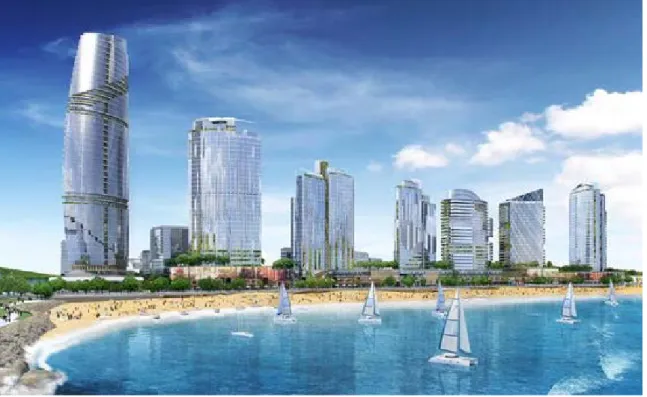
These glossy images or visions for regeneration and development at an urban scale show little relationship to the ‘ground’ or ‘street’ of these cities themselves, and show buildings rendered as “glass boxes on green sites” (Fig 3)(Watson, 2014). Cities here are represented as statiscally resolved entities, with little relationship to the reality of the material condition that is ever-changing in the city space itself for those who are its inhabitants.
This, coupled with South Africa’s history of apartheid separate development interventions, leads urban theorists and planners to already anticipate the marginalisation and increased exclusion of the poor, as infrastructure and property development (architectural) approaches targeting the middle to elite classes, in order to quickly recover development costs (Pieterse, 2011). The language of urban development and city futures becomes one of articulating the means of transition between the apartheid and post-apartheid city, as well as the local and global city. It sees the everyday mundane realities of the diverse urban population, against those intercepting images of “dignified” and developed images projected to a globalised world.
The South African city of Durban cites various urban visions for change, at both urban and architectural scales. Whilst aerial renders of the city’s future populate the newspapers as well as the internet, this study considers urban visions generated
‘from the ground up’, where local (community) actors participate in strategizing in development decisions, pertaining to architectural infrastructure which will impact the way in which they create a livelihood in the city. (ELARD, N.D.).
2 The Precinct of Warwick in Durban is an example of an area of transition, not only as a physical gateway into the city, but an area marked for ‘urban regeneration’ and development (Skinner, 2011). Through various architectural proposals and existing interventions, it shows how various stakeholders including the urban poor, government, and private developers co-produce the built form of the African city (Pieterse, 2009).
This study provides a point of departure here. Although the current study is situated in Warwick Junction, Durban, its larger discourse pertains to African cities both present and future, as they change through built form. This dissertation focuses on examining a means through which city visions of development can be better generated to relate to the ground, and to produce inclusive architecture. It argues that, in order for development to be truly transformative and impactful in creating greater change in the city, its architecture needs to be contextually sensitive to the needs, resources and aspirations of its urban locality.
Motivation
New visions of urban development in Sub Saharan African disregard the reality that the bulk of the urban population therein is poor (Watson, 2014). For this reason, it is of great importance that the urban poor be included in new imaginaries for urban civil society. (Pieterse, 2011)
This new vision of urban change cannot merely be created by government, private capital, urban theorists, planners, and architects, but informed by the unique dynamics of African urban living. Pieterse has noted that ‘the fundamental intellectual, policy, design and artistic challenge confronting (African) urbanists, is to draw out the logistics, emergent dynamics, and aesthetics of everyday urbanisms, and connect those with normative imperatives to squarely address the dramatic injustices touched on before’ (2011: 3).
If the history of South Africa and its apartheid era have taught visionaries ways in which the built environment might exclude the other through segregated cities and buildings, where the political was mimicked by the social geography of the time (Peters, 2007), then new strategies ought to be learnt to create inclusive architecture as part of future city vision.
3 This research will look at ways in which African urbanisms can be better articulated in order for the visions of development to be challenged by what exists on the ground, according to African urban theory. It will also examine how architecture, which is a tool for these visions to meet the ground, can be strategically used to as a tool for inclusive and collaborative city making towards meaningful urban change.
Definition of Problem, Aims and Objectives 1.1
Definition of terms 1.1.1
The following are terms that will be used throughout this document. The definitions are framed in the context of the argument presented in this dissertation document.
Key Terms
• Inclusive: In a city, it denotes, a right to the city (equal participation) of all residents – including the most vulnerable and marginalised poor through empowering their representative voice in governance, the consideration of their urban practices visible in infrastructural planning, their social and cultural preferences considered. (Douglas, 2014)
• Transformation: is a social concept in South Africa to describe a spatial and social process of practical interventions and projects, which alter urban space with the intention of reflecting values of a more democratic, and inclusive social order (Williams, 2000).
• Urban Regeneration: neighborhood development, usually branded as
“creative” renewal in lifeless or declined area in the city (Madden, 2013). Not only does it predominantly envision the upgrading of building stock by developers, but is also aimed at attracting middle to upper-income consumer classes to live and work in the ‘renewed’ neighborhoods (Crawford, 2013).
(Pieterse, 2010).
• Imagery:
1. Visually descriptive or figurative language, especially in a literary work; Visual Symbolism
4 2. Visual images collectively.
• Everyday urbanism: is a theory that draws on social and urban theory, largely specific to fieldwork, which portrays how everyday spaces are a product of intricate networks of social, political, economic, and aesthetic forces operating in the city (Crawford, 2013).
• Global South: refers to the nations, cities, and territories of Africa, Central, and Latin America, as well as large parts of the Middle East Asia and Asia.
Definition of the Problem 1.1.2
In pursuit of so-called modernisation and ‘development’, many African cities are re- envisioned to look like cities such as Dubai and Singapore (Watson, 2014). South African cities are no exception, with popular images (renders) of future modernist urbanism lacking an ostensible relationship to the life of the city itself. Consequenty, the urban poor are marginalised. The proposal for the development of a mall in Warwick Junction in Durban, South Africa illustrates the local and global interests to formalise economic practices through “shopping malls”, with possible architectural and social impact of such disconnected and exclusively generated visions, in a city in need of transformation, as inclusive of architectural design.
Aims and Objectives 1.1.3
The dissertation aims to do the following:
1. to propose alternate and inclusive visualisations of Africa’s future cities through presenting a discourse based on African scholars and research;
2. to foreground the need for spatial transformation, in urban developmentas amore relevant concept in the context of the African city;to identify the tools (and methodologies) needed to design inclusive and transformed
environments that reflect local identity, using the process of architectural design as an agent for transformation.
Scope
1.2
5 This study is grounded in the South African context, specific to its history, politics and development trajectories. In researching urban transformation, it must be noted that policy interventions and directives, as well as participation protocols and urban governance, have great influence in the processes of urban development, which has both physical and spatial implications.(Miraftab, 2004) (Williams, 2000: 23) Obstacles to shifting approaches to urban architectural developments that are inclusively designed include, firstly, the economic model, and its associated system of wealth generation. (Mbembe, 2006) Secondly, the political interests and systems, as well as culture values in the short-term, and their growth over the long-term.
Thirdly, institutional habits and structures that dominate that dominate local development at city-regional and neighborhood scale. (Miraftab, 2004) (Williams, 2000). A complete imagination of transformed spaces in the city would include a full strategy for infrastructure, housing, health and public services as imperative in catering for the exponentially exploding urban population. (South African Cities Network, 2016) These, although considered, will not be fully examined due to time constraint. The primary focus of the thesis will be on architectural and street scale interventions as a catalyst for greater urban change. Although the study is situated in the neighborhood of Warwick junction, Durban, South Africa, there will be a specific focus on the spaces that exhibit local values as well as the engagement of the formal and informal networks, traders and spaces in Warwick.
Research assumptions 1.2.1
The current approach and popular visualisations of urban regeneration result in architectural interventions that are exclusive of the greater urban population which is poor (Madden, 2013).
• A further inquiry into an alternative theoretical approach to urban development in Southern African urbanism, created through a deeper appreciation and understanding of the everyday dynamics and urban logic of growth and adaptation, regardless of conventional industrial modernism, will result in transformed and inclusive cities (Pieterse, 2011).
6
• Research methodologies that enable a better understanding of “what happens on the ground” in poorer areas of the city, and how the poor take the initiative to meet their needs (through so-called informality) can inspire new strategies for the ways in which architecture might respond to urban needs of the excluded in the same way.
• It is assumed that visions and their impressions articulate a set of beliefs and ideals and have the power to set norms and aspirations, and to drive what is eventually built, envisioning a minority whilst undermine the majority/
populous. Southern Urbanism theories attempt to engage the theoretical knowledge and practice gap which exists in the context of the Global South.
• Whilst the practical nature of the architectural interventions contextually relevant for ‘informality’ in African Cities, cannot be determined exactly, there are various ways and approaches to conceptualising the fluid and adaptable nature of informality which can be translated into architecture that is phased over time (as a means of being more inclusive).
Hypothesis 1.2.2
A better understanding of what happens on the ground in impoverished and disempowered neighborhoods in the city, through a number different tools of engaging the ‘other’, inspire more transforming visualisations of the city, through strategies which produce more inclusive architectural responses. (O'Toole, 2015)
Key Question 1.3
What strategies can be used as a means of creating inclusive architecture in Durban?
Secondary Questions 1.3.1
The key to the research is the writings and perspectives of African Urban Scholars, as well as those whose focus is the urbanity of the Global South.
1. What are alternative theoretical frameworks through which to approach responsive urban development in African cities?
2. How can spatial transformation of the built form be achieved, in order to produce inclusive cities in South Africa.
7 3. What strategies can lead to the production of more responsive architecture, to
the needs and realities on the ground?
Key Theories and Concepts 1.4
Introduction
The following key theories and concepts selected answer the aforementioned key question, and subsequent questions, as well as prove the hypothesis. The theories systematically explore approaches to urban developments, which render exclusive imaginaries and inequitable urban change. They further provide a more contextualised approach to urban development in African cities at an urban planning and design scale, as well as provide insights into the role of infrastructure (including the built environment or architecture) as a tool for the urban poor to negotiate a presence in an otherwise exclusive neoliberal vision of urban change.
Theories 1.4.1
Critical regionalism and ordinary cities
Jennifer Robinson’s (2006) ‘ordinary cities’ theory presents a post-colonial paradigm in the field of urban planning, that analyses an approach to planning (and implied architectural approach) to development and modernisation, which is dominated by Western discourses. She argues that all cities should be considered ‘ordinary’ in their diversity and validated in constructing their own ways of modernity. In doing so, she reveals the necessity of an urban vision for future development in cities (of the Global South) which does not imitate global images of modernity, which may limit the imagination of development interventions to those exclusive of the urban poor and their lived realities.
With this post-colonial analysis as a point of departure, Pieterse (2013) draws out the current theoretical landscape revealing various angles of the emergent urbanisms in countries of the Global South. He broadly introduces the following four fields, which reveal the emergent pathways of ordinary cities. These four fields of knowledge production, coupled with ’the political’ he considers imperative considerations for southern urbanism. The four fields of the theory include Southern urbanism;
everyday urbanism, vitalist ontologies, and ecological urbanism.
8 Based on the projected population growth rates, as well as the expected growth in the economic power of cities, the future of wealth generation lies in the cities of the Global South, where the probable trajectory of global investment will be focused on the development of the cities of these countries as future generators of wealth (Watson, 2014; Pieterse, 2011; Pieterse, 2013; and Mickinsey, 2011).
On the other hand, these statistics predict that the quality of life expected for the mass populations of future African cities will result in the majority of the urban population being poor. (Pieterse, 2012) This justifies the urgent need for urban and architectural theory and practices that have the capacity to envision solutions for the development of future cities that are inclusive of the urban poor.
Beyond the economic opportunity for global investors to develop local city infrastructure in a neoliberal manner, lies potential for emergence of urban theories specific to forms of urbanity that exist and emerge from these countries, based on the sheer scale of the global population represented.
Everyday urbanism
Everyday urbanism emerges from social and urban theory; it values the everyday, social, cultural and economic practices of people in the city, to shape it (Crawford and Pieterse, 2013). Pieterse, in the Southern African context, envisions a similar approach to the value of ‘everyday’ social practices in the city as key determinants and drivers of well-being in the city (Pieterse, 2009, Simone, 2010).
Simone (2010) cites everyday urbanisms as more than a study of practices (of the urban poor and informality), but rather, as a force of change in the urban context, through implied consequences of what people do in the city, beyond merely acting to survive. In furthering the argument that people shape the urban spaces they occupy, the self-organisation of people networks serve as an invisible infrastructure which enables the carrying out of every day practises despite lack of basic service infrastructures (such as electricity, water supply etc.) in an urban context. (Amin, 2014) (Graham, 2010)
9
Concepts 1.4.2
Urban regeneration
Urban regeneration is the improvement of the physical structure and aesthetic, as well as the economy of an urban area in attempts to reverse urban degradation, (Weaver, 2001) Coined during a post-industrial era in the West, this concept has come to take on a different focus in the current context of the urban development of many African cities. (Dobson, 2015) It now often refers to the upgrade or ‘renewal’ of building stock by property developers, to attract middle to upper-income residents.
Pieterse (2013) raises concern over development projects that aim to develop cities into ‘world-class cities’ or ‘modern cities’ under the guise of ‘urban regeneration’
projects, making cities to reflect the image of ‘symbolic power”, where cities promote themselves as globally competitive rather than confronting the realities of the extent to which they address the functional needs of their citizens. (Robinson and Parnell, 2011) (Watson, 2013)
Self-organisation
The theory of self-organisation challenges the normative frameworks of architecture and urbanism, which give local actors very little influence on outcomes that affect them. Self-organisation offers an alternative framework for the production of space. It can be used as a tactic within architectural practices that in itself produces alternative and transformational approaches to architectural processes as well as solutions which originate from peoples own practices and abilities to alter their own environments. (Spatial Agency, N.D.) (Holsten, 2008)
Self-organisation projects become relational practices, as they involve many different actors. Simone affirms this approach in his discourse of ‘people as infrastructure’ in the southern urban theory of ecological urbanism, which contextualises the need for infrastructural development within urban environments shaped as profoundly by their social networks as they are by the built environment (Pieterse, 2012). Self- organisation not only suggests alternative distributions of powers in envisioning the future of cities in the Southern urban context, but also gives rise to alternative processes and outcomes in the physical infrastructural growth of cities.
10
Methodology and Materials 1.5
The aim of the research has been to identify and outline the reason for the disparity between the images of urban development under the concept of ‘regeneration’, and the realities that exist and are imminent in the future of African cities.
The research, therefore, places great emphasis on understanding the current theoretical approaches to the development of cities and the built environment. It will also pay attention to the social, economic, and spatial practices of the urban poor in the built environment, in order to visualise a current reality, before suggesting an alternative, inclusive one, that is, through architecture.
In order to build a sufficient understanding of the problem, Southern Urbanism theories provide insight into the South African city of Durban. A collection of the research data is as follows:
Site observation
Site observations were carried out in two streams, and were corroborated through interactions and interviews with members of the NGO Asiye eTafuleni1 with the following outcomes in mind:
Site observations would involve full immersion into the research precinct, as fieldwork for each of the projects.
1) The researcher would have direct access to a team who have built a relationship with the community of Warwick.
2) Observations made would be able to be queried for validity against the NGO’s first-hand experience.
3) The observations were verified by the informal interviews conducted with traders.
The researcher used the time spent onsite to understand the existing context, in terms of the physical composition of the informal worker's workplace. Observation of occupancy was reiterated as a means of cultivating a grounded understanding of the
‘informal sector’ that inclusive design would need to consider.
1Asiye eTafuleni (AeT) is a non-profit organisation focused on promoting and developing good practice and process around inclusive urban planning & design.
11 Mapping
The tool of mapping through photographs and drawings is used as an exploratory method of observation and recording the socio-spatial everyday activities that unfold in an urban context.
Primary data collection 1.5.1
The research is qualitative and exploratory in nature. The data is processed in an inductive way, which is tested against the secondary data findings. In terms of the approach to understanding African Urbanism, Pieterse (2009) suggests the need to carry out investigations at a local, place specific scale, as there is a large gap in knowledge of specific places in African cities. He suggests that this may be the reason for such broad assumptions made with regards to interventions in African cities.
The following sections give an outline as to why the case studies and interviewees were selected and analysed:
Case studies
The case studies selected, illustrate examples of ‘on the ground’ experiences, commonly experienced by the majority of African urban residents, who are the poor.
Each of the case studies, present architectural spaces layered with multiple narratives, as they are inhabited and experienced by citizens often excluded from the globalised imagery of ‘modern’ developments in the city.
The selection criteria were that both case studies should be an existing built form, presented as an image of ‘development’ or regeneration, in an African city, where one of which had to be in a South African city. Both case studies had to be built by a built-environment professional, and used by the urban poor as a space for social, economic or cultural urban practice. The author has spent time researching in both these contexts.
The Warwick Junction area case was chosen as the key case study, as it is a neighborhood in the city identified as needing infrastructural development as part of iTRUMP (Inner EThekwini Regeneration and Urban Management Programme). The precinct is particularly ‘South African’ in its spatiality, as an ‘apartheid city’. It services a major proportion of Durban’s’ urban and rural inhabitants, and is a site which is under constant transformation, in terms both formal and, particularly, informal. The
12 informal economic practices therein provide examples to the arguments forwarded in theories of Southern urbanism, and a case study is integrated into part three of the literature in this regard.
The Corner House Arcade is a shopping complex in downtown Kampala. It is a multi-storey group of buildings. It is privately-owned and strictly secured, yet is a politically contested space that is transformed daily by the insurgent actions of its users, whose movements and tactics enables them to claim their inclusion in an otherwise exclusive space.
This case study was chosen because it reflects actual globalised and ‘formal’ urban development in African cities today in a way that provides insight into ways in which these developments actually function. Such examples can provide a ‘near reality’ of how future development in African cities might be imagined with greater accuracy.
The methods used in analysing the case studies mentioned are predominantly empirical, through a series of photographs, collages, mapping drawings and field notes, which are then tested against the theoretical assumptions made in the literature reviewed, as well as the insight provided by the interviews. This method counteracts the primary hermeneutic issues identified by Watson as discussed earlier, and proposes an alternative that might provide greater insight.
Qualitative interviews
Key informant interviews, as well as informal interviews, were carried out in a qualitative, semi-structured and open-ended manner. They are intended to provide clarity and explanation with regards to the experiences of the researcher in the field, as well as that which may have not necessarily been evident to the researcher.
With a focus on obtaining a better understanding of the particular subject currently considered responsible for generating a transformative urban vision, and who might be better suited to do so, the interviews challenge the processes and products of these urban imaginaries, through inquiry into alternative methodologies and practices.
Richard Dobson (Architect)
Richard Dobson, an architect by training, worked for over ten years for the eThekwini Municipality as a project leader, first of the Warwick Junction Urban Renewal Project,
13 and then for the inner city renewal programme (as Project Leader of ITRUMP). He left the city in 2006 to establish Asiye eTafuleni and focus on offering design and facilitation services to those working in the informal economy. His professional technical, design and project work has been recognised through various local, national and international awards and citations – namely, when he was the recipient of the 2014 Diakonia Human Rights Award for advancing the rights of informal workers (Asiye eTafuleni, 2015)
ITRUMP, Area-based Management
Established in response to the urgent need to prioritise the regeneration of the inner city, post-apartheid in Durban ITRUMP is an ABM programme. It was initially funded to clean up the city in order to stimulate private sector interest, whilst fulfilling the needs of the individuals that use public spaces (including informal trades and the poor). At its inception, its role was seen as that of the agency connecting the vision of city line departments to realisation and management the realities of those vision through projects on the ground.
Asiye eTafuleni, Tasmi Quazi (researcher)
Tasmi Quazi has worked for the last 10 years in the development field within local government, academic institutions, architectural firms and the NGO sector. She is a Master’s graduate of Development Studies with research and experiential background in architecture, community-based development, governance, and informality. As Asiye eTafuleni’s (AeT) Research Officer since 2009, she has been merging aspects of design, training with the field of development research and implementation. (Asiye eTafuleni, 2015)
The NGO represents stakeholder group, which is usually under-researched, and often excluded in the conception of future visions by both governance and private developers.
Nardus Van Heerden, Urban Planner at City Architects
His current position is that of an Urban Planner in the Strategic Architectural Projects Branch of the eThekwini Municipality. City Architects is an agency which realizes the vision of government line departments with built form and infrastructure, and is thus critical stakeholders in the manifestation of transformative imageries and built form.
14
Secondary Data collection 1.5.2
Literature Review
The literature reviewed frames the discussions presented in the thesis, as a grounded African urban study, prioritising the theories and concepts presented by African Urban scholars in a post-colonial approach. The discussions set forth present a framework for issues that are in varied ways faced globally, where resonances in the Global South are sought out.
The first section of the literature review looks at the imageries that popularly symbolise ‘modern’ development in Africa which perpetuate exclusion of the poor. It then argues the need to approach urban development in South African cities using the frameworks presented in the Southern urbanism theoretical framework towards a critical regionalism. These critical regional theoretical frameworks support alternative imageries that support envisioning spatially transformed cities, inclusive of the poor.
The second section of the literature examines alternative methods of understanding local urban contexts, through the concept of ordinary cities, in order to equip design professionals with tools to construct localised urban visions that produce inclusive outcomes, based on local values, particular to a city. Alternative methodologies which challenge typical governmental (top-down) processes and community (bottom –up) engagement processes of urban project delivery are discussed. This articulates possible strategies towards inclusive architecture through the negotiation of power, between institutions and local communities.
Precedent Studies
The precedent studies were selected in the same manner as the case studies. The precedents illustrate possible applications of key principles that emerge from the theories and primary data. The following precedents are analysed.
The Manguinhos Complex is an urban-scaled intervention located between two neighborhoods, one affluent and the other poor. The project, not only bridges physical spatial disjuncture, but also is also transformative in nature, through its inclusion of the ‘informal’ urban practices in its regeneration. It is also an example of an alternative process of understanding the conditions on the ground from which an intervention emerges (from the ‘bottom’, up), rather than imposed externally by built
15 environment professionals who are not able to or who have not considered its lived dynamics.
Elemental Social Housing was selected to show a collaborative process of design.
It involves development that is incremental, by providing a structural framework of a building, and allowing the end users to shape its image towards completion.
Conclusion 1.6
This chapter has stated the research problem and the motivation of the study. It has also introduced a theoretical framework, under which the research is grounded. The research has also set out to explore the means to presenting alternate visualisations of Africa’s future cities, which are representative of their local, lived dynamic. It also aims to find methods of including the urban poor (which are predominantly represented by the informal sector) in urban development’s aiming to economically and socially ‘regenerate’ the city. It aims to do so by presenting a specifically African contribution and perspective of how future cities ought to look.
16
2 CHAPTER 2: LITERATURE REVIEW
Figure 2 Warwick Junction, South Africa. Source: Author.
17 Introduction
2.1
Part one of the literature review presents some of the prominent theoretical approaches to urban development and regeneration in Africa in order to understand what and who drives various types of urban development, and the resultant images projected for the envisioning of the future of the city. It then focuses on Warwick Junction’s apartheid history in order to contextualise the research in a current lived reality of Durban.
The main cIaims, which are then substantiated by the relevant assumptions made in this section are:
1. the imperative of a post-colonial African-born approach to development (Robinson, 2007)
2. the need for a transformative urban development strategy in the context of South Africa (Dewar, 1991) ;
3. the need to produce imageries that represent a greater urban stakeholder group, which comprising the excluded urban poor population, whose livelihoods in the city are usually understood as ‘informality’. (Simone, 2004) In response to an alternative theoretical approach to envisioning urban change in South African cities is the need for alternative methodologies of implementing African urban logic to the processes which produce built environments in the city. When the diversity and originality of informality are appreciated, under-represented urbanisms such as those that are produced by the informal economy might be understood and translated into tools for transformation (Pieterse, 2009).
South Africa’s cities, are largely a product of undemocratically designed top- down institutional descisions which resulted in cities shaped through large-scale infrastructures which prioritised ‘formal’ economic growth and the urban needs of the elites, whist devaluating the presence of the black majority in urban spaces, and further overlooking their infrastructural needs as pedestrians who acceses the city on foot, as well as disempowering their voice as urban stakeholders through, limiting their economic opportunity to trade fairly with their counterparts and branded their trading as ilicit by law (SAhistory online).
18 The discourse on the opportunity to transform institutional practices argues that the role of government is critical in creating democratic urban spaces where the urban poor are envisaged as being valid users of public space, informal economies are validated as a part of diverse economic activity, and the needs of these stakeholders are heard and included by local authorities. (Dobson, 2009).
The idea of designing cities ‘from the streets’ presents an inverted perspective to designing cities (to the draconian way of apartheid) through a more contextually informed and democratic shaping of urban spaces understanding how urban spaces are shaped by human occupation, as well as the role of infrastructure in shaping urban cultures and informality. It examines how the systems and principles of informality work to counteract historical and current social and economic urban exclusion . By doing so, the principles sought could inform alternative imageries that are inclusive and transformative, through the depiction of what is seen in the city.
Laslty, we look at how architecture, through inclusive practice, process and product can be an agent of transformation, through small-scale change, which can incrementally influence urban scale trajectories. The principles found in this section will inform the strategies and tools that might produce inclusive architectural typologies.
A Critical Regionalist Theoretical Approach to Transformative Urban 2.2
Development
The popular approach to upgrade and development 2.2.1
Africa’s cities (in the Global South) were once dominantly been defined by the urgent need for infrastructural development, in the face of multidimensional poverty, poor political governance and economic marginalisation and dysfunction, amongst other negatives. (Pieterse, 2014, Mbembe, 2016). Although many of these facts remain true, they do not represent a fixed state of being, nor Africa’s contribution to our global narrative in its entirety, contrary to a Hegelian standpoint of Africa’s stagnancy and non-development.
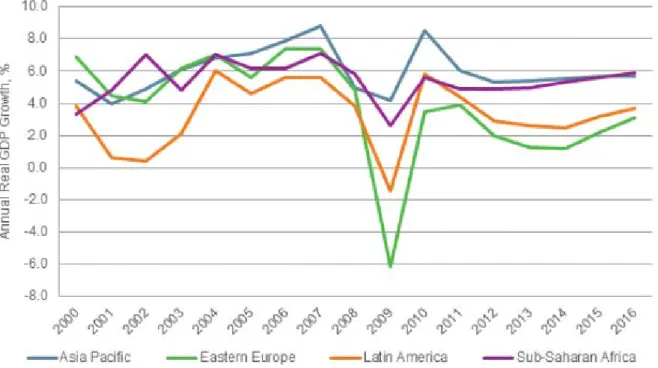
19 Narratives of ‘Africa rising’, present newer, more positive imageries of the future development in Africa. Although the concept of ‘Africa Rising’ doesn’t prioritise inclusive local development for community , it expresses the basis on which Africa's urban growth is premised,as largely advocated by the world of high finance (Mbembe, 2016). Although The GDP in many Sub-Saharan African countries, is steadily rising compared to other developing economies, the lack of growth in household incomes means that economic growth is uneven, leading to increased poverty and inequality levels. (Hodgson, 2014)
Increase in economic investment is due to the fact that for many, the growing population and consumer markets of Africa’s cities present a fertile environment for what might be considered the last frontier of capitalism (McKinsey & Company, 2012) As such, economically driven imageries have major implications, where this study explores those which have relevance to transformation which affects urban form; namely, neoliberal deregulation, as well as the privatisation of the public realm.
Neoliberal deregulation has meant that the most likely forms of urban change are dependent on the flow of global capital, where the responsibility for public provision has been replaced by private purchases and growth, in order to serve urban elites (Ismail, 2013). Accompanying such values are the imageries of urban futures that Figure 3 African Annual GDP rate. Source: www.africa-me.com/will-kenyas-ambitious-konza-city-project- prove-doubters-wrong/
Figure 3 African Annual GDP rate. Source: www.africa-me.com/will-kenyas-ambitious-konza-city-project-prove- doubters-wrong/
20 are characterised by modernist styled architecture and commercial appeal, which prioritise the visions shaped by developers and politicians with economic agendas (Robinson, 2006; Watson, 2014).
The following traits are characteristic in the images of a vast number of large scale proposed developments including Nigeria’s Victoria Island, and The Point in Durban, South Africa as illustrated in the figures (6) which show the proposed design images against those of current reality.
• The proposed development images represent large area planning with a lack detail of detail as to the everyday activity, which has been thoughtfully
considered at street level.
• The graphic representations of the proposed interventions are predominantly three dimensional, with no contextual sensitivities to detail or permeability of the ground floor plan.
• No reference to existing diversity of population groups, which make up the markets, and subcultures, which exist are depicted.
Watson sites these visions as being problematic, not only by virtue of their unrealistic relation to current diverse lived urban realities and their abstracted and inaccurate socio-economic representation of urban citizens, but also because they have become part of an embellished rhetoric of ‘urban regeneration strategies’, ‘smart cities’ and ‘eco-cities’. (2014)
The challenge of ‘urban regeneration’.
The cultural and socio-economic regeneration offered by a Western post-industrial approach to development, as a solution for the restoration of fragmented and degenerated urban form, such as that of ‘the rise of the creative class’ (Madden, 2013), is, importantly, subservient to global economic practice, presenting ‘urban change’ as that which may be accessible only those who can afford experiences in the city, perpetuating the conventional practices of capitalism, and offering little in the way of inclusive social change. (Mbembe, 2016)
Many urban regenerative developments in Africa’s megacities, such as Lagos, Nairobi, Kinshasa and Johannesburg, are led by neoliberal forms of urban
governance, that attract global investors whose extractive ‘regeneration’ projects of
21 V
Fig 4A
Fig 4B
Fig 4C
Fig 4D
Fig 4E
Fig 4F
Figure 4 (A-C). Victoria Island Lagos, existing context. Source:
www.ghettyimages.com. Figure 5 Eko Atlantic Renders, Nigeria, Victoria Island Development Proposal. Source: www.ekoatlantic.com.
22 Figure 6 Proposed development of Point Waterfront, Durban. Source:
http://www.timeslive.co.za/sundaytimes/stnews/2015/07/19/Planned-Durban-skyscraper-proves-sore-point
Figure 7 Real issues of urban exclusion and xenophobic attacks, in proximity to the proposed development precinct. Point area, Durban. Source: www.ewn.co.za
23 theeconomic natures influence the transformation of the city, yet are not held responsible for local social, political and environmental impact (Madden, 2013).
As a result, such extractive capitalism not only commodifies urban spaces and urban futures, but also thrives on the objectification of people through the increase of social inequality. This presumes the object of consumption as having a higher value than that of social need. A large number of urban inhabitants are therefore excluded in public discourse, through the lack of a common reference to the city as a domain of public life, ‘national belonging’, and as a site of facilitation of social cohesion (Mbembe, 2016).
It is therefore evident that regeneration, driven by the interests of global capitalism and neoliberal political agendas, does not produce democratic cities, but rather
‘objectified cities’, which exclude those who are unable to afford to live in a commoditized environment. (Robinson and Parnell, 2011) Where regeneration priorities change through urbanisation (built form and morphology), transformation, as defined earlier, offers the possibility of urban change on a level beyond that of built form, through the way in which life itself is lived out in the city.
Figure 8 Jeppestown evictions show the poorer urban residents in and around the area, excluded from the benefits of regeneration. Source: https//www.dailymaverick.co.za/article/2015-09-30-in-photos-jeppestown- eviction/
24
Alternative post-colonial and Critical Regionalist approaches to Urban 2.2.2
Change.
The shortcomings of the outcomes of the aforementioned approach to development and ‘regeneration’ strategies in cities in Africa (exclusionary forms of governance) affirm the imperative of more regionally considered approach to envisioning African urban futures and their transformation (Pieterse, 2012), where Western theory already identifies itself as “developed” and having ‘arrived at’ modernity, a theoretical position which, one might easily argue, is largely unsuited to respond to the greater complexities of African urban life (Robinson, 2006).
Building on from the fundamental postcolonial approach, Southern urban theories are representative of emergent urbanism, which are related to the global south as a whole, yet are multidirectional in their trajectories. (Pieterse, 2012).
Rather, African urban landscapes can be envisioned as ‘a body in motion’, through which a multiplicity of opportunities exist for modernity and development, far beyond the fixes of western modernity (Mbembe, 2016). This implies that theory emerging in response to Southern urbanism requires an innovative and progressive value base, which is both socially and ecologically informed, as well as a built environment which Figure 9 Maboneg precinct in JHB. ‘Rise of the creative class type regenerative urbanism.
Source:http//propertuity.co.za/Johannesburg
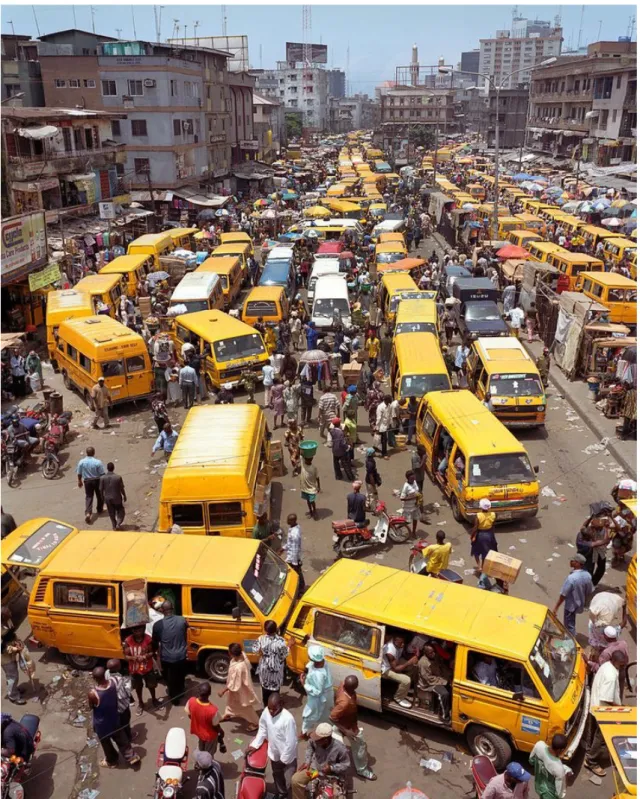
25 responds accordingly in a flexible and adaptive manner over time, as seen in transportation hubs in Lagos (Fig. 12).
Critical to the argument of the value of multiplicity in approach to development is the critique of polarisation of countries as belonging either to the first or third world (Mahrotra, 2008). Robinson suggests an alternative perspective, which sees the
Figure 10 The critical mobility of goods people and services in the city. Lagos, Nigeria.
Source: https://www.hengleinseets.com
26 potential to learn from both dichotomies, through the proposal of a cosmopolitan comparison rather that polarising formality and ‘informality’, the latter being understood to counter urbanity, rather than as an equally valid solution to urban growth.
These fields begin to engage the complexity of imagining futures in African cities based on their own logic, geographies and everyday aesthetic values, whilst taking into account the various ways through which urban needs and injustices might be counter acted (Pieterse, 2011) .Interestingly, they open up a variety of ways through which urban change happens, through acknowledging the value of multidimensional approaches through which the complexity of urbanism in Africa can be understood.
South African Cities and the Need for Urban Transformation 2.2.3
The legacy of the political history of South Africa is deeply entrenched in the physical, economic and social fabric of its cities today. The contextual realities and socio-economic challenges inherited from the planning of cities for the benefit of an elite minority have set trajectories which undermine the rhetoric of the ‘smart’ and
‘modern’ cities aspired to.
The following points illustrate key factors on the post-apartheid urban agenda, which need to be addressed if transformation in South Africa’s cities is to be realized (SOSC, 2016: 68).
• Demographic exclusion to the city, through explicit racial social and economic dispossession.
• Physical spatial barriers and underinvestment into public infrastructure.
• Social context of poverty resulting from poor education and skills and disenabling environment.
• Economic complexities of a growing urban population, whose majority is unskilled labour.
• Governance complexities in dealing with competing local and global interests, ideals and needs.
Spatial barriers and Apartheid city planning
27 South Africa’s socio-political history adds a layer of complexity to the imagining of inclusive urban future, in light of the spatially entrenched philosophy of racial exclusion of the apartheid era. South African cities currently exhibit how space and architecture were used as a mechanism of segregation, in favor of a white elitist minority. (Fig.16.) which still influences social and economic inequalities.
Consequently, there was lack of provision or proximity to public amenities and public space. The deficit in public infrastructural provision at various levels was a result of national government agendas which prioritized infrastructure for formal businesses and global investments rather than the needs of all citizens. The lack of investment in public transport as well as the lack of pedestrian connectivity in cities has resulted in continued urban exclusion and unequal access to different parts of the city.
Whilst urban change is largely shaped by the economic production of cities, the socio-economic challenges that still dominate South Africa’s urban agenda demonstrate that despite local government and formal sector economic interventions in the city, support from other stakeholders such as civil society is necessary to achieve social and spatial transformation desired.
The growth of the informal economy is demonstrating the capacity to empower the urban poor to participate in the urban life and the means to meet their basic needs through providing jobs to urban residents with limited skill (Skinner, 2009). In this regard, the informal economy is an expression of economic diversity, and a valid agent of transformation in South African cities.
The above mentioned contextual specificities premise the need for place-driven change in response to current urban development trajectories, as well as imply that local city futures could be visualized more diversely.
In addition to the cost of time and money, the economic and social inequities manifest in embedded spatial imbalances labour living far from work is that of strain on household incomes, as well as strain on local governments the investment into resources towards service delivery. (South African Cities Network, 2016: 51)
28 .
Figure 11 Durban City Apartheid Group Areas Act Spatial planning.’Natives’ living furtherest from the city center. Source: http://www.sahistory.org.za/article/apartheid-legislation-1850s-
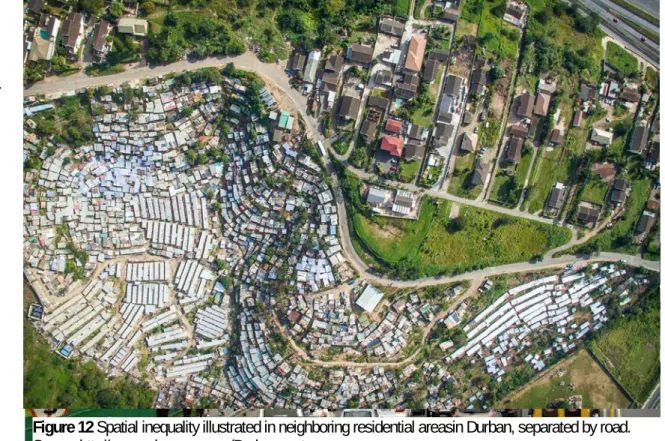
Figure 12 Spatial inequality illustrated in neighboring residential areasin Durban, separated by road.
Source:http//unequalscenes.com/Durban-metro.
29 Because current economies follow historical patterns, which are concentrated far from the poor majority, many people flock to the city in search of job opportunities in formal jobs. Due to the urban growth being predominantly made of those with no or
Figure 13 People accessing the city by foot, along motor dominated route into city. Source: Google, 2015
Figure 14 Separate entrances for blacks and whites at train station. Source:
https://artasculturaldiplomacy.wordpress.com/2011/07/08/for-europeans-only-pre-european union/
30 limited skills, South African cities have high levels of poverty, unemployment, social tension and lack access to basic services, and are therefore dependent on opportunities provided by the informal economy.
Economic complexities
South Africa emerging as a global competitor in global markets implies the heightened acceleration of urban change and development (Mbembe, 2016), which, in the case of South Africa, is paralleled by the pressures of growing urban populations, as well as social pressures. Contextual response to urban living in South Africa’s cities means a response to local sensibilities of large-scale unemployment, poverty, inequality and ‘informality’, as the neglect of such undermines investment in basic services, social development and infrastructure (Gungubelele, 2013).
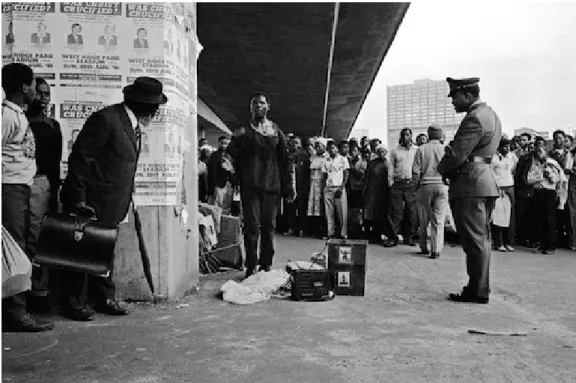
Historically institutionalized socio-economic marginalization of black people, through limiting opportunity for economic practices on public space in the city through stringent law enforcement continues to perpetuate the stigma around informal trade and cultural practices in city centers (Schensul and Heller, 2010).This left the impression that the informal practices of the urban poor were illicit, whilst only
‘formal’ economies, institutions and networks were given legitimacy and provided infrastructural investment, according to their contribution to the GDP of the country.
The infrastructural investment of local government into the regeneration of the Warwick Junction Precinct (post-apartheid) has facilitated the economic and cultural transformation of the city through enabling the participation of diverse urban stakeholders in economic production. This exhibits the opportunity that other South African cities have to affirm the validity of the contribution of the informal economy to the city’s economic growth, social and cultural fabric, through its empowering of people to generate urban livelihoods. (SOSCR, 2014)
31 Figure 15 Informal sector contribution to SA’s GDP. Source:
https://www.slideshare.net/mobile/africancc/the-informal-economy-current-realities
32
An African Logic to South African City Transformation 2.3
Translating African urban logic into architecture 2.3.1
A contextual theoretical approach to urban change is validated by its response to both power stakeholders in city developments as well as those on the ground, which suggests the imperative for direct engagements of the city with its inhabitants as key in transforming the city from a theoretically African urban logic. Such direct engagements can be realised through experiential and investigativ