i
TRENDS IN M.Ed. STUDIES ABOUT EDUCATIONAL
LEADERSHIP AND MANAGEMENT CONDUCTED AT ONE SOUTH AFRICAN HIGHER EDUCATION INSTITUTION DURING 1995-2004
BY
JENNIFER VALLEN
Submitted in partial fulfilment of the requirements for the Degree of Masters in Education
At the
University of KwaZulu-Natal
2012
ii Supervisor’s permission to submit for examination Date:
Student Name: Jennifer Vallen Student no.: 207524514
Dissertation Title: Trends in M.Ed. studies educational leadership and management conducted at one South African Higher education institution during 1995-2004.
As the candidate’s supervisor, I agree to the submission of this dissertation for examination.
Based the Turnitin report and to the best of my knowledge, the dissertation is primarily the student’s own work and she has acknowledged all of the sources she has used.
The student has also satisfied the requirements of English language competency.
Name of Supervisor:
Signature:
iii
DECLARATION
I ... declare that
(i) The research reported in this dissertation, except where otherwise indicated, is my original work.
(ii) This dissertation has not been submitted for any degree or examination at any other university.
(iii) This dissertation does not contain other persons’ data, pictures, graphs or other information, unless specifically acknowledged as being sourced from other persons.
(iv) This dissertation does not contain other persons’ writing, unless specifically acknowledged as being sourced from other researchers. Where other written sources have been quoted, then:
a) their words have been re-written but the general information attributed to them has been referenced;
b) where their exact words have been used, their writing has been placed inside quotation marks, and referenced.
(v) Where I have reproduced a publication of which I am an author, co-author or editor, I have indicated in detail which part of the publication was actually written by myself alone and have fully referenced such publications.
(vi) This dissertation does not contain text, graphics or tables copied and pasted from the Internet, unless specifically acknowledged, and the source being detailed in the dissertation and in the References sections.
Signed:
iv
DEDICATION
As a First Generation University entrant in my Family, I dedicate this work to the memories of my dearest parents, the late Mr Bobby and Mrs Kistamah Naidoo who valued Education as a “Prize” which sadly had been denied to them as a result of their historical lack of access.
v
ACKNOWLEDGEMENTS
My Divine inspiration for being my constant source of Strength and Guidance through this sometimes overwhelming and demanding Academic pursuit.
The completion of this Dissertation would have been impossible without the efficient assistance, unceasing motivation and competent support of many people. I therefore wish to express my Appreciation and Gratitude to the following who found time to assist:
Dr Jenni Karlsson, my Supervisor, for her Guidance, sublime patience, deep understanding and insightful comments.
Dr Richard Steele for going beyond the call of duty and for his amazing editorial abilities.
Morgan and Sushie Pillay of Zion Kingdom Community, my spiritual leaders, for their gentle but persuasive motivation as they believed in my true worth.
Neera Laban and Tamara Morsi, my friends who inspired and supported me through this long and arduous academic journey.
My Family at Austerville School, Principal and Staff for their support at various times and for their caring collegiality.
Hayden Vallen, my Partner, for help with technical and administrative aspects in preparation of this Dissertation.
My girls, Claire Marcelle and Keleigh Anne Vallen for the sacrifices they made as my work often kept me away from home.
Last but not least, my sisters: Sharlene, Sharyn and in memory of my late sister Rhoda as well as their respective families for their love and abiding support, whose gentle nagging reminder “when will this study be over”, was at times unwelcoming but caringly inspirational.
vi
TRENDS IN M.Ed. STUDIES ABOUT EDUCATIONAL LEADERSHIP AND MANAGEMENT CONDUCTED AT ONE
SOUTH AFRICAN HIGHER EDUCATION INSTITUTION DURING 1995-2004
ABSTRACT
The advent of democracy in South Africa in 1994 led to new areas of research interest, not least in the field of educational leadership and management (ELM). However, besides the Project on Postgraduate Education Research (PPER), not much research has been conducted to investigate the trends in research conducted by postgraduate students in South African universities. This study therefore aimed to contribute by investigating the trends in postgraduate research in ELM at a selected institution in the decade 1995-2004. Working in the interpretivist paradigm, the study employed an institutional case-study approach to conduct a study of 53 M.Ed. dissertations in the PPER database from the selected institution.
The dissertations dealt with ELM topics. Statistical analysis on this dataset and content analyses of three selected dissertations were used to identify trends in education research at the selected institution. Robin Usher’s four concepts of con-text, pre-text, sub-text and inter- text were employed as a framework within which to interpret the findings. From the analysis it is evident that the first ten years of the democratic era in South Africa witnessed a change in the demographic profile of postgraduate research. The trends are that Black students completed more dissertations followed by Indian, White and Coloured students; there are more dissertations from males than females, although by the end of the decade the number of woman writing dissertations had increased significantly; research of ELM is mostly qualitative in approach and of small-scale studies; dissertation topics cover a range of five ELM areas of interest, with few authors exploring the con-text of ELM within the broader socio-political context of the decade under consideration.
vii
CONTENTS
DECLARATION ... iii
DEDICATION ... iv
ACKNOWLEDGEMENTS ... v
ABSTRACT ... vi
CONTENTS ... vii
LIST OF TABLES ... xii
LIST OF FIGURES ... xiii
LIST OF APPENDICES ... xiv
CHAPTER ONE ... 15
Introduction and Background to the Study ... 15
1.0 Introduction ... 15
1.1 Statement of the problem ... 17
1.2 Background to the problem ... 18
1.3 Research question ... 20
1.4 Significance of the study ... 21
viii
1.5 The conceptual framework ... 21
1.5.1 Robin Usher’s ideas about educational research ... 22
1.5.1.1 Con-text ... 23
1.5.1.2 Pre-text ... 23
1.5.1.3 Sub-text ... 24
1.5.1.4 Inter-text ... 25
1.6 Conclusion ... 26
CHAPTER TWO ... 28
Literature Review ... 28
2.0 Introduction ... 28
2.1 The importance of postgraduate education research ... 28
2.2 Postgraduate education research in South Africa ... 31
2.3 Trends in postgraduate education research in South Africa (1995-2004) ... 34
2.3.1 Number of dissertations and their focus areas ... 34
2.3.2 Demographic trends ... 35
2.3.3 Research approaches and designs used ... 37
2.4 Conclusion ... 39
CHAPTER THREE ... 40
ix
Research Design and Methodology ... 40
3.1 Introduction ... 40
3.2 Research paradigm ... 40
3.3 Research design ... 42
3.4 Research approach ... 43
3.5 Purposive selection of ELM dissertations ... 44
3.6 Data analysis methods ... 48
3.7 Trustworthiness in the study ... 48
3.8 Ethical issues ... 49
3.9 Limitations of the study ... 49
3.10 Conclusion ... 50
CHAPTER FOUR ... 51
Data Presentation, Analysis and Discussion ... 51
4.0 Introduction ... 51
4.1 Statistical analysis ... 51
4.1.1 ELM dissertation productivity at the institution from 1995-2004 ... 51
4.1.2 Some demographic trends about ELM researchers at Masters level at the institution ... 54
x
4.1.3 Focus Trends ... 58
4.1.3.1 Focus on School Management Teams ... 60
4.1.3.2 Principals ... 62
4.1.3.3 Women in leadership ... 63
4.1.3.4 The notion of leadership ... 64
4.1.3.5 Policy implementation ... 65
4.1.4 Methodological trends ... 66
4.1.4.1. Research approaches ... 67
4.1.4.2 Research paradigms ... 68
4.1.4.3 Research designs ... 70
4.2. Content analysis ... 74
4.2.1 Dissertation 1 ... 75
4.2.2 Dissertation 2 ... 80
4.2.2 Dissertation 3 ... 84
4.3 Conclusion ... 88
CHAPTER FIVE ... 90
Conclusion ... 90
5.0 Introduction ... 90
xi
5.1 Summary of findings ... 91
5.1.1 Student demography ... 91
5.1.2 Research focus ... 92
5.1.3 Methodological choices ... 93
5.1.4 Theoretical choices ... 94
5.4 Conclusion ... 95
5.3 Recommendations ... 97
REFERENCES ... 98
xii
LIST OF TABLES
Table 1: C Categories of information on the PPER database with data from one sampled
dissertation ………..45
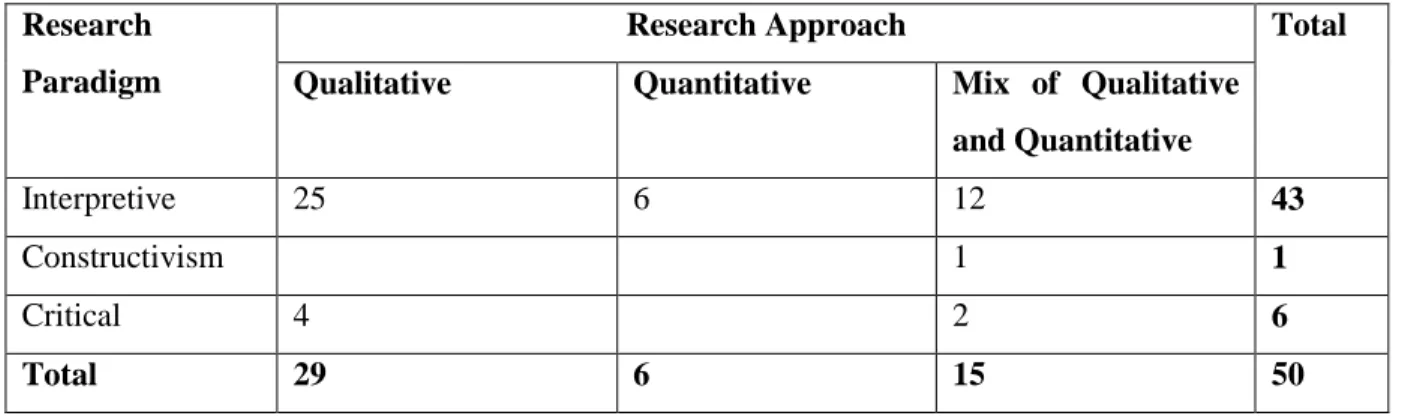
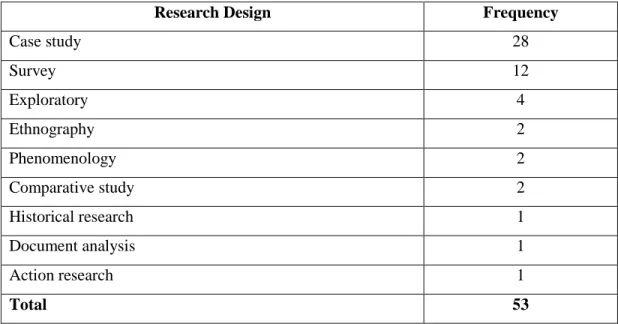
Table 2: A correlation of research paradigms and research approaches employed ... 69
Table 3: Number of EML dissertations by research design ... 70
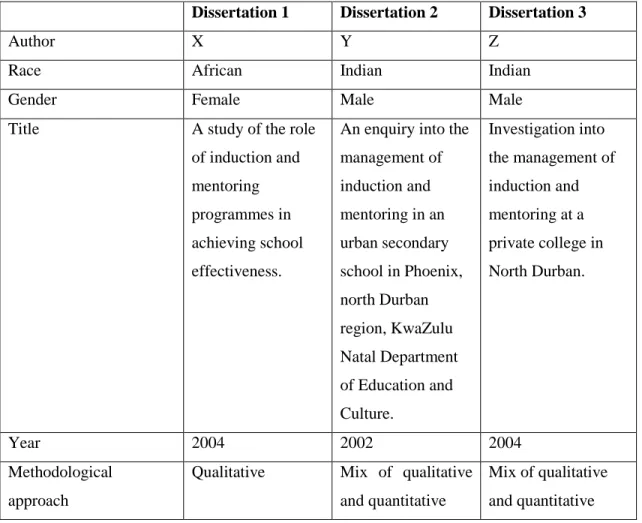
Table 4: Summary of key points for three ELM dissertations ... 74
xiii
LIST OF FIGURES
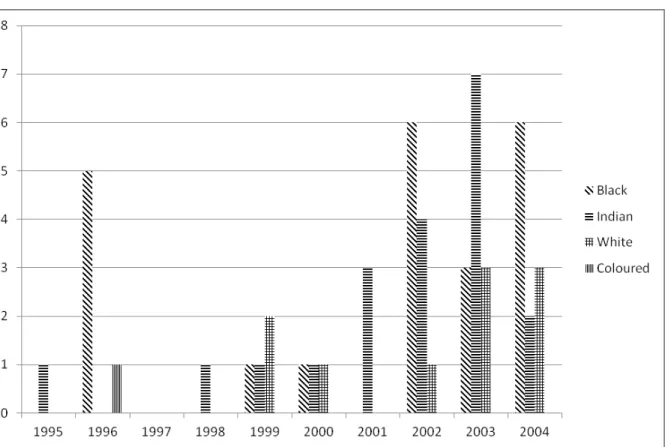
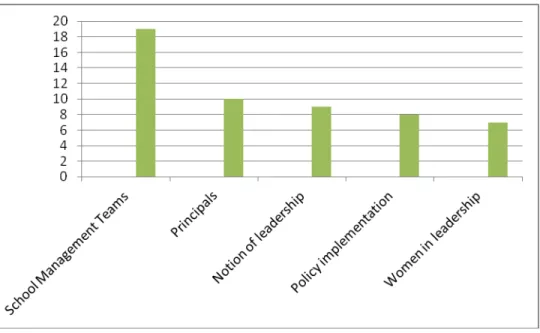
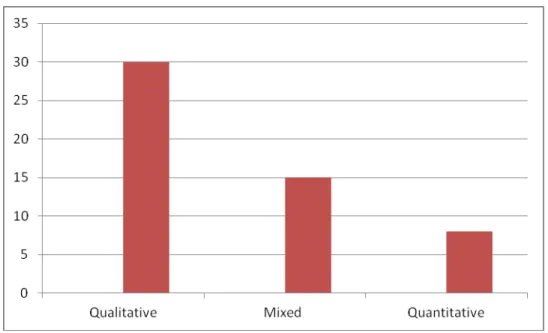
Figure 1: Postgraduate education research output from UKZN by year and gender ... 36 Figure 2: ELM research productivity at the institution per year over the decade 1995-2004 52 Figure 3: Gender trends in the 53 ELM dissertations ... 55 Figure 4: Race trends in the 53 ELM dissertations ... 56 Figure 5: Comparison of the number of dissertations within the five general focus categories ... 59 Figure 6: A comparison of dissertations by research approach ... 67
xiv
LIST OF APPENDICES
Appendix A: Dataset used for study………109 Appendix B: Letter of consent to access data………..…123 Appendix C: Ethical clearance certificate ………..……….…..124 Appendix D: Letter requesting permission to use the PPER database and archive, with signed consent ………...125
15
CHAPTER ONE
Introduction and Background to the Study
1.0 Introduction
The major aspect of postgraduate studies in any field is research. Therefore when students enrol for postgraduate studies they are faced with the challenge to come up with worthwhile and do-able research in their chosen field. Multiplicities of factors determine what the students will end up researching. When looked at from a broad point of view certain trends of research focuses can be identified. One level at which trends can be seen is at institutional level within a particular time frame. With this in mind, this study explores the trends that are evident within one institution in the first ten post-Apartheid years in South Africa. To report on my research project, I introduce this study in this chapter by stating the purpose of this study, the problem, background to the problem, the rationale, the research questions and significance of the study.
My interest in studying research conducted by Masters Students at the selected institution was prompted initially by my dilemma in identifying a researchable topic. I faced a bewildering array of options and choices available to a budding researcher. I soon realised that many of the topics that I thought warranted enquiry had already been researched. I found myself in a quandary regarding what to research. As a novice researcher I found myself asking questions about past M.Ed. research studies emanating from the institution where I was registered and in the process I came across the Project on Postgraduate Education Research (PPER) database. This database is a comprehensive repository of M.Ed
16
dissertations and D.Ed theses for the period 1995-2004.1 Consequently, I began to pose a repertoire of questions:
• Who are the researchers?
• Are there more qualitative than quantitative studies?
• Are the studies descriptive, theoretical or exploratory in nature?
• Are the concepts of equity and diversity that predominated in the educational discourse in the early stages of South Africa’s democracy reflected in the topics selected?
• Are there more studies in one topic than others, for example, on the role of school governing bodies?
• Are there ELM related studies and what is the range that they cover?
• Are studies on educational management focused on social justice issues than on implementation and technical issues?
• Are there changes in trends of such studies in the ten years following the demise of apartheid and the adoption of democracy?
These questions led me to embark on a study about trends in research conducted by educational leadership and management (ELM) Masters students at one institution between 1995-2004. I chose this date range because that is the era covered by the PPER database, and I wanted to use the PPER database as the dataset for my study.
For me the construction and dissemination of knowledge through dissertation writing is at the heart of what Masters students research is about. Hence I begin to conjure a picture of the Masters student on an academic journey across a learning environment with supervisors as their mentors. Lave and Wenger (1991) describe this sort of situated learning activity involving students and supervisors as a community of practice and they point to the importance of context for knowledge construction and dissertation writing. Polat (2011) says
1 The database is described more fully in section 1.2
17
that the context of human life concerns time and place. This is also true for Masters students writing their dissertations. They write in a particular locale and at a particular period in history. Thus context should be taken seriously when trying to understand trends in a set of dissertations as I do in this study. I aimed in this study to understand the patterns and trends in a sample of supervised research. The sample selected for this purpose is dissertations completed by ELM Masters students at one institution in the period 1995-2004. This ten year period was the first decade of democracy in South Africa. During this period there were great efforts by government to produce social transformation and change in educational policy was seen as a key driver in this process. Thus it is a significant period for understanding trends in local South African academic communities of practice.
1.1 Statement of the problem
In order to understand how postgraduate researchers were responding to their political context in South Africa during the first decade of democracy, it is important to know who the Masters students researching education leadership and management (ELM) in South Africa are, what they have researched, what methodologies and theories they have used and how have they contributed to the broad debates within ELM in South Africa. Broad debates within ELM in South Africa during that period included those related to the equitable access to education, governance (national, provincial, school), school level management, leadership, and curriculum review and revision (Department of Education, 1996b; Sayed, 2002;
Chisholm, 2005; Christie, 2010). Hence, a research study (such as mine) that tracks the trends and patterns in dissertations completed by a set of ELM Masters students will be a valuable contribution to understanding knowledge production within this discipline in South Africa. Some dissertations on postgraduate education trends have been completed (for example, see Madiya, 2009). However, I found that no study focuses on trends of postgraduate research in the ELM discipline in particular. I came to this conclusion after searching for books and journals in my local university library and on electronic databases (e.g. SABINET, JSTOR and EBSCO Host) and via search engines such as Google and
18
Google Scholar. The lack of knowledge about ELM dissertations from South Africa is a problem which I address in this study.
For the purpose of my research study about ELM dissertations I employ the PPER database which is a national survey of postgraduate research from South African higher education institutions during 1995-2004 (Balfour, Moletsane & Karlsson, 2011). The database is education specific and comprehensive, therefore suitable as a reliable data source for this study. I accessed the PPER database via researchers who had worked in the survey and extracted the M.Ed. items that were ELM specific, from one institution (see Appendix A for the dataset). Using the database, I sought to identify the trends in dissertations completed by the ELM Masters students at one institution over the period 1995-2004.
1.2 Background to the problem
The state of postgraduate studies at South African tertiary institutions has come under scrutiny since South Africa adopted democracy in 1994 (Mouton, 2007). To provide an overview of the current state of postgraduate education in South Africa in the first decade of democracy, the Project on Postgraduate Education Research (PPER) commenced in February 2007 (Molefe et al., 2011). It sought to survey postgraduate education studies completed in South Africa in the first democratic decade that spans 1995-2004. Balfour et al. (2011) explain that the PPER aimed to contribute to the broader sphere of knowledge production in relation to South Africa. This stemmed from their recognition that there was an absence of information about postgraduate educational research undertaken in South Africa, both in terms of subject-content knowledge and methodological approaches. Reports by the PPER researchers (Madiya, 2009; Bengesai, 2010; Balfour & Moletsane, 2011; Balfour et al., 2011;
Goba, Balfour & Nkambule, 2011; Karlsson & Pillay, 2011; Madiya, Bengesai & Karlsson, 2011; Molefe, et al., 2011; Moletsane & Madiya, 2011; Nkambule, Balfour, Pillay &
Moletsane, 2011; Pillay & Balfour, 2011; Rule, Davey & Balfour, 2011; Rule, 2011) provide trends of postgraduate education dissertations and theses completed in the decade between
19
1995-2004 in all South African universities, and how these trends relate to contextual factors such as changes in the higher education landscape and policy terrain.
Balfour et al. (2011) aver that significant shifts occurred in education policy during the period under review. For example there was the transformation of the curriculum and adoption of Outcomes-Based Education in 1997. These shifts should be reflected in a concomitant shift of research focuses in postgraduate dissertations and theses. At a simplistic level such new policies might render a shift in research focuses in the country.
The annual output of postgraduate education research publication in South Africa fluctuated over the 10 year period 1995-2004. Already a correspondence has been identified in the annual output of postgraduate education research publication in South Africa. For example, Deacon, Osman and Buchler (2012, p. 100) surveyed journal publications by postgraduate researchers and state that “the total quantity of research production increased annually from 1995 to 1998, briefly declined in 1999, increased again up to a peak in 2001, and thereafter levelled off, with a brief dip in 2004.” They go on to say that the fluctuations in the numbers of dissertations and theses produced can perhaps be explained as being a result of interest generated by the educational reforms of the late 1990s. Mouton (2007) explains the slow growth in Masters dissertations as being a result of the uneven quality of postgraduate supervision available.
Deacon et al. (2012) find that education research concentrates in four disciplinary or thematic areas: educational theory, education management, education policy and higher education studies. Madiya et al. (2011) add that there is also a focus on curriculum. However, other topics such as rural education and gender have not received much attention among postgraduate education researchers (Nkambule et al., 2011) and education studies about violence, gender and HIV/AIDS lag behind (Moletsane & Madiya, 2011). Despite the finding by Deacon et al. (2012) that ELM is a major focus among postgraduate education researchers, none of the PPER research reports analyse the ELM studies in the database. The PPER researchers also find that studies conducted between 1995-2004 are mainly using a
20
qualitative approach and are small in scale. Karlsson, Balfour, Moletsane and Pillay (2009) postulate that 82% of postgraduate research over that period is qualitative and employs case study methodology.
1.3 Research question
Based on my understanding of the problem of inadequate knowledge of trends in postgraduate research in the ELM field in South Africa I pose a critical research question to guide my investigation. The research question provides an intellectual focus, and influences the choice of research methodology.
The research question is as follows:
• What are the trends of M.Ed. dissertations in educational leadership and management produced at one institution from 1995-2004 in terms of:
a) Student demography;
b) Research focuses;
c) Methodological choices; and d) Underlying theory?
In order to answer this question I have selected ELM dissertations from only one higher education institution. The selected institution is geographically located in a large city and it serves the educational needs of one of South Africa’s poorest and most heavily populated provinces. At the time when the government rationalised the higher education sector, the selected institution was brought into existence in 2005 as a result of the merger of two universities which existed in close geographical proximity to each other. One of the universities had incorporated a formerly autonomous college of education in 2001. The incorporation and merger led to the formation. The incorporation and merger led to the formation of one large education faculty and within it a group of about 10 academics dedicated to the teaching of educational leadership and management at postgraduate level.
21 1.4 Significance of the study
Ocholla and Bothma (2007) contend that research and development form the backbone of any profession and any teaching programme. It is therefore vital for those in education and those involved in teacher education to understand trends in education research. My study describes trends in ELM Masters dissertations from one institution in the period 1995-2004.
This information is important for the institutional research fraternity because it may help them reflect on the research product and supervision that led to its achievement. My study may be useful to those involved in academic teaching who seek to reflect on their teaching about research and doing supervision. The study may also benefit future ELM Masters students wanting to know about which topics have already been researched, how and when.
My understanding of the trends is framed by four concepts which I explain in the next section.
1.5 The conceptual framework
In this section I discuss the conceptual framework underlying this study. Despite my earlier comment about a ‘community of practice’, I have not used Lave and Wenger’s (1991) theory because it is not directly applicable. The PPER data base does not include the names of supervisors, so a major element of the community of practice is missing. Instead, I have used a conceptual framework about educational research texts put forward by Usher (1996a).
Usher (1996a) brings together four concepts about research production that are originated by other scholars and he refers to the concepts as: Con-text, Pre-text, Sub-text and Inter-text.
These four concepts are explained in this section and I show how they are going to be applied in my study of ELM Masters dissertations produced from 1995-2004 at the selected institution.
22
1.5.1 Robin Usher’s ideas about educational research
Usher (1996a) argues that writing types are located within particular textual practices each with their own characteristics and therefore their own form and content of writing, making a unique genre. Thus, education research produces knowledge relevant to its community, and its process of writing and dissertation products relate to the field of education knowledge.
Usher (1996a) argues that educational research is located in a community thus it is a social practice in the sense that it follows activities and processes supported and endorsed by that community.
Many research texts are presented and read in a way that pay little attention to the production process of text. That subsequently results in the diminution of the author’s voice (Usher &
Scott, 1996). Sometimes what the author is saying can be better understood if the production process is taken into account. Not having access to information about each author’s process of writing his/her dissertation, readers tend to concentrate on the output of a given text without paying particular attention to the writing process itself. Usher demystifies that by developing a conceptual framework that looks not just at the text, but also its production. The framework helps in the interrogation of the text’s textuality and thinking about the writing and reading of the research text. Usher (1996a) argues that texts are not simply “an unmediating means for communicating a reality that is ‘outside’ the text” (1996a, p. 33), but research writing is “a practice which ‘constructs’ reality” (1996a, p. 33). Usher states that a text’s textuality can be understood through analysing certain features underlying the writing of a text, namely, con-text, pre-text, sub-text and inter-text.
Usher’s conceptual framework of textuality is suitable for use in my research because my aim is to understand trends in the demographic details of student authors, their topic focuses, the research designs and methodologies that they chose in the production of their dissertations and their theoretical frameworks. Ushers’ four concepts were used to structure my data analysis and guide my understanding of the trends. In the next four sub-sections, I explain Usher’s (1996a) four concepts.
23 1.5.1.1 Con-text
Usher states that “text always has a con-text, in the sense of that which is with the text”
(1996a, p. 45, italics in original). In the first place, this is the author and their biographical details. This includes the researcher’s “gender, ethnicity, sexuality, and class.” (Usher, 1996a, p. 45). In the second place, con-text also refers to the socio-cultural subjectivity of the author, the con-textual self – what Usher describes as “the embodied and embedded self”
(Usher, 1996a, p. 45). These con-textual aspects influence form, outcomes and consequences of research. Thus, the reader should not only be looking at outcomes of research, but the biographical and socio-cultural context of the author as well so as to improve critical engagement with the choices made by the author regarding topic, methodology and underlying theory, as well as the outcomes. Usher (1996a) argues that con-textual significations are important to consider for a deep understanding or appreciation of the text.
Erben (1996) concurs with Usher. They both argue that biography provides narrative about the life and self of the author and needs to be considered as an element in the interpretation of the author’s text. Usher’s con-text is relevant to this study as a tool for understanding trends in research choices made by students in terms of their race, gender and the social context of the first 10 years of South Africa’s democracy. However, sexuality and class are not categories that appear in the dissertation excerpts in the PPER database, so were not considered as cont-text in this study.
1.5.1.2 Pre-text
According to Usher (1996a), pre-text concerns that which existed before the final text was written. This pre-text includes things such as language used in the early drafts, discourses used to organize meaning, known textual strategies used, literary conventions and rhetorical devices. Understanding pre-text in terms of the language and discourses that the researcher draws on enables readers to have insight into the text and all that surrounds its production rather than simply reading the final product as the first and only draft of the dissertation.
Scott (1996) agrees with Usher’s view that acknowledging pre-existing language and
24
discourses provides understandings about how the text was constructed. Readers are usually fascinated by the completed dissertation in which they look at knowledge that has been produced without considering how it came to be produced. Because readers do not have access to early drafts of dissertations, they cannot draw reliable conclusions about the pre- text, except for what remains in the completed research writing. The reader can analyse the choices made regarding wording and methodology which reveal important aspects of the pre- text. Usher (1996a) says the reader focuses too much on the researcher’s text without asking how the final text was created.
Paying attention to pre-existing methodologies and theories (pre-text) in my study of ELM dissertations helped to elucidate the trends in those studies.
1.5.1.3 Sub-text
Usher (1996a) argues that research texts have a sub-text in the sense of that which is beneath the text such as research paradigms and their effects. Usher (1996b) views paradigms as frameworks that function as maps or guides for scientific communities; they lead to the questions researchers ask and the theories or explanations they find acceptable. Research as a social practice reflects the way in which researchers view, approach and work in the world and that is what a paradigm entails. For example, a researcher working within a feminist paradigm is concerned with the well-being of women in all aspects of his/her research work.
Looking at paradigms as the sub-text enables the reader to interrogate the researcher’s practice and position in relation to their chosen topic (Usher, 1996a). What lies beneath the text in the researcher’s paradigmatic practice and position can shed light on shifts in research focuses. In my study of ELM dissertations completed at the selected institution from 1995- 2004, I sought to uncover researchers’ sub-texts in the form of the paradigms that they preferred. For my study, this would help reveal how the postgraduate researchers understand their world.
25 1.5.1.4 Inter-text
Research texts such as dissertations are a component of the larger body of research literature.
They relate to other research texts and over time they form a body of knowledge greater than that in each individual text. This is referred to as intertextuality. It means texts have a referability and that they are productive by way of making possible new knowledge in conjunction with other related texts (Usher, 1996a). Usher argues that intertextuality points to the accumulation of textual production. It looks at the way in which history is inserted into the text for example in the way in which each dissertation may refer to other dissertations and build on and extend the knowledge of earlier dissertations. Inter-text is a useful conceptual element in my study because trends in a set of ELM dissertations from one institution for the period 1995-2004 is a form of intertextuality in that they have been exposed to a common pool of knowledge via the course work programme, and on occasion, sharing the same supervisor. However, the PPER dissertation excerpts do not contain literature review chapters or List of References, so the issue of inter-text as described by Usher (1996a) could not be fully explored.
To sum up, Usher’s (1996a) conceptual framework is generally suited for my study of ELM dissertations completed at the selected institution from 1995-2004. This is because the framework advocates for readers to look not just at the research outcome of the final dissertation, but also to consider the production process and how texts relate to one another.
Aldridge (1993) agrees and says that there is a need to reveal, understand and analyse not only the product of knowledge, but its production, and therefore its producer. My study is not about production processes of research, but about trends evident in completed Masters ELM dissertations. In using Usher’s framework I sought to look at trends in biographical details and paradigmatic positions which Usher called con-text and sub-text respectively. I also sought to look at trends in methodologies, theories and topics chosen by authors, enlightened by Usher’s concepts of pre-text and intertextuality.
26 1.6 Conclusion
The work covered in this study is presented in six chapters that are interrelated. This conclusion presents a brief summary of what each of the six chapters entails.
CHAPTER ONE has presented the introduction and background to the study. The background shows that the dataset for this study is drawn from the Project Postgraduate Education Research (PPER). This chapter also covers the focus of the study and the critical questions underpinning the research. It ends by presenting Usher’s conceptual framework which is used to notice and understand the trends in ELM M.Ed research at the selected institution.
CHAPTER TWO presents a literature review that is related to my topic of trends of M.Ed.
research in educational leadership and management at the selected institution within a period of 1995-2004. The chapter first reviews international literature to discuss postgraduate education research in general, then focuses particularly on general postgraduate education research in South Africa where trends of dissertations written from 1995-2004 are discussed in greater detail. The trends focused on biographical details of authors (gender and race), focus trends, research designs and methodologies, and underlying thories/paradigms used in the writing. The chapter ends by discussing information about educational leadership and management research in the twenty first century.
CHAPTER THREE presents the research design and methodologies used to carry out this study. It begins by describing the paradigmatic position in the study. It then discusses research design, approaches used and methods of sampling. It covers data analysis, trustworthiness, ethical issues and limitations of the study.
CHAPTER FOUR is about data presentation, analysis and discussion of my findings. It presents data analysis in two broad sections. The first section provides a statistical analysis of data about demography, focus and methodology. The second section provides a content analysis of three selected dissertations.
27
CHAPTER FIVE presents a discussion of my findings as an answer to my research question.
Findings that arise from the statistical analysis and content analysis covered in Chapter Four are summarized and discussed. As this is the closing chapter of the dissertation, I briefly explore the implications of the study and offer recommendations for further research.
28
CHAPTER TWO
Literature Review
2.0 Introduction
In this chapter I review literature relevant to postgraduate education research. Since my focus is on trends in ELM postgraduate education research, I had to first look for literature on that issue. However, I have found no single study that looks specifically at trends of postgraduate ELM research in South Africa and abroad. I came to this conclusion after searching for literature in my local university library and other university catalogues, on electronic databases such as SABINET, JSTOR and EBSCO Host and via search engines such as Google and Google Scholar.
Hence, my literature review discusses literature on postgraduate education more generally.
The scope then narrows to literature about postgraduate education research in South Africa especially with reference to the PPER project which provides broad insights about postgraduate education research completed from 1995-2004. My review describes trends of postgraduate education research in South Africa completed from 1995-2004. The focus is on the number of dissertations written from 1995-2004, demographic trends, research approaches and designs, and underlying paradigms. The chapter closes with what has been learnt from the review and gaps in knowledge that my study aims to fill.
2.1 The importance of postgraduate education research
This section consists of a review of mainly international literature about postgraduate education research. It discusses literature related to the importance and benefits of postgraduate education research in general in terms of knowledge production. International
29
literature is my main source about this because in South Africa there has been little written on the issue under focus.
The first benefit evident from the literature is the product of postgraduate research. A distinctive feature of postgraduate research in any discipline is the production of a dissertation or thesis which students must complete as part of their degree programme.
Murray and Beglar (2009) argue that writing a dissertation or thesis for postgraduate education is a long process in which writers benefit through the intellectual and emotional challenges at every step. Therefore the end product does not always reflect the nature of the study when it was first conceptualised. Postgraduate education research also plays a fundamental role in the process of knowledge production. Fraenkel and Wallen (2007) assert that postgraduate education research is important because it suggests improvements for practice in the workplace. This can happen for example when action research seeks to improve classroom practice (McMillan & Schumacher, 2010). Therefore there can be a relationship between the issue that the researcher studies and their practice.
The second feature is that postgraduate education research develops intellectuals who can think critically and make meaningful decisions (Cadman, 2000). It gives students a chance to research and use their minds to come up with new knowledge. Polat (2011) argues that postgraduate education should push students to be open-minded. Being an open-minded researcher therefore entails the production of research that does not necessarily fall under control of certain forces. Therefore the trends in postgraduate should reflect the nature of academic freedom that the students experience.
The third feature is that the research also prepares students to be competent in academia.
Sayed, Kruss and Badat (1998) put forward the notion that postgraduate work at the Masters' level is commonly conceived as inducting students into the academic enterprise, or in terms of an apprenticeship. This supports the view above that there is a link between the research process and the researcher’s work.
30
Fourth, postgraduate education researchers enable knowledge about the education discipline to develop and evolve because of new ideas they contribute. The new knowledge in turn contributes, for example, to practical education leadership and management in the schools.
Ocholla and Bothma (2007) argue that research forms the backbone of any profession because students develop deep professional understanding of research in general while also contributing new knowledge to their fields.
A fifth importance of postgraduate education research is that it can provide educators and policymakers with the skills to make evidence-based decisions about education, such as school programming and teaching practice (Lauer, 2006). Through research, teaching of leadership and management in learning institutions also can be improved because research usually provides more reliable knowledge compared to other sources such as stories and personal anecdotes. McMillan and Schumacher (2006) concur with Lauer. They argue that empirical research in education has become essential for making decisions and for forming and changing policies.
The sixth feature about the importance and value of postgraduate research concerns the approaches and methodologies that can be employed. Creswell and Plano Clark (2012) contend that the educational researcher needs a large toolbox of approaches to study the complex educational issues in society. Student researchers need comprehensive understanding of different approaches and methodologies of conducting research in education enabling them to have a variety of research approaches to draw from when engaging in research. Having different approaches available will yield variety in postgraduate education research. From the toolbox, ELM postgraduate education researchers can focus their studies in different fields and use different research designs and methodologies.
Researchers in the 21st century need to know about quantitative, qualitative and combined approaches to inquiry and to have an in-depth understanding of the multiple research designs and procedures available with which to understand contemporary issues. Such knowledge equips students to choose fresh approaches rather than repeatedly using one design such as small scale studies case studies and qualitative approaches. New approaches provide new
31
ways of understanding phenomena (Rule et al., 2011). According to McMillan and Schumacher (2006) the last few decades have witnessed a diversification of methodologies following quantitative, qualitative and mixed-method approaches. However, despite the value of different approaches, their finding is that most postgraduate education researchers use qualitative approaches. This can be explained by the fact that education research falls within the social sciences which seem to emphasise subjectivity rather than objectivity. This view is supported by Creswell and Plano Clark (2012) who contend that most researchers use qualitative approaches more than quantitative or mixed approaches. This view is shared by Cohen, Manion and Morrison (2007) who assert that the greater part of education research is qualitative in nature because of people’s preferences. They contend that some researchers prefer qualitative to quantitative approaches because they wish to interact more with participants during research in order to get depth and not breadth of meanings. Qualitative approaches allow researchers to interact with people of different cultures in their respective societies (Rule & John, 2011). Murtonen (2005) and Vermunt (2005) argue that postgraduate students lack sufficient orientation and training to be motivated to choose quantitative research.
To sum up, the literature that I consulted revealed six features of postgraduate education research discussed above. These features characterise research at the international level and also to some extent noted by African authors. However, there are issues which are specific to South Africa and these are discussed next.
2.2 Postgraduate education research in South Africa
The previous section looked at the important features in postgraduate education research in general. In this section I focus specifically on postgraduate education research in South Africa. I review scholarly literature about postgraduate education research within the first decade of post-apartheid South Africa (1995-2004). There are four findings from literature pertaining to this issue.
32
First, Ganqa (2012) reports that postgraduate education research in South Africa has received some attention as a result of the social restructuring and political transformation of the country. There is change in South African universities resulting in increased access and educational opportunities for those previously disadvantaged during the apartheid era. In turn, there is an increase in the number of postgraduate students enrolling for Masters’
research programmes.
The second finding is from Balfour et al. (2011). They argue that postgraduate education research in South Africa has specific hallmarks. First, their research illuminates the diverse points of view and perceptions among South Africans. They say that bringing that reality to light is core to research because it makes possible the generation of new knowledge as scholars engage on contentious issues. Second, Balfour et al. (2011) assert that postgraduate research provides possibilities of conceptualising a better future in South African education.
This is because the research focuses on issues troubling contemporary education in the country.
Third, Balfour et al. (2011) argue that the PPER survey of South African postgraduate education research shows that it takes time for education change and the concomitant redirection of resources to have an effect. Postgraduate education research generates new knowledge in different disciplines such as ELM which could be useful towards changing leadership and management in schools, but Balfour et al. (2011) argue that little is done with knowledge that is generated from postgraduate education students’ research. Balfour et al.
Moletsane (2011, p. 206) point out that findings from education research are underused:
It is less clear how research impacts on the worlds of practitioners, policy-makers, and government bureaucracy. In particular, the extent to which the findings and conclusions from postgraduate education students impacts on schools and communities, has not been fully understood.
It is vital for policy-makers to consider findings of research from postgraduate students in education because the findings can generate useful information for policy making. Mouton
33
(2007) argues that the work of researchers ought to be supported in South Africa because new knowledge that is generated by theses and dissertations is vital to policy makers and for development in education. It is through research that problems in education can be identified and possible solutions worked out. Regardless of the importance of postgraduate research in South Africa, many problems hamper students’ successful completion of their theses and dissertations. The problem could be the shortage of supervisors with expertise in the field.
Ganqa (2012) reports that there is a need to improve the capacity and quality of postgraduate supervision in South African universities. A comparative analysis of postgraduate education research of three universities completed from 1995-2004 by Madiya et al. (2011) reports that availability of supervisory capacity is crucial for increased and successful postgraduate education research. In relation to this, Herman (2011) argues that the shortage of skilled personnel in social sciences and research is likely to be a barrier to the country’s aspiration to increase its production of postgraduate students. This shows how much postgraduate research depends on factors such as the quality of supervision.
My fourth finding is in relation to Mouton’s (2007) view that in the field of postgraduate studies, the management and supervision of Masters students at South African universities is inefficient. He substantiates this by arguing that students take too long (on average) to complete their studies. This idea is supported by Ganqa (2012) who asserts that many postgraduate education research dissertations are not completed on time because the majority of students are part timers who require extensive supervision, more time to complete and more research methods teaching. One reason for a coursework approach is to teach students more about research so that they are able to produce a dissertation. Rowley and Slack (1998) argue that modules such as research methods in education can be a means of ensuring that all students have a common grounding to support their research, particularly where students enter a Master's programme with a variety of previous experiences, and where the Master's programme is research based. However, Masters students in South Africa may not get enough research knowledge from course work. A study conducted by Sayed et al. (1998, p.
284) about postgraduate students’ experiences reveals that:
34
A single module on research methodology, which tends more towards research methods and techniques, and some additional work around the research proposal, is inadequate in preparing students for the mini-thesis component of the programme and to become independent researchers.
Thus, there is a need for more research-related teaching for South African postgraduate students so that they are competent to complete their dissertations.
2.3 Trends in postgraduate education research in South Africa (1995-2004)
I found a body of literature about the survey of postgraduate education research in South Africa produced in 1995-2004 and I review that in the next section.
2.3.1 Number of dissertations and their focus areas
Research conducted by Karlsson et al. (2009) shows a discernible difference in the volume of knowledge generation (number of dissertations and theses produced) between the first five years (1995-1999) and the second five years (2000-2004) of the first decade of democracy in South Africa. Balfour and Moletsane (2011, p. 206) found there are 3774 postgraduate dissertations and theses written from 1995-2004, with 708 from 1995-1999 and 2066 from 2000-2004. Bengesai (2010) attributes the smaller volume of postgraduate education research in South Africa in the first five years after the onset of democracy compared to the second five years to the upheaval in academic development due to under-funding during the 1990s that negatively impacted supervisory capacity.
Deacon et al. (2012) conducted analysis of the focus areas of postgraduate education research published in journals. They found that:
... much education research has been classroom-based, small in scale, focused on the formal schooling sector, concentrated in the eight disciplinary/thematic areas of educational theory, education management, education policy, higher education studies, teacher education, language studies, educational psychology and academic
35
development, and with its annual output having increased over time to reach a certain plateau. (2012, p. 109)
Moletsane and Madiya (2011) argue that most postgraduate education research focuses are informed by the education transformation that happened after apartheid. Karlsson et al.
(2009) found that most postgraduate studies conducted between 1995-2004 focus on issues such as curriculum and education management at the expense of topics like rurality and rural education, gender, and career planning (Karlsson et al., 2009). In the South African context, A comparative analysis of postgraduate education research topics (1995-2004) found that there is a significant amount of research on education management (Madiya et al., 2011).
Nevertheless, an analysis of ELM dissertations specifically did not ensue.
2.3.2 Demographic trends
In this section I review literature on demographic trends of postgraduate education research productivity from 1995-2004. Balfour and Lenta (2009) argue that demographic factors are relevant to research productivity at higher education institutions because of how South Africa’s past advantaged and disadvantaged certain racial groups. Karlsson and Pillay (2011) argue that an analysis that tracks trends about the race and gender of South African postgraduate researchers is important for understanding the progress made to transform South Africa’s higher education and increase access to higher degrees.
Postgraduate education researchers in 1995-2004 comprised a racially heterogeneous group.
For example, Masters dissertations from the University of KwaZulu-Natal written during the first decade of democracy in South Africa were by African (37%) and Indian (37%), White (26%) authors with none written by Coloured (0%) (Karlsson & Pillay, 2011, p. 242). During the apartheid era higher education institutions were established for particular racial group use but after democratic elections in 1994 access was opened to all (Jansen, 2002). Increased access to higher education resulted in more postgraduate education research by Black, Coloured and Indian students across South Africa. Although previously privileged White people constitute a minority in the South African population, they continue to feature
36
significantly in certain areas in postgraduate education research. For example, a 2002 survey in education showed that most White students were engaged in studying natural sciences and commercial subjects at university, while most Black students were registered to study education, social sciences and humanities (Van der Berg & Siebrits, 2010). Such a trend was not uniform across disciplines (Bengesai, 2010). This raises questions about ELM Masters students. I sought to look for such racial trends in dissertations produced at the selected institution for my study.
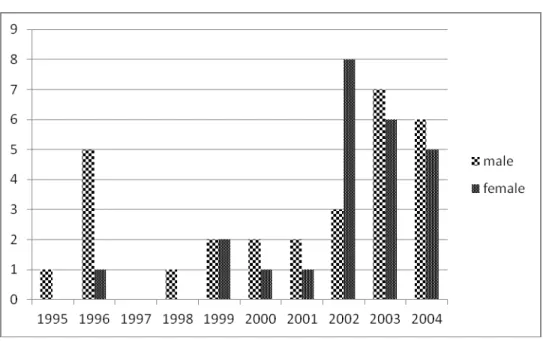
Tracking the gender of postgraduate education researchers is important because it provides insight into how male and female students took up opportunities in changing the higher education landscape. Karlsson and Pillay (2011) report that more postgraduate education (Masters and Ph.D.s) research from the University of KwaZulu-Natal in 1995-2004 was completed by females than males. Figure 1 presents statistics about postgraduate education research output from the University of KwaZulu-Natal by gender and year.
Figure 1: Postgraduate education research output from UKZN by year and gender
(Source: Karlsson & Pillay, 2011, p. 241)
37
Figure 1 shows that in all years except 1998 and 2004 there are more female than male student authors. Balfour et al. (2011) concur that over the decade 1995-2004, most research was produced by female researchers. It is significant that despite being disadvantaged under apartheid (Wing and de Carvalho, 1995), black women were able to be the majority postgraduate education researchers in the decade immediately after apartheid. Nevertheless, the statistics do not yield reasons for this phenomenon. Despite this I sought to explore if a similar gender trend was present among the ELM student authors from the selected institution over the same ten year period.
2.3.3 Research approaches and designs used
In this section I review literature about research approaches and research designs that postgraduate researchers use. I discuss trends from international research and then I narrow the scope to South Africa.
South African scholars have similar findings to international researchers in regard to the use of research approaches in dissertations (see Chapter 2.1). Karlsson et al. (2009) reveal that most postgraduate education research conducted between a period of 1995-2004 is small scale and qualitative in nature. They found that 82% of postgraduate research is qualitative.
Madiya (2009) and Bengesai (2010) also confirm that from 1995-2004 most postgraduate education research was qualitative. They agree with Deacon et al. (2012) who point out that the most important gap in postgraduate education research in South Africa from 1995 to 2006 is the lack of large scale and quantitative research. This suggests that postgraduate researchers are not sufficiently skilled in quantitative approaches.
Rule et al. (2011) are of the view that the reason the qualitative approach is preferred in postgraduate research in education is that that there is a shortage of supervisors with science and statistical expertise to help postgraduate students with quantitative approaches. De Beer and Mason (2009) and Monk, Foote and Solem (2012) have similar views to Rule et al.
(2011), concluding from their studies that while South Africa is experiencing a growth in postgraduate research programmes, there is an insufficient number of suitably trained
38
supervisors. Mouton (2007) takes this point one step further by contending that one of the main reasons South African universities are not producing enough postgraduates is because of inefficient supervision and not merely insufficient supervision. The proportion of academics that hold a Ph.D. declined steadily in South African universities over the period from 2004-2008 (North, Zewotir & Murray, 2011). This decline affects the production of postgraduate education research because a Masters student must be supervised by someone with a doctoral degree. Rule et al. (2011) report that the small-scale qualitative case study is a common choice because of the limited capacity among postgraduate education supervisors in quantitative methods.
Another perspective on the lack of quantitative research is provided by Madiya (2009). who argues that there are less quantitative research because of students’ resource constraints.
Barnett (2006) supports this argument, stating most research employs qualitative approaches because the constraints placed on student research budgets do not encourage large projects.
The most commonly used design in postgraduate education research in South Africa is the case study. The PPER researchers found that case study is the most popular methodology among South African Masters dissertations completed from 1995-2004 (Rule et al., 2011).
According to Punch (2009, p. 119) “the case study aims to understand the case in depth, and in its natural setting, recognizing its complexity and its context. It also has a holistic focus, aiming to preserve and understand the wholeness and unity of the case.” Rule et al. (2011) give three reasons why South African students prefer a case study methodology: accessibility to the site and participants; the manageability of a small scale study; and, its direct relevance to the student’s practice. The topics and focuses of most postgraduate education research from 1995-2004 were compatible with the strengths of case studies, as noted by Punch (2009), which enable researchers to have an understanding of the case through in-depth analysis. On the basis of this information, I sought to find out if a similar trend is evident in the designs employed in the ELM dissertations from the selected institution for this study.
39 2.4 Conclusion
In this chapter I discussed literature related to postgraduate research starting with international literature and then narrowing down to the trends of postgraduate education research from 1995-2004. I learnt that the education transformation that happened in post- apartheid South Africa led to researchers taking up new topics that corresponded with the transformation that the country was experiencing. More dissertations were written from 2000-2004 than from 1995-1999. Most postgraduate education research from that decade used a qualitative approach and case study design. This tallies with international literature which also finds evidence of more qualitative education research than quantitative (Lauer, 2006). I found that the reasons for these trends were multiple and included the influence of the context, inefficient and insufficient supervision, resource-constraints and students interests.
However, none of the reports on postgraduate education research in South Africa from 1995- 2004 looked at the trends in ELM dissertations. The lack of confirmation of knowledge about this research area gave me the incentive to pursue my study. In the next chapter I explain my research design and methodology for this study.
40
CHAPTER THREE
Research Design and Methodology
3.1 Introduction
In the previous chapter I reviewed literature that relates to my study. In this chapter I move on to explain my paradigmatic position, my research design and the methodology that I used to carry out this study. I describe my case study of Masters dissertations in the field of ELM from the selected institution during 1995-2004. I give an account of my analysis strategies, which were both qualitative and quantitative in nature, my ethical stance and how I addressed the issue of the trustworthiness of my findings.
3.2 Research paradigm
Every research project is guided by the researcher’s paradigmatic position, identified by Usher (1996a) as pre-text. Different scholars define paradigm in different ways. Mertens (2012) avers that a paradigm is the framework of philosophical assumptions that guide the researcher. Neuman (2007, p. 81) defines paradigm as a “general organizing framework for theory and research that includes basic assumptions, key issues, models of quality research, and methods for seeking answers.” Thus, based on these definitions, I understand that paradigms shape the way we see and understand the world. My research paradigm is interpretivist. According to Neuman (2011, p. 107), “The interpretivist paradigm is the foundation of social research techniques that are sensitive to context, that are more concerned with achieving an emphatic understanding of the phenomenon”. The interpretivist paradigm was suitable for this study because I want in-depth description of the dissertations I have in my dataset. The interpretive paradigm allows me to describe and interpret the trends in postgraduate ELM research while being sensitive to the context of the particular institution
41
which I selected. Two other paradigms I considered as frameworks for this study were the positivist and critical theory paradigms. The positivist paradigm assumes that there is an objective reality separate from the observer, which can be accurately measured and described, the methodology is primarily experimental (Guba & Lincoln, 1994). This paradigm is not suitable for this project because there is no experiment involved, and Usher’s content analysis is based on not taking text literally at face value as if it is an objective reality. Usher writes: “... research is not simply a matter of representing, reflecting or reporting the world but of ‘creating’ it through a representation” (1996a, p. 35).The critical theory paradigm is similar to the interpretivist paradigm in that it does not hold with the subjective-objective divide, but it is based on dialogue between the researcher and individuals or groups out of which emerges new information and theories. In addition, critical theory based research is usually orientated toward a particular outcome which involves social or political change (Guba & Lincoln, 1994). However, this study does not involve communication with any individuals or groups, only the written text, and is not aimed at social or political change.
McMillan and Schumacher (2010) state that intepretivism allows researchers to use their professional judgements and perspectives to interpret data. Schultz and Hatch (1996) argue that interpretivists seek to understand and describe meaningful social actions and to understand meanings of the subject under study. This is achieved in my study by engaging in analysis and discussion of trends of 53 ELM M.Ed. dissertations from one institution over the period 1995-2004 with a close reading of three dissertations in order to understand their meaning in terms of my research question. Interpretive researchers use systematic procedures but maintain that there are multiple socially constructed realities, unlike post-positivism, which postulates a single reality (McMillan & Schumacher, 2010). The acknowledgement of multiple realities tallies with my employment of the case study design as it assumes that research findings are contextual. In addition, Usher’s approach to textual analysis acknowledges and seeks to reveal the multiple realities of the authors themselves, based on textual analysis according to con-text, pre-text, sub-text and inter-text (1996a, p. 45-48).
42 3.3 Research design
Research designs are procedures for generating, analysing, interpreting and reporting data in research studies (Creswell & Plano Clark, 2012). They explicitly describe the procedures that will be followed to gain answers to the research questions. According to Yin (2003b, p. 19),
“every empirical study has a research design and a research design is the logic that links the data to be collected (and the conclusions to be drawn) to the initial questions of the study”.
For this study I used a case study design as it was suitable to answer my research question about ELM Masters research at one higher education institution. My choice of methodology informed the data collection methods I used and the conclusions I drew at the end. McMillan and Schumacher (2010) define case study as qualitative research method that examines a bounded system, or a case, over time in depth, employing multiple sources of data found in the setting. For my study the bounded case was ELM Masters research from one selected institution from 1995-2004. Case study research is useful for understanding topics, processes or situations in their context and they are ideal for a small scale project. In the case of my study the context is higher education in South Africa during the 1995-2004 period.
Other qualitative research designs such as phenomenology and ethnography were considered but were rejected for this study because they focus on lived experiences and study of culture respectively (McMillan & Schumacher, 2010). Case study was the most appropriate because I defined the ELM Masters dissertations as the case and the selected institution and period from 1995-2004 as its boundaries.
Yin (2003a) states that case studies can either be explanatory or exploratory. For this study I employed the explanatory case study because it allows me to develop descriptions and explanations of trends about the dissertations from the selected institution. Rule and John (2011) assert that an explanatory case study has the advantage of explaining what happens in a particular case or why it happens. A single and explanatory case study was ideal for this study mainly because it allowed me to develop an in-depth analysis of the trends of dissertations from one institution. Punch (2009) argues that the case study aims to understand
43
the case in depth, and in its natural setting, recognizing its complexity and its context. I conducted an in-depth study by focusing on only a few dissertations from one institution. A case study has a holistic focus, aiming to preserve and understand the wholeness and unity of the case. I kept the holistic focus by not analysing dissertations from other institutions or about other education specialisations. Thus, through the use of a case study design, I focused on ELM dissertations from one institution in order to have a clear understanding of the trends in matters such as topic focus and methodological trends as the product of ELM community at that institution in the selected historical period. Creswell, Hanson, Plano Clark and Morales (2007) postulate that many case studies focus on one issue within the selected case to provide insight into the case. My issue was the trends in postgraduate ELM Masters research and my case was the ELM research from the selected institution.
3.4 Research approach
All data required for research falls into two types namely, primary and secondary data (Kothari, 2004). Primary data is generated specifically for a particular research project by the researcher of that project. On the other hand, secondary data comprises data generated for an earlier purpose by another author. The data that I used in this study is secondary data because it was first generated by the PPER team and stored in a database.
For this study I used a mix of qualitative and qualitative approaches. Creswell and Plano Clark (2012) argue that a mixed approach is characterised by knowledgeable data collection and analysis underpinned by an understanding of one’s supporting philosophical assumptions. Both qualitative and quantitative approaches are employed in this study because of the need to describe a few ELM dissertations qualitatively and analyse a larger set statistically i.e. quantitatively. Martella, Nelson and Martella (1999) argue that qualitative and quantitative research approaches are not opposed to one another. The different research approaches can complement each other or each can be used to answer separate aspects of the research question that can only be answered by the appropriate approach. Using only one research approach was not going to make this study successful because there was a need to
44
describe a few ELM dissertations in-depth as well as analyse trends in several dissertations.
A qualitative approach enables extensive descriptions and explanations about data. Mack, Woodsong, Macqueen, Guest and Namey (2005) opine that the qualitative approach is able to provide complex textual descriptions of that data. Cohen et al. (2007) argue that content analysis of documents is mainly a qualitative method. This made the qualitative aspect of my approach suitable for one aspect of my analysis. I used the quantitative approach to determine the frequencies of themes from the data. This helped to extrapolate trends in the set of ELM dissertations regarding focus, authors’ biographical details and the methodologies used by the researchers. The mixed approach had an effect on the way I selected the dissertations for analysis.
3.5 Purposive selection of ELM dissertations
The dissertations that I analysed were the units of analysis in my study. According to Kothari (2004), there are many procedures through which units can be selected for study but the units’ applicability depends on the type and demands of the research and availability of resources. The selection technique for the qualitative component was purposive. In almost all qualitative research, selection is purposive. This means that researchers use their judgment to select a set of units that they believe, based on prior information, will provide the data they need (Fraenkel & Wallen, 2007). I first conducted a search of the PPER database for all Masters dissertations from the selected institution for the period 1995-2004, 343 in total. I then used a purposive process to identify ELM Masters dissertations amongst this dataset.
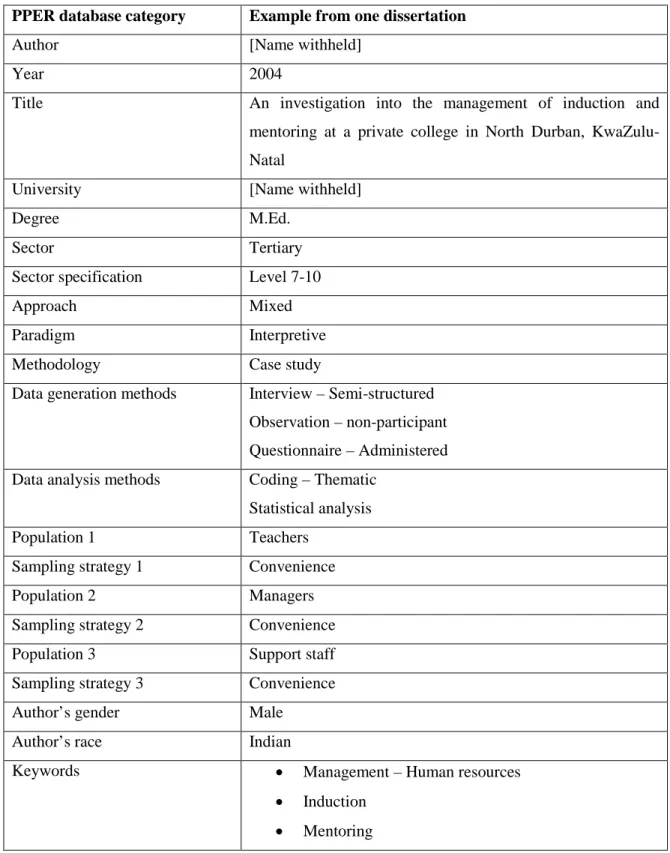
For this process, I searched the title category of each of the 343 entries on the database. On the basis of my knowledge of the ELM field, I determined there were 53 dissertations in the ELM field. The 53 dissertations became my selected dataset for statistical analysis of trends, and are listed in Appendix A. Table 1 shows all the categories in the PPER database that were utilised in this study.