University of Cape Town
The potential for increased · use of LPG for cooking in South Africa: A rural case study
ENERGY AND DEVELOPMENT RESEARCH CENTRE
June 2003
ENERGY & DEVELOPMENT RESEARCH CENTRE University of Cape Town
University of Cape Town
Table of contents
Acknowledgements
Abbreviations and acronyms used
1. Introduction
1.1 Main aims of theca e study 1.2 Rationale
1.3 Selecting the locale for the case study 2. The supply of LPG in South Africa
2.1 Volumes
lll
lV
1
2
2 2
2.2 LPG production in South Africa 4
2.3 LPG pricing ex-refinery 5
2.4 Disttibution of LPG 6
2.4.1 Company shares 6
2.4.2 Cylinder sizes and ownership 7
2.4.3 The LPG distribution chain (for residential LPG cylinders) 7 2.4.4 Options for more direct distribution of LPG to rural areas 9
2.5 End-user LPG prices 12
2.5.1 Sample end-user prices 12
2.5.2 Comments on sample prices l3
2.6 Availability and costs of common domestic LPG appliances 14
2.6.1 Types of cooking appliances 14
2.6.2 Examples of prices 15
2.6.3 Some international comparisons 16
2.7 Discussion of supply-side barriers limiting the wider use of LPG for cooking 16 3. Factors affecting demand for LPG as a cooking fuel
3.1 Comparative monetary costs of using LPG for cooking
3.1.1 Typical cooking fuel combinations in the case study area 3.1.2 Prices of other cooking fuels in the case study area
3.1.3 Comparative energy costs for cooking in the case study area 3.1.4 Comparative costs of appliances
3.2 Non-monetised costs and benefits of different cooking-energy options 3.2.1 Convenience and performance
3.2.2 Flexibility 3.2.3 Health and safety 3.2.4 Environmental impacts
3.3 Perceived barriers affecting residential LPG demand 3.3.1 Price
3.3.2 Access 3.3.3 Safety
3.4 Price-sensitivity of LPG demand 3.4.1 Demand curve model 3.4.2 A rural demand curve 3.4.3 An urban demand curve
21 21 21 25 26 27 28 28 30 31 31 31 32 33 33 34 34 34 35
3.4.4 Discussion
3.4.5 Sensitivity of residential LPG demand to electricity prices
4. Energy sector linkages
4.1 Displacement of paraffin and biomass 4.2 Links with electrification
5. Possible measures to reduce the barriers restricting LPG use for cooking 5.1 Proposed measures for improved access, through energy centres
5.1. 1 Achievable price reductions and improved access 5.1.2 Awareness campaigns
5.1.3 Operational and management training for energy centre staff 5.2 Cost estimates for establishing energy centres and their LPG operations 5.3 A fuel-switch scenario
6. Environmental assessment 6.1 GHG emissions assessment
6.1.1 Impact of GHG emissions 6.1.2 Possibility of carbon financing 6.2 Indoor air pollution impact
Appendix A: Heuristic model for household LPG demand curves Appendix B: External costs of household fuels
References
36 37
38 38 38
40 40 40 42 42 42 44
45
45 45 48 48
50
53
55
Acknowledgements
Several members of the Energy and Development Research Centre (EDRC) and Energy Research Institute (ERI) at the University of Cape Town contributed in the preparation of this report. From EDRC, Bill Cowan wrote Sections 1-5. Randall Spalding-Fecher wrote Section 6. Harald Winkler was chiefly responsible for initiating this study, and commented on drafts. Jean-Marc Lukamba and Ogunlade Davidson prepared initial materials. Gamieda Gierdien collected price data for LPG sales and appliance costs in different areas of the country. Pierre Mukheibir was project manager and Tim James assisted with editing and DTP. From ERI, Philip Lloyd provided access to previous and current data, and his analyses, and contributed additions to the text.
Andrew Marquard (parliamentary researcher, and EDRC PhD student) provided valuable comments and information, particularly in relation to government policy developments.
Member of the LPGas Safety Association of Southern Africa generously provided information and insights, and commented on the draft report.
The work for this report was contracted by the Lawrence Berkeley National Laboratory (USA), as part of a project titled Supporting Economic Development through Sustainable Energy Supply and Use.
iii
BEST DME
GHG IBLC IDP IP LPG LPGSASA NMHC PASASA PV
SANEA SAPIA SEED SHS VAT WHO WLPGA
Abbreviations and acronyms used
basic electricity support tariff
Department of Minerals and Energy (South Africa) greenhouse gas
in bond landed cost (an import parity formula) integrated development plan
illuminating paraffin
Liquefied petroleum gas
LP Gas Safety Association of Southern Africa non-methane hydrocarbons
Paraffin Safety Association of South Africa photovoltaic/s
South African National Energy Association South African Petroleum Industry Association Sustainable Energy, Environment and Development solar home system
value-added tax
World Health Organisation World LP Gas Association
iv
The potential for increased use of LPG for cooking in South Africa
1. Introduction
1.1 Main aims of the case study
The purpose of this case study is to help explore the potential for increased use of LPG (liquefied petroleum gas) for cooking in South Africa. It examines the supply, distribution and pricing of LPG and LPG appliances in South Africa, with a particular attention to how these affect access to LPG in remoter rural communities. Supply-side constraints are identified, which presently make it more difficult for low-income households to make use of this versatile clean-burning fuel. Strategies for reducing these present supply-side constraints are suggested, taking account of local conditions and experience.
From the energy-users' perspective (again focusing on lower-income and mainly rural households, in this case study) the costs and benefits of using LPG are examined, relative to other energy options for cooking. Important factors included in this comparison are the comparative money costs, labour costs, health and safety risks, and the convenience associated with using various cooking fuels, such as biomass, paraffin, LPG or electricity. Factors affecting the "acceptability" and hence market demand for LPG, including perceptions that LPG is dangerous, will be discussed - with proposals for helping community groups and individual householders to make well-informed judgements.
Two assumptions in this case study, based on other studies over many years, are that
• people who are struggling to meet their basic needs (including energy for cooking) adopt versatile coping strategies, which are price-sensitive and which change according to the prices of the options they have;
• people who are short of resources to meet their immediate living needs (like energy for cooking, paying school fees, etc) are less able to take a "long view" in their expenditure choices, and tend to choose a survival strategy which allows them to meet immediate pressing needs, even if that is going to be more costly and inefficient for them in the long run.
The ways in which such factors can affect the use of LPG will be considered, together with possible ways to improve affordable access to LPG in these circumstances.
1.2 Rationale
The most widely used cooking fuels among low-income rural households in South Africa are biomass (wood, agricultural residues, dung) and illuminating paraffin (IP). Even in electrified areas, most cooking is done using such non-electric fuels. The hazards of using paraffin are significant, with more than 100 000 cases of paraffin poisoning and some 50 000 paraffin-related fires reported annually (Biggs & Greyling 2001). By comparison with paraffin, LPG is cleaner-burning, safer, easier to control and more efficient. The problems associated with the burning of biomass include high levels of exposure to particulates and other harmful emissions, which correlate with increased risk of illnesses such as acute respiratory infections; the labour, time and sometimes physical dangers of biomass collection; and in some areas, local environmental damage from deforestation.
The use of both biomass and paraffin reflects "energy poverty" in poor rural areas of South Africa. If LPG were more widely accessible, and more affordable, this could reduce energy poverty by allowing more households to use this higher-quality cooking fuel.
The most significant environmental benefits of an increased use of LPG among rural households would be a reduction in the localised air pollution associated with moky fires or stoves. In the early 1990s the World Bank estimated that indoor air pollution was responsible for nearly 50% of the disease resulting from poor household environments in developing countries. The 1992 World Development Report described it as one of the four most critical environmental problems, globally (quoted in WHO 1996). The 2002 World Health Report of the WHO describes indoor air pollution as having a risk factor of as high as 86% in developing Africa and the percentage disability-adjusted life years [DALYs] as totalling 56% for men and 87% for women (WHO 2002: Annex 7-8).
Depending on what fuel/s it replaces, an increased use of LPG could also help to reduce greenhouse gase (GHG) emissions. For example, the C02-equivalent emissions of the LPG fuel-cycle are less than a third of those for electricity generated from coal (World Bank/WLPGA, 2002: 26). This case study will include an evaluation of such potential effects, based on a particular rural community situation in the Eastern Cape province.
ENERGY AND DEVELOPMENT RESEARCH CENTRE
The potential for increased use of LPG for cooking in South Africa 2
1.3 Selecting the locale for the case study
Situations in which LPG is used (or could be used) for cooking in South Africa are widespread but quite varied. There are different circumstances in urban and rural areas, and also variations among different rural areas and urban areas in the country. LPG prices and accessibility are quite variable in these different circumstances.
We have selected a rural area for the case study, because
• the barriers against using LPG in rural areas are higher (higher distribution costs, lower income-levels, etc);
• the incentives for switching to LPG use for cooking are higher in rural areas (less widespread access to electricity, greater advantages in using LPG versus other common cooking fuels like paraffin and biomass);
there is therefore greater scope to achieve advantages of increased LPG use in rural areas, if the higher barriers can be reduced.
A representative rural area, chosen for this case study, is in the north-eastern section of one of South Africa's poorest provinces, Eastern Cape. Set within the Alfred Nzo district municipality, there are a number of rural villages between the small towns of Matatiele and Mt Fletcher. One group of villages (Magadla) will be a focus for attention, because of previous work done there, in collaboration with village-based community groups, helping people to identify their energy needs and possible solutions.
One of the solution paths adopted by residents was to form a local energy committee, and subsequently an energy and development co-operative which operates a small community-managed
"energy centre". Among other functions, this energy centre acts as a more direct and accessible local distribution outlet for fuels like paraffin and LPG. This provides a practical opportunity to investigate the potential for increased use of LPG in this area, through improvements in distribution and other possible supportive measures.
2. The supply of LPG in South Africa
This section provides an overview of LPG supply in South Africa. It includes some comparisons with LPG supply in other countries.
2. 1 Vol umes
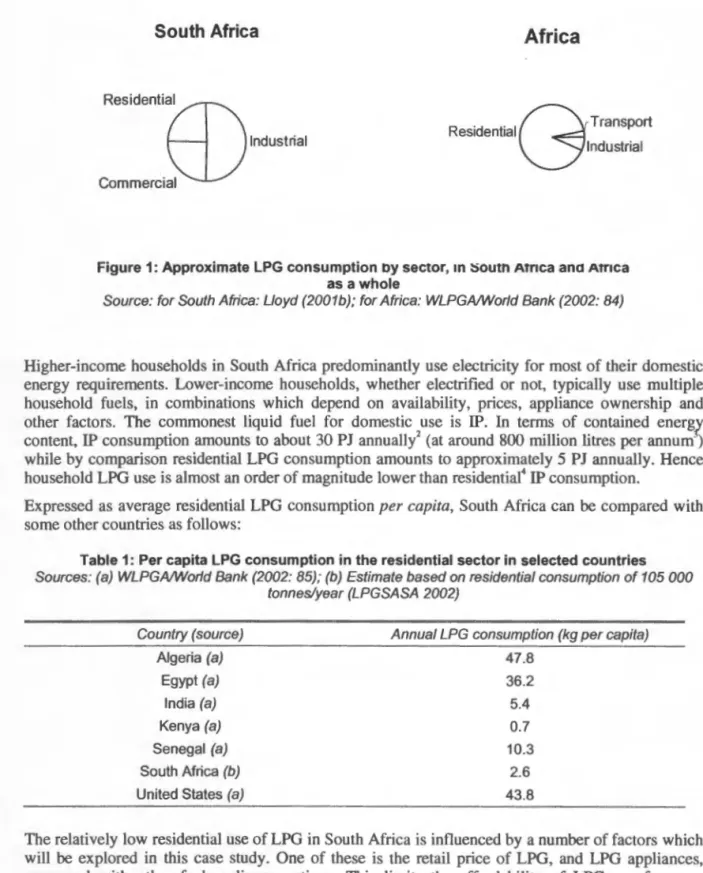
Reported inland consumption of LPG in South Africa is in the order of 600 Ml or 325 000 tonnes per annum.1 LPG production volumes are larger than this, as it is used as a fuel at refineries, and about 10% of product is exported to neighbouring countries (LPGSASA 2002). The largest proportions of South African LPG are consumed in the industrial and commercial sectors. Based on 2000 figures, Lloyd (200la) estimated that the industrial and commercial sectors accounted for approximately 75% of the total, while the residential sector only accounts for about 25% of sales volumes. The residential share of LPG use in South Africa is a much lower percentage than in other African countries, and other developing regions. For example, the average residential share of LPG consumption in African countries is about 90%, and in Latin America about 74% (World Bank!WLPGA 2002: 84), compared with South Africa's 24% (Lloyd 2001b). The lower residential sector proportion in South Africa reflects both a higher consumption in commerce and industry as well as the fact that LPG is not very widely used here as a household fuel.
Inland LPG consumption volume for 200 I, as rep01ted by the South African Petroleum Industry Association, www.mbendi.co.za/sapia/rsacons.htm. LPG density of 0.541 kg/1 taken from DME, 200 I: I 05.
ENERGY AND DEVELOPMENT RESEARCH CENTRE
The potential for increased use of LPG for cooking in South Africa
South Africa
ResidentiLJ\
~Industrial Commercial
Africa
R .d est entta . 1GTransport Industrial
Figure 1: Approximate LPG consumption oy sector, m :soutn Atrlca ana Atnca as a whole
Source: for South Africa: Lloyd (2001b); for Africa: WLPGA!World Bank (2002: 84)
3
Higher-income households in South Africa predominantly use electricity for most of their domestic energy requirements. Lower-income households, whether electrified or not, typically use multiple household fuels, in combinations which depend on availability, prices, appliance ownership and other factors. The commonest liquid fuel for domestic use is IP. In terms of contained energi' content, IP consumption amounts to about 30 PJ annual!/ (at around 800 million titres per annum) while by comparison residential LPG consumption amounts to approximately 5 PJ annually. Hence household LPG use is almost an order of magnitude lower than residential4 IP consumption.
Expressed as average residential LPG consumption per capita, South Africa can be compared with some other countJies as follows:
Table 1: Per capita LPG consumption in the residential sector in selected countries Sources: (a) WLPGA!World Bank (2002: 85); (b) Estimate based on residential consumption of 105 000
tonnes!year (LPGSASA 2002)
Country (source) Algeria (a)
Egypt (a) India (a) Kenya (a) Senegal (a) South Africa (b) United States (a)
Annual LPG consumption (kg per capita) 47.8
36.2 5.4 0.7 10.3
2.6 43.8
The relatively low residential use of LPG in South Africa is influenced by a number of factors which will be explored in this case study. One of these is the retail price of LPG, and LPG appliances, compared with other fuel-appliance options. This limits the affordability of LPG use for poor households. Nonetheless, the majority of residential LPG consumption is by households classified as
"low income" (Lloyd 2001 b) amounting to approximately 70% of total consumption within the
residential sector. In recent years, it appears that the sales volumes of IP have been declining,5 while total LPG sales volumes have been increasing at a modest rate. Figure 2 illustrates this trend, based
PJ, Petajoules: l 0" Joules.
Approximate annual paraffin sales in 2001-2- see Figure 2.
It is assumed that reported IP sales are mainly to the residential sector. Total kerosene sales include jet fuel and power paraffin as well as IP. With the increase in international air traffic since South Africa's transition to democracy in 1994, the consumption of paraffin as jet fuel has risen rapidly, to a point where jet fuel kerosene consumption is approximately twice as much as the national consumption of paraffin.
A decision to remove VAT on paraffin led to the diversion of considerable quantities into the diesel pool, as a result of which in 2000 a dye was introduced to prevent the practice.
ENERGY AND DEVELOPMENT RESEARCH CENTRE
The potential for increased use of LPG for cooking in South Africa 4
on published data from the South African Petroleum Industry Association, SAPIA (at www.mbendi.co.za/sapia/rsacons.htm).
0.9
-
.... 0.8
ns
~ ~
Q)
>.
0.7
:;::.
-- ~
--+--LPG (total sales)::2:
X 0.6
0
a.
0.5--IPsales
~ a.
0.4
U'J
Q)
...
E 0.3 ____...._Residential LPG (if 25%
:::l
0 > 0.2 ... of total LPG)
U'J Q) 0.1
'jij
en 0
- -
...,.
LO <.0 ,.._ 00 a> 0 ...a> a> a> a> a> a> 0 0
a> a> a> a> a> a> 0 0
... ... ... ... ... ... N N
Notes:
a) The estimated proportion for residential LPG sales (approximately 25% of the SAn LPG market) is based on 2001 estimations by Lloyd (2001 ). It is possible the residential proportion is variable over the time period shown.
b) SAPIA data in Ml per quarter have been converted and smoothed to Mt/year.
Figure 2: SAPIA trends for total sales volumes of LPG and IP, and estimated residential LPG sales
The decrease in the indicated sales volumes for IP since 1999 is quite dramatic. In part, this probably reflects an effect of South Africa's national electrification programme.6 However, another factor may be price rises for IP. In rands, the government-quoted prices for paraffin increased by 160% between the beginning of 1999 and the end of 2001 (DME 2001: 26).7 Given that IP is mainly used by low- income households, many of whom seek cheapest energy solutions, it is likely that these IP price rises caused poorer rural households to back-switch to using non-commercial fuels, where possible.
It is less likely that the modest rise in LPG sales volumes and the rather sharp downturn in paraffin sales reflects inter-competition between these fuels, although this too could be a minor contributory factor.
Industry estimates are that the total market volume for LPG in South Africa is likely to remain fairly static between 2000 and 2005, but that there may be significant changes in sectoral shares, with industrial consumption expected to decrease and residential consumption to increase. Between 2005 and 2010, however, a growth of about 25% is expected, mainly attributable to major growth in the lower-income residential sector, moderate commercial-sector growth and stabilised industrial consumption levels (LPGSASA 2002).
Historically, the global annual growth in LPG has averaged about 4% per year in the past decade, faster than for oil products as a whole (1.3% per year, since 1990). Growth has been most rapid in the residential sector, particularly in developing countries. African LPG demand has grown by some 7% annually between 1990 and 2000, while India's residential demand has grown by about 10% p.a.
and China's by more than 20% p.a. during this period (WLPGA/ World Bank 2002: 32-33).
2.2 LPG production in South Africa
In principle, LPG could be imported in bulk, as a refined product, or it can be produced locally as a by-product of oil refineries. In South Africa, LPG is produced locally. There are six refineries in
An interviewed IP retailer in the case study area said that this was the main reason for declining IP sales in his stores-particularly among larger rura! IP consumers, such as rural shop-keepers and wealthier households.
Using the quoted coastal price for 20 litre cans of IP. In practice, final retail prices for IP are very variable, depending on steps in the distribution chain and the margins which distributors and retailers are able to charge.
ENERGY AND DEVELOPMENT RESEARCH CENTRE
The potential for increased use of LPG for cooking in South Africa 5
South Africa - SAPREF (BP and Shell), GENREF (Engen), NATREF (Total/Elf), CALREF (Caltex), SASOL, and PetroSA-Mossgas. The latter two produce liquid fuels from local coal and natural gas, respectively, contributing to about 40% of South African gasoline volumes and 25% of the total liquid fuel supply, while the remainder is refined from imported crude oil.
The proportion of refinery output that is LPG can vary, according to the feedstock and the techniques used, but is typically a small fraction of total net output (e.g. 2-3% in energy terms, for crude oil refining). It is in this sense that LPG may be regarded as a by-product, dominated by the refining of major refinery outputs like petrol and diesel. To some extent, therefore, growth in LPG production is expected to be dependent on growth in demand for the major refinery fuels. However, if there are incentives for the producers to do this, the proportion of LPG could be increased through adaptations in refinery techniques. In addition, LPG flaring could be reduced. There have also been reports of significant quantities being vented to the atmosphere by SASOL, which should be potentially recoverable. The production capacity for LPG is therefore not considered a constraint for LPG market growth in the near term.
South Africa exports approximately 10% of its LPG product to neighbouring countries such as Botswana, Lesotho, Swaziland and Namibia (LPGSASA 2002).
It is interesting that for sub-Saharan Africa as a whole, the proportion of LPG obtained through international trade in the product, as opposed to production in local refineries, is low by world standards- around 5%, compared with South America at 21% and Asia at 50% (World Bank, 2001:
38). Some of the constraints on large-scale importation (by sea) include suitable port and LPG storage facilities, market size, and the significantly higher unit freight costs for shipping smaller cargoes of LPG. Nonetheless, in the South African case, some commentators have put forward the view that South Africa could obtain cheaper LPG through direct import, compared with the local refinery-gate price, as regulated by the government (Lloyd 2001 a).8 However, it appears that others within the industry are doubtful about this, for reasons such as the high costs of large storage facilities and the increased unit shipping costs if LPG were imported in smaller parcels (Marquard 2002).
2.3 LPG pricing ex-refinery
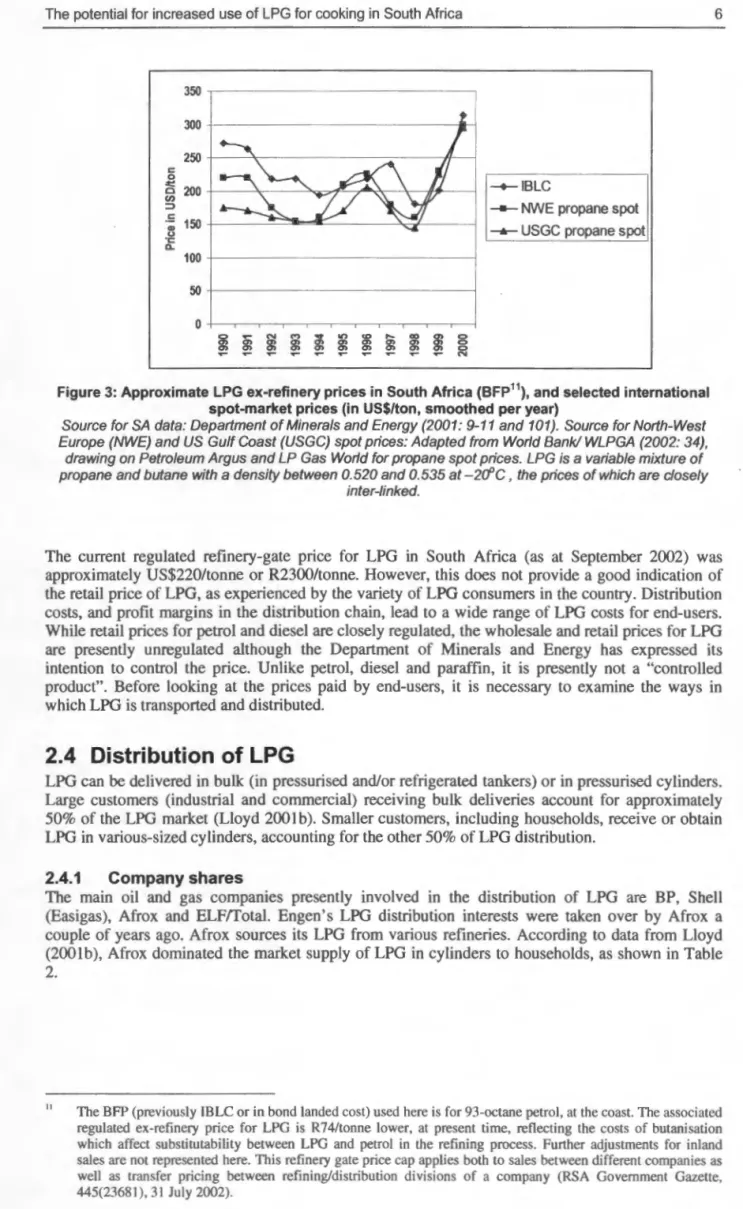
The South African refinery-gate price for LPG is regulated by government,9 and is closely linked to the price-setting for 93-octane petrol. This in turn is based on the BFP formula (basic fuel price), which is an arms-length internationally based benchmark for the calculated costs of importing petrol (two grades) and diesel fuels to South Africa, using a basket of spot and tenn prices from a selection of refineries in the MeditelTanean, Arab Gulf and Singapore, plus international freight, insurance and leakage charges. The BFP is updated regularly. It is intended to reflect the alternative cost if these refined products were to be imported, instead of produced/refined locally.
As a result of this mechanism, the ex-refinery LPG price in South Africa is subject to international vatiations in oil prices and to exchange rate fluctuations. Figure 3 shows approximate yearly- smoothed refinery-gate prices for LPG in South Africa. For comparison, some approximate yearly- smoothed international spot market prices'0 are also indicated.
10
For example, in presentations to members of the Parliamentary Portfolio Committee on Minerals and Energy.
This is in principle. In practice, it is said that refinery pricing and transfer-pricing for ex-refinery LPG is not effectively regulated, as it is not a "controlled product" and transactions are not monitored by government.
LPG spot-market prices are negotiated cargo by cargo, reflecting market conditions at the time of deal.
ENERGY AND DEVELOPMENT RESEARCH CENTRE
The potential for increased use of LPG for cooking in South Africa 6
350 300 250
c:: 0
a
en 200 -+-IBLC---NWE propane spot -.-- USGC propane spot
:::.
.!: 150
"'
u
&:
100 50 0
0 a; N M ~ 10 <D ... 00 0> 0
0> 0> 0> 0> 0> 0> 0> 0> 0> 0
~ 0> ~ 0> ~ 0> ~ 0> ~ 0> ~ 0> ~ 0> ~ 0> ~ 0> ~ N 0
Figure 3: Approximate LPG ex-refinery prices in South Africa (BFP11), and selected international spot-market prices (in US$1ton, smoothed per year)
Source for SA data: Department of Minerals and Energy (2001: 9-11 and 101 ). Source for North-West Europe (NWE) and US Gulf Coast (USGC) spot prices: Adapted from World Bank! WLPGA (2002: 34),
drawing on Petroleum Argus and LP Gas World for propane spot prices. LPG is a variable mixture of propane and butane with a density between 0.520 and 0.535 at -2o"C, the prices of which are closely
inter-linked.
The current regulated refinery-gate price for LPG in South Africa (as at September 2002) was approximately US$220/tonne or R2300/tonne. However, this does not provide a good indication of the retail price of LPG, as experienced by the variety of LPG consumers in the country. Distribution costs, and profit margins in the distribution chain, lead to a wide range of LPG costs for end-users.
While retail prices for petrol and diesel are closely regulated, the wholesale and retail prices for LPG are presently unregulated although the Department of Minerals and Energy has expressed its intention to control the price. Unlike petrol, diesel and paraffin, it is presently not a "controlled product". Before looking at the prices paid by end-users, it is necessary to examine the ways in which LPG is transported and distributed.
2.4 Distribution of LPG
LPG can be delivered in bulk (in pressurised and/or refrigerated tankers) or in pressurised cylinders.
Large customers (industrial and commercial) receiving bulk deliveries account for approximately 50% of the LPG market (Lloyd 200lb). Smaller customers, including households, receive or obtain LPG in various-sized cylinders, accounting for the other 50% of LPG distribution.
2.4.1 Company shares
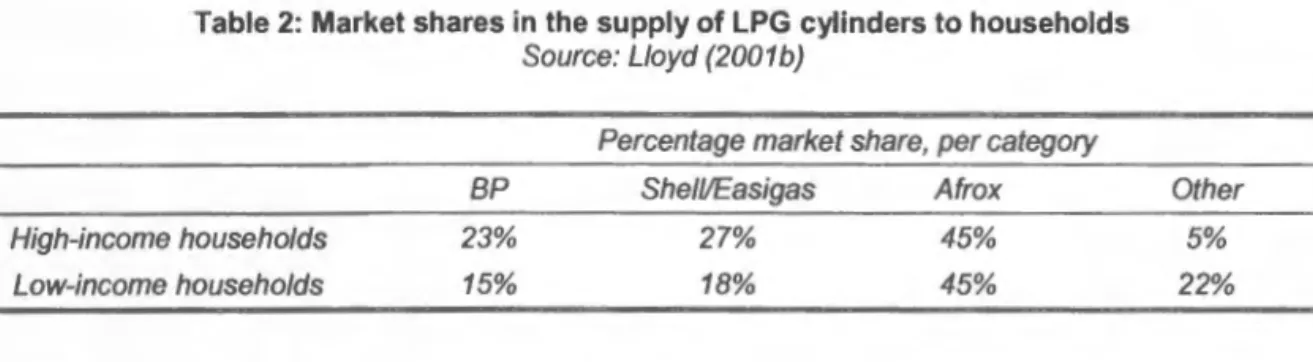
The main oil and gas companies presently involved in the distribution of LPG are BP, Shell (Easigas), Afrox and ELF/Total. Engen's LPG distribution interests were taken over by Afrox a couple of years ago. Afrox sources its LPG from various refineries. According to data from Lloyd (200lb), Afrox dominated the market supply of LPG in cylinders to households, as shown in Table 2.
II The BFP (previously IBLC or in bond landed cost) used here is for 93-octane petrol, at the coast. The associated regulated ex-refinery price for LPG is R741tonne lower, at present time, reflecting the costs of butanisation which affect substitutability between LPG and petrol in the refining process. Further adjustments for inland sales are not represented here. This refinery gate price cap applies both to sales between different companies as well as transfer pricing between refining/distribution divisions of a company (RSA Government Gazette, 445(23681 ), 31 July 2002).
ENERGY AND DEVELOPMENT RESEARCH CENTRE
The potential for increased use of LPG for cooking in South Africa 7
Table 2: Market shares in the supply of LPG cylinders to households Source: Lloyd (2001b)
High-income households Low-income households
BP 23%
15%
Percentage market share, per category She/1/Easigas Afrox
27%
18%
45%
45%
Other 5%
22%
2.4.2 Cylinder sizes and ownership
Larger cylinders, which come in 9, 14, 19 and 48 kg sizes, remain the prope1ty of the supplier.
Customers pay a deposit (which, however, is less than the cylinder cost, so that when these cylinders leave circulation, either because of sporadic LPG use or use of cylinders for other purposes, this represents a loss to the supply companies). Smaller cylinders are purchased by the end-user, and are refilled as required, rather than exchanged. Commonest cylinder sizes for low and mjddle-income households are 9 kg (leased), and the No. 7, 10 and l3 sizes (user-purchased). These latter sizes were originally denoted in pounds: the corresponding metric LPG content is 3 kg, 4.5 kg and 6 kg for the No.7, 10 and 13 sizes respectively.
The distinction between leased and user-purchased cylinders can have potential safety implications.
Company-owned cytinders are subject to thorough safety checks, as the integrity of the cylinder is a company responsibility. In principle, LPG dealers who refill user-owned cylinders are responsible for checking these cylinders as we\J, and are not supposed to re-fill damaged cylinders. But in some cases it is possible that this checking may not be as thorough.
The size and weight of the cylinders can be an important consideration for residential LPG users, particularly those in rural village areas where transport is a difficulty. The cylinders themselves are heavy, in order to be safe at pressure (for example, a cytinder holding 3 kg of LPG can weigh a further 4.6 kg).12 This reduces the energy density (MJ/kg) of the cylinder-LPG combination. From this point of view, LPG can be more burdensome to transport than for instance paraffin. Further aspects relating to cylinder sizes will be discussed in Section 3 below.
2.4.3 The LPG distribution chain (for residential LPG cylinders)
The LPG distribution chain -from refineries to households- is variable in South Africa, but the two main channels can be outlined as follows.
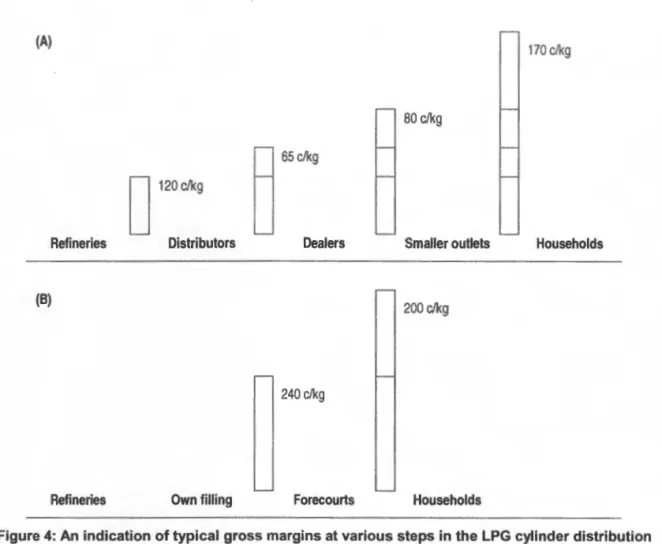
a) Refineries sell to LPG distributors (such as Afrox) who in turn supply LPG cylinders to dealers.
There may be another stage, where larger LPG dealers on-sell to smaller outlets. Depending on the situation, households may be able to purchase LPG from larger dealers or smaller outlets.
The smaller outlets may be more accessible locally, but may charge an additional price margin.
b) Some oil companies producing or purchasing LPG at the various refineries are involved in more direct distribution of LPG for sale at their branded service station forecourts. They do their own cylinder filling, and deliver cylinders to service stations. They may also sell to other LPG dealers. In this more vertically-integrated model, the oil companies' LPG distribution business may be ring-fenced to some degree.
An indication of typical LPG retail price build-ups for such residential LPG cylinder sales is illustrated in Figure 4. The figures are approximate and the estimates for the price increments (indicative gross margins) at each stage of distribution are adapted from Lloyd (2001 b).
ll LPG with a higher propane content (as in South Africa) requires higher liquefication pressure than LPG with a higher butane content.
ENERGY AND DEVELOPMENT RESEARCH CENTRE
The potential for increased use of LPG for cooking in South Africa
(A)
Refineries
(B)
Refineries
D
120dkgDistributors
Own filling
u 65~g
Dealers
240 c/kg
Forecourts
170 clkg
80 c/kg
Smaller outlets Households
200 c/kg
Households
Figure 4: An indication of typical gross margins at various steps in the LPG cylinder distribution chain from refineries to households
Source: Adapted from Lloyd (2001b), with indicative gross margins inc/litre converted to c/kg 8
For a more specific illustration relevant to this case study, the following example indicates typical steps in the distribution chain from the refinery to a rural villager (in this example, to a household in a village near Mt Fletcher in Eastern Cape).
An example of steps in the distribution chain, to obtain LPG in an Eastern Cape village 1. Bulk delivery by road tanker from refinery in Durban to an LPG depot in Kokstad (distance
about 200 km).
2. The depot refills large cylinders and delivers these to a dealer in the small market town of Matatiele (distance about 70 km).
3. The customer travels by bus from her village to Matatiele (distance about 50 km) and refills her No. 10 cylinder (which she owns herself). She uses a shopping trolley to move the cylinder from the bus rank to the LPG dealer and back.
4. The bus operators load LPG cylinders on the roof of the bus. (They charge both for the person's bu fare as well as the cylinder transport).
5. From the bus stop, her son helps to transport the cylinder home using a wheel-barrow.
In this particular illustration, the customer goes through this rather arduous refilling process once or twice a month in winter. Despite the extra costs and effort of travelling by bus to get the cylinder refilled, she judges this is cheaper in the end, because of the lower LPG prices in the town. (There can be quite fierce price competition in such rural market towns, which act as "filling stations" for surrounding rural areas - both for energy products like LPG, paraffin and candles, and for other staple commodities including food. Of course, in all these cases, the cost of transport into town and back to village areas adds a premium to the effective final price paid by villagers.)
ENERGY AND DEVELOPMENT RESEARCH CENTRE
The potential for increased use of LPG for cooking in South Africa 9
A common comment among rural villagers in these areas is "they should bring these services closer to us". In the example given above, the distances covered by the organised supply chain and by the customer's transp011 give an indication of this problem:
Organised distribution
Customer's transport
Bulk tanker transport delivery Batch cylinder delivery Customer's bus transport Walking and carrying
200 km (one way) 70 km (one way) 100 km per load some 2 km per load
Alternatively, villagers (especially those unable to travel, for financial or other reasons) can usually make some fuel purchases locally, from small "spaza" shops. The prices are then higher, both because of the transport costs incurred by the shop-keeper in obtaining stock, and the additional mark-up to make these shops profitable. Among fuels, paraffin and candles are readily obtained from local spaza shops, as these can be sold in small quantities with little overheads, but LPG is les commonly available from local informal shops - hence price and availability are both constraints.
These are facets of the commonly-expressed opinion that LPG distribution does not extend far enough into rural areas of South Africa: for individual rural customers, it is more often a case of "if you want it, come and get it" (from dealers in towns, garage forecourts, etc).
Another view, of course, is that LPG is a superior and more expensive fuel compared with paraffin, and as a result would be chosen by only a minority of somewhat wealthier rural households. This would reduce the density of demand and the viability of having LPG distribution outlets in villages.13
2.4.4 Options for more direct distribution of LPG to rural areas (a) Community-managed energy centres
In recent years, a number of village communities in this Maluti-Mt Fletcher district of Eastern Cape formed energy committees, in an effort to improve their supplies and uses of energy.14 In one cluster of villages, Magadla (between Matatiele and Mt Fletcher), the membership decided to form a co- operative. One purpose was to facilitate bulk-buying of fuels like paraffin and LPG, for local resale to households, small shops, etc. 15 Broader aims were to establish an Energy and Development Centre which would carry a range of commercial fuels and appliances as well as provide non-commercial services to assist community members: for example, safety campaigns, other information campaigns, demonstrations of improved appliances, improved techniques, etc. The scope was (and is) intended to expand beyond energy, and to include energy-related production opportunities (facilities for small business operations), a communications centre, and ways of helping to address pressing service and health issues in the area, like water and sanitation, and HIV/Aids campaigns.
This Caba-Mdeni Energy and Development Co-operative has so far succeeded in obtaining a paraffin tank and pumping equipment, receiving small-bulk deliveries from a depot in Kokstad, and in bringing down the local price of paraffin. Subsequently, batch deliveries of LPG cylinders were organised in a similar way. The Energy Centre building (which is so far unelectrified) also hosts a sewing project; and a number of other people from some of the poorest families in the village are employed part-time by the co-operative.
13
14
IS
An interviewed Easigas depot manager in Kokstad opposed this view, saying that there is a vast underlying demand for LPG in rural areas of Eastern Cape, and that there are excellent business opportunities for village- based entrepreneurs (with LDVs/bakkies) to bridge the gap between LPG depots and rural customers. They would be able to charge a mark-up of about 40-50% on the depot wholesale price, and still find a strong customer base.
This was facilitated by the Rural SEED project (Sustainable Energy, Environment and Development), carried out by EDRC in cooperation with Danish NGOs and the local NGO, Environmental Development Agency Trust. A full-time Rural SEED Facilitator worked with communities, local government and energy service providers in this area of Eastern Cape. Another facilitator worked in areas of Limpopo Province, in the north of the country. The SEED programme was sponsored by Danish Cooperation for Environment and Development (DA CEO).
It should be mentioned that the standard for the refilling of cylinders of domestic size (9kg and less) in rural areas allows for the use of simple liquid withdrawal systems rather than complex flow-limiting systems required in urban areas. This concession was made specifically to assist energy centres in setting up refilling stations. See SABS 087-7 2000 The handling, storage and distribution of liquefied pelrolewn gas in domestic, commercial and industriaL installations Part 7 Note to Section 5.2.2, Ed 2. I. SA Bureau of Standards, Pretoria
ENERGY AND DEVELOPMENT RESEARCH CENTRE
The potential for increased use of LPG for cooking in South Africa 10
(b) Commercial energy centres and one-stop energy stores
The idea of rural energy centres, or of one-stop energy stores, has been a topic of discussion for several years in South Africa. Apart from developments in community-managed rural energy centres, there have also been initiatives by oil companies and other energy companies/consortia to establish these.
Some of the oil companies have set up retail outlets which are referred to as energy centres, because they carry a wider range of fuels and energy-related products than conventional service stations.
These have been established mainly in high customer-density locations (e.g. urban and peri-urban localities).
More generally, branded service station outlets for the main liquid fuels, petrol and diesel, have been diver ifying their product range (e.g. selling electricity tokens, cellphone coupons, foodstuffs), partly as a marketing strategy. This may reflect the difficulties of competing for market share in an environment where the prices of the main products, petrol and diesel, are regulated, and where these products are largely identical for each company.16
A futther set of initiatives for supplying fuels like LPG and paraffin in rural areas revolves around solar electrification projects. Photovoltaic (PV) electrification does not cover households' important energy needs for cooking and sometimes heating. Therefore it is often thought that solar electrification should be accompanied by improved provision of thermal fuels as well, to provide a more complete energy service. For example, Eskom piloted this approach fairly successfully in a KwaZulu-Natal village area (kwaBhaza), offering a package combination of LPG for cooking and PV electricity for lighting, radio and television. On a larger scale, there is a national programme for non-grid electrification, whereby selected companies/consortia are given concession rights to provide solar home systems (SHSs) in demarcated geographic areas. The government will provide a significant subsidy per installed SHS17, and this has attracted the interest of major companies, including several oil companies, as participants. As part of their contractual obligations, the companies awarded concession rights' are expected to ensure an improved provision of thermal fuels as well as PV systems. However, like the programme as a whole, progress in this aspect has tended to lag behind. The pioneering Eskom-Shell Joint Venture for solar electrification in an area of Eastern Cape, for example, is said to have neglected the provision of thermal fuels, to date.
Nonetheless, at least some of the concessionaires are committed to their plans to establish one-stop rural energy stores, which will not only be marketing, installation and maintenance centres for SHSs (and hopefully other PV systems as well) but will also stock liquid fuels and a range of energy appliances.
The location of these energy stores may not be ideal for liquid fuels distribution. If the primary business is in SHSs (which tend to be fairly scattered and low density) it would make sense to locate such energy stores in a small town, serving a fairly large sunounding area, rather than within a village cluster. This might still leave villagers with transpott difficulties if they wish to access LPG or paraffin from such a store.
(c) Government-initiated integrated energy centres
In recent years, the terms "integrated energy" and "integrated development" have become commonly used. "Integrated energy" has two main connotations in South Africa:
• supply and use of a combination of fuels, as opposed to a single focus on one energy service such as electricity;
• integrating improved energy supplies into the overall household, productive and service needs of a community.
Each of these aspects came to be highlighted in the course of South Africa's massive national electrification programme. Especially in the case of rural electrification (but also among low-income urban communities) it became increasingly evident that electricity alone was not meeting all the
16
"
18
One refinery can provide the same fuel to several companies. The only difference between brands at different
service stations may lie in proprietary additives which the companies are permitted to add individually.
Currently R3500 subsidy per system, close to the capital cost of a SHS.
"Concessions" is a commonly-used term, in connection with this programme for non-grid service provision, but
is not a term which the government favours, as it implies too much. More exactly, the '·concessionaire companies" have exclusive access to the SHS subsidy in their awarded area, for a limited time period.
ENERGY AND DEVELOPMENT RESEARCH CENTRE
The potential for increased use of LPG for cooking in South Africa 11
energy needs of low-income households and that people were continuing to use non-electric fuels for cooking and even ughting.
There was also increasing concern that although ambitious numerical electrification targets were being met or exceeded, the benefits for people's well-being, and broader socio-economic development, were less than originally anticipated. It was hoped that improvements on this could be obtained by adopting a more integrated approach, implying
a closer match between energy demand and supply;
a more coordinated cross-sectoral approach;
• applying an integrated local development planning framework ("integrated development planning", IDP).
The idea of "energisation"- meaning improved provision of a bundle of fuels- became more widely used, as a target for improving energy services. An integrated sustainable rural development strategy was developed, placing emphasis on local-level empowerment and expression of demand, improved coordination between different service sectors, and the planning and accomplishment of local economic development goals within the IDP process. With regard to energy, some of the main energy strategies within the strategy (or as it has now become, the integrated sustainable rural development programme) are to
• incorporate electrification planning, and other energy planning, within a unifying IDP framework;
• promote local empowerment around energy issues;
• promote the development of integrated energy centres, which are intended to improve local access to a range of energy sources and appLiances, enhance people's abiuty to make well- informed choices, and promote safe, healthier, efficient and more sustainable energy use in surrounding communities.
Points of relevance for the present case-study include the following:
i) The "energisation" approach is recognised as relevant in both grid-electrified, non-grid- electrified and non-elect1ified areas, emphasising government policy support for improving access to affordable non-electric fuels such as paraffin and LPG.
ii) The energy centre concept has policy support and active government sponsorship, indicating that successful achievements of better fuel supplies, safety awareness, etc. at rural energy centres19 can have good opportunities for wider repLication in the country.
It can be suggested that there is not yet sufficient practical experience to show how far rural energy centres and one-stop energy stores wi II succeed in delivering better distribution routes for fuels like LPG, on a sustainable basis, or what the relative strengths of the different models will be (community-managed, purely commercial, government-sponsored20). However, there appears to be sufficient momentum in the country to make it worthwhile to examine the potential for such energy centres and stores to encourage household use of LPG, which is one of the objectives of this study.
d) A "market day" approach
Given that one of the major baniers affecting the flow of goods and services into (and out of) rural areas is the high cost and limited availability of transport, it makes sense to consider a variety of options for rationalising transport costs and rendering transport services more effective. Localised energy centres/stores are one broad option, but with an emphasis on rationalising in-coming transportation costs for fuel supplies. Another option, which could be suited patticularly to "deep"
rural areas - where road transport costs are very severe- is to rationalise transport by operating a
"market day" supply circuit, or more ambitiously, an import/export circuit, bringing goods into rural villages and transporting local products back to towns. Although this option will not be examined further in this case-study, mainly because it could be complex to achieve in South Africa, it could have a number of advantages, not Limited to improved fuel supplies.
19
'"
Government-sponsored integrated energy centres are not restricted to rural areas, although at present they are mostly planned to serve high-need rural areas.
It should be pointed out that government-sponsored IECs email both industry co-operation and elements of community management. They can therefore be regarded as public/private/CBO partnerships.
ENERGY AND DEVELOPMENT RESEARCH CENTRE
The potential for increased use of LPG for cooking in South Africa 12
The picture is that villages, or village clusters, would be visited on a certain day each month (or more frequent days in the month, depending on demand) to provide a range of products for sale, including energy supplies and appliances, foodstuffs, and po sibly services. An obvious choice of day is "pension day", when State support payments are paid to pensioners and registered unemployed. Typically on this day both citizens and service providers gather round the payment location, and more transactions take place than during the rest of the month.
In this picture, rationalised trucking of these goods and services would reduce transportation overheads. The transport rationalisation could require
• a transporter caJTying a range of products, from different supply companies (hence the complexity);
• travelling in a circuit, from one village area to another day by day, rather than having expensive to-and-fro consignments from towns to individual remote areas;
• large carrying capacity for the transporters, to enable circuit-wise distribution and economies of scale;
• mixed-load capabilities;
time-coordination of multiple transporters, if required.
In order to contribute to sustainable development of such rural areas, it would be important that a system like this should not only reduce the costs of rural ("import") supplies, but also reduce the barriers for "exporting" rural products to urban markets. At a simple level, this implies that the market-day transportation system should be able to transp011 local rural products back to towns.
However, the marketing system for rural products to sell in towns, or nationally and internationally, is a much more complex matter than multi-product supply to rural areas. A single entrepreneur could possibly organise the sourcing and delivery of a wide range of consumer products (in the way an algem.eene handelaar [Afrikaans for general dealer] operates) for sale on rural market days, but marketing a wide range of rurally-sourced products would probably require either many agencies involved, or an intermediary organisation capable of handling the collection and on-sale of multiple rural products. These are challenges.
It is possible that oil companies, in particular their distribution divisions or off-shoots, could have an advantage in venturing into a circuit-wise market day transportation initiative for rural areas. They have the infrastructure and organisation for road-transport deliveries across the country, and possibly fuel-price advantages for road haulage. In South Africa and internationally, oil companies show interest in diversification of their retail products- but as mentioned above, this is probably organised more around attracting customers to their sales outlets for main products (petrol and diesel) in the short term. A system for transporting diverse products to and from rural areas of developing countries is probably one step outside the marketing strategies of oil companies, but could possibly be encouraged by their social-responsiveness policies and government requests.
2.5 End-user LPG prices
Wholesale and retail prices for LPG are not controlled in South Africa, only the refinery-gate price.
There are considerable variations in the final prices which customers pay. These depend on location, transport costs, other storage and distribution costs, the number of steps in the distribution chain, and the size of the price mark-ups at each step.
2.5.1 Sample end-user prices
A number of examples are given below. First, three supply routes for an LPG customer in the Eastern Cape village area of Magadla are examined. Then for comparison, some urban prices for re- filling or exchanging LPG cylinders are given, and also some bulk supply prices. The urban prices are from Cape Town. All prices are for October 2002, are in rands, and include VAT (at 14%). The prevailing refinery gate price for this period was approximately R2300/tonne (R2.30/kg) or US$220/tonne, according to the BFP formula. The prevailing rand/US$ exchange rate was variable but approximately RlO:US$.
ENERGY AND DEVELOPMENT RESEARCH CENTRE
The potential for increased use of LPG for cooking in South Africa
Example 1: A customer from Magadla refilling or exchanging gas cylinders from a cost-cutting furniture store in the town of Matatiele
Bus fare (two ways) Cyunder transport charge LPG cost (R per cylinder)
LPG cost (R/kg) excluding local transport LPG cost (R/kg) including transport11
Refilling a No.7 cylinder (3 kg)
R4 R2.50
R22 R7.33 R9.50
Exchanging a 9 kg cylinder
R4 R15 R60 R6.67 R8.78
13
Example 2: A customer from Magadla refilling or exchanging gas cylinders from a petrol station in the town of Matatiele
Bus fare (two ways) Cylinder transport charge LPG cost (R per cylinder)
LPG cost (R/kg) excluding local transport LPG cost (R/kg) including transport
Refilling a No.7 cylinder (3 kg)
R4 R2.50
R22 R7.33 R9.50
Exchanging a 9 kg cylinder
R4 R15 R62.50
R6.94 R9.06
Example 3: A customer from Magadla exchanging gas cylinders at the Caba-Mdeni Energy and Development Cooperative in Magadla
LPG cost (R per cylinder) LPG cost (R/ko)
Exchanging a 9 kg cylinder
R60 R6.67
Example 4: Urban LPG supply, in a middle-income Cape Town suburb
LPG cost (R per cylinder) LPG cost (Rfko)
Refilling a No.7 cylinder (3 kg)
R28 R9.33 Example 5: Urban LPG supply, in low-income Cape Town suburbs
LPG cost (R per cylinder) LPG cost (Rikg)
Refilling a No.7 cylinder (3 kg) R25.45 to R28 R8.48 to R9.33
Example 6: Urban LPG supply in delivered 48 kg cylinders (commercial) Exchanging a 48 kg
c Linder
LPG cost (R per cyljnder) R368
LPG cost (Rfko) R7.67
Example 6: Urban LPG supply in bulk (industrial), Cape Town
LPG cost (R/kg) R5.60
2.5.2 Comments on sample prices Urban/rural price differences
Exchanging a 19 kg cylinder
Rl24 R6.53
Exchanging a 9 kg cylinder
R76.85 R8.54
Exchanging a 9 kg cylinder R68.95 to R80 R7.66 to R8.89
One would expect that the costs of supplying LPG would be higher in a rural area, than in an urban area like Cape Town (which has a nearby local oil refinery). The transport costs of LPG distribution to retailers must be higher for the rural examples given above. Nonetheless, it is striking that the rural retail prices are lower, both for refilling and for exchanging LPG cylinders in Matatiele (which
11 Assuming the trip is specifically for purchasing LPG. In practice, trips usually have combined purposes.
ENERGY AND DEVELOPMENT RESEARCH CENTRE
The potential for increased use of LPG for cooking in South Africa 14
is hundreds of kilometres from refineries) than in Cape Town suburbs. Averaging the sampled retail prices shows this comparison more clearly (see Table 3).
Table 3: Averaged sample retail prices for residential LPG (October 2002)
A] Sampled prices in rural Matatiele area (including the Caba-Mdeni Energy Co-operative)
8] Prices in urban Cape Town samples Urban I rural retail price differential [(8-A)/A%]
Refilling a 3 kg cylinder 7.33 Rlkg
9.05 R/kg 23%
Exchanging a 9 kg cylinder 6.76 R!kg
8.14 R!kg 20%
In Section 3.4 below, it will be suggested that the effective demand curves for LPG in the rural case study area may be different from LPG demand in an urban area like Cape Town. This could partly explain how rural prices could be pushed lower. However, it also seems likely that there are some limitations on LPG price competition at work. In addition, most small-cylinder LPG sales in urban areas are for recreational purposes such as barbecues or camping, in which far higher margins can be achieved than when in competition for domestic fuels.
Rural co-operative LPG prices are lowest, in the sample
Notably, the lowest retail prices for residential LPG, among all the rural and urban samples given in Section 2.5.1, are the prices quoted by the small village-based Caba-Mdeni Energy and Development Co-operative's energy centre-the outlet furthest from an oil refinery (in these examples).
In fact, the only LPG price in these samples which is lower than the prices offered by the Caba- Mdeni Co-operative is the price for bulk industrial supplies in Cape Town (R5.60 per kg).
Understandably, bulk supply in areas close to a refinery should be cheaper, cutting out cylinder bottling and maintenance costs and reducing LPG transport delivery costs.
Comparing LPG and 93-octane petrol prices
As will be discussed further in Section 2.7 below, the retail energy cost (in R/MJ) for 93-octane petrol is lower than that for LPG in cylinders, at these sampled prices. Using October 2002 prices, 93-octane petrol retailed at about 0.12 R/MJ and LPG 0.13 to 0.18 R/MJ. This is despite the fact that the refinery gate price for LPG is supposed to be virtually the same as 93-octane petrol, and that petrol is subject to fuel taxes and levies making up about one-third its retail price, while LPG is not.
2.6 Availability and costs of common domestic LPG appliances
2.6.1 Types of cooking appliances
The focus of this case study is on LPG for cooking. The main LPG cooking appliances one would expect to find in lower-income rural (and urban) households are a cooking ring which is screwed directly on the top of a smaller-size LPG cylinder, and a flat two-burner cooker. LPG appliances can be designed for high gas pressure (e.g. a cooking ring connected directly to a cylinder) or for lower pressure (in which case, an in-line pressure regulator is required). Some two-plate LPG stoves in South Africa are designed to be connected to cylinders without a need for in-line pressure regulation, while others are "low pressure" appliances, requiring a pressure regulator.
Small LPG cylinders with direct stove attachments are portable, as a unit, and are probably designed mainly for the camping market. They have some limitations for general household use, such as
relatively poor tability, especially for large pots;
• pots can slide off the cooker, e.g. when stirred or knocked;
• a single burner is a limitation on cooking practices.
A flat two-burner cooker is more stable, versatile, and easier to control, but more expensive. Other LPG cooking appliances include "skottel braais", grill plates, "potjie" cooker tops22, full stove/ovens,
"
"Potjie'' is Afrikaans for a small pot, but it typically refers to a heavy iron pot in which stews can be made. overa fire or in this case using an LPG attachment. The pots often have three legs so that they can be set above an open fire. Such three-legged pots are very common cooking utensils in rural areas where people cook on open
ENERGY AND DEVELOPMENT RESEARCH CENTRE
The potential for increased use of LPG for cooking in South Africa 15
and simple heavy-duty cooking burner stands. A skottel braai (skottel means "dish" in Afrikaans) is similar to a wok, with a large dish-shaped surface heated from underneath by gas. Food can be fried, simmered or contact-grilled on the skottel. Although this versatility is appealling in some food traditions, LPG skottel braais are fairly expensive to purchase and are likely to be fuel-inefficient. In South Africa they are used mainly for special outdoors occasions, where they allow convenient cooking of foods like sausages in a way that resembles a traditional "braaivleis" (grilling meat over a fire; a barbecue). Rural householders who want to grill meat are likely to prefer traditional methods, using real fires if possible.
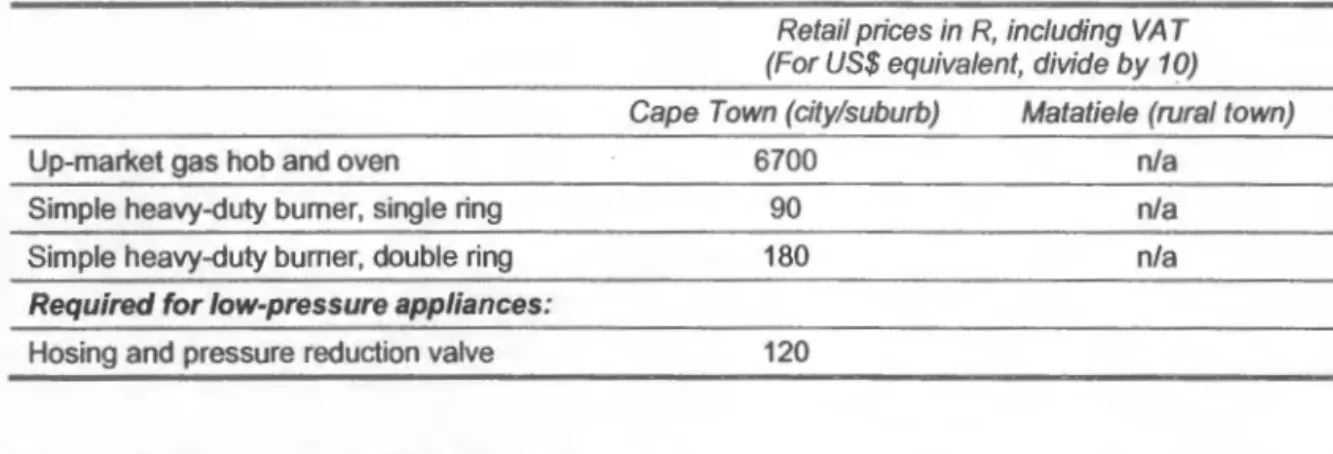
Full gas ovens, usually with four cooking rings (or, in some luxury models, two gas rings and two electric plates) tend to be rather expensive in South Africa and more difficult to obtain than the smaller LPG cooking appliances. Sample prices are given in the next section. Some wealthier households choose to cook with gas rather than electricity, for reasons such as easier control of cooking temperatures. However, expensive gas ovens are likely to be unaffordable for most rural
hous~hol~s, although it is lik_el~ that most households would value having an oven, for baking and roastmg, If they could afford Jt -.
There could be a demand for simple, heavy-duty gas cooking rings, which can be set on the floor and which could accommodate large pots (including the common "three-legged" pots widely used in rural areas) more safely than a camping-type LPG stove. These are available from some appliance outlets. As far as known, they are not yet readily available in rural stores.
2.6.2 Examples of prices
Table 4 provides examples of retail prices for a range of LPG cooking appliances, obtained from shops in a city (Cape Town) and a small rural town (Matatiele) in October 2002. The cost of smaller- size gas cylinders is included here, as they are integral to the appliance. Alternatively, the costs of putting down a deposit on larger LPG cylinders are also indicated in the table.
Table 4: Examples of retail prices for LPG cooking appliances and LPG cylinders (October 2002, in Cape Town and Matatiele)
LPG cylinders (purchase) No.7 (3 kg)
No. 10 (4.5 kg)
LPG cylinder deposits 9 kg
19 kg 48 kg Stoves
Camping-type screw-in cooker plate (single) Two-ring LPG cooker (no regulator)
Skottel attachment
Four-ring stove and oven (basic)
Retail prices in R, including VAT (For US$ equivalent, divide by 10) Cape Town (city/suburb} Matatiele (rural town)
180 200
230 265
85 85
85 85
85 85
45 55
260 255
240 310
3000 1400
<