UNIVERSITY OF KWAZULU-NATAL
Value Added by Occupational Health and Wellness (OH&W) Progams in the Construction Industry
By
Ignatia Nombuyiselo Dionne Myeza Student Number: 203518017
A dissertation submitted in partial fulfillment of the requirements for the degree of Master of Business Administration
Graduate School of Business & Leadership College of Law and Management Studies
Supervisor: Steven Msomi
2015
DECLARATION I Ignatia Nombuyiselo Dionne Myeza declare that:
(i) The research reported in this dissertation/thesis, except where otherwise indicated, is my original research.
(ii) This dissertation/thesis has not been submitted for any degree or examination at any other university.
(iii) This dissertation/thesis does not contain other persons’ data, pictures, graphs or other information, unless specifically acknowledged as being sourced from other persons.
(iv) This dissertation/thesis does not contain another persons’ writing, unless specifically acknowledged as being sourced from other researchers. Where other written sources have been quoted, then:
a) their words have been re-written but the general information attributed to them has been referenced:
b) Where their exact words have been used, their writing has been placed inside quotation marks, and referenced.
(v) This dissertation/thesis does not contain text, graphics or tables copied and pasted from the Internet, unless specifically acknowledged, with the source being detailed in the dissertation/thesis and in the References section.
Signature: ………..
Ignatia Nombuyiselo Dionne Myeza (Student Number: 203518017)
ACKNOWLEDGEMENTS
I wish to express my sincere appreciation and gratitude to the following individuals, without whose assistance, this study would not have been possible:
Steven Msomi, my supervisor, whose expert advice, patience and guidance has assisted me tremendously with the research and who has lent his support during the course of my studies.
Ndabenhle Myeza, my honey who supported and encouraged me throughout this process. Thank you for taking over my role as a wife and mother by being a pillar of strength at home while I was engrossed with my studies.
Both the Dlamini and the Myeza families, my son, Kusasa and, my daughter Nomvelo for their everlasting love and emotional support. My late uncle, Joe Ngcobo for his support and encouragement throughout my studies (May his soul rest in peace).
Wendy Clarke and Zarina Bullyraj and the GSB teaching staff who have made the MBA programme a great learning and enjoyable experience.
My business partner Nqobile Zulu, my colleague Angel Mangena and eSpanini health staff for their support and encouragement.
Group Five management, especially Mr Sydney Mthembu and Roy for their support in motivating for the gate keeper and working with me in handing over questionnaire.
Finally, my group “Dissertation fighters” for their love, support and encouragement all the way even when I had lost hope.
ABSTRACT
It is an undeniable fact that transformation in South Africa has impacted positively on most business sectors, however, while other sectors were quick to adapt, others stumbled when they encountered challenges. Globally, it has been realised that employees are the most important assets of a businesses. Therefore as engines they must be kept healthy and productive. Legislation such as the Occupational Health and safety Act of 1993, emphasises the responsibility of the employer to keep workers healthy and to provide a safe and healthy working environment. The nature of other sectors, such as agriculture and construction tends to deny them an opportunity to develop and sustain Occupational Health and Wellness programmes. The construction industry may present worker with a hazardous environment.
The study focuses on issues related to the challenges faced by the construction industry in trying to maintain healthy employees. It assists in identifying the strategies to adopting order to address their needs as short term mobile sector.
The survey was conducted in Pietermaritzburg, one of Group Five construction sites. The site was targeted because the project duration was more than five years and comprised many sub-contractors who were taking part in the project. The topic required experts in the field of Occupational Health and Safety, therefore certain categories of quantitative study data were collected using a non-probability sample. There were 112 valid respondents. According to the findings, most contractors seem to have benefited from current Occupational Health and Wellness programmes, but the challenges still exist which are hindering progress. Some of the challenges were perceived cost of running the programmes, pressure from the client to complete projects, inaccessible Occupational Health and Wellness centres. Without a paradigm shift by all stakeholders in the South African construction industry, occupational health and wellness standards will not improve. Stakeholders need to make a paradigm change in order to adopt strategies which will change the face of Occupational Health and Wellness programmes in the construction world.
TABLE OF CONTENTS
DECLARATION ... II
ACKNOWLEDGEMENTS ... III
ABSTRACT ... IV
CHAPTER 1 ... 1
1. INTRODUCTION ... 1
1.2 MOTIVATION FOR THE STUDY ... 2
1.2.1 CONSTRUCTION INDUSTRY ... 2
1.2.2 THE DEPARTMENT OF LABOUR ... 2
1.2.3 THE DEPARTMENT OF HEALTH ... 2
1.2.4 SMALL AND MEDIUM CONTRACTORS (SMC) ... 3
1.2.5 THE COMMUNITY AND FAMILIES ... 3
1.2.6 OTHER RESEARCHERS AND POLICY MAKERS ... 3
1.3 STUDY FOCUS ... 3
1.4 PROBLEM STATEMENT ... 4
1.5 RESEARCH QUESTIONS ... 4
1.6 STUDY OBJECTIVES ... 5
1.7 STUDY LIMITATION ... 5
1.8 STUDY FRAMEWORK ... 6
1.9 SUMMARY ... 7
CHAPTER 2 ... 8
2.1 INTRODUCTION ... 8
2.2 THE ROLE OF LEGISLATION IN OCCUPATIONAL HEALTH AND WELLNESS 9
2.3 OCCUPATIONAL HEALTH, WELLNESS AND THE CONSTRUCTION
INDUSTRY. ... 13
2.3.1 OCCUPATIONAL HEALTH ... 13
2.3.2 WELLNESS ... 16
2.3.2.1 AN OVERVIEW OF EMPLOYEE WELLNESS PROGRAMME ... 16
2.3.2.2 ELEMENTS OF THE EMPLOYEE WELLNESS PROGRAM ... 18
2.4 THEORIES RELATING TO PHYSIOLOGICAL AND HEALTH NEEDS ... 19
2.4.1 MASLOW’S HIERARCHY OF NEEDS. ... 19
2.4.2 BENEFITS OF EMPLOYEE WELLNESS PROGRAMS ... 21
2.5 CONSTRUCTION INDUSTRY OVERVIEW ... 22
2.5.1 SUPPLY CHAIN MANAGEMENT IN CONSTRUCTION INDUSTRY ... 24
2.5.2 THE CONSTRUCTION INDUSTRY GOVERNING BODY ... 25
2.5.3 CURRENT OCCUPATIONAL HEALTH PROGRAMMES IN THE CONSTRUCTION INDUSTRY ... 26
2.5.4 OCCUPATIONAL HAZARDS IN THE CONSTRUCTION INDUSTRY ... 27
LIFESTYLE WORKPLACE WORKOUT ... 28
2.5.5. DISCUSSING EMPLOYEE HEALTH AND WELLNESS IN THE CONSTRUCTION INDUSTRY ... 29
2.6 INTEGRATING OCCUPATIONAL HEALTH AND WELLNESS ... 30
2.6.2 OCCUPATIONAL HEALTH AND WELLNESS CHALLENGES IN CONSTRUCTION INDUSTRY ... 32
2.7 SUGGESTED STRATEGIES TO IMPROVE OCCUPATIONAL HEALTH AND WELLNESS IN CONSTRUCTION INDUSTRY ... 35
2.8 CONCLUSION ... 37
CHAPTER 3 ... 38
RESEARCH METHODOLOGY... 38
3.1 INTRODUCTION ... 38
3.3 RESEARCH AIM, QUESTIONNAIRE AND OBJECTIVES ... 39
3.3.1 THE AIM OF THE STUDY ... 39
3.3.2 RESEARCH QUESTIONNAIRE ... 39
3.3.3 OBJECTIVES ... 39
3.4 RESEARCH METHODOLOGY... 40
3.5.1 RESEARCH DESIGN ... 41
3.5.2. DATA COLLECTION ... 41
3.6 SAMPLING ... 42
3.6.1 THE POPULATION ... 43
3.6.2 SAMPLING ... 43
3.6.3 SAMPLING DESIGN ... 44
3.6.4 SAMPLE SIZE ... 46
3.7 DATA COLLECTION METHODS ... 47
3.8 DESIGN AND DESCRIPTION OF QUESTIONNAIRE ... 48
3.8 DECIDING ON RESEARCH QUESTIONS ... 49
3.8.1 OPEN-ENDED QUESTIONS ... 49
3.8.2 CLOSED-ENDED QUESTION ... 49
3.8.3 NOMINAL DICHOTOMOUS QUESTIONS... 50
3.8.4 LIKERT-TYPE AND INTERVAL QUESTIONS ... 50
3.9 PRE-TESTING ... 51
3.10 STUDY LIMITATIONS ... 52
3.12 VALIDITY OF THE QUESTIONNAIRE ... 53
3.13 DATA ANALYSIS ... 53
3.14 SUMMARY ... 54
CHAPTER 4 ... 55
PRESENTATION OF RESULTS ... 55
4.1 INTRODUCTION ... 55
4.2 ANALYSIS OF RELIABILITY ... 55
4.4 DEMOGRAPHICAL INFORMATION ... 57
4.4.4 RESPONDENTS POSITION WITHIN THE PROJECT ... 60
4.4.5 RESPONDENTS BY THE DURATION OF EMPLOYMENT WITHIN THE COMPANY ... 61
4.5 OBJECTIVE 1. HOW EFFECTIVE ARE THE CURRENT OCCUPATIONAL HEALTH AND WELLNESS PROGRAMMES? ... 62
4.5.3 IT HAS INCREASED EMPLOYEE RETENTION. ... 63
4.5.4 IT HAS INDIRECTLY IMPACTED ON THE SUCCESS OF THE COMPANY. ... 64
TABLE 4.3 THE IMPACT ON THE SUCCESS OF THE COMPANY. ... 64
4.5.5 IT HAS LOWERED ABSENTEEISM ... 64
TABLE 4.4 ABSENTEEISM RATE. ... 64
4.5.6 THE INJURY STATISTICS HAS DECREASED. ... 65
4.5.7 GENERAL HEALTH OF THE WORKERS. ... 66
TABLE: 4.5 IMPROVED GENERAL HEALTH OF THE WORKERS VS IMPROVED WORK PERFORMANCE. ... 66
TABLE 4.6 ORGANISATIONAL BRAND IMAGE ... 67
TABLE 4.8 THE ROLE PLAYED BY LEGISLATION IN OH&W PROGRAMMES. ... 69
4.6.2 THE ROLE OF CIDB IN OCCUPATIONAL HEALTH AND WELLNESS. .... 70
TABLE 4.9 COMPLIANCE TOWARDS HEALTH AND SAFETY RELATED LEGISLATIONS. ... 73
TABLE 4.10 STAKEHOLDER PERCEPTION ... 75
4.7.2 ACCESSIBILITY OF OCCUPATIONAL HEALTH AND WELLNESS SERVICES. ... 77
4.7.5 THE FOCUS IS ON SAFETY NOT ON WELLNESS PROGRAMMES ... 80
DISCUSSION, RECOMMENDATIONS AND CONCLUSION ... 85
5.1 INTRODUCTION ... 85
5.2 SUMMARY. ……… .. 85
5.3 RECOMMENDATIONS ... 85
5.4 RECOMMENDATIONS FOR FUTURE STUDIES ... 87
5.5 CONCLUSION ... 88
REFERENCES ... 89
APPENDIX 1 QUESTIONAIRE ... 106
APPENDIX 2 ETHICAL CLEARANCE ... 111
APPENDIX 3 TURNITIN REPORT... 112
LIST OF FIGURES
Figure 2-3 Benefits of Emplyee wellness programme ... 21
Figure 2-4 Construction site - Coega ... 22
Figure 2-5 Lifestyle Workplace Workouts ... 28
Figure 4.1 Overview of the results ... 56
Figure 4.2: Respondent’s gender ... 57
Figure 4.3 Respondents distribution by race ... 58
Figure 4.4 Respondent’s company working for in the project ... 59
Figure 4.5 Respondent’s position ... 60
Figure 4.6 Length of service in the current position ... 61
Figure: 4.7 Improved workers performance. ... 62
Figure 4.8 The injury statistic ... 65
Figure 4.9 CIDB role in occupational health and wellness ... 70
Figure 4.10 Level of support to small and medium contractors ... 71
Figure 4.11 Provision of guidelines towards maintaining healthy workforce. ... 72
Figure 4.12 Research and development in occupational health and wellness ... 74
Figure 4.13 Short term workers cannot sustain OH&W programme ... 76
Figure 4.14 Poor accessibility of Occupational health services. ... 77
Figure 4.15 Pressure to complete projects on time. ... 78
Figure 4.16 Occupational health is a compliance issue. ... 79
Figure 4.17 Focus is on safety not on wellness ... 80
LIST OF TABLES
Table 4.1 Reliability Statistics ……… ..56
Table 4.2 Increased employee retention ………. ..63
Table 4.3 The impact in the success of the company ………64
Table 4.4 Absenteeism rate ……….64
Table 4.5 Improved General Health of worker s vs work performance……. …….66
Table 4.6 Organisational brand image ………67
Table 4.7 Occupational related diseases reporting ………..68
Table 4.8 The role played by Legislation ………69
Table 4.9 Compliance towards health and safety related legislations ……… 73
Table 4.10 Stakeholder perception ………. 75
Table 4.11 Improve quality of O H & W programmes……….81
Table 4.12 Activities of Occupational health and Wellness programmes ……….. 82
Table 4.13 Occupational Health and Wellness Activities ……….. 84
CHAPTER 1
1. Introduction
Occupational Health and Wellness (OH&W) plays an important role in maintaining a healthy workforce. Occupational Health is described as the protection of the bodies and minds of people from illness resulting from the materials, processes or procedures used in the workplace. Lopes 2011 (cited vol. 17 no.2 Occupational Health Journal). Whereas, wellness is the dynamic process of promoting and pursuing ideas, attitudes and behaviours, and making choices towards a culture and a way of life on balance, good health and peace of mind(Sieberhagen et al., 2009a). In South Africa legislations has played an important role in ensuring that the safety, health and wellness of employees are maintained (Jeebhay and Jacobs, 1999).
The construction industry is characterized by short term, mobile, unstable and low income workers. The health challenges faced by the industry are equivalent to those faced by the agriculture and mining industries (Govender, 2012). It is accepted that human capital is the best investment a profitable business can make. Developing countries are facing these challenges and South Africa is no exception. South Africa, as a liberated and developing country, is faced with fast growing small micro and medium enterprises. The construction industry comprises a number of emerging sub-contractors with informal employment (community upliftment whereby community projects are required to employ locally). The short term projects challenge the compliance and maintenance of Occupational Health and Wellness programmes. In China it was found that in the construction industry the implementation of Occupational Health and Wellness programmes is not common (Zou et al., 2007) , yet construction workers are exposed to different types of work hazards. The focus is more on safety than health and wellness (EL-Safty et al., 2010) forgetting that safety statistics could be improved through maintaining a healthy workforce. (Rooney, 2012b) Occupational health and wellness standards separated from safety standards could yield better results. According to Malek, it could result in a number of benefits such as higher quality work and increased productivity (Malek et al., 2010).
1.2 Motivation for the study
The study was conducted in order to identify occupational health and wellness challenges in the construction industry in order to devise strategies that will increase the value of occupational health and wellness in the construction industry, in South Africa. The beneficiaries identified were as follows:
1.2.1 Construction industry
The construction industry is fragmented, short term and mobile which makes it difficult to streamline Occupational Health and Wellness programs. The shortage of skills in South Africa affects all sectors. Therefore to maintain the little we have workplace health programs needed to improve. Therefore, the results of the study seek to contribute toward improving health and safety status of the workers. By formulating strategies which will improve occupational health, safety and wellness of the construction workers the benefits will be enjoyed by all stakeholders.
1.2.2 The Department of Labour
According to all regulations pertaining to the workforce Health, Safety and Wellness the Department of labour plays a crucial role of ensuring adherence and compliance. The study will also look into unveiling challenges that are hindering the progress when it comes to health, safety and wellness in the construction industry. The department of labour is the custodian of all employee and employer related legislations.
1.2.3 The Department of Health
The Department of Health is the custodian of all health programmes in South Africa.
Therefore workplace programmes are supposed to work in partnership with the health department. Workplace health programmes create a good environment for promoting health.
In the construction industry the majority is made up of low income earners who are dependent on the state health facilities. Therefore the results will give support to the industry.
1.2.4 Small and Medium Contractors (SMC)
The small and medium contractors will benefit from the findings of the study in that they will be able to understand the value added by occupational health and wellness programmes and perhaps change the mindset in supporting the programmes. The small and medium contractors are still developing and usually struggle with starter capital. Therefore without realizing the value of the Occupational Health and Wellness programmes they will not embark on such programmes.
1.2.5 The Community and Families
The community and the families are the primary recipients of the occupational health and wellness programme. The workers come from the community and are family members therefore once the strategies are identified; the benefits will be enjoyed by all. This will generate a pool of potentially healthy and skilled workers to make it easier to recruit from the area. A healthy community is a happy community which in turn contributes to a stable society.
1.2.6 Other researchers and policy makers
The research findings will assist other scholars to know more about occupational health and wellness challenges facing the construction industry in terms of maintaining a healthy
workforce. The research can be utilised by construction policy makers and the government to make sound and informed policies with regard to construction occupational health and wellness issues.
1.3 Study focus
The focus of the study was confined to all contractors involved including the principal contractor in Pietermaritzburg Group Five Project sites in Kwa - Zulu Natal. The sample
comprises of client representatives, project designers, project managers, site managers and health and safety management co coordinators on site. The construction industry operates differently from the corporate world. The site manager, project managers and occupational health and safety coordinators are fully responsible and accountable for the project health and safety issues. The sample comprised of the main contractor, and all other sub - contractors involved with the projects. The selection was based on the experience and accessibility to information. According to (Sekeran and Bourgie, 2010) , subjects are selected based on the expertise of the subjects under investigation (Sekeran and Bourgie, 2010).
1.4 Problem Statement
It has been identified that the construction industry is facing serious problems when it comes to the management of occupational health, safety and wellness issues. The problem is much worse with small and medium contractors. It is a generic problem in developing countries to focus on the redistribution of wealth by empowering and awarding small and medium companies. The problem surfaces when other pillars are ignored. The Occupational Health, Safety and Wellness programme should be the main focus as it supports all strategies by keeping healthy economic generators. In construction, the focus is more on safety than health and wellness (EL-Safty et al., 2010). forgetting that safety statistics could be improved through maintaining a healthy workforce (Rooney, 2012a). Occupational health and wellness standards separated from safety standards could yield better results. According to Malek it could result in a number of benefits such as higher quality work and increased productivity (EL-Safty et al., 2010). According to Malek et al (2010) the expense of occupational health problems in the construction industry have been escalating and are a concern to the construction and industrial fields (Malek et al., 2010). The neglect of wellness programmes has been found to be a huge contributor in the loss of valuable skilled and productive workers. Personal experience has led to exploration of the topic. The lack of integration of Occupational Health and Wellness is a major problem. Therefore, the study will focus on the alignment strategies between the two.
1.5 Research questions
The research will answer the following questions:
• What value does occupational health and wellness programmes add in the construction industry?
• How has Occupational health related legislation contributed to the health status of construction workers?
• How do construction stakeholders view workplace Occupational Health and Wellness programmes?
• What challenges are faced by the construction industry in sustaining Occupational health and wellness programmes.
• What strategies can be adopted by the construction industry in order to improve the quality and status of Occupational Health and Wellness?
1.6 Study Objectives
In order to address the research questions the following objectives have been formulated:
• To analyse the effectiveness of the current OH&W programmes in the construction industry.
• To establish the role played by legislation in occupational health and wellness in the construction industry
• To determine construction stakeholders’ attitudes towards workplace Occupational Health and Wellness (OH&W) programmes.
• To identify challenges facing occupational health and wellness programmes in the construction industry(advancement)
• To identify strategies that will assist in improving the quality and status of Occupational Health and Wellness programmes in construction.
1.7 Study Limitation
The limitations of the study were as follows:
• The sample consisted of high ranked employees who were involved with issues of Occupational Health and Wellness and excluded all other employees on site.
• Secondly, only one site was selected to participate in the research. As a result generalisations apply only to Pietermaritzburg Group five sites.
• Thirdly, data collection time was minimal as the time given to the respondents to complete the questionnaire was only a month as the research had to be completed and submitted by the end of the semester (30 November 2015).
1.8 Study Framework
The study is presented in five chapters as follows:
• The first chapter comprised an introduction, the motivation for the study which discusses who will benefit from the study, the focus of the study, the problem statement, questions to be answered by research, the study objectives as well as limitations of the study.
• The second chapter is a review of literature which looks at other research studies on OH&W. This includes studies conducted by Malek, et al (2010) on occupational health and wellness integration in construction (EL-Safty et al., 2010).
• The third chapter defines research methodology and design including reasons why the methodology was used, participants and study location, sampling methods and sampling design. It also outlines the study population, sample size, discusses how participants were recruited, discusses the data collection strategies, questionnaire design, pre-testing and validation, questionnaire administration, as well as instruments and systems that were used to analyse data.
• The fourth chapter is the presentation, interpretation and analysis of results. The first part of this chapter showed the demographic profile of the respondents, positions of the respondents, findings on the benefits of occupational health and wellness in construction, challenges and the perception of construction stakeholders on occupational health & wellness programmes. The second part of this chapter deals with the presentation and discussion of findings in-line with the five objectives of the study and reference was made in-line with relevant literature review.
• The fifth chapter is the concluding chapter which comprises for recommendations and suggestions which arise from the research findings. This chapter also provides the conclusion and it outlines study limitations.”
1.9 Summary
Employees are the cornerstone and are valuable assets of any organisation and it is therefore important to ensure that issues that may negatively affect their productivity are identified and addressed. In this chapter, objectives were listed which will help in ensuring that the study is approached systematically and addresses to the key issues facing the construction industry in terms of health, safety and wellness. This chapter introduced the research on challenges facing construction industry in terms of occupational health and wellness programmes. It outlines the nature of the research together with the direction that was followed in this research. The problem statement was formulated, as well as the objectives study, research questions and limitations of this study. The next chapter focuses on the literature review, which formed the basis for the empirical study.
CHAPTER 2 2.1 Introduction
Basic occupational health and wellness programs play an important role in maintaining a healthy workforce. An unhealthy workforce could result in the loss of productivity for companies, loss of income for employees and in the long term affects economy of the country (Malek et al., 2010). It has been recognised that safer and healthier workplaces form part of the competitive advantage hence it boosts employee morale thus improving productivity (Nunez and Villanueva, 2011) (Sieberhagen et al., 2009b). In South Africa approximately 3.5% of the gross domestic product (GDP) is the cost of occupational accidents and diseases.
This, according to the Department of Labour, is translated into about R30 billion per annum According to the World Health Organisation (WHO) expert report committee report it was reported that the lifestyle related health problems have dramatically increased which has marked the importance of embarking on health promotion in the workplace (Muto et al., 1999). The study in Japan proved that the occupational diseases and injuries were decreasing but in contrast other chronic degenerative diseases such as diabetes mellitus, cardiovascular diseases, hypertension and mental health problems have emerged as major occupational health related problems (Muto et al., 1999).
A prevalence of behavioural risk factors associated with workers’ health including smoking, sedentary lifestyle, obesity, stresses and lack of exercise has proven to be enough to motivate employers to invest on the workplace health programmes (Helen et al., 2006). A study conducted by the American Health Care System proved that chronic conditions are on the rise. It was projected that employers will be faced with the high cost of providing health support whilst losing income due to an unhealthy workforce (Hymel et al., 2011a) . Comparing this to the construction industry worse could be expected due to the nature of the industry. Therefore, there is no doubt workplace health programmes should combine occupational health and wellness.
The literature review will attempt to unpack and compare research on OH&W and wellness programmes in the construction industry. The topic is aimed at identifying the perceived
benefits of balancing both health and wellness with safety programmes in the workplace.
This chapter focuses on synchronising and linking current and related literature on occupational health and wellness in the construction industry. The discussion will focus on:
The role of Legislation in Occupational Health and Wellness, the main employment statutes in S.A., discussion of key terms: OH&W and construction industry, the effect of legislation on OH&W, the background of Occupational health and wellness in the construction industry, a South African overview of OH&W in construction comparing it with international trends.
The benefits of OH&W will be discussed exploring the researched benefits. Challenges faced by the construction industry in terms of OH&W and finally proposed strategies for improving the level of OH&W in construction.
The research on the topic is limited but it is our aim to include existing literature in order to to discover gaps and identify strategies that will boost construction health and safety status thus contributing to preserving human capital. International research papers will be utilised to strengthen the validity of the findings.
Sekeran and Bougie 2010 outline the following as the aims of the literature review:
To review and critique published literature in order to identify gaps and attempt to the find solutions.
To summarize and synthesize the range of recommendations made and apply to South African context.
To highlight the main issues addressed in the international literature and apply information data to the South African context (Sekeran and Bougie, 2010).
2.2 The role of legislation in Occupational Health and Wellness
In South Africa Legislation has played an important role in ensuring that safety, health and wellness of employees is maintained, though the focus is mostly on safety. Malek argues that health and wellness of employees should be given equal attention as safety in the workplace since it can affects the bottom line (Malek et al., 2010). According to Rantanen et al, 2004 cited Sieberhagen 2009, comparing the developed and developing countries he says the focus on OH&W is lacking more in developing countries than the developed countries
(Whereas, in developed countries the scope is wider and outside mandatory issues (Sieberhagen et al., 2009a) . The psychosocial aspects are also taken into consideration. In developing countries the focus is more on Occupational health and safety issues which totally ignore health and wellness (Sieberhagen et al., 2009a). According to Smallwood and Haupt, (2009) media coverage on construction accidents has contributed towards awareness of health and safety thus changing the way projects are planned and designed (Smallwood and Haupt, 2007b)
2.2.1 The main employment related statutes in South Africa pertaining to OH&W are as follows:
• The Abdullah Report
The Abdullah Report of January 1996, reports on the investigation into Occupational Health services in South Africa. It covers the legislation and statutory agencies dealing with Occupational Health in South Africa; profiles on occupational injuries and diseases and services provided; issues such as human resources, information systems and research, as well as proposals for a coherent Occupational Health and safety system, and the role of the Department of Health at National, Provincial, and District levels (Organization, 2013).
• Erasmus Commission of Inquiry 1974
The Commission found many inadequacies in the provision of health services in industry.
These covered areas of hazardous exposure; lack of statistics regarding environment, state of health of the workers and the nature of diseases; and inadequate rehabilitation of workers affected by occupational diseases. It further revealed that the state of legislation affecting occupational health was grossly deficient, grossly duplicated (12 separate Government Departments involved), and that 71% of workers were not covered by legislation. No single body was responsible and the ability to change the legislation was hampered by the slowest departments. This inquiry resulted in the passing of the Machinery & Occupational Safety Act in 1983
• The Constitution of the Republic of South Africa (Africa, 1996) (Ebrahim, 1998) The right of access to health care is set out in section 27 of the constitution of the Republic South Africa. The constitution states that: employee has the right to fair labour practices;
every worker has the right to form and join a trade union, to participate in the activities and programme of a trade union, and to strike. The employer has the right to form an employer’s organisation and to participate in the activities thereof and every trade union, employer’s organisation and employer has the right to engage in collective bargaining ( Grogan, 2005,p.
129) The constitution gives every worker the right to be protected from unfair labour practice (Grogan, 2005).
• The Occupational Health and Safety Act (no. 85 of 1993)
The act applies to all employers except in mining, owners of certain shipping vessels, those exempted by the Minister and temporary employment services. Council is established to advise the Minister on Occupational health and safety (Quinlan, 1993)
The general duties of the employer are as follows:
• To provide reasonable healthy and safe working environment.
• To provide information, training and supervision as necessary to ensure health and safety.
• To report to an inspector any injuries or illnesses that may cause death or serious illness.
The general responsibility of an employee is as follows:
• To obey health and safety rules.
• To report all potential incidents and accidents to employer representatives (Government, 1993) (Quinlan, 1993)
Where employers have more than 10 employees, health and safety representatives should be appointed to assist in health and safety related issues. Under this act certain regulations such as Hazardous Chemical regulation is covered (Grogan, 2005).
The Construction Regulation 2014
The Minister of labour has under Section 43 of the OH&S Act 1993 (Act No. 85 of 1993)
….. made regulations in the schedule (Bluff, 2015) .
The Construction Industry Development Board (CIDB) - a Schedule 3A public entity - was established to promote a regulatory and developmental framework that builds:
o The construction delivery capability for South Africa’s social and economic growth.
o A proudly South African construction industry that delivers to globally competitive standards (CIDB, 2004).
The construction industry development board focus is on:
• Sustainable growth, capacity development and empowerment
• Improved industry performance and best practice
• A transformed industry, underpinned by consistent and ethical procurement practices
• Enhanced value to clients and society(CIDB, 2004).
• The Labour Relations Act (no. 66 of 1995)
The act emphasises that the employers need to consult with workplace forums on a regular basis on issues related to the health and safety of employees (Grogan, 2005). The act ensures that employees’ voices can be heard and that employee health and wellness issues can be addressed through workplace forums (Du Plessis and Fouché, 2015) (Sieberhagen et al., 2009).
• The Basic Conditions of employment Act (No. 75 of 1997)
The Act ensures that the working hours do not exceed the maximum, employees are granted adequate breaks during working days (Barker, 1999) (Grobler, 2005) which could have an impact on health and safety status. This act protects the health and wellness of employees through strict rules that ensure rest periods for employees, adequate leave and overtime pay (Sieberhagen et al., 2009). This applies to construction environment where workers are
• The Compensation for Occupational Diseases and Injuries Act (no.130 of 1993) The Act ensures that employees or their dependants who suffered injury, illness or death arising from the execution of their work is compensated (Republic, 1993) (South Africa, 1993 cited Sieberhagen et al, 2009). This Act influences the health and wellness of employees in that it ensures compensation for employees whose health was negatively affected while performing their work (Sieberhagen et al., 2009).
• The Skills Development Act (Act 56 of 1997)
The acts established a National Skills Authority, Sector Education and Training Authorities (SETAs and Skills Development Planning Units (Grogan, 2005 cited Sieberhagen et al, 2009). The act influences health and wellness by promoting the development of skills levels which translates into reducing stress levels among employees (Sieberhagen et al., 2009) (Smallwood and Haupt, 2007).
2.3 Occupational health, Wellness and the Construction industry.
2.3.1 Occupational Health
Occupational health is described as the protection of the bodies and minds of people from illness resulting from the materials, processes or procedures used in the workplace (Lopes et al (2009, cited volume. 17 no 2 Occupational health journal). The World Health Organisation describes “occupational health as a promotion and maintenance of the highest degree of physical, mental and social wellbeing of all workers in all occupations. It is the prevention among workers of departure from health caused by their working conditions, as well as protection of workers in their working conditions, as well as protection of workers in their employment from risk, resulting from factors adverse to health. It is placing the worker in an occupational environment adapted to his physiological wellbeing and equipment to summarise the adaptation of work to man and each man to his job” (WHO, 1990).
According to Hymel et al (2011), occupational health is analysed as the workplace health protection and promotion as the strategic and systematic integration of distinct environmental health, and safety policies and programs into continuum of activities that enhance the overall health and wellbeing of the workforce and prevent world related injuries and illnesses.
(Hymel et al., 2011b). The driving force for the demand of health and wellness in the workplace is the challenges faced by state of health in terms of work fitness (Hymel et al., 2011b).
The International Commission on Occupational Health. (ICOH) define Occupational health as a broad field which covers the prevention of all impairments arising out of employment, work injuries and work-related disorders, including occupational diseases and all aspects relating to the interactions between work and health (Lavicoli, 2009).
The new workplace as defined by Hymel et al (2011) characterised by technological, economic, globalisation and environmental changes supports construction industry especially in South Africa whereby the sprang of small and medium enterprise in construction have created challenges especially on health and wellness issues (Govender, 2012).
2.3.1.1 Basic Principles of occupational health
International Commission on Occupational Health summarised the principles into three categories:
The purpose is to serve the health and social-wellbeing of the workers individually and collectively.
The Occupational health practitioner should practise with full professional independence and ethical compliance, maintaining integrity and protecting the health data.
The main duties include defending the health and life, respecting the pride and promoting the highest ethical principles in occupational health policies and programmes. (Lavicoli, 2009). (Lavicoli, 2001)
2.3.1.2 Elements of comprehensive occupational health service
An overview of elements is based on available literature, findings have shown that elements are crafted based on the requirements of that specific company (Lavicoli, 2009). The National health guidelines of South Africa have endorsed the following elements as guidelines. (S.A, 2003)
(i) Promotion of wellness in the workplace.
Promotion of health through health and medical surveillance which is further defined as:
• A legally – mandatory medical examination of applicants and employees, aimed at promoting, preventing and maintaining a healthy workforce .
• It is a planned or periodic examination (which may include clinical examinations, biological monitoring or medical tests.) of employees by an occupational health practitioner (Goetzel, 2015).
(ii) Prevention occupational injuries and diseases The monitoring of risk associated with the work processes.
(iii) A clinical service
The offering of primary health care services which includes emergency services and chronic conditions management.
(iv) Occupational Hygiene
The programme identifies workplace hazards, (including chemical, physical, psychosocial, biological, mechanical and ergonomic). The program focuses on control, monitoring and evaluation of risks.
(v) Consultation Services / Administration
This provides consulting service on occupational health related matters. This includes development of OH management system and statutory reports.
(vi) Research
Continuous research is required to keep abreast of new developments in occupational health globally.
(vii) Employee Assistance programme
An Employee Assistance Program (EAP) is a voluntary, work-based programme that offers free and confidential assessments, short-term counselling, referrals, and follow-up services to employees who have personal and/or work-related problems. The programme addresses an all psychosocial problems such as emotional well-being, stress, grief, family issues and substance abuse (Richard, 2014).
2.3.1.3 Models of Occupational health services
The occupational health models are crafted and based on the specific industry risk profile including the entire workforce profile (Xingdi et al., 2011). According to Dr Ivan there are four models identified:
(i ) The healthcare separation model whereby the primary health care (PHC) is separated from occupational health services. The PHC is provided by the community health services around the workplace or closer to their residential areas (Xingdi et al., 2011)
(ii) The comprehensive or integrated type where Primary Health Care and basic occupational health services are provided by the local health care providers. The model is an outsourced type of occupational health services (Xingdi et al., 2011)
(iii) The on-site comprehensive occupational health service whereby the service is fully owned by the company to cater for its employees and its stakeholders (Xingdi et al., 2011) (iv) Privately owned occupational health services. This is owned by occupational health professionals. Outsourced occupational health services use privately owned clinics. This is an ideal option for industries like construction because of the nature of business. The service provided is driven by the demand (Xingdi et al., 2011).
2.3.2 Wellness
Wellness is the dynamic process of promoting and pursuing ideas, attitudes and behaviours, and making choices towards a culture and a way of life on balance, good health and peace of mind (Sieberhagen et al., 2009). It is described as a “multidimensional state of being describing the existence of positive health in an individual as exemplified by quality of life and a sense of well-being” Corbin and Pangrazi, 2001: 7 cited in (Csiernik and Chechak, 2014) . Furthermore, Bouchard, Shepard and Sutton argue that positive health means capacity to enjoy life and withstand life challenges (Bouchard et al., 2012).
2.3.2.1 An overview of Employee Wellness programme
Big organisations have identified the need for an integrated wellness programme which increases on organisational employee value proposition (Rossouw, 2010). Findings by
revealed that there was a remarkable result in favour of wellness benefits. It did not only improve the two variables but impacted on the return on investment and improved overall health (Baicker et al., 2010). The analysis did not recommend attributes that are the core of health and wellness programmes.
Wellness pertains to what you are, not what you do (Corbin, 2016). Therefore, good behaviour in terms of healthy lifestyle translates to wellness (Dunn, 1959 cited in Corbin and Pangrazi 2001). Yong (2011) argues that the crucial goal of wellness programmes is to promote an efficient, safe and sustainable industrial development. As much as wellness in the workplace is seen as impacting more on productivity, the positive behaviour is the main effect (Yong, 2011). Finally, Rothmann, (2006 cited in Sieberhagen 2009) defines employee wellness as the state of energetic, motivated, healthy, and productive and committed to an organisation and its goals (Sieberhagen et al., 2009).
According to (Johnson, 2013) wellness programs create an environment whereby companies benefit from healthier, productive and committed employees. He further states that lack of participation from the management and other stakeholders impacts negatively on the success of the programme (Johnson, 2013). Through workplace – based disease prevention and health promotion the companies benefit on lowering cost of absenteeism and health care cost (Baicker et al., 2010b) Therefore to maximize profits, investing in human capital, is a must for companies. Employee wellness programmes are structured in a manner that talks to employee profile and the needs (Rooney, 2012).
In the United Kingdom the studies proved that the stress and stress related illness followed musculoskeletal disorders as one of the major causes of occupational health disease (Sieberhagen et al., 2009). In the Netherlands, mental health cases comprised the majority of work incapacitation followed by musculoskeletal disorders (Sieberhagen et al., 2009). Both studies proved the importance of a holistic approach including psychological adjustment to the work environment and job demands. The neglect of occupational health and wellness programme in the workplace could result in low production, high production errors, employee turnover, increased absenteeism and high accident statistics (Cartwright and Cooper, 2014). In South Africa, the level of workforce performance is considered low due to poor health and living conditions (Sieberhagen et al., 2009). This proves that there is a need for health and wellness programmes in the workplace in order to reverse the situation (WHO, 1990) (Parks and Steelman, 2008). In South Africa the importance of health and wellness has
been proven by the emerging of health and wellness companies in response to the demand.
Workforce Group is one of the companies that has been created to cater for the entire workforce and has positively added value to the business. (Malkin, 2011) .
An Employee wellness programme targets behavioural change but focuses on health related issues. There is a growing interest among policy- makers, government representatives and employers in health and wellness programmes in order to improve the quality of life (Baicker et al., 2010b).
2.3.2.2 Elements of the employee wellness program
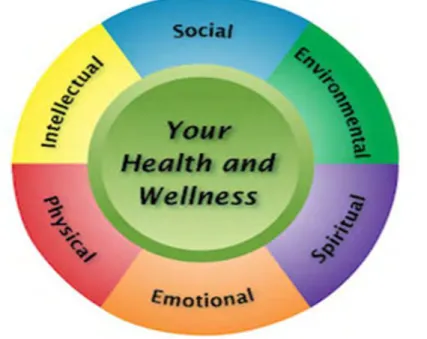
FIGURE2-1 WELLNESS WHEEL
SOURCE:(MAHIDA,2015)(HTTPS://RDE.STANFORD.EDU/COMMITMENT-WELLNESS,2013) In figure 2-1 Wellness Wheel Components at Health and Wellness for Families comprise six elements to form health and wellness. The components are summarised as physical health, emotional health, spiritual, intellectual, social and environmental health. The elements displayed are usually the of employee wellness programmes. Employee wellness program is industry specific hence different types of programmes exist. The elements are based on the employee health profile. It is vital to conduct risk assessment for the entire workforce in
programmes mostly target lifestyle modification such as exercise, gym, online health management systems, incentive based healthy programmes, disease management program, stress management, and work life balance programs (Parks and Steelman, 2008).
2.4 Theories relating to physiological and health needs
2.4.1 Maslow’s hierarchy of needs.
According to the assumptions of Maslow’s theory, it stated that within each human being exists a hierarchy of five needs (Robbins et al., 2009). These needs are divided into higher and lower orders, where higher order needs are satisfied within the human being and lower order needs satisfied externally by things such as health and wellness benefits (Robbins et al., 2009).
The first is the physiological need which includes thirst, shelter, hunger and other physical needs.
The second is the safety need which includes security and protection from physical and emotional harm.
The third is the social need which includes the need for belonging; acceptance, affection and friendship.
The fourth is the need for esteem and includes the need for internal factors like autonomy; achievement and self-respect as well as need for external factors like recognition and attention and status.
The fifth is the need for self-actualisation which includes things like growth, the urge to achieve ones' potential and self-fulfilment (Robbins et al., 2009). As each need becomes largely satisfied, the next need in the hierarchy becomes dominant. This theory of needs supports that employers are required to create an environment which will suggests all levels and maintain needs when they become dominant. Robbins et al (2009) stated that employers need to establish what level of the hierarchy is each employee currently at, and then devise strategies that will satisfy needs above that level. In the case of construction employees, the very basic needs could be physiological needs, safety and security needs for the subcontractors working in remote areas. Secondly, social needs as they are away from their families. Thirdly, the senior personnel will fall under the need for esteem and self –
actualization. Employers should seek to find out what the employees need and should not provide according to what they think is right. She argued that a homeless employee will not worry about promotion when he does not have a shelter (Phelan, 2014) .
Figure 2.2 Maslow' hierarchy
Source:HTTP://WWW.DRPHELANIPRESUME.BLOGSPOT.COM/2014/03/APPLYING-MASLOWS- HIERARCHY-OF-NEEDS.HTML
According to Maslow’s theory as shown in Diagram 2.2, not much evidence was presented to support the assumptions that unsatisfied needs motivate and that a satisfied need activates movement to a new level (Robbins et al., 2013). The fulfilment of employees’ psychological needs which is attained through being able to buy food, shelter and clothes with the money earned from work results to employee commitment towards that organisation (Robbins et al., 2013). The theory proves that should the need be attained the employee find satisfaction and gain strength to perform his duties. Happy workers translate to healthy profits(Robbins et al., 2013).
2.4.2 Benefits of employee wellness programs
FIGURE 2-3BENEFITS OF EMPLYEE WELLNESS PROGRAMME
Source: http://www.kkrwellnessworks.com
As per diagram 2.3, the workplace wellness programme of an organisation increases productivity, job performance and decreases health care costs, absenteeism and sick leave and employee turnover (https://rde.stanford.edu/commitment-wellness, 2013). The programs are designed to suit the need of a particular organisation. A study by Parks and Steelman (2008) proved that an employee health and wellness programme contributes positively in reducing absenteeism statistics in organisations (Parks and Steelman, 2008). Health and wellness is one of the organisational factors which positively contribute towards job satisfaction (Parks and Steelman, 2008). The management of human resources have taken a strategic role within
business spheres (Parry et al., 2005). According to Robbins et al (2009) job satisfaction is one of the contributory factors towards employee retention(Robbins et al., 2009). It is therefore through health programs that companies can be able to retain skills and brains.
Parks and Steelman (2008) argue that that employer who provides health and wellness are perceived as caring organisation and therefore enhance employee morale and attitude towards organisation (Parks and Steelman, 2008). U.S. research suggests that employers can benefit more by spending in the wellness of employees who are healthy rather than focusing on the sick minority (Paton, 2012). Research supported by Patterson, Warr and West (2004), cited in Parks and Steelman (2008) proves that employee welfare is one of the characteristics that may influence job satisfaction therefore health and wellness is grouped as one. (Parks and Steelman, 2008). Other organisations use health and wellness programmes as a recruitment tool to attract prospective applicants but it has not proven as successful (Parks and Steelman, 2008) (Shamiah and Jardali, 2007). ”
2.5 Construction industry Overview
FIGURE 2-4CONSTRUCTION SITE -COEGA
HTTP://STFRANCISCHRONICLE.FILES.WORDPRESS.COM/2013/06/DSC_7074-COPY.JPG
The Figure 2.4 of Coega the industrial development project, illustrates the way construction work operates, the positions adopted by the worker which contribute to back strain which is one the problems encountered by construction workers (EL-Safty et al., 2010). The dust exposure on site confirms the need for health and wellness activities such as medical screening for all workers. Gounden (2000) has defined the construction industry in South Africa as a vehicle that is playing a pivotal role in the reconstruction of the South African economy, via the delivery of economic and social infrastructure (Gounden, 2000).
The construction industry is a fundamental economic sector which permeates most of the other sectors as it transforms various resources into constructed physical economic and social infrastructure necessary for socio-economic development (EL-Safty et al., 2010).
Construction industry is characterized by short term, itinerant, unstable and low income earners. The health challenges faced by the industry are equivalent to agriculture and mining industry (Govender, 2012),(Zou et al., 2007). It is acknowledged that that human capital is the best investment a profitable business can make. The developing countries are facing these challenges, South Africa is no exception. South Africa, as a liberated country which is developing economically is faced with fast growing small, micro and medium enterprises.
Itinerant
The Globalisation has unveiled many gaps in construction industry which require some changes and improvement in all sectors in response to global competition. The improvement has been noticed on the following processes:
Total quality management (TQM)
Lean Manufacturing
Supply chain management
The three have been around for a long a time for the manufacturing industry however construction industry is left behind. The emerging of small and medium construction companies has exposed construction sector to competition and forced industry stakeholder to adopt business innovative strategies (Saunders, 2013b). Total Quality Management deals with product quality without which in the construction industry, there would be disaster. This is because health and safety depends mostly on the quality of work (Goetsch, 2013).
According to Saunders (2013) projects in construction has adopted lean tools “Kaizen”
(Kaizen is the practice of continuous improvement), visualisation techniques and other techniques which have impacted on health safety (Goetsch, 2013)
The fragmentation of the construction industry is a true picture of supply chain processes which requires structured management systems in place (Saunders, 2013b). The following section will discuss supply chain in the construction industry:
2.5.1 Supply chain management in construction industry
Supply chain management (SCM) is a common phenomenon in the manufacturing industry; it was an improvement from the total quality management (TQM) and just in time (JIT) (Saad et al., 2002)et al., 2002). It is defined by other scholars as the process of planning, implementing and controlling the operations of the supply chain as efficiently as possible (Faisol et al., 2006) (Black et al., 2000), (Saad et al., 2002). (Cooper et al., 1997a) defines supply chain management as “the integration of business processes from end user through original suppliers that provide products, services and information that add value for customers” (Cooper et al., 1997a)
According to Akintoye, (2000) supply chain in construction is a new development which is still in the infancy stage (Akintoye et al., 2000). The Construction industry comprises of a number of phases, stages and different stakeholders who demands reliable procurements processes, therefore a state of the art supply chain will be able to improve competitiveness (Burke, 2006). The department of Architecture and building services in Gaborone, (2000) in analysing developing countries construction industry, identified the lack of commitment in integrated project processes. An integrated project process is defined as the process that applies the full construction team, sourcing the stakeholder’s resourceful skills to focus on satisfying clients’ needs (Datta, 2000). The report also revealed that selection of new partners inhibits innovation and leads to project delays which could be improved by employing good supply chain management (Datta, 2000, Akintoye et al., 2000).
As explained the concept of supply chain management is new in the construction industry.
However in developed countries, SCM seems to be gaining a competitive advantage globally (Akintoye et al., 2000). Faisol, Dainty and Price, (2006) studied perceptions on construction
proved that the organisations have realised the importance of developing a good relationship with their suppliers (Faisol et al., 2006). The benefits of a good relationship with partners were further divided into:
• Project level, improved quality, reduced cost, reduced risk and completion on time.
• Business level, increased profits, increased market share, enhanced competitiveness.
• Corporate level, cost effectiveness, increased labour productivity, increased innovative opportunity, continuous quality improvements (Faisol et al., 2006).
The benefits of SCM as confirmed by other scholars revolved around human capital, the driver of all processes. The construction industry is still dominated by manual labour which therefore unveils the need for occupational health and wellness in construction (Datta, 2000).
Faison el al, (2006) argued that the success of construction projects relied on good relationships throughout the supply chain (Faison et al., 2006). According to Malik et al (2010) health and wellness in the workplace contributes to a high productivity rate, mitigate the occurrence of illness and injuries, improves organisational culture and finally, boost the morale in the workplace (Malik et al., 2010). As the construction industry is labour intensive, improving the health of employee will indirectly improve project processes. Construction projects use the services of contractors, subcontractors and other stake holders (Burke, 2006) (Govender, 2012) (De Silva and Wilmalaratne, 2012).
Supply Chain Management spans all movement and storage of raw materials, work-in- process inventory, and finished goods from point-of-origin to point-of-consumption (Cooper et al., 1997b).
2.5.2 The construction industry governing body
Construction Industry Development Body (CIDB) Construction plays an important role in South Africa’s economic and social development. It provides the physical infrastructure and backbone for economic activity with a high rate of employment. Since 1994, the South African construction industry has encountered a number of development and transformation challenges.
The challenges identified by South African construction industry were as follows:
• Improving effectiveness of public sector spending on physical infrastructure development and maintenance.
• Improving labour absorption, labour relations and job stability.
• Accelerating sustainable transformation through access to opportunity, finance and training.
• Reducing the impact of HIV and AIDS in construction
• Ensuring international competitiveness.
2.5.3 Current occupational health programmes in the construction industry
Generally, the benefits of occupational health have been explored in most industries except in construction, agriculture and among small and medium companies (Walters et al., 1997). The study conducted in Egypt and the United State of America construction industry supported an idea that construction companies that focused on Occupational Health and Wellness yielded positive results (EL-Safty et al., 2010). Occupational Health has become the focus of the Department of labour, unions, department of health and Department of Minerals and Energy (mines). The Department of Labour has enforced laws that require employers to develop occupational health programs that comply with the industry legislations (Jeebhay and Jacobs, 1999). There will be no discussion on mines related legislation for this topic. In South Africa the recent surge of private occupational health services was in response to the demand created by different legislations. There is not much research done on this topic hence the construction industry has neglected occupational health and focused on safety issues (Stocks et al., 2015), Malek et al., 2010).
Occupational health services in the construction industry are mostly on a part time consultancy basis. The nature of the industry makes it difficult to have an in house OH services (Lopes et al., 2009). This contributes to poor development of OH culture among industry stakeholders (De Silva and Wimalaratne, 2012b)). Mobile OH services have become the solution to the industry. However, sometimes it becomes a challenge to source
challenge. There is a lack of integrated services between occupational health and public health services (Jeebhay and Jacobs, 1999). The sub-contractors at the bottom of the supply chain are most sufferers when it comes to occupational health and safety issues.
Fragmentation is one of the biggest challenges to the maintenance of health and safety in construction (Smallwood and Haupt, 2007.) The gap creates problems in the referral system and continuous monitoring of chronic cases. This undermines the benefits brought by OH programmes in industry.
2.5.4 Occupational hazards in the construction industry
According to De Silva and Wilmalaratne (2012) the work environment in the construction industry is more hazardous than in other industries (De Silva and Wimalaratne, 2012a).
Supported by Ahmed et al, (2006) and (Molenaar et al., 2015) the nature of operations, dangerous tools, hazardous materials, and uncertainty of the environment is the cause of a dangerous environment (Molenaar et al., 2015). The degree of health hazards in construction differ from one worker’s trade to another and also from one type of project to another (De Silva and Wilmalaratne, 2012).
2.5.4.1 The common Occupational Health hazards
Occupational health hazards are categorised as follows:
• Physical and mechanical (noise, vibration, heat, radiation, various gases etc.)
• Chemical (chemical substances, dust, fumes, vapour, asbestos, cement, etc.)
• Ergonomic (sitting position, lifting, repetitive task, climbing, working at height and bending)
• Biological and environmental ( Tuberculosis, hepatitis, malaria etc.,)
• Substance abuse (drugs, alcohol and smoking). (Palihawadane, 2009) (De Silva and Wilmalaratne, 2012).
LIFESTYLE WORKPLACE WORKOUT
FIGURE 2-5LIFESTYLE WORKPLACE WORKOUTS SOURCE:HTTP://WWW.COMMERCIALAPPEAL.COM
The figure 2.5 lifestyle workout shows commitment of the employer in providing general exercising for the entire workforce on-site. The goal was to prevent back strain injuries by warming up the soft muscles (www.sparkpeople.com/resource/wellness_articles.asp?id=246, 2014).
According to (Molenaar et al., 2015) (Frantz and Himalowa, 2012) the low back pain (LBP) is one of the complications of working as a construction worker hence the industry is manual work dominated (Frantz and Himalowa, 2012). The most dangerous risk factor identified was the awkward, prolonged working postures, daily lifting and manipulation of heavy objects (Frantz and Himalowa, 2012). Further to that low back pain is the major contributory cause of absenteeism and disability in construction industry. LBP also contributed to the psychological and functional status of the participants. Frantz and Himalowa (2012) have recommended that multidisciplinary involvement by all stakeholders is imperative in order to adopt primary preventative measures (Frantz and Himalowa, 2012). The Figure 2-5 shows workers taking part in exercises as part of health and wellness activity.
According to De Silva and Wimalaratne (2012) the most vulnerable construction trade worker are masons, carpenters or roofers, plumbers, electricians, workers finishing work or painters, welders or steel workers, tillers and unskilled labourers (De Silva and Wilmalaratne 2012). This leads one to conclude that the entire construction project is hazardous and therefore requires comprehensive occupational health programmes. The studies have proved that, generally the degree of occupational exposure varies from one trade to another as well as from project to project environment. (Palihawadane, 2009) (Smallwood and Haupt, 2007).
Most studies have focused on occupational safety processes and neglect the occupational health hazards as the main underlying cause of most of the accidents that happens on site.
2.5.5. Discussing employee health and wellness in the construction industry
There has been much research conducted on health and wellness in general but nothing much has been done on the construction industry. According to Rooney (2012), the focus on health and wellness has increased and progressed considerably, using absenteeism and job satisfaction as variables (Rooney, 2012b).
Since 1994, they have been a complete turnaround of occupational health and safety monitoring in South Africa. Department of labour has instituted stringent controls in all sectors most especially the most neglected sectors such as agriculture, mining and the construction industry http://www.workforcehealthcare.co.za.
The worksite has been identified as the good environment for the provision of health and wellness promotional services, hence the amount of time spent in the workplace (Fielding and Piserchia, 1989). Health and wellness programs are industry specific hence occupational health risk exposure and the demographic profile (Hymel et al., 2011b).
The findings presented by Alavinia et al (2009, cited Welch, L.S. 2009) suggested that the contributory factors towards keeping construction workers productive longer revolve around obesity, healthy lifestyle, chronic disease management and management of risks. Therefore he recommended comprehensive health promotion programmes for the construction industry (Welch, 2009). His view was supported by other scholars and proved that employee wellness intervention improved retirement age by 0.24% compared to the non-intervention group (Welch, 2009).