The current submission is the first at the University of KwaZulu-Natal to meet the requirements for a Doctor of Philosophy qualification. Opinions and conclusions reached are those of the author and should not be attributed to the CoE in Human Development.
- Background
- Rational for the study
- Philosophical underpinnings of the study
- Aim (s) and objectives of the study
- Study aim
- Study objectives
- Research questions
- Outline of the thesis
Chapter two is a review of the literature review related to the HIV/AIDS epidemic and school youth. Recognizing the critical role that VMMC plays in the current HIV prevention revolution, the article focused on the legal and policy framework that informs school health care in Zimbabwe.
Introduction
Background
As such, in-school adolescents in sub-Saharan Africa are identified as a key population for HIV prevention interventions (Abdool Karim et al., 2014). This has led to the investment of hope in those interventions that attempt to address structural drivers of the epidemic (Bekker et al., 2015).
HIV/AIDS, the socio-economic and political environment in Zimbabwe
However, sex education in Zimbabwe is in crisis, with little consensus on quality and content of the curriculum (Jackson, 2002; Chikovore et al., 2009). Unfortunately, this phase was short-lived and ended with a total collapse of the health system (Terry, 2006).
Economic Structural Adjustment Programme, HIV/AIDS and social service delivery in
The immediate negative effects of ESAP on social outcomes include a decline in social service provision due to the introduction of user fees in healthcare and education in the context of rising unemployment ( Murisa, 2010 ). The introduction of user fees at healthcare institutions and the end of free education against the backdrop of declining employment militated against the provision of social services as these crucial services fell out of reach for many.
HIV/AIDS and authoritarian statism: 2000 and beyond
With a total collapse of the health delivery system, HIV and AIDS statistics experienced an astronomical rise. Therefore, the implementation of Operation Restoration Order worsened the living conditions for most of the country's population.
Sexuality and HIV/AIDS in Zimbabwe
The intolerance is also evident in the government's continued refusal to provide prisoners with condoms despite overwhelming evidence that homosexuality is rampant in the country's prisons. As such, the government is reluctant to promote condoms in prisons, as homosexuality is codified as a crime in the country's criminal law (Constitution of Zimbabwe,
HIV/AIDS and the policy environment in Zimbabwe
It is important to highlight that in some cases; there are contradictions and conflicts between the country's statutes and policy position at the ministry level (Chikovore et al., 2009; Marindo et al., 2003). It is important to highlight that although not legally stipulated, Zimbabwe is generally a Christian nation (Duri et al., 2013).
Conclusion
It is important to state that condom use or discussion thereof is largely prohibited as a social norm, while being supported by legislation that is vague. In Zimbabwe, "[p]oliticians and traditional and Christian leaders promote abstinence as the exclusive strategy for all young people, whereas non-governmental organizations and the private sector promote condom use" (Marindo et al., 2003, p.1).
Introduction
VMMC for HIV prevention in Zimbabwe
This policy sought to promote the provision of VMMC for HIV prevention across the wider male population (NAC, 2011). In another study, Shumba (2014) conducted a qualitative exploration of Lemba perspectives on VMMC for HIV prevention in Midlands Province's Mberengwa District.
Condom use and promotion
At the population level, evidence pointing to the effectiveness of condoms is often drawn from success stories such as that of the government of Thailand during the early days of the AIDS epidemic (UNAIDS, 2002). Both the Sonagachi project in India and Uganda's pioneering of the ABC approach, characterized by aggressive social marketing of condoms, point to the effectiveness of condoms in reducing HIV incidence (Dutta, 2008; Nkwi & Bernard, 2012 ).
The female condom
For example, the Women's and AIDS Support Network (WASN) was instrumental in embarking on a nationwide campaign to promote femido (CHANGE, 2011; Peters et al., 2010). Compared to other prevention approaches, the procurement and growth of femdom in Zimbabwe has been generally negligible.
Condom availability
Policy makers, traditional and socio-religious leaders in Zimbabwe prescribe abstinence as the only strategy to stop HIV transmission while non-governmental organizations (NGOs) and the private sector see hope in condom use (Chikovore et al., 2009). In Zimbabwe, and other African countries, evidence that sexual debut is occurring much earlier than ever before is overwhelming (Guttmacher Institute, 2014; Mbotho et al., 2011).
Male circumcision
A high prevalence of circumcision is often attributed to the low prevalence of HIV in West Africa (Auvert et al., 2005). Different groups of untreated circumcisers cut different amounts of foreskin (Gruskin, 2007; Peltzer et al., 2007).
Adolescence, sexuality and HIV/AIDS
Despite a proliferation of psychological literature that normalizes conflict during the transition phase, debunking this discourse that portrays adolescence as a period of turmoil is proving a mammoth task (Frizelle et al., 2013). Because of their sporadic behaviour, young people are therefore seen as lacking autonomy, vulnerable and irresponsible; and consequently needed adult guidance, protection and constant supervision (Frizelle et al., 2013).
Gendered constructions of adolescent sexuality
This study is firmly anchored in a bedrock of Health Promotion; thus, it is inspired by the spirit of the historic Alma-Ata Declaration of 1978. It is my belief that if strong sex education is provided in school, females will benefit by gaining confidence in themselves and their decisions.
Adolescent sexual and reproductive health in Zimbabwe
Such an approach is fundamentally opposed to the dominant paradigm, where school-based sexuality programs are largely based on a moralistic agenda determined to promote abstinence as the only prescription for maintaining an HIV-free status (Bay-Cheng , 2003; .Marindo et al., 2003). Other strategies such as VMMC for HIV are new tools in the “HIV prevention toolbox” and are not promoted in a comprehensive manner as best practice requires (Hankins, 2007; Montague et al., 2014).
School based sexual and reproductive health education
However, it is difficult to convince all young people to privately adhere to religious teachings on abstinence. Therefore, the fallibility of religious and non-religious youth for sexual sins requires urgent consideration in the social marketing of contraceptives, especially condoms.
Conceptual framework
- Culture
- Structure
- Agency
Within the framework of CCA, the concept of culture relates to the local contexts within which health meanings are not only constituted, but negotiated and interpreted. As a function of the structure, certain population groups are relegated to the fringes of the healthcare system and vice versa (Dutta, 2008).
Application of the CCA to the study
Being in dialogue means committing yourself to a continuous transformation of reality.” One of the crucial commitments of the CCA is to foreground the voice of the subordinate participant (Dutta, 2008). Moreover, regarding the role of the researcher, the CCA proposes a shift in perspective.
Contextualising the ‘new’ sociology of childhood
Pursuing a social justice agenda, which the researcher thought would increase engagement with young people (conceived as marginal) in a critical sense, as the title of this thesis implied; the researcher was inclined to conduct research with school youth rather than youth in school. The selection of young people in school as the main focus in this study not only served an ethical mandate, that of giving the previously marginalized and silenced voice an opportunity to be heard, but also helped to (re)assert agency social of young people.
Conclusion
Research can maintain hegemony through traditional stereotypes, where 'other' populations, such as the young, are relegated to the margins, while researchers occupy themselves with the 'centre' (Goldberg, 2013). The work with the youth population within health promotion has Flicker et al. 2008) suggested that young people should be considered as community assets, privileged with the potential to create viable partnerships in diagnosing community health challenges and developing possible solutions.
Introduction
The study context– Zimbabwe
This caused an unprecedented wave of unemployment and abject poverty in Zvishavane and its hinterland. In Zvishavane Urban, VMMC is only offered at Zvishavane District Hospital (White Hospital), while Mberengwa has several healthcare centers offering this important healthcare service.
Outline of the chapter
Research paradigm and design
- Focus group discussions
- In-depth individual interviews
Furthermore, these authors argue that the epistemological and ontological assumptions that the researcher espouses play an important role in the choice of research design. This quote can be read as a kind of “methodological fundamentalism” that strictly insists on a given research design as a “design” (Carter & Little, 2007).
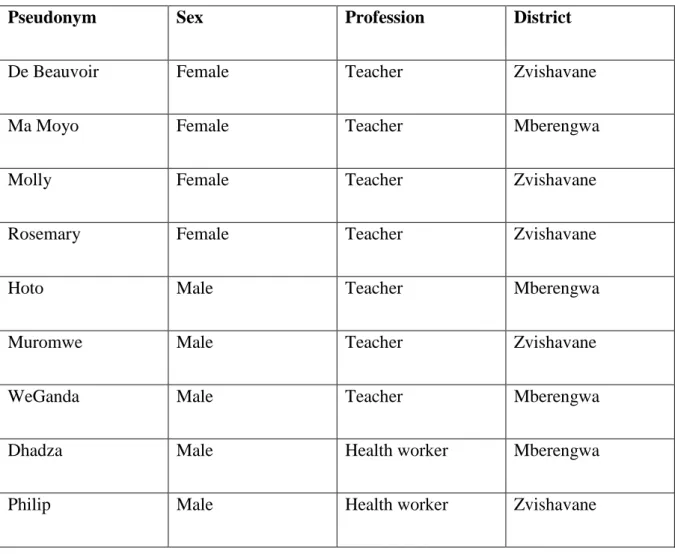
Selection of participants
Because depth takes precedence over breadth in qualitative research mentioned above (Ulin, Robinson, & Tolley, 2005), the researcher found it ideal to have multiple interview sessions with each of the nine adult participants. Students would identify fellow students with the set characteristics that the researcher would approach and invite to participate.
Research instruments
- Researcher as key instrument
- Interview guide
- Piloting the interview guide
Similarly, the teachers were very invaluable persons in the process of selecting participants. The structure and order of the questions in the interview guide were not concrete, but rather fluid, as they could always be adjusted depending on how the conversation would develop.
Data collection and procedures
- Entry into the research site
- Navigating the initial, ethical and methodological hurdle
- Data collection
Tacitly, the researcher used what might be called 'social intelligence' to navigate the above hurdle, while at the same time striving to protect the integrity of the study and the quality of data. The researcher(s) asked permission from participants to audio record the interviews and permission was granted.
Data analysis
Thorough reading resulted in the researcher becoming 'immersed' in the data, leading to greater familiarity with the depth and breadth of the data sets. Second, member checks provided additional volunteer information that ultimately contributed to the richness and thickness of the data.
Conclusion
Introduction
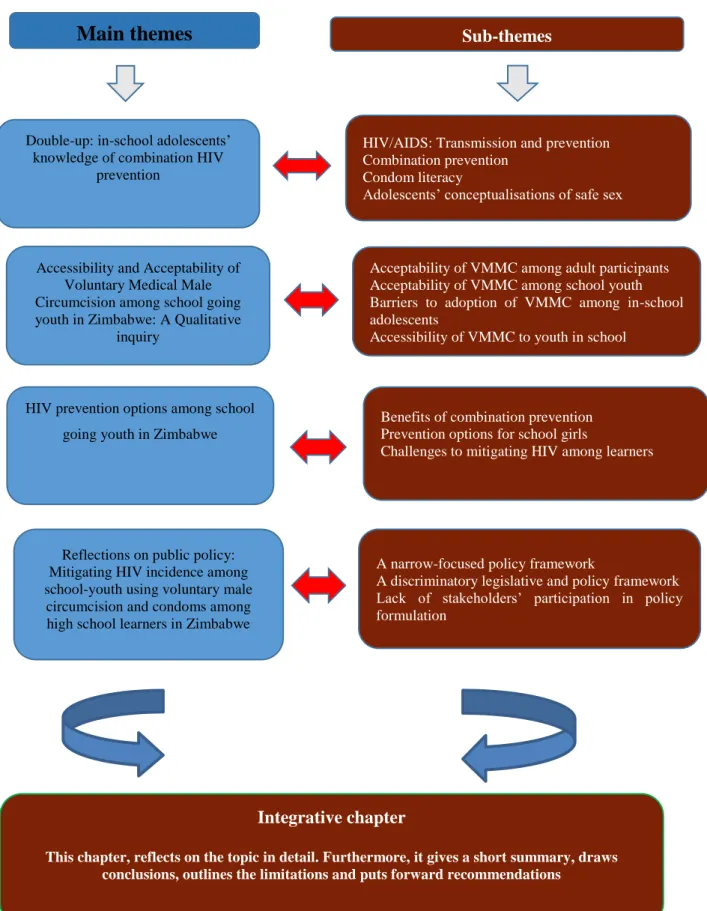
Emergent themes from the findings
Acceptability of VMMC among adult participants Acceptability of VMMC among school youth Barriers to adoption of VMMC among school youth. The researcher does not seek to suggest that these four themes represent an exhaustive list of the most salient topics regarding VMMC and condoms for HIV prevention among youth in school.
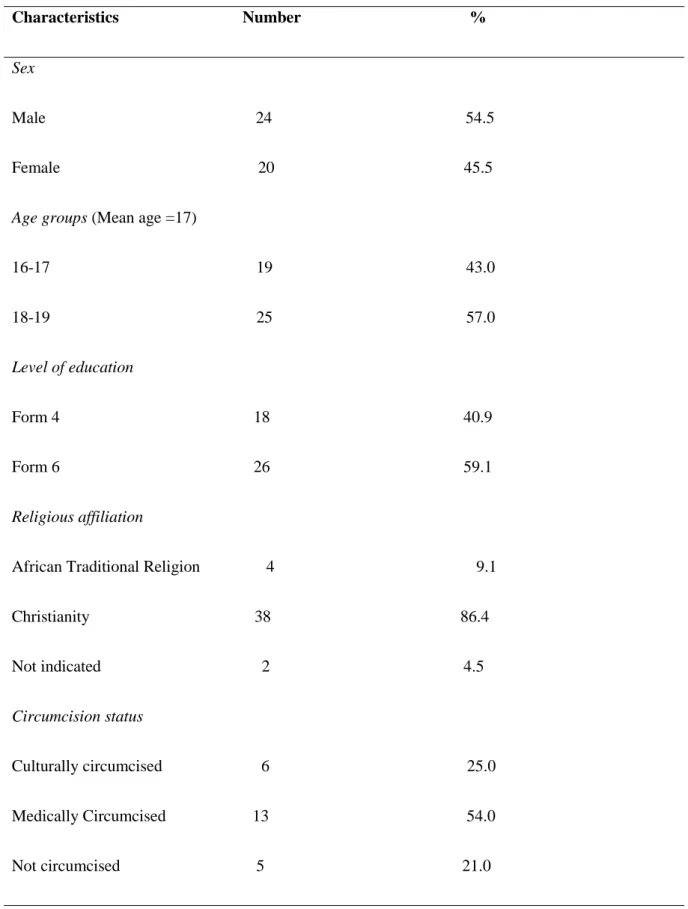
Socio-demographic data for study sample
It should be emphasized that these topics are closely related, so some subtopics may overlap. The sequencing of the topics was a deliberate process in an effort to be consistent, as the topics are closely related.
Knowledge and comprehension of HIV/AIDS: A focus on prevention
- HIV/AIDS: Transmission and prevention
- Combination prevention
- Condom literacy
- Adolescents’ conceptualisations of safe sex
According to Barnett and Whiteside (2002), "the principle of successful prevention lies in ensuring that people are not exposed to the disease or, if they are, that they are not susceptible to infection" (p.40). Pleasant sex awaits us in marriage, and for now it is the experience that matters (FGD: 4B, Mberengwa).
Discussion
This finding is consistent with the results of related studies conducted with participants (Jackson, 2002; Mavedzenge et al., 2014). It has been argued that there are high rates of condom breakage among and incorrect use of condoms by young people (Hensel et al., 2016).
- Background
- Analytical framework
- Findings
- Acceptability of VMMC among adult participants
- Acceptability of VMMC among school youth
- Accessibility of VMMC to youth in school
- Discussion
- Conclusion
The findings indicate an increasing acceptance of VMMC for HIV prevention among school youth by adults and youth themselves. Most of the participants emphasized that the preventive effect of VMMC was crucial in the decision to circumcise.
- Introduction
- Findings
- Discussion
- Limitations of the study
- Conclusions
There is therefore little study that focuses particularly on combination HIV prevention among school youth. The aim of this study was to explore participants' perceptions of HIV prevention among school youth.
- Background
- Adolescents, HIV/AIDS, the legal and policy framework in Zimbabwe
- Findings
- A narrow focused policy framework
- A discriminatory legislative and policy framework
- Lack of stakeholders’ participation in policy formulation
- Discussion
According to health worker participants, ASRH in schools can be a means of communicating age-specific health messages. For example, by expanding the VMMC knowledge base, there are also challenges with this approach, for example the complexity of managing mixed classes when discussing sensitive issues. This may have a negative impact on HIV preventive interventions such as condom use and VMMC, especially among school adolescents.
- Introduction
- Title of the thesis
- Integrative discussion
- Implications for interventions and practice
- The study’s contribution to academic knowledge
- Limitations of the study
- Recommendations
- Conclusion
There is a dearth of research that foregrounds youth, who ironically make up more than 60% of the VMMC customer base in this southern African country (Ashengo et al., 2014; WHO, 2013). Apparently, the narratives provided by most youth participants indicated that their constructions of the reality of preventing HIV incidence are largely a dichotomy of risk reduction versus risk avoidance.
ETHICAL CLEARANCE CERTIFICATE
CONSENT FORM FOR INDIVIDUAL PARTICIPANTS
CONSENT FORM FOR PARENT/GUARDIAN OF LEARNER
FOCUS GROUP GUIDE FOR LEARNERS