Arts in Practice 2019 v1.0
Applied Senior Syllabus
This syllabus is for implementation with Year 11 students in 2019.
Contents
1 Course overview __________________________________ 1
1.1 Introduction ... 1
1.1.1 Rationale ... 1
1.1.2 Learning area structure ... 2
1.2 Teaching and learning ... 3
1.2.1 Dimensions and objectives ... 3
1.2.2 Underpinning factors ... 5
1.2.3 Planning a course of study ... 8
1.2.4 Developing a module of work ... 9
1.2.5 Aboriginal perspectives and Torres Strait Islander perspectives ... 9
2 Subject matter ___________________________________ 11 2.1 Core ... 11
2.1.1 Arts literacies ... 11
2.1.2 Arts processes ... 12
2.2 Electives ... 13
2.2.1 Dance ... 13
2.2.2 Drama ... 13
2.2.3 Media arts ... 13
2.2.4 Music ... 13
2.2.5 Visual arts ... 13
3 Assessment ____________________________________ 14 3.1 Assessment—general information ... 14
3.1.1 Planning an assessment program ... 14
3.1.2 Authentication of student work ... 15
3.2 Assessment techniques ... 15
3.2.1 Project ... 17
3.2.2 Product (Artwork)... 20
3.2.3 Extended response... 21
3.2.4 Investigation ... 23
3.3 Exiting a course of study ... 25
3.3.1 Folio requirements ... 25
3.3.2 Exit folios ... 25
3.3.3 Exit standards ... 25
3.3.4 Determining an exit result ... 25
3.3.5 Standards matrix ... 27
4 Glossary _______________________________________ 29
1 Course overview
1.1 Introduction
1.1.1 Rationale
The arts are the common threads of life in all communities and the mirrors of society’s aspirations. They have the capacity to engage, inspire and enrich the lives of students,
exciting the imagination and encouraging them to reach their creative and expressive potential.
They provide opportunities for students to learn how to create, design, represent, express, communicate and share their imagined and conceptual ideas, emotions, observations and experiences.1
In this syllabus, the term ‘the arts’ embraces studies in and across the visual, performing and media arts — dance, drama, media arts, music and visual arts. While these five art forms reflect distinct bodies of knowledge, understanding and skills, and involve different approaches to arts practices, critical and creative thinking and meaning-making processes, they have close relationships and are often used in interrelated ways.
The interdisciplinary nature of the arts is becoming a more prevalent characteristic of
contemporary arts practice. In authentic, contemporary art-making situations, art forms are often integrated, allowing artists to meet purposes and express ideas and meanings while creating powerful 21st century artworks. Interdisciplinary art practices are becoming more prevalent in shaping future arts.
The Arts in Practice syllabus gives students opportunities to engage with two or more art forms to create an artwork. The realised artwork might be a performance, a product or a combination of both that is an innovative expression of a personal aesthetic.
Through this broad-based, interdisciplinary course of study, students explore the core of arts literacies and arts processes, apply techniques and processes, analyse and create artworks, and investigate artists’ purposes and audience interpretations. They have the opportunity to engage with creative industries and arts professionals as they gain practical skills, use essential
terminology and make choices to communicate ideas through their art-making.
The Arts in Practice syllabus recognises that the needs and interests of students vary
considerably. Schools are given the flexibility to cater for students with diverse interests and skills in the arts.
Pathways
A course of study in Arts in Practice can establish a basis for further education and employment by providing students with the knowledge and skills that will enhance their employment prospects in the creative arts and entertainment industries, and help them to understand the different careers available. With additional training and experience, potential employment opportunities may be found in areas such as arts management and promotions, arts advertising and marketing, theatre and concert performance, multimedia, video game and digital entertainment design, screen and media, and creative communications and design.
1 The Australian Curriculum: The Arts, Foundation to Year 10, v 7.3, Rationale
1.1.2 Learning area structure
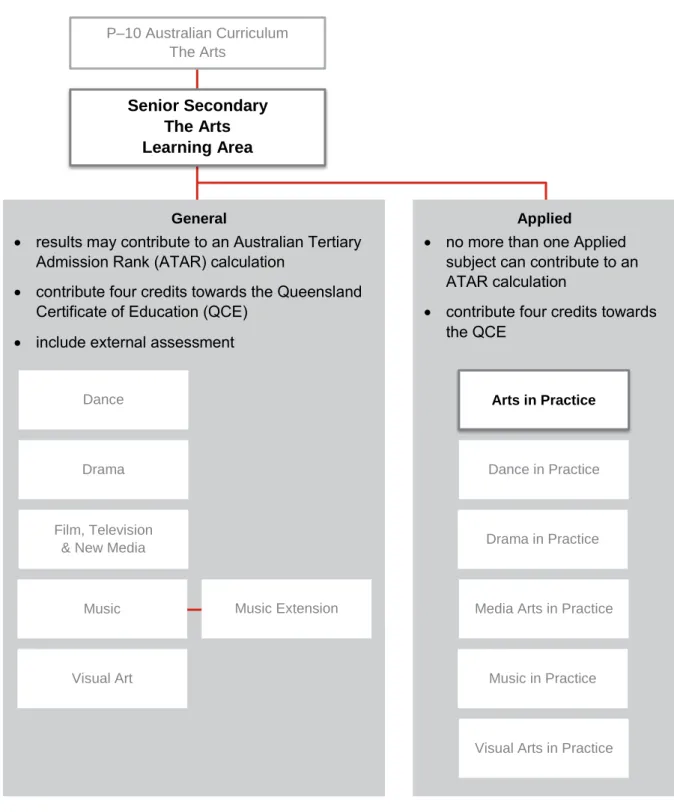
Figure 1: Summary of subjects offered in the Arts learning area
Applied
no more than one Applied subject can contribute to an ATAR calculation
contribute four credits towards the QCE
General
results may contribute to an Australian Tertiary Admission Rank (ATAR) calculation
contribute four credits towards the Queensland Certificate of Education (QCE)
include external assessment
Dance
Drama
Film, Television
& New Media
Visual Art
Arts in Practice
Dance in Practice
Drama in Practice
Media Arts in Practice
Music in Practice
Visual Arts in Practice Senior Secondary
The Arts Learning Area P–10 Australian Curriculum
The Arts
Music Music Extension
1.2 Teaching and learning
1.2.1 Dimensions and objectives
The dimensions are the salient properties or characteristics of distinctive learning for this subject.
The objectives describe what students should know and be able to do by the end of the course of study.
Progress in a particular dimension may depend on the knowledge, understanding and skills developed in other dimensions. Learning through each of the dimensions increases in complexity to allow for greater independence for learners over a four-unit course of study.
The standards have a direct relationship with the objectives, and are described in the same dimensions as the objectives. Schools assess how well students have achieved all of the objectives using the standards.
The dimensions for a course of study in this subject are:
Dimension 1: Knowing and understanding
Dimension 2: Applying and analysing
Dimension 3: Creating and evaluating.
Dimension 1: Knowing and understanding
Knowing and understanding refers to the knowledge and understanding of concepts and ideas related to arts literacies and arts processes. Students show their understanding by retrieving relevant knowledge from long-term memory and constructing meaning from oral, written, visual, aural and physical texts, including artworks.
Objectives
By the conclusion of the course of study, students should:
identify and explain concepts and ideas related to arts literacies and arts processes
interpret information about arts literacies and arts processes
demonstrate arts literacies and processes in arts making.
When students identify, they locate and recall information about the arts, recognising particular qualities and/or characteristics of arts processes. When students explain, they present meaning in a context with clarity, precision and completeness. They provide additional information and examples that demonstrate understanding and help clarify and exemplify the meanings of artworks and processes in particular styles and contexts.
When students interpret, they show understanding of meanings, aural and visual symbols, movement, skills and techniques by converting information from one form of representation to another, e.g. by translating written symbols into sounds (and vice versa), converting written or verbal briefs to media or interpreting aesthetic codes.
When students demonstrate, they show an understanding of arts literacies and arts processes by reproducing learnt skills within art forms and contexts, or through arts processes or products.
Dimension 2: Applying and analysing
Applying and analysing refers to the application, investigation and analysis of arts literacies and arts processes. It involves gathering and dissecting information about arts concepts and ideas to find meaning, determine relationships and identify patterns, similarities and differences in an overall structure.
Objectives
By the conclusion of the course of study, students should:
organise and apply arts literacies and arts processes to achieve goals
analyse artworks and arts processes
use language conventions and features to convey information and meaning about art forms, works and processes.
When students organise, they locate, select, classify and order relevant information about the arts. They demonstrate their understanding of arts literacies and arts processes by using them in context and interpreting information to make decisions. They determine how elements fit or function within a structure. When students apply, they carry out or use arts processes in a given situation to perform a familiar or unfamiliar task. They use arts literacies and arts processes for a purpose in authentic arts contexts.
When students analyse, they interpret patterns and relationships, explore and investigate artists’
functions, purposes and meanings, and audience interpretations. They dissect information about the purpose, form and context of art forms, works and processes to explore and examine
alternative viewpoints, showing recognition and significance of patterns, similarities and differences.
When students use language conventions and features, which may be verbal or symbolic, they use correct grammar, spelling, punctuation, vocabulary (including terminology specific to art forms), text types and structures, and notation across communication modes to convey information and meaning about art forms, works and processes.
Dimension 3: Creating and evaluating
Creating and evaluating refers to the generation and communication of arts ideas. This includes the planning and management of arts sources and resources, and the synthesis of arts literacies, practices and information. It encompasses reflection on the outcomes of activities in the arts, and appraisal of arts information, processes, strategies and practices.
Objectives
By the conclusion of the course of study, students should:
generate arts ideas and plan arts processes
implement arts processes to create communications and realise artworks
evaluate artworks and processes.
When students generate arts ideas, they conceptualise, create and develop ideas that are abstract, concrete, aural, visual or kinaesthetic, and that form a coherent or functional whole.
Ideas are trialled and solutions are found. This includes the process of constructing through the idea and innovating the concept. When students plan arts processes, they manage time and the technological, human, financial and consumable resources required to organise activities in the Arts, develop the processes and bring ideas and concepts to reality. They devise processes for
accomplishing tasks based on their ability to use knowledge and understanding of arts literacies and production processes, and their ability to analyse and apply them.
When students implement arts processes, they put their planning into effect to create and form a coherent or functional whole, which may be a communication, e.g. an artist’s statement, or a resolved artwork. When students create communications and realise artworks, they present information and convey meaning through written, spoken, physical, graphical, visual and/or auditory modes, appropriate to audiences, purposes and contexts. They combine aspects of arts literacies and arts processes, or reorganise elements into a new pattern or structure.
When students evaluate, they reflect on and critique their own and others’ artworks and arts processes. They judge the success of artworks and activities against information, the intended purpose and the perceived aesthetic qualities (visual, aural, technical and expressive). They provide reasons or evidence to support statements and decisions.
1.2.2 Underpinning factors
There are five factors that underpin and are essential for defining the distinctive nature of Applied syllabuses:
applied learning
community connections
core skills for work
literacy
numeracy.
These factors, build on the general capabilities found in the P–10 Australian Curriculum. They overlap and interact, are derived from current education, industry and community expectations, and inform and shape Arts in Practice.
All Applied syllabuses cover all of the underpinning factors in some way, though coverage may vary from syllabus to syllabus. Students should be provided with a variety of opportunities to learn through and about the five underpinning factors across the four-unit course of study.
Applied learning and community connections emphasise the importance of applying learning in workplace and community situations. Applied learning is an approach to contextualised learning;
community connections provide contexts for learning, acquiring and applying knowledge,
understanding and skills. However, Core skills for work, literacy and numeracy contain identifiable knowledge and skills which can be directly assessed. The relevant knowledge and skills for these three factors are contained in the course dimensions and objectives for Arts in Practice.
Applied learning
Applied learning is the acquisition and application of knowledge, understanding and skills in real-world or lifelike contexts. Contexts should be authentic and may encompass workplace, industry and community situations.
Applied learning values knowledge — including subject knowledge, skills, techniques and
procedures — and emphasises learning through doing. It includes both theory and the application of theory, connecting subject knowledge and understanding with the development of practical skills.
Applied learning:
links theory and practice
integrates knowledge and skills in real-world or lifelike contexts
encourages students to work individually and in teams to complete tasks and solve problems
enables students to develop new learnings and transfer their knowledge, understanding and skills to a range of contexts
uses assessment that is authentic and reflects the content and contexts.
Community connections
Community connections build students’ awareness and understanding of life beyond school through authentic interactions. This understanding supports the transition from school to participation in, and contribution to, community, industry, work and non-profit organisations.
‘Community’ includes the school community and the wider community beyond the school, including virtual communities.
Valuing a sense of community encourages responsible citizenship. Connecting with community seeks to deepen students’ knowledge and understanding of the world around them and provide them with the knowledge, understanding, skills and dispositions relevant to community, industry and workplace contexts. It is through these interactions that students develop as active and informed citizens.
Schools plan connections with community as part of their teaching and learning programs to connect classroom experience with the world outside the classroom. It is a mutual or reciprocal arrangement encompassing access to relevant experience and expertise. The learning can be based in community settings, including workplaces, and/or in the school setting, including the classroom.
Community connections can occur through formal arrangements or informal interactions.
Opportunities for community connections include:
visiting an arts business or community arts organisation or agency
organising an arts event for the school or local community
working with community arts groups in a range of activities
providing an arts-related service for the local community
attending arts industry expos and arts career ‘taster’ days
participating in mentoring programs and work-shadowing arts workers
gaining work experience in arts industries
interacting with visitors to the school, such as community representatives, industry experts, employers, employees and the self-employed
internet, phone or video conferencing with:
- other school communities
- personnel from arts organisations - practising artists
- gallery staff.
Core skills for work
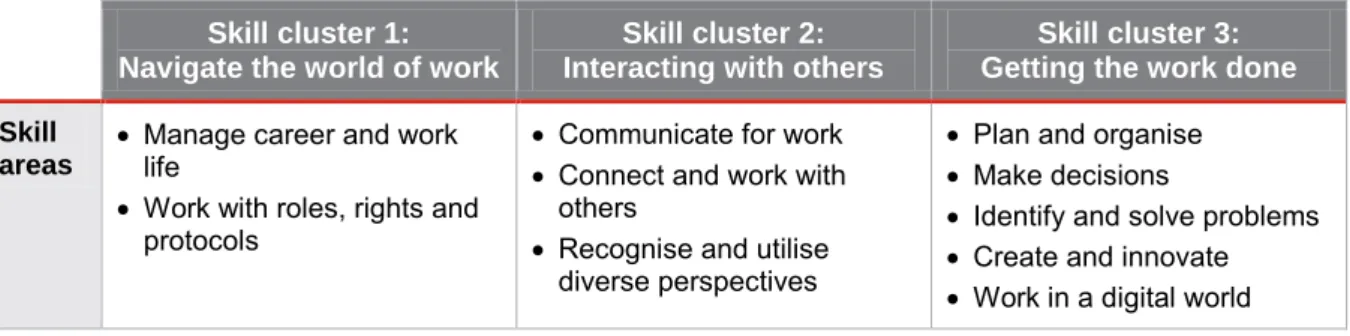
In August 2013, the Australian Government released the Core Skills for Work Developmental Framework (CSfW).2 The CSfW describes a set of knowledge, understanding and non-technical skills that underpin successful participation in work.3 These skills are often referred to as generic or employability skills. They contribute to work performance in combination with technical skills, discipline-specific skills, and core language, literacy and numeracy skills.
The CSfW describes performance in ten skill areas grouped under three skill clusters, shown in the table below. These skills can be embedded, taught and assessed across Arts in Practice.
Relevant aspects of core skills for work are assessed, as described in the standards.
Table 1: Core skills for work skill clusters and skill areas
Skill cluster 1:
Navigate the world of work
Skill cluster 2:
Interacting with others
Skill cluster 3:
Getting the work done Skill
areas
Manage career and work life
Work with roles, rights and protocols
Communicate for work
Connect and work with others
Recognise and utilise diverse perspectives
Plan and organise
Make decisions
Identify and solve problems
Create and innovate
Work in a digital world
Literacy in Arts in Practice
The information and ideas that make up Arts in Practice are communicated in language and texts.
Literacy is the set of knowledge and skills about language and texts that is essential for understanding and conveying this content.
Each Applied syllabus has its own specific content and ways to convey and present this content.
Ongoing systematic teaching and learning focused on the literacy knowledge and skills specific to Arts in Practice is essential for student achievement.
Students need to learn and use the knowledge and skills of reading, viewing and listening to understand and learn the content of Arts in Practice. Students need to learn and use the knowledge and skills of writing, composing and speaking to convey the Arts in Practice content they have learnt.
In teaching and learning in Arts in Practice, students learn a variety of strategies to understand, use, analyse and evaluate ideas and information conveyed in language and texts.
To understand and use Arts in Practice content, teaching and learning strategies include:
breaking the language code to make meaning of Arts in Practice language and texts
comprehending language and texts to make literal and inferred meanings about Arts in Practice content
using Arts in Practice ideas and information in classroom, real-world and/or lifelike contexts to progress students’ learning.
2 More information about the Core Skills for Work Developmental Framework is available at https://docs.education.gov.au/node/37095
3 The term ‘work’ is used in the broadest sense: activity that is directed at a specific purpose, which may or may not be for remuneration or gain.
To analyse and evaluate Arts in Practice content, teaching and learning strategies include:
making conclusions about the purpose and audience of Arts in Practice language and texts
analysing the ways language is used to convey ideas and information in Arts in Practice texts
transforming language and texts to convey Arts in Practice ideas and information in particular ways to suit audience and purpose.
Relevant aspects of literacy knowledge and skills are assessed, as described in the standards.
Numeracy in Arts in Practice
Numeracy is about using mathematics to make sense of the world and applying mathematics in a context for a social purpose.
Numeracy encompasses the knowledge, skills, behaviours and dispositions that students need to use mathematics in a wide range of situations. Numeracy involves students recognising and understanding the role of mathematics in the world and having the dispositions and capacities to use mathematical knowledge and skills purposefully.4
Although much of the explicit teaching of numeracy skills occurs in Mathematics, being numerate involves using mathematical skills across the curriculum. Therefore, a commitment to numeracy development is an essential component of teaching and learning across the curriculum and a responsibility for all teachers.
To understand and use Arts in Practice content, teaching and learning strategies include:
identifying the specific mathematical information
providing learning experiences and opportunities that support the application of students’
general mathematical knowledge and problem-solving processes
communicating and representing the language of numeracy in teaching, as appropriate.
Relevant aspects of numeracy knowledge and skills are assessed, as described in the standards.
1.2.3 Planning a course of study
Arts in Practice is a four-unit course of study.
Units 1 and 2 of the course are designed to allow students to begin their engagement with the course content, i.e. the knowledge, understanding and skills of the subject. Course content, learning experiences and assessment increase in complexity across the four units as students develop greater independence as learners.
Units 3 and 4 consolidate student learning.
The minimum number of hours of timetabled school time, including assessment, for a course of study developed from this Applied syllabus is 55 hours per unit. A course of study will usually be completed over four units (220 hours).
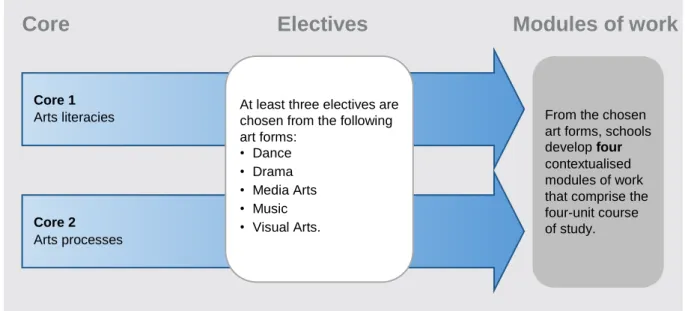
A course of study for Arts in Practice includes:
core topics — ‘Arts literacies’ and ‘Arts processes’ — and their associated concepts and ideas integrated into modules of work across Units 1 and 2, and further developed in Units 3 and 4
electives — exploration of at least three electives (art forms) across the four-unit course of study with at least two used in the creation of an product (artwork)
4 ACARA, General Capabilities, Numeracy,
www.australiancurriculum.edu.au/GeneralCapabilities/Numeracy/Introduction/Introduction.
modules of work — four contextualised modules of work, developed with a context and focus that provides a purpose and audience within authentic arts settings, situations or practices across a unit (55 hours).
Figure 2: A course of study — the relationship between core, electives and modules of work
1.2.4 Developing a module of work
A module of work is developed from one or more electives and outlines the concepts and ideas, and associated knowledge, understanding and skills, and assessment to be delivered. It should identify authentic and relevant learning experiences for students. Four contextualised modules of work (55 hours each module of work) must be included across the four-unit course of study.
Schools should consider the underpinning factors when planning and integrating the relevant aspects of the core as learning experiences. The emphasis given to each core topic, and the corresponding concepts and ideas, will vary from each module of work.
Each module of work in Arts in Practice:
establishes a context and focus that is set within a stated authentic arts setting, situation or practice that provides a purpose and audience for the creation of product (artwork)
allows for the exploration and creation of a product (artwork) from at least two art forms
provides opportunity for coverage of the core and the associated concepts, ideas, knowledge, understanding and skills from the chosen art forms
provides opportunities for teaching, learning and assessment of the objectives of Knowing and understanding, Applying and analysing, and Creating and evaluating.
1.2.5 Aboriginal perspectives and Torres Strait Islander perspectives
The Queensland Government has a vision that Aboriginal and Torres Strait Islander
Queenslanders have their cultures affirmed, heritage sustained and the same prospects for health, prosperity and quality of life as other Queenslanders. The QCAA is committed to helping achieve this vision, and encourages teachers to include Aboriginal perspectives and Torres Strait Islander perspectives in the curriculum.
Core Electives Modules of work
Core 1 Arts literacies
Core 2 Arts processes
At least three electives are chosen from the following art forms:
• Dance
• Drama
• Media Arts
• Music
• Visual Arts.
From the chosen art forms, schools develop four contextualised modules of work that comprise the four-unit course of study.
The QCAA recognises Aboriginal peoples and Torres Strait Islander peoples, their traditions, histories and experiences from before European settlement and colonisation to the present time.
Opportunities exist in Arts in Practice to encourage engagement with Aboriginal peoples and Torres Strait Islander peoples, strengthening students’ appreciation and understanding of:
frameworks of knowledge and ways of learning
contexts in which Aboriginal peoples and Torres Strait Islander peoples live
contributions to Australian society and cultures.
For Aboriginal peoples and Torres Strait Islander peoples the arts are a rich and integral aspect of community life and culture. Indigenous arts are not just a form of self-expression. They are a response to the world that conveys meaning and has a spiritual purpose. Through artworks — paintings, sculpture, carvings, ceremonial clothing, works in a range of media, songs, dances and storytelling — stories of creation, spirituality and beliefs are passed on and explained.
Students can gain knowledge, understanding and appreciation of Aboriginal histories and cultures and Torres Strait Islander histories and cultures through exploring the various forms of art produced by Aboriginal peoples and Torres Strait Islander peoples, and through the diversity of arts practices. They also need to develop ways of responding to the artworks in a culturally sensitive and responsible manner.
An Arts curriculum incorporating Aboriginal perspectives and Torres Strait Islander perspectives should ensure:
respect for Aboriginal peoples and Torres Strait Islander peoples
respect for the rights of the traditional owners of artworks
use of accurate and up-to-date resources
accessibility for Aboriginal students, Torres Strait Islander students and non-Indigenous students.
When planning practical learning experiences that incorporate Aboriginal perspectives and Torres Strait Islander perspectives, it is important to involve the local communities, as appropriate.
establishing a supportive school and classroom environment
consulting and collaborating with local Aboriginal communities and Torres Strait Islander communities
dealing with sensitive issues
selecting appropriate resources and texts
removing barriers to student success and engagement.
Guidelines about Aboriginal perspectives and Torres Strait Islander perspectives and resources for teaching are available at www.qcaa.qld.edu.au/k-12-policies/aboriginal-torres-strait-islander- perspectives.
2 Subject matter
2.1 Core
The core is the conceptual base for the four-unit course of study and is what all students who undertake this subject will have the opportunity to learn. The core of this subject consists of two topics:
Arts literacies
Arts processes.
Both core topics are integrated into the course of study through contextualised modules of work developed around the chosen art forms that allow core learning to be delivered in relevant, purposeful and meaningful ways.
The core topics are interrelated and are not intended to be treated in isolation. Both core topics include concepts and ideas, and associated knowledge, understanding and skills. Together, the two core topics are designed to encapsulate and develop an understanding of the Arts and the roles they play in Australian and world culture.
The core concepts and ideas will be explored and developed on multiple occasions. It is not expected that all the concepts and ideas will be covered in each module of work, but they must be covered across Units 1 and 2 and again across Units 3 and 4 of the course. The subject matter specified must be covered through learning experiences by the end of the four-unit course of study.
The core topics are presented in tables on the following pages, where they are described through concepts and ideas, and associated knowledge, understanding and skills.
2.1.1 Arts literacies
‘Arts literacies’ refers to the knowledge, understanding and skills that serve as a foundation for arts making. Well-developed arts literacy enables interpretation, appreciation, evaluation and aesthetic engagement with artworks. These literacies are realised through arts processes.
Concepts and ideas Knowledge, understanding and skills Arts communication
The ability to communicate in and about the arts facilitates the interpretation and presentation of information, the conveying of meaning, and the sharing of ideas about art forms, artworks and processes (C1.1).
arts-specific terminology
communication skills:
- active listening
- conflict resolution and negotiation skills - providing instructions
- reflection and review
- clarity of communication and expression Arts principles
Arts principles are the understandings that serve as a foundation for learning and engagement in the Arts (C1.2).
genres
forms and/or styles
elements and/or mediums
conventions
structures
functions and/or purposes Aesthetic appreciation
A knowledge and understanding of arts principles is essential for developing aesthetic appreciation or
description, analysis and interpretation of artworks, including comparative skills
evaluation of aesthetic choices
artistic awareness (i.e. understanding the meaning) of an artistic experience (C1.3).
reflective skills
provision of critiques, including feedback on artworks and arts processes
2.1.2 Arts processes
‘Arts processes’ refers to the creation of artworks through the application and manipulation of arts literacies in multiple art forms. Students’ creative thinking is nurtured as they follow and develop processes from conception to realisation, and work to create, express, convey and appreciate ideas and meaning.
Concepts and ideas Knowledge, understanding and skills Integration of art forms
Artistic expression is often strengthened through integrating art forms (C2.1).
skills in the integration of art forms
conceptualisation and planning of artworks
refinement and modification of arts ideas and art- making processes
decision-making and problem-solving skills
organisation of resources Arts technologies, techniques and skills
Art forms have specific technologies, techniques and skills (C2.2).
technologies specific to the chosen art forms
techniques and skills specific to the chosen art forms
techniques and skills common to multiple disciplines Artwork realisation
Each artwork has the capacity to convey intended meaning to an audience (C2.3).
production skills
presentation skills
curatorial skills Arts careers
Careers in the creative arts and entertainment industries are diverse, with many skills transferable to other vocations (C2.4).
interdisciplinary arts careers, e.g. music theatre, arts management and promotions, theatre and concert performances
business, marketing and entrepreneurial skills
interdisciplinary arts businesses
planning skills, e.g. establishing timelines, time management, resource (human and physical) management
project management skills, e.g. modifying
expectations, problem-solving and communicating
2.2 Electives
The electives in Arts in Practice are the art forms of dance, drama, media arts, music and visual arts. It is through these art forms that students explore the concepts and ideas, and associated knowledge, understanding and skills, of the two core topics.
The selection of electives is dependent on:
the interests and abilities of the student cohort or individual students
the expertise of teachers
available facilities and resources.
Each student must engage with at least two elective art forms in each contextualised module of work, and explore at least three different art forms over the four-unit course of study. Where possible, there should be flexibility for individual students to choose the art forms they wish to engage with in each module of work and over the course of study. Students with special skills or interest in a particular art form may choose this as a specialised elective art form in each module of work.
2.2.1 Dance
Dance is a physical art form that uses the body to communicate and express meaning through purposeful movement. It is often performed with music and follows a sequence of steps to express dance ideas that serve particular purposes. Arts in Practice gives students opportunities to establish and refine a movement repertoire, understand the technical and expressive
requirements of choreography and performance, and appreciate the role of dance and dance- making.
2.2.2 Drama
Drama is an art form that uses the voice and body as the main means of expression to communicate meaning to an audience. It involves the representation and re-enactment of experiences, ideas and stories. Arts in Practice gives students opportunities to apply their knowledge and understanding of dramatic processes, principles and practices and to appreciate dramatic works.
2.2.3 Media arts
Media arts encompass art forms that have in common their composition and transmission through film, television, radio, print, gaming and web-based media. Media arts works generally combine moving or still image with text or sound to create meaning and to express insight, commentary or critique. Arts in Practice gives students opportunities to apply their knowledge and understanding of media processes, practices, technologies and communications.
2.2.4 Music
Music is an aural art form that uses sound and silence as a means of personal expression and communication. It helps to create and heighten emotion and enhance arts experiences. Arts in Practice gives students opportunities to apply their knowledge and understanding of the elements and structures of music techniques, practices, processes and skills, and to express ideas in and through music.
2.2.5 Visual arts
Visual arts encompass art forms that communicate and express meaning through visual
perception. Visual artworks are created for personal expression, viewing, entertainment, function, purpose or decoration. Arts in Practice gives students opportunities to apply their knowledge and understanding of visual arts practices, visual mediums, art-making technologies and techniques to communicate meaning through visual forms.
3 Assessment
3.1 Assessment—general information
Assessment is an integral part of the teaching and learning process. It is the purposeful,
systematic and ongoing collection of information about student learning outlined in the syllabus.
The major purposes of assessment are to:
promote, assist and improve learning
guide programs of teaching and learning
advise students about their own progress to help them achieve as well as they are able
give information to parents, carers and teachers about the progress and achievements of individual students to help them achieve as well as they are able
provide comparable exit results in each Applied syllabus which may contribute credit towards a Queensland Certificate of Education (QCE); and may contribute towards Australian Tertiary Admission Rank (ATAR) calculations
provide information about how well groups of students are achieving for school authorities and the State Minister responsible for Education.
Student responses to assessment opportunities provide a collection of evidence on which judgments about the quality of student learning are made. The quality of student responses is judged against the standards described in the syllabus.
In Applied syllabuses assessment is standards-based. The standards are described for each objective in each of the three dimensions. The standards describe the quality and characteristics of student work across five levels from A to E.
3.1.1 Planning an assessment program
When planning an assessment program over a developmental four-unit course, schools should:
administer assessment instruments at suitable intervals throughout the course
provide students with opportunities in Units 1 and 2 to become familiar with the assessment techniques that will be used in Units 3 and 4
assess all of the dimensions in each unit
assess each objective at least twice by midway through the course (end of Unit 2) and again by the end of the course (end of Unit 4)
assess only what the students have had the opportunity to learn, as prescribed in the syllabus and outlined in the study plan.
For a student who studies four units, only assessment evidence from Units 3 and 4 contributes towards decisions at exit.
Further guidance can be found in the QCE and QCIA policy and procedures handbook.
3.1.2 Authentication of student work
Schools and teachers must have strategies in place for ensuring that work submitted for internal summative assessment is the student’s own.
Judgments about student achievement are based on evidence of the demonstration of student knowledge, understanding and skills. Schools ensure responses are validly each student’s own work.
Guidance about authentication strategies which includes guidance for drafting, scaffolding and teacher feedback can be found in the QCE and QCIA policy and procedures handbook.
3.2 Assessment techniques
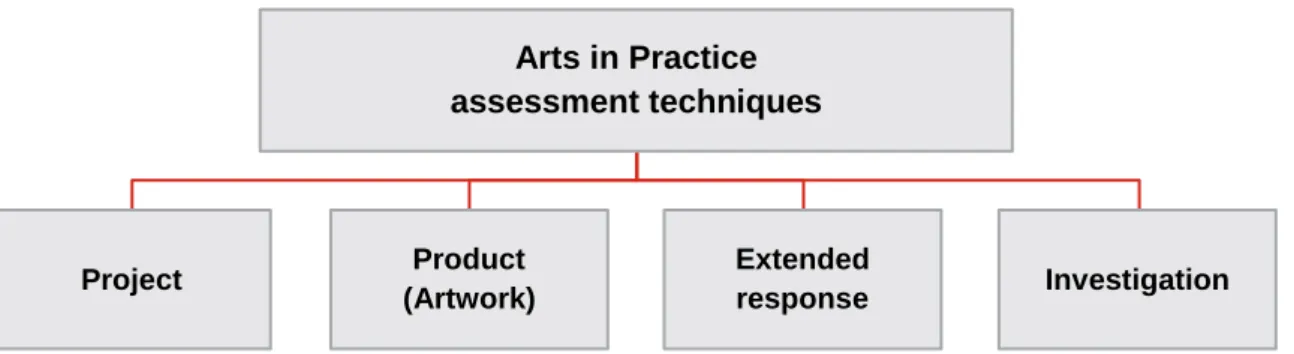
The diagram below identifies the assessment techniques relevant to this syllabus. The subsequent sections describe each assessment technique in detail.
Figure 3: Arts in Practice assessment techniques
Schools design assessment instruments from the assessment techniques relevant to this
syllabus. The assessment instruments students respond to in Units 1 and 2 should support those techniques included in Units 3 and 4. Assessment is designed to allow students to demonstrate the range of standards (see Determining an exit result).
Evidence
Evidence includes the student’s responses to assessment instruments and the teacher’s
annotated instrument-specific standards matrixes. Evidence may be direct or indirect. Examples of direct evidence include student responses to assessment instruments or digital recordings of student performances. Examples of indirect evidence include student notes, teacher observation recording sheets or photographic evidence of the process.
Further guidance can be found in the QCE and QCIA policy and procedures handbook.
Conditions of assessment
Over a four-unit course of study, students are required to complete assessment under a range of conditions (see Planning an assessment program).
Conditions may vary according to assessment. They should be stated clearly on assessment instruments and reflect the conditions stated for each technique.
Where support materials or particular equipment, tools or technologies are used under supervised conditions, schools must ensure that the purpose of supervised conditions (i.e. to authenticate student work) is maintained.
Arts in Practice assessment techniques
Project Product
(Artwork)
Extended
response Investigation
Assessment of group work
Where students undertake assessment in a group or team, instruments must be designed so that teachers can validly assess the work of individual students and not apply a judgment of the group product and processes to all individuals.
3.2.1 Project
Purpose
This technique assesses a response to a single task, situation and/or scenario in a module of work that gives students authentic opportunities to demonstrate their learning. The student response will consist of a Product (artwork) and at least one other assessable component demonstrated in different
circumstances, places and times, and may be presented to different audiences and through different modes.
In Arts in Practice, one project must arise from community connections.
Dimensions to be assessed
This assessment technique is to be used to determine student achievement in objectives from all of the following dimensions:
Knowing and understanding
Applying and analysing
Creating and evaluating.
All objectives from each dimension must be assessed.
Types of projects
A project occurs over a set period of time. Students may use class time and their own time to develop a response.
In Arts in Practice a project consists of a product (artwork) and at least one other assessable component chosen from the following:
written
spoken
multimodal.
The product (artwork) must demonstrate the significant contribution of at least two art forms.
The selected assessable components must contribute significantly to the task and to the overall result for the project. A variety of technologies may be used in the creation or presentation of the response.
Examples of projects in Arts in Practice include:
creating a performance installation for the week of feeder school visits that explores the idea of possible futures. It could involve any of the art forms and include a real or virtual performance, and a written artist’s statement (written component) explaining the product and art-making processes
creating a multimedia work that could be used by the local council to highlight the community. The product will be displayed in the foyer of the council chambers. It could involve media arts, visual arts and music. The project would consist of the product and an interview (spoken component) that would ask students to evaluate their product and art-making processes.
Note: Spoken delivery of a written component, or a transcript of a spoken component (whether written, electronic or digital), constitutes one component, not two.
Product (artwork)
This component requires students to apply a range of cognitive, technical, physical and/or
creative/expressive skills to create a product that expresses a personal aesthetic which integrates two or more art forms.
Examples of interdisciplinary products indicating possible art forms include:
sound installation (visual arts, media arts, music)
interactive picture book (drama, media arts, visual arts)
animated film clip (drama, media arts, music)
virtual installation (media arts, music)
performance installation (drama/dance, visual arts)
video game (visual arts, music, media arts).
Written component
This component requires students to use written language to communicate ideas and information to readers for a particular purpose. A written component may be supported by references or, where appropriate, data, tables, flowcharts or diagrams.
Examples include:
articles for magazines or journals
reviews, e.g. dance and stage productions, artists’ exhibitions, concert performances
folios
reports, which will normally be presented with section headings, and may include tables, graphs and/or diagrams, and analysis of data supported by references
blogs
artists’ statements
applications and submissions, e.g. a proposal for an product to be included in an arts festival.
Spoken component
This component requires students to use spoken language to communicate ideas and information to a live or virtual audience (i.e. through the use of technology) for a particular purpose.
Examples include:
oral presentations
debates
interviews
podcasts
seminars.
Multimodal component
This component requires students to use a combination of at least two modes delivered at the same time to communicate ideas and information to a live or virtual audience for a particular purpose. The selected modes are integrated to allow both modes to contribute significantly to the multimodal component.
Modes include:
written
spoken/signed
nonverbal, e.g. physical, visual, auditory.
The multimodal component can be a presentation or non-presentation. Examples of presentations include delivery of a slide show, short video clip or webinar. An example of a non-presentation is a webpage with embedded media (graphics, images, audio or video).
A variety of technologies may be used in the creation or presentation of the component. Replication of a written document into an electronic or digital format does not constitute a multimodal component.
Assessment conditions Units 1–2 Units 3–4
Written component 400–700 words 500–900 words
Spoken component 1½ – 3½ minutes 2½ – 3½ minutes
Multimodal component
non-presentation
presentation
6 A4 pages max (or equivalent) 2–4 minutes
8 A4 pages max (or equivalent) 3–6 minutes
Product (Artwork) Variable conditions
Schools give students some continuous class time to develop the product.
Schools should give students guidance so that products are possible to complete with available resources and within the allocated time.
Further guidance
If using digital recordings as direct evidence for products:
- allow the student(s) being assessed to be seen and heard clearly, ensuring the recording is as similar as possible to the original live performance situation
- use common file formats such as .avi, .mov, .mp3, .mp4, .wmv and .aac - clearly label the recording to identify students.
If providing indirect evidence for products, consider photographing evidence of the art-making process.
3.2.2 Product (Artwork)
Purpose
This technique assesses a range of cognitive, technical, physical and/or creative/expressive skills in the creation of an original product (artwork) that expresses a personal aesthetic.
Product (artwork) assessments involve student application of identified skills in specific art forms and may result in a performance, product/artefact or a combination of both. These products are created for a purpose and audience, convey meaning or intent and require problem-solving.
Products involve the integration of two or more art forms.
Dimensions to be assessed
This assessment technique is to be used to determine student achievement in objectives from all of the following dimensions:
Knowing and understanding
Applying and analysing
Creating and evaluating.
Not every objective from each dimension needs to be assessed.
Types of products (artwork)
This component requires students to apply a range of cognitive, technical, physical and/or creative/expressive skills to create a product (artwork) that expresses a personal aesthetic which integrates two or more art forms.
Examples of interdisciplinary products (artwork) indicating possible art forms include:
sound installation (visual arts, media arts, music)
interactive picture book (drama, media arts, visual arts)
animated film clip (drama, media arts, music)
virtual installation (media arts, music)
performance installation (drama/dance, visual arts)
video game (visual arts, music, media arts).
Assessment conditions Units 1–2 Units 3–4
Product (artwork) Variable conditions
Schools give students some continuous class time to develop the response.
Schools should give students guidance so that products are possible to complete with available resources and within the allocated time.
Further guidance
If using digital recordings as direct evidence for products:
- allow the student(s) being assessed to be seen and heard clearly, ensuring the recording is as similar as possible to the original live performance situation
- use common file formats such as .avi, .mov, .mp3, .mp4, .wmv and .aac - clearly label the recording to identify students.
If providing indirect evidence for products, consider photographing evidence of the art-making process.
3.2.3 Extended response
Purpose
This technique assesses the interpretation, analysis/examination and/or evaluation of ideas and information in provided stimulus materials. While students may undertake some research in the preparation of the extended response, it is not the focus of this technique.
Dimensions to be assessed
This assessment technique is to be used to determine student achievement in objectives from all of the following dimensions:
Knowing and understanding
Applying and analysing
Creating and evaluating.
Not every objective from each dimension needs to be assessed.
Types of extended response
An extended response occurs over a set period of time. Students may use class time and their own time to develop a response. Students respond to a question or statement about the provided stimulus materials.
Stimulus material could include:
artworks that combine multiple art forms
an artist’s manifesto
a local community event
a national or international event.
Each extended response must focus on the contribution of at least two art forms.
Written response
This response requires students to use written language to communicate ideas and information to readers for a particular purpose. A written response may be supported by references or, where appropriate, data, tables, flowcharts or diagrams.
Examples include:
articles for magazines or journals
reviews, e.g. dance and stage productions, art exhibitions, concert performances
reports, which will normally be presented with section headings, and may include tables, graphs and/or diagrams, and analysis of data supported by references
blogs.
Spoken response
This response requires students to use spoken language to communicate ideas and information to a live or virtual audience (i.e. through the use of technology) for a particular purpose.
Examples include:
oral presentations
debates
interviews
podcasts
seminars.
Multimodal response
This response requires students to use a combination of at least two modes delivered at the same time to communicate ideas and information to a live or virtual audience for a particular purpose. The selected modes are integrated to allow both modes to contribute significantly to the multimodal response.
Modes include:
written
spoken/signed
nonverbal, e.g. physical, visual, auditory.
The multimodal response can be a presentation or non-presentation. Examples of presentations include delivery of a slide show, short video clip or webinar. An example of a non-presentation is a webpage with embedded media (graphics, images, audio or video).
A variety of technologies may be used in the creation or presentation of the response. Replication of a written document into an electronic or digital format does not constitute a multimodal response.
Assessment conditions Units 1–2 Units 3–4
Written 500–800 words 600–1000 words
Spoken 2–4 minutes 3–4 minutes
Multimodal
non-presentation
presentation
8 A4 pages max (or equivalent) 3–5 minutes
10 A4 pages max (or equivalent) 4–7 minutes
3.2.4 Investigation
Purpose
This technique assesses investigative practices and the outcomes of applying these practices.
Investigation includes locating and using information beyond students’ own knowledge and the data they have been given. In Arts in Practice, investigations involve research and follow an inquiry approach.
Investigations provide opportunity for assessment to be authentic and set in lifelike contexts.
Dimensions to be assessed
This assessment technique is to be used to determine student achievement in objectives from all of the following dimensions:
Knowing and understanding
Applying and analysing
Creating and evaluating.
Not every objective from each dimension needs to be assessed.
Types of investigations and responses
An investigation occurs over a set period of time. Students may use class time and their own time to develop a response. In this assessment technique, students investigate or research the way art forms work together to enhance an aesthetic experience. In each investigation, students must demonstrate the relationship between, and significant contribution of, at least two art forms.
Examples of investigations in Arts in Practice include:
investigating the work of an artist who works across several art forms
investigating a production, entertainment or artwork where a number of art forms are integrated.
Written response
This response requires students to use written language to communicate ideas and information to readers for a particular purpose. A written response may be supported by references or, where appropriate, data, tables, flowcharts or diagrams.
Examples include:
articles for magazines or journals
reviews, e.g. dance and stage productions, art and artists’ exhibitions, concert performances
reports, which will normally be presented with section headings, and may include tables, graphs and/or diagrams, and analysis of data supported by references
blogs.
Spoken response
This response requires students to use spoken language to communicate ideas and information to a live or virtual audience (i.e. through the use of technology) for a particular purpose.
Examples include:
oral presentations
debates
interviews
podcasts
seminars.
Multimodal response
This response requires students to use a combination of at least two modes delivered at the same time to communicate ideas and information to a live or virtual audience for a particular purpose. The selected modes are integrated to allow both modes to contribute significantly to the multimodal response.
Modes include:
written
spoken/signed
nonverbal, e.g. physical, visual, auditory.
The multimodal response can be a presentation or non-presentation. Examples of presentations include delivery of a slide show, short video clip or webinar. An example of a non-presentation is a webpage with embedded media (graphics, images, audio or video).
A variety of technologies may be used in the creation or presentation of the response. Replication of a written document into an electronic or digital format does not constitute a multimodal response.
Assessment conditions Units 1–2 Units 3–4
Written 500–800 words 600–1000 words
Spoken 2–4 minutes 3–4 minutes
Multimodal
non-presentation
presentation
8 A4 pages max (or equivalent) 3–5 minutes
10 A4 pages max (or equivalent) 4–7 minutes
Further guidance
Establish a focus for the investigation, or work with the student to develop a focus.
Allow class time for the student to effectively undertake each part of the investigation assessment.
Independent student time will be required to complete the task.
The required length of student responses should be considered in the context of the tasks — longer is not necessarily better.
Implement strategies to promote the authenticity of student work. Strategies may include note-taking, journals or experimental logs, drafting, research checklists, referencing and/or teacher observation sheets.
Scaffolding is part of the teaching and learning that supports student development of the requisite knowledge, understanding and skills integral to completing an assessment task and demonstrating what the assessment requires. The scaffolding should be reduced in Units 3 and 4 as students develop greater independence as learners.
Provide students with learning experiences in the use of appropriate communication strategies, including the generic requirements for presenting research, e.g. research report structures, referencing conventions.
Indicate on the assessment the dimensions and objectives that will be assessed.
3.3 Exiting a course of study
3.3.1 Folio requirements
A folio is a collection of one student’s responses to the assessment instruments on which exit results are based. The folio is updated when earlier assessment responses are replaced with later evidence that is more representative of student achievement.
3.3.2 Exit folios
The exit folio is the collection of evidence of student work from Units 3 and 4 that is used to determine the student’s exit result. Each folio must include:
four assessment instruments, and the student responses
evidence of student work from Units 3 and 4 only
at least one project, arising from community connections
one product (artwork) (involving the integration of at least two art forms) that is separate from the assessable component of a project
a student profile completed to date.
3.3.3 Exit standards
Exit standards are used to make judgments about students’ exit result from a course of study.
The standards are described in the same dimensions as the objectives of the syllabus. The standards describe how well students have achieved the objectives and are stated in the standards matrix.
The following dimensions must be used:
Dimension 1: Knowing and understanding
Dimension 2: Applying and analysing
Dimension 3: Creating and evaluating.
Each dimension must be assessed in each unit, and each dimension is to make an equal contribution to the determination of an exit result.
3.3.4 Determining an exit result
When students exit the course of study, the school is required to award each student an A–E exit result.
Exit results are summative judgments made when students exit the course of study. For most students, this will be after four units. For these students, judgments are based on exit folios providing evidence of achievement in relation to all objectives of the syllabus and standards.
For students who exit before completing four units, judgments are made based on the evidence of achievement to that stage of the course of study.
Determining a standard
The standard awarded is an on-balance judgment about how the qualities of the student’s responses match the standards descriptors in each dimension. This means that it is not
necessary for the student’s responses to have been matched to every descriptor for a particular standard in each dimension.
Awarding an exit result
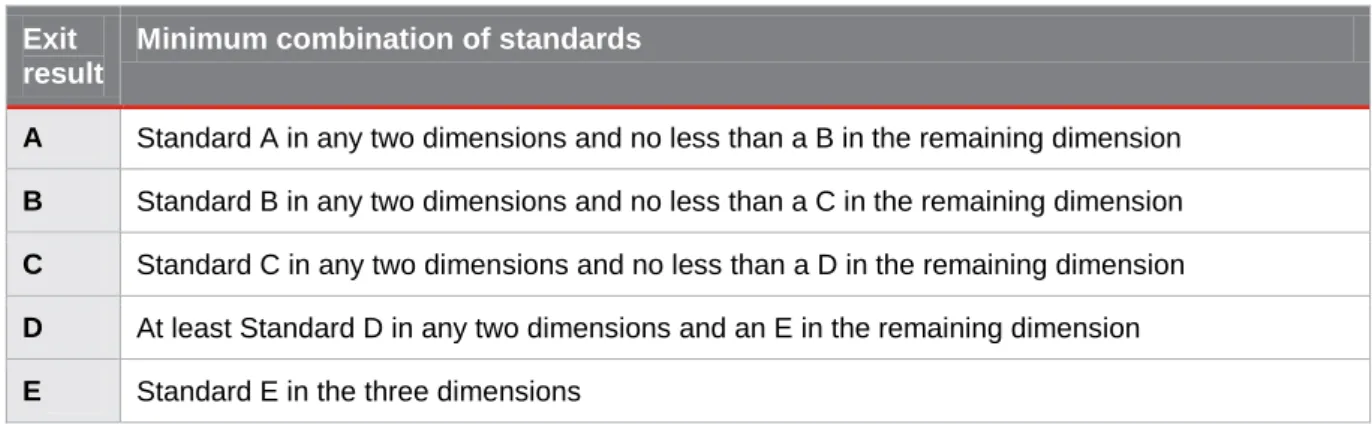
When standards have been determined in each of the dimensions for this subject, Table 2 below is used to award an exit result, where A represents the highest standard and E the lowest. The table indicates the minimum combination of standards across the dimensions for each result.
Table 2: Awarding an exit result
Exit result
Minimum combination of standards
A Standard A in any two dimensions and no less than a B in the remaining dimension B Standard B in any two dimensions and no less than a C in the remaining dimension C Standard C in any two dimensions and no less than a D in the remaining dimension D At least Standard D in any two dimensions and an E in the remaining dimension E Standard E in the three dimensions
Further guidance can be found in the QCE and QCIA policy and procedures handbook.
3.3.5 Standards matrix
Standard A Standard B Standard C Standard D Standard E
Knowing and understanding
The student work has the following characteristics:
The student work has the following characteristics:
The student work has the following characteristics:
The student work has the following characteristics:
The student work has the following characteristics:
identification and comprehensive
explanation of concepts and ideas related to arts literacies and arts processes
identification and thorough explanation of concepts and ideas related to arts literacies and arts processes
identification and explanation of concepts and ideas related to arts literacies and arts processes
partial identification and simple explanation of concepts and ideas related to arts literacies and arts processes
minimal identification and superficial statements about concepts and ideas related to arts literacies and arts processes
insightful interpretation of information about arts literacies and arts processes
effective interpretation of information about arts literacies and arts processes
interpretation of information about arts literacies and arts processes
variable interpretation of information about arts literacies and arts processes
superficial interpretation of information about arts literacies and arts processes
proficient demonstration of arts literacies and processes in arts making.
competent demonstration of arts literacies and processes in arts making.
demonstration of arts literacies and processes in arts making.
uneven demonstration of arts literacies and processes in arts making.
sporadic demonstration of arts literacies and
processes in arts making.
Applying and analysing
The student work has the following characteristics:
The student work has the following characteristics:
The student work has the following characteristics:
The student work has the following characteristics:
The student work has the following characteristics:
detailed and thoughtful organisation and application of arts literacies and arts processes to successfully achieve goals
methodical organisation and application of arts literacies and arts processes to achieve goals
organisation and
application of arts literacies and arts processes to achieve goals
variable organisation and application of arts literacies and arts processes to achieve some goals
minimal application of arts literacies and arts
processes
insightful analysis of artworks and arts processes
in-depth analysis of artworks and arts processes
analysis of artworks and
arts processes inconsistent analysis of artworks and arts processes
superficial analysis of aspects of artworks and/or arts processes
proficient use of language conventions and features to perceptively convey information and meaning about arts forms, works and processes.
controlled use of language conventions and features to clearly convey
information and meaning about arts forms, works and processes.
use of language
conventions and features to convey information and meaning about arts forms, works and processes.
inconsistent use of language conventions and features to convey
aspects of information and meaning about arts forms, works and processes.
minimal use of language conventions and/or features to present ideas about arts forms, works and processes.
Standard A Standard B Standard C Standard D Standard E
Creating and evaluating
The student work has the following characteristics:
The student work has the following characteristics:
The student work has the following characteristics:
The student work has the following characteristics:
The student work has the following characteristics:
generation of sophisticated arts ideas and efficient and competent planning of arts processes
generation of considered arts ideas and competent planning of arts processes
generation of arts ideas and planning of arts processes
presentation of
rudimentary arts ideas and partial planning of arts processes
presentation of rudimentary arts ideas
skilful implementation of arts processes to create cohesive communications and realise engaging artworks
competent implementation of arts processes to create clear communications and realise engaging artworks
implementation of arts processes to create communications and realise artworks
inconsistent
implementation of arts processes to produce vague communications and incomplete artworks
sporadic use of arts processes to produce unclear communications and aspects of artworks
reasoned and well- supported evaluation of artworks and processes.
considered evaluation of artworks and processes.
evaluation of artworks and processes.
inconsistent evaluation of artworks and processes.
minimal evaluation of aspects of artworks and and/or processes.
4 Glossary
Term Explanation
A
accurate precise and exact; to the point; consistent with a standard, rule, convention or known facts
aesthetic artistic awareness; deep appreciation of the meaning of an artistic
experience through intellectual, emotional and sensual responses to a work of art; in music, this involves the subjective responses by which music is perceived and judged, and that can be relevant to genre, style, time and/or place
analyse consider in detail for the purpose of finding meaning or relationships, and identifying patterns, similarities and differences; dissect to ascertain and examine constituent parts and/or their relationships
apply use or employ in a particular situation; carry out or use a procedure in a given situation
appreciate recognise the full worth of; understand (a situation) fully; grasp the full implications of
art forms in this syllabus, the visual, performing and media arts of dance, drama, media arts, music and visual arts
arts literacies the knowledge and understanding that serve as a foundation for arts making;
arts literacies encompass arts-specific terminology, genres, forms and styles, functions and purposes, arts principles, aesthetic appreciation and artistic awareness
arts processes the creation of artworks through the application and manipulation of arts literacies; arts processes encompass skills in integrating art forms, decision- making and problem-solving skills, processes, technologies, techniques and skills specific to the arts, planning and project management skills and communication skills
artworks creative products with imaginative or aesthetic appeal; the outcomes of creative arts processes; aesthetic items/objects or artistic creations; in this syllabus, works that integrate at least two art forms and are innovative expressions of a personal aesthetic
aspect a facet, phase or part of a whole C
clear easy to understand; fully intelligible; free from obscurity of sense; without ambiguity; explicit
clearly plainly and openly; without ambiguity
cohesive characterised by being united, bound together or having integrated meaning competent able to do something well; having suitable or sufficient skill, knowledge,
experience, etc. for the purpose; having the necessary ability, knowledge or skill to do something successfully; capable
comprehensive detailed and thorough, including all that is relevant; inclusive of a broad coverage of facts, ideas and information