Providing care to people with co-existing psychological problems and substance use by general practitioners. The GP must be aware of the complex interactions between substance use and the psychological problem.
Introduction
Identify key issues in identifying and managing people with co-existing mental health and substance use problems in the general practice setting. Managing people with a co-existing mental health and substance use disorder: Guidelines for service delivery.
Methodology
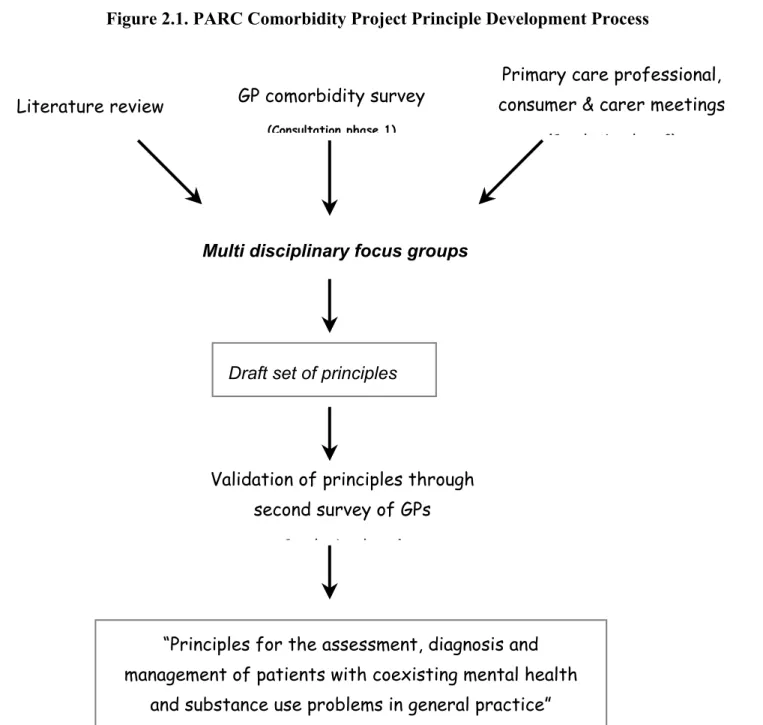
Findings from the literature review, primary care consultation, GP survey and the focus groups were used to develop an initial set of principles with the aim of providing a guide for GPs involved in the care of patients with co-existing substance use and mental health problems . This process enabled the development of a final set of principles for the assessment, diagnosis and management of patients with co-existing mental health and substance use problems in general practice.
Literature Review
Recognition of either drug use or a mental health problem should prompt the practitioner to inquire about the presence of comorbidity. Drug use is the result of an attempt to reduce the symptoms of a mental problem.
Management of comorbidity
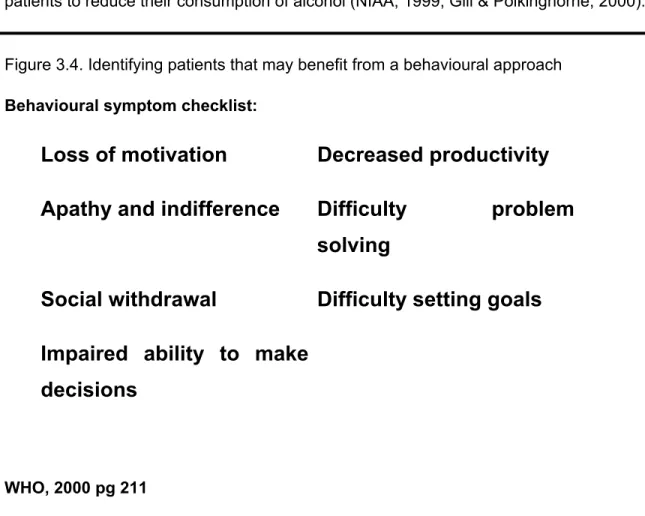
There are a number of psychological treatments that practitioners may find useful when trying to reduce the impact of substance use and mental health problems experienced by patients with comorbidities. A variety of behavioral approaches can be used by practitioners attempting to treat co-occurring substance use and mental health problems.
Activities of Divisions
Comorbidity was included in the rationale for the development and implementation of a division-wide mental health program. Local mental health teams include drug and alcohol workers who are able to provide support to GPs involved in the care of patients with co-morbidities. This department has focused on raising the skill level of GPs in shared care project activities, drug and alcohol problems (including methadone prescribing) and mental health promotion and prevention.
This department plans to provide educational programs for general practitioners in the areas of mental health and/or alcohol and other drugs. These subjects will help develop partnerships between GPs, drug and alcohol services and mental health services through care planning and case conferencing (RACGP, 2000). This department is currently running a number of projects working closely with Central Coast Area Health Services in the areas of mental health and alcohol and other drugs.
A GP needs assessment to identify opportunities to provide services in the areas of mental health and alcohol and other drugs. GPs were provided with an information pack which included some basic guidelines for managing patients with co-existing mental health and drug and alcohol problems♦. This project involved mental health services, drug and alcohol services, non-governmental organizations and GPs.
GP Comorbidity Survey:Consultation Phase 1
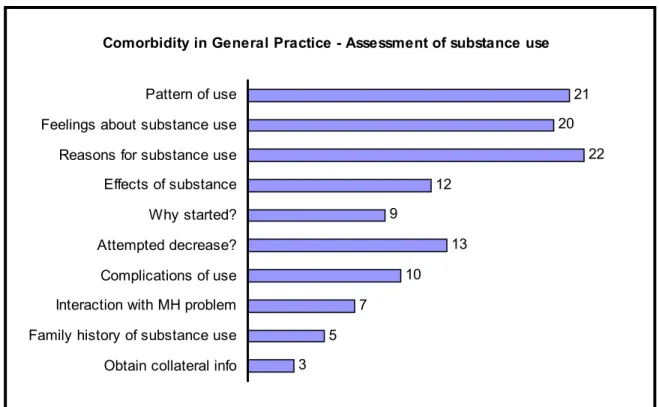
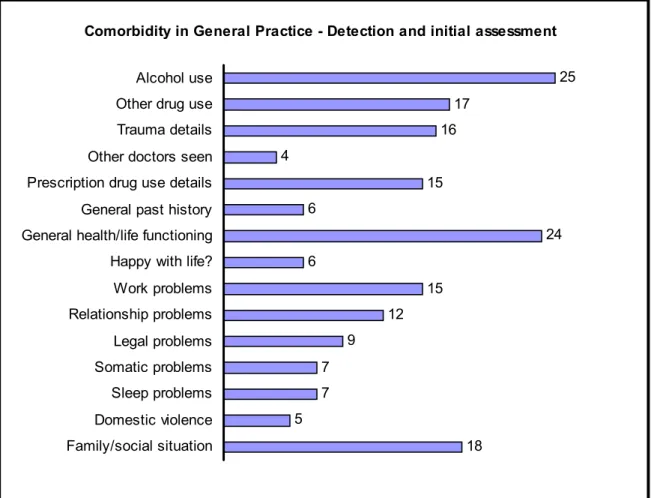
General areas of research that can aid in the detection of patients with co-existing mental health and substance use problems. The most important aspects of assessing substance use in a patient with an existing mental health problem are shown in Figure 6.2. Specific areas of research useful in assessing substance use in patients with coexisting mental health and substance use problems.
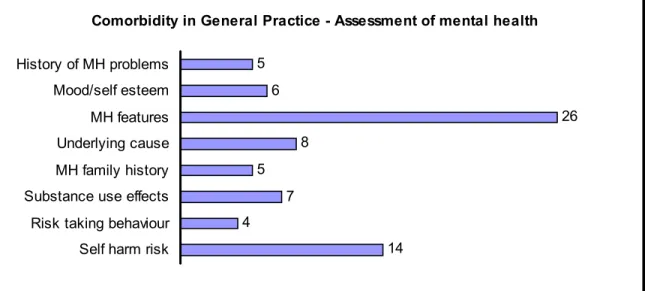
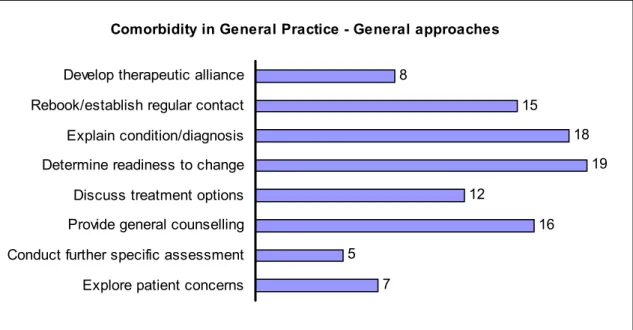
Other important aspects of mental health assessment for a patient with co-existing substance use are presented in Figure 6.3. Specific areas of investigation that are useful in the assessment of mental health for patients with co-existing mental health and substance use problems. Non-specific approaches useful in encounters with patients with co-existing mental health and substance use problems.
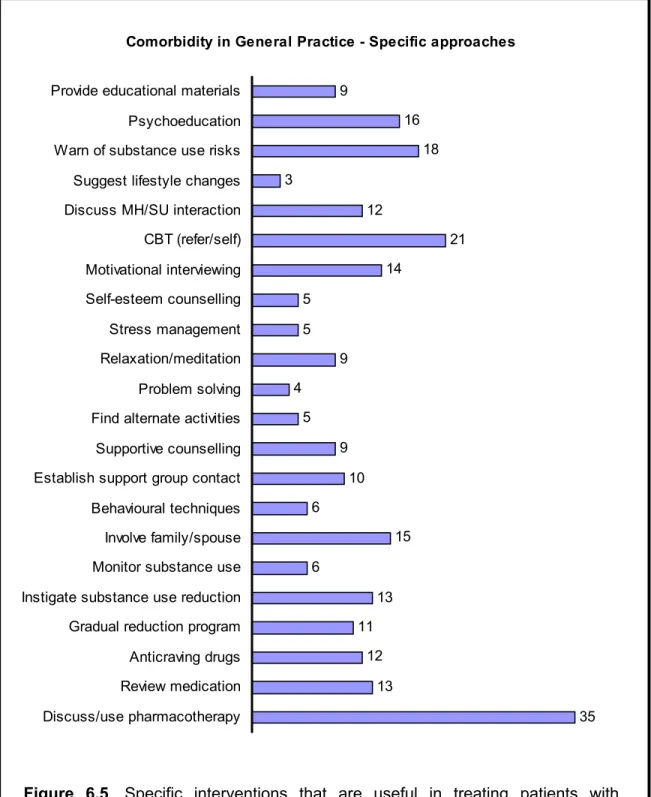
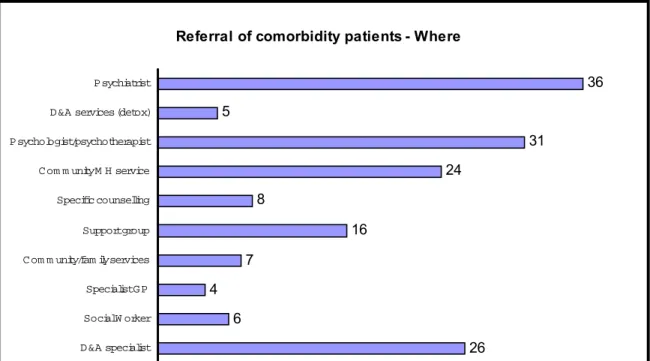
Specific interventions useful in treating patients with co-existing mental health and substance use problems. Services that GPs find useful when referring patients with co-existing mental health and substance use problems. Barriers inhibiting successful referral of patients with co-existing mental health and substance use problems.
Primary Health Care Meetings: Consultation Phase 2
All persons involved in this second phase of consultation had extensive experience in receiving and providing primary health care for people with co-existing mental health and substance use problems. As highlighted in other sections of this report, other primary care services need to appreciate the complex interplay between mental and substance use disorders when helping people with comorbid conditions. It is important that people experiencing comorbidity difficulties are able to get the right help and support as needed.
Primary health care workers must have access to a knowledge base of services available and appropriate for people experiencing comorbidity problems. There is a need to increase community awareness of comorbidity issues so that people become aware of the potential negative interaction between drug use and mental health problems. Negative perceptions were created over time as GPs overlooked or ignored mental health and substance use problems.
Issues that may underlie mental health and/or substance use problems are often left unappreciated, untreated, and untreated. GPs need to identify comorbidity when it is present in order to treat both the substance use and the mental health problem (and their overlap) and so that the patient is able to understand that the two are related . When assessing substance use it is important to explore patients' reasons for their use and to discuss the effects of this use on their mental and physical health.
Focus Groups Consultation Phase 3
A general practitioner may be aware that there is a problem underlying the patient's condition, but may be unwilling or unable to explicitly acknowledge the problem. The patient behaves in a rational way in response to the problems she is experiencing. It is important to understand the patient's understanding and level of insight in relation to the underlying issues and their sense of need to do something about these problems.
34; General practitioners should focus their approach on the patient's level of understanding of the problem and negotiate with them what can be done". actually exacerbates the patient's problems. Care should also be taken in offering advice on an issue, if the patient does not identify an issue as a problem, then there is no point in preaching to him.
The patient must recognize that something is a problem and want to do something about it before anything can really be done. For example - when the doctor explores drug use, the doctor may find that the patient considers their drug use to be beneficial. Side effects affect adherence to medication, outlook on life and vary from patient to patient, so practitioners must be aware of the side effects and other problems that the patient experiences with their medication, and make an effort to adjust the dose, etc.
Validation of Guiding Principles: Consultation Phase 4
Mental health and substance use problems can be either acute or chronic conditions, but usually require the use of long-term management approaches by general practitioners. It is important to recognize that substance use and mental health problems frequently coexist and that complex interactions between the two can have serious consequences for the health and well-being of the individual patient. Developing rapport is the first essential step in working with people with co-existing mental health and substance use problems.
Once a person has been identified as having a mental health problem, the GP should automatically inquire about alcohol and other drugs. Once a person has been identified with problematic use of alcohol or other drugs, the GP should automatically inquire about mental health difficulties. The patient's readiness to change regarding drug use may be different than regarding the psychological problem m = 4.3 SD = 0.8.
Perhaps this could be put in a more patient-centred way - "Perceptions of the extent of the problem attributable to either the substance use or the mental health issue may differ between the GP and the patient. Similarly, the willingness to change in each domain may be different, some see the need to address both issues, others minimize the role of one of the mental health issues of substance use. All approaches to comorbidity should focus on minimizing harm to the individual, their family and their community as a result of mental health and substance use issues.
Final Principles
Developing rapport is generally the first essential step in working with people with co-existing mental health and substance use problems. When a person has been identified with a mental health-related problem, the GP should inquire about alcohol and other drug use. When a person has been identified with the problematic use of alcohol or other drugs, the GP should inquire about mental health problems.
A patient's readiness for change related to substance use may be different from that related to a mental health problem. There is some evidence on primary care-based management of substance use problems and mental disorders that occur as a single entity. We are initially approaching a panel of general practitioners who have an interest in the field of substance use and mental health.
This work is developmental and will form the basis for the development of some guiding principles for the general practitioner management of people with comorbidities. He also uses cannabis for the same reason, but alcohol is more convenient and accessible. Christina is a 48-year-old ethnic Croatian refugee who has been living in Australia with her husband and three children for thirteen years.
We are specifically interested in a case where the patient presented with both substance use and mental health characteristics. Regarding detection, what signs alerted you to the possibility of both substance abuse and a mental health problem in this patient.