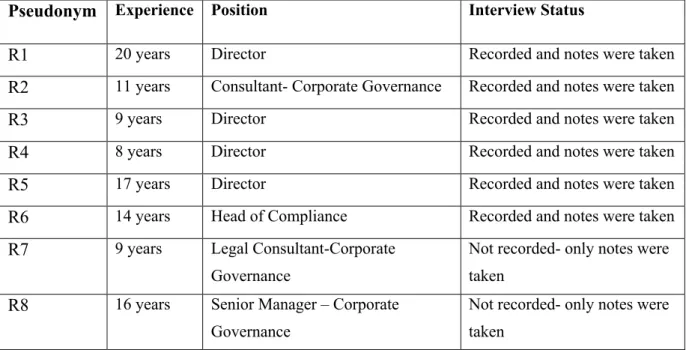
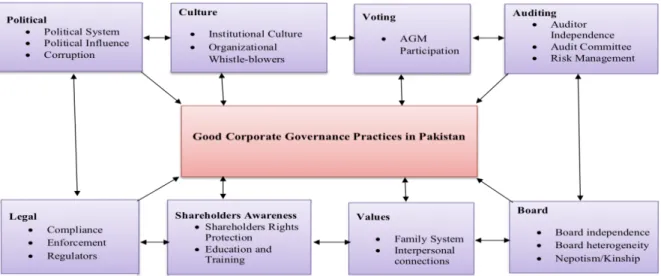
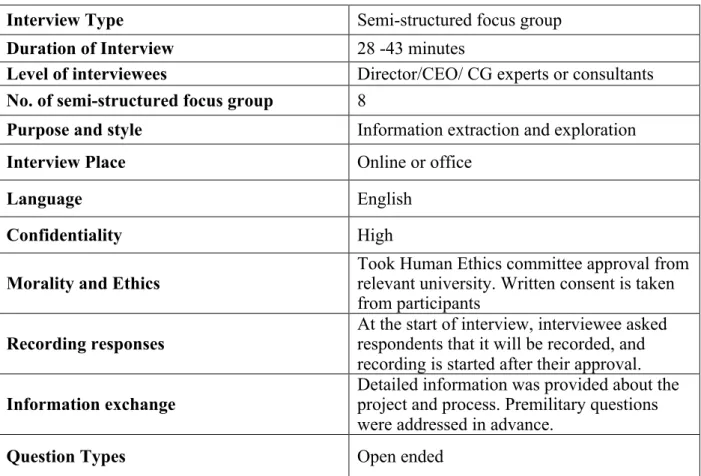
Accordingly, this research uses a case study of Pakistan to explore the key institutional determinants of corporate governance practices and ways to promote good corporate governance at the firm level. In the same vein, Samza (2016) conducted a study in Pakistan to identify weaknesses in corporate governance and explore opportunities for its improvement.
Auditing
Auditor Independence
However, focus group analysis reveals that auditor independence is compromised in listed firms of Pakistan. A focus group participant informed that the auditors do not verify the statements and that there is a practice of signing.
Audit Committee
Moreover, the focus group analysis also reveals that the audit committee should consist of independent directors. At Enron, serious issues arose regarding the independence of committee members despite the presence of the audit committee.
Risk Management
Political
Political System
In a similar vein, researchers documented that a country's political system is reflected by corporate governance (Adegbite et al., 2013) and that political influence can manifest itself in business (Adegbite, 2012). The focus group analysis shows that companies' standards and performance depend on the economy, and that the economy depends on political stability.
Political Influence
It is evident from the focus group that political issues are of major concern in the implementation of corporate governance practices in Pakistan. Focus group analysis reveals that almost all companies have political influence and this has disastrous effects on company performance and CG practices.
Corruption
And because of this political interference, SECP has been very dismal in ensuring corporate governance, enforcement of lease agreements in listed companies and because SECP is the main body responsible for ensuring corporate governance in public sector companies…. They are cautious and politically resistant, and their corporate governance practices have never been the government's concern. It is increasingly recognized that politics shapes corporate governance (Roe, 1991), especially in developing countries such as Pakistan, which is taking on more complex dimensions.
This raises the need to understand the links between a country's institution and corporate governance.
Legal
Compliance
In the same vein, Hamid and Kozhich (2007) pointed out that, after the introduction of the CG code in 2002, many firms were delisted from the Karachi Stock Exchange (KSE) due to the increased cost to comply with the CG code requirements. Since most companies in Pakistan are family-owned and controlled, companies prefer not to comply with strict regulation aimed at protecting the rights of minority shareholders (Khan, 2014). Similarly, Adu-Amoah et al. 2008) documented that this raises concerns regarding the application of corporate governance codes in developing countries developed by the Western world.
Enforcement
So that was the first hurdle, but then the process itself was a court sanction process, so you had to petition the provincial supreme court. I have looked at several rulings issued under these provisions, and in most cases I would say because of the process. Furthermore, complying with or explaining the nature of corporate governance regulations poses an additional enforcement challenge4.
Due to lack of enforcement, the goal of good corporate governance is not prevalent in Pakistan.
Regulators
It is clear that regulators are unable to perform better because of limited resources and political and other pressures. Effective regulations require sufficient authority and power to exercise and enforce compliance and enforcement of regulations. This lack of authority and power is contrary to assumptions of public interest theory (Den Hertog, 2010), which requires ample information and executive power to endorse public interest.
Therefore, regulators in developing countries like Pakistan not only suffer from a lack of necessary execution power, but also have access to limited information, limited by weak political and social institutions.
Board
Board independence
Researchers documented that independent directors are usually assumed to be more effective in protecting shareholders' interests (Baysinger and Butler, 1985), resulting in higher corporate performance (Baysinger and Hoskisson, 1990). Researchers pointed out that independent directors on board are very often directors of other companies (Fama and Jensen, 1983, Kaplan and Reishus, 1990). I think one thing that has really made corporate boards more effective in listed companies is the idea of having board independence and board independent directors (Participant -III)”.
Researchers documented that independent directors can intervene to protect the interests of all shareholders in the event of divergent interests between family and outside shareholders (Anderson et al., 2003).
Board Heterogeneity
However, the focus group pointed out that selection and appointments of board members are largely based on personal relationships and political gains. I'm a big proponent of diversity at board level, I've always talked about age diversity, I think gender diversity is also important.... When you have greater diversity, you bring people from different socio-economic backgrounds of different genders from different age structures. you bring people into a group who don't necessarily have the same level of comfort with each other and it's important that they start expressing their differences of opinion, because if there is a difference of opinion, there is a greater chance of a better conversation taking place and better decision-making takes place (participant – II)”. The analysis of focus group shows that diversity is very important to improve the CG practices in Pakistan.
Moreover, diversity in terms of age, gender, education and experience also helps in improving CG practices, but the extent of board diversity is unknown among listed companies in Pakistan.
Nepotism/Kinship
In Pakistan, you have a large shareholder who also has board representation, almost the entire board is made up of his family members, and then they also manage the business... In Pakistan, we have this high concentration of ownership, which means that I mean even among listed companies, we have majority shareholders a family owner who sometimes owns as high as eighty or ninety percent of the shareholding (Participant – III)”. In some companies, family members are employed at board and management level, and therefore this kinship is a major problem when evaluating board performance. Then again, it tends to vary, but where the board and management are professional and the internal auditor function is independent, there are greater chances of better efficiency and corporate governance compliance (Participant-II)”.
It is evident that family businesses in Pakistan create barriers to good management practices.
Shareholders Awareness
Shareholders Rights Protection
The focus group analysis shows that the rights of minority shareholders are protected in the law, but not in practice. I would refer to the Companies Ordinance of 1984, which predated the Companies Act of 2017. We had some provisions about minority shareholders and minority abuse. Moreover, no analogous provision exists for minority shareholders who represent less than 10% and do not have the power to petition the court or the SECP for mismanagement and oppression of minorities8.
Minority shareholders can enforce their claims in civil cases by suing for punitive damages under common law, but those cases take a long time and hinder company business9.
Education and Training
Additionally, shareholders can apply to the SECP to appoint an inspector to investigate the affairs of the company if they own at least 10% but less than 20% of the stock7. There's an allegation of abuse by the majority, so that was a big hurdle, and it actually meant effectively disenfranchising the minority shareholders, because if you look at the ownership structure, I think 20 percent was a long shot, because I think there was no way. minority shareholders, regardless of whether the total minority shareholder is five percent or ten percent to actually have that majority left. So it was a hurdle first, but then the process itself, it was a judicial sanction process, so you had to petition the High Court in the province (Participant-III)”.
It is argued that qualification and training alone are not a solution to the problems faced by developing countries (Abayo and Roberts, 1993), companies are unlikely to provide high quality information in the absence of demand and enforcement function .
Voting
AGM participation
However, his study reveals that most shareholders lack adequate education and shareholder activism (Cutajar, 2015). The majority of shareholders, especially minority shareholders, do not attend general meetings, and those who do do not have adequate knowledge and education. In addition, managers respond positively to questions and concerns of shareholders and try to influence them with positive news before general meetings.
These meetings are very important for shareholders, especially minority shareholders, to exercise their rights and increase value for the company.
Culture
Institutional Culture
In the extensive literature, researchers found that corporate governance disclosure was influenced by the prevailing culture (Haniffa and Cooke, 2002), especially in developing countries (Licht et al. conducted a study in Nigeria and found that national culture plays a central role in corporate performance ). Focus group analysis also reveals that culture has an impact on corporate governance practice in Pakistan Similarly, researchers have argued that the implication of culture on corporate governance practice is significant, especially in developing countries (Amaeshi et al., 2006).
Similarly, Pakistan has a national culture due to its historical relationships and spiritual attachments (Mughal, 2008) that influenced corporate culture and hindered the adoption of corporate governance.
Organizational Whistle-blowers
In addition, Licht et al. 2005) documented that the influence of culture on the practice of CG varies in different countries and depends on different factors. Recently, the Public Interest Disclosures Act (2017) has been passed in Pakistan to protect whistleblowers and encourages employees to raise their voice about corruption and wrongdoing within departments and organizations. DBs must ensure procedures for tracking any whistleblowers and take the necessary actions to protect whistleblowers.
Values
Family Systems
Similarly, Kimani (2010) asserted that the family determines moral and social norms and preserves spiritual and material traditions and customs. Researchers documented that core family values influence family business (Hendrick, 2000) and determine family enterprise behavior (Klein et al., 2005). Focus group analysis reveals that family values are high in Pakistan and the entire family owns and controls the business.
It is also imperative to mention that family and business are so intertwined that feelings are inevitable in a family business.
Interpersonal Connections
I have had the chance in my professional life to actually interview some of the family owners and in some cases I think I remember this family from a large family business in Karachi and the founder told me that in the beginning was skeptical about an independent director because it was a very close company with a family-only board, but now that person has been on board for one year, they see the value that person brings so I think a most influential (Participant-III) is”. In addition, it provides an opportunity to see how someone is doing the same thing that you are doing. In short, cross directorships held by BoDs have important implications for disclosure practice, as there will be greater access to information in more than one company.
In the case of Pakistan, cross-directorates are common among listed companies, but their impact on disclosure practice is unknown.
Conclusion and Recommendations
The study finds that institutional culture has a critical influence on corporate governance practice in Pakistan. The study also finds that shareholders are not aware of the potential benefits of corporate governance practices. Moreover, the expression mechanism does not affect the practice of corporate governance in Pakistan.