Recent reports indicate that ~ 88 % of the total catch of Australian fisheries comes from sustainable stocks (FAO 2014, Flood et al. 2014). Of the eight regions (6 States, 1 Territory and the Commonwealth) that make up Australia's fisheries management jurisdictions, Western Australian (WA) fisheries account for 24% of the total gross value of Australia's wild catch fisheries (Flood et al. 2014). . This initiative involves putting all WA commercial fisheries through the pre-assessment stage of the MSC certification process.
The MSC assessment process requires a large amount of technical knowledge and information (Washington and Ababouch 2011, Phillips and Ward 2013, Bellchambers et al. 2014) that is primarily the responsibility of the fishery client and associated managers and scientists. Therefore, it is essential that fisheries and stakeholders have a good understanding of MSC requirements and potential areas of weakness in the fishery under assessment (Heupel and Auster 2013, Bellchambers et al. 2014).
Objective 1: Increase the efficiency of generating submissions for MSC
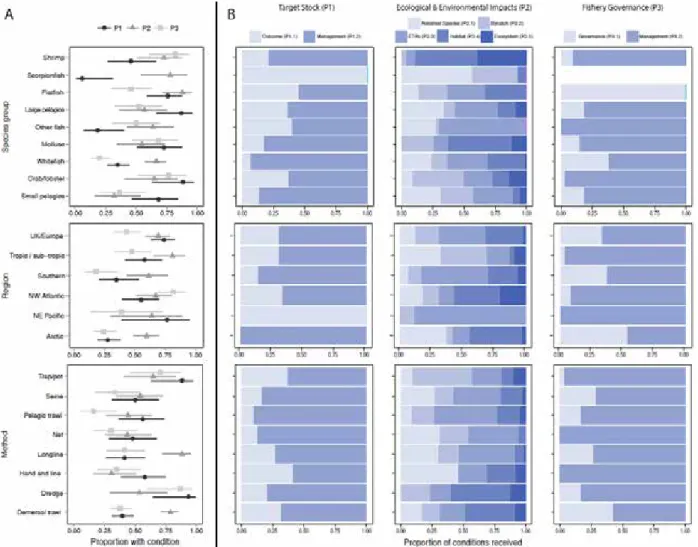
The effect of three discrete factors (species group, fishing method, and region) on the composition of conditions obtained by fishing within each Principle (P1, P2, and P3) was examined with Permutational Multivariate Analysis of Variance (PERMANOVA; Anderson 2001) using vegan package (Oksanen 2015). The risk assessment component of the workshop included presentations by Richard Stoklosa (facilitator of the risk assessment component of the workshop) on the MSC's risk-based framework and Dr Rick Fletcher (DoF) on qualitative risk assessment in Fisheries Management Ecosystem (EBFM) (Fletcher 2015). Describe how the specified time frame of the reconstruction relates to the Generation Time of the species (ie, mean age of sexual maturity).].
The stock assessment takes into account the most important characteristics relevant to the biology of the species and the nature of the fishery. Provide a detailed description of the Harvest Control Rule in place for the target species of the fishery.]. Describe how the selection or design of the Harvest Control Rules takes uncertainties into account.].
Provide a summary of the quantity and quality (fishery dependent and independent) of information collected to support stock assessment and harvest strategy for target species (see Box 6 for examples).]. What is the stock status of each of the 'major' species (although this is uncertain). Are the effects of fishing on each of these species within national/international limits for the protection of the species.
Describe the measures/strategy in place to limit or minimize the impact of the fishery on habitat structure and function. Describe the measures/strategy in place to address or limit the impact of the fishery on key elements of the ecosystem. Information on the relationship of stakeholders who are aware of the existence of dispute resolution arrangements;.
How the research plan takes into account relevant long-term fisheries management needs (ie a comprehensive research plan). How the research results are accessible to interested parties and the public.
Minimise the likelihood of unnecessary conditions being imposed during MSC
Objective 1: Increase the efficiency of generating submissions for MSC
Development of a MSC submission template for fishery clients
Examples of MSC certified fisheries that scored well on different PIs are included to illustrate a range of approaches to addressing the PIs and scoring criteria. All examples are obtained from public certification results from certified fisheries available on the MSC website (www.msc.org).
Formation of an international MSC reference group
Objective 2: Minimise the likelihood of unnecessary conditions being imposed
Collation of data from certified fisheries
Factors affecting conditions received
Identifying specific risk areas and mitigation strategies
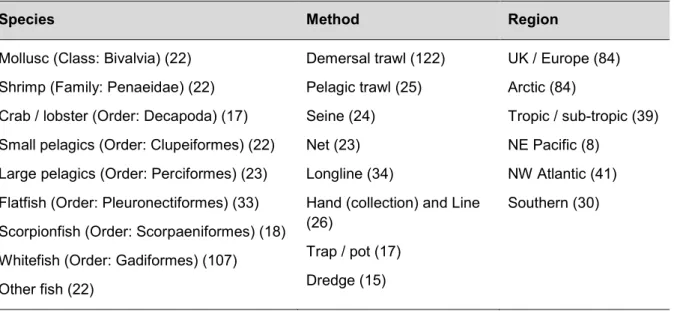
Stock status Reference points Harvest strategy Harvest control Rules and tools Information and monitoring Assessment of stock status Performance management information Performance management information Performance management information Performance management information Performance management information Legal and customary framework Consultation Long-term goals Incentives Fishery-specific goals Decision-making process Compliance and enforcement Research plan Management Evaluation. Penaeus esculentus, P. semisulcatus) DT Canada Offshore Striped Shrimp (SFAs 2, 3 & 4) (Pandalus montagui) DT Estonia Northeast Arctic Coldwater Shrimp (Pandalus borealis) DT Fogo Island Coop.
Objective 1: Increase the efficiency of generating submissions for MSC
Development of a MSC submission template for fishery clients
Formation of a MSC reference group
The risk assessment presentations and case studies identified strengths and weaknesses of the methods and recommendations for improvements in the MSC certification process. Review of the criteria driving the use of the MSC RBF and an example of how the scoring guidelines apply to assessments (MSC 2014c). The likelihood-consequence approach can include all the information considered in both the scale, intensity, consequence analysis (SICA) and productivity sensitivity analysis (PSA) of the MSC RBF.
This will require exposure of the DoF approach to CABs and calibration of assessment criteria. The PSA sensitivity score has difficulty reflecting fishing mortality of the target species, due to low post-catch mortality.
Objective 2: Minimise the likelihood of unnecessary conditions being imposed
Results
- Trends in data from certified fisheries
- Influence of factors on nature of the conditions received
- Specific risk areas for commonly certified fisheries
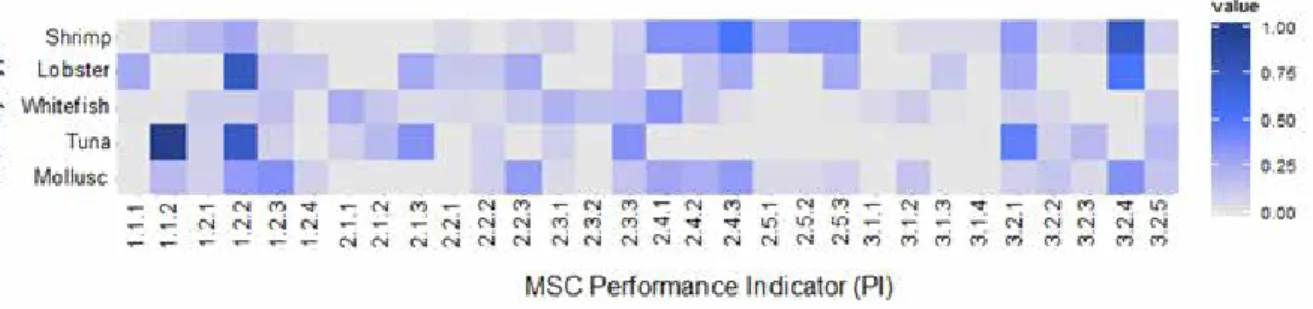
Most of the P1 conditions were within the management component (P1.2), with all P1 conditions in the Arctic region occurring within this area (Figure 1b). Fisheries from the UK/Europe, South and North Pacific regions all had a high proportion of conditions within the ETP species component of P2 (P2.3), while fisheries from the tropics/subtropics had a high proportion of conditions within the conserved areas . and Bycatch species components (P2.1 and 2.2 respectively). Both of these regions had a high proportion of conditions in fisheries-specific objectives (PI 3.2.1) and research plan (PI 3.2.4), although the NW Atlantic region also had a high proportion in management performance evaluation (PI 3.2.5).
Bottom trawling and mud fishing received the majority of conditions in the Habitat and Ecosystem components (P2.4 and P2.5 respectively), while conditions in most other method types related to retained and ETP species (P2.1 and P2.3 respectively) . The majority of conditions in P1 were related to Harvest Control Rules and Tools (PI of UoCs).
Discussion
- Trends in data from certified fisheries
- Principle 1
- Principle 2
- Principle 3
Each cooperative applies catch control rules based on the results of the last fishing season to maintain biomass above the BMSY. Among the fisheries examined in this study, only a few had P3 conditions for PIs related to management and policy (PI. Of the selected fisheries examined in this paper, each group of species had at least one UoC that received the objective condition , specific to fisheries (PI). 3.2.1).
However, about half of the tuna fishery developed a condition on this PI, despite a small number of other P3 conditions. An important benefit of this study is a better understanding of the MSC FAM by DoF, including the performance indicators and scoring criteria.
Objective 1: Increase the efficiency of generating submissions for MSC
Objective 2: Minimise the likelihood of unnecessary conditions being imposed
State of Western Australia Fisheries and Aquatic Resources Reports State of Fisheries. Food Certification International Ltd., Inverness, UK. http://www.msc.org/track-a-fishery/fisheries- in-the-program/certified/north-east-atlantic/agarba-spain-barents-sea-cod/assessment- downloads-folder/20131118_PCR_COD365. pdf. Convention to Strengthen the Inter-American Tropical Tuna Commission Established by the Convention of 1949 between the United States of America and the Republic of Costa Rica (“Antigua Convention.”).
Evaluation of environmental changes in fisheries included in the Marine Stewardship Council certification scheme. Longline tuna catch rates in the Indian Ocean: did industrial fishing cause a 90% rapid decline in the abundance of a large predatory species. Technical Guidance on the Use of Precautionary Approaches to Implement National Standard 1 of the Magnuson-Stevenson Fisheries Conservation and Management Act.
Primary Industries and Regions, South Australia, Adelaide, http://frdc.com.au/research/Documents/Final_reports/2010-061-DLD.pdf. The Convention on the Conservation and Management of Highly Migratory Fish Stocks in the Western and. Sustainability of harvest levels for Australian-flagged vessels in the high seas of the South Pacific and South Indian Ocean.
Intellectual Property
Project staff
Members of International Reference Group
MSC submission template for fishery clients
Include a description of controls in place under each of the above legislations, including other controls, e.g. A harvesting strategy (decision-making framework) provides a set of transparent and verifiable measures to assess and report on the performance of the fishery and demonstrate its sustainability. More detailed information on the different elements of the harvesting strategy should be presented under the appropriate subheading below.
Do elements of the Harvest Strategy work together to achieve objectives, or is the strategy designed to achieve objectives. The term "evaluated" refers to testing that the Harvest Strategy is robust to uncertainty appropriate to the scale and intensity of the fishery (MSC 2013b), which is typically undertaken using the Harvest (or Management) Strategy Evaluation approach ( see e.g. Point et al. 2005). Describe the monitoring undertaken to collect the information needed to evaluate the performance of the Harvesting Strategy.].
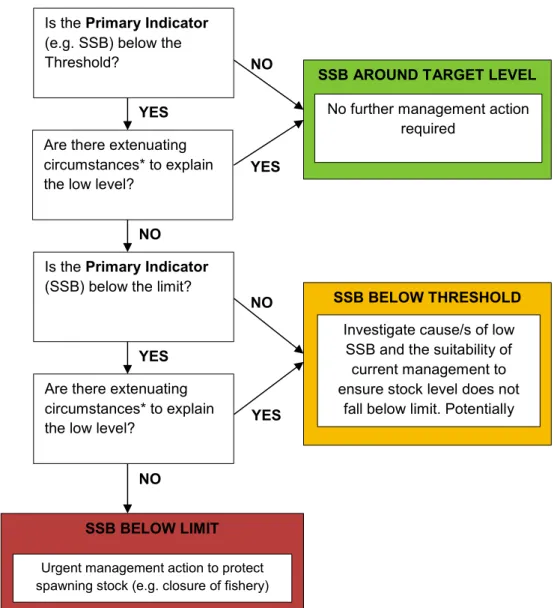
Is the Limit reference point set above the level at which there is a clear risk of damaging the reproductive capacity of the stock. It may be useful to provide a flow chart describing the design and implementation of harvesting control rules (see example in Figure 7.1). What information is available on the spatial extent of the interaction and the location and timing of fishing gear use.
Management and policy capture the broad, high-level context of the fisheries management system within which the fishery under assessment is found. National and international laws, arrangements, agreements and policies governing the actions of the authorities and actors involved in the management of the fishery; and. Consultation processes must be appropriate to the scale, intensity and cultural context of the fishery and must be described at both the management system level and the fishery-specific management systems contained therein (MSC 2013b).
How the consideration and/or use of the information is explained to the parties/stakeholders (ie how transparent the consultation process is). Describe any incentives that exist under the management system that encourage fishers to fish sustainably or create a sense of resource stewardship. This part of the IP addresses whether the fishery is operating within a legal or customary framework and whether there is evidence that this is not the case.
A research plan is a written document that includes a specific research plan for the fishery under assessment, relevant to the scale and intensity of the fishery and issues requiring research.