QUT Digital Repository:
http://eprints.qut.edu.au/27019
CRC for Construction Innovation (2005) Generic skills in design teams : literature review. CRC for Construction Innovation, Brisbane
The Participants of the CRC for Construction Innovation have delegated authority to the CEO of the CRC to give Participants permission to publish material created by the CRC for Construction Innovation. This delegation is contained in Clause 30 of the Agreement for the Establishment and Operation of the Cooperative Research Centre for Construction Innovation. The CEO of the CRC for Construction
Innovation gives permission to the Queensland University of Technology to publish the papers/publications provided in the collection in QUT ePrints provided that the publications are published in full. Icon.Net Pty Ltd retains copyright to the
publications. Any other usage is prohibited without the express permission of the CEO of the CRC. The CRC warrants that Icon.Net Pty Ltd holds copyright to all papers/reports/publications produced by the CRC for Construction Innovation.
Generic Skills in Design Teams:
Literature Review
Research Project No: 2002-024-B-03
The research described in this report was carried out by:
Project Leader Mary Lou Maher
Researchers Robin Drogemuller Zafer Bilda Kirsty Beilharz Linda Candy Andy Dong Mijeong Kim John Gero Tony Shi Mike Rosenman Ji Soo Yoon Thomas Bellamy Figen Gul Rod Gameson Yinghsiu Huang Willy Sher Sue Sherratt Tony Williams Adel Ahmed Stephen Egan Owen Macindoe Kathryn Merrick Robert Shen
Project Affiliates David Marchant
Carolyn Mitchell
Kanyarat Nemprempree
John Crawford
Lan Ding
Melissa James
Richard Hough
Steve Pennell
Research Program: B
Distribution List
Cooperative Research Centre for Construction Innovation Authors
Disclaimer
The Client makes use of this Report or any information provided by the Cooperative
Research Centre for Construction Innovation in relation to the Consultancy Services at its own risk. Construction Innovation will not be
responsible for the results of any actions taken by the Client or third parties on the basis of the information in this Report or other information provided by Construction Innovation nor for any errors or omissions that may be contained in this Report. Construction Innovation expressly disclaims any liability or responsibility to any person in respect of any thing done or omitted to be done by any person in reliance on this Report or any information provided.
© 2005 Icon.Net Pty Ltd
To the extent permitted by law, all rights are reserved and no part of this publication covered by copyright may be reproduced or copied in any form or by any means except with the written permission of Icon.Net Pty Ltd.
Please direct all enquiries to:
Chief Executive Officer
Cooperative Research Centre for Construction Innovation 9th Floor, L Block, QUT, 2 George St
Brisbane Qld 4000 AUSTRALIA T: 61 7 3138 9291 F: 61 7 3138 9151
E: [email protected] W: www.construction-innovation.info
Table of Contents
Table of Contents ... I
List of Tables ...ii
List of Figures ...ii
1. PREFACE... 1
2. EXECUTIVESUMMARY ... 2
3. BACKGROUND ... 4
4. AIMS AND OBJECTIVES FOR THE PROJECT AND LITERATURE REVIEW 6 4.1 Research Aims...6
4.2 Research Objectives ...6
4.3 Literature Review: Research Context...6
5. TEAMWORK... 7
5.1 Definition of Operational and Project Teams...7
5.2 Project Team Lifecycle and Processes ...7
6. COMPOSITION AND NATURE OF TEAMS...10
6.1 Definition of Co-located Teams...10
6.2 Definition of Virtual Teams ...10
6.3 Definition of Global Teams ...11
6.4 Comparison Between Colocated and Virtual Teams...11
6.5 Advantages of working in a Virtual Team ...12
6.6 Challenges Faced by those in Virtual Teams ...12
7. ISSUES OF GENERIC SKILLS ARISING FROM A VIRTUAL CONTEXT ...14
7.1 Core Generic Skills in a Virtual Context ...15
7.1.1 Adaptability...15
7.1.2 Shared situational awareness ...15
7.1.3 Performance monitoring and feedback...16
7.1.4 Team management ...16
7.1.5 Interpersonal relations...17
7.1.6 Co-ordination...18
7.1.7 Communication ...29
7.1.8 Decision making ...20
7.2 Team Skills in a Virtual Context...21
7.2.1 Trust ...21
7.2.2 Dealing with cultural issues ...22
7.2.3 Archiving...22
8. THE TEAM DESIGN ACTIVITY...23
8.1 Issues Impeding Design Team Collaboration...25
10. CONCLUSION ...31 11. REFERENCES ...32 12. BIBLIOGRAPHY ...35
List of Tables
Table 5.2.1 Comparison of Lipnack and Stamps (2000) and Cornick and Mather (1999) models ... 9 Table 5.2.2 Differing collaboration styles (as indicated by Maher et al 2000) ... 9 Table 6.2 A classification of virtual team working (Kimble et al, 2000)... 10 Table 6.4 Communication options for teams including temporal aspects (adapted from
Maher et al, 2000a) ... 11 Table 7 Integrated teamwork skills as adapted from Cannon-Bowers et al 1995
(adapted from Salas et al, 2000) ... 14 Table 8 Design activities adapted from Gay and Lentini (1995)... 24 Table 9 Summary of activity, skills classifications and profiles
...
30List of Figures
Figure 5.2.1 Model of stages in the project team lifecycle (based on Lipnack and Stamps, 2000) ... 8 Figure 5.2.2 Generic construction model of the stages of a project team lifecycle (based on
Cornick and Mather, 1999)...8 Figure 6.6 Diagram illustrating the variables that can impact on a team's ability or
willingness to become virtual (virtuality) ... 13 Figure 8 Generic step model of design team activities (Stempfle and Badke-Schaub,
2000) ... 23
1. PREFACE
The Cooperative Research Centre for Construction Innovation (CRC-CI) research project 2002-024-B: ‘Team Collaboration in High Bandwidth Environments’, is supported by a number of Australian Industry, government and university based project partners: University of Sydney; University of Newcastle; CSIRO; Woods Bagot Pty and Ove Arup Pty Ltd.
This report has been produced by the University of Newcastle in collaboration with all of the other project partners.
2. EXECUTIVE SUMMARY
Recent developments in networked three dimensional (3D) virtual worlds, and the
proliferation of high bandwidth communications technology, have the potential to dramatically improve collaboration in the construction industry.
This research project focuses on the early stages of a construction project in which the models for the project are developed and revised. The project investigates three aspects of collaboration in virtual environments:
1. The processes that enable effective collaboration using high bandwidth information communication technology (ICT);
2. The models that allow for multiple disciplines to share their views in a synchronous virtual environment;
3. The generic skills used by individuals and teams when engaging with high bandwidth information communication technology.
The third aspect of the project, listed above, led by the University of Newcastle, explores the domain of People and the extent to which they contribute to the effectiveness of virtual teams. This report relates, primarily, to this aspect.
It reviews and presents literature on the issues of teamwork, virtual teaming, generic skills involved with teamwork, and virtual teams. These themes are examined in the environment of early design from the perspective of a broad range of industries. The literature is then evaluated in relation to the overall research project’s aims and objectives, concentrating on the areas of: teamwork, virtual teams, generic skills and early design.
The objective of this report is therefore to:
• Analyse literature within the domain of design, supported by literature drawn from the broader domain of remote collaboration to identify factors of virtual teaming which may affect team member skills.
Environmental and technological changes have impacted on the way in which construction teams function. A major driver of environmental change has been a move towards more collaborative contractual arrangements, such as alliancing and partnering, which, in turn, promotes technological change. Longer term relationships between project team participants act as drivers for the uptake of new technologies. Investing time and money in new computer hardware and software is more attractive if such technologies can be used on many projects, with the same people.
With regard to the nature of teams, technology (i.e. cost of technology, speed of information transfer and the associated costs) promotes moves from co-located to more virtual team activities. However, the challenge of such a move is to incorporate aspects of co-location, for example, seeing people whilst interacting with them, and the ability to collaborate on issues such as developing an aspect of a design, within a virtual environment.
The report concludes that in order to function efficiently and effectively in a team environment, irrespective of whether it is a traditional or virtual team, team participants
require ‘appropriate skills’ (i.e. awareness, understanding, and abilities to apply). One cannot
‘assume’ that all team members automatically possess all of the necessary skills for virtual teaming. Previous research has identified that the introduction of new technologies can impact, both positively and negatively, upon the performance of teams. Therefore the ability to map and measure the skills of individuals and teams is seen as critical. Mapping and measuring these skills will lead to training in any deficient areas identified. The development of skills mapping and measurement tools will be the major outcome of this aspect of the
research project. The next phase will take the first of a series of steps by developing a framework for the analysis of design team activity categorising activities and skills.
3. BACKGROUND
Recent developments in networked 3D virtual worlds and the proliferation of high bandwidth communications technology have the potential to dramatically improve collaboration in the construction industry. There have been numerous studies of collaboration in Europe and the USA that have resulted in system architectures to support data transfer and information sharing. This project focuses on how these systems and the associated commercial tools can be used in a high bandwidth environment. It focuses on the early stages of a
construction project in which the models for the project are being developed and revised.
The project looks at three aspects of collaboration in virtual environments:
1. The processes that enable effective collaboration using high bandwidth information communication technology.
2. The models that allow for multiple disciplines to share their views in a synchronous virtual environment.
3. The generic skills used by individuals and teams when engaging with high bandwidth information and communication technology (ICT).
The third aspect of the project, led by the University of Newcastle, explores the People domain, and the extent to which they contribute to the effectiveness of virtual teams within the industry. This will be accomplished within the context of tools developed by the other two aspects (1 & 2) defined above. Relevant literature has been reviewed, and this is followed by the collection and analysis of data, mapping the factors which influence effectiveness across the domains identified above. Then conclusions are drawn which facilitate the development of skill profiles for virtual team participants. It is envisaged that the
development of skills profiles, both at the individual and team levels, will provide the basis for work based training, feeding into educational and continuing professional development (CPD) programs. The scope of the generic skills aspect of this project is limited to the early design phase experiments developed and implemented by the University of Sydney.
The genesis of research into virtual teams and skills came from a previous CRC-CI research project (Project Team Integration: Communication, Coordination and Decision Support [2001- 008-C-04] conducted at the University of Newcastle (Kajewski, 2003). One component of this scoping study investigated issues relevant to project teams working in virtual
environments. A case study was conducted where project team supply chain participants (from client representative to subcontractors), in a recently completed construction project, were interviewed. The project used a web portal for communication between team members.
Although there was consensus that the case study project team possessed the skills required to execute their responsibilities, most interviewees acknowledged that they had learnt and / or developed skills on the project, but found it difficult to identify the particular aspects / areas that had been learned / developed. With respect to the impact of Information and
Communication Technologies (ICT) and construction professionals engaging electronically in teams, the identification of the mix of skills required to operate in such environments will facilitate targeted (rather than ad-hoc) skills development programs. Goulding and Alshawi (2002; p501) noted that managers are, "….continually striving to match market opportunities with core competence, and increased importance is being placed on understanding how skills (and competence) contribute to organizational performance." An audit of the skills of participants in the construction supply chain will provide this strategic advantage as well as a focus for the identification of appropriate skills development opportunities.
A recommendation from this research, based upon its key findings, for further research was to identify and audit construction project virtual teams. Therefore this research seeks to investigate further, and specifically, project team skills, focusing, in particular, on design professionals.
This literature review begins by presenting a series of areas of relevance to teams working in virtual environments:
• Teamwork
• Composition and nature of teams
• Generic Skills, and
• Design team activities.
Then key issues relating to the above areas are then discussed. Conclusions are drawn and actions for the next phase of the research outlined.
4. AIMS AND OBJECTIVES FOR THE PROJECT AND THE LITERATURE REVIEW
Technology is continually changing throughout the entire construction industry; and
particularly in the design process. One of the principal manifestations of this is a move away from team working in a shared work space to team working in a virtual space, using
increasingly sophisticated electronic media. Due to the significant operating differences when working in shared and virtual spaces (discussed later) adjustments to generic skills utilised by members is a necessity when moving between the two conditions. This aspect, led by the University of Newcastle, is based on research of generic skills used by individuals and teams when engaging with high bandwidth information and communication technologies (ICT). It aligns with the other two aspects of collaboration in virtual environments, processes and models, which is being led by the University of Sydney. The entire project focuses on the early stages of a project (i.e. design) in which models for the project are being developed and revised.
4.1 Research Aims
The aims of this aspect of the research project, as stated in the CRC-CI contract are to:
1. Map and develop personal and team-working generic skills of virtual team members working in the design stage of construction projects, and,
2. Specify requirements to enable Construction Industry individuals and teams to operate effectively in CRC-CI ICT assisted environments during the design stage of construction projects.
4.2 Research Objectives
The objectives of this aspect of the research project are to:
a) Develop guidelines for the analysis of design teams and their participants whilst designing in virtual environments;
b) Develop terms of reference for the conduct of interviews and/or focus groups with design teams and their participants;
c) Analyse and document experience of collaboration amongst design teams and their members whilst working in virtual environments;
d) Analyse and document skills profiles required for different forms of collaboration in virtual environments, and
e) Report on the knowledge, skills, and attitudes required to effectively participate in design teams in virtual environments.
4.3 Literature Review: Research Context
This review aims to present literature on the issues of teamwork, virtual teaming, generic skills involved with teamwork and virtual teams. These themes are examined in the
environment of early design from a broad range of industries. The literature is then evaluated in relation to the stated research aims and objectives, concentrating on the areas of
teamwork, virtual teams, generic skills and early design. Therefore the objective of this report is to analyse literature within the domain of design, supported by literature drawn from the broader domain of remote collaboration. The outcomes of this review will inform the next phase of the research: the development of a framework for the analysis of design team activity.
5. TEAMWORK
As time and technology move forward, and design projects become more complex,
relationships, roles, and responsibilities have become more varied. It is through the sharing of ideas that superior products are created and delays and miscommunication are avoided (Maher et al., 2000a). Teams are a cluster of two or more people usually of differing roles and skill levels who interact ‘…adaptively, interdependently, and dynamically towards a common and valued goal.’ (Salas et al., 2000). They are the vehicle for the process of
collaboration (Beyerlein et al., 2003). In a majority of organisations there exists a wide variety of challenges and issues. The key issues and challenges are discussed below. The
following sections investigate, by definition and discussion, project teams and their life-cycles and processes.
5.1 Definitions of Operational and Project Teams
Literature tends to classify teams into two facets: ‘operational’ and ‘project’. Operational teams are stable teams existing in the same business environment (Jaafari and Tooher, 2002). Stable refers to the fact that those members are fixed and the team operates for an extended period of time over many projects. Teams which form for a specific project are defined as project teams (Jaafari and Tooher, 2002). These teams are primarily formed quickly and disbanded in the same manner. They are often comprised of members from different backgrounds (i.e. professions) who bring specialised skills to a project. Project teams often have multiple points of authority between the team members, and share
‘…decisions, results, and rewards…’ (Cleland and Ireland, 2002). Project teams form the basis of the review of virtual team literature as this research encompasses the early design process, which in the majority of cases, draws designers together for a specific project.
An historical trend in the construction industry has been that each time a project team is formed the make up of it’s members (both at an individual and organisational level) changes, resulting in little or no consistency of membership (Emmitt and Gorse, 2003). However, more recent trends, promoted in particular by large private and, more recently, public sector clients has led to the use of more ‘collaborative’ procurement systems such as ‘strategic alliancing’
and ‘partnering’ (Love et al., 2002). Such alliances have, to some extent, encouraged and promoted the developments and utilisation of newer technologies given that they promote longer term relationships between participants and thus encourage investment and utilisation of such technologies. For example, strategic partnering is used by companies to obtain advantages from long term cooperative work on more than one particular project (Love et al., 2002). Therefore changes to the structure of the construction industry, in particular longer term ‘alliances’, to work together on multiple projects, between different organisations, are seen as a driver of technological change and uptake.
5.2 Project team lifecycle and processes
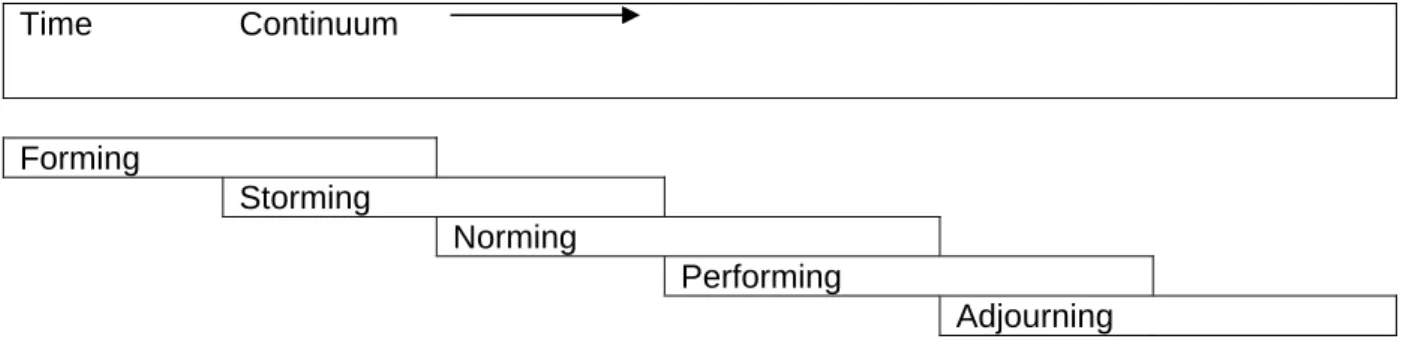
There is a significant degree of consensus between authors on the life cycle of a project team based upon Tuckman’s (1965) model (Lipnack and Stamps, 2000, Blair, 1991, Jaafari and Tooher, 2002). Figure 5.2.1, developed from Lipnack and Stamp’s (2000) work,
illustrates stages in the project team lifecycle.
Figure 5.2.1 Model of stages in the project team lifecycle (based on Lipnack and Stamps, 2000).
Time Continuum
Forming
Storming
Norming
Performing
Adjourning
‘Forming’ refers to the early development stage where all communication is directed by emergent leaders (Lipnack and Stamps, 2000, Tuckman, 1965, Blair, 1991). ‘Storming’ is the next stage which is associated with little communication and an increase in conflict between team members. The ‘Norming’ stage involves an opening of communication channels and a free flow of information with all members expressing their individual ideas. In ‘Performing’ a team system is established and project results are revealed (Lipnack and Stamps, 2000, Tuckman, 1965, Blair, 1991). According to Jafaari (2002) and Lipnack and Stamps (2000) there is one final stage, ‘Adjourning’, which encompasses the annulment of a team. This stage involves the slowing of work processes as the final product is delivered and feedback is sought. Feedback at this stage could result in a team ending interaction or moving to a new stage. However, this is dependent upon the particular design task (Lipnack and Stamps, 2000).
It is interesting and relevant to juxtapose the project team lifecycle shown in Figure 5.2.1 with Cornick and Mather’s (1999) model describing a generic model of the stages in a
construction project team lifecycle, Figure 5.2.2.
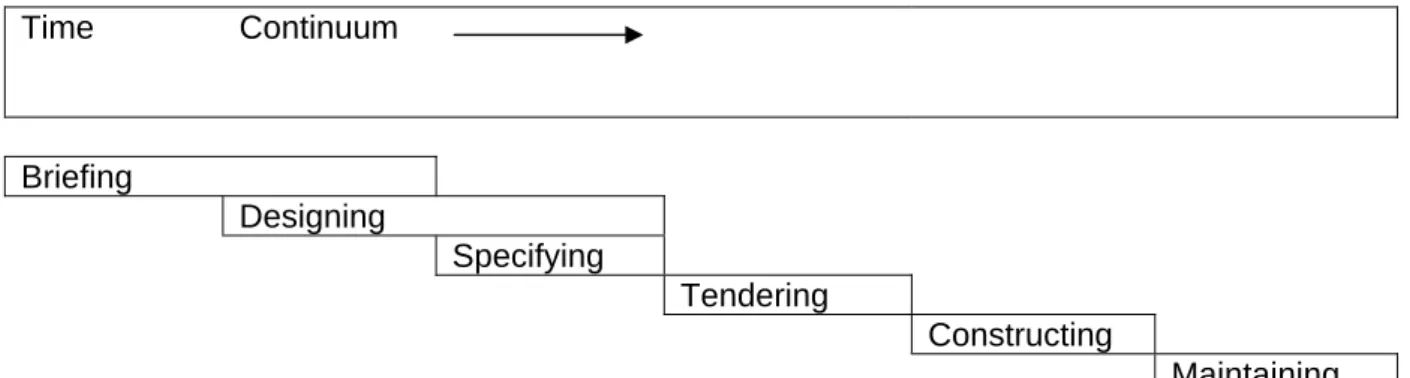
Figure 5.2.2 Generic construction model of the stages of a project team lifecycle (based on Cornick and Mather, 1999).
Time Continuum
Briefing
Designing
Specifying
Tendering
Constructing
Maintaining
‘Briefing’ refers to the phase of construction where the requirements of a project are identified (Cornick and Mather, 1999). ‘Designing’ encompasses the proposal and agreement stages of the design solutions. ‘Specifying’ is the defining of those production necessities for the
construction process. ‘Tendering’ is the process through which prices are determined for the production necessities. ‘Construction’ and ‘Maintaining’ are respectively the physical
production of the project and the post construction care and management of the project (Cornick and Mather, 1999).
This model demonstrates an alignment, in terms of the time continuum, with the ‘Generic construction model of the project team lifecycle’ in Figure 5.2.2 as illustrated by Cornick and Mather (1999), except that it refers to the actual conceptual processes, creation and refining
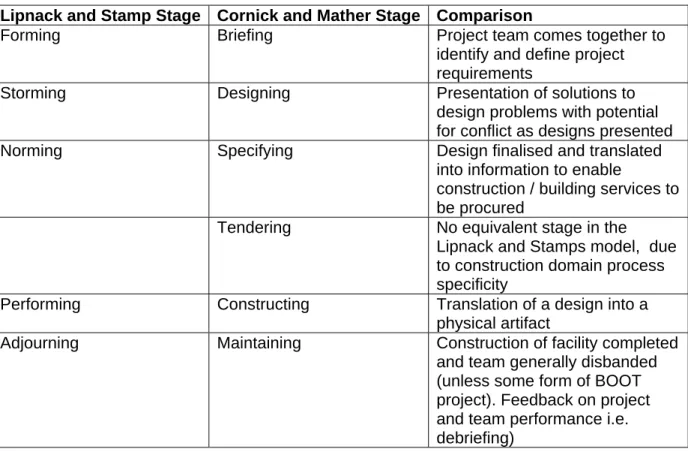
of a design rather than the phases of social interaction. Each of the construction stages, as defined by(Cornick and Mather, 1999) can be compared with Lipnack and Stamps’s (2000) stages of the project lifecycle, as shown in Table 5.2.1.
Table 5.2.1 Comparison of Lipnack and Stamp (2000), and Cornick and Mather (1999) models.
Lipnack and Stamp Stage Cornick and Mather Stage Comparison
Forming Briefing Project team comes together to
identify and define project requirements
Storming Designing Presentation of solutions to
design problems with potential for conflict as designs presented
Norming Specifying Design finalised and translated
into information to enable
construction / building services to be procured
Tendering No equivalent stage in the Lipnack and Stamps model, due to construction domain process specificity
Performing Constructing Translation of a design into a
physical artifact
Adjourning Maintaining Construction of facility completed
and team generally disbanded (unless some form of BOOT project). Feedback on project and team performance i.e.
debriefing)
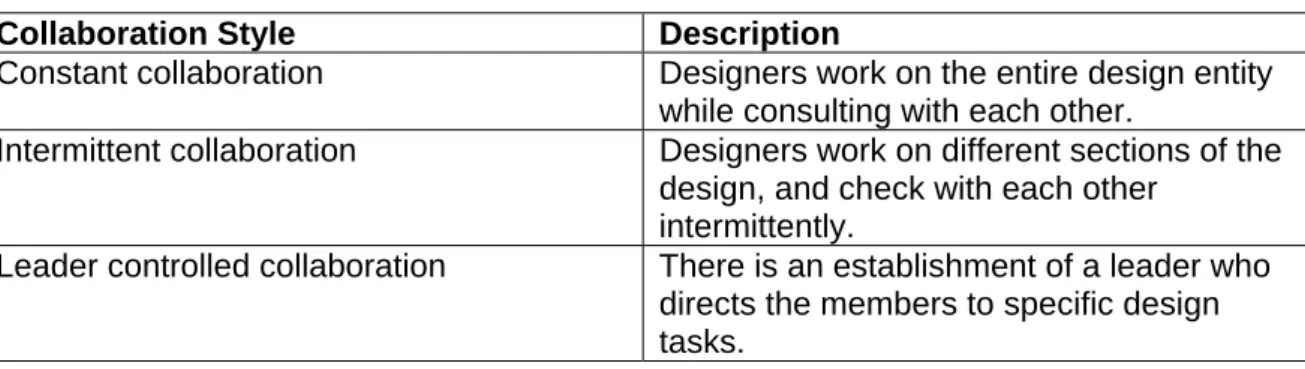
Collaborative teamwork in a construction context historically refers to a short term alliance (i.e. for a single project) between parties or companies. Cooperation is the term used to describe the relationship between companies that would exist for more than one project (Love et al., 2002). Maher et. al. (2000a) report three different styles of design collaboration, within a collaborative design experiment, as shown in Table 5.2.2.
Table 5.2.2 Differing collaboration styles (as indicated by Maher et al. 2000a) Collaboration Style Description
Constant collaboration Designers work on the entire design entity while consulting with each other.
Intermittent collaboration Designers work on different sections of the design, and check with each other
intermittently.
Leader controlled collaboration There is an establishment of a leader who directs the members to specific design tasks.
6. COMPOSITION AND NATURE OF TEAMS
Before examining the skills involved with teamwork and how they may be affected by virtual technologies, the composition and nature of teams requires definition. A succinct summary is provided by McDonough et al (2001; p 111) who categorises various types of teams, as follows:
• Co-located teams are comprised of individuals who work together in the same physical location and are culturally similar.
• Virtual teams are comprised of individuals who have a moderate level of physical proximity and are culturally similar. One example of virtual team is where team members are in the same building but on different floors.
• Global teams are comprised of individuals who work and live in different countries and are culturally diverse.
Each of the above categories is discussed below, before comparisons and challenges are discussed.
6.1 Definition of Co-located Teams
Historically co-location was the principal way that teams operated before technology provided the ability to communicate with others in different physical locations. Co-located teams are those whose members operate in the same physical and cultural space (McDonough III et al., 2001). Co-located teams’ interactions are synchronous, occur in a similar place, and their members may be culturally different in terms of different organisations. It is thought that team strength is a result of this social face-to-face (co-located) interaction with team members at work and outside of work (Lurey and Raisinghani, 2001). However, with increasing
globalisation of projects it is becoming harder to co-locate these national and global team members (McDonough III et al., 2001). Lipnack and Stamps (2000) suggest that in the North American culture, team members need to be physically close to operate effectively, reporting that if members are more than 50 feet apart the number of team interactions begins to drop dramatically.
6.2 Definition of Virtual Teams
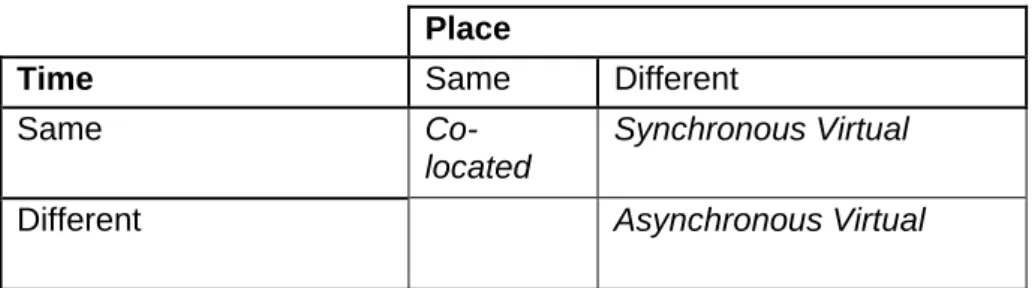
Virtual teams exist when those members of a team are culturally similar but operate, for the majority of their existence, in different physical spaces such as different cities within the same country (Lurey and Raisinghani, 2001, McDonough III et al., 2001). Kimble et al (2000) classify virtual teamworking by defining three dimensions, each with two variables, as shown in table 6.2.
Table 6.2 A classification of virtual team working (Kimble et al, 2000)
Place
Time Same Different
Same Co-
located
Synchronous Virtual
Different Asynchronous Virtual
As the clients of the construction industry demand more efficient and higher quality services the need to utilise different dimensions and variables on a project increases. Consequently
instead of an architect conceptually designing a structure and then seeking approval from a structural engineer, an engineer may be involved from the beginning of a project to advise on pertinent issues (Kayworth and Leidner, 2000). This need for group interaction has led to an increase in partnering between construction organisations from different disciplines (Love et al., 2002). Therefore, due to the different geographical locations of project team members, more complex and sophisticated electronic media are being used to communicate ideas and designs (Jaafari and Tooher, 2002).
6.3 Definition of Global Teams
A global virtual team exists when team members are also culturally displaced, such as in international collaborative ventures (Kayworth and Leidner, 2000). The majority of definitions of global virtual teams suggest that they are temporary in nature with a lifespan related to a specific project (Jarvenpaa and Liedner, 1998). The most important characteristics of a virtual team are the organisation and planning stages, without which the team will never have a solid foundation from which to run everyday operations (Cantu, 1997). The reasons why planning is so important is primarily concerned with the challenges facing virtual teams, which will be considered further in section 6.6.
6.4 Comparison between Co-located and Virtual Teams
According to Lurey and Raisinghani (2001) there is little difference in the issues that face a co-located team when compared with a virtual team; they are both ‘...first and foremost teams.’ (Lurey and Raisinghani, 2001).
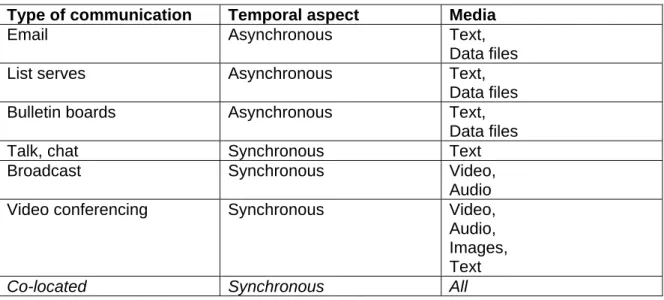
Co-located teams are always synchronous, meaning that they meet and exchange information at the same time, while virtual teams can be both synchronous and asynchronous. Where at times they will discuss a project in real time (i.e. via video
conferencing and web chat programs) the majority of methods involved email or electronic bulletin boards with a temporal distortion of received material (Maher et al., 2000a). Table 6.4, adapted from Maher et al (2000a), gives a portrayal of each of the most common forms of team interaction. With the co-located category added, it can be seen that not all virtual methods offer the same array of information, or synchronicity. However, due to time zone differences (i.e. in global teams) the concept of synchronicity is sometimes not relevant to global virtual teams (Kayworth and Leidner, 2000).
Table 6.4 Communication options for teams including temporal aspects (adapted from Maher et al 2000a).
Type of communication Temporal aspect Media
Email Asynchronous Text,
Data files
List serves Asynchronous Text,
Data files
Bulletin boards Asynchronous Text,
Data files
Talk, chat Synchronous Text
Broadcast Synchronous Video,
6.5 Advantages of Working in a Virtual Team
With the spread of organisations across the globe, and the increase in industrial alliances, virtual teams have become necessary to achieve efficiency, performance, knowledge, stable relationships, and client satisfaction (Gameson and Sher, 2002b). Organisations are able to increase the amount of knowledge and expertise they have on a project without the need for actual face-to-face meetings, lowering travel time and expenditure. Initially advantages may be seen when those members of a virtual team do not have a shared understanding of the project concepts (i.e. a mental model) in question. Without this shared understanding they must form their own understanding of the concepts. This is done through questioning and in most cases this method of establishing a shared mental model will highlight areas of
weakness or error (Stempfle and Badke-Schaub, 2002). For this reason teams with different cultures often out perform those with homogeneous cultures (Stempfle and Badke-Schaub, 2002). Virtual teams are also often able to shorten the production life cycle time, because the work can be done in parallel instead of in a stereotypical production line or serial mode (Lipnack and Stamps, 2000).
6.6 Challenges faced by those in Virtual Teams
With fast development of and changes in technology in most fields it is not inconceivable that virtual teams may soon exhibit the same generic attributes as co-located teams, such as body language. When looking at the skills involved with both co-located and virtual teams it is easy to say that ‘technology has all of the answers’; that the same skills seen in a co- located team can be utilised using technology in a virtual team. However, there are other issues to consider, such as: whether team members are operating synchronously or asynchronously, time differences, or whether the technology is available to all members of the team (Williams, 2004).
In a face-to-face meeting all contextual cues can be utilised; these include body language, eye contact, and changes in speech. These give information about the person speaking, how the message is conveyed, and the success of the communication (Driskell et al., 2003).
Virtual teams can therefore lose these verbal and visual cues. Without the use of gestures, body language and voice intonation in mediums such as e-mail, there can be significant misunderstandings due only to contextual constraints, that can lead to inter group conflicts (Riedlinger et al., 2004). Jaafari and Tooher (2002) have outlined a number of constraints of the virtual team including:
• The lack of personal contact minimising the ability to usesocial cues and body language
• A lack of leadership hierarchy within the remote groups
• The members are at the mercy of technology, the communication channels could be severed by a fault in the system.
Ensuring that all members of a team have an appropriate level of technical expertise in terms of using communication media is also a challenge that comes with using complex technology (Lahti et al., 2004).
Organisations cannot use the same management strategies in virtual teams that are already in place for operational teams. Members will be unable to complete their tasks when placed in a situation with those from other environments all under different managerial styles (Gameson and Sher, 2002b). A clear definition of roles, responsibilities and objectives is needed to allow for a more structured work environment. The virtual environment is not one that allows open discussion to resolve issues of procedure, and for these reasons clear boundaries and procedures must be created for all levels of membership.
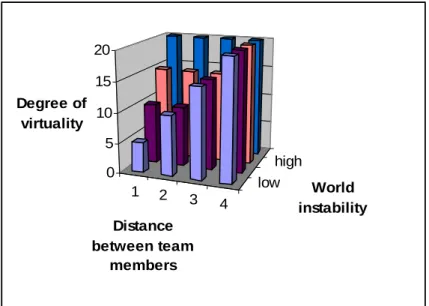
The move towards a virtual world is becoming ever more relevant in today’s unstable world environment. The extent to which a team becomes virtual can be affected by a number of
variables including the extent of the distance between members, the number of organisations the members represent, the length of time the team has functioned together (Ratcheva and Vyakaram, 2001), and the experience (i.e. technical skills) of the members (McMahan, 1998).
As can be seen in Figure 6.6 The extent of a team’s virtuality can also be affected by world instability, such as the events of September 11, so that as distance increases, and people are reluctant to leave home due to international issues, the degree of a team’s virtuality increases (Kirkman et al., 2002).
Figure 6.6 Diagram illustrating the variables that can impact on a team’s ability or willingness to become virtual (virtuality).
1 2 3 4
low 0 high
5 10 15 20
Degree of virtuality
Distance between team
members
World instability
Design professionals, in different design domains (for example manufacturing and
construction), have always collaborated. However, as the communicating world becomes smaller, somewhat paradoxically, communication difficulties between team members can increase. While new technologies and prices are making national and international travel easier for team members, cost cutting and economic downturn have seen an increase in the number of virtual teams operating between and within organisations. Whilst there are some challenges faced by those working in virtual teams, the benefits seem to be a selling point. In the long run virtual teams are less expensive and more time efficient, as well as increasing the amount of knowledge and skills within these teams.
7. ISSUES OF GENERIC SKILLS ARISING FROM A VIRTUAL CONTEXT
For the purposes of this literature review, generic skills are defined as the knowledge, skills and attitudes that a team member possesses when completing a task or communicating with fellow members (Salas et al., 2000), whether in a co-located or virtual environment. Skills development and training should be viewed by management as an investment in creating more valuable and skilled employees. Providing team members with the skills needed to communicate in a virtual environment is a long but necessary process (Goulding and Alshawi, 2002), if errors associated with miscommunication are to be avoided.
This section of the literature review gathers information on teamwork dynamics in a broad sense, and analyses its relevance to organisations and industries. In Salas’s research
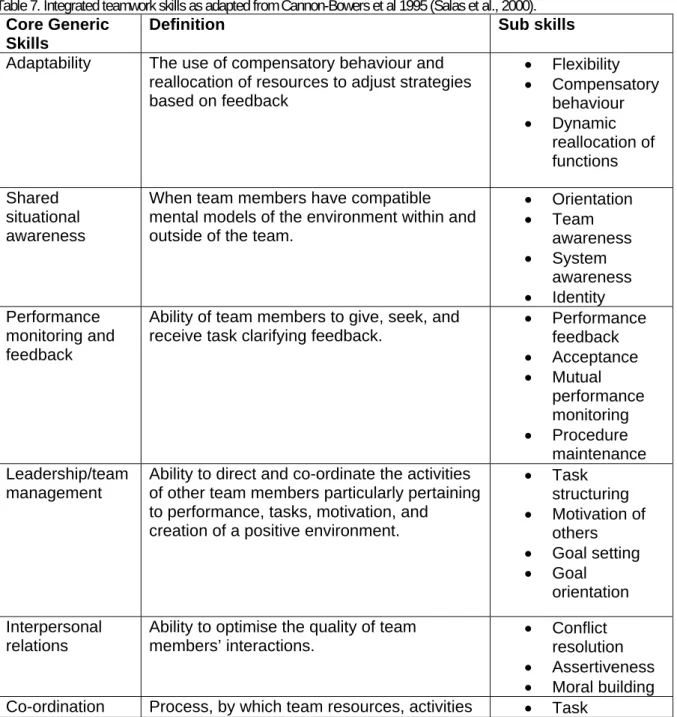
involving teams, generic skills have been defined as those that influence both individuals and teams (Salas et al., 2000). They are skills which are ‘…transportable and applicable across teams’ (Salas et al., 2000). Table 7 illustrates these skills which form the basis of an effective team (Salas et al., 2000).
Table 7. Integrated teamwork skills as adapted from Cannon-Bowers et al 1995 (Salas et al., 2000).
Core Generic Skills
Definition Sub skills
Adaptability The use of compensatory behaviour and reallocation of resources to adjust strategies based on feedback
• Flexibility
• Compensatory behaviour
• Dynamic reallocation of functions Shared
situational awareness
When team members have compatible mental models of the environment within and outside of the team.
• Orientation
• Team awareness
• System awareness
• Identity Performance
monitoring and feedback
Ability of team members to give, seek, and receive task clarifying feedback.
• Performance feedback
• Acceptance
• Mutual performance monitoring
• Procedure maintenance Leadership/team
management
Ability to direct and co-ordinate the activities of other team members particularly pertaining to performance, tasks, motivation, and
creation of a positive environment.
• Task structuring
• Motivation of others
• Goal setting
• Goal orientation Interpersonal
relations
Ability to optimise the quality of team members’ interactions.
• Conflict resolution
• Assertiveness
• Moral building Co-ordination Process, by which team resources, activities • Task
and responses are organized to ensure that tasks are integrated, synchronised and completed within established temporal constraints.
organisation
• Task interaction
• Timing Communication Information exchange between members
using the prescribed manner and terminology.
• Information exchange
• Consulting with others
Decision making Ability to gather and integrate information, use sound judgment, identify alternatives, select the best solution, and evaluate the consequences.
• Problem assessment
• Problem solving
• Planning
• Implementation
Notwithstanding the numerous skills identified in Table 7, we have elected to focus on those which occur most frequently throughout the literature reviewed. These are now discussed in the following section.
7.1 Core Generic Skills in a Virtual Context
The core generic skills listed in Table 7 are examined here in greater detail, and then analysed as they present in a virtual environment.
7.1.1 Adaptability
The skill of adaptability stems from the need to change in order to be efficient and/or work effectively in the dynamic team situations. For teams moving from co-location to virtual environments, an ability to adapt and change can be a long process riddled with trial and error scenarios. This process is seen as necessary to encourage effective virtual teams (Kirkman et al., 2002).
It may be said that the construction industry is struggling to adapt to newer technologies, changing culture (Baldwin, 2004), and the need for up-skilling in terms of the use of IT in virtual teams. This emphasises the rationale underpinning this project.
7.1.2 Shared situational awareness
Shared situational awareness refers to the skills that allow team members to arrive at a common understanding of a situation and, on the basis of this, to interact and solve problems (Salas et al., 2000). Sonnenwald and Pierce (2000) indicate that it is not only intragroup (within team members) shared situational awareness that teams need to develop skills in, the intergroup (between different teams) shared situational awareness is also important so that team members can be more effective through the goals they are attempting to achieve (Sonnenwald and Pierce, 2000).
transactions occur. This is termed a ‘place’, where team members build a sense of community (Lipnack and Stamps, 2000). A virtual system (such as a ‘bulletin board’) for building team identity would need to accommodate two ‘places’: a product place, where an actual project is designed and delivered, and a process place, where running of the teams and organisations occur (Lipnack and Stamps, 2000). This combination would allow team members to operate effectively across physical boundaries (Lipnack and Stamps, 2000).
7.1.3 Performance monitoring and feedback
One the easiest ways to exercise the skill of feedback is to conduct feedback meetings, either at the end of a project or at the end of a phase of a project (Emmitt and Gorse, 2003).
The ability to provide feedback is essential if problems in future projects are to be identified (Emmitt and Gorse, 2003).
Kirkman et al’s (2002) case study of Sabre Inc, a travel innovation company, highlighted a number of skills that management recognized as important for a virtual team, and feedback was one of these. In the case of virtual teams, feedback must be a constant process,
provided mostly by the team leader (Kayworth and Leidner, 2000) as this person is generally the major coordinator. Within the construction domain feedback can be defined as
clarification provided by a messenger to a receiver where an earlier message was not
understood. If the communication skills of messengers are not sufficiently developed the use of a multi-channel communication system may be required, such as the combination of telephone, email, and a shared whiteboard (Emmitt and Gorse, 2003).
7.1.4 Team management
7.1.4.1 Project Management
The skills of project management have been recognized as essential as projects become more ‘…global and complex…’ (Vitiello, 2001). Project management uses a set of generic skills to deliver projects within time, scope, and cost, while providing clients with a quality product (Smart, 2004). Vitiello (2001) outlines a list of skills necessary for effective project management (many of which have already been described above):
• Leadership skills
• Communication skills
• Conflict resolution skills
• Negotiation skills
• Listening skills
• Team building skills
• Relationship management skills
Smart (2004) also identifies the following project management skills:
• Planning skills
• Contract management skills
• Problem solving skills
The skills utilised by project managers in co-located teams are quite different to those used in a virtual team (Kayworth and Leidner, 2000). The techniques used to negotiate, resolve conflicts, and communicate change due to the different communication channels in place in these environments i.e. managers would not be able to negotiate one-on-one with a team member, nor would relevant information be close at hand; instead managers would have to exercise more detailed and rich negotiation strategies through an electronic medium
(Gameson and Sher, 2002a). Management of a global virtual team would also be difficult because of language and cultural differences This will be especially relevant for management
as it is suggested that managers spend almost 90% of their work time communicating with team members (Cleland and Ireland, 2002).
7.1.4.2 Leadership
While projects are coordinated by project managers, they need skills in leadership, and this is certainly true within the construction industry (Emmitt and Gorse, 2003). Emmitt and Gorse’s (2003) experiences show that a project manager who uses an open and inclusive leadership style, and allows a sense of ownership for team members, is more effective than one with an autocratic style. In the context of this research, a sense of ownership refers to the extent to which design professionals discuss problems and have ideas acknowledged by
management, whilst maintaining a high level of commitment to their tasks (Emmitt and Gorse, 2003). Whilst some authorities acknowledge that those leadership skills used in a co- located team are similar to those in a virtual team (Dharmawardena, 2003), there are also considerable differences. For a leader to be effective in a virtual world it is necessary to create a more structured and formal environment (Lurey and Raisinghani, 2001,
Dharmawardena, 2003). Newer technologies do not necessarily lead to greater team effectiveness; it is the implementation of the human aspects of a team (such as a positive and satisfying work environment) that leaders of virtual teams should seek to facilitate (Lurey and Raisinghani, 2001, Hoyt, 2000).
When leading a virtual team, proactive management skills are essential. Leadership involves taking the time and effort to contact and liaise with team members and to ensure that there are no clashes, be they cultural or personal or otherwise (Cantu, 1997, Kayworth and Leidner, 2000). Lipnack and Stamps (2000) however, suggest that it is the ability of virtual team leaders to influence and guide teams, rather than leading by force that creates an effective virtual environment.
7.1.4.3 Goal setting
An integral part of leadership is the ability to establish goals for the members of a team. Furst et al (1999) explain that goal setting is the ability to ‘…establish specific, challenging and accepted team goals’. Virtual team leadership is heavily founded on an ability to set clear goals for team members. The ability to deliver timely and appropriate feedback pertaining to these goals then follows (Dharmawardena, 2003).
7.1.5 Interpersonal relations
Interpersonal skills have been cited (Hoyt, 2000) as being of extreme importance to effective teams. They are the skills that allow for the management of conflict and disagreements between members of teams (Stevens and Campion, 1994). When attempting to use interpersonal skills such as peer support in a virtual team setting, the impact of body language may be lost because technologies such as email and telephone conferencing do not communicate them effectively (Hoyt, 2000). Industry case studies, such as that of Sabre Inc mentioned section 7.1.3, indicate that through trial and error, companies have realised the need for a balance between technical skills and interpersonal relations (Kirkman et al., 2002). It would be difficult in situations employing low bandwidth technologies for a team member to provide ‘body language’ cues to let, for example, a person know that they are being listened to or, for example, to congratulate them in a physical manner [such as a handshake] (Hoyt, 2000).
members to be heard. In a virtual environment assertiveness can be associated with ‘flaming’
or online conflict (Alonzo and Aiken, 2004). Alonzo and Aiken (2004) define ‘flaming’ in an online context as ‘…hostile intentions characterised by words of profanity, obscenity, and insults that inflict harm to a person’. The virtual online world creates an environment where team members may feel inhibited or invincible because they are able to be over-assertive without fear of actual physical harm. Skills in assertiveness involve members being able to state their point without creating unhealthy conflict.
7.1.5.2 Conflict resolution
Conflict within a team is not necessarily a negative element of team processes. Skills in conflict resolution centre around allowing a healthy amount and level of conflict that helps problem solving while discouraging unhealthy levels of conflict (Furst et al., 1999). Functional conflict management techniques (such as exploring differences) may be used in an attempt to solve disputes between team members or teams (Emmitt and Gorse, 2003), while
maintaining constructive relationships (Emmitt and Gorse, 2003). Conflict is not necessarily the reason team members get into disputes; it is generally the poor management of conflict by project managers or team leaders (Emmitt and Gorse, 2003) for example ‘I’ll listen to your unreasonable demands, if you’ll consider my unacceptable offer’ (Brilliant, 1970: cited in (Banner and Gagne, 1995). While it may be simple to understand when unhealthy conflict is occurring in a co-located team, with social cues such as menacing stares to full arguments, this diagnosis may be more difficult in virtual environments (Furst et al., 1999). If, when monitoring conflict in a virtual team, a late or rude reply of an email or phone message is discovered it may not be enough to suggest that conflict is becoming unmanageable. The virtual environment creates an atmosphere of ‘ambiguous’ communication, where it can be difficult to interpret whether a person’s communication is promoting unhealthy conflict (Furst et al., 1999).
7.1.6 Co-ordination
Co-ordination of team members is essential for the creation of an efficient and effective working team. It is the ability to synchronise information and the tasks of each team member and thus to control redundant work (Furst et al., 1999). The construction industry is highly fragmented and as a consequence there may be little or no co-ordination between members collaborating on a project (Mohamed, 2003). As a result the construction industry has
obtained a reputation for inefficiency(Mohamed, 2003). Co-ordination for the construction industry refers to the ability to deliver ‘accurate and timely information’ (Emmitt and Gorse, 2003) for decision making and problem solving.
Emmitt and Gorse (2003) have compiled a list of potential sub-skills that contribute to effective co-ordination:
• Ability to convey information with clarity and brevity
• Ability to report accurately
• Ability to be consistent
• Avoidance of redundant and repetitious information
• Checking ability
• Timing of information (Emmitt and Gorse, 2003)
The use of virtual technologies to co-ordinate construction processes should be beneficial to both team members and team management. Effective information co-ordination can reduce conflict significantly (Emmitt and Gorse, 2003) and an ability to record and transmit
information will aid in the co-ordination and tracking of decision making (discussed in section 7.2.3).
7.1.7 Communication
Communication according to Chiu (2002) is: ‘…the dynamic process in which one person consciously or unconsciously affects the cognition of another through materials or agencies in symbolic ways’. Artifacts are the most simple of the types of communication, they ‘allow the externalization and representation of objects, constraints, form, function, assembly, materials, and so on’ (Perry and Sanderson, 1998). They include such things as models or CAD visuals (Perry and Sanderson, 1998). In Perry and Sanderson’s (1998) study artifacts such as sketches, large scale printouts, and CAD visuals, were used to communicate ideas between engineers and drafts persons.
When changes in a design are needed these are often presented in the form of a new
artifact, so that when a faulty current design is withdrawn a new sketch or CAD visual may be put in its place (Perry and Sanderson, 1998). When these new artifacts are approved it is common practice that the majority of stakeholders initial the work to indicate those who have approved it. This allows a clear communication channel to be established for these
stakeholders (Perry and Sanderson, 1998).
Drawing is an important aspect of the communication process within design. Drawings can bridge differences between disciplines and professional jargon (Laseau, 2001). In a virtual environment drawings can be communicated by exchanging electronic files whether by email or in a shared networked space (Maher et al., 2000a).
Three dimensional (3D) virtual worlds have been defined as a ‘…single computer-mediated dynamic environment which provides virtual team members with a sense of place’. (Maher et al., 2000b). They commonly use avatars (3D representations of the team members), which allow the use of body language and emotion to a small degree. Most communication would still be text based, with the communication text appearing along side the relevant avatar (Maher et al., 2000b).
Common practice for virtual teams in their infancy is the creation of shared space in a computer environment for the sharing of files, unfortunately this does not allow for
communication (Maher et al., 2000b). Team members need more than just an indication of what other members may be working on, they need a medium through which they may express thoughts and ideas regarding their and others’ work.
Communication embodies a large area of research. This review divides communication skills into three areas: verbal communication, non-verbal communication, and receiving
communication. These areas may be affected by the virtual world, depending on the technologies and techniques utilised.
7.1.7.1 Verbal Communication
Learning and the majority of team interactions are primarily facilitated by conversation. It is through this skill that one learns the beliefs, and assumptions of team members that form the culture of a team (Gay and Lentini, 1995).
When engaged in conversation in a face-to-face environment, an important aspect is the ability to ask for feedback to ensure that the person one is communicating with is correctly
However, without members being able to access the same visual information, there may large amounts of miscommunication because of the difficulties of translating a three
dimensional object into words (Gabriel and Maher, 1999, Poltrock and Engelbeck, 1999, May and Carter, 2001). Gabriel and Maher’s (1999) study indicated there are four types of verbal communication in the design process (Maher et al., 2000b):
1. Communication control (interruptions, floor holding and handovers) 2. Communication technology (discussions of how to use the tools)
3. Social communication (time spent in social conversation, not related to design) 4. Design communication (discussion of design ideas, scope and task)
For the effectiveness of design collaboration settings, a majority of design communication would be advantageous. This majority of design communication interaction occurred in a 3D virtual environment which encompassed an avatar, as opposed to the use of video
conferencing (Maher et al., 2000b).
7.1.7.2 Non-verbal communication
Gestures are an important step in the hierarchy of communication (Williams, 2004). Design teams often use gesture to indicate the manipulation of objects in a design (Perry and Sanderson, 1998). In a team situation it is often the non-verbal cues which convey the most meaning; a wink, a raised eye brow, or an ear tug (Hoyt, 2000). These cues, whether created on purpose or accidentally, can give secret or subtle information about project or team
dynamics (Cleland and Ireland, 2002).
In experimentation with types of verbal communication for virtual interactions, acknowledged in section 7.1.7.1 above, it has been stated that communication via synchronous typed text rather than conversation (tele-presence) is more advantageous (Gabriel and Maher, 1999, Maher et al., 2000b). Typing conversations allowed more reflection on communication and greater concentration on the design communication. A written record was also generated which could be examined to clarify points of interest (Gabriel and Maher, 1999).
7.1.7.3 Receiving communication
When we think of the skills involved in the communication process, listening (or ‘receiving) is not widely mentioned. Listening is the ability to understand communication, to be a receiver.
When it is considered that humans can lose up to twenty five percent of the information they listen to (Cleland and Ireland, 2002), perhaps re-evaluation of this aspect is necessary. There is little focus on listening skills in formal education. In addition one’s ability to ‘receive’ can also be effected by emotional aspects relating to the information (Cleland and Ireland, 2002, Emmitt and Gorse, 2003), ‘…we only hear what we want to hear’. The major hurdle with some virtual technologies is ensuring that team members actually receive a communication.
Bulletin boards and email do not provide a checking mechanism to indicate that the intended person has actually viewed the communication.
7.1.8 Decision making
When making a decision, the majority of the time there are a limited number of alternatives (Stempfle and Badke-Schaub, 2002). Once an alternative surpasses a predetermined point of satisfaction, a decision is made. Little regard is held for other alternatives (Stempfle and Badke-Schaub, 2002). Decisions in the construction industry are often needed immediately and rarely allow adequate time for all data and perspectives to be considered (Emmitt and Gorse, 2003). As a consequence decision-making by virtual teams is more difficult than when teams are co-located. This is because of the need to clarify positions from a variety of
different locations. Interestingly Gorse’s (2002) research shows that those groups that are most effective are the ones able to utilise a broader range of communication techniques. This may contribute to a deeper understanding of contributors’ opinions and be facilitated by the use of more high bandwidth technology (Emmitt and Gorse, 2003). Most IT technologies
have been created to encourage greater collaboration between members of a construction management team (Emmitt and Gorse, 2003). Industry case studies, such as Sabre Inc, have shown that for decision making in a virtual team, there needs to be on going virtual training (Kirkman et al., 2002). Some studies have suggested that the use of virtual teams can lead to an increase in the time it takes to make decisions and also results in a drop in team cohesion (Driskell et al., 2003).
7.1.8.1 Problem solving
Problem solving is a precursor to decision making and so is appropriate as a sub-skill of decision making (Kirkman et al., 2002). It is the ability to highlight the problems or limitations within a task or team, and then subsequently to put in place appropriate action to remedy it (Furst et al., 1999). With respect to problem solving in the construction industry, it appears that project managers may take different approaches depending upon whom they are consulting (Emmitt and Gorse, 2003). When interacting with those lower in the hierarchy (such as sub-contractors) an informal approach to problem solving is used. However, when solving problems with other professionals, such as engineers or architects, more formal processes are often used. Those involved frequently spend more time evaluating problems before making contact with each other (Emmitt and Gorse, 2003). In the majority of these cases communication between the professions is via virtual methods such as fax or telephone (Emmitt and Gorse, 2003). The use of high bandwidth technologies in problem solving would allow a greater and quicker exchange of relevant information quickly but with increased richness and detail (Gameson and Sher, 2002a).
7.2 Team skills in a virtual context
Team skills are those which are held by team members that affect the performance of a team in which an individual is currently working (Salas et al., 2000). The dominant issues in team skills are presented below.
7.2.1 Trust
Computer mediated communication does not have the infrastructure to support all of the interactions and cues that convey trust between members of a team, such as the ability to convey warmth and compassion (Jarvenpaa and Liedner, 1998, Riedlinger et al., 2004).
Because of the highly complex nature of virtual teams and networked organisations trust is a necessity (Lipnack and Stamps, 2000, Mohamed, 2003), and without any face-to-face
interaction, members are required to work hard to maintain any level of trust (Lipnack and Stamps, 2000).
Poltrock and Engelbeck (1999) believe that videoconferencing will supply the visual contact thought necessary to facilitate trust. However, trust between team members is affected by a range of factors, not only visual contact. Trust is often simply associated with the amount of effort each of the team members contributes (Lipnack and Stamps, 2000).
Due to the expanse of space between members of a global virtual team, cultures may often clash. Individualism versus collectivism is one variable of culture that can affect the trust level of a team (Jarvenpaa and Liedner, 1998). An individualistic culture is one that promotes the
creates more communication (Sharp, 1996). Trust is a major component between members of a virtual team, so that even a small level of discontent in the team can be multiplied in virtual environments (McDonough III et al., 2001).
7.2.2 Dealing with cultural issues
Culture may be defined as the values, beliefs and ideals held by a group of individuals.
Culture is learned by individuals as they enter groups (Kayworth and Leidner, 2000), and is often a result of religion, nationality, ethnicity or even an individual’s organisational affiliation (Kayworth and Leidner, 2000). All tasks completed by team members are affected by their culture. Thus a clash of cultures is a common occurrence in virtual teams. Time management and language are the two major areas of culture clash (Kayworth and Leidner, 2000) perhaps due to the possible different countries and time zone differences these cultures may operate in. Possible solutions to these issues were identified in Kayworth and Leidner’s (2000) study which highlighted the following strategies for dealing with cultural issues:
1. Attempt to build skills in cultural awareness in virtual team members 2. Attempt to form virtual teams with members from complementary cultures.
Pena-Mora et al (2000) highlighted the on going work of Krishnamurthy and Fruchter (2000) in illustrating the many issues associated with communication between members of a culturally varied virtual team. These included ‘representation’, which comprises the issues surrounding the different jargon, labels (Poltrock and Engelbeck, 1999) and terminology utilised by different professionals (Pena-Mora et al., 2000). So when communicating there is a need for increased cultural awareness among virtual team members in a number of areas.
7.2.3 Archiving
Records of construction meetings frequently take the form of minutes. These often result in lost data because of inaccurate recording methods or individual agendas. This can result in a need to go over ‘old ground’ in the next meeting (Emmitt and Gorse, 2003). Using high bandwidth technology in a virtual team should allow for the direct recording of team minutes into verbal or text streams that can be accessed at any time by team members.
An ability to archive is important for collaboration as it allows members to revisit conversations and decisions made during past team interactions. This is stressed in Pena- Mora et al’s (2000) description of CAIRO, an online collaboration agent (a program able to organize and archive the meeting). Within the virtual environment of CAIRO, team meetings are logged under different team agenda headings, allowing members to scroll back and view any discussion on an agenda item of choice (Pena-Mora et al., 2000). A software review by Gallagher and Angus (1998) began by stating that with any teamware application there needs to be the ability to archive decisions (Gallagher and Angus, 1998, Fox et al., 1999) made and rejected so that the information can be sorted and understood in the future (Gallagher and Angus, 1998). The archiving of data for any team will enable an organisation to view successes or problems, and relate these to future team activities (Furst et al., 1999).
Archiving in a virtual team would, in some ways, be easier than within co-located environments, providing appropriate software is used; all communications may simply be logged as files and stored on each member’s computer (Furst et al., 1999).
8. THE TEAM DESIGN ACTIVITY
Lawson’s research (1990) identified collaboration as a large component of designer’s working time. Since this acknowledgement of the profile of collaboration there has been a move toward applying research methods to gain a better appreciation of this activity and the skills required to effectively participate in collaborative design processes. In the process of gaining an understanding of design team activities Muir (1995) defined collaboration as the activity of communication between parties involved on a project.
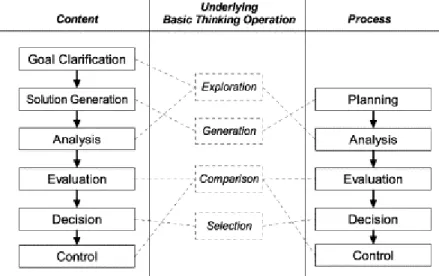
Professionals involved in team-related activities during the process of design undertake a complex multi-faceted process. The collaborative design process is different from traditional design processes undertaken by individual designers. The difference between individual designers and design teams is encapsulated in the collaboration between participants when creating a new artifact. To begin to appreciate the complexity of this collaborative process requires an understanding of the process. Stempfle and Badke-Schaub (2002) developed a model, shown in Figure 8, which conveys the characteristics of both Tuckman’s (1965) and Cornick and Mather’s (1999) models of project team lifecycle discussed above, in terms of the activities in which designers engage. Like the lifecycle models proposed earlier there appear to be protocol stages, which indicate a consistent process for design teams.
Figure 8 Generic step model of design team activities (Stempfle and Badke-Schaub, 2002).
Stempfle and Badke-Schaub’s (2002) model, Figure 8, illustrates the steps which define the processes design teams engage in. The content and process steps of the design team are linked via the cognitive processes underlying the actions of exploration, generation,
comparison, and selection.
Similarly Thorpe’s (2004) ‘Generic Design and Construction Process Protocol’ classifies the design collaboration process as a method of project management. Thorpe’s project
management process is based upon four broad stages:
• Pre-project
To provide a level of detail of the activities which occur within and across these four stages Thorpe (2004) identified the following phases of the process protocol:
• Demonstrating the need (Phase zero)
• Conception of need (Phase one)
• Outline feasibility (Phase two)
• Substantive feasibility study and outline financial authority (Phase three)
• Outline conceptual design (Phase four)
• Full conceptual design (Phase five)
• Coordinate design, procurement, and full financial authority (Phase six)
• Production information (Phase seven)
• Construction (Phase eight)
• Operation and maintenance (Phase nine)
The similarities between the construction process protocol as described by Thorpe (2004) and stages inherent in the design team lifecycle (Figure 8) illustrate that a process protocol could be established solely for design. These models allow us to understand that design and more importantly collaborative design, is a segmented process, punctuated by 4-5 stages that define design processes. From these similarities it is likely that designs process
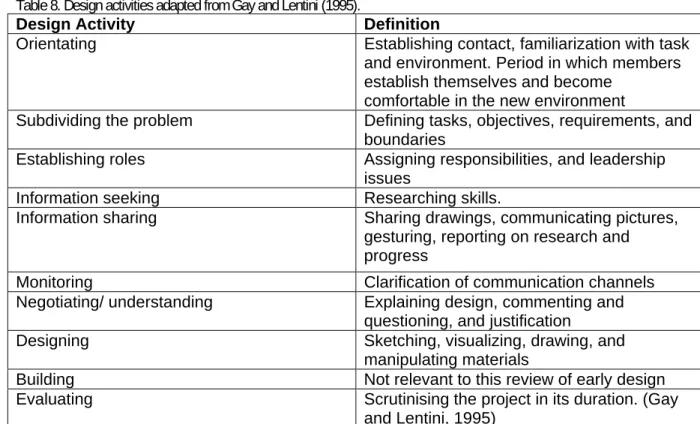
protocols could be those ‘process’ steps noted by Stempfle and Badke-Schaub (2002) which consist of the stages proposed by Gay and Lentini (1995). To appreciate the diversity of activity which occurs in the team design process requires an understanding of the range of these activities. Gay and Lentini’s (1995) study into deign processes in a collaborative virtual environment defined these activities. Their study identified ten specific activities which occurred in a virtual environment, and these are presented in Table 8:
Table 8. Design activities adapted from Gay and Lentini (1995).
Design Activity Definition
Orientating Establishing contact, familiarization with task and environment. Period in which members establish themselves and become
comfortable in the new environment
Subdividing the problem Defining tasks, objectives, requirements, and boundaries
Establishing roles Assigning responsibilities, and leadership issues
Information seeking Researching skills.
Information sharing Sharing drawings, communicating pictures, gesturing, reporting on research and progress
Monitoring Clarification of communication channels
Negotiating/ understanding Explaining design, commenting and questioning, and justification
Designing Sketching, visualizing, drawing, and
manipulating materials
Building Not relevant to this review of early design
Evaluating Scrutinising the project in its duration. (Gay
and Lentini, 1995)
The similarities between the‘Generic Design and Construction Process Protocol’ (Thorpe, 2004) and ,Stempfle and Badke-Schaub (2002) and Gay and Lentini’s (1995), descriptions of design team activity may warrant further investigation to ascertain whether the creation of design team protocol stages is appropriate.