To compensate or not to compensate?
Own motion investigation of Commonwealth arrangements for providing financial redress for
maladministration
Report under s 35A of the
Ombudsman Act 1976
September 1999
ABBREVIATIONS 5
EXECUTIVE SUMMARY 6
Problems with current arrangements 6
Overseas experience we can learn from 1 0
Conclusions 1 1
Recommendations 1 2
1. BACKGROUND 1 4
Introduction 1 4
Aims of the investigation 1 5
Scope of the investigation 1 5
How we conducted the investigation 1 5
2. CIRCUMSTANCES LEADING TO REQUESTS FOR
COMPENSATION FOR FINANCIAL LOSS 1 7
Case Studies 2 0
3. GENERAL CONTEXT IN WHICH COMPENSATION REQUESTS
ARISE 2 7
The goalposts are shifting all the time 2 7
APS values and standards of conduct 2 8
Service charters 2 9
Maintaining good customer relations 2 9
Customer expectations 3 0
4. CURRENT FRAMEWORK FOR PROVIDING COMPENSATION 3 1
Overview of current arrangements 3 1
Current mechanisms for providing compensation 3 2
5. PRINCIPLES RELEVANT TO COMPENSATION AND
OMBUDSMAN RECOMMENDATIONS 3 6
6. OMBUDSMAN’S EXPERIENCE OF CURRENT
ARRANGEMENTS FOR PROVIDING COMPENSATION 4 0
Problems affecting financial compensation 4 0
Resource intensive and time consuming 4 1
Can the present rules provide compensation in all circumstances 4 2
Disputes about the facts 4 7
Lack of understanding of the Ombudsman’s role 5 0
Limitations on backdating payments in social security legislation 5 1
Waiver of recovery of debts 5 2
7. INTERNATIONAL COMPARISON 5 3
The UK Ombudsman’s experience 5 3
Major incentives for improving compensation arrangements 5 4 DSS (UK) Guide to Financial Redress for Maladministration 5 4 Advantages compared with our compensation arrangements 5 5
ATTACHMENT A 6 0
COMPLAINTS CLOSED 1.1.97 TO 31.12.98 INVOLVING
COMPENSATION FOR ALLEGED MALADMINISTRATION 6 0
ATTACHMENT B 6 2
FMA ACT FRAMEWORK AND MECHANISMS FOR PROVIDING
COMPENSATION 6 2
Financial Management and Accountability Act 1997 6 2
Chief Executives’ Instructions (CEIs) 6 3
Current mechanisms for providing compensation 6 3
ATTACHMENT C 7 8
OMBUDSMAN AND AGENCY CORRESPONDENCE ABOUT
PROBLEMS WITH EXISTING ARRANGEMENTS 7 8
Ombudsman’s letter to major agencies in mid 1998 and their responses 7 8
ATTACHMENT D 9 9
AGENCIES CONTACTED DURING THE INVESTIGATION 9 9
ATTACHMENT E 1 0 1
MEETING ON 23 APRIL 1999 - SUMMARY OF DISCUSSION 1 0 1
Ombudsman’s views 1 0 1
Agency views 1 0 2
ABBREVIATIONS
AAT Administrative Appeals Tribunal ACS Australian Customs Service AFP Australian Federal Police
A-G’s Attorney-General’s Department
AGPS Australian Government Publishing Service AGS Australian Government Solicitor
AP Australian Postal Corporation APS Australian Public Service ATO Australian Taxation Office
CAC Act Commonwealth Authorities and Companies Act 1997 CDDA Compensation for detriment caused by defective administration
CEI Chief Executive’s Instructions CEO Chief Executive Officer
CES Commonwealth Employment Service CSA Child Support Agency
CSA (UK) Child Support Agency in the United Kingdom
DEETYA Dept of Employment, Education, Training & Youth Affairs DETYA Department of Education, Training and Youth Affairs
DEWRSB Dept of Employment, Workplace Relations & Small Business DFCS Department of Family and Community Services (formerly DSS)
DoF Department of Finance (now DoFA)
DoFA Department of Finance and Administration
DHAC Department of Health and Aged Care (formerly DHFS) DHFS Department of Health and Family Services (now DHAC) DIMA Department of Immigration and Multicultural Affairs DIST Department of Industry, Science and Tourism
DLO Office of the Defence Legal Organisation (Department of Defence)
DSS Department of Social Security (now DFCS)
DSS (UK) Social Security Benefits Agency in the United Kingdom FAC Federal Airports Corporation
FMA Act Financial Management and Accountability Act 1997
FMAR Financial Management and Accountability Regulations 1997 HIC Health Insurance Commission (including Medicare)
NZ New Zealand
OLSC Office of Legal Services Co-ordination (A-G’s) SSAT Social Security Appeals Tribunal
PSMPC Public Service and Merit Protection Commission TFN Tax file number
UK United Kingdom
EXECUTIVE SUMMARY
1. This report is based on an investigation of the adequacy of arrangements for most Commonwealth agencies to provide financial redress for maladministration. Successive Ombudsmen have expressed concern about these arrangements for years. The report analyses them; comments on how well they are operating; considers the principles on which they are based and the changing context in which they operate; compares them with new
arrangements in the United Kingdom (UK); and makes recommendations to improve their cost effectiveness and efficiency.
Problems with current arrangements
Resource intensive and costly
2. While the Ombudsman receives few complaints involving compensation requests and recommendations each year1, they are resource intensive and time consuming for agencies and the Ombudsman alike. The resources expended in dealing with most of these complaints far outweigh the amount of compensation involved.
No clear statement of general principle that individuals who suffer a loss should expect redress
3. The various schemes for providing financial redress are based on a variety of principles2 which, if interpreted broadly and as a whole, indicate that the government expects that individuals should be compensated if they suffer loss as a result of maladministration or special circumstances. But that general principle is not stated plainly anywhere.
4. As a consequence, agencies appear to hold different views about whether members of the community should expect compensation when they have suffered detriment as a
consequence of maladministration:
• some believe their customers have a right to be compensated if the agency’s action was defective: their service charters refer to the customer’s right to seek compensation in certain circumstances;
• others are concerned that the ‘flood gates’ will open if their customers know that
compensation is a possible remedy: that general view may affect their consideration of the merits of individual circumstances.
5. In some cases where there is no defective administration but there are special
circumstances, the agency concerned supports an act of grace payment, but the Department of Finance and Administration (DoFA) may reject it as not coming within their narrow
interpretation of rules they have devised for such payments3. We believe agencies should be responsible and accountable for making their own decisions about compensation. They should have the full range of powers to do so, in a customer service context where reasonable
1 Approximately 2% of all complaints finalised in 1997 and 1998.
2 See chapter 5.
3 Act of grace payments and waiver of the right to recover a debt owed to the Commonwealth can only be approved by the Minister for Finance and Administration or his delegates in DoFA, under the present FMA Act compensation arrangements. Centrelink is authorised to waive recovery of debts in circumstances specified in the Social Security Act 1991 and the Student Assistance Act 1973.
service standards are expected, and where providing redress when things go wrong is regarded simply as one aspect of good administration.
No generally accepted standards of service outcomes expected of agencies
6. There is no common understanding or acceptance of what constitutes standards of service and administration acceptable to the government and the community, against which
maladministration can be measured. Consequently, there are no generally accepted standards for measuring whether a compensation payment would be ‘publicly defensible’4, a
requirement for compensation for defective administration.
7. These are key concepts relevant to Ombudsman investigations and the various compensation mechanisms. The Ombudsman has a statutory obligation to report to an agency if he believes particular action should be taken to rectify, mitigate or alter the effects of the agency’s unlawful, unreasonable, oppressive, or unjust action5. Because there are no agreed objective standards against which these concepts can be measured, they can become the subject of debate between the Ombudsman and the agencies concerned lasting months or years in some cases. We often have to argue from first principles as a consequence.
8. Our impression is that agencies believe we recommend compensation too readily, without understanding the constraints under which they operate. By contrast, we believe agencies could provide compensation more often than they do, by adopting a more flexible, customer focused approach, based on a broad interpretation of the powers available to them and by reference to standards they set themselves, for example, in their service charters.
9. A more flexible approach would complement the greater willingness by governments and industry to view compensation for service delivery failures as a way of strengthening
accountability for service delivery. The move to industry based ombudsmen in the telecommunications, banking, private health insurance and energy industries, backed in some cases by the power to penalise an agency for failure to meet defined service standards, indicates a changing relationship between governments and the community. These moves encourage a more commercial and customer focused attitude towards service failures, compared with the traditional government approach of protecting their revenue base.
Rules are applied inconsistently
10. Although the compensation mechanisms should encourage consistency in decision making, this investigation highlighted the fact that they are applied inconsistently. They can be interpreted broadly enough to enable agencies to pay compensation in all cases where they believe it is warranted, or narrowly enough to exclude any request, depending on the agency’s approach to compensation generally or in individual cases.
Dismissive, defensive approaches to assessing compensation requests
11. Difficulties also arise when the agency concerned has no written evidence to corroborate a customer’s version of the events leading to their financial loss. As indicated in our report about oral advice6, some agencies rely on their lack of records of discussions with their customers to reject a request to consider compensation, apparently without considering the customer’s credibility or the consistency of the customer’s actions with their version of what took place.
4 Meaning ‘fair’ or ‘just’.
5 See section 15 of the Ombudsman Act 1976 .
6 Issues Relating to Oral Advice: Clients Beware, a report under s 35A Ombudsman Act 1976, December 1997.
12. It is reasonable for an agency to rely on their knowledge of the experience and skills of the particular staff involved, to test a customer’s assertions about what happened. But it is
unreasonable to refuse to entertain the idea that the customer’s version may be correct,
simply because there is no documentary evidence to corroborate it and because the agency has a general belief or hope that none of their staff would act in the way the customer says they did.
Agency approaches to Ombudsman investigations
13. For the Ombudsman to be effective, there has to be an element of trust and cooperation between his office and the agencies whose actions we investigate. Agencies must be able to have confidence that the Ombudsman will investigate complaints of alleged defective administration thoroughly and impartially, before drawing any conclusions or making any recommendations for remedial action. By the same token, the Ombudsman must be able to trust that the agency will cooperate with his staff during an investigation; will not withhold relevant information; and will consider both a conclusion that the agency has acted
defectively and a recommendation for remedial action with an open mind. Trust and respect must be earned on both sides. Achieving it will not lead to the Ombudsman automatically accepting an agency’s assertions or the agency accepting the Ombudsman’s conclusions without due consideration, but it should lead to a more balanced approach to considering financial remedies.
14. The Ombudsman and agencies may have to do more to ensure that the facts are clear before any conclusions are drawn and recommendations made. Any dispute about the facts can then be clarified as early as possible during an investigation. Once the facts are agreed, the focus can then shift to a remedy, if one is warranted. Much time and effort can be saved for agencies and the Ombudsman if they provide full details in response to our initial requests.
15. Some agency staff involved in Ombudsman investigations may not fully understand his role as an impartial investigator. We receive responses from agencies referring to our
‘representations on behalf of’ a complainant. This confuses the Ombudsman’s role with that of members of parliament, who do make representations on behalf of their constituents, without necessarily investigating the merits of their complaints. Such responses do not inspire confidence that the agency has properly considered the matters we put to it.
Complexity of current arrangements for compensation
16. The investigation clarified that most of the difficulties we experience are caused by the inconsistent approaches agencies use when applying the compensation mechanisms, rather than the mechanisms themselves. Nevertheless, the existing ‘system’ for providing financial redress, viewed as whole, is complex and difficult to understand.
17. One reason is that the ‘system’ comprises a mix of statutory and non-statutory
mechanisms, each with different rules. There are four separate mechanisms for providing compensation and two for providing relief from repayment of debts owing to the
Commonwealth. They have evolved from an incremental progression in government thinking about financial redress for maladministration and a pragmatic approach to addressing perceived problems7. This can cause problems, eg, a non-statutory mechanism such as the defective administration scheme cannot be used to override a statutory
7 Attachment B describes the current ‘system’ for providing compensation and how parts of it developed.
mechanism such as waiver of recovery of a debt, despite the fact that the debt may have arisen solely from defective administration.
18. It is not easy to keep in mind the different concepts and requirements, eg, to differentiate between the rules relating to legal liability and defective administration. That contributes to confusion for agencies and their customers in understanding the different schemes and the principles underpinning them. Submissions to agency decision makers sometimes reflect those confusions and indicate that some staff responsible for investigating and reporting on compensation requests appear not to have adequate skills or training to do so competently.
19. We (and some other agencies) believe DoFA unduly limit the exercise of the broad powers to make act of grace payments and to waive the Commonwealth’s right to recover debts.
DoFA adopt a theoretically pure approach to compensation and waiver requests that does not always give adequate weight to the practicalities of modern life. While DoFA’s decisions may appear logical in theory, they may also be unfair in individual circumstances.
Limitations in backdating provisions in the Social Security Act 1991
20. Most complaints handled by the Ombudsman’s office where compensation is sought and warranted relate to the provision of income support. In the past, 50% of our
recommendations for compensation for lost income support were rejected. In 1997 and 1998 Centrelink accepted 80% of our recommendations. If that trend continues, it will indicate an important and welcome change in approach to compensating customers who have lost income support.
21. Regardless of that change, the investigation confirmed that there is a particular problem with current limitations in backdating provisions in the Social Security Act 19918. They operate unfairly in some circumstances and give rise to requests for compensation. The existing compensation rules, in combination with present interpretations of common law principles relating to negligence, prevent payment of compensation in these cases.
22. Centrelink and the Department of Family and Community Services (DFaCS) indicated that the former Department of Social Security (DSS) were unsuccessful several years ago in having the arrears provisions amended to provide discretion for the agency head to pay arrears up to twelve months. We believe the Government should consider this matter afresh9.
Agency responses
23. We contacted all Commonwealth agencies with whom we have regular dealings about compensation for maladministration, eg, Centrelink, DFaCS and the Child Support Agency (CSA). We also contacted agencies who are responsible for some aspects of the current compensation ‘system’, eg DoFA and the Attorney-General’s Department (A-G’s)10.
24. DoFA believe the existing schemes are appropriate and do not require major change, but indicated that they are considering whether the act of grace and waiver powers should be devolved to agency heads. They indicated that they are prepared to consider other
adjustments to the present ‘system’.
8 The Ombudsman’s 1995-96 annual report describes this problem.
9 The debate is canvassed in chapter 6.
10 Attachment D provides a full list of Commonwealth agencies contacted during the investigation.
25. Most agencies represented at a meeting hosted by the Ombudsman in April 199911 agreed that:
• they could ‘live with’ the current ‘system’ if it were explained more simply and interpreted sensibly;
• agencies themselves are in the best position to manage their own risks;
• devolution of the act of grace power to agency heads would accord with the philosophy underpinning the FMA Act and the accountability regime it established. This would authorise chief executive officers of agencies to provide compensation in all possible circumstances.
26. Opinions varied on how compensation matters could be dealt with more effectively:
• some agencies support the idea of moving to a more integrated compensation scheme;
• some believe a more integrated explanation of the existing rules would suffice, as it would make the current arrangements easier to understand and apply;
• some believe the current arrangements are adequate, because they allow for compensation in all cases where these agencies believe it is warranted;
• A-G’s expressed strong reservations about any blurring of the distinction between
payments made on the basis of a legal liability and those paid under other mechanisms, but saw merit in including a cross reference to the other mechanisms in the text of the
Commonwealth’s policy on handling monetary claims.
27. Other suggestions agencies agreed with at the meeting in April 1999 were:
• decision makers need a principle based guideline rather than a prescriptive set of ‘rules’.
Agency guidelines on compensation would then consist of a set of general principles (those on which the current mechanisms are based) with examples of the kinds of circumstances in which compensation is warranted and those in which it is not12;
• complaints involving compensation may be resolved more quickly by meetings between the Ombudsman’s office and the agency concerned, with discussion focusing on areas of factual dispute between the agency and the Ombudsman, or proposed remedies; and
• an agency’s acceptance of the Ombudsman’s conclusion that there had been defective administration and his recommendation for compensation should be a sufficient basis for payment under the CDDA scheme13.
Overseas experience we can learn from
28. We considered overseas arrangements for providing financial redress for maladministration. Those in the UK appeared most relevant.
29. The UK Ombudsman’s 1997-98 annual report14 describes progress in working with income support agencies to define maladministration in practical terms and to reduce delays in
11 See Attachment E for a list of agencies represented and a summary of the discussion.
12 The guidelines issued by the Social Security Benefits Agency in the UK [DSS (UK)] are an example: ‘Financial Redress for Maladministration (Revised September 1998)’, Volume 1, published by HM Stationery Office in December 1998.
13 The mechanism for providing compensation for detriment resulting from defective administration. The CDDA guidelines will need to be clarified or amended to implement this suggestion.
14 ‘Parliamentary Commissioner for Administration, Fifth Report - Session 1997-98’, London: The Stationery Office. The Commissioner is also known as the Parliamentary Ombudsman. We have abbreviated his title to ‘the UK Ombudsman’.
resolving compensation requests. The DSS (UK) guidelines15 on financial redress for maladministration:
• include the UK Ombudsman’s descriptions of what kinds of circumstances constitute maladministration;
• set a context in which to consider ‘official error’ including six basic principles on which redress should be based;
• provide for payment of compensation for unreasonable or exceptional delay in paying income support; and
• contain indicators of delay for particular kinds of benefits, determined in relation to the department’s published service standards.
30. Agencies agreed during our meeting in April 1999 that adapting the UK experience to Australian circumstances may improve the effectiveness of the existing compensation arrangements here.
Conclusions
31. The compensation mechanisms provide adequate power to pay compensation whenever it is warranted, but they are difficult to understand and are applied inconsistently.
32. The complexity of the existing ‘system’, viewed as a whole, does little to promote a sound understanding of the principles underpinning compensation or a flexible approach to
providing it. Some agencies apply a narrow, inflexible interpretation of the rules which is out of step with the government’s increasing focus on providing good customer service. This does not compare favourably with the more flexible approach now apparent in the UK.
33. Appropriate compensation arrangements can provide a powerful incentive to improve service, as demonstrated by the UK experience.
34. The Ombudsman will initiate discussions with relevant agencies to adapt the UK compensation arrangements to our circumstances.
35. Backdating provisions in the Social Security Act 1991 are restrictive and operate unfairly in some circumstances. They do not adequately take into account the risks people face in falling through the income support net, in a complex, highly targeted legislative regime. If the provisions were amended to allow backdating for up to twelve months, many complaints we receive about lost income support could be resolved without the need to consider
compensation. We understand that DSS estimated that it would cost about $1,000,000 dollars annually. This would be a cost effective measure in view of the size of the social security budget and the resources currently expended in trying to resolve these disputes.
36. The CDDA guidelines should be modified to ensure that if the agency concerned agrees with the Ombudsman that there has been detriment caused by defective administration (however they define it) that would be a sufficient basis for paying compensation. This
proposal is consistent with arrangements during the trial devolution of the act of grace power from December 1988 to October 1995.
37. Consistent with the philosophy of devolution underpinning the FMA Act, agencies themselves should be responsible and accountable for exercising the full range of powers,
15 op cit.
including act of grace and waiver, to provide financial redress for maladministration and in special circumstances.
38. Improving the administration of compensation arrangements will involve:
• agencies adopting a flexible, customer focused approach to providing compensation, consistent with good administration and service delivery, whenever it appears that their actions have resulted in financial or other loss to a customer that could be remedied by financial compensation;
• agencies providing adequate training and clear guidelines for staff who are involved in investigating, providing submissions or making decisions on requests or
recommendations for compensation;
• agencies providing clear, adequate reasons for rejecting a compensation request;
• agencies ensuring that their staff understand the Ombudsman’s role and cooperate with his investigations;
• the Ombudsman negotiating standards with agencies about the kinds of actions and circumstances against which defective administration can be measured, where compensation is an appropriate remedy, similar to the DSS (UK) approach;
• the Ombudsman continuing to monitor his investigation and reporting procedures to ensure consistent, high quality investigations and recommendations; and
• the Ombudsman establishing a review team to examine and benchmark his investigation and reporting procedures for complaints involving consideration of financial
compensation.
39. The Ombudsman will monitor the outcome of compensation requests finalised in 1999- 2000, to ascertain whether there have been any discernible changes in outcomes or agencies’
approach and if not, what kinds of reform are required.
40. If these measures do not result in improved outcomes, a complete overhaul of the existing arrangements may be required.
41. The investigation resulted in several recommendations to improve the effectiveness of the compensation schemes and to amend provisions in the income support legislation that operate unfairly in some circumstances.
Recommendations
1. The backdating provisions in the Social Security Act 1991 should be amended to allow Centrelink discretion to backdate income support payments for up to twelve months in some circumstances.
(See paragraphs 6.52 to 6.60) 2. DoFA should
• recommend devolution of the act of grace and waiver powers to agency heads;
• consult with agencies about arrangements for effective devolution; and
• clarify the guidelines for providing compensation for detriment caused by defective administration, to ensure that if the Ombudsman and the agency concerned agree that there has been detriment caused by defective administration, that is a sufficient basis for paying compensation.
(See paragraphs 6.38; 6.50 to 6.51; and 6.61 to 6.62)
3. Agencies should:
• interpret the rules of the various compensation schemes broadly and flexibly;
• cooperate with Ombudsman investigations to ensure that all relevant facts are known as early in the investigation as possible;
• approach requests or recommendations for compensation with an open mind;
• provide adequate reasons for rejecting a compensation request or recommendation;
• assess training needs of staff who handle Ombudsman complaints and investigate compensation requests, and provide training to meet those needs in conjunction with training programs for staff dealing with client feedback;
• revise their guidelines on compensation for maladministration so that staff and members of the public can understand the principles on which the compensation ‘system’ is based and how a request or recommendation should be assessed; and
• discuss with the Ombudsman ways to adapt the DSS (UK) approach to providing financial redress for maladministration, consistent with the existing compensation schemes.
(See paragraphs 6.21; 6.25; 6.37; 6.39 to 6.45; and 7.36)
1. BACKGROUND
Introduction
1.1 The Commonwealth Ombudsman is an independent statutory officer, whose position was established by the Ombudsman Act 1976. His role is to consider complaints from people who believe they have been adversely affected by the defective administration of a
Commonwealth agency. He:
• investigates complaints where appropriate, using a broad range of powers, eg, to inspect files, copy documents and question people on oath;
• aims to resolve complaints in an impartial and effective way and achieve fair outcomes;
• seeks appropriate remedies;
• promotes improved administration by Commonwealth agencies;
• gives priority to complaints:
- which are the most serious;
- which raise systemic problems in government service delivery;
- where there is no other appropriate means of redress to solve the person’s problem; and
- where it is likely that a useful outcome can be achieved.
1.2 Where the Ombudsman believes an agency has acted defectively he can recommend remedial action, but he has no power to overturn the agency’s action. The Ombudsman Act allows for agencies to dispute the Ombudsman’s analysis of the facts or his conclusions in a particular case and to reject his recommendations. The Ombudsman relies on mutual respect and persuasion to effect a remedy and while it is his job to recommend one whenever he believes it is warranted, it is up to the agency to provide one.
1.3 The Ombudsman is authorised to investigate any action relating to a matter of administration by a Commonwealth agency, regardless of whether he has received a complaint about it. Such investigations are known as ‘own motion investigations’.
1.4 This report is based on an own motion investigation of the adequacy of mechanisms available to Commonwealth agencies to provide financial redress for maladministration. It arose from our investigations of individual complaints where we had asked agencies to consider providing financial redress as a remedy for defective administration. Our recommendations for compensation have met with varied success.
1.5 The investigation followed a report we issued in December 199716 concerning risks to members of the public in seeking and relying on oral advice from Commonwealth agencies.
Expanding on themes explored in that report, we issued a discussion paper in August 199817 on the need for agencies to accept a fair share of the risks of things going wrong in their service delivery activities. Our annual reports in recent years have canvassed some of the difficulties involved in using the existing avenues for providing compensation for losses resulting from Commonwealth maladministration.
16 op cit.
17 Balancing the risks: providing information to customers in a self-assessment income support system, a discussion paper issued by the Ombudsman in August 1998.
Aims of the investigation
1.6 In undertaking the investigation the Ombudsman sought to:
• assess the overall adequacy of the existing compensation mechanisms available to most Commonwealth agencies18 for providing financial compensation for maladministration;
• consider relevant international practices; and
• make practical recommendations for improving the existing system for providing compensation for maladministration.
1.7 Not every error constitutes defective administration warranting financial compensation.
The rules for providing compensation are contained in several different schemes that have developed over time19. The Ombudsman’s view is that when an agency’s action results in financial or other loss to a customer warranting compensation, paying it should be seen as simply another aspect of good administration and service delivery to customers. One aim of the investigation was to promote acceptance of that view among Commonwealth agencies.
Scope of the investigation
1.8 The investigation focused on the avenues available to Commonwealth agencies subject to the Financial Management and Accountability Act 1997 (the FMA Act). The regime
established by the FMA Act applies to most of the major Commonwealth departments and agencies. There are four separate mechanisms available to FMA Act agencies to provide financial compensation when things go wrong. The main focus of the investigation was the operation of these mechanisms, but we also considered whether the Commonwealth’s powers to waive the recovery of debts owing to it could be administered more effectively.
1.9 Other Commonwealth agencies not subject to the FMA Act are subject to the
Commonwealth Authorities and Companies Act 1997 (the CAC Act). They include the Australian Postal Corporation (AP); the Health Insurance Commission (HIC); Comcare; and the Federal Airports Corporation (FAC). Their enabling legislation provides them with a separate identity from the Commonwealth and legal ownership of their moneys, regardless of whether they receive government budget funding.
1.10 Agencies subject to the CAC Act can therefore be sued in their own right (not as the Commonwealth) and control their own funds through their own bank accounts. They can make arrangements for compensation in a particular case to the extent their enabling
legislation allows. Compensation avenues available to CAC Act agencies were not covered in the investigation, because of the variety of laws and regulations under which these agencies operate and because the Ombudsman has no power to investigate complaints about some of them anyway. Compensation avenues available to those agencies would be an interesting subject for further research.
How we conducted the investigation
1.11 In mid 1998 the Ombudsman wrote to relevant agencies seeking their comments on difficulties we had experienced in resolving complaints where compensation was involved.
Attachment C summarises that letter and agencies’ responses.
18 These are agencies subject to the Financial Management and Accountability Act 1997.
19 See chapter 4 and Attachment B for details.
1.12 We analysed our records of all complaints finalised in the two year period 1 January 1997 to 31 December 1998, where the subject of compensation for financial loss was one of the matters discussed20.
1.13 In March 1999 the Ombudsman issued a discussion paper21 to relevant agencies, referred to in this report as ‘the discussion paper’. It set out our understanding of the compensation rules, outlined the results of the investigation to that point and included some tentative conclusions and recommendations. Much of the technical material in this report is taken direct from the discussion paper. In essence, the main question posed was whether the current ‘system’ for providing compensation was broken and needed to be replaced.
1.14 In April 1999 the Ombudsman hosted a meeting with Commonwealth agencies with whom we have most frequent contact about compensation requests, to discuss matters raised in the discussion paper22.
1.15 This report takes into account the written responses provided by agencies to the
Ombudsman’s 1998 letter and the views they expressed during the meeting in April 1999 and subsequently.
20 Attachment A comprises the results of that analysis.
21 To compensate or not to compensate? That’s the question....but what’s the answer?, Discussion Paper, March 1999.
22 Attachment E summarises the main issues discussed during that meeting.
2. CIRCUMSTANCES LEADING TO REQUESTS FOR COMPENSATION FOR FINANCIAL LOSS
2.1 This chapter provides an outline and examples of circumstances in which people contact the Ombudsman when they have suffered a financial loss. Where it is established that there is a problem requiring a remedy, the agency will usually acknowledge the problem (whether it was caused by their action or not) and undertake to correct it if possible. Other remedies
include
• an apology;
• an explanation of how and why the problem occurred and what steps the agency has taken to avoid it recurring;
• remission of a penalty;
• a change in the agency’s procedures;
• writing off or waiving recovery of an overpayment or other debt owing to the Commonwealth where the law allows; and
• a payment of financial compensation where the client has suffered financial or non- financial loss as a direct consequence of the agency’s maladministration or because there are special circumstances.
2.2 Requests for financial compensation are rare compared with other remedies. Our records indicate that the Ombudsman’s office finalised a total of 45,528 complaints in the two year period 1 January 1997 to 31 December 1998. There were 1,020 finalised in that period where the question of compensation23 for financial or non-financial loss was one of the matters discussed between the investigation officer and the client. We investigated 595 of those complaints, 20 others were withdrawn and we declined to investigate the remaining 405, either because the client had not yet asked the agency concerned to consider their problem or there was no basis on which we could recommend compensation.
2.3 Because the available avenues and agency approaches to compensation mean that it is rarely paid, we do not usually suggest that clients ask agencies for it. On the contrary, in most cases investigation officers find themselves ‘hosing down’ client expectations about getting financial compensation for the consequences of an agency’s mistake. There is no point in raising expectations that are rarely fulfilled.
2.4 The following tables indicate what we know about outcomes of requests or
recommendations for compensation and waiver for complaint files closed between January 1997 and December 1998. We do not always know the outcome.
2.5 As well as instances where we refer a client back to the agency as a starting point, there are other circumstances where we do not pursue the matter to a final outcome. For example, if we have investigated a complaint to the point where we are satisfied that there has been defective administration, we may not know or be readily able to ascertain the extent of the client’s loss. In these circumstances we tell the agency and the client that we are satisfied there has been defective administration and that the agency should provide a remedy. We suggest that the client approach the agency themselves to ask for compensation when they have worked out the extent of their own loss. Some clients let us know the outcome, particularly if they are unhappy with the agency’s response. Others do not contact us about the matter again.
23 The general concept of ‘compensation’ used here includes waiver of the Commonwealth’s right to recover a debt owing to it.
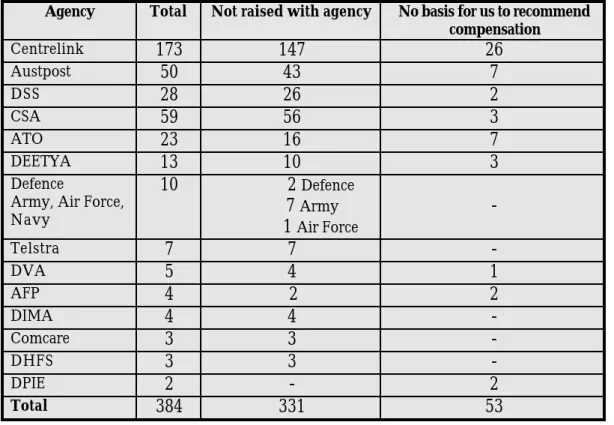
2.6 Table 1 indicates for the main agencies24 concerned, the number of complaints where compensation was discussed but we declined to investigate, because it was clear that either the client had not yet discussed the problem with the agency or there was no basis for us to
recommend compensation.
Agency Total Not raised with agency No basis for us to recommend compensation
Centrelink 173 147 26
Austpost 50 43 7
DSS 28 26 2
CSA 59 56 3
ATO 23 16 7
DEETYA 13 10 3
Defence
Army, Air Force, Navy
10 2 Defence 7 Army 1 Air Force
-
Telstra 7 7 -
DVA 5 4 1
AFP 4 2 2
DIMA 4 4 -
Comcare 3 3 -
DHFS 3 3 -
DPIE 2 - 2
Total 384 331 53
24 Attachment A provides details of complaints about all agencies where compensation was one of the matters discussed.
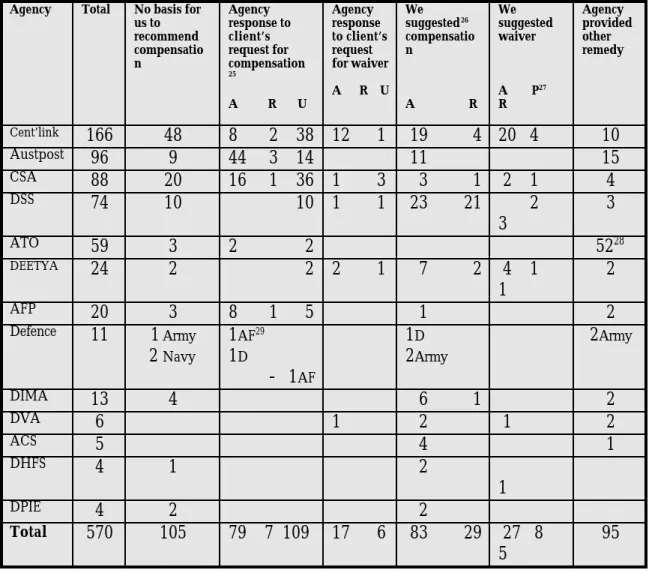
2.7 Table 2 indicates for the main agencies concerned, the number of complaints involving compensation where we did investigate, and the financial outcome so far as we know.
Agency Total No basis for us to recommend compensatio n
Agency response to client’s request for compensation
25
A R U
Agency response to client’s request for waiver A R U
We suggested26 compensatio n
A R We suggested waiver
A P27 R
Agency provided other remedy
Cent’link 166 48 8 2 38 12 1 19 4 20 4 10
Austpost 96 9 44 3 14 11 15
CSA 88 20 16 1 36 1 3 3 1 2 1 4
DSS 74 10 10 1 1 23 21 2 3
3
ATO 59 3 2 2 5228
DEETYA 24 2 2 2 1 7 2 4 1 1
2
AFP 20 3 8 1 5 1 2
Defence 11 1Army 2 Navy
1AF29
1D
- 1AF
1D 2Army
2Army
DIMA 13 4 6 1 2
DVA 6 1 2 1 2
ACS 5 4 1
DHFS 4 1 2
1
DPIE 4 2 2
Total 570 105 79 7 109 17 6 83 29 27 8 5
95
2.8 Tables 1 and 2 indicate that compensation requests arise most often in relation to income support lost or otherwise forgone. Centrelink, the Child Support Agency (CSA) and the former Departments of Social Security (DSS), and Employment, Education, Training and Youth Affairs (DEETYA) account for 65% of the total. The difference in outcomes between DSS and Centrelink is interesting, with DSS accepting 50% of our recommendations and Centrelink accepting 80%. Although striking, this difference should be treated cautiously because complaint numbers are small, fluctuating from year to year, and Centrelink had only
25 The columns headed ‘agency response to client’s request for compensation/ waiver’ refer to complaints we investigated where we did not suggest or recommend direct to the agency that they consider compensation. The agency may already have been considering compensation when we contacted them, or we may have suggested that the client discuss compensation direct with the agency after we had concluded that there had been defective administration. The letters indicate that the agency accepted (A) or rejected (R) the client’s request for compensation or waiver or that we are unaware of the outcome of their request (U).
26 ‘Suggested’ here includes instances where we wrote to an agency head recommending that they consider
providing compensation, as well as less formal approaches to the agency concerned. The Ombudsman rarely resorts to formal reports under section 15 or 16 of the Ombudsman Act.
27 This indicates that the agency waived the recovery of part of a debt or overpayment.
28 We received complaints in 1995 and 1996 about actions of Australian Tax Office (ATO) auditors in their audits of 52 taxpayers involved in a scheme promoted by a tax agent. Our investigation resulted in the ATO agreeing to reverse its assessments for the 52 taxpayers by granting them an extension of time to lodge an objection to the assessments. This exemplifies ‘other’ remedies available, depending on the legislation agencies administer.
29 These letters indicate Air Force (AF) and Department of Defence (D).
been operating for sixteen months when these statistics were compiled. If the trend
continues, it will indicate an important and welcome change in approach to compensating customers for lost income support by the agency that is now the main service provider.
2.9 We can infer that only a few people who complain to us about other matters are
interested in financial compensation as part of the remedy, apart from those who complain about lost or damaged mail items involving Australia Post30. Most people simply want the problem resolved and some assurance that it will not happen again. But we do receive a small, steady stream of complaints about agencies’ contracting practices, particularly from small businesses contracted or tendering to provide services to agency customers, that suffer losses they claim have resulted from the agency’s administration of the contract or tender procedures.
2.10 Because agencies are not always prepared to accept the version of events outlined by their customers, the existence of objective evidence and the credibility of individual customers are crucial. If there is no objective evidence, agencies rely on their knowledge or their
assumptions about how well their staff know their job and the laws they administer. In those circumstances a customer’s credibility can be vital to achieving a favourable outcome. The Ombudsman’s report on oral advice31 outlines some of the difficulties people face in those circumstances.
2.11 The following summaries typify the complaints we receive where compensation is one of the issues involved. They indicate a range of circumstances in which compensation may be considered by an agency and either approved or refused.
Case Studies
Child Support Agency (CSA) Case study 1
The ‘payer’ disputed paternity of a child for four years until DNA testing finally proved he was not the father. He incurred $8,000 in legal costs that the payee was ordered to pay. His solicitor advised him to accept the payee’s offer of $4,000. He asked the CSA to compensate him for the balance of $4,600 because he believed they were negligent in accepting a statutory declaration from the payee purporting to bear his signature, acknowledging paternity. The CSA denied liability and refused to pay compensation.
Our investigation revealed that the CSA had only seen a photocopy of the declaration of paternity, not the original. They had not done anything to investigate the payer’s protests that he had not signed any declaration.
The CSA agreed to pay compensation for its defective administration of $4,000 for
unrecovered legal costs and a further $600 costs that the ‘payer’ had incurred trying to recover the whole costs from the payee.
Case study 2
The payee wrote to the CSA seeking compensation for a delay of two years in registering her application for assessment. The CSA had evidence that they received the application in 1993 and accepted that they had lost it and did not assess the liability until the payee complained in 1995 about their failure to collect anything. The CSA then assessed the payer’s liability for
30 They made up 15% of complaints involving some discussion of compensation.
31 op cit.
1993 and 1994 based on his taxable income two years earlier. The payee said he earned more in 1993 and 1994 than he had two years earlier. She sought a review of the liability for those years. The review officer decided there was no just cause to review the earlier period.
Our investigation indicated that there was no basis to argue for compensation for the CSA’s delayed assessment because it was impossible to quantify the payee’s loss during that time. It was difficult to determine what the payer’s liability would have been in that period and in any event, he had accumulated large arrears since the assessment and may not have paid
anything anyway. The CSA could not be held responsible for that.
Department of Employment, Education, Training and Youth Affairs (DEETYA)32 Case study 3
The client participated in the Self Employment Development Scheme (SED) which involved an agreement that she receive Newstart Allowance from DSS for 12 months while she was establishing a small business. The client opened her shop in September 1996. The managing agent and the Commonwealth Employment Service (CES) conducted regular reviews and agreed that her activities complied with the SED requirements. DSS then determined that she was no longer eligible for Newstart Allowance because she worked in her shop full-time. DSS cancelled her payments. She had to close her business. She asked DEETYA for compensation for the costs she incurred in setting up the business as a consequence of their wrong advice.
Our investigation revealed that there had been a major breakdown in communication between DSS and the CES. DSS had cancelled several SED participants’ Newstart Allowance payments once they started to operate their businesses full-time. The CES had told the clients and their managing agents that they would be entitled to Newstart Allowance for 12 months until their businesses became viable.
DEETYA agreed to compensate the client $2,900 being the value of Newstart Allowance forgone.
Department of Social Security (DSS) Case study 4
DSS cancelled the client’s Mature Age Allowance in August 1994 when they wrongly assessed his pension fund as an asset. He was not aware of DSS’s error until May 1995. DSS then acknowledged their error and reinstated his payments from May 1995. DSS said they could not backdate the payments because he had not exercised his right to seek a review of the cancellation decision at the time. The SSAT recommended compensation. DSS refused.
Our investigation revealed that the information DSS had provided was insufficient to enlighten their customer about how they had calculated his payment and how the laws on pension funds operated in his circumstances. Without that information he did not have any reasonable basis on which to ask for a review of the decision to cancel his payments.33
We recommended that DSS compensate the client but they refused.
Case study 5
32 Employment programs such as NEIS which were provided by DEETYA are now provided by the Department of Employment, Workplace Relations and Small Business (DEWRSB).
33 Our discussion paper cited at footnote 17 addresses this problem in detail.
The client’s husband died in August 1996. DSS told her they would pay her 14 weeks’
bereavement payment. In January 1997 the client discovered that DSS had cancelled her Wife Pension after the 14 weeks. The client then claimed Widows Allowance and asked for
payment of the 7 weeks’ worth of payments she had lost in the meantime. The SSAT recommended that DSS compensate her. DSS declined.
We recommended that DSS compensate the client for the loss she suffered as a result of their failure to advise her that her Wife Pension had been cancelled and their failure to suggest that she test her eligibility for an alternative form of income support.
DSS agreed that these failures constituted a breach of their duty of care and compensated the client $830.
Case study 6
Clients complained that DSS had stopped their pension payments after they had been overseas for more than six months. The legislation had earlier been amended to deal with difficulties in monitoring payments to pensioners overseas. It required a pensioner to notify DSS that they intended to go overseas, so that DSS could check their entitlement to payment while they were away. DSS would then give them a departure certificate. If a pensioner had not received a certificate, the amendment had the effect of suspending their pension
payments after six months away until their return.
The clients had gone overseas intending to stay for a short time but had been unable to return for some unpredictable and pressing reason, such as sudden illness, having to care for a
relative unexpectedly, or being unable to travel because of war. DSS was aware of other people in the same position. In some instances a review tribunal or the Ombudsman’s office found errors in the process, eg, some clients had received wrong advice from DSS before they left Australia. Compensation could be paid to these people for loss resulting from defective administration. But in many cases the legislation had its intended outcome: payments were suspended, without any defective administration.
We argued that the amendment was unjust in these circumstances and should not have applied to people prevented from returning by unforeseen circumstances beyond their control. It was clear that this was an unintended consequence because Parliament amended the provision after these cases came to light. The new amendment allowed a limited
discretion to continue payments, but did not apply retrospectively. We wrote to DSS, then the Minister for Social Security and eventually the Prime Minister, arguing that it was unjust that people affected by the initial amendment should miss out on payments for the period when their pensions had been suspended.
The government agreed to compensate the people affected.
Centrelink Case study 7
The client received Parenting Payments from Centrelink until June 1998. She declared all her earnings and her husband’s. Centrelink overpaid her a large amount. She had tried to repay Centrelink repeatedly but they refused to accept it. Centrelink subsequently asked her to repay an old debt of $65 and kept asking her and her employer about her earnings. Centrelink wrote to her employer who returned the information in the required format. Centrelink wrote again asking for the same information in a different format. They had also made similar requests by phone. The client said her employer was getting annoyed and told her he had complained to the Ombudsman about Centrelink’s repeated demands. The client said she
handled money at work and the implication that she had defrauded Centrelink may have jeopardised her job.
The client was pregnant when she contacted the Ombudsman’s office about the overpayment.
She would need Parenting Payment again when the baby was born and did not want any further trouble. She was also worried that her employer may not keep her job available if he thought she was dishonest.
Our investigation revealed that the employer had not provided an itemised account of the client’s wages for the financial year. But there was a discrepancy between the total amount of earnings Centrelink took into account (for her Family Payment and Parenting Allowance and for her husband’s Newstart Allowance) and the amount the employer said she
had received. We asked Centrelink to check the amounts the client and her husband had declared.
Centrelink checked and concluded that the client had been overpaid $2,000 but decided they would waive recovery of it anyway.
Case study 8
The client incurred an overpayment of the Family Tax Payment from June 1997 until June 1998 because Centrelink believed her earnings were less than they actually were. The client said she told Centrelink what her actual earnings were and was told in return that her entitlement would be $30.80 per fortnight. Centrelink refused to waive recovery of the overpaid amount despite their computer records indicating that the client had notified their Teleservice centre of her actual earnings. Centrelink argued that the client would have received regular written advice from them, including a standard paragraph telling her how her payments were calculated and that if she earned over a specified amount she would not be entitled to any payments. For recovery of the overpayment to be waived Centrelink would have to be satisfied that it resulted exclusively from their own error and that the client
received it in good faith. There must be no fault on the client’s part, including not reading Centrelink’s letters properly.
Our investigation revealed that none of Centrelink’s letters to the client included the standard paragraph. Centrelink could not explain why.
Centrelink agreed to waive recovery of the $520 overpayment because it resulted from their defective administration.
Case study 9
The client did not receive his regular Austudy payment from Centrelink and only received $5 of the supplementary payment he was expecting. Because the full payment did not go into his bank account he incurred bank charges. The client said he had an appointment to see his doctor about chest pains he had experienced when he had been trying to sort out the payment problems with Centrelink. He wanted compensation from Centrelink.
Our investigation revealed that the problem lay with Centrelink’s computer system.
Centrelink said that the client would have to put his claim for compensation in writing and supply evidence of the bank charges and the costs for any medical treatment he had received.
Australian Federal Police (AFP) Case study 10
The client complained that the AFP had lost or failed to return his property, including a gold chain. The AFP’s internal investigation concluded that the complaint was not substantiated.
Our investigation concluded that the AFP’s failure to document the contents of the safety deposit box and to issue receipts for the client’s property contributed significantly to its loss and jeopardised its recovery. We advised the client of the avenues through which he could seek compensation.
Case study 11
The client sought a written apology and compensation for damage to a security door during a search of his premises.
The complaint was conciliated and the AFP paid $320 compensation and provided a written apology.
Department of Immigration and Multicultural Affairs (DIMA) Case study 12
The client wanted a refund of $2,040 fees charged by our Moscow embassy for English
language teaching that she did not receive after she arrived in Australia. The assessment of her English language skills in Russia indicated that she did not have a functional standard of English so she was required to pay the fee. The assessment on her arrival in Australia was that she did have a functional standard of English and was therefore not eligible for tuition.
The client complained to us that DIMA was taking a long time to decide whether to refund the money.
Our investigation revealed that there were 35 other immigrants in the same circumstances (not all from Russia). There was no provision in the migration laws for refunding the fees.
DoFA agreed to make act of grace payments to all the migrants concerned.
Case study 13
The client had received Australian passports between 1957 and 1981 in Pakistan but was later told in 1985 that he was not an Australian citizen. He arrived in Australia in 1987 on a temporary entry permit and applied for citizenship. Federal Court proceedings in 1993 determined that the client had been an Australian citizen since 1949. He then sought
payment of DSS entitlements for the period 1988 to 1992 when he was supported by friends in Australia during his battle to have his Australian citizenship recognised. DSS rejected his claim because he had not lodged claims for income support during that time (he was prevented from doing so until his Australian citizenship was recognised).
The Administrative Appeals Tribunal (AAT) referred the client to the Ombudsman. Our investigation revealed that DIMA was already considering
his claim as a compensation request on the grounds of defective administration.
The Minister approved compensation for the period 1990 to 1992 when the client would have been eligible for age pension, but refused compensation for the period 1988 to 1990 when he may have been able to claim unemployment benefits. The Minister refused compensation for that period because he could not be sure that the client would have met all the eligibility rules for unemployment benefits.
Department of Health and Family Services (DHFS)
Case study 14
A group of child care centres in Tasmania had jointly sought government funding to engage a consultant to provide financial and management advice for community based long day care centres faced with withdrawal of the government’s operational subsidy. DHFS advised the group that all the centres would be able to claim the travel subsidy for the consultant. But previously the adviser’s brief had indicated that the subsidy would only be available for ‘rural and remote’ centres. When all the centres claimed the travel subsidy 19 of them were not classified as rural or remote and their claims were refused.
Our investigation indicated that the advice given to the child care group was wrong or ambiguous and caused the 19 centres financial detriment.
DHFS accepted our recommendation to pay the travel subsidy to those centres.
Department of Finance and Administration (DoFA), CSA and DSS Case study 15
In 1995 the CSA asked the client to repay $1300 they had paid her as child support in 1994. The CSA said they had no authority to waive recovery of the debt. The client had received the money in good faith, had spent it supporting her children and believed it was unfair that she had to pay it back.
The CSA had paid the money because DSS had wrongly applied the rules for parents who separate after 1 October 1989 to the client, although she had separated from the children’s father before that date. DSS had changed the date of separation which the client had put on a child support assessment application form they had given her, from ‘1985’ to ‘1992’. She had separated from her second partner in 1992 and DSS mistakenly assumed he was her children’s father. DSS referred the altered form to the CSA who assessed the children’s father’s child support liability and collected $1300 of it. DSS should have queried the 1985 date with the client and suggested that she apply to a court for a maintenance order, instead of simply
changing the date. It was not until 1995 that CSA realised this, concluded that it had no power to assess the liability, refunded $1300 to the children’s father, and asked the client to repay that amount.
Later in 1995 the CSA intercepted the client’s tax refund to recover part of the debt. DSS then acknowledged their mistake. The client got a court order in 1996 for maintenance of $60 per week but because the children’s father had no capacity to pay more than that, the magistrate adjourned indefinitely her application for payment of the $1300 that the CSA had already paid her for the period since 1992. By 1997 the payer was unemployed and had not paid any of the maintenance ordered in 1996. The CSA said they would ask DoFA to waive recovery of the client’s debt.
We suggested that DSS consider paying the client compensation because their action had resulted in her losing the opportunity to apply for maintenance between 1992 and 1995, when the children’s father was employed. If she had obtained a court order in 1992 she would have been entitled to the amount the CSA had paid her in 1994. DSS said they were concerned that the client may be double dipping if they paid her compensation and DoFA later waived
recovery of the debt. DSS later asked DoFA to waive the debt. DSS had considered
compensating the client under the CDDA rules but could not do so because the rules prevent CDDA compensation to offset repayment of debts even if they resulted from defective
administration. (Waiver is the statutory power available in these circumstances and cannot be over-ridden by an administrative compensation scheme.)
DoFA rejected the waiver request. They believe maladministration is not enough to satisfy the exceptions to the Commonwealth’s policy to recover all debts wherever possible. The exceptions DoFA accepts are (1) where recovery would be inequitable because it would leave the debtor worse off financially than if the payment had not occurred, and (2) recovery would cause the debtor unreasonable hardship. DoFA suggested that if the children’s father got a job the client could return to court and ask for an order for the period 1992 to 1996. DoFA also said that waiver of the client’s debt would circumvent the child support objectives, to ensure that children received financial support that their parents are liable to provide. If DoFA approved waiver that would amount to the Commonwealth paying the liability for the period concerned rather than the children’s father. DoFA suggested that if the client could not afford further court action and was refused legal aid the CSA could consider writing off the debt.
We asked DoFA to explain why they had waived recovery of a debt to resolve a similar complaint but refused in this case. DoFA said that in the earlier case the CSA had overpaid the client for more than five years before discovering the error (whereas in this case it was three years). DoFA believed that pursuit of maintenance through the courts was no longer viable in that case because of the time that had elapsed (five years). That did not apply in this case because the magistrate had only adjourned the matter indefinitely. DoFA believed that left an avenue open to the client to seek arrears in the future.