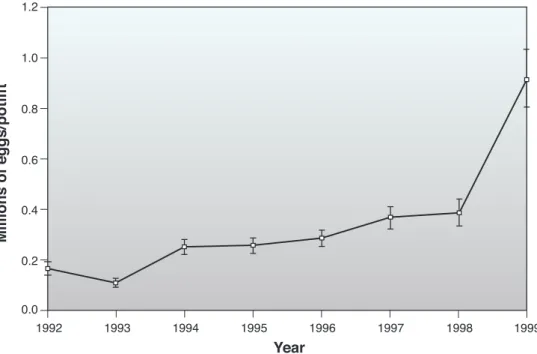
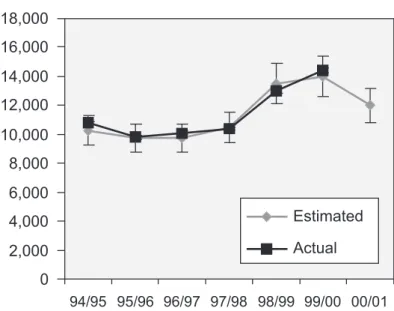
This report is available at the Digital Library: https://researchlibrary.agric.wa.gov.au/fr_esd/5. Biomass of each year class remaining at the end of the fishing season, and the.
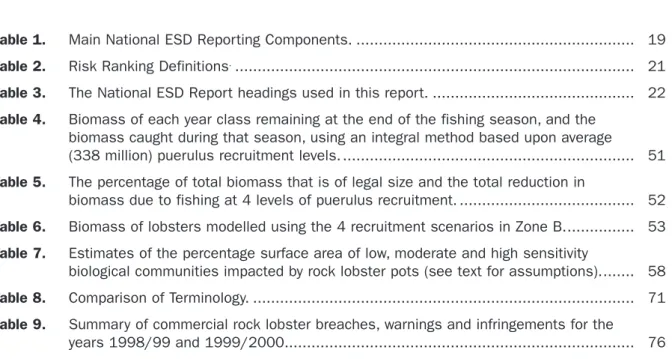
Introduction
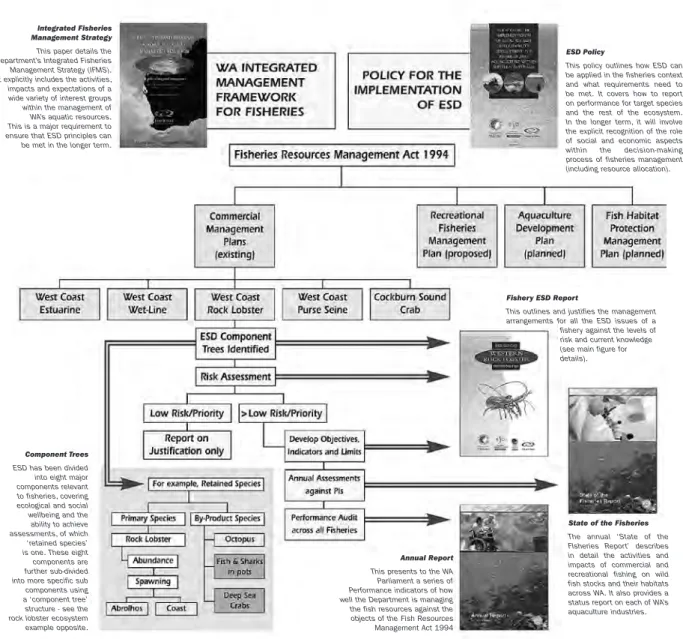
It covers how to report on performance for target species and the rest of the ecosystem. In the longer term, this will involve an explicit recognition of the role of social and economic aspects in the decision-making process for fisheries management (including resource allocation).
Overview
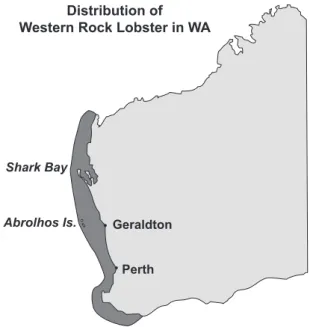
At present, this work is mainly carried out by the Research Division of the Department of Fisheries. The Ecological Risk Assessment Workshop was conducted in February 2001 to provide an inventory of potential ecological risks arising from the various activities conducted by the Western Reef Lobster Fishery (WRLF).
Background on the WRL Fishery
BIOLOgy OF ROck LOBSTERS
The western rock lobster is an opportunistic omnivore that feeds on a wide variety of food items from coralline algae to molluscs and crustaceans (Joll and Phillips 1984; Edgar 1990a), whose populations are likely to have high productivity, high turnover rates, and short life cycles. There are no predators that rely on western rock lobster as their only prey.
DEScRIPTION OF ThE FIShERy
When the "whites" (see above) begins, most commercial fishermen follow the haul offshore. A number of ongoing requirements are necessary for this accreditation to continue, including a risk assessment of the environmental risks associated with the fishery.

MajOR ENvIRONMENTS
Physical environment
WRL fisheries research and monitoring has been carried out for more than 50 years and has one of the best sets of biological and fisheries data in the world. About a third of commercial fishermen help monitor spawning stock and other aspects of the fishery by completing a detailed daily log.
Economic environment
Social environment
Outline of reporting process
ScOPE
OvERvIEW
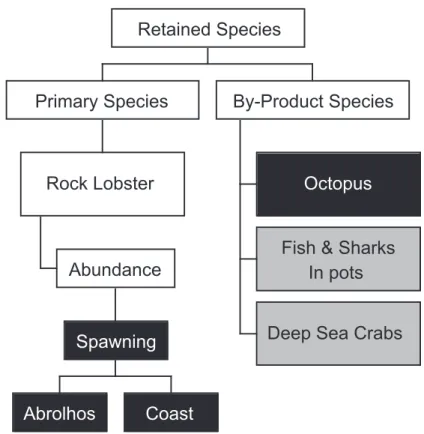
ISSUE IDENTIFIcaTION (component trees)
RISk aSSESSMENT/PRIORITISaTION PROcESS
Environmental risk assessment
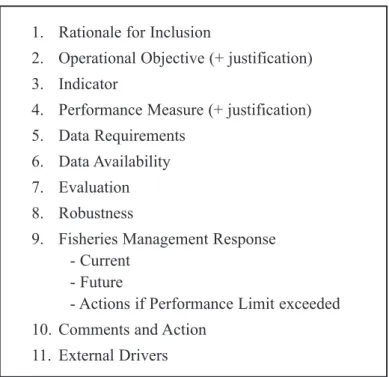
From these two numbers (consequence and probability), the overall level of Risk level, which is the mathematical product of the consequence and probability levels Risk = Consequence x Probability. This process was completed for each of the identified issues with a risk ranking developed and the rationale for assigning these rankings recorded.
This assessment was based on the joint judgment of the workshop participants, who together have a lot of expertise in the areas discussed. In this meeting, examples from each of the main component areas were sketched out so that they could understand what data the group needed to generate for each of the questions.
Completion of these component reports began at the initial SCFA-FRDC meeting in August 2000. Progress towards the completion of these reports was then made by a variety of Department of Fisheries staff in many areas assisted by the completion of the risk assessment document for MSC accreditation process.
OvERvIEW TaBLE
No – Low RiskN/AN/A/N/AN/A2.3.1-2.2.5Monitoring total lobster biomass 5.3.1.2 Impacts on Coral Awaiting further study Awaiting further data Acceptable2.3.1 -2.2.5 Implementation recommendations from Abrolhos Is. Current FRDC Project Focus 5.8.1.5 Interagency Coordination Draft Background 5.8.3.1 Consultations Draft Under Review Background 5.8.3.2 State of Fisheries Reporting (annual); Full ESD assessment (5 years) Acceptable BackgroundDeveloping MOU with EPA and OAG to undertake annual performance audits and 5 annual criteria assessments Acceptable BackgroundDeveloping memorandum with EPA and OAG to undertake annual performance audits and 5 annual criteria assessments.
Performance reports
RETaINED SPEcIES
Primary species
- Spawning biomass of lobsters
Consequently, current fishing performance to maintain sufficient levels of spawning biomass is acceptable. Although the parent stock of the Abrolhos breed has decreased slightly over the last 5 years, it is significantly above the levels of the early 1990s.

By-products
- Octopus
- Scalefish and sharks
- Deep sea crabs (including spiny crabs)
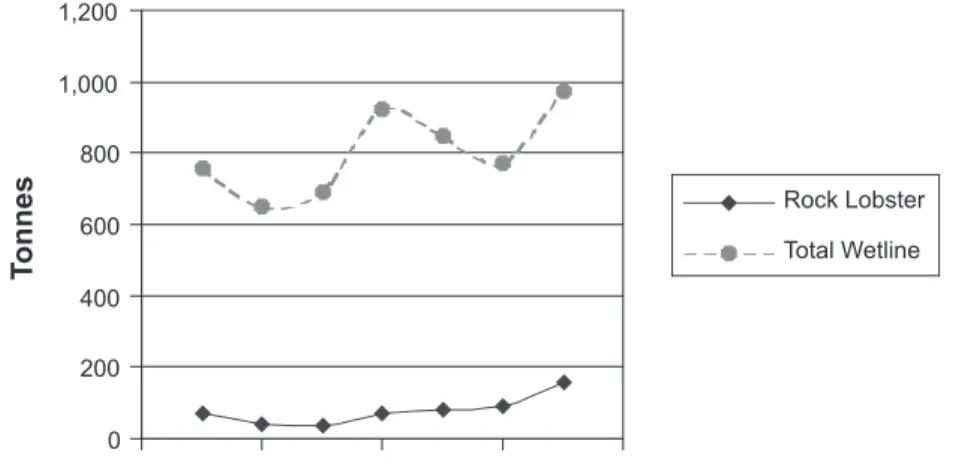
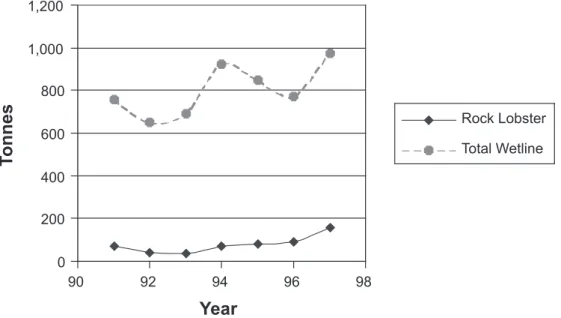
This could include - a ban on rock lobster fishermen taking squid or an annual limit on the catch taken by rock lobster fishermen. The management of the entire wetline fishery for scalefish off the west coast, including the whole issue of retention of scalefish by rock lobster fishermen (caught by any method), is currently the subject of the allocation review process (Toohey Committee).
NON-RETaINED SPEcIES
- Threatened/listed species australian white-naped hair sea lion
- Other non-retained: Moray eels
Interactions with seals, sea lions and their pups have been recorded in most fisheries around the world, and there have been occasional reports of sea lion pups being caught and drowned in spiny lobsters. To minimize capture and direct interaction with sea lions and thus the impact of fishing on the sea lion population. However, with sea lion populations in this region below a threat level, a precautionary approach will be taken to review arrangements if there is any increase in mortality as a result of fishing.
Anecdotal evidence suggests that while sea lion cubs occasionally drown in lobster pots, fishermen may be understandably reluctant to report such incidents. The abundance of rock lobsters and how close they are to areas frequented by sea lion pups/juveniles.
Direct impact but not caught in pots
- Sub–component: Leatherback turtles
- Threatened/Listed Species: Whales and Dolphins
- Non-retained: Manta ray
Media information and press reports of incidents related to lobster fishing with interactions with leatherback turtles. Anecdotal evidence and press reports suggest that while whales very rarely become entangled in lobster pot lines, fishermen are understandably reluctant to report such incidents. Department of Fisheries Research and Regional Services staff are able to extensively monitor lobster fishing activities and report these incidents.
Information from the media and press reports on incidents related to rock lobster fisheries and interactions with whales and dolphins. In addition, there are no reports of manta rays actually being killed by interacting with lobster pot ropes.
Impacts from removal or damage to environment
- Fishing impacts, through lobster removals, on ecosystem (both higher
- ghost fishing
- Physical impacts on coral from potting
- Impacts on limestone reefs
- Impacts on seagrass
Current total lobster biomass levels are likely to be at least 80% to 90% of uncaught levels. Current estimates of the total biomass levels of lobster suggest that it is at least 80% to 90%. For Zone B, the total rock lobster biomass is 21234 tonnes, and the catch of 1888 t therefore represents only about 9% of the total biomass (Table 7).
Similar estimates of the area of moderately sensitive habitat will be affected (Table 8). Estimates of the percentage area of low, moderate and high sensitivity biological communities affected by rock lobster pots (see text for assumptions).

Impact of addition of biological material
- Bait usage (impacts on ecosystem)
- Impact on bird and dolphin behaviour
Also, unpublished video studies of the lobster fishery conducted in the 1980s (R.S Brown, unpublished) found similar results. Reduction in the number of pots and pot size limits should have reduced the impact. In ranking benthic biological community classes of the marine ecological units of the Abrolhos Islands according to their relative sensitivity to anthropogenic physical damage, Hatcher et al. 1990) attributed a 'moderate' ranking of 4 to seagrasses compared to 'high' rankings of 1 and 2 attributed to coral assemblages.
Note that this is not a comparable ranking of risk as used in the WRL Risk Assessment Report as it looked at all forms of human activity).
- camping at the abrohlos Islands
- Other impacts on the environment: air quality
- Other Impacts on the environment: Debris
Vegetation disturbance and clearance The distribution and status of vegetation on the islands has not been established (Anon 1998). Fauna concern The distribution and abundance of fauna on the islands has not been established (Anon 1998). Develop a land use plan that takes into account the natural and heritage values of the Abrolhos Islands.
Develop a waste management strategy that produces the most environmentally acceptable waste management procedure for the islands. Issues for other agencies: CALM can be involved with issues around flora, fauna and fire on the islands.
- Management effectiveness (outcomes)
- Management arrangements
- compliance
- allocation among users
As an overall sub-component, the performance of the management arrangements is evaluated at two levels - the micro level, i.e. an explicit description of the management unit - The management unit is explicitly described in the "Fisheries declaration" section of the WRL plan. Management and regulatory details for the implementation of the actual management plan – The rules relating to the WRL fishery are located in both the WRL Plan and the FRMR and Orders (one set of which is provided to the EA).
Unification of fisheries to more explicitly include the 18% reduction in hunting in current hunting rights. This will be determined as part of the Toohey Committee's discussions (see below) on resource sharing data requirements.
Legal arrangements
- OcS arrangements
The extensive consultative processes involved in the management of both fisheries sectors also ensure that the rights of commercial and recreational fishers are respected. Resource sharing issues to be dealt with by the Minister independently of RLIAC or the Toohey Committee. These arrangements are underpinned by Part 3 of the FRMA relating to the management of Commonwealth fisheries and the Commonwealth Fisheries Management Act (1991).
The current jurisdictional arrangement is appropriate given the distribution of the jumping lobster and the good results that exist under this arrangement for the management of the jumping lobster fishery. The original arrangement, as set out in the 1988 agreement, is now covered as part of the more general 1995 agreement (for more details, see Brayford & Lyon, 1995).
- consultation (including communication)
- Reporting
The Minister (or the Department on his behalf), complies with FRMA's consultation requirements. The Rock Lobster Industry Advisory Committee (RLIAC) has several functions under section 30 of FRMA which are:-. Current: To report annually to Parliament and the community on the status of fisheries.
Annual reporting on fishing performance against agreed targets as part of the Fisheries Status Report. Current Affairs: For many years the Department has produced comprehensive and high quality documents reporting on the Department's operations and the status of its fisheries (including the WRL fishery)–.

The influence of macrofaunal abundance and size structure on diet and growth of the western rock lobster Panulirus cygnus George. Status of the western rock lobster, Panulirus cygnus, fishery and the effectiveness of management controls to increase stock egg production. Fish predators of the western rock lobster (Panulirus cygnus George) in nearby nursery habitat.
Spatial model of the population dynamics and utilization of the Western Australian rock lobster, Panularis cygnus. Report of the Standing Committee on Ecologically Sustainable Development on the Management of the Western Rock Lobster Hon Christine Sharp MLC (Chair).
Appendices
Materials supplied to Environment australia against their specific guidelines . 92
It provides a regular review of the performance of fisheries management arrangements and management strategies, objectives and criteria. Details are given in the 'non-conserved species' section of the national ESD report (Section 5.2.). The WRL breeding stock level is currently estimated to be above 22% in all regions.
A full description of the management arrangements for the commercial fishery is contained in the attached management plan. A formal risk assessment was completed (see section 3.3 for details) for each of the identified issues related to the WRL fishery (see the issue tree).