An Anthropological Study on the Socio-economic Condition of the Small-scale Poultry Farmers in
Bangladesh
A thesis presented by Adhiti Fatema Islam
ID: 19117004
to the Department of Economic and Social Sciences in partial fulfilment of the
requirements for the degree with honors of Bachelor of Social Sciences
BRAC University September 2022
ii Examining Committee:
Supervisor Dr. Mujibur Rahman
Senior Lecturer
Department of Economics and Social Sciences BRAC University
Program Coordinator Dr. Shahidur Rahman
Professor
Department of Economics and Social Sciences BRAC University
Chair Dr. Wasiqur Rahman Khan
Professor
Department of Economics and Social Sciences BRAC University
iii
CONTENTS
Chapter Title Page No.
I Introduction 1
II Literature Review 4
III Methodology 15
IV Results 17
V Discussion 31
VI Conclusion 46
References 50
Appendix 1 57
iv
1
Chapter I INTRODUCTION
An affordable source of high-quality, nutrient-rich animal protein is poultry. This is why poultry industry is also one of the fast-growing industries in Bangladesh.
Small-scale poultry production has grown in many developing countries around the world, including Bangladesh, as a significant source of income for the poor people especially in rural areas. The acknowledgment of small-scale commercial poultry production has helped to accelerate the pace of poverty reduction in Bangladesh, which has reached a new height in recent years. This poultry industry has a lot of potential in terms of contributing to the country's economic growth, meeting basic necessities and ensuring food and nutrition security, particularly animal protein for human consumption.
The present poultry farming structures in Bangladesh can be generally classified as follows: a traditional rural backyard or scavenging/semi-scavenging system, and a business-oriented farming system. Traditional poultry farming is an important part of rural family occupations where a few chickens are kept with little or no feed supplement to produce eggs and meat for home consumption, and any excess for selling. Sultana et al. (2012) stated that backyard poultry farming is quite common
2
in low-income countries' rural communities. It is a vital resource for rural families' livelihoods. It is crucial not only for production of food, but also for subsistence farmers, particularly women. On the other hand, commercial poultry farms are specialized for producing birds in restricted spaces with a focus on high-yielding breeds, profit generation, and business purposes. The commercial poultry farms in Bangladesh are now producing about 525 million broilers, 250 million slow- growing colored meat-type chickens (Sonali), and 60 million commercial layers per year. The majority of the commercial chickens (60-70%) are raised in small-scale farms (Larive and LightCastle, 2020; Rahman et al., 2021). These small-scale farms are mostly located in the backyard of households and are usually run by family members (Rahman et al., 2021). Hassan (2018) expressed that it is important to note that commercial small-scale poultry farms are vital for people in rural communities, particularly the underprivileged, women, and youths, by providing income and jobs.
There is a good amount of research on backyard poultry farmers (Alam et al., 2014;
Popy et al., 2018; Shanta et al., 2016; Sultana et al., 2012), but research on commercial small-scale poultry farmers is quite limited, which focused mostly on production and profitability (Rabbani and Ahmed, 2021) and marketing system of small-scale broiler (Akhter et al., 2020). However, it is highly important to know about the small-scale poultry farms and farmers from anthropological perspective.
Therefore, the present study was undertaken to find out the farmers’ socio- economic conditions including educational and economic background, income
3
generation, women empowerment and hygienic conditions. So the study was focused on the following research questions:
− What is the educational and economical background of the small-scale poultry farmers?
− What kind of impact poultry rearing has on the income generation of small scale poultry farmers?
− Are the small-scale poultry farms managed by family members or by hired employees?
− How visible is the involvement of women in these small-scale poultry farms?
− How hygienic are the environment and practices of these small scale poultry farms?
4
Chapter II
LITERATURE REVIEW
The human population is expanding very quickly worldwide and a major and growing demand for animal products is emerging due to changing consumption habits of people. Today, poultry farming is regarded as one of the most vital and competitive sectors of the global food industry. It appears that poultry farming is in a phase of rapid expansion. FAO (2014) stated that poultry refers to avian species that are domesticated and raised for meat, eggs, and feathers. In all of the world's poultry populations, chickens represent about 90% of the total population and are by far the most prominent species. Thus, chickens and poultry are frequently used synonymously. Abdi-Soojeede and Funwie (2022) elaborated that compared to raising other animals, raising poultry takes less investment. The return on investment is quick. Moreover, it is a traditional business venture. Wong et al.
(2017) explored that most small-scale poultry production systems are based in rural, resource-poor locations where food insecurity is a common phenomenon. They are accessible to the society's most disadvantaged sections and provide the households sources of income and food that is high in nutrients. But they also enhance food security, increase nutrient availability, contribute to mixed agricultural methods, support women's empowerment, and facilitate access to healthcare and education.
Isika et al. (2006) mentioned that due to shorter lifespan, high rate of return and proficiency in producing high-quality animal protein; poultry production is a
5
valuable source of animal protein. Permin et al. (2005) expressed that eggs and meat from poultry make up 30% of all animal protein consumed globally. Regmi (2001) described that between 1961 and 2001, the global production of poultry meat increased by about eight times, and in middle-income nations, it expanded by more than twelve times. By 2001, middle-income nations produced the majority of the world's poultry, with 52% of total production, compared to high-income countries' 42% and low-income countries' 6%. This is why it is becoming increasingly popular to target small-scale poultry systems as an efficient entry point for various programs and activities aimed at reducing poverty. According to UBC and HKI (2018), one of the main issues for rural communities is a lack of protein. The price of beef and mutton is rising, making them unaffordable for the poor. Small- scale poultry farming can be important for nutrition, income and livelihood in order to tackle the protein shortage. Additionally, eggs contain vitamins to keep young children healthy and give protein and micronutrients for children's developing bodies. Protein is more essential for young children between the ages of 1-3 than for adults. Physical and mental retardation can occur in children who do not receive sufficient protein and other nutrients. As a result, they get weak and become vulnerable to illness. Eggs are also very pricey, and the majority of rural poor households cannot buy them. Alders and Pym (2009) stated that for thousands of years, small-scale poultry approaches and techniques have been incorporated into human lifestyles which helped to improve the diet, income, and food and nutrition security of rural impoverished people.Besbes et al. (2012) elaborated that many individuals raise small flocks of poultry in developing countries for domestic
6
use, for selling, and for a variety of sociocultural purposes. Because of the initial concentration of this practice in villages, it was referred to as "village poultry"
production. However, as urbanization progresses, village-type poultry became more common in urban and peri-urban regions. The practice is sometimes referred to as "backyard production" when birds are housed all or most of the time. The word "scavenging poultry," which is nearly a synonym for village poultry, is used to characterize the feed supply of this production system. But the absence and declining scavengeable feed resource in villages have increased the need for supplemental feeding. In order to encompass the whole range of all small-scale poultry production practices present in rural, urban, and peri-urban areas of developing countries, the term "family poultry" was developed. This term refers to poultry production carried out by individual households to ensure food security, an income, and a job. FAO (2016) mentioned that there are four types of poultry productions systems which are-
• Small extensive scavenging
• Extensive scavenging
• Semi-intensive
• Small-scale intensive.
According to Poultry sector study Bangladesh (2020), in the past, Bangladesh's primary supply of poultry meat and eggs was backyard farming. With the importation of modern breeds, technologies, and marketing strategies; the poultry industry began to modernize. The Bangladeshi poultry sector steadily moved to a
7
commercial industry. The backyard poultry farming sector is increasingly moving away from traditional family farming methods and towards more professional farming approaches that require more investment and enhance productivity and profitability. Commercial poultry industry developed smoothly in the 1990s due to significant private sector investment. It was mainly pioneered by the Eggs and Hens Ltd. in 1954 and guided by the Biman Poultry Complex after independence. It is anticipated that this industry has invested about US$3.0 billion in capital and has provided jobs for about 6.0 million people. Huque et al. (2016) expressed that due to initial "low volume and high margin" investments, private sector's excellent performances and government policy encouraged competition in commercial poultry farming. Ali and Hossain (2012) described that the acknowledgment of small-scale commercial poultry farming during the previous few years has contributed to a rise in Bangladesh's rate of poverty reduction. The poultry sector has succeeded in elevating itself to a prominent position in the nation. Nielsen (1998) stated that Bangladesh is a fantastic illustration of how poultry may influence the empowerment of the underprivileged women and the alleviation of poverty.
Rana et al. (2012) mentioned that Bangladesh is a developing country, therefore unemployment, malnutrition, poverty, and a lack of arable land are its key issues.
When poor people need money, commercial broiler farming offers a convenient source of income. It also gives women and educated unemployed youth the chance to find jobs. People in both rural and urban areas are more inclined to establish
8
small-scale commercial farms as a result of the high price and demand in the domestic economy. Numerous NGOs have offered to assist them with the establishment of a small-scale poultry farm. Rabbani and Ahmad (2021) expressed that Bangladesh produces poultry for two main purposes: one is to provide meat, another is to produce eggs. Ali and Hossain (2012) stated that the total amount of money invested in Bangladesh's poultry industry in the 1990s was just BDT 1500 crores, but it became BDT 15000 crores within two decades. More than 60 lakh individuals now have the opportunity to find work because of this sector. The poultry business has been actively supplying Bangladesh's population with high- quality protein at the lowest cost possible. If both governmental and private sector initiatives are implemented together, poultry farming is simpler than other available options of livestock production. Additionally, biogas and organic fertilizer can be produced from the poultry industry. As compared to 1994–2005, the number of broiler chicken farms expanded by more than 26 times in 2001–02 in Bangladesh when broiler chickens accounted for about 24% of all meat production (Raha, 2005). Production of broiler chicken meat grew, going from 151,200 tons in 2001 to 547,200 tons in 2006. (BPIA -2008). 5.9 kg of meat were consumed yearly per person in 2006, and 3.9 kg (66%) of the total meat came from the commercial broiler chicken production industry (Dolberg, 2008). An estimated 525 million broilers, 250 million slow-growing colored meat-type chickens (Sonali), and 60 million commercial layers are produced yearly by Bangladesh's well-developed poultry industry. Small-scale poultry farms constitute about 60-70% of commercial poultry. The usual flock size of small-scale farms are 1000–3000 for broilers, 300–
9
2000 for Sonali chickens, 1000–8000 for layers (Larive and LightCastle, 2020;
Rahman et al., 2021). Despite being commercial, these small-scale farms are typically run by family members and are most often found in the backyards of their households (Rahman et al., 2021).
It is crucial to put special emphasis on the small-scale poultry farmers. Hassan (2018) explored that smallholder broiler farmers are known for their inadequate production methods, poor income, and hence limited expansion. Small farms therefore require professional care and policy assistance from the government. It should be emphasized that small-scale poultry farms are crucial for people in rural areas, especially for disadvantaged groups of people, through creating money and employment. Ali and Hossain (2012) elaborated that due to the oppression of the actual poultry farmers by the middlemen who steal the earnings, the high price will not profit the poultry farmers in any way. Negative effects also include the lack of modernized management in poultry farming of Bangladesh. Rahman et al. (2021) mentioned that Government policymakers need to pay more attention to the poultry farming in the country. The government can promote the availability of support services by the private sector and non-governmental organizations (NGOs), which strengthen farmers' skills and expertise through a variety of initiatives that eventually increase production efficiency, quality of products, and the accessibility to market-oriented services. For the development of small-scale farmers for poultry industry, a broad and readily accessible support service package is important.
Moreover, support services for farmers should be provided in a way that meets their
10
expectations over the long term. Shah et al. (2006) expressed that 428 (95%) of the 450 farmers cannot choose the right chicks for their requirements. 368 of them (82%) are small-scale farm owners. They had difficulty in finding adequate high- quality chicks in their region, which was a major factor in their failure to choose the right ones. Farmers are influenced while choosing chicks by various suppliers, traders, or dealers. For the majority of poultry farmers in Bangladesh, inadequate funding and loans are the biggest obstacles. They lack the finances to successfully manage a poultry business due to their poverty. High levels of technical experience are necessary for commercial poultry farming. Small-scale poultry farmers in Bangladesh face a threat to their ability to survive due to a lack of knowledge about poultry diets, biosecurity, and disease prevention measures. When raising poultry, small-scale poultry farmers face the risk of two different things. The risk of production is one, and the risk of price when selling the poultry in the market is another. 414 (92%) poultry farmers said that since they relied on middlemen to market their chickens or eggs, they frequently had trouble selling their chickens at the right time for the right price. 351 (78%) small to medium farmers in Bangladesh feel that the poultry industry is currently in danger, and 396 (88%) of them believe that their profits from this industry are inadequate. The majority of farmers depend heavily on brokers and middlemen to keep their poultry businesses running properly. Poultry farmers are having a lot of difficulties, which is limiting the expansion of small and medium-sized poultry farms. This is because of the inadequate roles played by some people such as chick suppliers, feed providers, veterinary medicine sellers, meat/egg buyers and so on. Greater success in
11
Bangladesh's poultry industry is likely to happen when a solid policy and a risk- free chain business network will be established that protects the affected farmers.
Rana et al. (2012) also addressed the similar type of problems. The key problems include high day-old chick prices, high feed prices, poor growth, lack of electricity, lack of financing, low broiler prices, disease outbreaks, environmental pollution, etc. By providing more veterinary care facilities and offering essential vaccines and medications at cheaper rates, the government should expand its veterinary care.
Akhter et al. (2020) described that it is crucial to create quick transportation options between various farms and the neighboring towns. A supervision credit system is also essential in this case. Sultana et al. (2012) stated that the poultry farmers suggest the government to fix and stabilize the price up to a certain point so that they can receive their deserved price. It is crucial to make sure that commercial day old chicks are available at fair market prices. It is also important to set up adequate training programs for broiler farmers. Poultry insurance system should be implemented for indemnity, security, and safety. Rahman et al. (2015) mentioned that small-scale poultry farmers, in particular, face trouble using the loaning system. Poultry farmers will be able to take more loans and enhance production if they are provided loans with minimal restrictions and low interest rates.
Government should often step up to help poultry farmers to reduce their risks. The poultry industry lack proper technical, medical, and managerial training.
Bangladesh's poultry farms have a large percentage of illiterate farmers. They are inexperienced and hesitant to embrace modern technology. Moreover, the hatchery's chicks that are superior in nature should also be ensured. Because
12
disease-free chicks guarantee good growth at the production level. However, Islam et al. (2010) emphasized on women empowerment in broiler production. Broiler production performance is highly dependent on the contribution of women, yet their technical expertise and knowledge are insufficient to achieve superior performance.
Women empowerment is a requirement for learning more knowledge and skills. In case of poultry farming, the knowledge and skills are typically passed down to women through their husbands. Training women in poultry farming can help broiler farms to produce good outcomes, which may boost their empowerment. In order to assist female poultry farmers, more female workers should be trained and assigned.
If they are capable of serving as extension workers and offer assistance and guidance to other female participants, women may experience increased empowerment. However, some of these major initiatives are also required in small- scale poultry farming of South East Nigeria, West Africa. Njideka Rita et al. (2022) described that since it is profitable to produce poultry, attention should be given to guarantee that the poultry industry's best practices are implemented by the Nigerian poultry farmers. Through the development of rural financial markets, it is necessary to encourage rural household schooling, infrastructural development, and greater access to credit facilities. Finally, the government must enhance the delivery of extension services, hire more extension agents, and appropriately encourage them to connect with the poultry farmers in those areas. The poultry farmers of Botswana also face some issues. Moreki et al. (2011) mentioned that small-scale commercial poultry farming often takes place in places without access to water or electricity, which results in high transportation costs and low profit margins. Technical,
13
socioeconomic, and institutional constraints limit small-scale commercial poultry farms from producing their products more effectively. The main obstacles are inconsistent and poor supplies of feeds and chicks, poor transportation, insufficient water availability, and uncoordinated marketing. Small-scale poultry was also greatly hampered by a lack of transportation system. The performance of the small- scale poultry farmers was reportedly hindered by the difficulty of transporting inputs to farm enterprises and finished products to the marketplace. Small-scale poultry farmers are sometimes ignorant about how to manage vaccines for their poultry. However small-scale commercial poultry production may play a significant role in the development of rural areas. The poultry farmers of KwaZulu- Natal also need some support for their betterment. Wynne and Lyne (2004) stated that Government policies should place emphasis on absorbing some of the transaction costs in resource-poor communities, i.e. by providing education, necessary infrastructure like public transportation and communications and transfer of technology through extension, in order to make the supply of poultry products more price elastic and thereby encourage economic growth in the rural areas of KwaZulu-Natal. This significant intervention ought to increase communication and product-flows into and out of rural regions, which will make it simpler to establish rural enterprises that produce plenty of tradeable goods like poultry. The poultry farmers from Mogadishu, Somalia deserve some special assistance too. Abdi – Soojeede and Funwie (2022) mentioned that in order to adapt to local climate change and attempt to reduce its negative effects, Somalian poultry farmers must be innovative in how they can increase poultry production. The government must
14
provide the poultry producers with financial and emotional support in order to improve their productivity.
15
Chapter III METHODOLOGY
Study Area & Selection of Farms:
My study areas were small-scale poultry farm-dense villages of Mymensingh and Tangail districts. I went to 18 small-scale poultry farms located in Mymensingh and Tangail and collected all my necessary data. It is a qualitative study which focused on non-numerical data collected through communicational conversation and participant observation. The study type is exploratory. My method was interview.
Development of Questionnaire:
The questionnaire consists of 42 questions. Some of them are demographic questions and others are related to the research questions. There are four questions about the location of the small-scale poultry farm, four questions about the interviewees, three questions about the origin of the farm, eight questions about their poultry, thirteen questions about the employees and finally ten questions about their hygienic practices. I tried to bring out all the relevant data which are relevant to my topic. The questionnaire is attached in the Appendix 1.
16 Data Collection:
I conducted oral interviews. I went to multiple villages and found out the small- scale poultry farms. I observed the poultry farms very attentively and found out the people of the farms to talk with. Sometimes the owners of the farms were available and other times I had to talk with the employees. But they all could give me the proper information I was looking for. I had my questionnaires in my hand and wrote down all the answers while making conversations with the small-scale poultry farmers.
Data Analysis:
For analyzing the data, I entered all my data I received on an excel sheet. Then I categorized the responses to each question and presented them in graphical forms, where applicable.
17
Chapter IV RESULTS
Characteristics of the small-scale poultry farms and their management
Most of the small-scale poultry farms in Mymensingh and Tangail districts are located in rural areas, for example Churkhai, Sokhipur Purbo Dokkhin Para, Bongi, Beltoli, Bolashpur, Boyra, Boro Bila, etc. Most of the small-scale poultry farms I visited do not have any specific name. Very few of them have names, for example Jahid Agro Farm, Dui Bhai Agro Farm, Tarin Poultry Farm, etc. But most of the farms are simply known by the farm owner’s name. Furthermore, I found that some farms are registered and some farms are not. Out of 18 small-scale poultry farms, 13 farms claimed that they are registered and 5 farms were not registered.
The farms were 1 year to 23 years old. The oldest one was established in 1998 and the newest one was established in 2021. However, 17 out of the 18 small-scale poultry farms had the same owners since their inception; only in 1 farm, the ownership was changed.
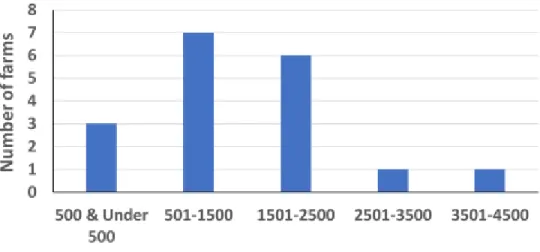
The number of chickens in the small-scale poultry farms I visited varied from 320 to 4000 birds per farm. The distribution of farm size is shown in Figure 01. It was
18
found that most of the small-scale poultry farms had 501-1500 chickens, followed by 1501-2500 chickens per poultry farm.
Figure 01: Number of birds in small-scale farms
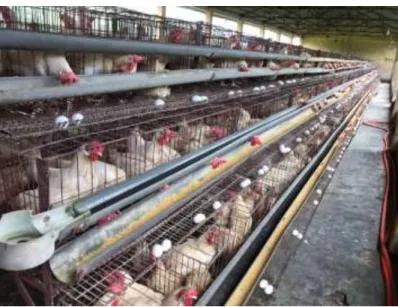
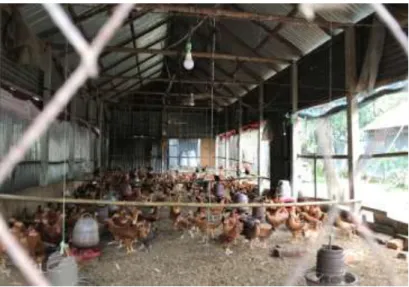
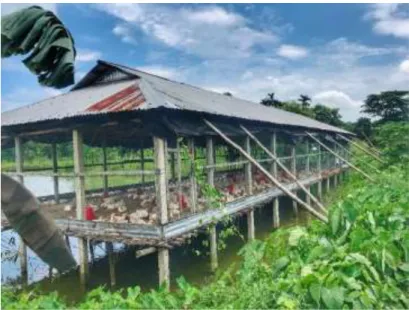
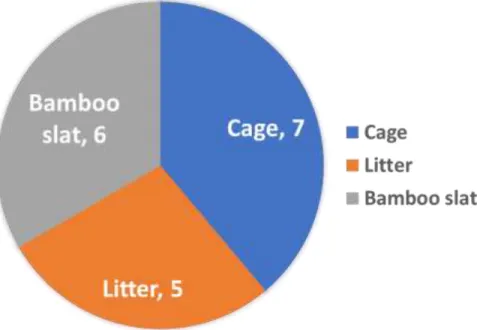
Most of the farms raise their poultry only under one shed. Out of 18 farms, 14 farms had 1 shed, 3 farms had 2 sheds and 1 farm had 3 sheds. They keep their poultry in cage, litter or bamboo slat over a pond (Figure 02, 03, and 04). The distribution of poultry housing systems is shown in Figure 05.
19
Figure 02: Poultry rearing in cage system
Figure 03: Poultry rearing in litter system
20
Figure 04: Poultry rearing in bamboo slat system
Figure 05: Distribution of different poultry housing systems
21
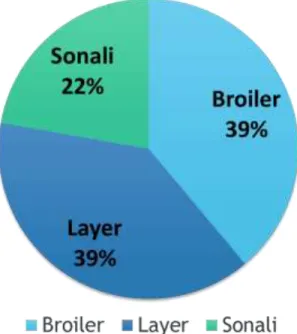
Out of 18 farms, 7 farms had broiler chickens, 7 farms had layer chickens and 4 farms had Sonali chickens. So both broiler and layer chickens are the most demanding poultry breeds among small-scale poultry farmers. The distribution of types of poultry is shown in Figure 06.
Figure 06: Type of chickens in small-scale poultry farms
Majority of the small-scale poultry farms prefer commercial feed for their poultry.
Out of 18 farms, 14 farms feed their poultry commercial feed and only 4 farms feed their poultry self-prepared feed. 10 out of 18 farms store their poultry feed in a separated store room, 5 farms store their poultry feed within the shed, 2 farms store their poultry feed both in the store room and inside the shed and 1 farm keeps their poultry feed in the owner’s house.
22
Most of the small-scale poultry farmers reported that their chickens had been dying from heat stroke. Out of 18 farms, 7 poultry farms lose their chickens frequently due to heat stroke when the temperature is too high. 1 poultry farm complained about the winter time as well. His chickens catch cold during winter and die. 1 poultry farm mentioned about outbreak of diseases and deaths of chickens as a result of that. 11 poultry farms claimed that they have healthy chickens. Moreover, out of 18 farms, 2 farms informed that their chickens get sick quite frequently, 9 farms informed that their chickens get sick occasionally, not on a regular basis; 1 farm informed that their chickens’ health condition is good but loses 1 chicken daily from sickness and 6 farms claimed that their chickens do not get sick.
Demography of the small-scale poultry farmers:
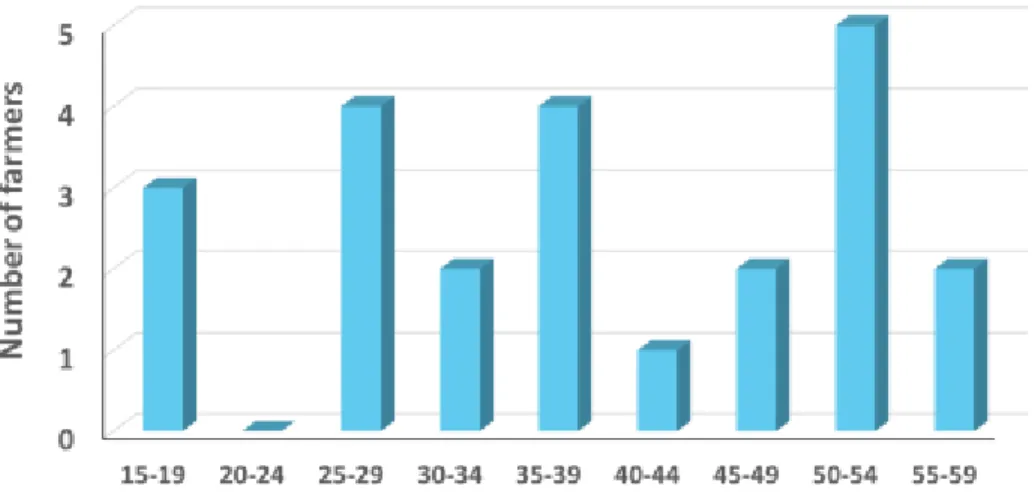
The age of the small-scale poultry farmers ranged from 15 to 55 years. The age is quite diverse. The distribution of age range of small-scale poultry farmers is shown in Figure 07.
23
Figure 07: Age range of small-scale poultry farmers
Most of the small-scale poultry farmers are male, only few of them are female. In 18 small-scale poultry farms, 26 male farmers and 7 female farmers were engaged.
Majority of the hired employees of these small-scale poultry farms have been working in the farms from the time of the farm establishment. The study found that 1-4 people are engaged in total to run these farms. Out of 18 small-scale poultry farms, 5 farms are run solely by the owner. On the other hand, 10 farms are run by the family members. Out of these 10 farms, 6 farms are run by husband-wife, 3 farms are run by father-son and 1 farm is run by mother-daughter. Sometimes these family members are hired employees by the farm owners. In case of hiring employees, the small-scale poultry farms usually hire 1-4 employees for their farms.
24
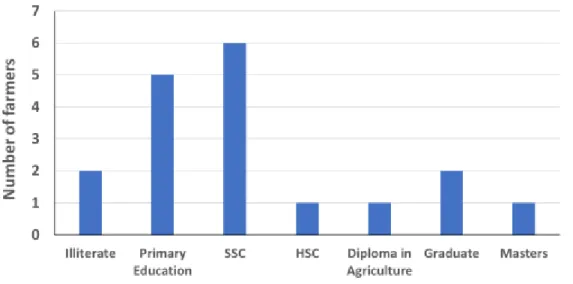
The small-scale poultry farmers came from diverse educational backgrounds, ranging from illiterate to Master’s degree. The distribution of educational backgrounds of small-scale poultry is shown in Figure 08.
Figure 08: Educational backgrounds of small-scale poultry farmers
Socio-economic conditions of the farmers:
The salary of the hired employees in the small-scale poultry farms was Tk. 3000 at the lowest to Tk. 15000 at the highest per month. The distribution of the salary of the hired employees in small-scale poultry farms is shown in Figure 09.
25
Figure 09: Salary of the hired employees in small-scale poultry farms (Monthly)
In 18 small-scale poultry farms, 11 farmers informed that their economic condition got better after starting small-scale poultry farming, 1 farmer informed that his economic condition is average, 3 farmers informed that sometimes there is profit, sometimes there is loss, economic condition is not stable; 1 farmer informed that his economic condition is good but recently he is facing a lot of loss by doing small- scale poultry farming, 1 farmer informed that his economic condition is not good because of the current market price and 1 farmer informed that his economic condition is bad and he is planning on leaving poultry farming.
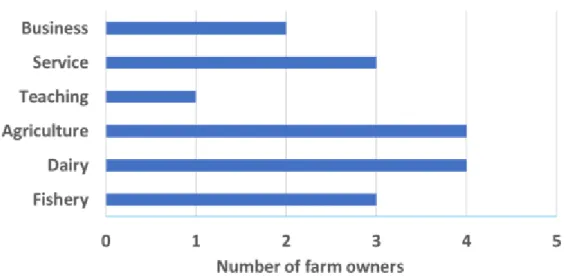
This study found that the owners of these small-scale poultry farms are more likely to have other professions besides poultry farming but the hired employees of these poultry farms usually do poultry farming as their sole profession. The distribution of side professions of small-scale poultry farmers is shown in Figure 10.
26
Figure 10: Other professions of small-scale poultry farmers
Some of the small-scale poultry farmers took loans from banks or NGO, however, accurate information could not be provided by the hired employees. Out of 18 small-scale poultry farms, only 2 farms mentioned about receiving trainings. One took training from Upazila Livestock Office and another took training from an NGO. Other 16 farms did not receive any training at all.
Hygiene Practices in Small-scale Poultry Farms:
Out of 18 small-scale poultry farms, 13 farms are located near the farmer’s house and 5 farms are located far away from the farmer’s house. Among those 18 farms, 9 farms have fences around them, 6 farms do not have any fence, 1 farm has fences but not strong at all, 1 farm has fences but extremely small in height and 1 farm has
27
fences but not in the back side of the farm. Moreover, 14 farms do not let any outsiders to enter the farm, 3 farms always allow outsiders’ entry and 1 firm allow outsiders’ entry occasionally. Next, 13 farms do not allow any children’s entry and on the other hand, 5 farms do.
16 out of the 18 farms do have the system of washing hands and feet before entering the farm. On the other hand, 2 farms do not have any system of washing hands and feet before entering the farms. Furthermore, 8 poultry farms use separate footwear for their farms, 8 farms do not use separate footwear, 1 poultry farm informed that they have the rule of wearing separate footwear but the previous footwear got damaged and did not buy a new one and 1 poultry farm informed that they have separate footwear but they do not use it always. 4 out of the 18 farms have protective clothing and 14 farms do not use any protective clothing.
Different small-scale poultry farms prefer different disinfectants to keep their farms disease-free. But bleach is the highest used disinfectant among them. The distribution of various disinfectants used by small-scale poultry farmers is shown in Figure 11.
28
Figure 11: Use of different disinfectants by small-scale poultry farmers
The small-scale poultry farms also use different methods when it comes to litter disposal. In case of litter system, the used litter is disposed at the end of the production cycle, however, in case of cage system the litter has to be cleaned regularly. On the other hand, in case of slat system the litter is dropped into the pond directly. It was found that in case of cage system, most of the farmers dispose the litter to the fish pond or a nearby ditch. Others throw their litters to the open field or forest. Only one farm uses litter for biogas production. The distribution of litter disposal in case of cage system is shown in Figure 12.
29
Figure 12: Litter disposal by small-scale poultry farmers (in case of cage system)
Finally, there are various practices of disposing dead chickens. Most of the small- scale poultry farmers either throw away the dead chickens in the forest, open field and fish pond or use compost pit. The distribution of the practices of dead chicken disposal among small-scale poultry farmers is shown in Figure 13.
30
Figure 13: Dead chicken disposal by small-scale poultry farmers
31
Chapter V DISCUSSION
The study is aimed to understand the socio-economic condition of the small-scale poultry farmers in Bangladesh. The study emphasized on the impact of poultry rearing on the income generation of the small-scale poultry farmers, their educational and economic backgrounds, variations in poultry businesses (family business/by hired employees), women empowerment and the farmers’ hygienic practices.
Small-scale poultry farming is a very common business in Bangladesh. Most of these farms are identified by the owner’s name. They usually do not have any brand name using which they would try to promote their farms. They are more concerned about which farm belongs to whom. So even though it is a commercial business, it is still very personal to the owner.
Small-scale poultry farms are mostly present in a rural setting. If someone wants to find this type of farms in Bangladesh, they will have to go to village areas. They are not much available in urban parts of the country. Hassan (2018) also had the similar findings. According to him, small-scale poultry farms are usually run by
32
people living in rural areas, particularly the poor, women, and youth, as they generate income and employment.
Even though most of the small-scale poultry farms claim that they are registered, but this could not be verified. Registration of these farms is very important. If a farm is registered, it can receive various supports from the government. But the unregistered farms do not receive these benefits. The farms which are not registered are also not monitored by anyone, so it is difficult to understand if these farms are treating their poultry appropriately or they are engaging in any kind of animal cruelty. Registration of these farms is extremely important for the welfare of the livestock. It will also strengthen their farms after receiving government benefits.
Most of the farmers doing this small-scale poultry business are adults. But there is involvement of some teenagers among the employees which seemed concerning.
Some of them are very young and they are not continuing their education. But everyone should have the right to education. They could do it as a part-time job but they sacrificed their education for this occupation. They will be able to prosper more in life if they continue the education. So it is not necessarily harmful for teenagers to contribute actively to small-scale poultry farming but it is crucial to make sure they are not dropping out of school. It is difficult for a person to contribute to the nation properly without being educated as education is considered as the backbone of a nation.
33
Most of the small-scale poultry farmers are male. The women are very less in number when it comes to this type of commercial poultry farming and majority of them are the farmers’ wives. So the empowerment of women is less visible here.
Commercial poultry farming is still largely depended on men. When the rural households used to rear poultry only in their backyard or within the households following the scavenging method, women used to play the most important part.
They were the ones who used to take after those chickens, they could earn some in- hand cash which helped them to reduce their financial dependence from their husbands and that also strengthened their social networking. Sultana et al. (2012) mentioned similar finding. Sultana et al. (2012) expressed that the rural women had their own source of income from the backyard poultry. They used this cash on food, cooking utensils, gifts, clothes for household members, medical care, loan repayment, and doctor expenses. But my study suggested that after the poultry farming being commercialized, the presence of women is not that strong. So it shows that it is still hard for rural women to come out of their household levels and engage in a commercial business where they will be exposed to more people. As women already excelled in household or backyard poultry farming, they definitely have the potential to excel in commercial poultry businesses as well since they know how to deal with poultry appropriately. Maybe women are not encouraged enough by their families or by the society to engage in commercial poultry farming and this is why there is a lack of women empowerment in this sector. Women’s lack of mobility, lack of resources, lack of opportunities, etc. can also contribute to
34
absence of women in the farms. Islam et al. (2010) made similar claim. He stated that knowledge and skills about poultry farming are often passed down to women through their husbands, and women empowerment is a must for gaining new expertise and skills in this sector. Women empowerment may level up as a result of providing them training in poultry farming, which can assist poultry farms to achieve favorable outcomes. More female workers and professionals should be hired and trained in order to support and encourage female poultry farmers.
Most of these poultry farms have permanent employees who had been working in those farms from day one. As these farms are small in size, they do not need to employ a lot of people to take care of them. They have pretty stable workforce. The owners of these farms also usually remain unchanged. It is mostly a personal business, not a shared business. The owners of these farms think of their own welfare and try to make profits to improve their own situation. By doing this, they can also serve the community as they are already contributing to the economy with their poultry meat and eggs.
They have sufficient number of chickens in their farms to run their business properly and make profits. As they are personal small-scale businesses, they rear limited number of chickens so that they can manage them without any hassle and without employing a lot of people for the farm. Sometimes they run these farms
35
only by themselves as well. They also do not need to create a lot of sheds for their farms as their chickens are limited in number.
Cage system, litter system and bamboo slat system are the common poultry housing systems for the small-scale poultry farms. Cage systems and litter systems are used widely in poultry production worldwide. On the other hand, there are safety concerns about the bamboo slat system which can be threatening for the environment. Poultry litter drops directly in the pond water and can cause water pollution and can also affect the fishes in the pond. But this bamboo slat poultry housing system is quite common among the small-scale poultry farmers in some parts of Bangladesh.
The farmers in Tangail prefer layer chickens more and the farmers in Mymensingh prefer broiler chickens more for their farms. Very few farmers from both of these districts rear Sonali chickens in their farms. So the study identifies that broiler chickens and layer chickens are considered as the most fruitful breeds for commercial poultry farming. Sonali chickens are preferred less by the farmers but it is still very possible to earn good profits by rearing Sonali chickens if the farmers can keep them disease-free and prevent the untimely deaths.
It is a good sign that most of the small-scale poultry farms feed their poultry commercial feed. Commercial poultry feeds are tested and verified and carry the
36
nutrition which poultry require for a good growth. But self-prepared feed for poultry can be a bit tricky as it requires the right formula to prepare them properly.
The feed will not be effective or sometimes harmful for the poultry if each material is not applied in the right amount. So self-prepared poultry feed definitely needs proper technical support.
Most of the farmers store their poultry feed in a separated store room which is the best practice. But still there are a lot of farmers who keep their poultry feed within the shed which is dangerous. If the poultry feed is kept with the poultry within the shed, there is a high risk of contamination. Rodents can also interfere with these feeds and spread diseases. So these farmers really need to be careful about their livestock welfare.
Even though the farms are capable of rearing healthy chickens, a lot of them complained about the tremendous heat of the sun causing the deaths of chickens.
Bangladesh stays very hot most of the time of the year and this hot weather makes the chickens suffer. They die very frequently as a result of heat stroke. There are other diseases which affect the poultry but the health issue which was mentioned by the farmers a lot was heat stroke. Rana et al. (2012) had a different opinion about it. According to him, Bangladesh’s climate is suitable for broiler farming. But my data opposes that the hot climate of Bangladesh is sometimes very intolerable for poultry which ultimately end up causing their deaths.
37
The frequency of poultry getting sick differs from one farm to another farm. Some farms’ chickens get sick or die very frequently, some farms’ chickens get sick or die occasionally and some farms’ chickens do not usually get sick or die. So the performance of the farms vary from one farm to another farm. Poultry diet, poultry management, poultry hygiene, etc. can determine this factor.
The farms are run and managed by very few number of people. As these farms are small in size, they do not require a lot of people to look after the poultry. Some farms are even run solely by the owners. They take the full responsibility of running and managing the farm. If they do not employ anyone, they can also enjoy all the profits themselves. They will not have to give salary to anyone.
A lot of small-scale poultry businesses are family businesses. Plenty of farms are run by husband-wife. There are also farms which are run by father-son and mother- daughter. So it is a family business. Even after the commercialization of poultry farming, it is still being practiced at a family level. According to Poultry Sector Study Bangladesh (2020), the backyard poultry farming industry is progressively moving away from traditional family farming practices towards more productive, professional and commercial farming techniques that demand greater financial commitment. But my data suggests that even after the professionalization
38
and commercialization, a lot of these farming practices are still family farming practices.
There might be a misconception about the small-scale poultry farmers that they are not much educated. Even though majority of them were not lucky enough to take their education that further, still there are some farmers who are very highly educated. Some of them completed their masters, graduation, diploma, etc.
Educational knowledge might assist them to finesse their poultry farming skills as well. Rahman et al. (2015) stated that the percentage of illiterate farmers in poultry farms of Bangladesh is very large. They lack experience and are reluctant to depend on advanced technologies. But my data suggests that even though in general the educational level tend to be low among farmers, there are still a lot of highly educated farmers present in small-scale poultry farms in Bangladesh.
The employees who work in those small-scale poultry farms get reasonable salary.
But the sad part is that the teenagers who are also working in the same industry are getting paid extremely low even though they are also working so hard just like the senior employees. The study found that there is a 15 years old employee who gets only 3000 taka per month for his hard work. So it is not a fair treatment towards him. He sacrificed his education for this profession and he is not getting the money he deserves even though he does the same work of the senior employees who are getting paid far more after doing the same work. So it is an age-based
39
discrimination. There are obviously other examples of the same treatments in small- scale poultry farming. They are from very poor families and cannot argue about the salary. This is why they have settled for less. But definitely they deserve much more than that.
Most of the farmers think that their economic condition got better after starting small-scale poultry farming. Ali and Hossain (2012) also had the similar finding about the improved economic condition of the farmers. Ali and Hossain (2012) described that the acknowledgment of small-scale commercial poultry farming during the past few years has assisted Bangladesh to reduce the rate of poverty. The poultry industry has been able to progress to a major position in the country. But my data suggests that still there are farmers who hold mixed opinions about this.
There are some farmers believe that the profit is kind of unpredictable. Sometimes it is very easy to earn profits and sometimes they struggle to overcome the loss. So according to some of them, it is depended on their fate and they do not have complete control over it. Some farmers also complained about the market price.
During August 2022, the price of the eggs increased suddenly in Bangladesh. The farmers became hopeful and happy about that inflation. But later the government took initiatives to make the egg price go down. That time the farmers became really frustrated. They criticized the drop in the market price.
40
Some farmers have other professions besides poultry farming for example agriculture, dairy, fishery, business, service, teaching and so on. But the people who have these side professions are basically the owners of the farms. But the employees who work under these farm owners do not usually have other professions. They do poultry farming as their sole profession. So these farms stay under their observation and these employed farmers take their job very seriously. They usually do not get engaged in other professions.
Some farmers choose to take loans from banks to have a smooth start. Some of them take loans from NGO as well but most of them prefer banks over NGOs when it comes receiving loans for their farms. Majority of the farmers did not receive any training at all. But training is very important for the farmers to increase their level of knowledge and skills about rearing poultry, poultry feed components, poultry litter management, disease prevention and so on. So it is a bit concerning that most of the farmers are raising poultry without receiving any training at all. Proper training in poultry farming is crucial to ensure the welfare of both livestock and public health.
Another concern about small-scale poultry farming is that most of the farms are located near the farmer’s house. The location of the farmer’s house and the farm are usually very close. But poultry farms are supposed to be isolated from the residential and commercial areas. It will help the poultry to have a better health if
41
the farms are located in a restricted place. It is also needed for the safety of public health.
The presence of fences around poultry farms is also very vital. Most of the farms have proper fences around them. But still there is a good number of farms which do not have fences. Again some farms might have fences but they are ineffective.
But fences are extremely important to make the farms restricted. It will also restrict the entry of other animals for example dogs, foxes, cats, etc. which can attack the chickens. They can carry a lot of diseases. If there are fences, people will also hesitate to go near the farms. But if it is completely unrestricted without any fence, people will go near the farm, they can carry germs with them which might have a very dangerous consequence for that poultry business.
Apart from the structural requirements of a hygienic poultry farm, the hygienic practices of the farmers are also very important. The farmers’ knowledge, attitude and practices towards hygiene are important anthropological aspects, which have impacts not only on the health of poultry, but also on the public health. Few such important hygienic practices of the farmers were observed in this study.
It is a good news that most of the farms do not allow outsiders’ entry in their farms.
One of the most serious risks to biosecurity is the movement of microorganisms by humans. Limiting unnecessary human traffic is a vital part of a sound poultry farm.
42
If a person needs to enter the farm, he must have a good reason for that. Otherwise it will threaten the life of poultry. Humans can also get diseases in the same way.
So it is good that most of the farms take this rule into consideration. The majority of the farms also have restriction against children’s entry which is a good sign as well. Children can become vulnerable to a lot of diseases from poultry farms. Some of them are too young to understand hygiene so they might end up touching the poultry, poultry waste, poultry feed, etc. They might not wash their hands afterwards and get exposed to diseases. Some of them might enter the farms with dirty clothes and shoes after playing and threaten the life of poultry by spreading diseases. If they are not supervised under adults, they might also hurt the chickens accidentally. Poultry farms should not be the place for children to spend time or play and it is good that a lot of small-scale poultry farms in Bangladesh are aware of it.
Most of the farms have the system (water tap) of washing hands and feet before entering and after exiting the farms. The water taps are usually located outside but near the sheds. It is a must for any poultry farm to reduce the risk of infectious germs.
Most of the farmers do not have the habit of wearing separate shoes for the farm.
Some of them have shoes but do not wear them every time they enter the farm or they do not repair or repurchase them after the shoes getting destroyed. They do not
43
take this practice seriously. Clean feet are the first line of defense against the infectious diseases, because one of the primary routes for virus particles to enter a poultry farm is through dirty shoes.
Majority of the farms do not have protective clothes for their farms as well. But it is very important for the optimum biosecurity of a farm. Clothes can be a carrier of a lot of infectious germs. Clothes come in contact with a lot of people and animals outside the farm and get contaminated as a result of that. So it is highly important to use protective clothing in poultry farms which will be worn only inside the farm.
It should not be used in other places from where it can get contaminated. Everyday clothes should not be permitted in poultry farms at all.
Various disinfectants are used by the farmers for disinfection such as bleach, lime, soda, potash and so on. Most of the farmers are aware of the importance of disinfecting their farms. Bleach is most preferred among them and it is also scientifically considered as a useful and standard disinfectant.
For litter disposal, most of the farmers rearing chickens in cage systems use ditch.
They usually wash out the litter directly to the ditch. Although it is convenient but it is not a good idea because it causes environment pollution. Some farmers also use fish pond to dispose the litter. The water of the pond gets polluted after litter disposal. If the fishes from the pond consume those litters, their health will be at
44
risk. Moreover, it is ethically not acceptable to feed unprocessed litter of one species to another. However, the litter can be used in the fish pond after composting.
Some farmers throw away the litter directly to the agricultural fields. It is a bad practice because it spreads bad smell. However, litter is a good fertilizer but it should be used after composting. Another practice was found is biogas plant which is the best practice even though it requires some investments. Litters are drained or transferred to a biogas digester from where the biogas is produced. This biogas can be used for cooking or generating electricity.
For dead chicken disposal, the most common practice is throwing away the dead chickens in open field, jungle or fish pond. Throwing away the dead chickens is the worst practice as they spread diseases from one farm to another. The next common practice is compost pit for dead chicken disposal which is the best practice as there is no risk of spreading disease. Another practice is burial which is also a good practice if the number of dead chickens is less and if there is enough land for burial.
The major limitations of my study were that my study is based on the small-scale poultry farms situated in Tangail and Mymensingh districts only and my sample size is not very big. The results might vary to some extent in other districts of Bangladesh.
45
Nevertheless the study generates some preliminary data on the socio-economic condition of the small-scale poultry farmers of Bangladesh including their social backgrounds, economic status and their farming and hygienic practices. This study will serve as the baseline information for designing and implementing further comprehensive study. This study also provides a good insight into the hygienic practices of the farmers which can be used by the policy makers to suggest good hygienic practices for small-scale poultry farming.
Further researches should focus on-
1. Comprehensive country-wide study on the impact of small-scale poultry farming in the improvement of the livelihood of the farmers as well as women empowerment.
2. An intensive and well-designed study to find out the best practices in farming and hygienic management from economic sustainability, biosecurity and public health points of view.
46
Chapter VI CONCLUSION
The small-scale poultry industry possesses enormous potential for Bangladesh in terms of changing livelihood, food and nutrition security, and boosting up the country's GDP growth rate. The study finds that most of the small-scale poultry farms are personal business and identified by the owner’s name and most of them claim that their farms are registered. Majority of these farms are found in rural areas of Bangladesh which generated employment of a lot of rural people. Most of the small-scale poultry farmers are adults but there is presence of teenagers in these poultry businesses as well. Some teenagers are really young and the extremely low wages which are given to them will concern a lot of people. Majority of them also discontinued their education. Unlike the scavenging sector, there is a lack of women empowerment in small-scale commercial poultry farming. Women are really less in number and many of them present in these farms are just the wives of these poultry farmers. Next, most of these farms own stable workforce who have been working in these farms from the very beginning. They also do not need to hire a lot of employees as these farms are small in size. The owners of these farms hardly get replaced as it is a very personal business. They rear limited number of chickens which will suit their farm size and capacity. Some farm owners also do not even hire employees because they feel comfortable to run the farms themselves without much hassle. It also enables them to enjoy all the profits without sharing. They
47
usually have one shed for their farm and the highest they might have is three. They have three types of poultry housing systems - cage system, litter system and bamboo slat system. Cage system and litter system are used worldwide for raising poultry but there are some concerns about environmental hazards when it comes to bamboo slat system over the waterbodies, which need to be further explored. All the three types of birds, broiler, layer and Sonali, are raised by the farmers. The farmers from Mymensingh prefer broiler chickens more and farmers from Tangail prefer layer chickens more. A few farmers from both of these districts go for Sonali chickens as well. Most of the farmers feed their poultry commercial feed which is a good practice as self-prepared feed requires right technical support to prepare them properly and this can be a bit tricky. Even though most of the farmers have separate store room to store their poultry feed, still there are a lot of farmers who keep their poultry feed within the shed which can cause the entry of rodents inside the feed and cause contamination. The small-scale poultry farmers raise healthy chickens in their farms but plenty of farmers complained about their chickens dying from heat stroke. As most of the time of the year in Bangladesh is very hot, chickens die very frequently due to heat stroke. So the weather of Bangladesh does not always suit poultry the best. However, some farms have higher rate of poultry sickness and some farms have lower rate of poultry sickness. So, the frequency of sickness of poultry varies from farm to farm. Next, many of these farms are family business. A lot of these farms are run by husband-wife, father-son or mother- daughter. So, the family tradition is still there even after the commercialization of the farms. Even though most of the farmers are not much educated, there are still
48
some highly educated farmers among them who completed their masters, graduation, diploma, etc. It is hard to generalize their educational level. The farmers who are working as employees under the owners get reasonable salary except the teenager ones. The teenage employees are somewhat exploited. Small-scale poultry farming benefitted majority of the farmers and enhanced their economic condition.
But still there are some farmers who complained about instability, uncertainty, fluctuating market price, sudden price drop and even their fate. Next, the owners of the farms sometimes have other professions besides poultry farming such as fishery, dairy, business, service, etc. But the employed farmers of the farms usually do poultry farming as their sole profession. Some farmers received loans from banks or NGOs for their farms. Most of the farms did not receive any training before starting poultry farming but training is very important to assure good performance and cope up with the competitive world. Majority of these farms are situated near the farmers’ house but they were supposed to be situated in a restricted location far away from the residential and commercial areas. A lot of these farms do not have appropriate fences around them as well, which are important to restrict other animals’ entry that may transmit diseases. But most of the farms are aware of the importance of restricting outsiders’ and children’s entry inside the farms. It is a crucial action to stop the movement of germs inside the farms to protect the poultry.
It is also a good thing that most of the farms have the system of washing hands and feet outside the shed. But a lot of these farms do not use separate shoes and protective clothing for their farms which is a dangerous habit because their regular shoes and clothing can carry a lot of infectious germs. However, these farmers
49
know the usage of disinfectants and decontaminate the farms frequently using bleach, soda, potash, etc. There are various practices among farmers for litter disposal, for example draining to a ditch, throwing litter to fish pond, using in a biogas plant, etc. Here biogas plant is most appropriate even though it is not a very common practice among the farmers. On the other hand, ditching and throwing the litter to pond both have negative impacts. For dead chickens’ disposal, farmers throw away the dead chickens in open field, jungle or fish pond; use compost pit or bury them. Using compost pit and burial are both good practices, but throwing away the dead chickens can be very harmful as they are capable of spreading diseases.
The limitations of this study is that the data were obtained from Mymensingh and Tangail districts only and the sample size was relatively small. So, the scenario might be a little different in other parts of Bangladesh. However, the study was based on primary data and would provide useful baseline information on the socio- economic condition of the small-scale poultry farmers in Bangladesh.
50
REFERENCES
Abdi-Soojeede, M. I. (2022). Challenges of chicken production on farmers in Mogadishu, Somalia. IQ Research Journal, 1:531-541.
Ahlers, C., Alders, R., Bagnol, B., Cambaza, A.B., Harun, M., Mgomezulu, R., Msami, H., Pym, B., Wegener, P., Wethli, E., Young, M. (2009). Improving village chicken production: A manual for field workers and trainers. Australian Centre for International Agricultural Research (ACIAR), Canberra, Australia.
Akhter, S., Hasan, A., Rahman, H.H., Hassan, M.K., Khan, M.T., Siddique, M.P., Rashid, M.H.A. and Hossain, M.I. (2020). Marketing system of small scale broiler in selected areas of Tangail district. Research in Agriculture, Livestock and Fisheries. 7:243-254.
Alam, M., Ali, M., Das, N., and Rahman, M. (2014). Present status of rearing backyard poultry in selected areas of Mymensingh district. Bangladesh Journal of Animal Science, 43:30–37. https://doi.org/10.3329/bjas.v43i1.19382
Ali, M.M. and Hossain, M.M. (2012). Problems and prospects of poultry industry in Bangladesh: an analysis. AIUB Bus Econ Working Paper Series, No 2012-01, http://orp.aiub.edu/WorkingPaper/WorkingPaper.aspx?year=2012
Assa, M.M. (2012). Poultry production and rural poverty among small-scale farmers in Mzimba district of Malawi. Livestock Research for Rural Development, 24:179.
51
Besbes, B., Thieme, O., Rota, A., Guèye, E.F. and Alders, R.G. (2012). Technology and programmes for sustainable improvement of village poultry production. In: V.
Sandilands and P.M. Hocking, (eds). Alternative Systems for Poultry: Health, Welfare and Productivity, Wallingford, CAB International. pp 110-127.
Dada, A. and Matin, I. (2003). Poultry against extreme poverty : an early assessment of poultry in CFPR/TUP. Research and Evaluation Division, BRAC.
Available at: https://bigd.bracu.ac.bd/publications/poultry-against-extreme- poverty-an-early-assessment-of-poultry-in-cfpr-tup/
Dolberg, F. (2003). The review of household poultry production as a tool in poverty reduction with a focus on Bangladesh and India [Online]. Italy [Rome]. FAO.
Available at: https://agris.fao.org/agris-
search/search.do?recordID=GB2012112054
FAO. 2014. Decision tools for family poultry development. FAO Animal Production and Health Guidelines No. 16. Rome, Italy.
Fattah, K.A. (2000). Poultry as a tool in poverty eradication and promotion of gender equality. In F. Dolberg and P.H. Pedersen (eds.). Proceedings of a workshop, March 102-26, 1999, Tune Landboskole, Denmark. KVL Department of Animal Science and Animal Health.
Green, T., Michaux, K., Moumin, N., & Talukder, Z. (2018). CIFSRF final technical report: scale up of homestead food production for improved household food security and nutrition in Cambodia-fish on farms Phase 2: family farms for
52
the future (CIFSRF Phase 2). Available at: https://idl-bnc- idrc.dspacedirect.org/bitstream/handle/10625/57722/57335.pdf
Hassan, M.M. (2018). Application of stochastic frontier model for poultry broiler production: evidence from Dhaka and Kishoreganj districts, Bangladesh.
Bangladesh Development Studies, XLI: 65-87.
Huque, K.S., Saleque, M.A. and Khatun, R. (2016). Commercial poultry production in Bangladesh. Available at: https://wpsa-bb.com/wp- content/uploads/2016/04/Keynote-Paper-7th.pdf
Isika, M.A., Agiang, E.A. and Okon, B.I. (2006). Palm oil and animal fats for increasing dietary energy in rearing pullets. International Journal of Poultry Science, 5:43-46.
Islam, M.K., Uddin, M.F. and Alam, M.M. (2014). Challenges and prospects of poultry industry in Bangladesh. European Journal of Business and Management, 6:116-127.
Islam, M.S., Takashi, S. and Chhabi, K.Q.N. (2010). Current scenario of the small- scale broiler farming in Bangladesh: potentials for the future projection.
International Journal of Poultry Science. 9:440-445.
Larive and LightCastle (2020). Poultry sector study Bangladesh. Available at:
https://www.rvo.nl/sites/default/files/2020/12/Poultry%20sector%20study%20Ba ngladesh.pdf
53
Mack, S., Hoffmann, D. and Otte, J. (2005). The contribution of poultry to rural development. World’s Poultry Science Journal, 61:7-14.
Moreki, J.C., Petheram, R.J. and Tyler, L. (2011). A study of small-scale poultry production systems in Serowe-Palapye sub-district of Botswana. Proceedings
INFPD Workshop. Available at:
http://www.ethnopharmacologia.org/prelude2020/pdf/biblio-vm-46-moreki.pdf
Nielsen, H. (1998). Socio-economic impact of the smallholder livestock development project in Bangladesh: results of the second impact survey. Hvidovre, Denmark. KVL Department of Animal Science and Animal Health.
Njideka Rita, C., Eucharia Chijindu, N. and Maurice U, O. (2022). Analysis of small scale broiler poultry production in South East Nigeria, West Africa.
International Journal of Animal and Livestock Production Research, 6:1-16.
Okantah, S.A., Aboe, P.A.T., Boa-Amponsem, K., Dorward, P.T., and Bryant, M.J.
(2005). Small-scale poultry production in peri-urban areas in Ghana. In: Small stock in development: Proceedings of a workshop on enhancing the contribution of small livestock to the livelihoods of resource-poor communities, Hotel Brovad, Masaka, Uganda.
Omodele, T., and Okere, I.A. (2014). GIS application in poultry production:
identification of layers as the major commercial product of the poultry sector in Nigeria. Livestock Research for Rural Development, 26:1-7.