An Approach for the Selection and Evaluation of Integrated Municipal Solid Waste Management in Bangladesh
by
:; ••1.,
Md. Khaled Hassan Chowdhury
A thesis submitted in partial fulfillment of the requirements for the degree of Master of Science in Civil Engineering at the Department of Civil Engineering
Khulna University of Engineering & Technology
Khulna 920300, Bangladesh
November 2006
t#
Declaration
This is to certify that the thesis work entitled "An Approach for the Selection and Evaluation of Integrated Municipal Solid Waste Management in Bangladesh" has been carried out by Md. Khaled Hassan Chowdhury in the Department of Civil Engineering, Khulna University of Engineering & technology, Khulna, Bangladesh. The above thesis work has not been submitted anywhere for any award of degree or diploma.
Dr. Muhammed Alamgir Md. Khaled Hassan Chowdhury
Professor Roll No. 0101506
I
4.
Approval
This is to certif' that the thesis work submitted by Md. Khaled Hassan Chowdhury entitled as
"An Approach for the Selection and Evaluation of Integrated Municipal Solid Waste Management in Bangladesh" has been approved by the board of examiners for the partial fulfillment of the requirements for the degree of Master of Science in Civil Engineering, Khulna University of Engineering & Technology, Khulna, Bangladesh in November 2006.
BOARD OF EXAMINERS
01
3 c
Dr. Muhainmed A'mgir Professor
Department of Civil Engineering
Khulna University of Engineering & Technology, Khulna
Dr. Quazi Harnidul Ban Professor and I-lead
Department of Civil Engineering
Khulna University of Engineering & Technology, Khulna
Chairman (Supervisor)
Member
Member Dr. Md. Rezaul Karim
Professor
Department of Civil Engineering
Khulna University of Engineering & Technology, Khulna
Dr. Md. Mujibur Rahman Professor
Department of Civil Engineering
Bangladesh University of Engineering & Technology Dhaka, Bangladesh
Member (External)
a
A
To
A'ti,,
beloved parents for their lovertlli1
nu/ dearest wife, for her continuous support and encouragement
ABSTRACT
Bangladesh, one of the Least Developed Asian Countries is facing very complicated situations for the management of vast quantities of municipal solid waste (MSW) generated by urban communities. Due to the absence of an integrated system there are many loop holes and constraints in the existing waste management practice, which ultimately fails to improve
the overall system.
This study provides information about the present situation of MSW and its characteristics, management practices and limitations in the six city corporations of Bangladesh, namely Dhaka. Chittagong, Khulna, Rajshahi, Barisal and Syihet. The key issues needs to be addressed for an efficient waste management system and the limitations of the present system r are also identified and illustrated here explicitly. For an integrated management of MSW, the study discuss several options such as cost benefit analysis, life cycle analysis and multicriteria decision analysis (MCDA) and propose a spreadsheet tool for an integrated management system based on the MCI)A. The tool is suggested for the verification of suitability and sustainability of the adopted approach. The proposed approach is based on series of spread sheets of waste system components such as contain & collect, sort &
recovery, transfer & treat and dispose & make safe, and aspects of evaluation such as source
& streams. cost & return, health & environment and community
&
structures. The spreadsheet can be used in two ways WasteCheck'—where the body of the table is used to highlight the most significant questions and 'WasteCase'—where the body of the table is used to highlight the most pertinent answers relating to the 'business and sustainability' justification. The selection and evaluation tools is then adopted theoretically for a case study city, Khulna, the third largest city of Bangladesh, to check its sustainability based on local needs and associated aspects. New terminology WastePoint for on-site disposal facility.WasteNode for waste transfer facility, StrategicSite for ultimate disposal facility is adopted in the study for better understanding and clarity. As the six study cities show a remarkable degree of similarity with respect to financial aspects, technical aspects and human resources development. the selection and evaluation approach can be easily extendable for other city corporations of Bangladesh as well.
a
Em
CONTENTS
Chapter Title Page
Title Page
Declaration ii
Approval iii
Acknowledgement iv
Dedication V
Abstract vi
Contents vii
List of Tables x
List of Figures xii
List of Boxes xiii
List of Photographs xiii
Abbreviations Xiv
Units of Measurement xv
INTRODUCTION 1.1 General
1.2 Background of the Study 3
1.3 Objectives of the Study 4
1.4 Scope and Limitations of the Study 5
1 .5 Organization of the Thesis 6
LITERATURE REVIEW
2.1 General 7
2.2 Sources of Municipal Solid Waste 7
2.3 Characteristics of Municipal Solid Waste 7
2.3.1 Composition 9
2.3.2 Physical properties 10
2.3.3 Chemical properties 12
2.3.4 Biological properties 13
2.3.5 Mechanical properties 14
2.4 Solid Waste Generation Rates 14
2.5 Definition of Integrated Solid Waste Management 16
2.6 Basic Requirements 16
2.6.1 Less waste 16
2.6.2 Effective solid waste management 17
2.7 Waste Management System 17
2.7.1 Characteristic of an effective system 18
2.7.2 The importance of an holistic approach 20
2.7.3 A total quality system 21
2.8 Planning for Integrated Waste Management 21
2.8.1 Proper mix of alternatives and technologies 21
2.8.2 Flexibility in meeting future changes 22
2.8.3 Monitoring and evaluation 22
2.9 1-lierarchy of Integrated Solid Waste Management 23
2.9.1 Source reduction 23
FMq
2.9.2 Storage at source and segregation 23
2.9.3 Collection of wastes 26
2.9.4 Transfer and transportation 26
2.9.5 Waste transformation 27
2.9.6 Recycling 27
2.9.7 Ultimate disposal 30
2.10 Necessity of Integrated Solid Waste Management 31
2.11 Typical Integrated Management System 33
2.12 Multicriteria Decision Analysis Systeni 36
2.12.1 General 36
2.12.2 Structural Elements 38
2.12.3 Advantages and Disadvantages of MCDA 40 III OVERVIEW OF THE STUDY AREAS
3.1 General 42
3.2 1-listorical Background of the Study Areas 42
3.3 General Information 44
3.3.1 Location and Layout 44
3.3.2 Population 46
3.3.3 Socio-economic condition 47
3.3.4 Environmental condition 48
3.4 Remarks 49
IV EXISTING MUNICIPAL SOLII) WASTE MANAGEMENT AND ITS CONSTRAINTS IN BANGLADESFI
4.1 General 51
4.2 Quantity of Solid Waste 51
4.3 Characteristics of Municipal Solid Waste in Bangladesh 54 4.4 Physical and Chemical Characteristics of MSW 56
4.4.1 Physical characteristics of MSW 56
4.4.2 Chemical characteristics of MSW 58
4.5 Existing Management Practices of MSW in Bangladesh 59
4.5.1 Source storage and segregation 62
4.5.2 Primary collection 64
4.5.3 On-Site storage 65
4.5.4 Secondary collection and transportation 68
4.5.5 Ultimate disposal 72
4.6 Processing of MSW 74
4.6.1 Recycling 74
4.6.2 Composting 80
4.6.3 Other treatments 82
4.7 Field Survey 84
4.7.1 Household solid waste segregation, storage and disposal 86
4.7.2 On-site storage and disposal 87
4.7.3 Waste management 89
4.7.4 Findings from the field survey 91
4.8 MSW Management Tiers 91
4.8.1 Source storage 92
4.8.2 Waste collection and transfer 92
4.8.3 Waste sorting and recover 94
4.9 Problems of Existing Management of MSW 95
4.9.1 Organizational 95
4.9.2 Human resources and capabilities 97
4.9.3 Technological capabilities 100
4.9.4 Financial aspects 100
4.9.5 Law, legislation and enforcement 101
4.9.6 Public awareness and motivation 102
4.10 ISWM for Bangladesh 103
V APPROACH FOR THE EVALUATION AND SELECTION OF INTEGRATED MANAGEMENT SYSTEMS
5.1 General 104
5.2 Waste System Components 104
5.2.1 Contain and Collect 104
5.2.2 Sort and Recover 107
5.2.3 Transfer and Treat Ill
5.2.4 Dispose and Make Safe 115
5.3 Aspect of Evaluation 116
5.3.1 Sources and Streams 116
5.3.2 Costs and Returns 118
5.3.3 1-IcaIth and Environment 119
5.3.4 Community and Structure 119
5.4 Integrated MSW Management Approach 121
5.4.1 Spread sheet for selection approach 122
5.4.1.1 Options for Container and Collection 122 5.4.1.2 Options for Sorting and Recovety 124 5.4.1.3 Options for Transfer and Treatment 125
5.4.1.4 Options for Safe Disposal 126
5.4.2 Spread sheet for evaluation approach 127
5.4.3 Full Spreadsheet Format 127
5.4.4 Use of spreadsheet 131
VI IMPLEMENTATION OF SELECTED APPROACH IN A CITY OF BANGLADESH
6.1 General 134
6.2 Khulna as a Case Study City 134
6.3 General information 134
6.3.1 Historical background 134
6.3.2 City layout 135
6.3.3 Geography and climate 136
6.3.4 Population and society 136
6.3.5 Environmental condition 138
6.3.6 Socio-econornic condition 139
6.3.7 Land use and infrastructure 139
6.4 Overview of MSW management in Khulna city 141
6.4.1 General 141
6.4.2 Characteristics of MSW in KCC 142
6.4.3 Logistic facilities of the KCC 142
6.4.4 Involvement of NGOs and Cl3Os 143
6.4.5 Management system 144
6.5 Integrated MSW management systems 145
6.5.1 Contain and Collect 147
6.5.2 Sort and Recover 149
6.5.3 Transfer and Treat 153
-r 6.5.4 Dispose and Make Safe 156
6.5.5 Evaluation and Modification 160
6.5.6 Summary of the proposed approach 164
VII CONCLUSIONS AND RECOMMENDATIONS
7.1 General 166
7.2 Conclusions 166
7.3 Recommendations for future studies 169
REFERENCES 170
ANNEXURE
Annexure A : Questionnaire survey sheet in Bengali and English 176
Annexure B : Laboratory Data Sheet 180
Annexure C : Photographs 183
List of Tables
Table
No. Caption of the Tables Page
2.1 Typical solid waste generating facilities, activities and locations 8 associated with various source classifications
2.2 Estimated distributions of all components of MSW generated in a 9 typical community
2.3 Typical distributions of components in residential MSW for low-, 10 middle and upper-income countries
3.1 Establishment of four city corporations of Bangladesh 44 3.2 Location of four city corporations of Bangladesh 45 3.3 Total population, city area and number of wards in four major cities of 47
Bangladesh
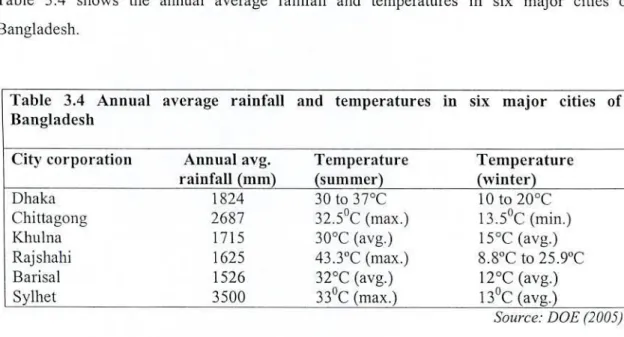
3.4 Annual average rainfall and temperatures in four major cities of 49 Bangladesh
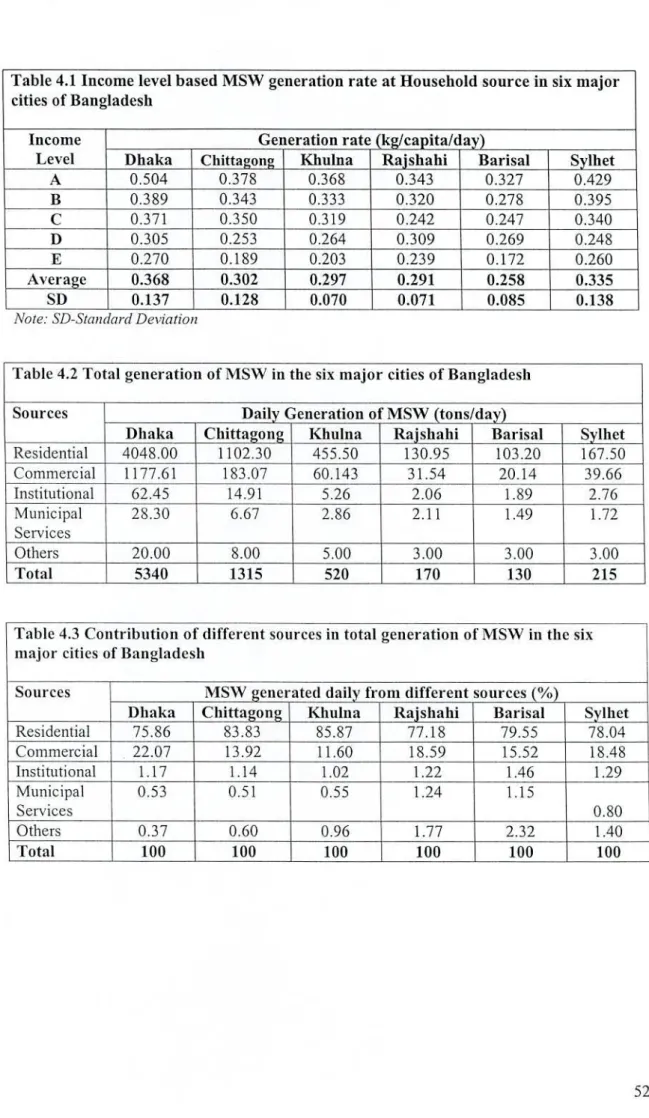
4.1 Income level based MSW generation rate at Household source in six 52 major cities of Bangladesh
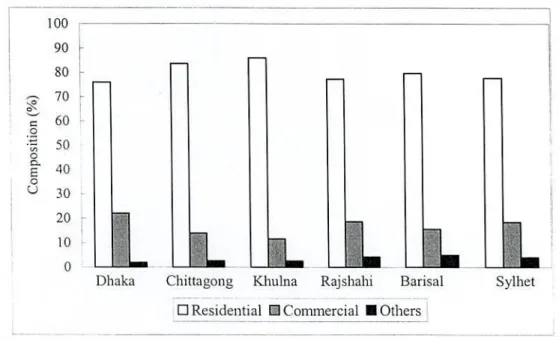
4.2 Total generation of MSW in the six major cities of Bangladesh 52 4.3 Contribution of different sources in total generation of MSW in the six 52
major cities of Bangladesh
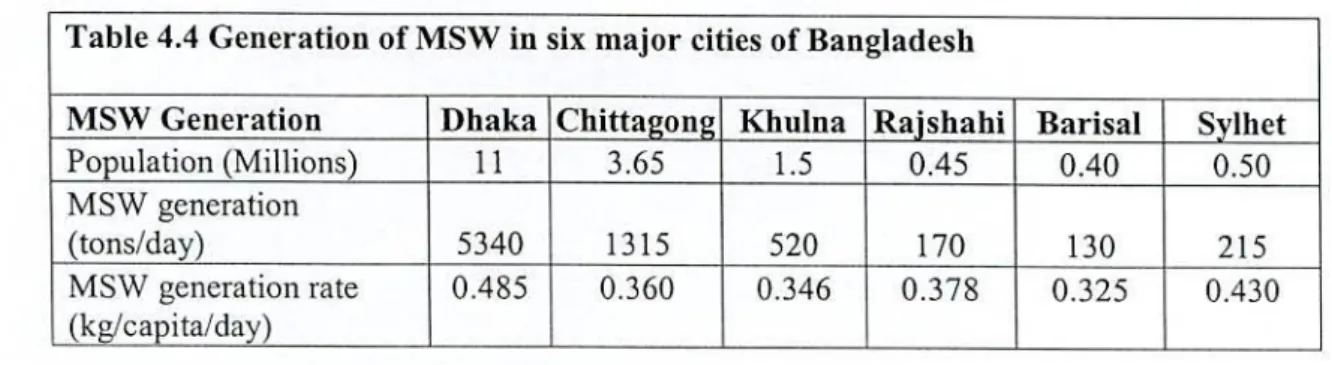
4.4 Generation of MSW in six major cities of Bangladesh 53
'4-
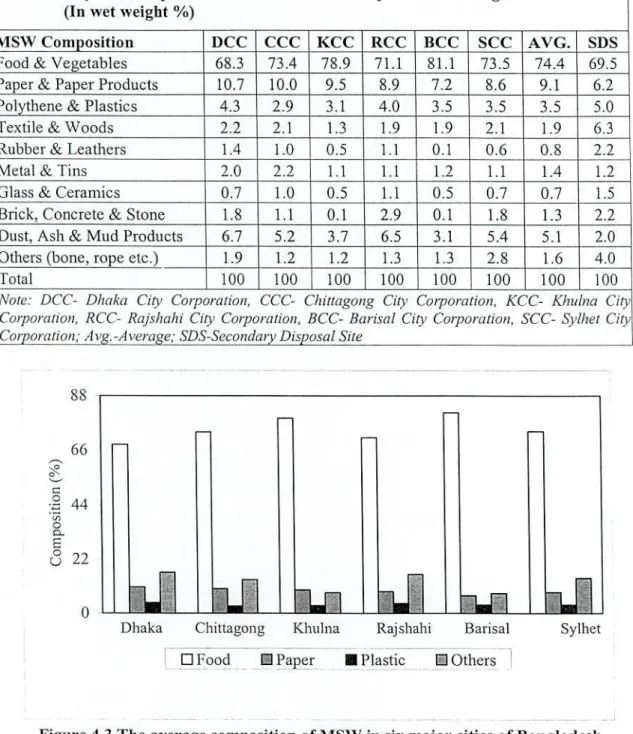
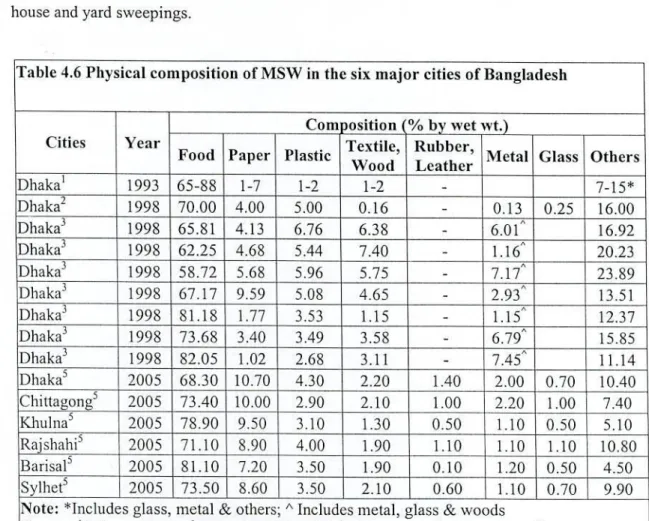
4.5 Physical composition of MSW in the six major cities of Bangladesh 55 4.6 Physical composition of MSW in the six major cities of Bangladesh 56 4.7 Physical characteristics of MSW in six major cities of Bangladesh 57 4.8 Particle size distribution of MSW in six major cities of Bangladesh 58 4.9 Chemical characteristics of MSW in six major cities of Bangladesh 59
4.10 Calorific values for major components of MSW 59
4.11 Basic information of six city corporations of Bangladesh 61 4.12 Typical segregation of household waste of Bangladesh 63 4.13 Number of Motorized vehicles and for collection, transportation and 70
disposal
4.14 Daily recyclable wastes in six major cities of Bangladesh 79 4.15 Different compost plants in six major cities of Bangladesh 81 4.16 Typical manpower involved in conservancy department of major cities 98
of Bangladesh
5.1 Typical elaboration of 'Contain & Collect' checklist 123 5.2 Typical elaboration of 'Sort & Recover' checklist 124 5.3 Typical elaboration of 'Transfer & Treat' checklist 125 5.4 Typical elaboration of 'Dispose & Make Safe' checklist 126
5.5 Typical Aspects of Evaluation 127
5.6 Conceptual framework for spreadsheets 127
5.7 The filler spreadsheet framework 129
5.8 Use of spreadsheet in a WasteCheck application 132 5.9 Use of spreadsheet in a WasteCase application 133
6.1 Major slum areas of KCC 138
6.2 Land use pattern in Khulna city 141
6.3 'I'otal manpower involved in conservancy department of KCC 143 6.4 Private organizations involvement in MSWM at Khulna 144 6.5 Overall starting point for the KCC waste dialogue 146
6.6 WasteCase-the MeterCube proposal 149
6.7 WasteCase-the SinpleSorts Strategy 152
6.8 WasteCase -Transfer & Treat- the 'BacktotheLand' Emphasis 156
6.9 WasteCase-the LevellingUp Strategy 159
6.10 New Starting Point for Second Phase 162
4-.
List of Figures
Figure
No Caption of the Figures Page
2.1 Typical hierarchy of integrated solid waste management 24
2.2 Extended tiers for ISWM hierarchy 25
2.3 Simplified flow diagram of MCDA 40
3.1 Location of study areas in Bangladesh 45
4.1 Percentage of MSW generations in six major cities of Bangladesh 53 4.2 MSW generations according to major sources in the six cities of 54
Bangladesh
4.3 The average composition of MSW in six major cities of Bangladesh 55 4.4 Average particle size distribution of MSW in six major cities of 58
Bangladesh
4.5 Flow path of MSW from source to ultimate disposal in Bangladesh 61 4.6 Different types of bin uses at household in residential areas 63
4.7 Collections of waste from generation sources 65
4.8 Deposition of wastes at on-site storage 65
4.9 Secondary disposal sites of MSW in major cities of Bangladesh 67
4.10 Typical wastes collection process 69
4.11 Typical wastes transportation process 69
4.12 Typical ultimate disposal process 69
4.13 Final disposal sites at six study areas 73
4.14 Recyclable items collection 74
4.15 Recyclable items in solid wastes 75
4.16 Scavenging for recycling materials in SI)S in Bangladesh
Scavenging for recycling materials in UDS in Bangladesh 77
4.17 Typical flow chart of composting process 81
4.18 Typical composting process 82
4.19 Different burning units in Bangladesh 83
4.20 People comments about household solid waste segregation, storage and 87 disposal
4.21 People comments about on-site storage and disposal 88 4.22 People comments about waste management system 90 4.23 Typical flow diagram of storage at source and its parameter 92 4.24 Typical flow diagram shows waste collection and transfer options from 93
P.!
secondary disposal site
4.25 Typical flow diagram shows waste sorting options 94
4.26 Typical organizational set-up for MSWM in the major cities of 96 Bangladesh
4.27 Total budget allocations for a city corporation of Bangladesh 101 5.1 Simplified flow diagram for the concept of WastePoint 107 6.1 Location of Khulna city in context of Bangladesh and Khulna District 135
6.2 Layout of Khulna City Corporation 137
6.3 Ward wise distribution of income groups and housing types of KCC 140
6.4 Waste stream scenario of KCC 142
6.5 Existing dumping site at Rajbandha in Khulna 145
6.6 Proposed WasteNodes in KCC area 155
6.7 Difference between the existing and proposed system 165
List of Boxes
Box
No. Caption of the Box Page
2.1 Community motivation slogan for Reduce 29
5.1 The steps should be considered for source storage by local authorities 105 5.2 The strategies can be pursued for source reduction 108 5.3 The regulation should be introduced at WastePoint 109 5.4 The steps should be considered for sustainable recycling trade chains 110 5.5 Important aspects to be considered for involvement of Private sectors 114 5.6 Important points for ensuring sustainable waste transfer and transport 115
List of Photographs
Photogra L)11
No.
Caption of the Photographs PageC.1 Separation of wastes in household level 183
C.2 Door to door solid waste collection by NGOs in Khulna city 183 C.3 Condition of Secondary disposal site in Dhaka city 184
>-
.4.
C.4 Collected wastes are disposed at secondary disposal site in Khulna city 184 C.5 MSW transfer from secondary disposal site to final disposal site in 185
Chittagong city
* C.6 MSW is open dumped at ultimate disposal site in Khulna city 185 C.7 Waste scavenging at ultimate disposal site in Dhaka city 186
C.8 Recycling activities in Rajshahi City 186
C.9 Sample preparation for physical characteristics determination 187 in laboratory
C.10 Composting activities in Khulna city 187
C.11 Ultimate disposal site in Rajshahi city 188
C.12 Ultimate disposal site in Chittagong city 188
C.13 Different sizes sieves for particle size distribution 189
C.14 Disposal of wastes in Sythet city 189
C.15 Collection of wastes in Khulna city 190
10, C.16 Condition of ultimate disposal site in Dhaka city 190 C.17 Animal scavenging at secondary disposal site in Khulna 191 C.18 Unmanaged municipal wastes at roadside in Khulna city area 192 C.19 Transportation of recyclable materials to Dhaka from Khulna 193 C.20 Present situation of the disposal site in Khulna 194 C.21 View of future disposal site at Rajbandha in Khulna 195
Abbreviations
ADB : Asian Development Bank BBS : Bangladesh Bureau of Statistics
BCAS : Bangladesh Centre for Advanced Studies BCC : Barisal City Corporation
BCSIR Bangladesh Council of Scientific and Industrial Research BUET : Bangladesh University of Engineering and Tecimology CBO : Community Based Organization
CCC Chittagong City Corporation CDA : Chittagong Development Authority CDS : Central Development Society C/N : Carbon Nitrogen Ratio DCC Dhaka City Corporation
DMDP : Dhaka Metropolitan Development Program DOE : Department of Environment
EPA : Environmental Protection Agency EPI : Extensive Programme for Immunization EPZ Export Processing Zone
GOB Government of Bangladesh HIT : Hospital Improvement Initiative ISWM Integrated Solid Wastes Management IWT : Indonesian Windrow Technique
JICA : Japan International Cooperation Agency KCC Khulna City Corporation
KDA : Khulna Development Authority
KUET : Khulna University of Engineering & Technology LDCs : Least Developed Countries
LDACs : Least Developed Asian Countries MSW Municipal Solid Waste
NGO : Non Governmental Organization
PRISM : Project in Agriculture, Rural Industry, Science and Medicine RAJUK : Rajdhani Unnayan Kartipakkha
RCC : Rajshahi City Corporation RDA : Rajshahi Development Authority
RUSTIC Rural Unfortunates Safety Talisman Illumination Cottage SDS : Secondary Disposal Site
SRDI : Soil Resource Development Institute SWM Solid Waste Management
Tk. Taka (BDT)
UDS : Ultimate Disposal Site
IJNEP United Nations Environmental Programme UNDP United Nations Development Programme WHO World Health Organization
Units of Measurement
Btu : British Thermal Unit
gm : Gram
kg : Kilogram
km : Kilometer km2 : Square Kilometer
Kg/rn 3 : Kilogram per Cubic Meter KJ/kg : Kilojoule per Kilogram kg/day : Kilogram per Day
kg/cap/day : Kilogram per Capita per Day I/day : Liter per Day
mm Millimeter
In : Meter
m3 Cubic Meter
inl : Milliliter mg : Milligram
mg/I : Milligram per liter
nrn Nanometer
ppm : Parts per million A
CHAPTER ONE
INTRODUCTION
1.1 General
Solid wastes comprise all the wastes arising from human and animal activities that are normally solid and discarded as useless or unwanted. The term solid waste means all- inclusive, encompassing the heterogeneous mass of throwaways from the urban community as well as the more homogeneous accumulation of agricultural, industrial and mineral wastes (Tchobanoglous et al., 1993). Solid waste can be classified into different types according to sources such as municipal solid waste (MSW), industrial waste, agricultural waste, municipal sludges and others waste. MSW is normally assumed to include all the community wastes with the exception of industrial process wastes, agricultural solid wastes and sewage sludges.
The problem of municipal solid waste management (MSWM) has acquired in alarming dimension in the developing countries during the last few decades. The quantity of solid waste generated has increased significantly and its characteristics have changed as a result of the changes in the peoples' lifestyles due to swift industrialization and urbanization. Rapid population growth and increase of economic activities combined with a lack of training in modern solid waste management practices complicate the efforts to improve the solid waste service (ISWA & UNEP, 2002). Improvement of MSWM practices is a subject of concern for public health and environmental protection agencies in most developing countries. Compared to high income countries, the urban residents of developing countries produce less per-capita solid waste, but the capacity of the developing countries to collect, process, dispose or reuse it in a cost effective way is limited. The wastes generated by human settlements and the associated problems are similar in the developing nations with variances bet\veen regions and locations based on geographic, socio-cultural, industrial, infrastructure, legal and environmental factors.
The major issues in MSW are increasing waste quantities, unmanaged wastes, lack of quality data, lack of reliable theoiy, absence of implementable legislation and standards. In
developing countries waste management sector does not get much attention, so inadequate budget in this sector is also a big problem. In these countries involvement of non- governmental sectors are noticeable. They usually practice door-to-door collection, transfer, recycling, composting and peoples' awareness and motivation program. But due to the absence of an integrated system there are many loop holes and short comings in the present systems, which ultimately fail to improve the overall system.
Planning of an integrated waste management needs a structural dialogue between all the stakeholders. Such a dialogue should be structured around an open evaluation of intervention options. It can be achieved by selecting proper mix of alternatives and technologies to meet changing local waste management needs (Tchobanoglous et. al. 1993).
Bangladesh. one of the Least I)eveloped Asian Countries (LDACs), is ficing very complicated situations for the management of vast quantities of MSW generated by urban communities. I)ue to severe rapid urbanization, rapid population growth, linancial constraints, lack of motivation and absence of proper technology and effective legislation to protect the environment and to handle the waste, the whole system is becoming a threat for city dwellers, planners and other concerned stakeholders. The rapidly increasing unmanaged solid wastes have been severely degrading the urban environment and creating serious strains on natural resources and consequently, undermining equitable and sustainable development.
Inadequate or unavailable solid waste collection and disposal services result indiscriminate dumping of solid wastes on streets and public areas, clogging of urban drainage Systems, contamination of water resources and proliferation of insects and other rodent vectors. Solid waste generation in urban areas of Bangladesh is increasing proportionately with the growth of its population, which is around 5.6 percent per annum (JICA, 2004), while solid waste management capacity in cities and towns is lagging far behind and the gap is widening every day. All these are making the environmental scenarios of our urban life quite gloomy and dismal for the 21 St
century.
Solid waste management at Bangladesh is in the primitive stage and needs modernization through innovative and appropriate approach for its proper management. Biological and other treatment offers a cost effective sustainable solution for MSW. The viable options of treatment are composting, biomass briquette (fire wood) manufacturing and power A generation. In practice, the main biological process applied in Bangladesh for solid wastes is
composting. Any cost effective sustainable solution andlor proper management of MSW; it is essential to know the generation rate, amount, composition, physical and chemical characteristics.
In this study, as background information, the solid waste generation, in terms of rate and total quantity, composition and basic characteristics data are taken from different studies for the six major cities of Bangladesh, namely, Dhaka, Chittagong, Khulna, Rajshahi, Barisal and Sylhet. The present study mainly concenti-ated about the identification and evaluation of existing MSWM systems, constraints of the present practices, people's requirements and possible sustainable solutions. This study also illustrates the key issues need to be addressed for the practice of an integrated MSW management for Bangladesh and considerations of all the aspects relevant to the proposed possible options of integrated management of MSW suitable for the situation of Bangladesh are suggested.
1.2 Background of the Study
For a clean, healthier environment, appropriate and sustainable method of solid waste management is essential, especially in densely populated urban areas. In Bangladesh, one of the densely populated countries of the world, the situations are even worsening. Due to economical and technological drawbacks, absence of an integrated and sustainable management system and lack of giving l)loper importance in this field, the management of solid waste in Bangladesh is in very primitive's stage yet. Without some exception, the solid waste management in municipal areas is just collecting the waste from some secondary disposal point and then dumped into a low-lying area (Alamgir. 2003a and Alamgir et. al., 2005).
In Bangladesh, specifically in the urban areas, indiscriminate throwing of solid waste by the generators at the waste collection stations and improper collection system have resulted in scattered garbage, offensive odor, polluted water and breeding place for mosquitoes and flies.
The sanitaly environment in the urban areas has deteriorated causing adverse impacts on the health of the residents. Furthermore, partially collected wastes are disposed unscientifically at the final disposal site in ,in Ol)fl low-lying areas or abandoned land, even along the roads.
A
causing serious adverse environmental impacts, which threat to human and nature (Alamgir et. al. 2005a and Au, 2001).
4 Accepting these serious issues, many researchers in different institutes and organizations are presently conducting many studies to address the situation better and try to make some improvement for the city dwellers specially. The details research work can be found in Ahsan 2005, Alamgir et. al. 2005a, 2005b, 2005c, Alamgir et al. 2003, Ali 2000, 2001, 2004, DUET 2000, CDM 2004, Enayetullah 1995, Enayetullah at. al. 2003, Mohiuddin et. al. 2005, Rahman 1993a, 1993b, WasteSafe 2005 etc. In all these studies generally the collection of wastes, recycling, composting, management of clinical wastes, ultimate disposal etc. were studied and most of the studies concentrated about the present situation and its possible
improvement without thinking of the other tiers of the waste management system.
This study provides the information and data about the present situation of MSW and its characteristics, management practices in the urban areas and their limitations. The studies also highlight the several options of integrated management of MSW and propose a method for selection and an evaluation tools for the verification of suitability and sustainability of the adopted methods. All of these lindings will help to select a method of MSW management, to cope with the present situations with better environmental considerations, to help the planners, environmentalists and engineers to choose an economically, technically as well as socially sound alternatives for better solid waste management in Bangladesh.
Effective management of solid wastes requires sound planning and setting of human resources, technical and infrastructural support. This study will provide an approach for the selection of an appropriate management of MSW from all the available alternatives. The evaluation tools will help to build a sustainable solid wastes management system for Bangladesh through sustainability check based on local needs and associated aspects.
1.3 Objectives of the Study
The main objective of this research is to develop an evaluation tool and a process for using them for the selection of all integrated municipal solid waste management in Bangladesh.
However, the main objectives of this research work can be outlined as:
Al 1. To find out the limitations and drawbacks of the present MSW management
practiced in major cities of Bangladesh through field survey, visit and direct communication.
- 2. To conduct the questionnaire survey regarding waste management issues, peoples perceptions and awareness, and also to identify the city dweller's requirements.
To select the key issues need to be addressed for an integrated MSW management.
Identify the possible options of integrated management of MSW suitable for the situation of Bangladesh.
To develop a technique for the selection of appropriate method for the selection of an integrated municipal solid waste management in Bangladesh and evaluation tool
011 to asses the system and check its sustainability and reality, which would be technically and economically suitable for a developing country like Bangladesh
1.4 Scope and Limitation of the Study
At present no effective MSW management is being practiced even in major cities of Bangladesh. MSW generation, composition, physical and chemical characteristics, existing facilities and problems, options for improvements in six major cities of Bangladesh are analyzed through this study for economically and technologically feasible and sustainable waste management. The reliable informations are collected and the relevant parameters are determined based on the data of primary and secondaiy sources. This study will provide an approach for the selection of an appropriate management of MSW from all the available alternatives. The approach is compared with available MSW management approaches.
The limitations faced in this research arc mainly reliable data and length of study period. The study period is allowed to collect the required data and relevant information for a specified period which is not sufficient to handle such a complex natured problem. There are the problems of acquiring all relevant data due to time constraints and confidential nature of data.
Seasonal variation of MSW generation, composition, and characteristics are not identified in the study.
1.5 Organization of the Thesis
The thesis presents literature review, data analysis and findings of the study in seven chapters and three annexure. Chapter one includes general introduction, background, objectives, scope and limitations of the study. Chapter two include literature review covering details about waste characterization, integrated waste management, hierarchy of MSW management, typical integrated management system and details of multicriteria decision analysis system are described here. In chapter three overview of study areas and general information are presents. Chapter four presents the existing MSWM practices in the study cites, including quantity, characteristics, management system; waste processing, field survey, management tiers and problems of the existing MSWM. Chapter five aims to propose an integrated approach to the evaluation, selection and improvement of solid waste management system in the study areas. Chapter six presents an illustration of the implementation of the approach in Khulna city and the assessment and reality check of the implemented approach. Chapter seven includes a precise list of conclusions of the findings as an outcome of this study and provides a number of recommendations for ftiture research.
CHAPTER TWO
LITERATURE REVIEW
2.1 General
The purpose of this chapter is to provide necessary information regarding the different aspects of ISWM, importance of ISWM, implementation options and tools, elements of ISWM etc. are described briefly in this chapter. Characteristics of MSW also described here.
2.2 Sources of Municipal Solid Waste
Generally the sources of solid wastes are related to land use and economical zoning.
Although a great many source classifications can be developed, the following categories have been found useful (Tchobanoglous et al., 1993):
Residential Commercial Institutional
Construction & demolition Municipal services
Treatment plans Sites Industrial, and Agricultural.
Typical waste generation facilities, activities or locations associated with each of these sources are presented in Table 2.1.
2.3 Characteristics of Municipal Solid Waste
The composition of MSW differs for different countries and regions. Developing countries have generally high food and yard wastes whereas developed countries have a large fraction
of paper and plastic content (Dhussa Ct al., 2000). Identification of waste composition is crucial for the selection of the most appropriate technology for treatment, taking essential health precautions and space needed for treatment facilities.
Table 2.1 Typical solid waste generating facilities, activities and locations associated with various source classifications
Source Typical Facilities, activities or Types of solid wastes locations where wastes are
generated
Residential Single family and multiflirnily Food wastes, paper, cardboard, detached dwellings, low-, plastics, textiles, leather, yard medium-, and high-rise apartments wastes, wood, glass, tin cans,
etc. aluminum, other metals, ashes,
street leaves, special items (including bulky items, consumer electronics, yard wastes, batteries), household hazardous wastes
Commercial Stores, restaurants, markets, office Paper, cardboard, plastics, buildings, hotels, motels, print wood, food waste, glass, shops, service stations, auto repair metals, special waste,
shops etc. hazardous wastes etc.
Institutional Schools, hospitals, prisons, As above in commercial government centers
Construction New construction sites, road Wood, steel, concrete, dirt etc.
& repair/renovation sites, razing of demolition buildings, broken pavement
Municipal Street cleaning, landscaping, catch Special wastes, rubbish, street services basin cleaning, parks and beaches, sweepings, landscape & tree other recreational areas trimmings, general wastes from parks and recreational areas
Treatment Water, wastewater and industrial Treatment plant wastes, plants sites treatment processed etc. residualsludge
Municipal All of the above All of the above Solid
\V astcs
(M SW)
Industrial Construction, fabrication, light & Industrial process wastes, heavy manufacturing, refineries, scrap materials, special wastes, chemical plants, power plants etc. hazardous wastes, non-
________ industrial general wastes
Agricultural Field & row crops, orchards, Spoiled food wastes, vineyards, feedlots, farms etc. agricultural wastes, rubbish,
hazardous wastes
2.3.1 Composition of MSW
Composition is the term used to describe the individual components that make up a solid 1 waste stream and their relative distribution. Information on the composition of solid waste is
important in evaluating equipment needs, systems and management programs and plans.
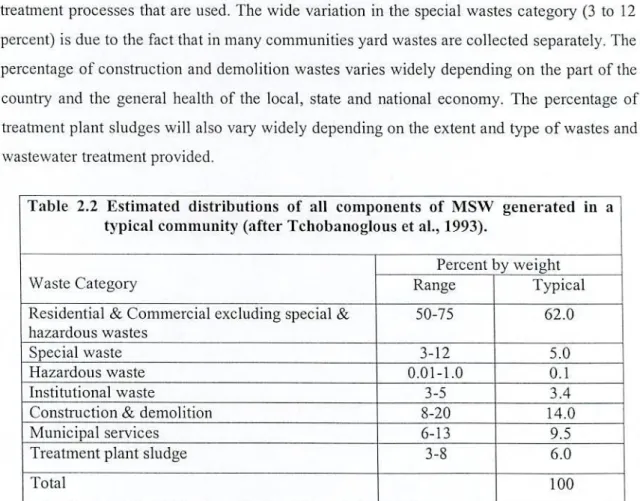
The total municipal solid wastes from a community are composed of the waste materials identified in Table 2.1. Typical data on the distribution of MSW are presented in Table 2.2.
As noted in Table 2.2, the residential portion and commercial portion makes up about 50 to 75% of the total MSW generated in a community. The actual percentage depends on (a) the socio-economical factor, (b) the extent of the construction and demolition activities, (c) the extent of the municipal services provided, and (d) the types of water and wastewater treatment processes that are used. The wide variation in the special wastes category (3 to 12 percent) is due to the fact that in many communities yard wastes are collected separately. The percentage of construction and demolition wastes varies widely depending on the part of the country and the general health of the local, state and national economy. The percentage of treatment plant sludges will also vary widely depending on the extent and type of wastes and wastewater treatment provided.
Table 2.2 Estimated distributions of all components of MSW generated in a typical community (after Tchobanoglous et al., 1993).
Waste Category
Percent by weight________
Range Typical
Residential & Commercial excluding special &
hazardous wastes
50-75 62.0
Special waste 3-12 5.0
Hazardous waste 0.0 1-1.0 0.1
Institutional waste 3-5 3.4
Construction & demolition 8-20 14.0
Municipal services 6-13 9.5
Treatment plant sludge 3-8 6.0
Total 100
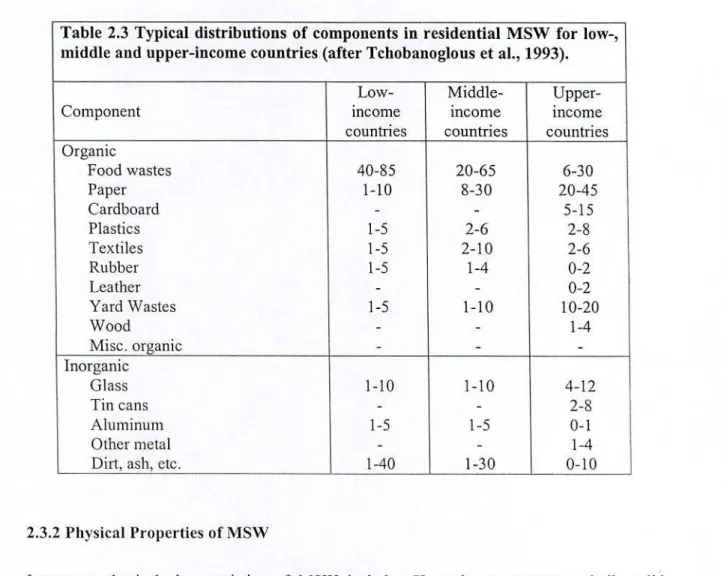
Table 2.3 shows the typical distribution of components in residential MSW for low, middle and upper-income countries. This table excludes the recycled materials.
-,
Table 2.3 Typical distributions of components in residential MSW for low-, middle and upper-income countries (after Tchobanoglous et al., 1993).
Low- Middle- Upper-
Component income income income
countries countries countries Organic
Food wastes 40-85 20-65 6-30
Paper 1-10 8-30 20-45
Cardboard - - 5-15
Plastics 1-5 2-6 2-8
Textiles 1-5 2-10 2-6
Rubber 1-5 1-4 0-2
Leather - - 0-2
Yard Wastes 1-5 1-10 10-20
Wood - - 1-4
Misc. organic - - -
Inorganic
Glass 1-10 1-10 4-12
Tin cans - - 2-8
Aluminum 1-5 1-5 0-1
Other metal - - 1-4
Dirt, ash, etc. 1-40 1-30 0-10
2.3.2 Physical Properties of MSW
Important physical characteristics of MSW include p1I, moisture content, volatile solid content and ash residue, Bulk density and particle size distribution.
pH
In 1909, a Danish scientist first uses the term pH (Povoire hydrogene i.e. power of hydrogen).
p1-I is the numerical expression of the concentration of hydrogen ions in a solution. Organic materials with a wide range of pH values from 3 to 11 can be composted, but the more desirable pH range for composting is between 5.5 and 8.5 (Tchobanoglous et al., 1993).
Moisture Content
The important physical characteristics of solid waste are moisture content. Moisture content is a property of particular importance to incinerator design and operation because of its effect on the calorific value and the ignition characteristics of the refuse. Moisture content is also
important in composting of MSW. Moisture content varies widely which influenced by local climate conditions, refuse-storage practices, method of refuse collection and refuse composition. Moisture content is usually expressed as the percentage weight of moisture per unit weight of wet or dry material. For the wet-weight moisture content it can be expressed as (Chan, 1993):
Moisture content (%)= (a —b)xl0O a Where, a= initial weight of sample
b= weight of sample after drying at 110°C for 1 hour
c) Volatile solid content and ash residue
The portion of organic material that can be released as a gas when organic material is burned
114- in a muffle furnace at the temperature of 550°C (Tchobanoglous et al., 2002). Volatile solids
are a particularly useful parameter in gas production. Gas production in terms of volatile solids introduced is a most functional parameter, because it is a measure of the efficiency of the utilization of volatile solids by the culture (Diaz et al., 1996). Ash residue is nothing but the residue amount rest in a muffle furnace after burnt at 550°C when the volatile matter totally removed.
(1) Bulk density
Bulk density is the important physical characteristics of solid waste for final sample size reduction operation. Density data is often required to obtain the mass and volume of waste that must be managed. Knowledge of this property is also important in designing the collection equipment and treatment plant capacity. Bulk density is defined as the weight of a material per unit volume, i.e. lb/ft3 or kg/rn3. The Bulk density can be measured as loose, as found in container, uncoinpacted and compacted conditions (Diaz et al., 1996).. These data
arc often needed to assess the total mass and volume of waste that must be managed.
e) Particle size distribution
The size of the particles in the MSW is a nutrient-related factor, because the waste is the substrate in composting and the substrate is the source of nutrients. The relation to nutrition is
the effect of size of the individual particles. Particle size also determines the ratio of mass-to- surface and hence amount of a particle's mass that is exposed to microbial attack (Diaz etal., 1996). For a basic understanding of the nature of the wastes that are generally encountered, the type of distribution of particle sizes are must to be known. The particle - size distribution of waste is usually determined by sieve analysis.
2.3.3 Chemical Properties of MSW
Information on chemical characteristics of solid waste is important on evaluating alternative processing and recovery processes. The important characteristics are:
a) Proximate analysis
Proximate analysis for the determination of the properties of combustible components present in MSW includes the following tests:
Moisture content (loss of moisture when heated to 105°C for I Ii)
Volatile combustible matter (additional loss of weight on ignition at 950°C in a covered crucible)
Fixed carbon (combustible residue left after volatile matter is removed)
Ash (weight of residue after combustion in an open crucible)Fusing point of ash
b) Fusing point of ash
The fusing point of ash is defined as the temperature at which the ash resulting from the burning of waste will form a solid (clinker) by fusion and agglomeration. Typical fusing temperatures for the formation of clinker from solid waste range from 2000 to 2200°F (1100 to 12000C).
c) Ultimate analysis of solid waste components
The ultimate analysis of waste component typically involves the determination of the percent of C (carbon), I-I (hydrogen), 0 (oxygen), N (nitrogen), S (sulfur) and ash. Because of the concern over the emission of chlorinated compounds during combustion; the determination of halogens is often included in an ultimate analysis. The results of the ultimate analysis are
used to characterize the chemical composition of the organic matter in MSW. They are also used to define the proper mix of waste materials to achieve suitable ON ratios for biological conversion processes (Tchobanoglous et al., 1993).
Calorific value
Calorific value of organic components of MSW is determined in laboratory by using a bomb calorimeter. Two types of euergy. tpaluc are usually ascertained; one is 1-ligher Calorific Value (IICV) and another is Lower Calorific value (LCV). Any substance that can be burnt or modified by some chemical or nuclear process to produce heat energy is called fuel. The term calorific value of waste is the quantitative estimate of heat energy released by burning (or modifying) a unit aniount of the waste in a specified process.
Chemical analysis
Chemical characteristics of MSW are known by chemical analysis. Chemical analysis is the most important method of investigation and is widely used in all branches of science, which are related to chemistiy. Chemical methods are used in the study of sciences like mineralogy, geology, physiology, microbiology, medicine, agriculture and other technical sciences. In practice, the analyst's problem is usually simplified considerably, because the chemical composition of most of the investigated substances is well known (Alam et al., 1991). The important chemical characteristics of MSW that are measured by different method of chemical analysis are Carbon, Nitrogen, Hydrogen, Oxygen, Potassium, Phosphorous, Sulfur and Boron.
2.3.4 Biological properties of MSW
Almost, all organic components can be converted biologically to gases and relatively inert organic & inorganic solids. The controlled biological decomposition process of organic wastes into humus, which can be used as a good soil conditioner, is known as composting.
The MSW of Bangladesh is suitable for composting due to its high moisture and organic content. Excluding plastic, rubber and leather components, the organic fraction of most MSW can be classified as follows:
(i) Water-soluble constituents, such as sugars, starches, amino acids and various organic acids
EM
Hemicellulose, a condensation product of five- and six-carbon sugars Cellulose, a condensation product of the six-carbon sugar glucose
Fats, oils and waxes, which are esters of alcohols and long-chain fatty acids
Lignin, a polymeric material containing aromatic rings with methoxyl group (-OCI-I3), the exact chemical nature of which is still not known (present in some
paper products such as newsprint and fiberboard) Lignocellulose, a combination of I ignin and cellulose Proteins, which are composed of chains of amino acids
2.3.5 Mechanical properties
Despite the fact that the proper design of processing plants as well as final disposal facilities should include a thorough understanding of the properties of refuse and its components which are until have been ignored. Perhaps this can be explained by the absence of reliable information readily available in the literature. This problem is particularly more pronounced in economically developing countries. Mechanical properties are especially important in the design of sanitary landfills and ancillary systems (Diaz et al., 1996). Major mechanical characteristics of MSW are stated below:
Stress-strain behaviour
Absorptive and field capacities Permeability of compacted waste
2.4 Solid \Vaste Generation Rates
A reliable estimate of the quantity of solid waste generated in the city is very important for proper solid waste management. While there is a consensus among common people regarding the adverse environmental impact of solid waste, experts seem to differ widely on the estimates of waste generated in the city. MSW generation rates vary in different countries and cities because of different influencing factors. The most important factors are:
-r
Population density
Socio economic condition and standard of living Frequency of collection and service coverage 1-labits and custom of living
Geographic location Season of the year
Characteristics of service area
Source reduction and recycling activates Public attitude and legislation
The quantities of MSW generated can be estimated in many ways:
Load-count analysis (Tchobanoglous et al., 1977)
In this method the number of individual loads, the corresponding vehicle load volume and the sources of waste have been collected and the weights are noted over a specified period. The
unit generation rates are determined by using the field data or published data.
2. Secondary data method (Vesilind and Rimer, 1981)
This method uses secondary information such as income, product sold in stores and so on, and by means of stepwise linear regression analysis, calculates MSW production as
y=a+bX1 +cX 2 + ... ±nX Where, y= the independent variable of solid waste generation
X1 , X2 ... X,, = the independent variables of each influencing parameters a, b, c...n = constant
In most countries, the population and economic situation are often affecting the waste generation, thus the background data of population and economic indices such as GNP and GDP are required. They should be forecast in order to estimate the future solid waste generation. However, other parameters such as housing projects, land use planning and solid waste service coverage may affect the solid waste generation in the future and they can be used in this forecasting task too.
2.5 Definition of Integrated Solid Waste Management
According to Oxford Dictionary definitions of 'waste' invariably refer to lack of use or value, or 'useless remains'. Waste is a by-product of human activity. Physically, it contains the same materials as are found in useful products; it only differs from useful production by its lack of value. Pfeffer (1992) defined the solid waste is any solid material in the material flow pattern that is rejected by society. Management can be defined as the judicious use of a means to achieve an end. 'And end' is the removal of the rejected material from the material
flow pattern.
It is generally accepted that the 'cost' of solid waste management is the number of 'dollars' required to eliminate the rejected material from contact with human populations. If this could be accomplished by dumping it in a used gravel pit, hauling it to sea, volatilizing it in to the
OR atmosphere, or whatever, that is the minimum cost.
Tchobanoglous et al. (1993) stated that the solid waste management may be defined as the discipline associated with the control of generation, storage, collection, transfer and transport, processing, and disposal of solid wastes in a manner that is in accord with the best principles of public health, economics, engineering, conservation, aesthetics, and other environmental considerations, and that is also responsive to public attitudes.
Tchobanoglous ci al. (1993) also defined integrated solid waste management (JSWM) as the selection and application of suitable techniques, technologies and management programs to achieve specific waste management objectives and goals.
2.6 Basic requirements
The basic requirements of ISWM are to produce less amount of wastes, by applying different approaches and managing them efficiently. In the following articles these two elements describes briefly.
2.6.1 Less waste
The Brundtland report of the United Nations 'Our Common Future' (WCED, 1987) depicts that sustainable development would only be achieved if society in general, and industry in
particular, learned to produce 'more with less'; more goods and services with less use of the world's resources (including energy) and less pollution and waste. 'Waste minimization', 'waste reduction' or 'source reduction' are usually placed at the top of the conventional waste management hierarchy. In reality, however, source reduction is a necessary precursor to effective waste management, rather than part of it. Source reduction will affect the volume, and to some extent, the nature of the waste, but there will still be waste for disposal. What is needed, beyond source reduction, is an effective system to manage this waste.
2.6.2 Effective solid waste management
Solid waste management systems need to ensure human health and safety. They must be safe for workers and safeguard public health by preventing the spread of disease. In addition to these prerequisites, an effective system for solid waste management must be both environmentally and economically sustainable.
- Enviroizinentally sustainable: It must reduce as much as possible the environmental impacts of waste management, including energy consumption, pollution of land, air and water, and loss of amenity.
- Economically sustainable. It must operate at a cost acceptable to the community, which includes private citizens, businesses and government. The costs of operating an effective solid waste system will depend on existing local infrastructure, but ideally should be little or no more than existing 'waste management cost.
It is difficult to minimize two variables, cost and environmental Impact, simultaneously.
There will always be a trade-off. The balance that needs to be struck is to reduce the overall environmental impacts of the waste management system as far as possible, within an acceptable level of cost. Deciding the point of balance between environmental impact and cost will always generate debate. Better decisions will be made if data on impacts and costs are available; such data will often prompt ideas for further improvements.
2.7 Waste Management Systems
A management system is the framework of processes and procedures used to ensure that an
organization can fulfill all tasks required to achieve its objectives (The Free Dictionary, 2006). An environmental management system enables organizations to improve their environmental performance through a process of continuous improvement. An oversimplification is 'Plan, Do, Check, Act." A more complete system would include accountability (an assignment of personal responsibility) and a schedule for activities to be completed, as well as auditing tools to implement corrective actions in addition to scheduled activities, creating an upward spiral of continuous improvement.
2.7.1 Characteristics of an effective system
An economically and environmentally sustainable solid waste management system is likely to be integrated, market-oriented and flexible. The execution of these principles will vary on a regional basis.
An integrated system:
An integrated system would include waste collection and sorting, followed by one or more of the following options (Tchobanoglous Ct al. 1993):
- Recoveiy of secondary materials (recycling): this will require adequate sorting and access to reprocessing facilities.
- Biological treatment of organic materials: this will produce marketable, compost or reduce volume for disposal. Anaerobic digestion produces methane that can be burned to release energy.
- Thermal treatment: this will reduce volume, render residues inert and may recover energy.
- Landfill: this can increase amenity via land reclamation but will at least minimize pollution and loss of amenity.
To handle all waste in an environmentally safe and sustainable way requires a range of the above treatment options. Landfill is the only method that can handle all waste alone, since recycling, composting and incineration all leave some residual material that needs to be landfilled. Landfill, however, does not valorize any part of the waste. It can be used to reclaim land, but it can also cause methane emissions and groundwater pollution and con- sume space. Use of the other options prior to landfilling can both valorize significant parts of
the waste stream, reduce the volume and improve the physical and chemical stability of the residue. This will reduce both the pace requirement and the potential environmental impacts of the landfill.
Market-oriented:
Any scheme that incorporates recycling, composting or waste-to-energy technologies must recognize that effective recycling of materials and production of compost and energy depends on markets for these outputs. These markets are likely to be sensitive to price and to con- sistency in quality and quantity of supply. Managers of such schemes will need to play their part in building markets for their outputs, \vorking with secondary material processors, and helping to set material quality standards. They must also recognize that such markets and needs will change over time, so such standards should not be rigid and based on legislation, but be set as part of a total quality customer-supplier relationship.
Flexibility:
An effective scheme will need the flexibility to design, adapt and operate its systems in ways which best meet current social, economic and environmental conditions. These will likely change over time and vary by geography. Using a range of waste management options in an integrated system gives the flexibility to channel waste via different treatments as economic or environmental conditions change. For example, paper can be recycled, cornpostcd or incinerated with energy recovery. The option used can be varied according to the economics of paper recycling, compost production or energy supply pertaining at the time.
Scale:
The need for consistency in quality and quantity of recycled materials, compost or energy, the need to support a range of disposal options, and the benefit of economies of scale, all suggest that integrated waste management should be organized on a large-scale, regional basis. The optimal size for such a scheme should be in an area containing upwards of 5,000,00 households (White, 1993). Therefore, implementation of such schemes will require local authorities to work together.
2.7.2 The importance of a holistic approach
The operations within any waste management system are clearly interconnected. The collection and sorting method employed, for example, will affect the ability to recover materials or produce marketable compost. Similarly, recovery of materials from the waste stream may affect the viability of energy recovery schemes. It is necessary, therefore, to consider the whole waste management system in an holistic way. What is required is an overall system that is both economically and environmentally sustainable. A lot of recent effort has been put into schemes concentrating on individual technologies, e.g. recycling, or on materials from one source only. From the perspective of the whole waste management system, such schemes may well involve duplication of efforts or other inefficiencies, making them both environmentally and economically ineffective.
The relevance of looking at the whole system could be challenged, since waste management is split up into so many different compartments. Collection is the duty of local authorities, although it may be contracted out to waste management companies. Different operators may contribute to recycling activities. Similarly, incineration, composting and landfill operations may all be under the different operators.
Considering these the holistic approach has the following advantages:
I. It gives an overall picture of the waste management process. Such a view is essential for strategic planning. Handling of each waste stream separately is inefficient.
Environmentally, all waste management systems are part of the same system, the global ecosystem. Looking at the overall environmental burden of the system is the only rational approach; otherwise reductions in the environmental impacts of one part of the process may result in greater environmental impacts elsewhere.
Economically, each individual unit in the waste management chain should run at a profit, or at least break-even. Therefore, within the boundaries controlled by each operator, the financial incomes must at least match the outgoings. By looking at the wider boundaries of the whole system, however, it is possible to determine whether the whole system operates efficiently and whether it could run at breakeven, or even at a profit. Only then can all the constituent parts be viable, provided that income is divided up appropriately in relation to costs.
p..-
2.7.3 A total quality system
To achieve fully integrated waste management will require major system changes from the present situation. The objective of an integrated system is to be both environmentally and economically sustainable. This is a total quality objective (Oakland, 1989); it can never be reached, since it will always be possible to reduce environmental impacts further, but it will lead to continual improvements.
Application of total quality thinking can be of further use in waste management. To reach a total quality objective one builds a system to achieve this objective. To deliver environmentally and economically sustainable waste management requires putting together a system designed for this purpose. This is a key point. Trying to improve present systems by using recycling or composting as 'bolt-on extras' is unlikely to work. Different components of the system are inter-connected so it is necessary to design a whole new system rather than tinker with the old one. Radical system changes may also allow previous economic inefficiencies to come to light, which can be used to offset any increased costs.
2.8 Planning for Integrated Waste Management
Developing and implementing an ISWM plan is essentially a local activity that involves the selection of the proper mix of alternatives and technologies to meet changing local waste management needs while meeting legislative mandates. Three important aspects are the proper mix of technologies, flexibility in meeting future changes and the need for monitoring and evaluation are considered briefly in the following discussion.
2.8.1 Proper i\'Lix of Alternatives and Technologies
A wide variety of alternative programs and technologies are now available for the management of solid wastes. Several questions arise from this variety: What is the proper mix between (1) the amount of waste separated for reuse and recycling, (2) the amount of waste that is composted, (3) the amount of waste that is eombusted, and (4) the amount of waste to be disposed of in landfills? What technology should be used for collecting wastes
separated at the source, for separating waste components at Materials Recovery/Transfer Facilities (MRFs), for composting the organic fraction of MSW, and for compacting wastes at a landfill? What is the proper timing for the application of various technologies in an ISWM system and how should decisions be made?
Because of the wide range of participants in the decision-making process for the implementation of solid waste management systems, the selection of the proper mix of alternatives and technologies for the effective management of wastes has become a difficult, if not impossible, task. The development of effective ISWM systems will depend on the availability of reliable data on the characteristics of the waste stream, performance specifications for alternative technologies, and adequate cost information.
2.8.2 Flexibility in Meeting Future Changes IL
The ability to adapt waste management practices to changing conditions is of critical importance in the development of an ISWM system. Some important factors to consider include,
Changes in the quantities and composition of the waste stream,
Changes in the specifications and markets for recyclable materials, and Rapid developments in technology.
If the ISWM system is planned and designed on the basis of a detailed analysis of the range of possible outcomes related to these factors, the local community will be protected from unexpended changes in local, regional, and larger-scale conditions.
2.8.3 Monitoring and Evaluation
ISWM is an ongoing activity that requires continual monitoring and evaluation to determine if program objectives and goals (e.g., waste diversion goals) are being met. By developing and implementing monitoring and evaluation programs required changes can be made to the ISWM system. It depends on wastes characteristics, changing specifications and markets for recovered materials and development of new and improved waste management technologies etc.
2.9 Hierarchy of Integrated Solid Waste Management
A hierarchy (arrangement in order of rank) in waste management can be used to rank actions to implement programs within the community. ISWM programs and systems should be developed in which the elements of the hierarchy are interrelated and are selected to com- plement each other. The ISWM hierarchy is composed of the following elements: source reduction, recycling, waste transformation, and landfilling. In Figure 2.1 (Tchobanoglous et al. 1993) typical hierarchy of MSW management is present. For the broadest interpretation of the ISWM hierarchy, it can be expanded to waste management tiers as source reduction and segregation, Waste collection, Waste transfer and transportation, Waste transformation, Recycling of waste by various approaches and ultimate disposal. The schematic diagrams of these tiers are shown in Figure 2.2. In the following sections these are discussed briefly.
2.9.1 Source reduction
The highest rank of the ISWM hierarchy, source reduction, involves reducing the amount and/or toxicity of the wastes that are generated. The term source reduction is used to describe those activities that decrease the amount (weight or volume) or toxicity of waste entering the solid waste stream. It also encompasses those activities that increase product durability, reusability and reparabi lity.
Source reduction is first in the hierarchy because it is the most effective way to reduce the quantity of waste, the cost associated with its handling and its environmental impacts. Waste reduction may occur through the design, manufacture and packaging of products with minimum toxic content, minimum volume of material, or a longer useful life. Waste reduction may also occur at the household, commercial or industrial facility through selective buying patterns and the reuse of products and materials.
2.9.2 Storage at source and segregation
In 1757 in USA the dwellers of the New York City begin digging refuse pits instead of throwing garbage out of windows and doors (EPA, 2006) which are the first reported ancient on-site source storage. On-site storage facilities of wastes and proper segregation before that
are two most important elements of ISWM. Storage of MSW at the source is influenced by the following factors:
The effect of storage on the waste components. important considerations in the onsite storage of wastes are the effect of storage itself on the characteristics of wastes being stored. These effect of storing wastes includes (i) biological decomposition, (ii) the absorption of fluids, and (iii) the contamination of waste components
The type of containers to he used. The types and capacities of the containers used depend on the characteristics and types of solid wastes to be collected, the type of collection system in use, the collection frequency and the space available for the placement of containers.
I Least Preferred I
Landfill\ .
Waste
\
Transformation
\
(Composting, Incineration & Other)
Recycling
Source Reduction
I Most Preferred I Figure 2.1: Typical hierarchy of integrated solid waste management.
The container location: The container locations depend on the type of dwelling or commercial and industrial facilities, the available spaces and access to collection services.
Public health and aesthetics: In developing countries most of the generated MSW are from residential sources, which are generated in areas with limited storage space. As a result, they can have significant public health and aesthetics impacts. Public health concerns are related primarily to the invasion of areas used for the storage of solid wastes with vermin and insects that often serve as potential disease vectors. Aesthetic A