
Salmonella, a member of the Enterobacteriaceae family (Dunkley et al., 2009), is a gram-negative, non-spore-forming bacillus. Salmonella organisms are gram-negative facultative anaerobic rods within the family Enterobacteriaceae (Yan et al., 2003). Beal et al., 2005) determined that age and genetics influence the ability of chickens to resist Salmonella colonization.
In an in vitro study, (Cox et al., 1972) a reduced survival rate for Salmonella spp.

The Antimicrobial Resistance Pattern of Salmonella Infection
The Salmonella Pathogenicity Island (SPI) 1 (discrete genetic units) contributes to colonization of the chicken with Salmonella, while SPI2, in the absence of SPI1, inhibits colonization (Dieye et al., 2009). Rabsch et al., (2000) suggested that the increase in incidence of Salmonella Enteritidis was the result of the industry's actions leading to the reduction in the incidence of Salmonella Gallinarum and Salmonella Pullorum. Thomson et al., (2008) sequenced the genomes of Salmonella Enteritidis PT4 isolate P125109, a host-promiscuous serovar, and Salmonella Gallinarum isolate 287/91, a chicken-restricted serovar.
Ngwai et al., (2006) looked at the in vitro growth suppression of antibiotic-resistant Salmonella Typhimurium DT-104 by non-DT104 strains.
The Resistance to Penicillin
The Resistance to Cephalosporins
The Resistance to Carbapenems
Therefore, long-term use of these antibiotics may be related to Salmonella showing increased resistance patterns to the penicillin family of antibiotics in chickens.
The Resistance to Fluroquinolones
The Resistance to Aminoglycosides
The Resistance to Macrolides
The Resistance to Lincosamides
The Resistance to Tetracyclines
Salmonella from the poultry environment are more likely to develop resistance to tetracyclines, posing a risk to animals and humans. Salmonella's ability to resist can allow it to enter the food chain and pose a serious threat to human life. AMR surveillance techniques should be used to limit the emergence of bacterial resistance in chicken farms in Bangladesh and other countries.
The Resistance to Phenicols
The Resistance to Rifampicin
Previously, Zdragas et al., (2012) reported 33.30% rifampicin resistance in avian Salmonella in Greece and Ramatla et al., (2019) reported 100% rifampicin resistance in avian Salmonella in South Africa. The reported resistance in avian isolates may be caused by horizontal transfer of rifampicin-resistant genes from human isolates to avian species.
The Resistance to Glycopeptides
The Resistance to Sulphur Drugs
The Resistance to Polymyxins
Antimicrobial resistant gene in Salmonella
Diagnosis of Salmonella 1. Serological diagnosis
Molecular diagnosis
Pathological findings
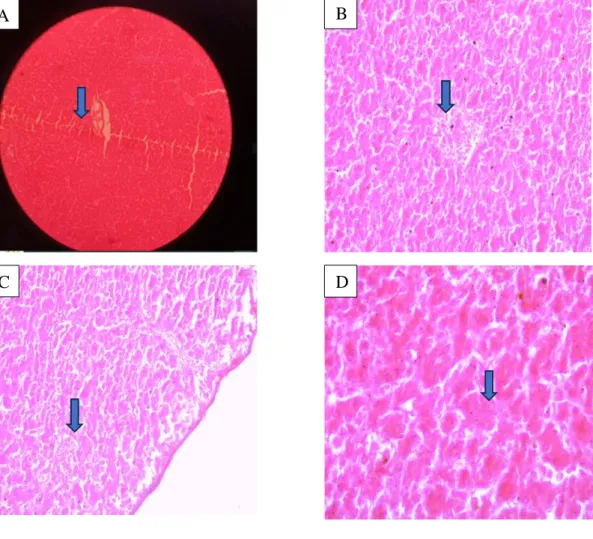
Spleen: Similar histopathological changes, including focal necrosis, reticuloendothelial cell hyperplasia and secondary lymphoid follicles, have been reported by Shivaprasad (Shivaprasad, 2000) in the spleen. Intestine: The presence of thick, slimy mucous secretions on the mucosal surfaces of the intestinal lumen in some cases indicated the presence of catarrhal enteritis. The mucosal epithelium was histopathologically desquamated, leaving exposed villi and a necrotic mass filling the lumen.
Some secretory glands atrophied as a result of an extreme influx of mononuclear cells and heterophils. There was often goblet cell hyperplasia and localized fibroblastic connective tissue proliferation between the glands. Similar degenerative and infiltrative changes in the kidneys of birds affected by fowl typhus have been described by Shivaprasad, (2000).
Proventriculitis: Congestion, mucosal breakdown, and heterophilic and lymphocytic infiltration in the mucosa, occasionally up to the serous layer, were characteristic features of proventriculitis.
The Status of non-typhoidal Salmonella in Bangladesh
The pathomicrobial studies on Salmonella sp infection in broiler chickens All age groups of broiler chickens are susceptible to salmonellosis, an acute septicemic
Thus, the poultry industry faces major setbacks due to frequent outbreaks of salmonellosis (Fatma et al., 2016). However, salmonellosis outbreaks still remain a serious economic problem in countries where control measures are not effective or in areas where climatic conditions favor the spread of these microbes in the environment (Barrow and Freitas Neto, 2011).
CHAPTER-3
MATERIALS AND METHODS
- Study area
- Sample collection duration
- Biological sample collection
- Data collection
- Bacteriological Investigation 1. Isolation of the Salmonella sp
- Sub-culturing on blood agar
- Preservation of isolates
- Molecular detection of Salmonella
- DNA extraction from the isolates
- Identification of Salmonella by polymerase chain reaction (PCR)
- Antimicrobial susceptibility testing (AST)
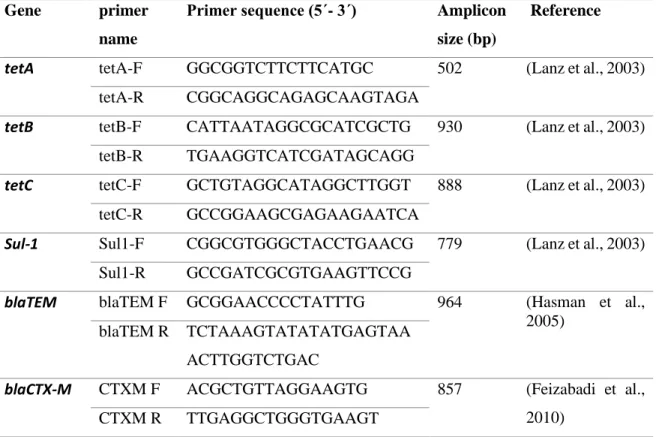
- Detection of antimicrobial resistance genes
- Histopathological study of Salmonella sp
- Equipment and appliances for histopathology 1. 10% neutral buffered formalin
- Collection of samples and processing
- The Routine hematoxylin and eosin staining procedure The sectioned tissues were stained as described below
- Statistical analysis
Suspected Salmonella colonies were grown on blood agar and kept at 80°C for later analysis. The Polymerase chain reaction was performed for molecular detection of Salmonella as described earlier (Dashti et al., 2009). Later, suspected isolates were confirmed by conventional PCR test using Salmonella genus-specific primers ST-11 (5ʹ -AGCCAACCATTGCTAAATTGGCGCA-3ʹ) and ST-15 (5ʹ-TGGTAGAAATTCCCAGCGGGTACTG-3ʹ) (Gouws et al., 1998).
If an isolate showed resistance to more than two different classes of antimicrobials, it was defined as 'MDR' (Weill et al., 2006). Fixed tissues were cut at 5 μm thickness and stained with hematoxylin and eosin according to the standard method (Luna, 1968). During the tissue collection the following points were taken into consideration; the tissues were collected under as fresh conditions as possible.
Washing: The formalin was removed from the tissues by cutting them into thin sections and washing them in running water overnight. Dehydration: To stop cell shrinkage according to the following schedule, the tissues were dehydrated using an ascending ethanol series. Cleaning: To remove ethanol, the tissues were washed in chloroform for three hours (two shifts; one and a half hours each).
The tissues were then rehydrated using progressively lower concentrations of alcohol (three changes in absolute alcohol, each lasting three minutes; 95 percent alcohol for two minutes; 80 percent alcohol for two minutes; and 70 percent alcohol for two minutes), followed by distilled water for five minutes. The tissues were then sectioned by two to four dips in acid alcohol (1 part HCL and 99 parts 70 percent alcohol).
CHAPTER-4 RESULTS
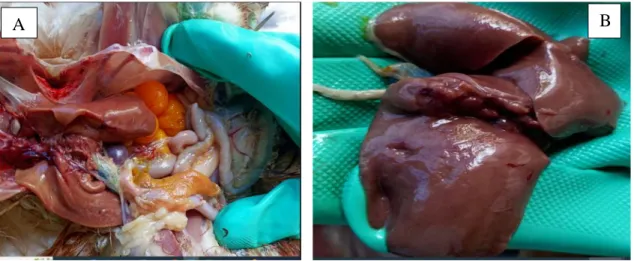
- Results of postmortem findings of Salmonella sp infection in broiler chicken The liver displayed a variety of visible gross abnormalities, such as friable and bronze
- The histopathological examination of Salmonella sp infection in broiler chicken
- Prevalence of Salmonella sp infection in farm level
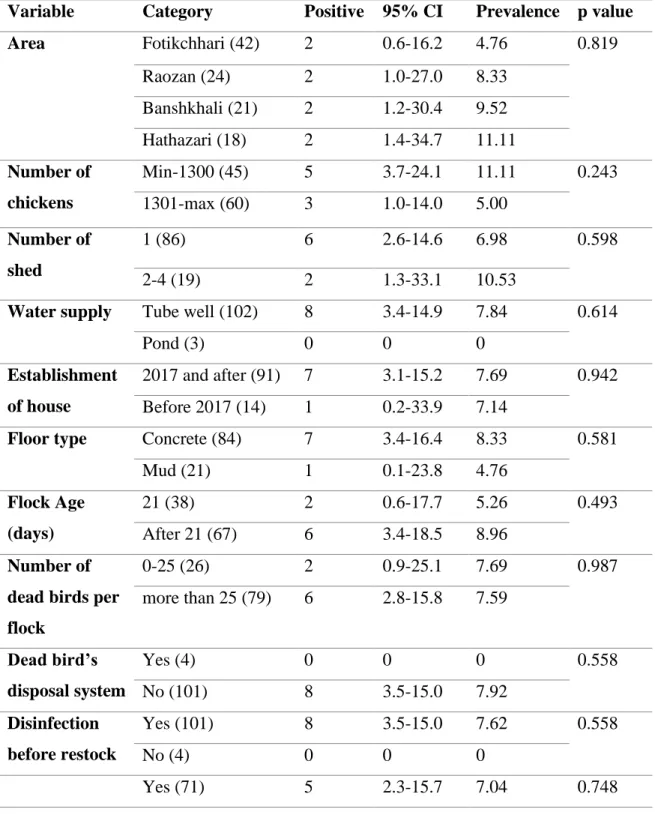
- Analysis of risk factors
- Prevalence of Salmonella sp according to potential explanatory variables in different upazila in Chattogram
- Univariable association of risk factors with the occurrence of Salmonella sp in broiler chickens at farm level
- The antimicrobial resistance profile and percentage of multidrug resistance to Salmonella sp. isolates
- The distribution of antimicrobial resistance genes
- The results of growth characteristics of Salmonella sp in XLD and Blood agar
- The result of DNA extraction, PCR and culture sensitivity test of Salmonella sp
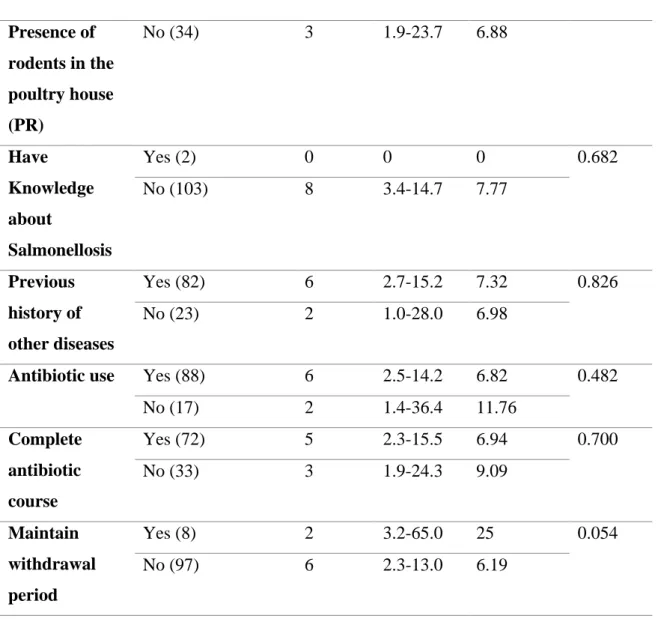
For the isolation and identification of Salmonella sp. a total of 105 pooled samples (cloacal swabs) were collected from different parts of Chattogram district, Bangladesh. Prevalence of Salmonella sp with respect to possible explanatory variables in different upazilas in Chattogram of different upazilas in Chattogram. Percentage isolation of Salmonella sp in cloaca samples according to different location, number of chickens per flock, number of houses, type of soil, age of flock and water source.
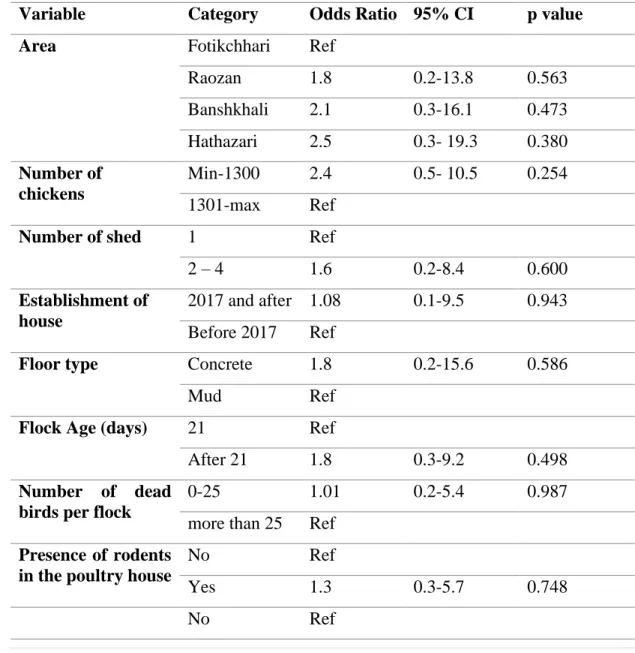
Univariable association between risk factors and the prevalence of Salmonella sp in broilers at the farm level in broilers at the farm level. The broiler farm where no antibiotics were used showed higher prevalence of Salmonella sp than the farm where the farmer used antibiotics. On the other hand, the prevalence of Salmonella sp on farms that had more than 1300 birds per flock, and the holdings that had 1300 or fewer birds per herd per sp was higher on farms that had 2-4 sheds per farm, than the farms that only had a number of sheds on the farm (0.2% vs.
Most of the positive samples (7) were multidrug-resistant (MDR) in Salmonella sp infection in broilers at the farm level. In the current investigation, Salmonella presented pink colonies with a black center on XLD agar, indicating cultural characteristics. In the current investigation, the isolated colonies were first tested for antimicrobial susceptibility, DNA extraction and molecular confirmation using PCR.
The expected width of the gel band was used to monitor the positive sample and images were captured using a UV transilluminator.
CHAPTER-5 DISCUSSION
Similarly, (Alam et al., 2003) reported a prevalence of Salmonella infection of 23.8% in poultry in Dinajpur district of Bangladesh. Another study (Bari et al., 2012) reported a variation in the prevalence of Salmonella in different areas such as Gazipur (20%), Manikgonj (16%) and Saver (15%) in Bangladesh. Previously, a study in Bangladesh found the highest percentage of Salmonella in cloacal swabs (32%) among various poultry samples (Karim et al., 2017) and another study found 48%.
In addition, occasional shedding and uneven distribution in poultry houses may also be responsible for the variability of results (Proux et al., 2002). Resistance to penicillin, ampicillin, tetracycline and erythromycin was frequently observed due to the low cost, ready availability and abuse of the drugs (Van et al., 2007). Similar findings of multidrug resistance among Salmonella strains have been reported from Bangladesh and various parts of the world (White et al., 2001;.
However, another study showed that Salmonella isolates were found to be susceptible to ampicillin, piperacillin/tazobactam, nitrofurantoin, imipenem and amikacin, as previously reported (Zhang et al., 2018). Another study showed that there has been an increase in the number of studies reporting the emergence of ciprofloxacin resistance in non-typhoidal salmonella around the world (Hsueh et al., 2004; Mulvey et al., 2013). Ahmed and Shimamoto, (2012) also found only tetA gene among the six genes screened (tetA, tetB, tetC, tetD, tetE and tetG) in MDR S. Adesiji et al., 2014) showed the presence of four Tetracycline resistance genes detected (tetA, tetB, tetC and tetG) in MDR Salmonella from retail meat, poultry feces and mussels with tetA being the most common (100%).
Tetracycline resistance was comparable to the findings of (Akbar and Anal, 2013) but less than that of (Ellerbroek et al., 2010) who reported 100% resistance in their study. This will reduce the occurrence of microbial insects which are spreading worldwide and are responsible for the fatal outcome of the disease in different parts of the world (Aarestrup et al., 2001).
CHAPTER-6 CONCLUSION
CHAPTER-7
LIMITATION: RECOMMENDATIONS AND FUTURE PERSPECTIVES
Appendix: Questionnaire survey
Presence of rodents in the poultry farm: Yes/No Practice of all-in all-out system: Yes/No. Disinfection of farm prior to stocking: Yes/No Knowledge of salmonellosis: Yes/No Previous history of any disease. Yes/No Daily disposal of dead birds: Yes/No What types of drugs are commonly used.
Molecular characterization of motile serovars of Salmonella enterica from breeder and commercial broiler poultry farms in Bangladesh. Genetic relatedness, antimicrobial resistance and biofilm formation of Salmonella isolated from naturally contaminated poultry and their processing environment in northern Malaysia. Prevalence and antimicrobial resistance of Salmonella isolated from broilers, chicken carcasses and street market restaurants in Casamance, Senegal.
Epidemiological, molecular characterization and antibiotic resistance of Salmonella enterica serovars isolated from chicken farms in Egypt. Isolation and prevalence of Salmonella from chicken meat and bovine milk collected from local markets of Patna, India. Identification and molecular characterization of Salmonella species isolated from poultry value chains of Gazipur and Tangail districts of Bangladesh.
Isolation, serotype diversity and antibiogram of Salmonella enterica isolated from different poultry species in India. Prevalence and multiresistance pattern of Salmonella with extended spectrum β-lactamase in frozen chicken meat in Bangladesh. Antibiotic resistance genes, integrons and multiple antibiotic resistance in thirty-five serotypes of Salmonella enterica isolated from humans and animals in the United Kingdom.
Prevalence of Salmonella spp in cloacal, faecal, and gastrointestinal mucosal samples from North American wild turtles. Virulence and antimicrobial resistance profiles of Salmonella enterica serovars isolated from chicken in wet markets in Dhaka, Bangladesh. Quantification of horizontal transmission of Enteritidis serovar Salmonella enterica bacteria in pair-housed laying hen groups.
BIOGRAPHY

![Figure 4.1: The antimicrobial resistance pattern of Salmonella isolates [n = 8]](https://thumb-ap.123doks.com/thumbv2/filepdfnet/10890213.0/39.893.187.837.167.584/figure-4-1-antimicrobial-resistance-pattern-salmonella-isolates.webp)
![TABLE 4.4. The occurrence of antimicrobial resistance genes among Salmonella isolates [n = 8] from broiler chicken](https://thumb-ap.123doks.com/thumbv2/filepdfnet/10890213.0/40.893.179.872.196.467/table-occurrence-antimicrobial-resistance-salmonella-isolates-broiler-chicken.webp)
